
 Download PDF
 Download PDF
Market Overview
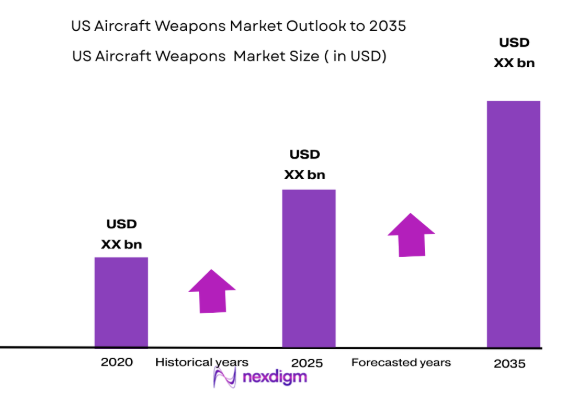
The US Aircraft Weapons Market is valued at approximately USD ~ billion, driven by increasing military expenditures and advancements in weaponry technologies. Factors such as the need for advanced air-to-air and air-to-ground systems, along with enhanced military preparedness, are fueling this growth. Additionally, the increasing geopolitical tensions and modernization programs are also contributing significantly to the market’s expansion. With a high emphasis on precision and automated systems, the market’s evolution is further supported by rapid technological innovations in hypersonic weapons, drones, and artificial intelligence.
Dominant countries such as the United States continue to lead the market due to their robust defense spending and extensive technological capabilities. The country’s ongoing military modernization initiatives, especially fighter jets and unmanned aerial vehicles, further solidify its dominance. Other nations like China and Russia are also significant players, but the US remains at the forefront due to its global defense contracts, technological superiority, and substantial military budgets. These countries are focused on innovation and maintaining an advanced defense infrastructure that meets emerging threats.
Market Segmentation
By Product Type
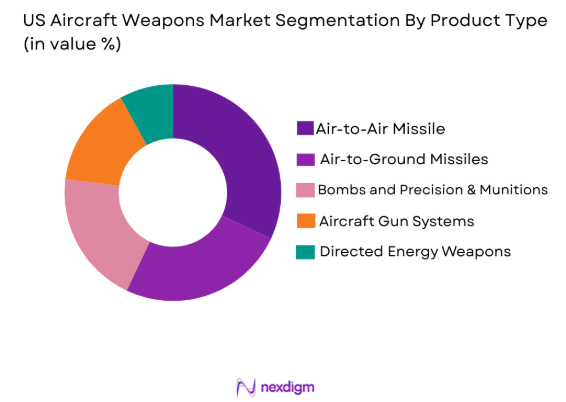
The US Aircraft Weapons Market is segmented by product type into air-to-air missiles, air-to-ground missiles, bombs and precision-guided munitions, aircraft gun systems, and directed energy weapons. The dominant sub-segment in this category is air-to-air missiles, which hold a major share due to the growing need for advanced defense capabilities in aerial combat. The increasing importance of air superiority and the need for rapid, precision strikes in modern warfare have made air-to-air missiles critical components of the US military arsenal. This growth is further driven by ongoing upgrades in missile technologies, especially those incorporating AI and advanced guidance systems, making them more effective and reliable.
By Platform Type
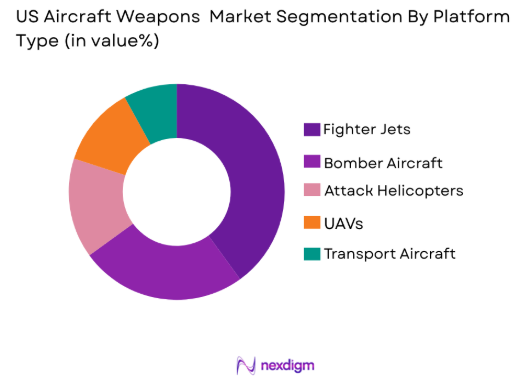
The US Aircraft Weapons Market is segmented by platform type into fighter jets, bomber aircraft, attack helicopters, UAVs (unmanned aerial vehicles), and transport aircraft. The dominant sub-segment here is fighter jets, which continue to lead the market due to their versatility and integral role in both offensive and defensive operations. With advancements in stealth, speed, and weapon integration, fighter jets have become the primary platform for deploying sophisticated air-to-air and air-to-ground weapons. This dominance is also supported by significant investments in developing next-generation fighter jets, which are expected to carry advanced weapons systems in the coming years.
Competitive Landscape
The competitive landscape of the US Aircraft Weapons Market is dominated by leading aerospace and defense firms that continue to innovate and consolidate their position through mergers and acquisitions. These companies play a vital role in shaping the market’s future by providing cutting-edge technologies and forming strategic alliances with defense ministries. The industry is marked by intense competition among key players, with each focusing on enhancing the performance, range, and precision of aircraft weaponry to stay ahead in the global defense sector.
|
Company Name |
Establishment Year | Headquarters | Technology Focus | Market Reach | Key Products | Revenue (USD) | Additional Parameter |
| Lockheed Martin | 1912 | Bethesda, MD | ~ | ~ | ~ | ~ | ~ |
| Raytheon Technologies | 1922 | Waltham, MA | ~ | ~ | ~ | ~ | ~ |
| Northrop Grumman | 1939 | Falls Church, VA | ~ | ~ | ~ | ~ | ~ |
| Boeing | 1916 | Chicago, IL | ~ | ~ | ~ | ~ | ~ |
| General Dynamics | 1899 | Reston, VA | ~ | ~ | ~ | ~ | ~ |
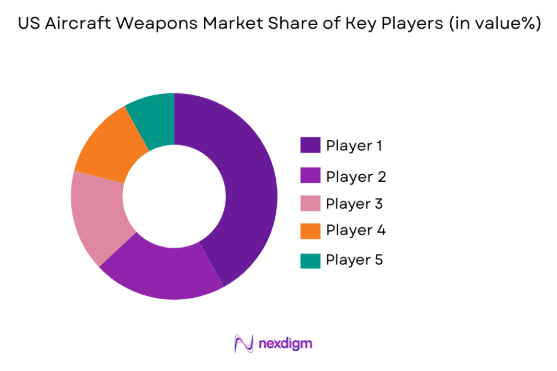
US Aircraft Weapons Market Analysis
Growth Drivers
Technological Advancements in Aircraft Weaponry
Technological advancements in aircraft weaponry continue to drive the US Aircraft Weapons Market. With an increasing demand for precision-guided munitions, systems like smart bombs, and advanced missile technologies, the US military’s focus on enhancing operational efficiency and strike accuracy is pushing for rapid innovation in this sector. These advancements, including integration with AI and machine learning, ensure improved targeting and reduced collateral damage in military operations. Moreover, the integration of hypersonic technology and directed energy weapons is expected to revolutionize the way aircraft engage with targets. Modern weapons also offer longer range, higher speed, and better survivability, which are critical for operations in contemporary warfare. As global defense spending increases, particularly in response to rising geopolitical tensions, the US is prioritizing the development and deployment of next-generation aircraft weapons. These developments are further supported by the US government’s defense budget, which funds research, development, and procurement programs aimed at advancing military technology. All these factors contribute to the growing demand for advanced aircraft weapons, boosting the market’s growth prospects in the coming years.
Rising Geopolitical Tensions and Defense Budget Increases
Rising geopolitical tensions around the world have led to an increase in global defense budgets, with the US continuing to be the largest spender in the defense sector. This surge in defense spending is particularly focused on enhancing the capabilities of armed forces through modernized weapon systems. Aircraft weapons, as part of the broader modernization initiatives, are essential for maintaining superiority in various regions, including the Asia-Pacific and Europe, where potential threats continue to grow. With new challenges such as cyber threats, missile defense systems, and unconventional warfare, the need for advanced and versatile aircraft weapons has become even more urgent. The US government, in response to these evolving threats, has allocated substantial funds towards enhancing the capabilities of its air forces. Investments in next-generation weapons, such as the integration of AI-powered munitions and the development of hypersonic missiles, are central to this shift. As the US military continues to adapt to changing security dynamics, these growth drivers are expected to contribute to significant market expansion.
Market Challenges
High Development and Production Costs
The high development and production costs of advanced aircraft weapons pose significant challenges to the US Aircraft Weapons Market. Research and development (R&D) expenses for new technologies, such as hypersonic missiles and precision-guided munitions, require substantial investments, which can be difficult to sustain. The complexity of designing, testing, and manufacturing these sophisticated systems often leads to long timelines and escalating budgets. Moreover, the procurement costs for defense contractors, combined with stringent quality assurance and regulatory compliance requirements, further contribute to the overall expenses. While the US government has committed to funding defense technologies, the rising costs can limit the speed and scale at which these technologies are deployed. Additionally, the economic challenges posed by inflation and budget constraints at the federal level can impact defense procurement, resulting in delays or modifications to weapon system orders. For defense contractors, managing the balance between cost and technological innovation is a constant challenge that must be navigated to maintain market position.
Regulatory and Compliance Challenges
The US Aircraft Weapons Market faces substantial regulatory and compliance challenges, particularly in relation to the development, export, and use of advanced weapons systems. The US government enforces strict regulations to ensure that these technologies do not fall into the wrong hands, often restricting the transfer of sensitive technologies to certain foreign governments. These regulations, which include compliance with the International Traffic in Arms Regulations (ITAR) and export control laws, can delay the procurement process and limit market access for manufacturers. Additionally, the evolving nature of defense policies and international relations means that companies must remain agile in responding to new restrictions and regulations that may be implemented as political landscapes shift. This regulatory burden increases the cost and complexity of business operations within the defense sector, and non-compliance can result in significant fines or other penalties, further complicating the market’s dynamics.
Opportunities
Expansion of UAV and Autonomous Aircraft Weapons
The growing demand for unmanned aerial vehicles (UAVs) and autonomous aircraft systems presents significant opportunities for the US Aircraft Weapons Market. UAVs are increasingly being deployed in combat scenarios due to their ability to carry out missions without risking human lives. The integration of advanced weapons systems on UAVs, such as precision-guided munitions and air-to-air missiles, is transforming military operations by providing more flexible and cost-effective options for strategic strikes. The US military has already been investing in UAVs with advanced capabilities, such as long endurance, stealth, and autonomous flight, making them an integral part of modern combat tactics. These technologies offer an opportunity for defense contractors to innovate and develop next-generation aircraft weaponry tailored for unmanned systems. Furthermore, the adoption of artificial intelligence and machine learning to enhance autonomous decision-making capabilities in UAVs is expected to expand the potential applications of these systems in warfare, thus driving market growth. With continued investment in autonomous aircraft systems, this opportunity is poised to shape the future of the aircraft weapons sector.
Emerging Hypersonic Weapon Systems
Hypersonic weapons, capable of traveling at speeds greater than Mach 5, present an exciting opportunity for growth in the US Aircraft Weapons Market. These weapons offer superior speed and maneuverability, making them more difficult to intercept by traditional missile defense systems. The US is heavily investing in the development of hypersonic missiles, which can strike targets at unprecedented speeds, providing a strategic advantage in combat scenarios. The growing need for such high-speed, precision weapons is being driven by global security concerns, particularly with adversaries like Russia and China making significant strides in hypersonic technology. The development and deployment of hypersonic weapon systems offer a substantial opportunity for defense contractors to establish themselves as leaders in this emerging field. As the US military seeks to maintain its technological edge, hypersonic weapons are expected to be a key component of the future airpower strategy, contributing significantly to the market’s expansion.
Future Outlook
The future outlook for the US Aircraft Weapons Market is expected to witness substantial growth over the next five years. Key drivers include technological advancements in UAVs, hypersonic weapons, and artificial intelligence-driven munitions, as well as sustained government defense spending. The continued development of cutting-edge weaponry will enable the US military to maintain its dominance in global defense operations. Additionally, increasing geopolitical tensions will likely spur demand for advanced aircraft weapons systems. Regulatory support and defense budget growth are expected to bolster this trend, ensuring a robust market trajectory.
Major Players
- Lockheed Martin
- Raytheon Technologies
- Northrop Grumman
- Boeing
- General Dynamics
- Thales Group
- BAE Systems
- L3 Technologies
- Saab Group
- Harris Corporation
- Leonardo
- Rheinmetall AG
- Elbit Systems
- Hewlett Packard Enterprise
- Sikorsky Aircraft
Key Target Audience
- Investments and venture capitalist firms
- Government and regulatory bodies
- Military contractors
- Aerospace manufacturers
- Defense procurement officials
- Security forces and military personnel
- Defense technology developers
- Airforce and aviation agencies
Research Methodology
Step 1: Identification of Key Variables
Identification of key market variables, including technological trends, regulatory factors, and military requirements, to guide the research process.
Step 2: Market Analysis and Construction
Comprehensive analysis of current market conditions, technological developments, and industry trends to construct a detailed market model.
Step 3: Hypothesis Validation and Expert Consultation
Engagement with industry experts, consultants, and stakeholders to validate hypotheses and ensure accuracy of market assumptions.
Step 4: Research Synthesis and Final Output
Synthesis of all data, insights, and findings into a comprehensive final report, outlining market size, trends, and forecasts.

- Executive Summary
- Research Methodology (Definitions, Scope, Industry Assumptions, Market Sizing Approach, Primary & Secondary Research Framework, Data Collection & Verification Protocol, Analytic Models & Forecast Methodology, Limitations & Research Validity Checks)

- Market Definition and Scope
- Value Chain & Stakeholder Ecosystem
- Regulatory / Certification Landscape
- Sector Dynamics Affecting Demand
- Strategic Initiatives & Infrastructure Growth

- Growth Drivers
Increased Government Defense Spending
Advancements in Smart Munitions and Precision Strikes
Rising Demand for Advanced Aircraft Weapon Systems in Modern Warfare - Market Challenges
High Cost of Research and Development
Challenges in Weapon System Integration
Regulatory and Compliance Barriers - Market Opportunities
Growth in Unmanned Aircraft Weaponry
Technological Advancements in Hypersonic Weapons
Increasing Adoption of AI in Weapon Systems - Trends
Growth in AI and Automation in Aircraft Weapons
Integration of Hypersonic Technologies in Aircraft
Surge in Demand for Precision-Guided Munitions - Government Regulations & Defense Policy
Export Control and Compliance Policies
Government Funding and Grants for Defense Technologies
Data Protection and Privacy Regulations

- By Market Value, 2020-2025
- By Installed Units, 2020-2025
- By Average System Price, 2020-2025
- By System Complexity Tier, 2020-2025

- By System Type (In Value%)
Air-to-Air Missiles
Air-to-Ground Missiles
Bombs and Precision-Guided Munitions
Aircraft Gun Systems
Directed Energy Weapons - By Platform Type (In Value%)
Fighter Jets
Bomber Aircraft
Attack Helicopters
UAVs (Unmanned Aerial Vehicles)
Transport Aircraft - By Fitment Type (In Value%)
On-premise Solutions
Cloud-based Solutions
Hybrid Solutions
Modular Solutions
Integrated Solutions - By EndUser Segment (In Value%)
Military Forces
Defense Contractors
Government Agencies
Security Services
Private Sector / Technology Firms - By Procurement Channel (In Value%)
Direct Procurement
Government Tenders
Private Sector Procurement
Online Bidding Platforms
Third-party Distributors - By Material / Technology (In Value%)
Composite Materials
Advanced Propulsion Systems
Guidance & Control Technologies
Electronic Warfare Components
AI and Automation Technologies

- Market structure and competitive positioning
- Market share snapshot of major players
- Cross Comparison Parameters (System Type, Platform Type, Procurement Channel, End User Segment, Fitment Type)
- SWOT Analysis of Key Competitors
- Pricing & Procurement Analysis
- Porter’s Five Forces
- Key Players
Lockheed Martin
Raytheon Technologies
Northrop Grumman
General Dynamics
Boeing
Thales Group
BAE Systems
L3 Technologies
Saab Group
Harris Corporation
Leonardo
Rheinmetall AG
Elbit Systems
Hewlett Packard Enterprise
Sikorsky Aircraft

- Military Forces’ Demand for Advanced Aircraft Weapon Systems
- Government Agencies’ Role in Regulating and Procuring Defense Systems
- Defense Contractors’ Shift Towards Innovation and Integration
- Private Sector’s Growing Interest in Autonomous Weapon Systems

- Forecast Market Value, 2026-2035
- Forecast Installed Units, 2026-2035
- Price Forecast by System Tier, 2026-2035
- Future Demand by Platform, 2026-2035


 Request a Sample
 Ask for Customization
 Get a Quote
 Enquire Now