

 Download PDF
Market Overview
The US Biocides Market generated USD 2,072.3 million in 2024, according to Grand View Research’s United States market dataset. The same source identifies halogen compounds as the largest product segment and quaternary ammonium compounds as the fastest-growing product segment within its forecast framework. Demand is supported by microbial control requirements across water treatment, disinfectants, paints and coatings, oil and gas, food processing, institutional hygiene, and industrial preservation. The US Environmental Protection Agency (EPA) states that antimicrobial pesticides are used to disinfect, sanitize, suppress microorganisms, and protect surfaces, water, industrial processes, and materials from microbial deterioration.
The US Biocides Market is concentrated around major industrial, chemical, manufacturing, energy, healthcare, and water-treatment clusters including Houston, Chicago, New York, Los Angeles, Philadelphia, Dallas, Atlanta, and the Gulf Coast industrial corridor. Texas is particularly important because of its concentration of oil and gas production, petrochemical manufacturing, refineries, industrial water systems, and chemical production. The Gulf Coast also provides a dense customer base for cooling-water treatment, pipeline microbial control, paints and coatings, and industrial preservation. California and New York contribute through large healthcare, institutional, manufacturing, municipal-water, and consumer-product markets. EPA’s regulatory framework encompasses antimicrobial products used across water, industrial processes, surfaces, materials, healthcare and public-health applications, reinforcing the breadth of demand across these industrial clusters.
Market Segmentation
By Product Type
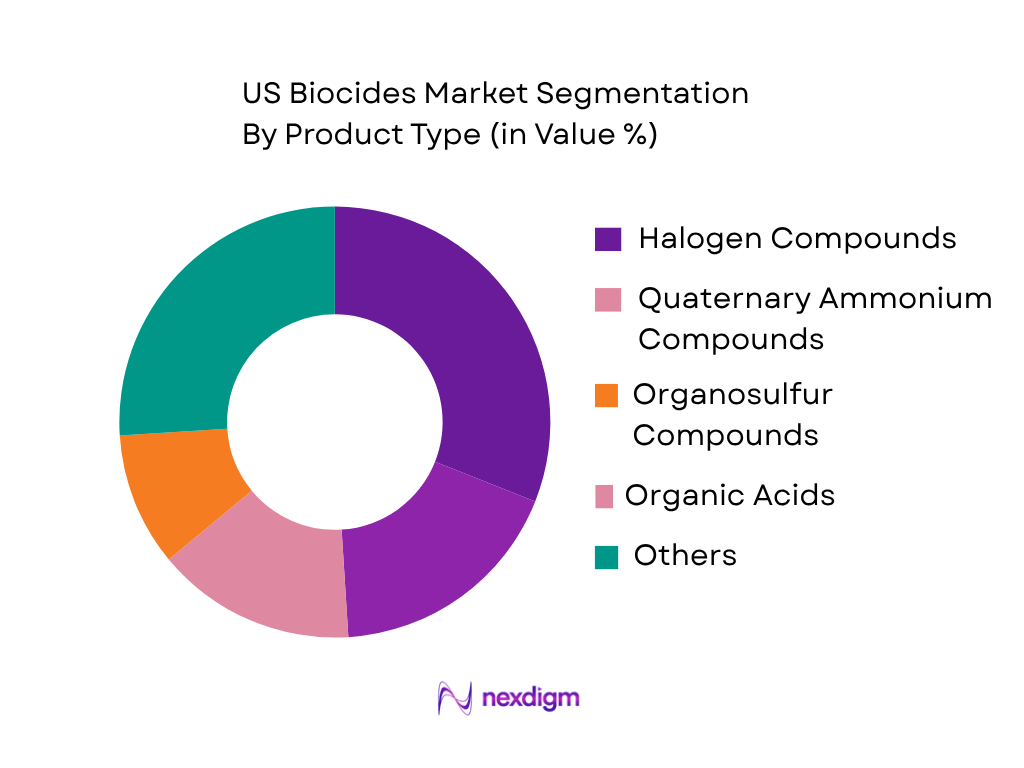
The US Biocides Market is segmented by product type into halogen compounds, quaternary ammonium compounds, organosulfur compounds, organic acids, metallic compounds, phenolic compounds, nitrogen-based biocides, and glutaraldehyde. Halogen compounds represented the dominant product category in 2024 according to the published US market dataset. Their leadership is supported by established use in water treatment, disinfection, cooling systems, industrial process-water management, and other microbial-control applications. Chlorine- and bromine-based chemistries provide broad-spectrum microbial control and are compatible with established treatment infrastructure, which supports their continued utilization across municipal, industrial, institutional, and commercial applications. Quaternary ammonium compounds occupy an important position because of their use in disinfectants, sanitizers, industrial hygiene, and surface-treatment products. The EPA recognizes antimicrobial pesticides as products designed to destroy or suppress microorganisms or protect materials and systems from microbial deterioration. This broad regulatory scope creates multiple end-use pathways for different active-ingredient families. The combination of established application technology, broad microbial efficacy, extensive distribution infrastructure, and compatibility with existing treatment systems supports halogen compounds as the leading product category in the US Biocides Market.
By Application
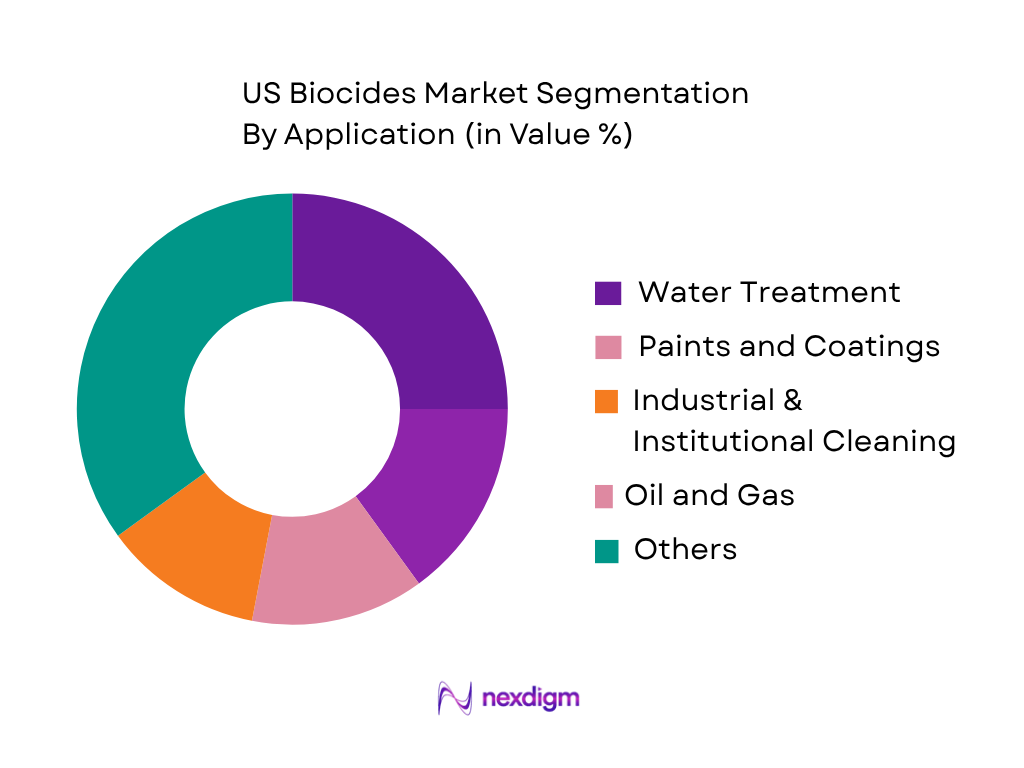
The US Biocides Market is segmented by application into water treatment, paints and coatings, industrial and institutional cleaning, wood preservation, food and beverage processing, oil and gas, pulp and paper, personal care and cosmetics, fuel preservation, HVAC and cooling systems, plastics and polymers, textiles, and antifouling. Water treatment represents the leading application because microbial growth can affect cooling systems, industrial process water, wastewater systems, pipelines, membranes, and other water-intensive operations. Biocides are used to control bacteria, algae, fungi, slime-forming organisms, and biofilms, supporting system reliability and reducing biological fouling. The EPA specifically recognizes antimicrobial pesticides intended to protect water and industrial processes from microbial contamination, fouling, or deterioration. Beyond water treatment, demand extends into public-health disinfection, industrial preservation, coatings, wood protection, and oilfield applications. The broad US manufacturing and industrial infrastructure therefore creates multiple recurring demand channels. Water treatment maintains the leading position because microbial control is integrated into ongoing system operation rather than being limited to occasional product use. This creates recurring consumption across cooling-water systems, industrial process-water applications, wastewater treatment, and other high-volume water-management environments.
Competitive Landscape
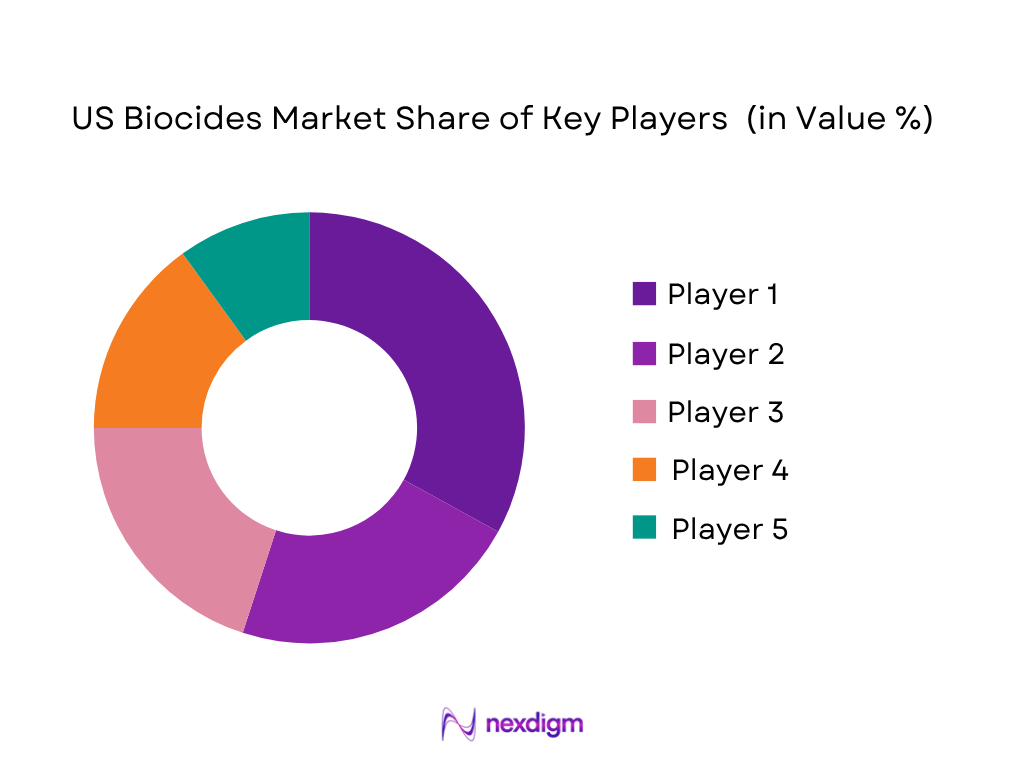
The US Biocides Market includes major global specialty-chemical producers, antimicrobial manufacturers, water-treatment companies, and industrial preservation suppliers. Competitive positioning is determined by active-ingredient breadth, formulation capability, EPA registration coverage, technical efficacy, application expertise, manufacturing footprint, and distribution reach. Companies including LANXESS, BASF, Ecolab, Arxada, and Albemarle maintain differentiated positions across industrial water treatment, antimicrobial preservation, coatings, oil and gas, wood protection, and specialty chemical applications. The regulatory environment is an important competitive barrier because antimicrobial products generally require EPA registration before lawful sale or distribution, with scientific data requirements covering product identity, composition, efficacy, human-health effects, environmental effects, and environmental fate.
| Company | Establishment Year | Headquarters | Key Biocide Portfolio | Primary Applications | EPA / Regulatory Capability | US Manufacturing Presence | Technical-Service Strength | Key Competitive Parameter |
| LANXESS AG | 2004 | Cologne, Germany | ~ | ~ | ~ | ~ | ~ | ~ |
| BASF SE | 1865 | Ludwigshafen, Germany | ~ | ~ | ~ | ~ | ~ | ~ |
| Ecolab Inc. | 1923 | St. Paul, USA | ~ | ~ | ~ | ~ | ~ | ~ |
| Arxada AG | 2017 | Basel, Switzerland | ~ | ~ | ~ | ~ | ~ | ~ |
| Albemarle Corporation | 1887 | Charlotte, USA | ~ | ~ | ~ | ~ | ~ | ~ |
US Biocides Market Analysis
Growth Drivers
Industrial Water Treatment Demand
Industrial water treatment is a core growth driver for the US Biocides Market because manufacturing, energy, chemicals, food processing, and other water-intensive industries require continuous control of bacteria, algae, fungi, and biofilms in process and cooling systems. The U.S. Geological Survey identifies manufacturing uses including processing, washing, cooling, product transport, and facility sanitation, while EPA specifically recognizes antimicrobial pesticides for protecting industrial processes and water systems from microbial fouling and deterioration. The scale of the industrial base is substantial: U.S. real GDP increased 2.8% in 2024, according to the Bureau of Economic Analysis, while private goods-producing industries increased 3.4%. The U.S. Census Bureau reported USD 49.956 billion in 2024 shipments of paints, coatings, and adhesives, demonstrating the size of an important materials-preservation customer base. EPA also states that antimicrobial products contain approximately 275 active ingredients and that more than 4,000 antimicrobial products are registered for US sale. These figures indicate a broad and established microbial-control ecosystem rather than a narrow specialty application. Continued industrial production, water-intensive processing, cooling requirements, and microbial-fouling risks therefore sustain recurring demand for oxidizing and non-oxidizing biocides, particularly in recirculating cooling water, industrial process water, wastewater, and manufacturing systems.
Microbial Control and Cooling-Water Management
Microbial control requirements in cooling-water systems are creating a strong application base for US Biocides Market participants because uncontrolled microbial growth can produce biofilms, slime, fouling, corrosion, and health risks. EPA finalized specific efficacy-testing guidance for antimicrobial products against Legionella pneumophila in cooling-tower water in August 2024, reflecting the increasing technical importance of validated microbial-control treatments. EPA notes that 6 community-associated Legionnaires’ disease outbreaks occurred in New York City since 2006, producing 213 cases and 18 deaths, with cooling towers associated with major outbreaks. The regulatory framework is particularly relevant because antimicrobial pesticides making microbial-kill claims must be registered with EPA before sale or distribution. The broader industrial demand base is reinforced by US energy activity: EIA reports 94.21 quadrillion Btu of total US primary-energy consumption in 2024, including 34.179 quadrillion Btu of natural-gas consumption and 103.31 quadrillion Btu of primary-energy production. Industrial and power-generation facilities operate extensive cooling and water-management systems where microbiological control is necessary. EPA’s antimicrobial guidance also covers once-through and recirculating industrial water systems, indicating the breadth of applications. Consequently, cooling-tower management, Legionella control, industrial process-water protection, and biofilm prevention create recurring demand for registered antimicrobial products with demonstrated efficacy under defined operating conditions.
Market Challenges
EPA Registration Requirements and Active Ingredient Restrictions
EPA registration requirements represent a significant challenge for US Biocides Market participants because antimicrobial products must satisfy regulatory requirements covering product identity, composition, efficacy, labeling, human-health effects, environmental effects, and environmental fate. EPA’s current antimicrobial registration framework requires applicants to address additional antimicrobial-specific data and efficacy requirements beyond the general pesticide-registration process. EPA’s antimicrobial database encompasses approximately 275 active ingredients and more than 4,000 registered antimicrobial products, creating a large but highly regulated product environment. For public-health antimicrobial claims, efficacy requirements are particularly important because manufacturers must demonstrate that products perform against specified microorganisms under defined conditions. The regulatory burden can become more significant when companies introduce new active ingredients, modify formulations, expand claims, or enter sensitive applications such as drinking-water disinfection, healthcare, and cooling-tower Legionella control. EPA’s 2024 final guidance for Legionella pneumophila specifically established a test method for supporting efficacy claims in cooling-tower water, illustrating how application-specific claims can require dedicated validation. EPA also evaluates potential adverse effects on people, wildlife, plants, surface water, and groundwater during registration. Consequently, companies must continuously manage technical dossiers, efficacy testing, labeling requirements, environmental assessments, and regulatory amendments, which can constrain rapid product commercialization and encourage manufacturers to prioritize established active ingredients and formulations with existing regulatory pathways.
Environmental Persistence and Product Reformulation
Environmental persistence and associated toxicological requirements create challenges for the US Biocides Market because antimicrobial products must balance microbial efficacy with acceptable human-health and environmental profiles. EPA evaluates environmental effects involving wildlife, plants, surface water, and groundwater as part of antimicrobial pesticide registration. The issue is particularly relevant to water-treatment biocides because EPA’s registration guidance recognizes that once-through industrial systems can discharge treated water directly into rivers, estuaries, or marine environments, creating potential environmental exposure. The scale of US water and industrial activity increases the significance of this issue. EIA reports 94.21 quadrillion Btu of primary-energy consumption in 2024, while the industrial sector accounted for 24% of US primary-energy consumption; energy-intensive facilities frequently depend on water and cooling systems where microbial control is required. EPA’s 2024 guidance on cooling-tower Legionella products further demonstrates that efficacy must be established under representative operating conditions rather than assumed from laboratory activity alone. Product developers therefore face pressure to improve biodegradability, reduce residual environmental exposure, optimize dosing, and maintain antimicrobial effectiveness simultaneously. Reformulation can require new efficacy data, label amendments, compatibility testing, and potentially additional regulatory review. These requirements create technical and commercial barriers for suppliers seeking to replace conventional chemistries with lower-impact alternatives while maintaining equivalent microbial-control performance in demanding industrial environments.
Market Opportunities
Advanced Water Treatment and PFAS-Related Formulations
Advanced water treatment presents a significant opportunity for the US Biocides Market because increasingly stringent water-quality requirements are creating demand for more targeted microbial-control and disinfection technologies. EPA finalized its National Primary Drinking Water Regulation for 6 PFAS in April 2024, establishing individual maximum contaminant levels of 4.0 nanograms per liter for PFOA and PFOS and 10 nanograms per liter for PFHxS, PFNA, and HFPO-DA, alongside a hazard-index limit of 1 for specified PFAS mixtures. Although PFAS removal itself is not synonymous with biocide treatment, the regulatory framework increases the need for integrated drinking-water treatment systems in which disinfection, microbial control, contaminant removal, and water-quality management operate together. EPA also provides specific guidance addressing antimicrobial products intended for drinking-water treatment under both FIFRA and the Safe Drinking Water Act. The opportunity is supported by the breadth of US industrial water use: USGS defines industrial water use across manufacturing activities including processing, washing, cooling, dilution, product transport, and facility sanitation. The development of advanced treatment trains creates opportunities for specialized biocides with improved compatibility, controlled residuals, targeted microbial efficacy, and lower interference with downstream filtration and membrane processes. Suppliers able to integrate antimicrobial chemistry into advanced water-treatment programs can address municipal, industrial, and commercial applications while responding to increasingly demanding contaminant and microbial-control requirements.
High-Performance Cooling-Water Treatment and Industrial Hygiene
High-performance cooling-water treatment and industrial hygiene provide opportunities for US Biocides Market expansion as industrial facilities require validated microbial-control programs that address increasingly specific organisms and operating conditions. EPA released final efficacy guidance for Legionella pneumophila in cooling-tower water in August 2024, establishing a dedicated test method and claim framework for antimicrobial products targeting this organism. EPA reported 7 Legionnaires’ disease cases associated with a nearby New Hampshire cooling tower in August 2024, while its historical review identified 213 cases and 18 deaths from 6 community-associated outbreaks in New York City since 2006. These data reinforce the operational importance of cooling-tower microbial management. The opportunity extends across industrial cooling systems, where EPA recognizes both once-through and recirculating systems as applications for microbiocides. The broader energy infrastructure supports a substantial installed base of industrial and commercial water systems: EIA recorded 34.179 quadrillion Btu of US natural-gas consumption and 103.31 quadrillion Btu of primary-energy production in 2024. High-performance biocides can therefore differentiate through broader microbial-spectrum control, faster action, biofilm penetration, compatibility with treatment programs, and efficacy under variable temperature and water-chemistry conditions. Suppliers combining validated antimicrobial chemistry with monitoring, dosing, and water-management expertise can capture opportunities in cooling towers, industrial process systems, institutional facilities, and other microbial-control environments.
Future Outlook
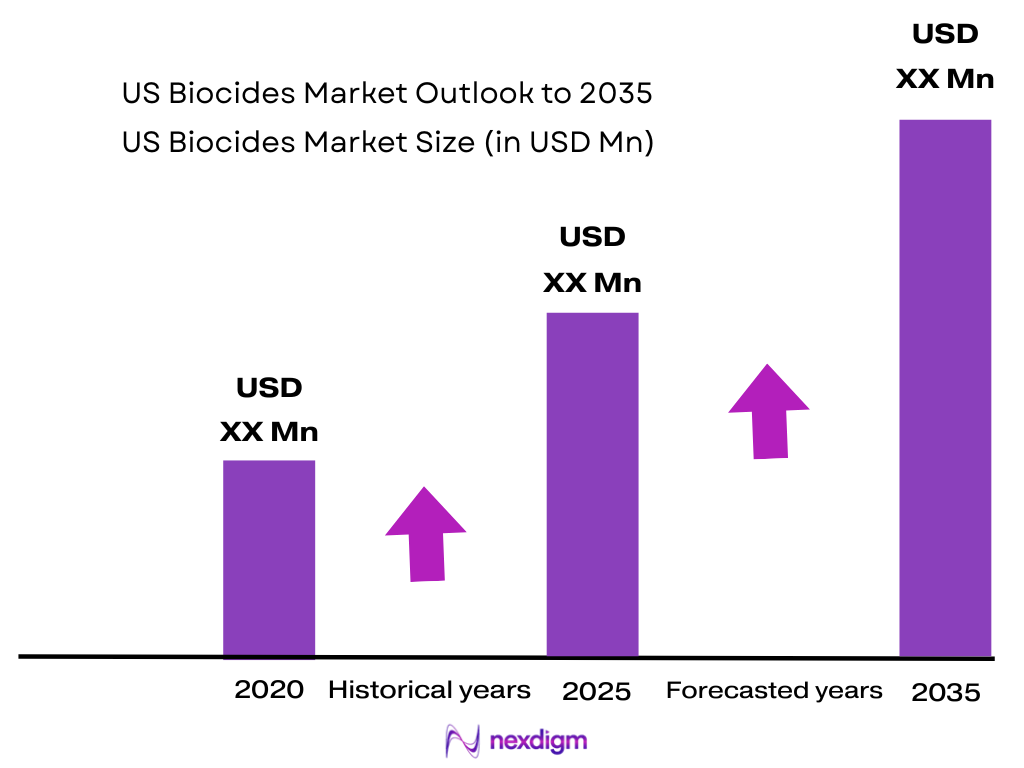
The US Biocides Market is expected to expand at a ~3.5% CAGR during 2026–2035, supported by continued microbial-control requirements across industrial water treatment, healthcare, food processing, coatings, oil and gas, and material preservation. The available US-specific market dataset projects revenue from USD 2,072.3 million in 2024 to USD 2,550.4 million in 2030, corresponding to a 3.5% CAGR during 2025–2030.
Future market development is expected to emphasize higher-performance and application-specific formulations, particularly where users require improved efficacy, lower environmental impact, reduced treatment frequency, or compatibility with sensitive materials. The EPA’s antimicrobial framework specifically addresses efficacy requirements and human-health and ecological-risk assessment, increasing the importance of scientifically validated formulations. Demand is also expected to diversify toward selective microbial-control solutions, combination chemistries, low-toxicity formulations, and products designed for increasingly complex industrial water and materials-preservation conditions. Companies capable of combining active-ingredient development with EPA registration expertise, formulation technology, and technical field support should remain competitively positioned.
Major Players
- LANXESS AG
- BASF SE
- Ecolab Inc.
- Arxada AG
- Albemarle Corporation
- Solvay SA
- Clariant AG
- ICL Group Ltd.
- Lonza Group Ltd.
- Troy Corporation
- Neogen Corporation
- Ashland Inc.
- Nouryon
- Stepan Company
- Lubrizol Corporation
Key Target Audience
- Biocide and antimicrobial active-ingredient manufacturers
- Water-treatment chemical manufacturers and industrial water-treatment operators
- Paint, coatings, adhesives and construction-material manufacturers
- Oil and gas operators and industrial process-chemical users
- Food and beverage processors and institutional hygiene operators
- Wood-treatment companies and building-material manufacturers
- Investments and venture capitalist firms (Specialty-chemical investors, water-technology funds, industrial biotechnology investors, sustainable-chemistry investors)
- Government and regulatory bodies (U.S. Environmental Protection Agency, U.S. Food and Drug Administration, Occupational Safety and Health Administration, state pesticide regulatory authorities)
Research Methodology
Step 1: Identification of Key Variables
The initial phase involves mapping the US Biocides Market ecosystem across active-ingredient producers, formulators, distributors, water-treatment companies, coatings manufacturers, oil and gas operators, healthcare facilities, food processors, wood-treatment companies, and regulatory authorities. The research establishes variables covering active-ingredient chemistry, formulation, application, microbial target, registration status, end-use industry, distribution, and replacement requirements. EPA’s antimicrobial pesticide framework is used to define the regulatory boundary.
Step 2: Market Analysis and Construction
Historical market information is compiled across product type, application, end-use industry, formulation, active ingredient, and distribution channel. The market model evaluates revenue, consumption volumes, formulated-product demand, active-ingredient demand, domestic production, imports, exports, and recurring treatment requirements. The published US market value of USD 2,072.3 million in 2024 is used as the market-sizing benchmark.
Step 3: Hypothesis Validation and Expert Consultation
Market hypotheses are validated through consultations with biocide manufacturers, formulators, water-treatment companies, coatings producers, industrial users, distributors, and regulatory specialists. Interviews assess active-ingredient selection, microbial-control requirements, formulation performance, treatment frequency, procurement criteria, regulatory barriers, product substitution, and emerging application requirements. These insights are triangulated against publicly available regulatory and industry information.
Step 4: Research Synthesis and Final Output
The final stage integrates primary research, company-level information, EPA regulatory datasets, industry statistics, trade information, and market-sizing benchmarks. Product-level and application-level estimates are reconciled through top-down and bottom-up approaches. EPA registration requirements, efficacy standards, product-use categories, and environmental considerations are incorporated to ensure the resulting assessment reflects the specific operating structure of the US Biocides Market.

- Executive Summary
- Research Methodology (Market Definition and Scope, Biocide and Antimicrobial Pesticide Classification, EPA Product-Registration Mapping, Active Ingredient Mapping, Market Sizing Framework, Top-Down Analysis, Bottom-Up Analysis, Demand-Side Assessment, Supply-Side Assessment, Primary Industry Interviews, Import-Export Analysis, Formulation-Level Assessment, End-Use Validation, Data Triangulation, Forecasting Framework, Scenario Analysis, Assumptions, Research Limitations)

- Definition and Scope
- US Biocides Industry Evolution
- US Biocides Industry Ecosystem
- US Biocides Value Chain
- US Biocides Supply Chain Analysis

- Market Growth Drivers (Industrial Water Treatment Demand, Microbial Control Requirements, Cooling-Water Management, Paint and Coatings Preservation, Food Processing Hygiene, Healthcare Disinfection, Industrial Asset Protection)
- Market Challenges (EPA Registration Requirements, Active Ingredient Restrictions, Toxicological Requirements, Environmental Persistence Concerns, Worker Exposure Controls, Product Reformulation, Supply-Chain Volatility, Resistance Management)
- Market Opportunities (Advanced Water Treatment, Low-Toxicity Biocides, Bio-Based Biocides, PFAS-Free Formulations, Sustainable Preservatives, High-Performance Cooling-Water Treatment, Specialty Coatings Preservation, Industrial Hygiene)
- Market Trends (Chlorine-Free Biocides, Low-VOC Formulations, Bio-Based Active Ingredients, Specialty Non-Oxidizing Biocides, Combination Formulations, Long-Lasting Preservation, Targeted Microbial Control, Sustainable Chemistry)
- Regulatory and Compliance Analysis (EPA FIFRA, Antimicrobial Pesticide Registration, Efficacy Testing, Product Labeling, Active Ingredient Review, Risk Assessment, Treated Articles, State-Level Requirements, FDA Interface, OSHA Exposure Requirements))
- Porter’s Five Forces Analysis
- PESTLE Analysis
- SWOT Analysis

- By Revenue (2020-2025)
- By Biocide Consumption Volume (2020-2025)
- By Active Ingredient Consumption (2020-2025)
- By Formulated Biocide Volume (2020-2025)
- By Active Ingredient Revenue (2020-2025)
- By Formulated Product Revenue (2020-2025)
- By Domestic Production (2020-2025)

- By Product Type (In Value %)
Halogen Compounds
Quaternary Ammonium Compounds
Organosulfur Compounds
Organic Acids
Phenolic Compounds
Metallic Compounds
Nitrogen-Based Biocides
Glutaraldehyde
Isothiazolinones - By Mechanism of Action (In Value %)
Oxidizing Biocides
Non-Oxidizing Biocides
Cell-Membrane Disrupting Biocides
Protein-Denaturing Biocides
Enzyme-Inhibiting Biocides
Metabolic-Pathway Inhibitors - By Application (In Value %)
Water Treatment
Paints and Coatings
Industrial and Institutional Cleaning
Wood Preservation
Food and Beverage Processing
Oil and Gas
Pulp and Paper
Personal Care and Cosmetics
Fuel Preservation
HVAC and Cooling Systems - By End-Use Industry (In Value %)
Municipal and Industrial Water Treatment
Paints, Coatings and Construction Materials
Oil and Gas
Pulp and Paper
Food and Beverage
Healthcare and Institutional Facilities
Personal Care and Cosmetics
Wood and Timber Products
Chemical and Petrochemical
Power Generation - By Formulation (In Value %)
Liquid Formulations
Concentrated Liquids
Water-Soluble Powders
Granules
Tablets
Ready-to-Use Formulations
Emulsions and Dispersions
Microencapsulated Formulations - By Function / Use Pattern (In Value %)
Disinfectants
Sanitizers
Preservatives
Microbial Growth Inhibitors
Algaecides
Fungicides
Bactericides

- Market Share of Major Players (By Revenue, Active Ingredient Type, Application, End-Use Industry, Product Category, Distribution Channel)
- Cross Comparison Parameters (Active Ingredient Portfolio Breadth, EPA-Registered Product Portfolio, Water-Treatment Biocide Capability, Paint and Coatings Preservation Capability, Specialty Biocide Chemistry Coverage, Formulation and Application Expertise, US Manufacturing and Distribution Footprint, Regulatory and Technical-Service Capability)
- SWOT Analysis of Major Players
- Detailed Profiles of Major Companies
LANXESS AG
BASF SE
Ecolab Inc.
Arxada AG
Troy Corporation
Lonza Group Ltd.
Solvay SA
Albemarle Corporation
Clariant AG
ICL Group Ltd.
Neogen Corporation
Ashland Inc.
Nouryon
CloroxPro
Stepan Company

- Water-Treatment Operator Assessment
- Paint and Coatings Manufacturer Assessment
- Wood-Treatment Operator Assessment
- Food and Beverage Manufacturer Assessment
- Healthcare and Institutional Buyer Assessment
- Industrial Procurement Assessment

- By Revenue (2026-2035)
- By Biocide Consumption Volume (2026-2035)
- By Active Ingredient Consumption (2026-2035)
- By Formulated Biocide Volume (2026-2035)
- By Active Ingredient Revenue (2026-2035)
- By Formulated Product Revenue (2026-2035)
- By Domestic Production (2026-2035)


 Request a Sample
 Ask for Customization
 Get a Quote
 Enquire Now