

 Download PDF
Market Overview
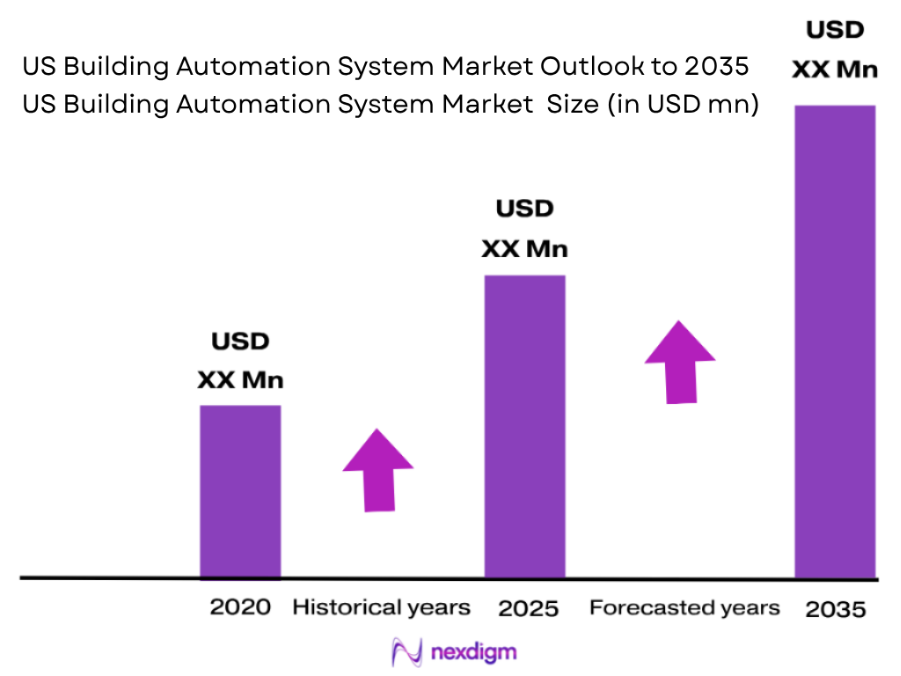
The US Building Automation System Market is valued at approximately USD ~ billion, based on the defined scope covering BAS hardware, software, system integration, installation, commissioning and lifecycle services. A published estimate places the broader US building automation and control systems market at USD 20.36 billion, while the Department of Energy identifies buildings as responsible for 41% of primary energy use and 74% of electricity consumption in the United States. Commercial-building controls therefore represent an important efficiency lever, particularly as owners seek centralized HVAC optimization, automated lighting, energy monitoring and operational visibility.
New York, Los Angeles, Chicago, Washington, D.C., Dallas, Houston, San Francisco and Atlanta represent major demand centres for the US Building Automation System Market because they combine large commercial building inventories, healthcare facilities, industrial properties, institutional campuses and technology-intensive facilities. US construction activity also provides a substantial addressable installation base, with the Census Bureau maintaining annual construction data across private, public, state and local categories. Data-center-intensive markets such as Northern Virginia, Texas and parts of the Midwest further strengthen demand for HVAC controls, electrical monitoring, environmental sensing and integrated facility-management platforms.
Market Segmentation
By Component
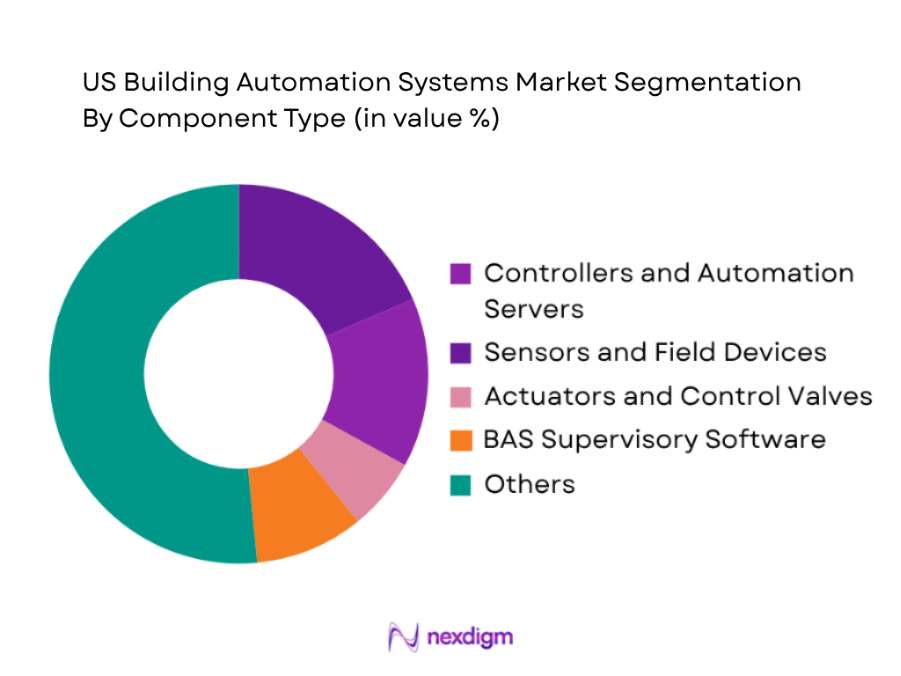
The US Building Automation System Market is segmented by component into BAS controllers, programmable automation controllers, direct digital controllers, input and output modules, sensors and field devices, smart meters, actuators and control valves, variable frequency drives, communication gateways, supervisory software, energy-management software, building analytics software, cloud-based BAS platforms, IoT devices, system integration, installation and commissioning, and maintenance services. BAS controllers and automation servers represent the leading sub-segment because they provide the central control layer connecting HVAC equipment, sensors, actuators, meters and supervisory applications. Their importance increases as commercial facilities move from isolated mechanical controls toward centralized, networked automation. Controllers also support integration across heating, ventilation, air-conditioning, lighting and electrical systems, making them relevant across offices, healthcare facilities, industrial buildings, hotels and institutional campuses. The continued development of BACnet and open-protocol systems strengthens controller interoperability. ASHRAE Standard 135-2024 specifically defines communication services and protocols for monitoring and controlling HVAC&R and other building systems, reinforcing the role of interoperable digital controls within modern BAS architectures.
By Building Type
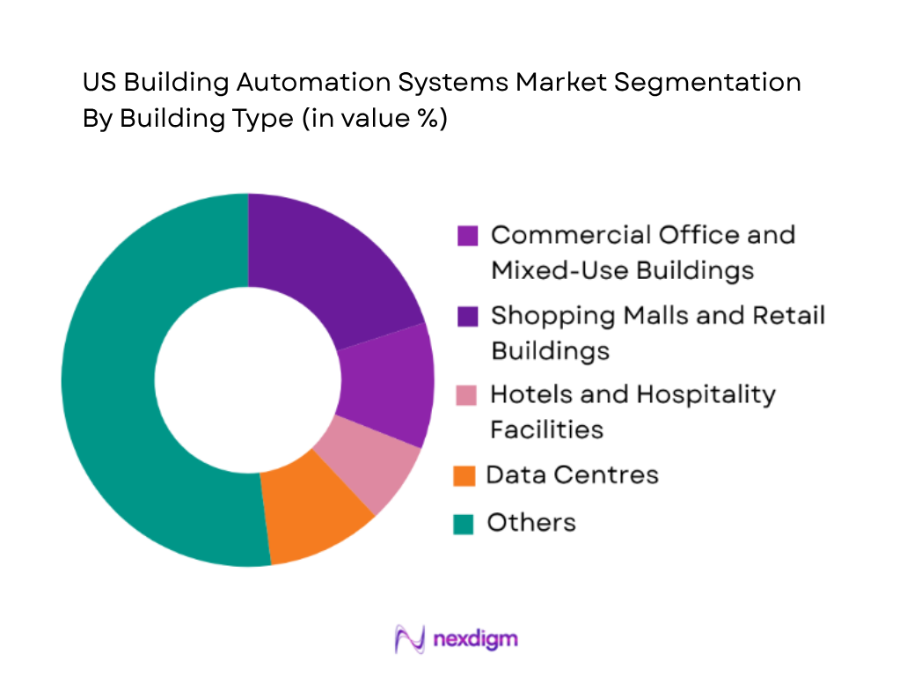
The US Building Automation System Market is segmented by building type into commercial office buildings, retail and shopping centers, hotels and hospitality facilities, healthcare facilities, educational buildings, industrial and manufacturing facilities, warehouses and logistics facilities, data centers, government and public buildings, sports and entertainment facilities, airports and transportation facilities, multifamily residential buildings, high-rise residential buildings and mixed-use developments. Commercial office buildings represent the leading sub-segment because they combine extensive HVAC loads, multiple occupied zones, lighting systems and increasingly sophisticated energy-management requirements. Offices also provide a large retrofit opportunity because existing properties can integrate modern controllers, sensors, analytics and cloud platforms without necessarily replacing their entire mechanical infrastructure. The US Department of Energy notes that more than 90% of commercial buildings are small or medium-sized and have little or no whole-building automation, highlighting substantial modernization potential. Building controls can address HVAC scheduling, occupancy response, temperature management, ventilation and equipment performance while providing centralized operational data to facility teams.
Competitive Landscape
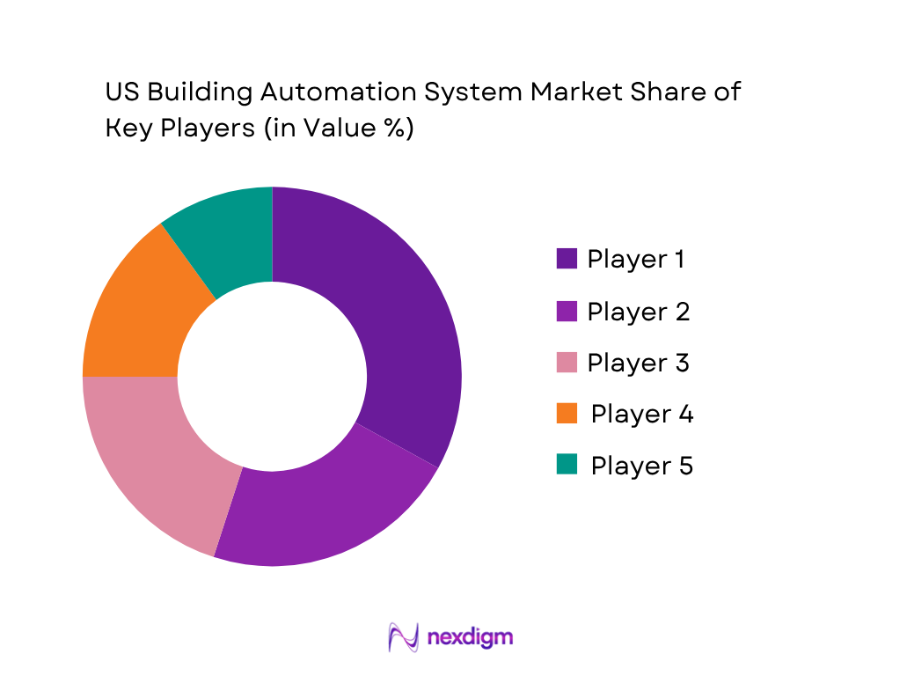
The US Building Automation System Market is characterized by competition among major global building-technology companies with capabilities spanning HVAC controls, building automation, energy management, analytics, IoT connectivity and lifecycle services. Johnson Controls, Honeywell, Siemens, Schneider Electric and Trane Technologies are among the prominent participants, while Carrier, ABB, Automated Logic, Delta Controls and Distech Controls strengthen competition across specialized BAS and HVAC applications. Competitive differentiation increasingly centres on integrated platforms, open-protocol interoperability, cloud connectivity, cybersecurity, AI-enabled analytics, energy optimization and the ability to connect legacy equipment with modern digital infrastructure. Johnson Controls, for example, supports integration between Metasys and OpenBlue and enables BACnet/IP connectivity with third-party BAS environments. Johnson Controls Docs
| Company | Establishment | Headquarters | BAS Platform / Offering | HVAC Automation | Energy Management | Cloud / IoT Capability | Open-Protocol Capability | Key US Application |
| Johnson Controls | 1885 | Cork, Ireland | ~ | ~ | ~ | ~ | ~ | ~ |
| Honeywell | 1906 | Charlotte, USA | ~ | ~ | ~ | ~ | ~ | ~ |
| Siemens | 1847 | Munich, Germany | ~ | ~ | ~ | ~ | ~ | ~ |
| Schneider Electric | 1836 | Rueil-Malmaison, France | ~ | ~ | ~ | ~ | ~ | ~ |
| Trane Technologies | 1871 | Dublin, Ireland | ~ | ~ | ~ | ~ | ~ | ~ |
US Building Automation System Market Analysis
Growth Drivers
Commercial Building Modernization and HVAC Energy Optimization
Commercial building modernization is a major growth driver for the US Building Automation System Market because existing properties increasingly require centralized HVAC control, automated scheduling, occupancy-based operation, energy monitoring and equipment optimization. The US Department of Energy states that high-performance building controls can reduce HVAC energy use by approximately 30%, while nationwide deployment could reduce total US energy consumption by more than 3%. The scale of the underlying building stock strengthens the retrofit opportunity because BAS can be deployed incrementally across HVAC equipment, lighting, meters and other building systems rather than requiring complete redevelopment. Construction activity also provides a continuing pipeline for new BAS installations. US construction spending reached USD 1.815 trillion on a year-to-date basis through October 2024, compared with USD 1.693 trillion during the corresponding period of 2023, while nonresidential construction reached USD 1.023 trillion compared with USD 952.4 billion. This expanding construction base supports BAS demand in offices, healthcare facilities, retail buildings, educational properties, industrial facilities and other nonresidential assets. In parallel, DOE’s building-controls program emphasizes interoperable systems capable of responding to occupant and grid requirements, reinforcing demand for connected controllers, sensors, analytics and energy-management platforms.
Data Center Expansion and Digitally Intensive Building Infrastructure
Data-center development is strengthening demand for the US Building Automation System Market because these facilities require continuous monitoring and automated control of cooling, ventilation, electrical systems, environmental conditions and equipment performance. The US Energy Information Administration reports that commercial electricity-demand growth has been concentrated in states experiencing rapid development of large-scale computing facilities. Virginia added 14 billion kWh of commercial electricity demand between 2019 and 2023, while Texas added 13 billion kWh, illustrating the scale of electricity-intensive computing infrastructure concentrated in major US data-center markets. EIA also reports that office buildings containing data centers have materially higher electricity intensity than comparable offices without data centers, with total electricity intensity 87% higher for buildings of 50,000 square feet or less, 60% higher for buildings between 50,001 and 200,000 square feet, and 20% higher for buildings exceeding 200,000 square feet. Such operating characteristics increase the need for sophisticated BAS architectures capable of coordinating cooling systems, airflow, temperature, humidity, electrical loads and alarms. The Department of Energy also identifies advanced building controls as a mechanism for integrating building operations with grid requirements. Consequently, data-center expansion creates demand not only for conventional HVAC controls but also for high-availability automation, real-time analytics, remote monitoring and energy-management capabilities.
Market Challenges
Legacy BAS Infrastructure and Interoperability Constraints
Legacy BAS infrastructure remains a significant challenge for the US Building Automation System Market because many existing commercial buildings contain control equipment installed at different stages of their operating life, often using proprietary architectures or incompatible communication protocols. Modern BAS projects therefore frequently require gateways, protocol conversion, controller replacement, additional sensors and engineering integration before centralized monitoring can be achieved. The Department of Energy specifically identifies interoperability as a strategic area within its building-controls program and highlights the importance of open communication standards and integration platforms. Modern control systems increasingly use TCP/IP networking together with building-specific protocols such as BACnet, but the presence of older equipment can complicate migration toward these architectures. The retrofit challenge is particularly relevant because the US building stock includes a very large population of small and medium-sized commercial facilities with limited automation. DOE’s advanced-controls work identifies small and medium buildings, large buildings and grid-edge applications as distinct strategic deployment areas. The challenge is therefore not simply installing new BAS hardware; it involves maintaining compatibility between legacy HVAC equipment, new controllers, sensors, meters and cloud platforms while preserving building operations during retrofit work. These requirements can lengthen project engineering, commissioning and integration activities and create uncertainty around technology selection for building owners.
Cybersecurity, Skilled Controls Requirements and Retrofit Complexity
Cybersecurity and technical implementation requirements represent another challenge for the US Building Automation System Market as BAS platforms become increasingly connected to enterprise networks, cloud applications, remote-management platforms and IoT devices. Connected building systems create additional interfaces that must be secured while maintaining reliable operation of HVAC, electrical and life-safety-related equipment. At the same time, BAS deployment requires specialized capabilities in controls engineering, programming, HVAC integration, commissioning and ongoing system optimization. The complexity becomes greater when modern controls are introduced into operating buildings containing multiple generations of mechanical equipment. US federal building requirements demonstrate the increasing technical expectations surrounding energy performance. The Department of Energy requires new federal commercial buildings to meet 10 CFR 433, while federal energy-efficiency requirements reference ASHRAE 90.1-2019 for federal commercial buildings. The federal Clean Energy Rule also established requirements targeting reductions in on-site fossil-fuel-generated energy consumption for qualifying new construction and major renovation projects, with requirements of 90% for applicable projects in fiscal years 2025–2029 and 100% from fiscal year 2030 onward, subject to the current implementation status. DOE also identifies project thresholds of approximately USD 3.6 million, USD 3.8 million and USD 1.8 million for different categories of qualifying federal projects. These requirements increase the need for properly engineered controls while raising technical and compliance complexity.
Market Opportunities
Data Center BAS and AI-Enabled Building Optimization
Data-center BAS represents a significant future opportunity for the US Building Automation System Market because computing facilities require continuous environmental control and operate with substantially higher electricity intensity than conventional office environments. EIA data show that office buildings containing data centers can have total electricity intensity 87% higher, 60% higher and 20% higher than comparable buildings without data centers across three building-size categories. Commercial electricity demand has also been concentrated in major computing-facility states, with Virginia adding 14 billion kWh and Texas adding 13 billion kWh between 2019 and 2023. These operating conditions create a strong application for automated cooling control, temperature and humidity sensing, airflow optimization, electrical monitoring, alarm management and predictive equipment analytics. The opportunity extends beyond conventional BAS because data-center operators can integrate building automation with digital infrastructure, power-management systems and real-time analytics. DOE’s grid-interactive building guidance specifically addresses controls and electrification upgrades for federal and commercial facilities, providing a framework for connecting building loads with broader energy-management strategies. As data centers increasingly require high operational availability, BAS suppliers can address demand for redundant controls, remote diagnostics, equipment-level monitoring and predictive maintenance. This creates an opportunity for suppliers offering integrated hardware, software, analytics, cybersecurity and lifecycle services rather than isolated HVAC-control products.
Commercial Building Retrofits and Grid-Interactive Building Management
Commercial building retrofits represent a substantial opportunity for the US Building Automation System Market because existing buildings can use advanced controls to improve HVAC operation, occupancy response, energy monitoring and equipment scheduling without requiring complete reconstruction. DOE reports that high-performance control strategies can deliver approximately 30% annual HVAC energy savings across relevant commercial building types, while universal deployment could produce an absolute reduction exceeding 3% of total US energy consumption. DOE’s 2024 grid-interactive efficient-building guidance specifically targets building owners, energy managers and facility managers undertaking retrofit projects and identifies controls, electrification and grid-interactive technologies as retrofit considerations. The broader construction environment further supports modernization activity: US public construction reached USD 492.7 billion in 2024, compared with USD 450.7 billion in 2023, while educational construction reached USD 105.2 billion and highway construction reached USD 142.7 billion. These figures indicate continued investment across building and infrastructure assets where automation and energy-management systems can be incorporated during renovation or modernization programs. The opportunity is particularly relevant to aging offices, institutional buildings, healthcare facilities, retail properties and government assets where BAS can connect existing HVAC equipment with modern sensors, controllers, analytics and cloud-based management systems.
Future Outlook
The US Building Automation System Market is expected to expand through increasing adoption of connected controls, energy-management systems, intelligent HVAC optimization and cloud-based building platforms. Demand will be supported by commercial-building modernization, data-center development, industrial automation and the continued need to improve building energy performance. The market is also moving toward integrated platforms that connect HVAC, lighting, electrical systems, occupancy sensing, indoor-air-quality monitoring and facility analytics. Future competition is expected to focus increasingly on interoperability, cybersecurity, AI-enabled optimization, predictive maintenance and portfolio-level building management rather than standalone HVAC controls.
Major Players
- Johnson Controls
- Honeywell
- Siemens
- Schneider Electric
- Trane Technologies
- Carrier
- ABB
- Automated Logic
- Delta Controls
- Distech Controls
- Azbil Corporation
- Lutron Electronics
- Legrand
- Mitsubishi Electric
- KMC Controls
Key Target Audience
- Commercial and Mixed-Use Property Developers
- Commercial Real Estate Owners, REITs and Asset Managers
- Facility Management and Integrated Facilities Services Providers
- Data Center Operators and Digital Infrastructure Developers
- Industrial, Manufacturing and Logistics Facility Operators
- BAS, HVAC and MEP System Integrators
- Investments and Venture Capitalist Firms
- Government and Regulatory Bodies (U.S. Department of Energy, General Services Administration, Environmental Protection Agency, Department of Defense, State and Local Building Authorities)
Research Methodology
Step 1: Identification of Key Variables
The initial phase involves constructing a US-specific building automation ecosystem covering BAS manufacturers, HVAC controls providers, system integrators, MEP contractors, facility managers, property owners and technology suppliers. The assessment maps controllers, sensors, actuators, meters, supervisory software, analytics, communication protocols and cloud platforms. Particular attention is given to HVAC automation, energy management, building retrofits and data-center requirements.
Step 2: Market Analysis and Construction
In this phase, historical market information is compiled by separating BAS hardware, software, integration, installation, commissioning and lifecycle services. Demand is assessed across commercial offices, retail, healthcare, education, industrial facilities, data centers and government buildings. Construction activity, building modernization, energy-efficiency requirements and technology adoption are incorporated into the market-sizing framework.
Step 3: Hypothesis Validation and Expert Consultation
Market hypotheses are validated through interviews with BAS manufacturers, HVAC controls providers, system integrators, MEP contractors, facility-management companies, property owners and building operators. Discussions focus on controller deployment, retrofit activity, HVAC integration, communication protocols, cloud adoption, energy-management requirements and procurement practices. Operational inputs are used to test and refine assumptions developed through the bottom-up assessment.
Step 4: Research Synthesis and Final Output
The final stage triangulates supplier-side information with construction activity, building-level demand indicators and application-specific deployment trends. New-build BAS installations are separated from retrofit and modernization requirements to identify distinct demand pools. The resulting framework provides market sizing, segmentation, competitive benchmarking and future demand assessment across major US building categories.

- Executive Summary
- Research Methodology (Market Definitions and Assumptions, US Building Automation System Classification, BAS and BACS Scope, Building Controls Mapping, HVAC Automation Assessment, Direct Digital Control Assessment, Sensors and Field Devices Mapping, Controllers and Programmable Logic Controllers Assessment, Supervisory Software Assessment, Energy Management System Assessment, Building Analytics Assessment, IoT and Edge Connectivity Assessment, Cloud-Based BAS Assessment, BACnet and Open-Protocol Assessment, Cybersecurity Assessment, System Integration Assessment, Commissioning Assessment, Retrofit and Modernization Assessment, New-Build BAS Assessment, Building Stock Mapping, Commercial Building Assessment, Industrial Facility Assessment, Data Center Assessment, Healthcare Facility Assessment, Institutional Building Assessment, Government Building Assessment, Supply-Side Assessment, Demand-Side Assessment, Top-Down Market Sizing, Bottom-Up Market Sizing, Primary Industry Interviews, Building Construction Pipeline Assessment, Data Center Development Pipeline Assessment, Energy-Efficiency Policy Assessment, Data Triangulation, Forecasting Framework)

- Definition and Scope
- US Building Automation System Industry Evolution and Development of Pneumatic Controls, Direct Digital Controls, Distributed Building Automation, HVAC Control Systems, Energy Management Systems, Integrated Building Controls, BACnet-Based Automation, Open-Protocol Systems, IoT-Enabled Building Controls, Cloud-Based BAS Platforms, Building Analytics, Fault Detection and Diagnostics, AI-Enabled Building Optimization, Digital Twins, Cybersecure Building Automation, Grid-Interactive Buildings
- Building Automation System Value Chain Analysis
- Building Automation System Supply Chain Analysis

- Growth Drivers (Commercial Building Modernization, HVAC Energy Optimization, Federal Building Efficiency Requirements, Data Center Expansion, Smart Building Adoption, Industrial Automation, Building Electrification, Grid-Interactive Building Development, Energy Management Adoption, Indoor Air Quality Requirements, Digital Facility Management, IoT Sensor Deployment)
- Market Challenges (Legacy BAS Infrastructure, Proprietary Control Systems, Interoperability Constraints, Protocol Compatibility Issues, Cybersecurity Vulnerabilities, Skilled Controls Engineer Requirements, Retrofit Installation Complexity, Fragmented Building Controls Ecosystem, Long Equipment Replacement Cycles, Integration With Existing HVAC Systems, Building Data Management Complexity, Capital Allocation Constraints)
- Market Opportunities (Data Center BAS, Cloud-Based Building Automation, AI-Enabled Building Optimization, Predictive HVAC Maintenance, Smart Chiller Controls, Commercial Building Retrofits, Industrial Facility Automation, Indoor Air Quality Monitoring, Occupancy Analytics, Grid-Interactive Buildings, Demand Response Integration, Digital Twin-Based Building Management, Multi-Site Facility Management, Building Electrification Controls, EV Charging and Building Energy Management)
- Market Trends (Cloud-Native BAS, Open-Protocol Architecture, BACnet/IP Adoption, BACnet Secure Connect, AI-Based Fault Detection, Machine Learning Energy Optimization, Edge Computing, Wireless Sensors, Digital Twins, Automated Fault Detection and Diagnostics, Cybersecure OT Networks, Predictive Maintenance, Integrated Energy Management, Occupancy-Based Controls, Grid-Interactive Efficient Buildings)
- Government Regulations and Standards (ASHRAE Guideline 13, ASHRAE Standard 135 BACnet, ASHRAE Standard 100 Building Energy Performance, ASHRAE Standard 36 High-Performance HVAC Sequences, ASHRAE Standard 202 Commissioning, ASHRAE Standard 205 HVAC&R Performance Data, International Energy Conservation Code Requirements, International Building Code Requirements, IECC Commercial Building Controls, Department of Energy Building Efficiency Requirements, Federal Building Performance Standards, ENERGY STAR Building Performance Requirements, State and Local Building Energy Codes, Cybersecurity Requirements for Building Operational Technology) ASHRAE
- SWOT Analysis
- Porter’s Five Forces Analysis
- PESTLE Analysis
- Stakeholder Ecosystem

- By Market Value (2020-2025)
- By BAS Hardware Revenue (2020-2025)
- By BAS Software Revenue (2020-2025)
- By System Integration Revenue (2020-2025)
- By Installation and Commissioning Revenue (2020-2025)
- By Maintenance and Lifecycle Services Revenue (2020-2025)

- By Component (In Value %)
BAS Controllers
Programmable Automation Controllers
Direct Digital Controllers
Input and Output Modules
Sensors and Field Devices
Temperature and Humidity Sensors
Occupancy and Motion Sensors
CO₂ and Indoor Air Quality Sensors
Pressure and Flow Sensors
Smart Meters and Energy Monitoring Devices
Actuators and Control Valves
Variable Frequency Drives
Communication Gateways
BAS Supervisory Software
Energy Management Software - By Building Type (In Value %)
Commercial Office Buildings
Retail and Shopping Centers
Hotels and Hospitality Buildings
Healthcare Facilities
Educational Buildings
Industrial and Manufacturing Facilities
Warehouses and Logistics Facilities
Data Centers
Government and Public Buildings - By Application (In Value %)
HVAC Control and Optimization
Chiller Plant Management
Air Handling Unit Control
Boiler and Heating Control
Ventilation Control
Lighting Control
Energy Monitoring and Management
Indoor Air Quality Management
Occupancy-Based Building Control
Fire and Life Safety Integration
Access and Security System Integration
Electrical Power Monitoring
Demand Response and Grid Interaction - By Deployment (In Value %)
New Construction
Building Retrofit
BAS Replacement
BAS Expansion
System Modernization
Multi-Site BAS Deployment
Cloud BAS Deployment
Edge BAS Deployment - By Region (In Value %)
Northeast
Midwest
South
West

- Market Share of Major Players (By US Revenue, BAS Hardware Revenue, BAS Software Revenue, System Integration Revenue, Installed Controller Base, Connected BAS Points, Building Coverage, Commercial BAS Capability, Industrial BAS Capability, Data Center BAS Capability, Cloud BAS Capability, Energy Management Capability, HVAC Automation Capability, Geographic Coverage)
- Cross Comparison Parameters (BAS Product Portfolio Breadth, Controller and Field Device Portfolio, HVAC Automation Capability, Energy Management Platform Capability, Cloud and IoT Architecture, BACnet and Open-Protocol Compatibility, Cybersecurity and OT Protection Capability, System Integration and Lifecycle Service Footprint)
- SWOT Analysis of Major Players
- Detailed Profiles of Major Companies
Johnson Controls
Honeywell
Siemens
Schneider Electric
Trane Technologies
Carrier
ABB
Delta Controls
Distech Controls
Automated Logic
Lutron Electronics
Legrand
Mitsubishi Electric
Azbil Corporation
KMC Controls

- Commercial Property Owner BAS Requirement Assessment
- Commercial Real Estate Developer BAS Specification Assessment
- Facility Management Company BAS Procurement Assessment
- Mechanical and Electrical Contractor BAS Requirement Analysis
- BAS System Integrator Procurement Assessment
- Data Center Operator BAS Requirement Assessment

- By Market Value (2026-2035)
- By BAS Hardware Revenue (2026-2035)
- By BAS Software Revenue (2026-2035)
- By System Integration Revenue (2026-2035)
- By Installation and Commissioning Revenue (2026-2035)
- By Maintenance and Lifecycle Services Revenue (2026-2035)


 Request a Sample
 Ask for Customization
 Get a Quote
 Enquire Now
