

 Download PDF
Market Overview
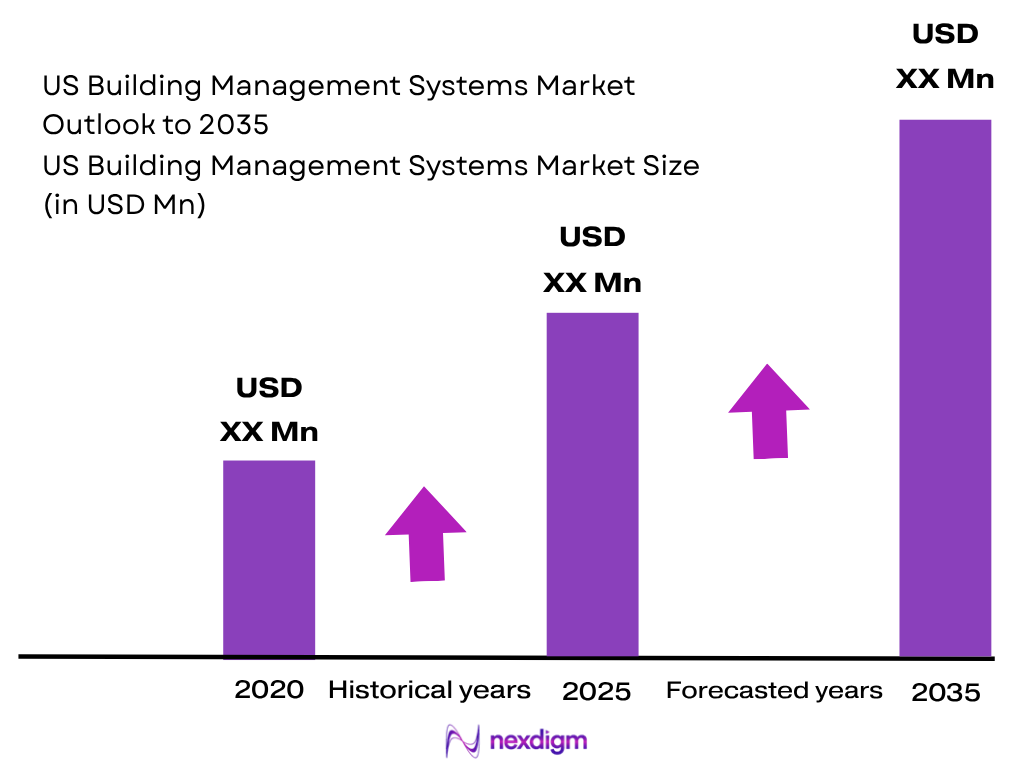
The US Building Management Systems Market is valued at approximately USD ~ billion, according to Global Market Insights. Demand is reinforced by building energy costs, with average commercial electricity prices increasing from 12.59 cents/kWh to 12.75 cents/kWh across the two latest annual observations. Residential and commercial buildings also accounted for 20.6 quadrillion Btu of end-use energy in the earlier observation, strengthening the economic case for automated HVAC, lighting, metering and energy optimization.
New York, Boston, Northern Virginia, Atlanta, Chicago, Dallas-Fort Worth, Phoenix and California’s major metropolitan areas are important BMS demand centers because of dense commercial portfolios, high-performance building requirements and data-center concentration. Northern Virginia alone carries 2,930.1 MW of data-center inventory, while Atlanta recorded 705.8 MW of net absorption. Federal smart-building investment also covers around 560 facilities, creating additional demand for advanced metering, sensors and building controls.
Market Segmentation
By System Type
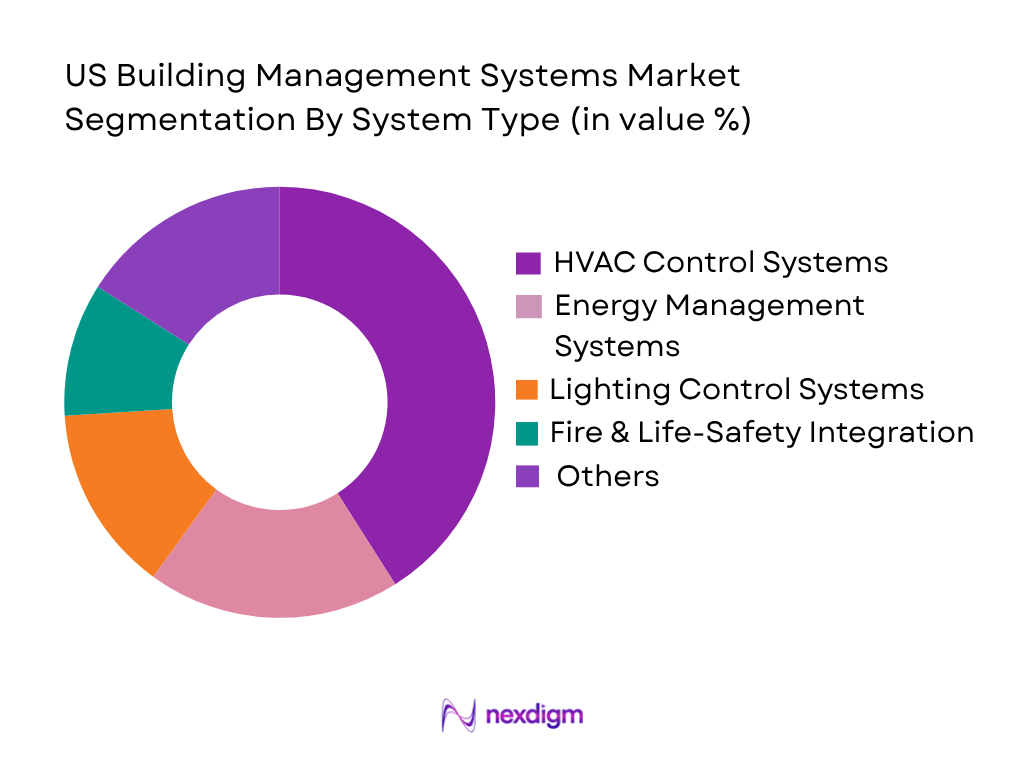
The US Building Management Systems Market is segmented into HVAC control systems, energy management systems, lighting controls, fire and life-safety integration, access and security integration, and indoor-air-quality management systems. HVAC control systems hold the dominant position because heating, cooling, and ventilation represent one of the largest controllable loads in commercial buildings and require continuous scheduling, sequencing, temperature control, airflow management, and plant optimization. The U.S. Department of Energy states that high-performance building controls can reduce commercial-building HVAC energy use by around 30% on average, emphasizing the operational importance of advanced control sequences. Modern systems increasingly integrate chillers, boilers, rooftop units, air handlers, VAV boxes, heat pumps, meters, and occupancy data into unified supervisory platforms. Open protocols such as BACnet also enable building owners to integrate equipment from multiple manufacturers. These capabilities make HVAC automation the central functional layer around which broader BMS deployments are typically constructed.
By Building Type
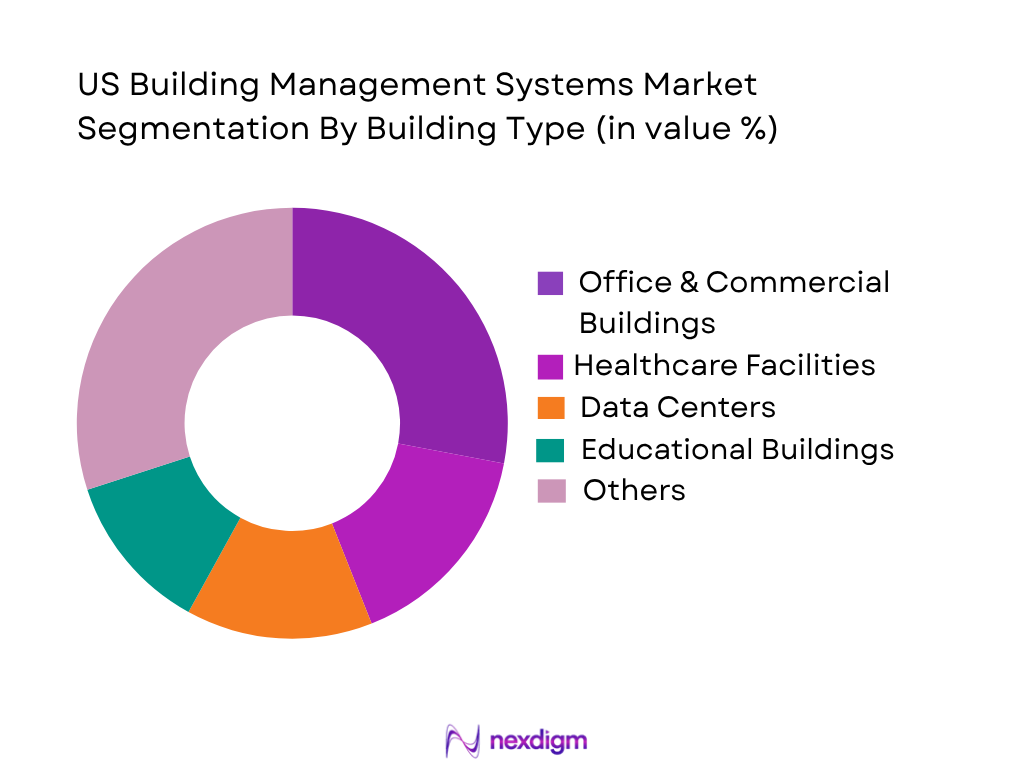
The US Building Management Systems Market is segmented into office buildings, healthcare facilities, data centers, educational buildings, retail properties, hotels, government facilities, industrial buildings, and other commercial properties. Office and large commercial buildings represent the dominant segment because these facilities contain complex HVAC zoning, lighting schedules, occupancy variation, access-control systems, and centralized mechanical plants that benefit significantly from automation. U.S. commercial buildings account for a substantial share of national energy use, with the most recent comprehensive EIA building-stock survey identifying approximately 5.9 million commercial buildings covering 96.4 billion square feet. Larger buildings are particularly suitable for BMS because their operating complexity justifies supervisory software, direct digital controls, automated scheduling, fault detection, and enterprise-level analytics. Building owners are also increasingly subject to energy-performance and emissions requirements in major cities, encouraging upgrades to controls and monitoring systems. These factors support continued BMS penetration across offices and other large commercial properties.
Competitive Landscape
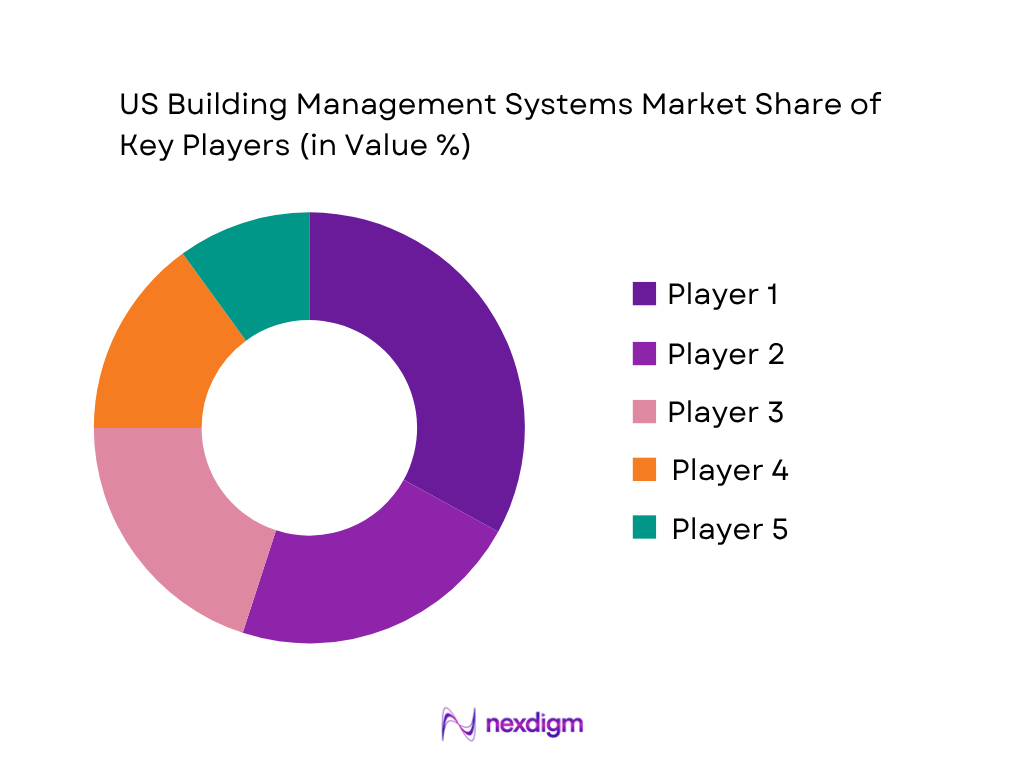
The US Building Management Systems Market features a concentrated group of multinational building-technology companies supported by specialist controls vendors, independent system integrators and regional contractors. Honeywell, Johnson Controls, Siemens, Schneider Electric and Trane Technologies maintain particularly strong positions through extensive installed bases, proprietary and open-control architectures, HVAC expertise, cloud platforms and nationwide service capabilities. Competition is increasingly shifting from conventional controller sales toward software subscriptions, AI-driven optimization, cybersecurity, remote operations and lifecycle building services.
| Company | Establishment Year | Headquarters | Core BMS Platform | HVAC Controls Capability | Cloud and AI Capability | Open-Protocol Interoperability | Energy Optimization Capability | System Integration and Service Network |
| Honeywell International Inc. | 1906 | Charlotte, North Carolina, US | ~ | ~ | ~ | ~ | ~ | ~ |
| Johnson Controls International plc | 1885 | Cork, Ireland | ~ | ~ | ~ | ~ | ~ | ~ |
| Siemens AG | 1847 | Munich and Berlin, Germany | ~ | ~ | ~ | ~ | ~ | ~ |
| Schneider Electric SE | 1836 | Rueil-Malmaison, France | ~ | ~ | ~ | ~ | ~ | ~ |
| Trane Technologies plc | 2020 | Swords, Ireland | ~ | ~ | ~ | ~ | ~ | ~ |
US Building Management Systems Market Analysis
Growth Drivers
Rising Commercial Electricity Consumption and Energy-Optimization Requirements
The US Building Management Systems Market is being supported by the expanding electricity load of commercial facilities and the resulting requirement for more granular HVAC, lighting, metering and equipment controls. U.S. Energy Information Administration data show that commercial-sector electricity sales reached 1,450,941 million kWh in 2024, compared with 1,408,109 million kWh in the preceding annual dataset, while total US electricity sales reached 3,975,382 million kWh. This scale of commercial electricity utilization increases the operational relevance of scheduling, occupancy-based ventilation, automated set-point adjustment, demand management and fault detection within offices, healthcare facilities, retail properties, hotels and data-intensive buildings. Commercial buildings therefore represent a substantial controllable load for integrated BMS platforms. The broader economic environment also supports capital-intensive building modernization: the World Bank records US GDP at approximately USD 29,298.013 billion in 2024, demonstrating the depth of the economy supporting commercial-property investment and digital infrastructure deployment. The Department of Energy further identifies controls as the building’s integrated operational layer for HVAC, hot-water, lighting and other equipment. Together, high electricity throughput and a large economic base strengthen the business rationale for advanced building automation, centralized monitoring and energy-management functionality.
Expansion of Nonresidential and Technology-Intensive Building Infrastructure
The continuing scale of US nonresidential construction is creating a large flow of buildings in which controls, sensors, HVAC automation, electrical monitoring and supervisory software can be specified during design rather than retrofitted later. The US Census Bureau reports USD 1,254,081 million of nonresidential construction put in place during 2024. Within BMS-intensive end markets, office construction accounted for USD 104,374 million, healthcare facilities for USD 69,036 million, educational facilities for USD 138,223 million, and commercial construction for USD 132,345 million in the revised annual dataset. These building categories typically require coordinated mechanical systems, environmental controls, alarms, metering and increasingly centralized data interfaces, supporting demand for integrated BMS architectures. The macroeconomic capacity underpinning this construction base is substantial: World Bank data place US GDP at USD 29,298.013 billion in 2024, while GDP per capita stood at USD 84,534 in the published 2024 indicator set. A large pipeline of technically complex nonresidential assets broadens the installed base into which BMS OEMs, controls contractors and system integrators can deploy supervisory controllers, sensors, analytics and connected-building platforms, making construction activity a direct structural driver for the market.
Market Challenges
Shortage and Capacity Constraints in Specialized Building-Controls Labor
The US Building Management Systems Market faces an execution challenge because BMS projects depend on overlapping electrical, HVAC, networking, commissioning and controls-programming capabilities that cannot be substituted easily with general construction labor. Bureau of Labor Statistics data show that the construction sector employed 582,130 electricians, 302,390 heating, air-conditioning and refrigeration mechanics and installers, and 277,520 construction managers in May 2024. Despite this sizeable workforce, BLS recorded an annual average of approximately 301,000 construction job openings during 2024, indicating substantial unfilled labor demand across the sector competing for many of the same technical trades needed for BMS installations and retrofits. Specialized automation projects add further requirements for BACnet integration, controller programming, commissioning, cybersecurity configuration and troubleshooting across legacy equipment. The challenge exists within a very large economy: World Bank data record US GDP of approximately USD 29,298.013 billion in 2024, meaning building construction, infrastructure, manufacturing and data-center developments are simultaneously competing for technical labor. Consequently, BMS vendors and integrators can face project scheduling pressure, commissioning bottlenecks and difficulty scaling regional service capacity, particularly when projects involve multiple HVAC systems, electrical interfaces and legacy automation platforms that require experienced field personnel.
Legacy-System Integration and Cybersecurity Complexity
Increasing connectivity creates a major technical challenge for the US Building Management Systems Market because modern BMS deployments must integrate older controllers and field devices with IP networks, cloud platforms, enterprise applications and remote-access systems without weakening operational security. The scale of the modernization problem is visible in the federal estate. In 2024, the US General Services Administration announced smart-building upgrades affecting an estimated 560 federal buildings, including approximately 1,000 new electricity, water and gas meters, smart sensors in more than 70 buildings, unified interfaces across more than 150 buildings, and advanced HVAC controls at approximately 15 facilities. GSA’s Smart Buildings directive specifically requires cybersecurity best practices for IP-network-based building systems and downstream devices, illustrating how modernization increasingly combines automation engineering with cyber-risk management. The challenge is amplified by the country’s extensive economic and digital infrastructure: World Bank data record US GDP at USD 29,298.013 billion in 2024 and a population of roughly 340 million, supporting a vast and heterogeneous building stock operated by government agencies, corporations and institutional owners. BMS suppliers must therefore manage protocol conversion, legacy-device compatibility, secure remote connectivity, segmentation and lifecycle patching alongside conventional controls integration, increasing project complexity.
Market Opportunities
Federal Smart-Building Modernization and Controls Retrofits
Federal building modernization provides a clear future expansion opportunity for the US Building Management Systems Market because current programs are already establishing the infrastructure needed for wider deployment of advanced controls, analytics, smart metering and integrated operating interfaces. The US General Services Administration’s 2024 smart-building initiative covers approximately 560 federal facilities across 49 states, Puerto Rico, the US Virgin Islands and Washington, D.C. The program includes approximately 1,000 new utility meters, environmental smart sensors across more than 70 facilities, unified building-management interfaces at more than 150 facilities, and high-performance HVAC controls at approximately 15 buildings. These deployments demonstrate current institutional demand for the core technologies supplied by BMS vendors: sensing, metering, supervisory controls, real-time data acquisition and integrated operational software. The opportunity is reinforced by the scale of the national economy. World Bank data place US GDP at approximately USD 29,298.013 billion in 2024, providing a substantial macroeconomic foundation for public and private infrastructure modernization. As these federal deployments establish technical standards and operating experience, suppliers with interoperable controllers, analytics, cybersecurity, metering integration and retrofit expertise are positioned to address similar modernization requirements across state government, healthcare, commercial real estate and other large multi-building portfolios.
Smart Controls for Expanding Nonresidential Building Portfolios
The large existing flow of nonresidential construction provides a strong future opportunity for BMS vendors to embed advanced controls during new construction and later expand those deployments through analytics, cloud supervision and lifecycle services. Revised US Census Bureau data show that nonresidential construction put in place reached USD 1,254,081 million in 2024, including USD 138,223 million in educational buildings, USD 104,374 million in offices, USD 69,036 million in healthcare facilities and USD 24,353 million in lodging. These asset classes typically contain significant HVAC, ventilation, lighting, electrical and safety infrastructure, creating multiple control points that can be consolidated through integrated building-management platforms. In parallel, the Energy Information Administration recorded 1,450,941 million kWh of commercial electricity sales in 2024, demonstrating the scale of energy-consuming assets potentially addressable through automated scheduling, metering, fault detection and equipment optimization. World Bank data place the US economy at approximately USD 29,298.013 billion in 2024, supporting continued investment in digitally managed physical assets. This combination of large construction activity and substantial commercial electricity demand creates room for BMS providers to move beyond basic supervisory controls toward cloud platforms, digital operations, automated diagnostics, portfolio dashboards and grid-responsive building functionality.
Future Outlook
Over the forecast period, the US Building Management Systems Market is expected to record a CAGR of approximately ~XX% during 2026-2035. Growth will increasingly shift toward cloud BMS, AI-assisted HVAC optimization, predictive maintenance, wireless retrofits, digital twins and enterprise-level portfolio management. Building owners will seek systems capable of connecting energy, HVAC, occupancy and distributed-energy assets while providing actionable performance data. Open architectures and cybersecurity will therefore become increasingly important purchasing criteria.
Retrofit activity represents one of the largest structural opportunities. The United States has millions of commercial buildings, many containing legacy control platforms, aging HVAC infrastructure or fragmented automation systems. Rather than complete system replacement, building owners are increasingly able to deploy gateways, new supervisory controls, wireless sensors, analytics and cloud applications over existing infrastructure. This lowers disruption while extending asset life and creates recurring software and service opportunities for BMS providers.
Major Players
- Honeywell International Inc.
- Johnson Controls International plc
- Siemens AG
- Schneider Electric SE
- Carrier Global Corporation / Automated Logic
- Trane Technologies plc
- ABB Ltd.
- Delta Controls / Delta Electronics
- Distech Controls / Acuity Inc.
- Robert Bosch GmbH
- KMC Controls
- Lutron Electronics Co., Inc.
- Tridium Inc.
- Legrand
- Emerson Electric Co.
Key Target Audience
- Building Management System and Building Automation System OEMs
- HVAC Equipment, Controls, Sensor and Smart-Meter Manufacturers
- Building System Integrators and Smart-Building Solution Providers
- Commercial Real Estate Owners, REITs and Facility Management Companies
- Data Center, Healthcare, Hospitality and Industrial Facility Operators
- Energy Service Companies, Utilities and Building-Energy Solution Providers
- Investments and Venture Capitalist Firms
- Government and Regulatory Bodies (US Department of Energy, US General Services Administration, National Institute of Standards and Technology, State and Local Building-Energy Regulatory Authorities)
Research Methodology
Step 1: Identification of Key Variables
The initial phase involves developing a detailed ecosystem map of the US Building Management Systems Market covering OEMs, controls manufacturers, software providers, HVAC companies, system integrators, building owners and facility operators. Extensive desk research is used to identify critical demand variables, including building stock, retrofit activity, controls penetration, construction activity, energy costs, technology adoption and regulatory requirements.
Step 2: Market Analysis and Construction
Historical information is compiled to assess BMS adoption across commercial, industrial and specialized buildings. A bottom-up model evaluates installed hardware, software, integration services, retrofit projects and recurring service revenue, while a top-down model considers commercial-building activity, construction expenditure and automation penetration. Cross-validation between both approaches is used to establish market boundaries and revenue estimates.
Step 3: Hypothesis Validation and Expert Consultation
Market hypotheses are validated through computer-assisted telephone interviews and structured discussions with BMS manufacturers, system integrators, controls contractors, facility managers and industry specialists. Interviews focus on project pricing, hardware-software mix, replacement cycles, system architecture, end-user demand and competitive positioning. These interactions are used to validate assumptions and identify differences between published market information and actual operating conditions.
Step 4: Research Synthesis and Final Output
The final phase combines supply-side findings, demand-side interviews and secondary research into a consolidated market model. Vendor offerings, project activity, end-user adoption patterns and regulatory developments are triangulated against the bottom-up and top-down calculations. Forecast assumptions are then applied to new construction, retrofit penetration, software adoption, cloud migration and automation intensity to generate the final US Building Management Systems Market outlook.

- Executive Summary
- Research Methodology (Market Definitions and Assumptions, US Building Management Systems Market Classification, BMS and BAS Scope, Building Energy Management System Mapping, HVAC Controls Assessment, Lighting Controls Assessment, Building Energy Management Assessment, Security and Access Control Integration Assessment, Fire and Life Safety Integration Assessment, Indoor Air Quality Monitoring Assessment, Building Analytics Assessment, Fault Detection and Diagnostics Assessment, Cloud-Based BMS Assessment, On-Premise BMS Assessment, Edge-Control Architecture Assessment, BACnet Protocol Assessment, Modbus Protocol Assessment, IoT Sensor Assessment, Controller and Gateway Assessment, Smart Building Platform Assessment, Building Automation Installed-Base Assessment, Retrofit and Modernization Assessment, New Construction Assessment, Energy-Efficiency Assessment)

- Definition and Scope
- US Building Automation Industry Evolution and Development of Building Management Systems, Building Automation Systems, Building Energy Management Systems, Direct Digital Controls, HVAC Controls, Lighting Controls, Integrated Building Controls, Enterprise Building Management Platforms, Cloud-Based BMS, IoT-Enabled Building Controls, Fault Detection and Diagnostics Platforms, Building Analytics, Digital Twins, AI-Based Building Optimization, Occupancy-Based Controls, Indoor Air Quality Monitoring, Grid-Interactive Building Controls, Distributed Energy Resource Integration, Smart Building Platforms, Autonomous Building Controls
- Building Management Systems Value Chain Analysis
- Building Management Systems Supply Chain Analysis
- Sensor Manufacturers, Controller Manufacturers, Actuator Manufacturers, Smart Meter Suppliers, Gateway and Edge Device Manufacturers, HVAC Equipment Manufacturers, Building Automation Software Providers, Cloud Platform Providers, Building Analytics Providers, Fault Detection and Diagnostics Providers, BMS OEMs, Building Controls Contractors, System Integrators, Mechanical Contractors, Electrical Contractors, Consulting Engineers, Energy Service Companies, Commercial Property Developers, Building Owners, REITs, Facility Management Companies, Data Centre Operators, Healthcare Facility Operators, Educational Institutions, Government Agencies

- Growth Drivers (Commercial Building Energy-Efficiency Requirements, Building Decarbonization Initiatives, Data Centre Construction, Smart Building Adoption, HVAC Energy Optimization, Building Performance Standards, Cloud-Based Building Management Adoption, IoT Sensor Deployment, AI-Based Building Optimization, Predictive Maintenance Requirements)
- Market Challenges (High Initial BMS Installation Costs, Complex Legacy Building Integration, Proprietary Controls Architecture, Vendor Lock-In, Building Automation Cybersecurity Risks, Shortage of Skilled Controls Technicians, High System Integration Complexity, Inconsistent Building Data and Metadata, Legacy Controller Obsolescence)
- Market Opportunities (Legacy BMS Modernization, Cloud-Based BMS Platforms, AI-Based Building Optimization, Fault Detection and Diagnostics, Digital Twin Platforms, Wireless Building Controls, Small and Medium Commercial Building Automation, Data Centre Building Management Systems, Building Performance Standard Compliance Platforms, Grid-Interactive Efficient Buildings, Distributed Energy Resource Integration, BMS-as-a-Service, Managed Building Services, Building Cybersecurity Services)
- Market Trends (Cloud-Native Building Management Platforms, AI-Driven HVAC Optimization, Predictive Maintenance, Automated Fault Detection and Diagnostics, Digital Twin Integration, Edge Computing, Wireless Sensors, Open-Protocol Building Controls, BACnet Secure Connect Adoption, Building Data Semantic Standardization)
- Government Regulations and Standards (ASHRAE Building Energy Standards, International Energy Conservation Code Requirements, BACnet Standards, ENERGY STAR Building Benchmarking Requirements, Federal Building Energy-Efficiency Requirements, State and Local Building Performance Standards, Building Energy Benchmarking Ordinances)
- SWOT Analysis
- Porter’s Five Forces Analysis
- PESTLE Analysis
- Stakeholder Ecosystem
- Building Automation and Smart Building Project Ecosystem

- By Market Value (2020-2025)
- By Building Management Systems Installed Base (2020-2025)
- By BMS-Enabled Buildings (2020-2025)
- By Connected Building Floor Space (2020-2025)
- By Hardware Revenue (2020-2025)
- By Software Revenue (2020-2025)
- By Services Revenue (2020-2025)
- By New Construction BMS Revenue (2020-2025)
- By Retrofit and Modernization Revenue (2020-2025)
- By Cloud-Based BMS Revenue (2020-2025)
- By Commercial Building BMS Revenue (2020-2025)
- By Data Centre BMS Revenue (2020-2025)

- By Offering (In Value %)
Hardware
Sensors
Controllers
Supervisory Controllers
Actuators
Smart Thermostats and Room Controllers
Energy Meters and Sub-Meters
Gateways and Edge Devices
Control Panels
Software
BMS Supervisory Software
Building Energy Management Software
Fault Detection and Diagnostics Software
Building Analytics Platforms
AI-Based Optimization Platforms
Cloud BMS Platforms
Digital Twin Platforms
Services
Design and Engineering Services
Installation and System Integration
Testing and Commissioning
Remote Monitoring
Preventive Maintenance
Managed Building Services - By System Type (In Value %)
HVAC Control Systems
Building Energy Management Systems
Lighting Control Systems
Electrical and Power Monitoring Systems
Security and Access Control Integration
Fire and Life Safety Integration
Indoor Air Quality and Environmental Monitoring Systems
Occupancy and Space Management Systems
Water and Plumbing Monitoring Systems
Distributed Energy Resource Control Systems
Integrated Building Management Platforms - By Deployment Type (In Value %)
On-Premise Building Management Systems
Cloud-Based Building Management Systems
Hybrid Building Management Systems
Edge-Enabled Building Management Systems
Multi-Site and Portfolio-Level Building Management Systems - By Application (In Value %)
New Building Construction
Building Automation Retrofit
Legacy BMS Modernization
HVAC Controls Upgrade
Building Energy Optimization
Building Decarbonization
Fault Detection and Predictive Maintenance
Indoor Air Quality Optimization
Demand Response and Load Management
Building Portfolio Digitalization
Grid-Interactive Building Deployment - By Building Type (In Value %)
Commercial Office Buildings
Data Centres
Healthcare Facilities
Educational Buildings
Government and Public Buildings
Retail and Shopping Centres
Hotels and Hospitality Buildings
Industrial and Manufacturing Facilities
Warehouses and Logistics Facilities
Airports and Transportation Facilities
Mixed-Use Developments
Multifamily Residential Buildings
Life Sciences and Laboratory Facilities
Sports and Entertainment Facilities - By Communication Protocol (In Value %)
BACnet
BACnet/IP
BACnet Secure Connect
Modbus
KNX
LonWorks
MQTT
OPC UA
Zigbee
Z-Wave
Wi-Fi
Bluetooth Low Energy
EnOcean
Proprietary Protocols - By Project Type (In Value %)
Greenfield BMS Projects
Brownfield BMS Retrofits
Controls Modernization Projects
Legacy System Migration
Building Portfolio Standardization
Energy Performance Contracting
Cloud Migration Projects
Smart Building Transformation Projects - By Customer Type (In Value %)
Commercial Property Owners
Real Estate Investment Trusts
Corporate Real Estate Owners
Property and Facility Management Companies
Data Centre Operators
Healthcare Organizations
Educational Institutions
Government Agencies
Industrial Enterprises
Developers and General Contractors
Energy Service Companies - By Region (In Value %)
Northeast
Midwest
South
West
California
Texas
New York
Florida
Virginia
Illinois
Washington
Georgia
North Carolina
Arizona
Rest of the US

- Market Share of Major Players (By US BMS Revenue, Building Automation Installed Base, Hardware Revenue, Software Revenue, Services Revenue, HVAC Controls Revenue, Cloud BMS Revenue, Building Energy Management Revenue, Commercial Building Project Portfolio, Data Centre Project Portfolio, System Integration Capability, Smart Building Platform Capability, Service Network Coverage, Retrofit and Modernization Capability, Recurring Software and Maintenance Revenue)
- Cross Comparison Parameters (Building Automation Installed Base, Native HVAC Controls Portfolio Breadth, Open-Protocol Interoperability Capability, Cloud BMS and SaaS Capability, AI and Fault Detection and Diagnostics Capability, System Integrator and Service Network Reach, Grid and Distributed Energy Resource Integration Capability, OT Cybersecurity Capability)
- SWOT Analysis of Major Players
- Competitive Positioning Matrix
- Major Companies
Honeywell International Inc.
Johnson Controls International plc
Siemens AG
Schneider Electric SE
Carrier Global Corporation / Automated Logic
Trane Technologies plc
ABB Ltd.
Delta Controls / Delta Electronics
Distech Controls / Acuity Inc.
Robert Bosch GmbH
KMC Controls
Lutron Electronics Co., Inc.
Tridium Inc.
Legrand
Emerson Electric Co.

- Commercial Property Owner BMS Requirement Assessment
- Facility Manager Building Automation Requirement Assessment
- Corporate Real Estate Portfolio Management Assessment
- Data Centre Building Controls Requirement Assessment
- Healthcare Facility BMS Requirement Assessment
- Educational Campus Building Automation Assessment
- Government Building Energy Management Assessment
- Retail and Multi-Site Building Management Assessment
- Hospitality Building Automation Requirement Assessment
- Industrial Facility Building Controls Assessment
- Consulting Engineer Specification Assessment
- System Integrator Project Requirement Assessment

- By Market Value (2026-2035)
- By Building Management Systems Installed Base (2026-2035)
- By BMS-Enabled Buildings (2026-2035)
- By Connected Building Floor Space (2026-2035)
- By Hardware Revenue (2026-2035)
- By Software Revenue (2026-2035)
- By Services Revenue (2026-2035)
- By New Construction BMS Revenue (2026-2035)
- By Retrofit and Modernization Revenue (2026-2035)
- By Cloud-Based BMS Revenue (2026-2035)
- By Commercial Building BMS Revenue (2026-2035)
- By Data Centre BMS Revenue (2026-2035)


 Request a Sample
 Ask for Customization
 Get a Quote
 Enquire Now
