
 Download PDF
Market Overview
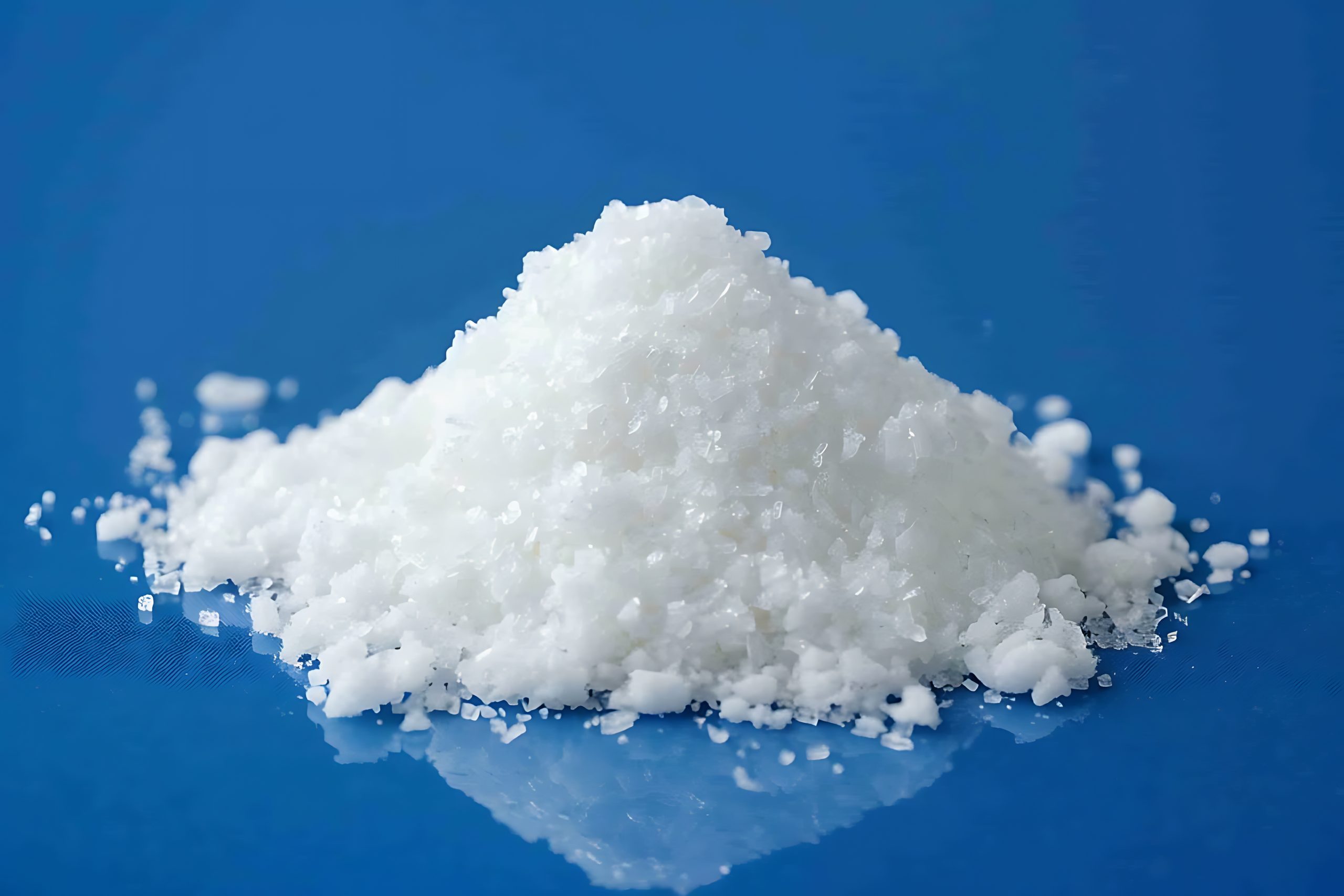
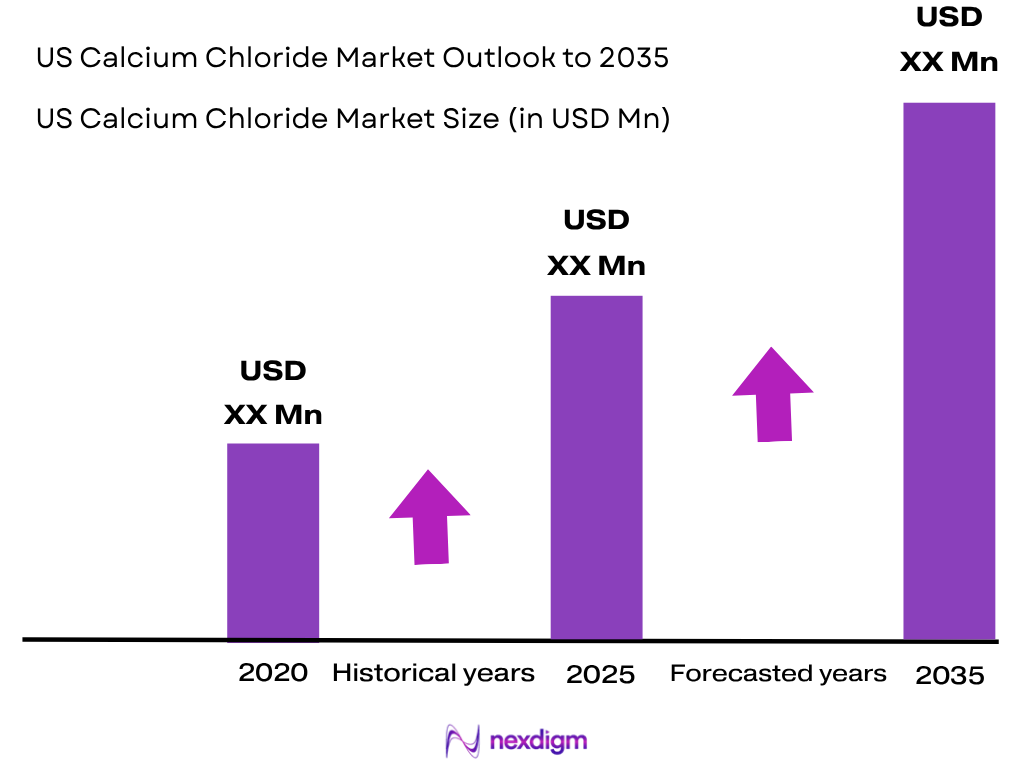
The US Calcium Chloride Market is valued at approximately ~USD XX billion, with demand supported by winter road maintenance, oil and gas drilling, dust suppression, concrete acceleration, industrial processing, food manufacturing, water treatment and refrigeration applications. The US energy and industrial base provides a substantial downstream demand platform. EIA reported US crude oil production at 13.2 million barrels per day in 2024, compared with 12.9 million barrels per day in 2023, while dry natural gas production reached 37.72 trillion cubic feet in 2024 versus 37.65 trillion cubic feet in 2023.
Texas, New Mexico, the Gulf Coast, Midwest and Northeast represent important calcium chloride demand centers because of oilfield activity, chemical manufacturing, winter deicing and infrastructure maintenance. The Permian region produced 6.3 million barrels of crude oil per day in 2024, while US producing oil and gas wells numbered 918,481. The Midwest and Northeast generate substantial seasonal deicing requirements, while Gulf Coast industrial clusters support oilfield, chemical, water-treatment and industrial applications. These geographically diverse demand bases reduce reliance on a single end-use industry.
Market Segmentation
By Product Form
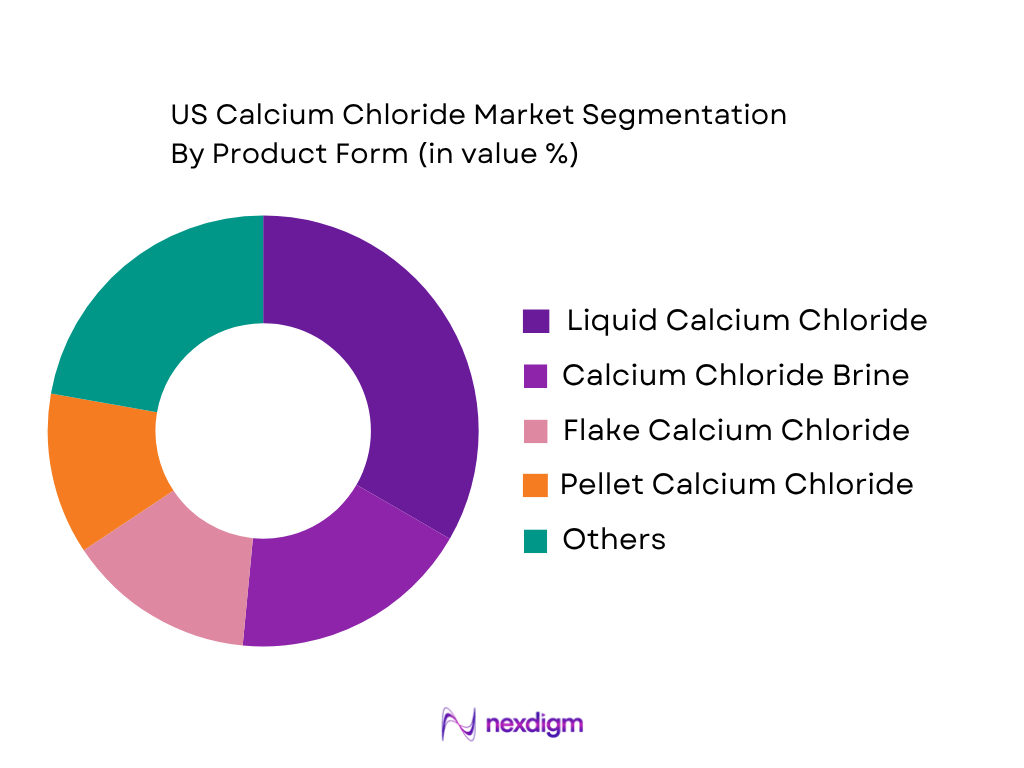
The US Calcium Chloride Market is segmented by product form into liquid calcium chloride, calcium chloride brine, flakes, pellets, granules, briquettes, anhydrous calcium chloride and powdered calcium chloride. Liquid calcium chloride and calcium chloride brine represent the leading application-oriented forms because they can be directly applied in anti-icing, deicing, dust suppression, road stabilization and industrial processes without requiring dissolution before use. Their relevance is particularly strong for transportation agencies and contractors seeking rapid chemical application during winter-weather events. Liquid formulations also support controlled dosing and pre-wetting of conventional road salt, while concentrated brines are used where application equipment is designed for bulk liquid treatment. Solid products remain important because they offer convenient storage, transportation and controlled dosing for oilfield, concrete, food and industrial customers. Product-form selection is therefore closely connected to application requirements, concentration, logistics and dispensing systems. The diversity of physical forms enables suppliers to address municipal, industrial and commercial requirements through application-specific formulations.
By Application
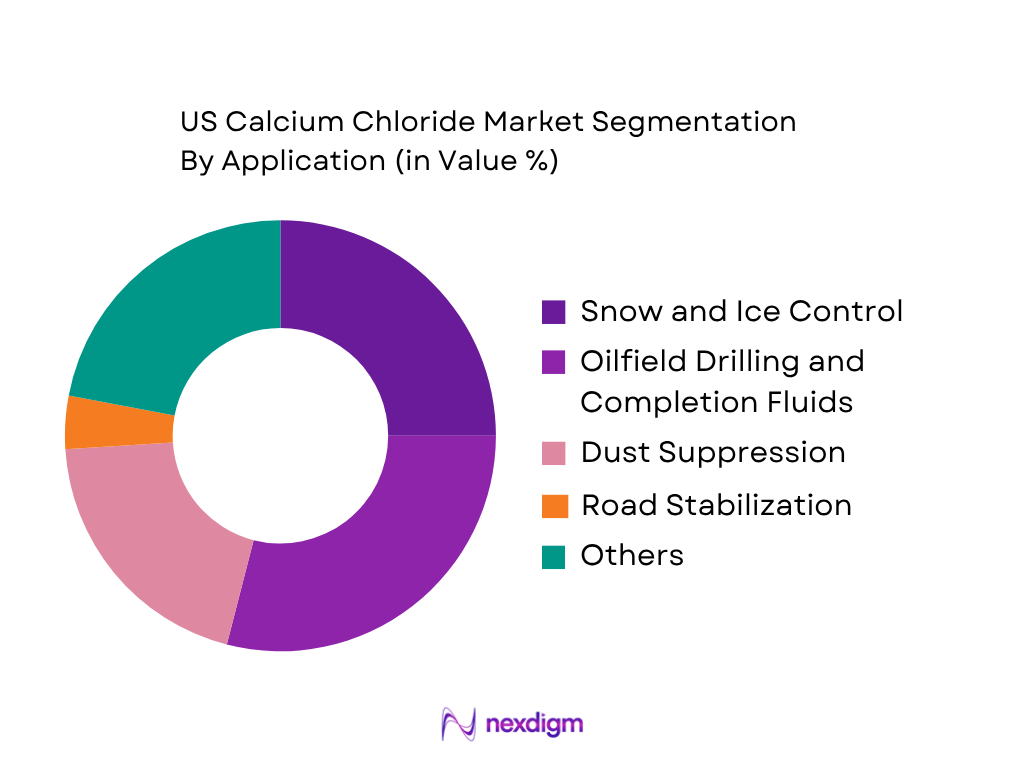
The US Calcium Chloride Market is segmented by application into snow and ice control, oilfield drilling and completion fluids, dust suppression, road stabilization, concrete acceleration, water treatment, food processing, refrigeration brine, industrial processing, agriculture and other applications. Snow and ice control represents a major application category because calcium chloride remains useful for winter road treatment due to its ability to depress the freezing point and perform at lower temperatures than conventional sodium chloride. Federal Highway Administration documentation identifies liquid calcium chloride as a pre-wetting and anti-icing material, including applications where sodium chloride is pre-wetted with calcium chloride to improve road-treatment performance. Oilfield demand forms another major industrial outlet. EIA reported 918,481 producing US oil and natural gas wells in 2024, while US crude oil production averaged 13.2 million barrels per day. Calcium chloride is used in completion and workover brines where high-density salt solutions are required. The breadth of these applications creates diversified demand across transportation, energy, construction and industrial markets.
Competitive Landscape
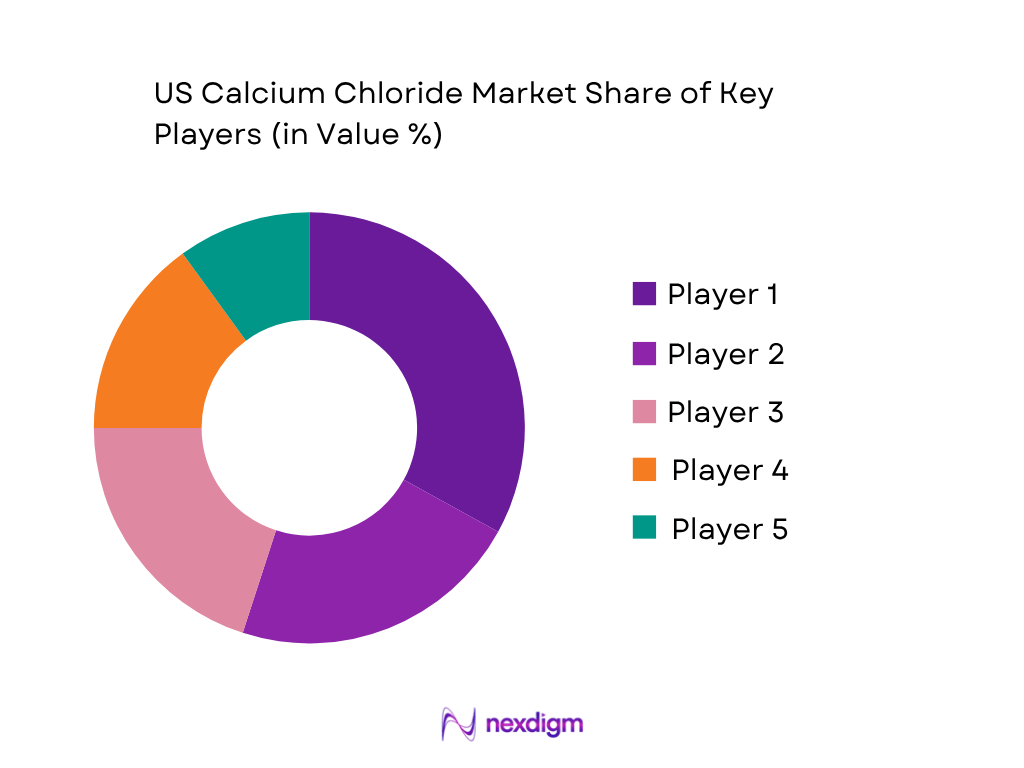
The US Calcium Chloride Market includes integrated chemical producers, brine and mineral-resource companies, specialty chemical suppliers and regional distributors. Competitive differentiation is based on domestic production capacity, access to natural brine or other feedstocks, solid and liquid product portfolios, deicing relationships, oilfield-brine capabilities, food-grade qualifications and bulk logistics. The market serves highly differentiated customers ranging from state transportation departments and municipalities to oilfield service companies, concrete producers, food processors and industrial users.
| Company | Establishment Year | Headquarters | Product Portfolio | Deicing Capability | Oilfield Brine Capability | Industrial Applications | Domestic Manufacturing | Distribution Coverage |
| Occidental Chemical Corporation | 1906 | Dallas, USA | ~ | ~ | ~ | ~ | ~ | ~ |
| TETRA Technologies | 1981 | The Woodlands, USA | ~ | ~ | ~ | ~ | ~ | ~ |
| Tiger Calcium | 1972 | Canada | ~ | ~ | ~ | ~ | ~ | ~ |
| Ward Chemical | 1970s | USA | ~ | ~ | ~ | ~ | ~ | ~ |
| Hill Brothers Chemical | 1888 | Kansas City, USA | ~ | ~ | ~ | ~ | ~ | ~ |
US Calcium Chloride Market Analysis
Growth Drivers
Winter Snow and Ice Control Requirements
The U.S. calcium chloride market continues to receive substantial demand support from winter road maintenance because calcium chloride is used as a deicer and as a component of liquid brines for anti-icing and pre-wetting operations. The scale of the addressable transportation network is large: Federal Highway Administration Highway Statistics for 2024 records approximately 8.8 million public-road lane-miles across the United States, creating a broad physical base requiring winter maintenance in snow-affected states. (Federal Highway Administration) The U.S. Geological Survey reported that domestic salt production reached approximately 40 million metric tons in 2024, while approximately 39 million metric tons were sold or used; highway deicing represented the largest single salt-consuming application, accounting for roughly 16 million metric tons when the reported consumption share is applied to total salt use. The same federal dataset identifies 64 salt-producing plants across 16 states, demonstrating the scale of the domestic deicing-material supply chain with which calcium chloride participates. (USGS Publications) Calcium chloride has specific operational relevance because it can be incorporated into liquid winter-maintenance programs where agencies need rapid ice melting, pre-wetting and lower-temperature performance. The requirement is particularly significant across northern road networks and high-traffic metropolitan corridors. For example, FHWA recorded 42,749 roadway miles in the New York–Jersey City–Newark urbanized area during 2024, while the area generated 281.852 million daily vehicle-miles of travel. Los Angeles is less relevant climatically, highlighting why calcium chloride demand is geographically concentrated rather than proportional to total national road mileage. (Federal Highway Administration) The wider economic base also supports continued public winter-maintenance capability: World Bank data place U.S. GDP at $28.75 trillion in 2024 and population at 340,110,988, indicating the scale of economic activity and mobility dependent on functioning transportation infrastructure. (World Bank Open Data) The combination of millions of road lane-miles, substantial traffic exposure and a large existing deicing-material supply chain therefore provides a direct, market-specific demand foundation for calcium chloride in U.S. winter snow and ice management.
Expansion of Oil and Gas Drilling Activity
Oilfield applications provide another important demand channel for U.S. calcium chloride, particularly because calcium chloride brines are used in drilling, completion, workover and well-control fluids where operators require controlled density and fluid properties. U.S. Energy Information Administration data show that the country produced a record 13.2 million barrels of crude oil per day in 2024, while dry natural-gas production approached 38 trillion cubic feet. Total domestic energy production exceeded 103 quadrillion British thermal units, demonstrating the exceptionally large operating base supporting demand for oilfield chemicals and brine systems. (U.S. Energy Information Administration) The installed well base is equally significant: EIA’s December 2025 report identifies 918,481 producing U.S. oil and natural-gas wells in 2024. In December 2024 alone, oil production averaged 13.4 million barrels per day, while gross natural-gas withdrawals averaged 128.8 billion cubic feet per day. (U.S. Energy Information Administration) Drilling activity remained extensive even as operators improved productivity. EIA recorded an average 599 rotary rigs operating during 2024, comprising 580 onshore rigs and 19 offshore rigs; by drilling target, 491 rigs were directed toward crude oil and 105 toward natural gas. (U.S. Energy Information Administration) Activity has remained material into 2026: EIA reported 589 operating rigs in August 2026, including 578 onshore rigs, with 452 oil-directed rigs and 128 natural-gas-directed rigs. (U.S. Energy Information Administration) This sustained upstream footprint is important for calcium chloride because drilling and completion intensity, rather than only the number of newly drilled wells, generates demand for brines used in well servicing and completion operations. The Permian Basin provides particularly strong operating support: marketed natural-gas production there averaged 25.4 billion cubic feet per day in 2024, while the region accounted for almost all incremental U.S. natural-gas production that year. (U.S. Energy Information Administration) With hundreds of thousands of producing wells, hundreds of active rigs and record hydrocarbon output, U.S. upstream operations provide a substantial recurring industrial-use base for calcium chloride.
Market Challenges
Environmental Impact of Chloride Runoff
Environmental management is a significant constraint for the U.S. calcium chloride market because calcium chloride applied to roads, parking areas and unpaved surfaces ultimately contributes chloride ions to runoff, surface water and groundwater. The issue becomes commercially relevant as winter-maintenance agencies seek to reduce total chloride loading while preserving roadway safety. The U.S. Environmental Protection Agency’s national recommended freshwater aquatic-life criteria for chloride are 860,000 micrograms per liter for acute exposure and 230,000 micrograms per liter for chronic exposure, equivalent to 860 milligrams per liter and 230 milligrams per liter, respectively. (US EPA) These numerical thresholds create an important environmental reference point for agencies and industrial users managing chloride-containing materials. The exposure base is substantial because FHWA records roughly 8.8 million public-road lane-miles in 2024, meaning chloride management occurs across one of the world’s largest transportation networks. (Federal Highway Administration) USGS’s 2025 Mineral Commodity Summary further reported approximately 39 million metric tons of salt sold or used domestically during 2024, with highway deicing representing the largest end-use category. (USGS Publications) Calcium chloride represents only part of the overall chloride load, but the scale of road-salt utilization places all chloride-based deicers under increasing scrutiny regarding application rates, storage, runoff and watershed effects. The issue is especially relevant where roads intersect densely populated urban watersheds. FHWA’s 2024 data show the New York–Jersey City–Newark urbanized area alone contained 42,749 roadway miles and carried approximately 281.852 million vehicle-miles of daily travel, illustrating the requirement to balance road safety with environmental exposure in major northern metropolitan areas. (Federal Highway Administration) At the macroeconomic level, the World Bank records a U.S. population of 340,110,988 in 2024, indicating the extensive municipal infrastructure and water-resource footprint potentially affected by chloride management. (World Bank Open Data) Consequently, environmental compliance, optimized spreading, controlled brine application and runoff management can restrict indiscriminate volume growth even where calcium chloride remains operationally effective.
Competition from Sodium Chloride and Alternative Deicers
Calcium chloride operates within a highly competitive U.S. deicing system in which sodium chloride has a deeply established domestic production, distribution and storage infrastructure. U.S. Geological Survey data show that domestic salt production reached approximately 40 million metric tons in 2024, while producers sold or used approximately 39 million metric tons. Production was spread across 64 plants in 16 states, but seven major producing states—Kansas, Louisiana, Michigan, New York, Ohio, Texas and Utah—accounted for most domestic output. (USGS Publications) This established supply structure creates a substantial competitive challenge for calcium chloride because transportation departments, municipalities and commercial applicators can source conventional salt through a mature nationwide system. USGS identifies calcium chloride as a substitute for salt in deicing and certain industrial applications, confirming that the materials compete within overlapping end-use segments rather than serving completely separate markets. (USGS Publications) The competitive issue is amplified by the enormous volume of highway material requirements: approximately 16 million metric tons of the 2024 salt consumption base can be associated with highway deicing when the USGS-reported end-use allocation is applied to total salt sold or used. Meanwhile, FHWA reports approximately 8.8 million public-road lane-miles in 2024, providing the infrastructure base across which transportation agencies must select among sodium chloride, calcium chloride, magnesium chloride, blended liquids and other winter-maintenance methods. (Federal Highway Administration) Calcium chloride therefore competes not merely on chemical performance but on availability, logistics, storage compatibility, application equipment and established procurement practices. Competition can intensify during relatively mild winters, when agencies may have less need for materials intended for difficult temperature conditions and can rely more heavily on conventional rock salt. The broader U.S. economy provides large underlying transportation demand—World Bank data report $28.75 trillion of GDP in 2024 and a population of 340.1 million—but that macroeconomic scale does not eliminate substitution risk within deicing procurement. (World Bank Open Data) For calcium chloride suppliers, growth therefore depends on demonstrating application-specific operational benefits rather than relying solely on expansion of total road-maintenance volumes.
Market Opportunities
Advanced Anti-Icing Programs
Expansion of liquid anti-icing and pre-wetting programs represents a significant forward opportunity for the U.S. calcium chloride market because transportation agencies can use calcium chloride-containing brines proactively rather than relying exclusively on solid deicers after snow and ice have bonded to pavement. The opportunity is supported by the scale of existing infrastructure rather than speculative future demand. FHWA’s 2024 Highway Statistics identify approximately 8.8 million public-road lane-miles nationwide, creating a very large installed surface base where improved winter-maintenance practices can be implemented. (Federal Highway Administration) The National Highway System alone contains extensive high-priority interstate, freeway and arterial lane mileage that must remain operational during severe winter conditions. Individual state networks demonstrate the addressable scale: Alabama recorded 207,426 lane-miles, Arizona 165,260 lane-miles, and Arkansas 203,737 lane-miles in 2024, while northern states add substantial snow-exposed networks where anti-icing is more directly applicable. (Federal Highway Administration) The opportunity is strengthened by continued infrastructure expenditure. U.S. Census Bureau construction statistics show that public highway construction reached $142.7 billion during 2024, while total public construction amounted to $492.7 billion. In December 2024, highway construction was running at a seasonally adjusted annual rate of $143.3 billion. (Census.gov) These figures indicate continued government investment in transportation assets where winter-maintenance technologies can be integrated into broader asset-management programs. Calcium chloride can benefit as agencies expand calibrated liquid application, automated spreading, pavement-temperature monitoring and pre-treatment strategies designed to improve material placement and reduce unnecessary chloride loading. This is particularly relevant given EPA’s chloride aquatic-life benchmarks of 230 milligrams per liter for chronic exposure and 860 milligrams per liter for acute exposure, which increase the operational value of controlled application rather than excessive spreading. (US EPA) World Bank data place the 2024 U.S. economy at $28.75 trillion, supporting a substantial fiscal and commercial base for transportation operations. (World Bank Open Data) The opportunity for calcium chloride is therefore not simply higher deicer consumption; it is greater penetration of technically managed liquid anti-icing programs across a massive existing roadway system.
Oilfield Heavy Brine Applications
Heavy and specialty brine applications provide a strong expansion pathway for U.S. calcium chloride because the domestic oil and gas industry combines a very large producing-well inventory with continuing drilling and completion activity. Calcium chloride brines can be used in completion, workover and drilling-fluid systems, positioning suppliers to benefit from activity per well as well as new drilling. EIA records 918,481 producing oil and natural-gas wells in the United States during 2024, providing an unusually large installed base requiring ongoing servicing, intervention and production-support operations. (U.S. Energy Information Administration) Domestic crude-oil production reached a record 13.2 million barrels per day in 2024, while dry natural-gas output approached 38 trillion cubic feet and total U.S. energy production exceeded 103 quadrillion British thermal units. (U.S. Energy Information Administration) The drilling base also remains substantial. EIA recorded an average 599 rotary rigs during 2024, including 491 oil-directed rigs, 105 natural-gas-directed rigs, 580 onshore rigs and 19 offshore rigs. (U.S. Energy Information Administration) Current operating data indicate that the upstream activity platform remains large: in August 2026, the United States had 589 rotary rigs, of which 578 were onshore, 452 were drilling for crude oil, and 128 were targeting natural gas. (U.S. Energy Information Administration) Regional concentration strengthens the opportunity for specialized calcium chloride supply and logistics around major producing basins. The Permian region averaged 25.4 billion cubic feet per day of marketed natural-gas production in 2024, while Haynesville production averaged 14.6 billion cubic feet per day; Haynesville wells typically extend to depths of 10,500–13,500 feet, compared with approximately 4,000–8,500 feet for Marcellus wells, illustrating the technically demanding environments in which engineered fluid systems are required. (U.S. Energy Information Administration) U.S. oil and gas extraction also supported 123,200 workers in 2024, according to federal labor-productivity statistics, demonstrating the industrial scale behind upstream operations. (bls.gov) These current operating indicators support future calcium chloride growth through higher-value brine formulations, completion-fluid supply and recurring well-servicing demand rather than dependence solely on additional rig deployment.
Future Outlook
Over the next decade, the US Calcium Chloride Market is expected to develop through continued requirements for winter road maintenance, oilfield completion fluids, dust control and industrial applications. Increasing use of liquid anti-icing systems can support demand for concentrated calcium chloride solutions. Oil and gas activity remains an important industrial demand source, while construction, food processing, water treatment and refrigeration provide additional applications. Product differentiation around concentration, purity, physical form and application performance is expected to remain important for suppliers.
Major Players
- Occidental Chemical Corporation
- TETRA Technologies, Inc.
- Solvay S.A.
- Tiger Calcium
- Ward Chemical
- Nedmag B.V.
- Zirax Limited
- Hill Brothers Chemical Company
- Keg River Chemical
- Weifang Taize Chemical Industry Co., Ltd.
- Weifang Haibin Chemical Co., Ltd.
- Tangshan Sanyou Chemical Industries Co., Ltd.
- Shandong Haihua Group
- GEO Specialty Chemicals
- South Eastern Road Treatment
Key Target Audience
- Calcium Chloride Manufacturers and Chemical Producers
- State Departments of Transportation and Municipal Winter Maintenance Authorities
- Oilfield Service Companies and Drilling Contractors
- Concrete Producers and Road Construction Contractors
- Water Treatment and Industrial Chemical Companies
- Investments and Venture Capitalist Firms
- Government and Regulatory Bodies (Federal Highway Administration, Environmental Protection Agency, Food and Drug Administration, Occupational Safety and Health Administration)
- Industrial Chemical Distributors and Bulk Logistics Companies
Research Methodology
Step 1: Identification of Key Variables
The initial phase involves constructing a comprehensive ecosystem map covering calcium chloride manufacturers, brine producers, chemical distributors, transportation agencies, oilfield service companies, concrete producers and industrial users. Key variables include product form, concentration, production route, application, end-use industry, regional demand, domestic production, imports and distribution infrastructure.
Step 2: Market Analysis and Construction
This phase compiles and analyzes historical information covering calcium chloride production, consumption, imports, exports and application-level demand. Transportation activity, oil and gas production, drilling activity, construction requirements, winter-weather treatment practices and industrial applications are evaluated to establish relationships between calcium chloride supply and downstream consumption.
Step 3: Hypothesis Validation and Expert Consultation
Market hypotheses are validated through discussions with calcium chloride producers, distributors, oilfield service companies, transportation contractors and industrial users. Interviews focus on product specifications, concentration preferences, procurement cycles, application requirements, domestic-versus-imported supply, storage requirements and customer qualification processes.
Step 4: Research Synthesis and Final Output
The final phase integrates supply-side, demand-side, trade and competitive information into the US Calcium Chloride Market assessment. Top-down industry indicators are reconciled with bottom-up application analysis, while producer and end-user inputs are used to validate segmentation, competitive positioning and future demand requirements.

- Executive Summary
- Research Methodology (Market Definition and Scope, US Calcium Chloride Market Classification, Calcium Chloride Production Route Assessment, Natural Brine Recovery Analysis, Hydrochloric Acid and Limestone Production Route Assessment, Solid and Liquid Calcium Chloride Supply Mapping, Deicing Demand Assessment, Oilfield Brine Requirement Analysis, Dust Control and Road Stabilization Assessment, Concrete Acceleration Application Analysis, Food Grade Calcium Chloride Demand Assessment, Industrial Water Treatment Application Assessment, Refrigeration and Brine System Assessment, Domestic Production Capacity Assessment, Import Dependency Analysis, Primary Industry Interviews, Data Triangulation, Forecasting Framework, Limitations and Future Conclusions)

- Definition and Scope
- US Calcium Chloride Industry Evolution
- US Calcium Chloride Value Chain Analysis
- US Calcium Chloride Supply Chain Analysis

- Growth Drivers (Winter Snow and Ice Control Requirements, Expansion of Oil and Gas Drilling Activity, Highway and Road Infrastructure Maintenance, Growing Dust Suppression Requirements, Concrete and Cement Application Demand, Food Processing Consumption, Industrial Water Treatment Demand, Refrigeration and Brine Applications)
- Market Challenges (Environmental Impact of Chloride Runoff, Competition from Sodium Chloride and Magnesium Chloride, Seasonal Deicing Demand Volatility, Production Concentration, Transportation and Storage Requirements, Corrosion Concerns, Energy Requirements for Processing, Regulatory Requirements for Industrial and Environmental Management)
- Market Opportunities (Advanced Anti-Icing Programs, Oilfield Heavy Brine Applications, Dust Control and Road Stabilization, Food Grade Calcium Chloride Expansion, Industrial Water Treatment, Concrete Performance Applications, Mining and Mineral Processing, Refrigeration and Thermal Storage Applications)
- Market Trends (Pre-Wetting and Anti-Icing Adoption, Liquid Brine Application, High-Purity Calcium Chloride Demand, Automated Road Treatment, Precision Deicing, Dust Suppression Solutions, Oilfield Brine Optimization, Food Grade Product Development, Sustainable Road Maintenance, Calcium Chloride Blending and Customized Concentrations)
- Government Regulations and Standards (Federal Highway Administration Requirements, State Department of Transportation Specifications, Environmental Protection Agency Stormwater Requirements, Food and Drug Administration Food Grade Requirements, NSF Drinking Water Treatment Standards, Occupational Safety and Health Administration Chemical Handling Requirements, ASTM Calcium Chloride Standards, State Chloride Management Requirements)
- SWOT Analysis
- Porter’s Five Forces Analysis
- PESTLE Analysis
- Stakeholder Ecosystem
- Competition Ecosystem

- By Market Value (2020-2025)
- By Calcium Chloride Consumption Volume (2020-2025)
- By Solid Calcium Chloride Consumption Volume (2020-2025)
- By Liquid Calcium Chloride Consumption Volume (2020-2025)
- By Calcium Chloride Brine Consumption Volume (2020-2025)

- By Product Form (In Value %)
Liquid Calcium Chloride
Calcium Chloride Brine
Flake Calcium Chloride
Pellet Calcium Chloride
Granulated Calcium Chloride
Briquette Calcium Chloride
Anhydrous Calcium Chloride
Powdered Calcium Chloride - By Concentration and Grade (In Value %)
Calcium Chloride 30–35% Solution
Calcium Chloride 35–40% Solution
Calcium Chloride 70–75% Solid
Calcium Chloride 77–80% Solid
Calcium Chloride 83–87% Solid
Calcium Chloride 94–97% Anhydrous Grade
Food Grade Calcium Chloride
Technical Grade Calcium Chloride
Industrial Grade Calcium Chloride - By Application (In Value %)
Snow and Ice Control
Road Deicing and Anti-Icing
Dust Suppression
Road Base Stabilization
Oilfield Drilling Fluids
Completion and Workover Fluids
Pipeline Hydrotesting
Concrete Acceleration
Cement and Construction Applications
Water Treatment
Industrial Processing
Refrigeration Brine
Food Processing
Agricultural Applications
Tire Ballasting
Pool and Spa Treatment - By End-Use Industry (In Value %)
Winter Road Maintenance
Oil and Gas
Construction
Mining
Transportation Infrastructure
Food and Beverage
Water Treatment
Chemical Processing
Agriculture
Refrigeration and Cold Storage
Pulp and Paper
Pharmaceuticals
Pool and Spa
Industrial Manufacturing - By Raw Material and Production Route (In Value %)
Natural Brine Recovery
Hydrochloric Acid and Limestone Route
Chlor-alkali By-Product Recovery
Natural Brine Concentration
Industrial Brine Recovery
Integrated Chemical Manufacturing - By Customer Type (In Value %)
State Departments of Transportation
Municipalities
County Road Authorities
Oilfield Service Companies
Drilling Contractors
Concrete Producers
Water Treatment Companies
Food Processors
Industrial Chemical Distributors
Mining Companies
Agricultural Operators
Industrial Manufacturers - By Region (In Value %)
Northeast USA
Midwest USA
South USA
West USA
Great Lakes Region
Gulf Coast Region
Rocky Mountain Region
Pacific Region

- Market Share of Major Players (By US Revenue, Calcium Chloride Sales Volume, Solid Product Sales Volume, Liquid Product Sales Volume, Deicing Sales Exposure, Oilfield Brine Exposure, Domestic Manufacturing Footprint, Distribution Network Coverage)
- Cross Comparison Parameters (US Calcium Chloride Revenue, Product Form and Concentration Portfolio Breadth, Domestic Production Capacity, Natural Brine and Raw Material Access, Deicing and Winter Maintenance Coverage, Oilfield Heavy Brine Capability, Food Grade and High-Purity Product Capability, Distribution and Bulk Logistics Network)
- SWOT Analysis of Major Players
- Detailed Profiles of Major Companies
Occidental Chemical Corporation (OxyChem)
TETRA Technologies, Inc.
Solvay S.A.
Tiger Calcium
Ward Chemical
Nedmag B.V.
Zirax Limited
Hill Brothers Chemical Company
Keg River Chemical
Weifang Taize Chemical Industry Co., Ltd.
Weifang Haibin Chemical Co., Ltd.
Tangshan Sanyou Chemical Industries Co., Ltd.
Shandong Haihua Group
GEO Specialty Chemicals
South Eastern Road Treatment

- State Department of Transportation Calcium Chloride Procurement Assessment
- Municipal Winter Maintenance Calcium Chloride Demand Analysis
- Oilfield Service Company Calcium Chloride Brine Requirement Assessment
- Drilling Contractor Calcium Chloride Fluid Requirement Analysis
- Concrete Producer Calcium Chloride Accelerator Demand Assessment
- Road Construction Contractor Dust Control Requirement Analysis

- By Market Value (2026-2035)
- By Calcium Chloride Consumption Volume (2026-2035)
- By Solid Calcium Chloride Consumption Volume (2026-2035)
- By Liquid Calcium Chloride Consumption Volume (2026-2035)
- By Calcium Chloride Brine Consumption Volume (2026-2035)


 Request a Sample
 Ask for Customization
 Get a Quote
 Enquire Now