
 Download PDF
 Download PDF
Market Overview
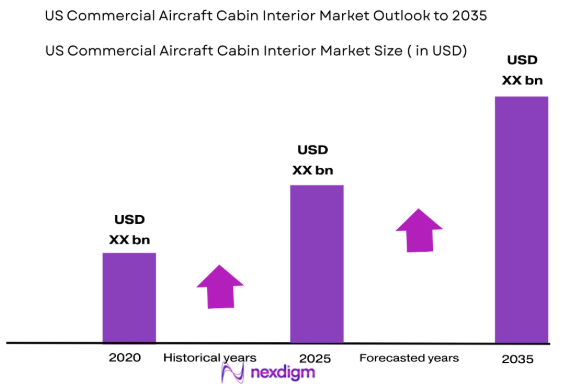
The US Commercial Aircraft Cabin Interior Market is valued at USD ~ billion based on a recent historical assessment. Growth in this market is driven by increasing demand for enhanced passenger comfort, safety standards, and innovations in cabin technologies. As airlines invest heavily in modernizing aircraft interiors, factors such as improved seat designs, advanced lighting, and connectivity systems are contributing to the expansion. Regulatory standards and environmental concerns also play significant roles in shaping product development and operational strategies within this market.
The market is dominated by key players based in regions with high air traffic, such as the United States and Europe. The US, in particular, has a major share due to its significant aircraft manufacturing hubs and the presence of leading airlines that consistently upgrade their fleets. Other countries contributing heavily to the demand include China and Japan, driven by their expanding commercial aviation sectors and high volume of domestic and international flights. These countries remain dominant due to the growing emphasis on enhancing the passenger experience and integrating state-of-the-art technologies into cabin designs.
Market Segmentation
By Product Type
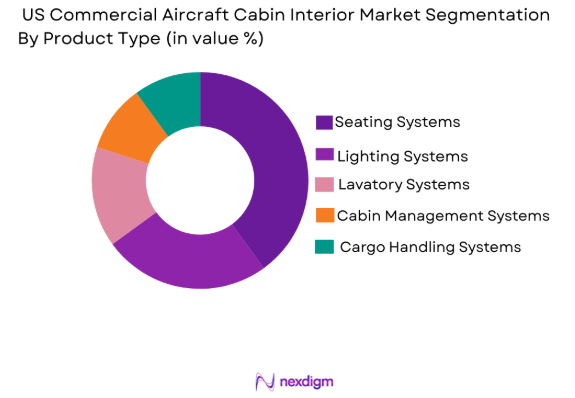
The US Commercial Aircraft Cabin Interior market is segmented by product type into seating systems, lighting systems, lavatory systems, cabin management systems, and cargo handling systems. Recently, seating systems have dominated the market share due to factors such as rising passenger demand for comfort and safety, regulatory requirements for seat configurations, and the continual innovation in seat design. Airlines are increasingly opting for customizable and ergonomic seating solutions to enhance passenger experience, while the growth of low-cost carriers also accelerates the demand for efficient and space-saving seating solutions. Furthermore, the integration of advanced materials and smart technologies in seating systems is a major contributor to their market dominance, making them an essential element in cabin interior upgrades.
By Platform Type
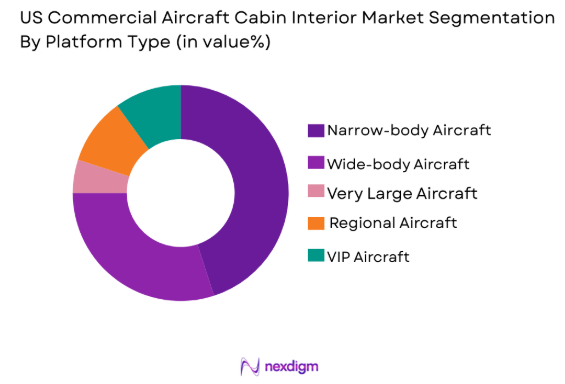
The market is segmented by platform type into narrow-body aircraft, wide-body aircraft, very large aircraft, regional aircraft, and VIP aircraft. Narrow-body aircraft have the largest market share in the US Commercial Aircraft Cabin Interior market. This dominance is driven by the high number of narrow-body aircraft used for short to medium-haul routes, primarily by low-cost and major airlines. The increased demand for these aircraft is attributed to their cost-efficiency, versatility, and the rising number of passengers flying on domestic and regional routes. Airlines are focusing on maximizing space and comfort in narrow-body aircraft to accommodate the growing number of travelers, making this platform type a key driver in the overall market.
Competitive Landscape
The US Commercial Aircraft Cabin Interior market is characterized by a highly competitive environment with several established players dominating the sector. These companies continuously innovate in response to evolving customer needs, regulatory demands, and the increasing focus on sustainability. The influence of major players such as B/E Aerospace, Collins Aerospace, and Zodiac Aerospace is significant, contributing to ongoing market consolidation. Smaller players are also leveraging niche technologies and unique product offerings to maintain a competitive edge, focusing on specific aspects such as customization and eco-friendly solutions.
|
Company Name |
Establishment Year | Headquarters | Technology Focus | Market Reach | Key Products | Revenue (USD) | Product Innovation |
| B/E Aerospace | 1987 | USA | ~ | ~ | ~ | ~ | ~ |
| Collins Aerospace | 2018 | USA | ~ | ~ | ~ | ~ | ~ |
| Zodiac Aerospace | 1896 | France | ~ | ~ | ~ | ~ | ~ |
| Safran | 2005 | France | ~ | ~ | ~ | ~ | ~ |
| Thales Group | 2000 | France | ~ | ~ | ~ | ~ | ~ |
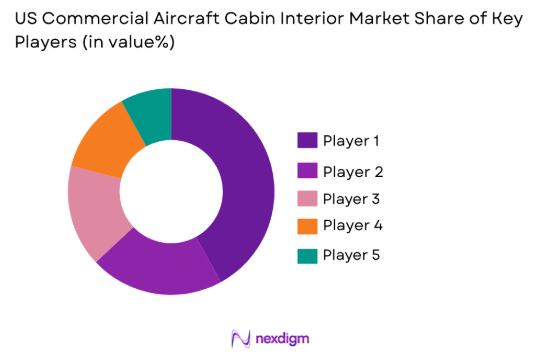
US Commercial Aircraft Cabin Interior Market Analysis
Growth Drivers
Technological Advancements in Passenger Comfort
Technological advancements in seating, lighting, and entertainment systems are among the key drivers of growth in the US Commercial Aircraft Cabin Interior market. The demand for increased passenger comfort has resulted in airlines incorporating more ergonomic seating, customizable layouts, and high-tech entertainment systems. Innovations such as mood lighting, in-flight connectivity, and enhanced noise reduction have significantly improved the travel experience. These advancements also align with evolving passenger preferences for luxury and personalized services during flights, boosting demand for advanced cabin systems. Additionally, as airlines compete for customer loyalty, investment in passenger comfort has become a priority. Furthermore, the increasing use of lightweight, durable materials in cabin interiors has allowed airlines to offer more spacious and efficient designs, leading to higher passenger satisfaction and more efficient operations.
Regulatory Standards Driving Innovation
The evolving regulatory landscape in the aviation sector also plays a significant role in driving innovation in the commercial aircraft cabin interior market. Regulatory bodies such as the FAA and EASA have strict standards governing cabin safety, including fire resistance of materials, seating configurations, and evacuation procedures. These standards push manufacturers to develop new technologies and materials to meet these requirements while enhancing the overall passenger experience. As airlines continue to update and modernize their fleets to comply with these regulations, the demand for advanced cabin interiors is expected to grow. Regulatory incentives, such as those promoting environmentally friendly materials and fuel-efficient cabin systems, further encourage the development of sustainable solutions. As a result, regulatory compliance is not only a market driver but also a key factor influencing product development and innovation.
Market Challenges
High Cost of Aircraft Interior Upgrades
One of the most significant challenges facing the US Commercial Aircraft Cabin Interior market is the high cost of upgrading or retrofitting aircraft interiors. Airlines are constantly looking for ways to improve the passenger experience, but the financial burden of upgrading existing fleets can be considerable. The cost of replacing seats, installing new lighting systems, or integrating advanced cabin management systems often requires substantial capital investment. For smaller carriers or those with older fleets, these upgrades can be prohibitively expensive, making it difficult to remain competitive in an increasingly customer-driven market. Additionally, the need for compliance with complex safety and environmental regulations adds to the financial strain. As a result, balancing the cost of upgrades with the desire for improved passenger experiences remains a key challenge for industry players.
Supply Chain Disruptions and Material Shortages
Another challenge in the US Commercial Aircraft Cabin Interior market is the ongoing supply chain disruptions and material shortages. The aviation industry has faced significant supply chain challenges in recent years, exacerbated by global events such as the COVID-19 pandemic and geopolitical tensions. The limited availability of essential materials, such as lightweight composites and high-grade textiles, has delayed the production and delivery of cabin interior components. Additionally, fluctuating raw material prices and transportation delays can increase manufacturing costs and lead to extended lead times for airlines seeking to retrofit their aircraft. These disruptions create uncertainty and hinder the ability of manufacturers and suppliers to meet the growing demand for cabin interior systems, limiting market growth potential.
Opportunities
Integration of Sustainable Materials
One of the most promising opportunities in the US Commercial Aircraft Cabin Interior market is the increasing demand for sustainable materials. Airlines, driven by both regulatory pressure and consumer demand, are increasingly opting for eco-friendly and recyclable materials for their cabin interiors. These materials not only help airlines reduce their environmental footprint but also align with broader industry trends toward sustainability. Manufacturers are responding by developing new materials that are both lightweight and durable, such as bio-based composites and recycled textiles. As airlines seek to meet sustainability targets and appeal to environmentally conscious passengers, the adoption of sustainable materials presents a significant growth opportunity for the cabin interior market.
Growing Demand for Customizable Cabin Solutions
The growing demand for personalized and customizable cabin solutions is another major opportunity in the US Commercial Aircraft Cabin Interior market. As airlines focus on enhancing the passenger experience, they are turning to customizable seating, lighting, and entertainment options that can be tailored to specific customer preferences. This trend is particularly prominent in premium cabin segments, where passengers are increasingly seeking luxury and unique experiences during flights. With the rise of boutique airlines and the increasing number of wealthy travelers, airlines are offering more bespoke cabin experiences. This shift towards customization presents opportunities for manufacturers to develop more flexible and modular cabin interior systems that can be easily adapted to various airline needs, contributing to market expansion.
Future Outlook
The future outlook for the US Commercial Aircraft Cabin Interior market is optimistic, driven by technological advancements, sustainability initiatives, and growing demand for passenger-centric innovations. Over the next five years, the market is expected to witness significant growth in areas such as in-flight connectivity, personalized cabin designs, and eco-friendly materials. Regulatory support for sustainability and passenger comfort will further fuel innovation, making the market ripe for both established players and new entrants. The expansion of low-cost carriers and increasing air travel volumes will also provide ample opportunities for manufacturers to innovate and scale their solutions.
Major Players
- B/E Aerospace
- Collins Aerospace
- Zodiac Aerospace
- Safran
- Thales Group
- Recaro Aircraft Seating
- GKN Aerospace
- Diehl Aviation
- Aviointeriors
- KLM Equipment Services
- Aircraft Interiors Expo
- Magellan Aerospace
- Optimares
- Aerospace Manufacturing Group
- JAMCO Corporation
Key Target Audience
- Investments and venture capitalist firms
- Government and regulatory bodies
- Airlines and aviation companies
- Aircraftmanufacturers
- Aircraftinterior system suppliers
- Maintenance, repair, and overhaul (MRO) service providers
- Aircraftleasing companies
- Environmental regulatory agency
Research Methodology
Step 1: Identification of Key Variables
The first step involves identifying critical variables influencing the commercial aircraft cabin interior market, including technological trends, regulatory standards, and consumer demand.
Step 2: Market Analysis and Construction
Detailed market analysis is performed to construct a comprehensive view of current market conditions, key drivers, and challenges affecting the industry.
Step 3: Hypothesis Validation and Expert Consultation
Experts within the aviation and manufacturing sectors are consulted to validate hypotheses and refine market insights, ensuring accuracy and relevance.
Step 4: Research Synthesis and Final Output
The final step involves synthesizing all gathered data into a cohesive report, presenting actionable insights for stakeholders in the commercial aircraft cabin interior market.

- Executive Summary
- Research Methodology (Definitions, Scope, Industry Assumptions, Market Sizing Approach, Primary & Secondary Research Framework, Data Collection & Verification Protocol, Analytic Models & Forecast Methodology, Limitations & Research Validity Checks)

- Market Definition and Scope
- Value Chain & Stakeholder Ecosystem
- Regulatory / Certification Landscape
- Sector Dynamics Affecting Demand
- Strategic Initiatives & Infrastructure Growth

- Growth Drivers
Increasing demand for passenger comfort and experience
Technological advancements in materials and cabin systems
Growing investments in airline fleet modernization
Rising air passenger traffic
Improvement in aircraft design and fuel efficiency - Market Challenges
High installation and retrofitting costs
Stringent regulatory and certification standards
Supply chain disruptions and material shortages
Balancing innovation with cost efficiency
Safety and compliance challenges - Market Opportunities
Adoption of environmentally friendly materials in cabin interiors
Emerging demand for in-flight connectivity and entertainment systems
Integration of smart technologies in cabin management systems - Trends
Growth in demand for premium cabin configurations
Increased focus on eco-friendly and sustainable cabin interiors
Customization of aircraft interiors based on consumer preferences
Rise in demand for healthier and cleaner cabin environments
Technological innovation driving connected cabin solutions - Government Regulations & Defense Policy
FAA regulations on cabin safety standards
Environmental regulations concerning cabin materials
Government incentives for energy-efficient cabin technologies

- By Market Value, 2020-2025
- By Installed Units, 2020-2025
- By Average System Price, 2020-2025
- By System Complexity Tier, 2020-2025

- By System Type (In Value%)
Seating Systems
Lighting Systems
Lavatory Systems
Cabin Management Systems
Cargo Handling Systems - By Platform Type (In Value%)
Narrow-body Aircraft
Wide-body Aircraft
Very Large Aircraft
Regional Aircraft
VIP Aircraft - By Fitment Type (In Value%)
Line-fit Solutions
Retrofit Solutions
Modular Solutions
Integrated Solutions
Customized Solutions - By EndUser Segment (In Value%)
Commercial Airlines
Aircraft Manufacturers
Maintenance, Repair, and Overhaul (MRO) Providers
Private Aircraft Operators
Government and Military Agencies - By Procurement Channel (In Value%)
Direct Procurement
Aircraft Manufacturers
MRO Contracts
Government Tenders
Online Bidding Platforms - By Material / Technology (In Value%)
Composite Materials
Aluminum Alloys
Textile Materials
Thermoplastics
Electronic Systems

- Market structure and competitive positioning
- Market share snapshot of major players
- Cross Comparison Parameters (System Type, Platform Type, Procurement Channel, End User Segment, Fitment Type, Material/Technology, Installed Units, Average System Price)
- SWOT Analysis of Key Competitors
- Pricing & Procurement Analysis
- Porter’s Five Forces
- Key Players
B/E Aerospace
Collins Aerospace
Zodiac Aerospace
Safran
Thales Group
Recaro Aircraft Seating
GKN Aerospace
Diehl Aviation
Aviointeriors
KLM Equipment Services
Aircraft Interiors Expo
Magellan Aerospace
Optimares
Aerospace Manufacturing Group
JAMCO Corporation

- Commercial airlines focusing on luxury cabin designs
- Aircraft manufacturers shifting toward modular interior solutions
- MRO providers adapting to new technologies for retrofits
- Private aircraft operators seeking customized interiors

- Forecast Market Value, 2026-2035
- Forecast Installed Units, 2026-2035
- Price Forecast by System Tier, 2026-2035
- Future Demand by Platform, 2026-2035


 Request a Sample
 Ask for Customization
 Get a Quote
 Enquire Now