
 Download PDF
Market Overview
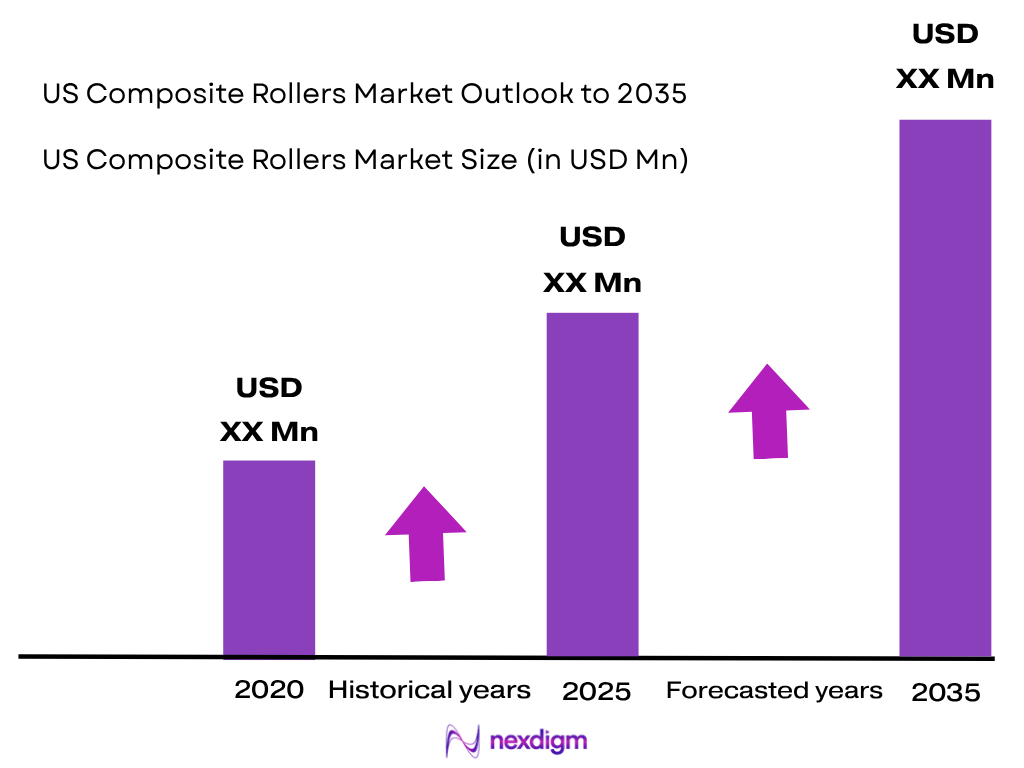
The US Composite Rollers Market is valued at approximately USD ~XX million in 2024 and is projected to grow at a CAGR of ~XX% during 2026-2035. The market growth is supported by increasing adoption of lightweight composite materials in industrial manufacturing, printing, packaging, battery production, textiles, and converting applications. Demand is driven by the replacement of conventional steel rollers with carbon fiber and fiberglass composite rollers due to reduced weight, improved corrosion resistance, lower inertia, and enhanced operational efficiency in high-speed production environments.
The US Composite Rollers Market is primarily concentrated across industrial hubs including the Midwest, Southeast, and West Coast regions due to the presence of advanced manufacturing facilities, aerospace production clusters, packaging industries, and converting equipment manufacturers. States such as Michigan, Ohio, Illinois, California, and North Carolina demonstrate strong demand because of their established industrial ecosystems, automotive manufacturing activities, renewable energy component production, and investments in automation technologies. The availability of composite material suppliers, engineering expertise, and specialized manufacturing capabilities supports regional dominance.
Market Segmentation
By Material Type
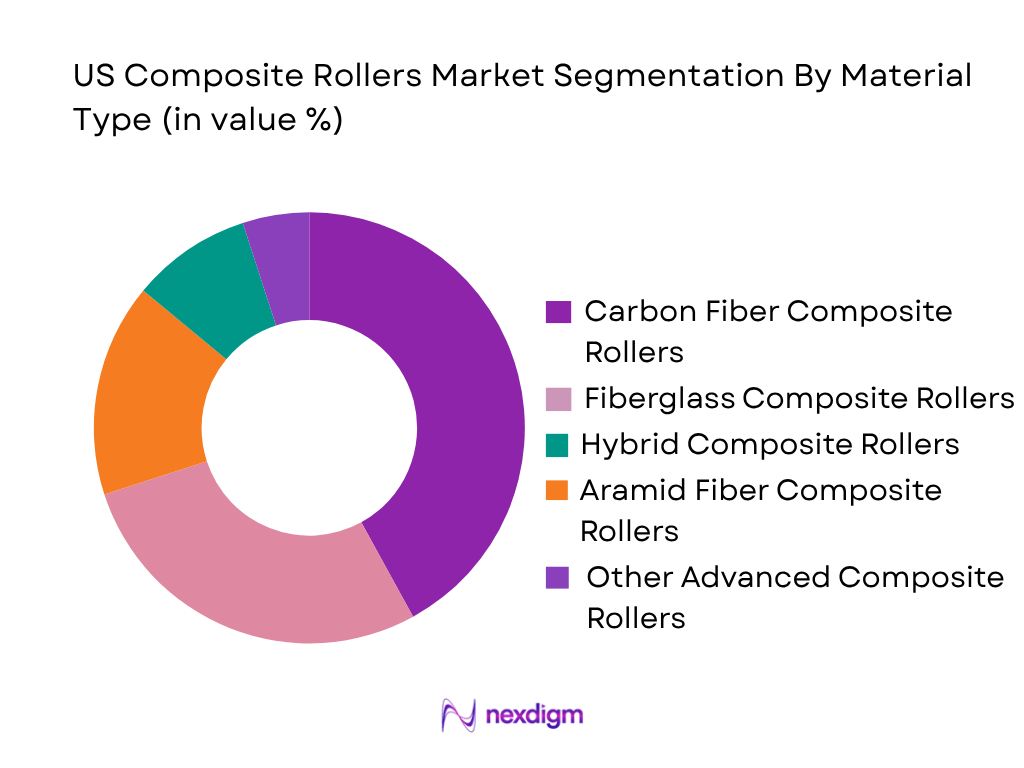
The US Composite Rollers Market is segmented by material type into carbon fiber composite rollers, fiberglass composite rollers, hybrid composite rollers, aramid fiber composite rollers, and other advanced composite rollers. Carbon fiber composite rollers represent the dominant segment with a market share of ~XX% in 2024 due to their superior strength-to-weight ratio, high stiffness, low rotational inertia, and suitability for high-speed industrial operations. Carbon fiber rollers are extensively used in printing presses, battery manufacturing lines, film processing equipment, and advanced converting applications where precision and speed are critical. Their ability to reduce machine vibration, improve energy efficiency, and support wider web handling systems has increased adoption among manufacturers seeking operational improvements. Additionally, continuous development of carbon fiber manufacturing technologies and increasing demand for lightweight industrial components are strengthening the position of carbon fiber composite rollers.
By Application
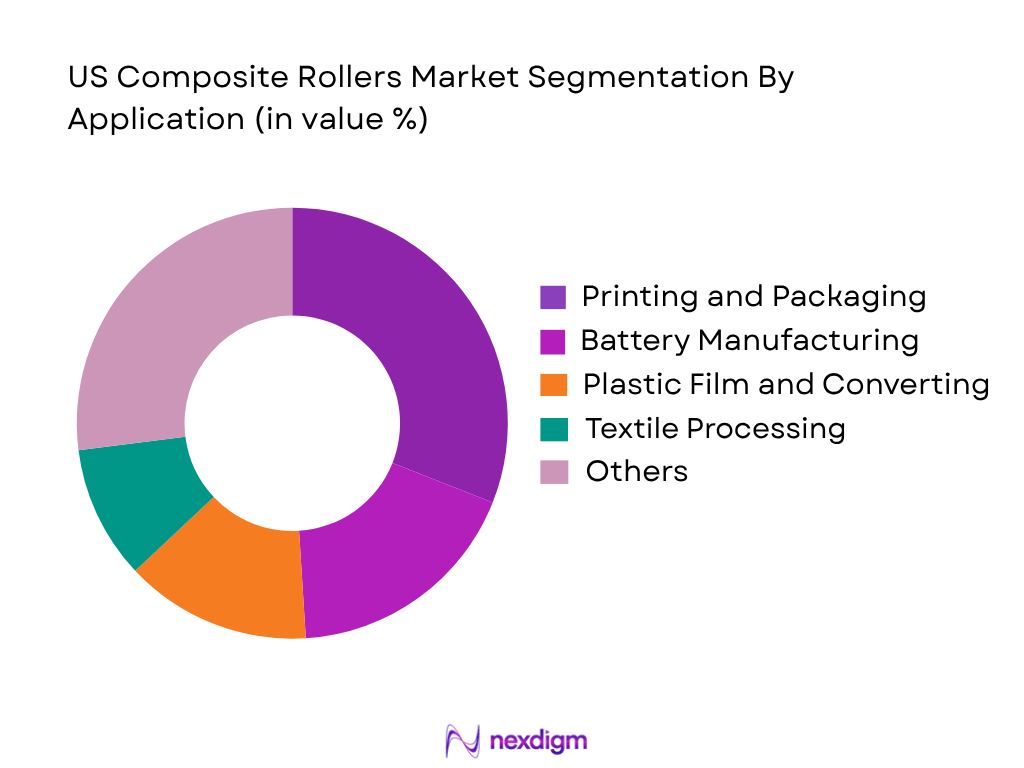
The US Composite Rollers Market is segmented by application into printing and packaging, battery manufacturing, textile processing, plastic film and converting, paper processing, food processing, semiconductor manufacturing, aerospace manufacturing, and industrial machinery applications. Printing and packaging applications represent the dominant segment with a market share of ~XX% in 2024 due to extensive usage of composite rollers in high-speed printing presses, flexible packaging lines, and converting equipment. Composite rollers are preferred in these applications because they provide dimensional stability, reduced weight, improved surface performance, and resistance against corrosion and wear. Growing demand for lightweight packaging materials, expansion of digital and industrial printing operations, and increasing automation in production facilities are supporting adoption. Furthermore, manufacturers are replacing traditional metal rollers with composite alternatives to achieve higher operating speeds, reduced maintenance requirements, and improved process efficiency.
Competitive Landscape
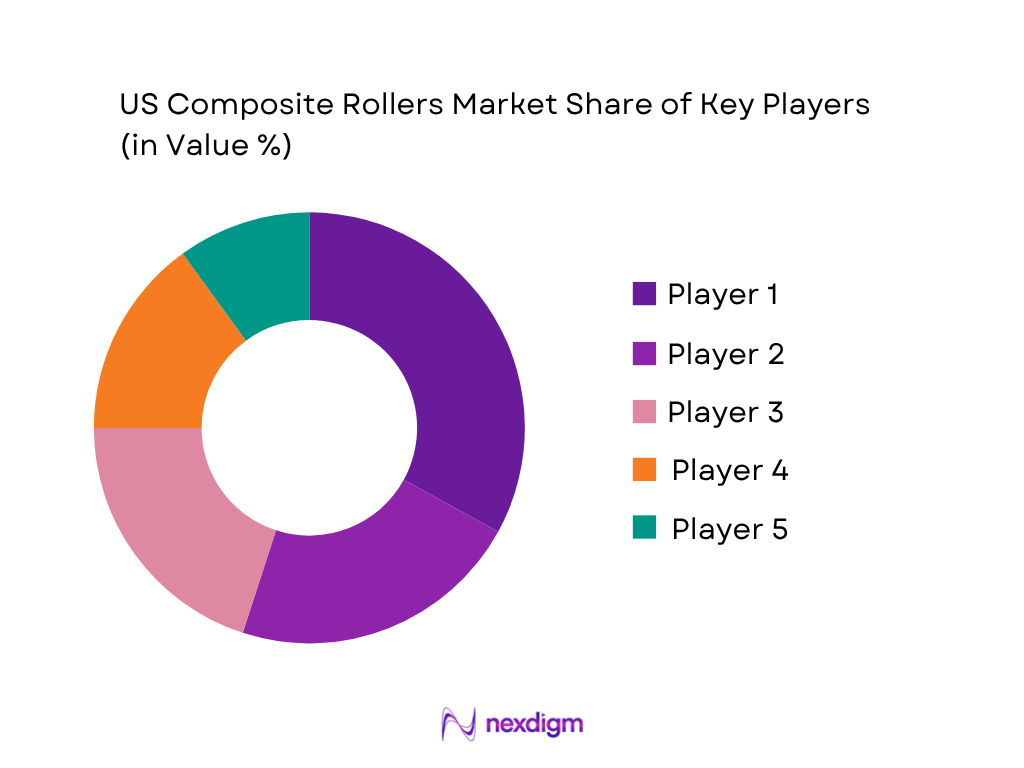
The US Composite Rollers Market is characterized by the presence of specialized composite roller manufacturers, industrial component suppliers, and advanced materials companies focusing on lightweight, high-performance rotating solutions. The competitive environment includes companies serving printing, packaging, battery manufacturing, aerospace, textile, and industrial automation industries. Major players differentiate themselves through carbon fiber manufacturing capabilities, customized roller engineering, surface treatment technologies, precision balancing capabilities, and application-specific solutions designed for high-speed production environments.
| Company | Establishment Year | Headquarters | Composite Roller Portfolio | Core Material Expertise | Key Application Areas | Manufacturing Capability | Customization Capability | Industry Focus |
| Double E Company | 1960 | West Bridgewater, USA | ~ | ~ | ~ | ~ | ~ | ~ |
| Maxcess | 2008 | Oklahoma City, USA | ~ | ~ | ~ | ~ | ~ | ~ |
| American Roller Company | 1930 | Union Grove, USA | ~ | ~ | ~ | ~ | ~ | ~ |
| PFE Technologies | 1995 | Minneapolis, USA | ~ | ~ | ~ | ~ | ~ | ~ |
| Pronexos | 2010 | UK/US Operations | ~ | ~ | ~ | ~ | ~ | ~ |
US Composite Rollers Market Analysis
Growth Drivers
Expansion of Advanced Manufacturing and Industrial Automation
The US Composite Rollers Market is supported by the continued expansion of advanced manufacturing industries requiring lightweight, high-performance rotating components for automated production systems. The United States manufacturing sector remains a major contributor to industrial demand, with manufacturing value added reaching approximately USD 2.3 trillion in 2024, according to World Bank data. Increasing automation across packaging, printing, battery production, and industrial processing facilities is encouraging manufacturers to adopt composite rollers that improve machine efficiency, reduce rotational weight, and support higher operating speeds. The US industrial sector has also benefited from investments in domestic production capacity, particularly in electric vehicle battery manufacturing and semiconductor-related facilities. According to the US Department of Energy, domestic battery manufacturing capacity continues expanding through large-scale facility development, increasing demand for precision web-handling and lightweight roller systems. Composite rollers are increasingly integrated into these production environments due to their corrosion resistance, dimensional stability, and reduced maintenance requirements. Additionally, the growth of industrial equipment modernization programs is encouraging replacement of conventional steel rollers with carbon fiber and fiberglass composite alternatives. This shift supports broader adoption across manufacturing sectors where operational efficiency, energy reduction, and precision material handling are critical requirements.
Growth of Packaging, Battery Manufacturing, and High-Speed Processing Industries
The increasing demand for advanced production systems in packaging, battery manufacturing, and high-speed converting industries is creating significant opportunities for the US Composite Rollers Market. According to the World Bank, the US economy recorded a GDP value exceeding USD 28 trillion in 2024, supporting continued investment in industrial infrastructure and manufacturing capabilities. The packaging industry remains a major consumer of composite roller technologies due to the increasing use of flexible packaging materials, films, and lightweight substrates that require precise handling during production. The US Census Bureau reported that manufacturing remains one of the largest contributors to domestic economic activity, with thousands of establishments involved in machinery, plastics, fabricated materials, and industrial processing. Furthermore, the growth of electric vehicle and energy storage manufacturing has increased demand for precision coating, calendaring, and film-handling equipment, where composite rollers are widely applied. The US Department of Energy has highlighted continued investment in domestic battery supply chains, including new production facilities requiring advanced manufacturing equipment. Composite rollers provide advantages such as reduced inertia, improved speed control, and resistance to chemical exposure, making them suitable for these applications. Growing industrial output and modernization of production lines are therefore supporting wider adoption of composite roller solutions.
Market Challenges
High Manufacturing Complexity and Dependence on Advanced Composite Processing
The US Composite Rollers Market faces challenges due to the complexity involved in manufacturing advanced composite components and the requirement for specialized production capabilities. Composite rollers require precise fiber placement, resin processing, curing systems, surface finishing, and balancing procedures to achieve required performance standards. According to the National Institute of Standards and Technology, advanced manufacturing industries increasingly depend on specialized material processing capabilities and precision engineering technologies to maintain product quality. The availability of skilled manufacturing labor remains an important factor affecting production scalability, as composite fabrication requires technical expertise in material science and processing methods. The US Bureau of Labor Statistics reported continued demand for skilled industrial production and engineering-related occupations, highlighting the importance of specialized workforce availability in advanced manufacturing sectors. Additionally, composite rollers often require application-specific designs based on operating speed, load conditions, surface requirements, and environmental exposure. This customization increases engineering requirements compared with conventional metal rollers. Smaller industrial users may face adoption barriers due to limited technical resources and higher investment requirements for composite-based solutions. These manufacturing complexities can influence production timelines and restrict rapid adoption across price-sensitive applications.
Competition from Conventional Metal Rollers and Material Cost Constraints
The US Composite Rollers Market experiences competitive pressure from traditional steel, aluminum, and other metallic roller solutions that continue to be widely used across industrial applications. Although composite rollers provide advantages such as lower weight and improved performance, conventional rollers remain attractive for applications where initial investment cost is the primary consideration. According to World Bank industrial indicators, the United States maintains a large manufacturing base across sectors such as metals, machinery, and fabricated products, supporting continued utilization of traditional industrial components. Metal processing industries remain well-established, creating strong supplier networks for conventional roller technologies. Additionally, fluctuations in raw material availability for carbon fiber, fiberglass, and specialty resins can affect manufacturing planning and supply chain stability. The International Energy Agency has highlighted increasing demand pressures on advanced materials used in clean energy and high-technology manufacturing sectors, which may influence availability of certain composite inputs. Composite roller manufacturers must therefore continue improving production efficiency, developing cost-effective material combinations, and demonstrating long-term operational benefits to compete effectively with established metal roller solutions. Adoption is expected to depend on industries prioritizing performance improvements, energy efficiency, and productivity gains over initial equipment costs.
Market Opportunities
Rising Domestic Production of Electric Vehicle Batteries and Advanced Energy Technologies
The expansion of electric vehicle battery manufacturing in the United States creates opportunities for composite roller adoption in precision production environments. Battery manufacturing requires specialized equipment for electrode coating, calendaring, separator processing, and material handling, where lightweight and corrosion-resistant rollers are increasingly important. According to the US Department of Energy, the United States continues to expand domestic battery manufacturing capabilities through investments in new production facilities and supply chain development initiatives. The growth of clean energy industries is also supported by broader economic activity, with renewable energy investments increasing demand for advanced manufacturing equipment. Composite rollers are suitable for these applications because they provide precise dimensional control, reduced vibration, and compatibility with high-speed manufacturing systems. As battery producers increase production capacity, demand for specialized components supporting continuous manufacturing processes is expected to increase. Composite roller manufacturers have opportunities to develop customized solutions for battery production equipment suppliers and industrial automation companies. Additionally, increasing focus on domestic supply chains creates opportunities for local composite component manufacturers to strengthen partnerships with advanced manufacturing industries and reduce dependence on imported industrial components.
Adoption of Lightweight Components in Aerospace and High-Performance Manufacturing
The growing focus on lightweight materials across aerospace, automotive, and advanced manufacturing industries provides additional opportunities for the US Composite Rollers Market. The aerospace sector continues to prioritize weight reduction and advanced material adoption to improve efficiency and performance. According to the International Monetary Fund, the US economy maintained strong industrial and technological capacity in 2024, supporting continued investment in high-value manufacturing sectors. The Federal Aviation Administration reported continued activity within the US aviation industry, supporting demand for advanced materials and precision manufacturing technologies. Composite rollers can support aerospace-related production processes involving composite material handling, film processing, and specialized manufacturing operations. The automotive industry is also increasing adoption of lightweight materials due to the transition toward electric vehicles and improved vehicle efficiency. These trends are encouraging manufacturers to invest in equipment capable of handling advanced materials with greater precision. Composite rollers provide benefits including lower rotational mass, improved process stability, and reduced wear in demanding environments. Manufacturers that develop application-specific roller solutions for aerospace, automotive, and high-performance industrial applications can benefit from increasing demand for lightweight production technologies and advanced material processing capabilities.
Future Outlook
The US Composite Rollers Market is expected to witness sustained growth during the forecast period, supported by increasing industrial automation, demand for lightweight machinery components, and adoption of advanced composite materials across manufacturing sectors. Expansion of battery production facilities, growth of flexible packaging, and increasing investments in high-speed production equipment are expected to create new opportunities for composite roller manufacturers. Technological advancements in carbon fiber manufacturing, surface engineering, and precision fabrication are likely to improve product performance and expand application areas.
Future market development will also be influenced by manufacturers’ focus on reducing machine energy consumption, improving production efficiency, and replacing conventional metal rollers with lightweight alternatives. Industries requiring high rotational speeds, precise material handling, and reduced maintenance requirements are expected to remain key demand generators.
Major Players
- Double E Company
- Maxcess
- American Roller Company
- PFE Technologies
- Pronexos
- Voith Group
- Valmet Corporation
- Andritz AG
- SchaeferRolls
- Achenbach Buschhütten GmbH
- Kampf Schneid- und Wickeltechnik GmbH
- Webex Inc.
- Menges Roller Company
- Roll Solutions Inc.
- Precision Roll Solutions
Key Target Audience
- Composite roller manufacturers and industrial component suppliers
- Printing, packaging, and converting equipment manufacturers
- Battery manufacturing companies and lithium-ion production equipment suppliers
- Automotive component manufacturers and lightweight material users
- Aerospace manufacturers and advanced composite component buyers
- Investments and venture capitalist firms
- Government and regulatory bodies (U.S. Department of Energy, National Institute of Standards and Technology, Federal Aviation Administration)
- Industrial automation and machinery solution providers
Research Methodology
Step 1: Identification of Key Variables
The initial phase involves developing an ecosystem map covering composite roller manufacturers, raw material suppliers, end-use industries, equipment manufacturers, and technology providers. This process includes evaluating key market variables such as composite material adoption, application demand, manufacturing capabilities, and industrial usage patterns. Secondary research is conducted to define market structure and identify critical growth factors influencing the US Composite Rollers Market.
Step 2: Market Analysis and Construction
This phase focuses on compiling historical market information related to composite roller production, application penetration, demand patterns, and industrial adoption. A detailed assessment of material types, end-use industries, manufacturing processes, and supply chain dynamics is conducted to establish market estimates. Demand-side and supply-side evaluations are combined to analyze industry performance and market development.
Step 3: Hypothesis Validation and Expert Consultation
Market assumptions are validated through discussions with industry participants, including composite material suppliers, roller manufacturers, machinery providers, and end users. These consultations provide insights into operational requirements, technological developments, purchasing behavior, and application-specific trends. Expert inputs are used to refine market understanding and validate industry observations.
Step 4: Research Synthesis and Final Output
The final stage involves consolidating findings from primary and secondary research sources to develop a comprehensive market analysis. Information related to product segments, competitive landscape, application trends, and future opportunities is integrated to provide a detailed assessment of the US Composite Rollers Market. Data validation ensures consistency across market sizing, segmentation, and competitive evaluation.

- Executive Summary
- Research Methodology (Market Definition and Scope, US Composite Rollers Market Classification, Composite Roller Technology Mapping, Carbon Fiber Composite Roller Assessment, Fiberglass Composite Roller Evaluation, Hybrid Composite Roller Analysis, Polymer Matrix Composite Evaluation, Thermoset and Thermoplastic Composite Assessment, Filament Winding Technology Assessment, Pultrusion Manufacturing Analysis, Compression Molding Evaluation, Roller Design and Engineering Assessment, Surface Coating and Treatment Evaluation, Load Capacity Analysis, Dynamic Performance Assessment, Thermal Resistance Evaluation, Corrosion Resistance Assessment, Weight Reduction Analysis, Industrial Application Mapping, Manufacturing Capability Assessment, Domestic Production Assessment, Import Dependency Assessment, Supply-Side Assessment, Demand-Side Assessment, Top-Down Market Sizing, Bottom-Up Market Sizing, Primary Industry Interviews, Data Triangulation, Forecasting Framework)

- Definition and Scope
- US Composite Rollers Industry Evolution and Development of Carbon Fiber Rollers, Fiberglass Composite Rollers, Lightweight Industrial Rollers, High-Speed Web Processing Rollers, Non-Metallic Rollers, Corrosion-Resistant Composite Rollers, Thermal Processing Rollers, Printing and Converting Rollers, Battery Manufacturing Rollers, Semiconductor Processing Rollers, Aerospace Composite Rollers, Renewable Energy Manufacturing Rollers, Automated Manufacturing Line Rollers, Advanced Composite Manufacturing Technologies
- Composite Rollers Value Chain Analysis
- Composite Rollers Supply Chain Analysis
- Carbon Fiber Suppliers, Glass Fiber Manufacturers, Resin System Suppliers, Epoxy and Polymer Matrix Suppliers, Composite Material Producers, Pultrusion Equipment Manufacturers, Filament Winding Technology Providers, Composite Roller Manufacturers, Precision Machining Providers, Surface Treatment Providers, Industrial Equipment Integrators, Printing Equipment Manufacturers, Battery Manufacturing Equipment Suppliers, Aerospace Component Manufacturers, Automotive Manufacturers, Renewable Energy Equipment Producers, Industrial End Users

- Growth Drivers (Increasing Demand for Lightweight Industrial Components, Expansion of Battery Manufacturing Facilities, Growth of High-Speed Web Processing Industries, Rising Adoption of Corrosion-Resistant Materials, Aerospace Manufacturing Expansion, Automotive Lightweighting Requirements, Industrial Automation Growth)
- Market Challenges (High Composite Material Manufacturing Costs, Limited Awareness Among Traditional Industries, Complex Repair and Maintenance Requirements, Dependence on Specialized Composite Materials, High Initial Investment Compared with Metal Rollers, Limited Standardization Across Applications)
- Market Opportunities (Battery Production Equipment Expansion, Semiconductor Manufacturing Growth, Sustainable Composite Material Development, Replacement of Heavy Metal Rollers, Aerospace Manufacturing Applications, Smart Manufacturing Integration, Automated Composite Roller Production)
- Market Trends (Carbon Fiber Composite Adoption, Hybrid Fiber Material Development, Lightweight Machinery Design, Automated Composite Manufacturing, Precision Surface Engineering, Digital Manufacturing Integration, Longer Service-Life Roller Development, Sustainable Composite Solutions)
- Government Regulations and Standards (ASTM Composite Material Standards, FAA Aerospace Material Requirements, OSHA Industrial Safety Requirements, EPA Environmental Regulations, Automotive Material Standards, Manufacturing Quality Standards, Composite Testing Requirements, Industrial Equipment Safety Regulations)
- SWOT Analysis
- Porter’s Five Forces Analysis
- PESTLE Analysis
- Stakeholder Ecosystem
- Competition Ecosystem

- By Market Value (2020-2025)
- By Composite Roller Production Volume (2020-2025)
- By Installed Roller Units (2020-2025)
- By Average Selling Price per Roller Unit (2020-2025)
- By Carbon Fiber Composite Roller Consumption Volume (2020-2025)
- By Fiberglass Composite Roller Consumption Volume (2020-2025)
- By Industrial Web Processing Roller Volume (2020-2025)
- By Printing and Converting Application Volume (2020-2025)
- By Battery Manufacturing Application Volume (2020-2025)
- By Aerospace and Automotive Application Volume (2020-2025)

- By Fiber Material Type (In Value %)
Carbon Fiber Composite Rollers
Fiberglass Composite Rollers
Aramid Fiber Composite Rollers
Hybrid Fiber Composite Rollers
Basalt Fiber Composite Rollers
Natural Fiber Composite Rollers - By Resin Matrix Type (In Value %)
Epoxy Matrix Composite Rollers
Polyester Matrix Composite Rollers
Vinyl Ester Matrix Composite Rollers
Polyurethane Matrix Composite Rollers
Thermoplastic Composite Rollers
High-Temperature Resin Composite Rollers - By Application (In Value %)
Printing and Packaging Machinery
Paper and Pulp Processing
Plastic Film and Flexible Packaging
Battery Manufacturing Equipment
Semiconductor and Electronics Processing
Textile Machinery
Food Processing Equipment
Aerospace Manufacturing
Automotive Manufacturing
Renewable Energy Equipment - By End-Use Industry (In Value %)
Printing Industry
Packaging Industry
Paper Manufacturing Industry
Automotive Industry
Aerospace Industry
Electronics and Semiconductor Industry
Battery Production Industry
Textile Industry
Food and Beverage Industry
Renewable Energy Industry - By Roller Type (In Value %)
Idler Rollers
Guide Rollers
Pressure Rollers
Cooling Rollers
Heating Rollers
Drive Rollers
Tension Control Rollers
Coating Rollers - By Region (In Value %)
Midwest USA
Northeast USA
South USA
West USA
California
Texas
Michigan
Ohio
Pennsylvania
Rest of USA

- Market Share of Major Players (By US Revenue, Composite Roller Product Portfolio, Carbon Fiber Technology Capability, Fiberglass Composite Capability, Manufacturing Capacity, Roller Design Capability, Application Coverage, Industry Presence, Customization Capability, Surface Treatment Capability, Technical Support Capability, Distribution Network, Customer Base)
- Cross Comparison Parameters (Fiber Material Technology Capability, Roller Weight Reduction Performance, Maximum Operating Speed Capability, Thermal Resistance Performance, Corrosion Resistance Capability, Load Bearing Capacity, Manufacturing Process Expertise, Industry-Specific Application Experience)
- SWOT Analysis of Major Players
- Competitive Positioning Matrix
- Major Companies
Double E Company
C.R. Products Inc.
Menges Roller Company
Webex Inc.
Western Machine Works
American Roller Company LLC
Coastal Enterprises Inc.
Kinetic Co.
Advance Composite Structures
Carbon Axis
Reifenhäuser Group
Voith GmbH & Co. KGaA
Kadant Inc.
Maxcess International
TSE Troller AG

- Industrial Equipment Manufacturer Requirement Assessment
- Printing and Packaging Machinery Demand Analysis
- Paper Manufacturing Roller Requirement Assessment
- Battery Manufacturing Equipment Application Assessment
- Aerospace Production Requirement Analysis
- Automotive Manufacturing Application Assessment
- Semiconductor Equipment Requirement Assessment
- Renewable Energy Manufacturing Assessment
- High-Speed Processing Line Requirement Analysis
- Composite Performance Requirement Assessment (Weight Reduction, Durability, Thermal Stability, Corrosion Resistance, Load Capacity)

- By Market Value (2026-2035)
- By Composite Roller Production Volume (2026-2035)
- By Installed Roller Units (2026-2035)
- By Average Selling Price per Roller Unit (2026-2035)
- By Carbon Fiber Composite Roller Consumption Volume (2026-2035)
- By Fiberglass Composite Roller Consumption Volume (2026-2035)
- By Industrial Web Processing Roller Volume (2026-2035)
- By Printing and Converting Application Volume (2026-2035)
- By Battery Manufacturing Application Volume (2026-2035)
- By Aerospace and Automotive Application Volume (2026-2035)


 Request a Sample
 Ask for Customization
 Get a Quote
 Enquire Now