
 Download PDF
Market Overview
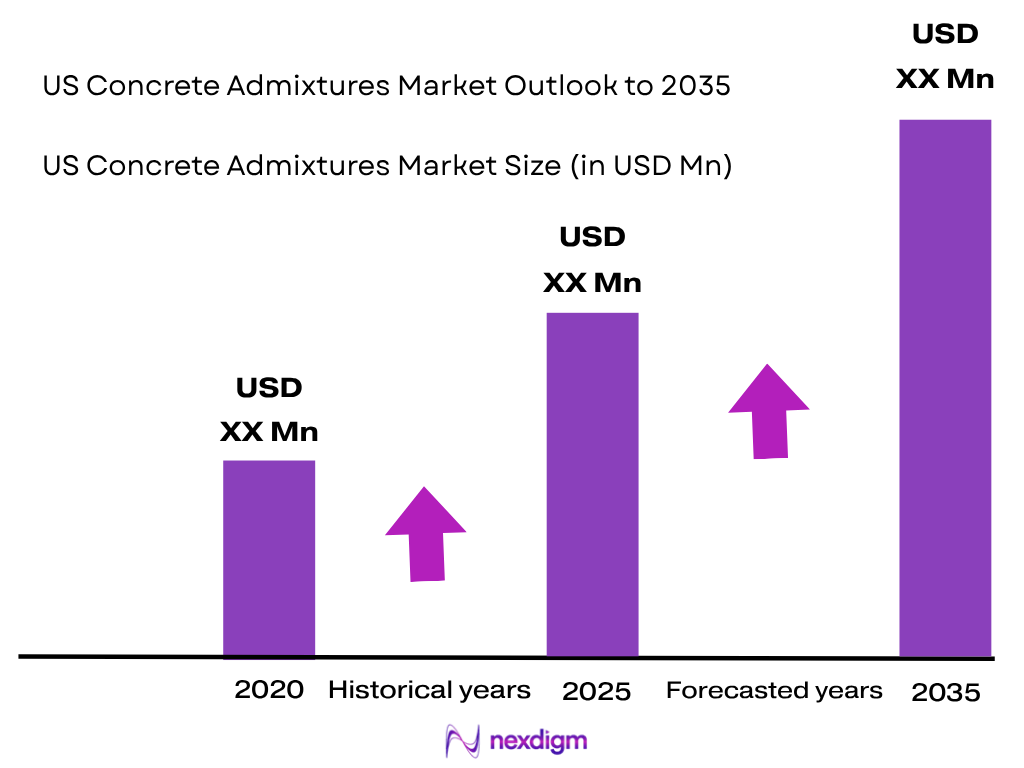
The US Concrete Admixtures Market is valued at approximately ~USD XX million, supported by infrastructure, commercial construction and ready-mix concrete consumption. Annual public construction spending moved from USD 450.7 billion to USD 492.7 billion, while highway and street construction increased from USD 137.0 billion to USD 142.7 billion. U.S. cement shipments remained around 110 million metric tons, creating a substantial concrete-production base requiring water reducers, accelerators, retarders, air entrainers and specialty admixtures.
Texas, Missouri, California and Florida are prominent demand centers because they remain the leading U.S. cement-producing states and support substantial ready-mix, infrastructure and building construction activity. Cement continued to be produced at 99 plants across 34 states and Puerto Rico, while shipment value moved from approximately USD 16 billion to USD 17 billion across the two latest observations. Large transportation programs, fast-growing metros and industrial construction reinforce admixture consumption in these states.
Market Segmentation
By Admixture Type
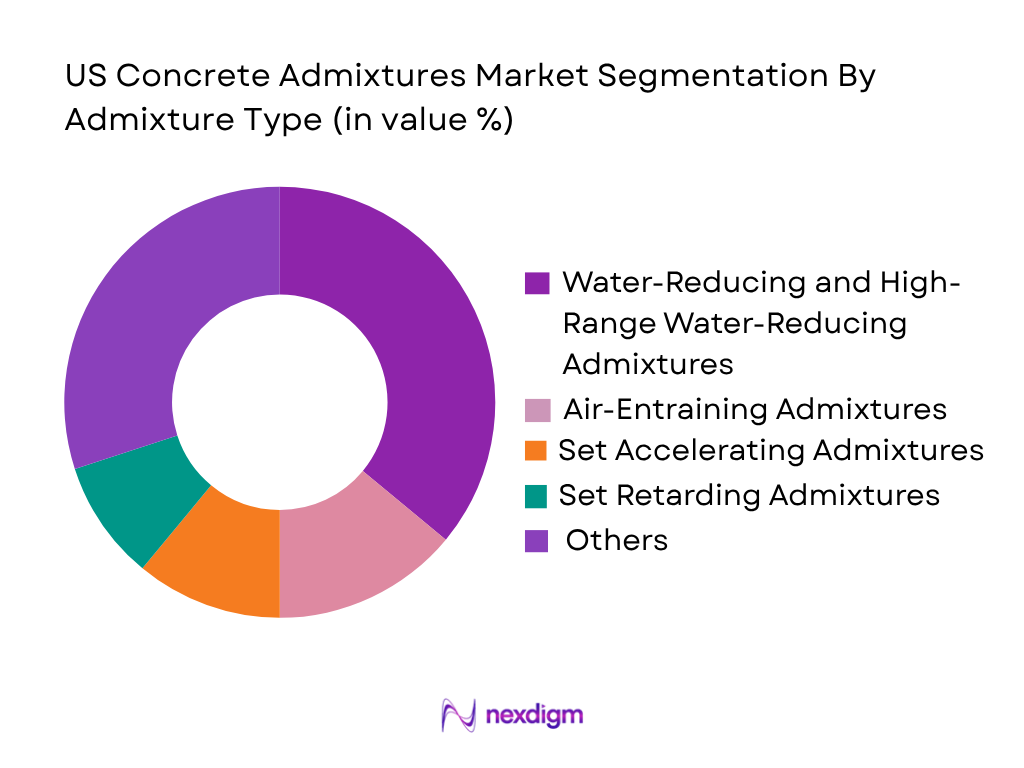
The US Concrete Admixtures Market is segmented into water-reducing admixtures, high-range water reducers, polycarboxylate ether superplasticizers, retarders, accelerators, air-entraining agents, viscosity modifiers, shrinkage reducers, corrosion inhibitors, hydration stabilizers and specialty durability admixtures. Water-reducing and high-range water-reducing admixtures represent the dominant modeled segment because they address several core requirements simultaneously: reduced mixing water, increased workability, higher strength, improved pumpability and compatibility with lower-clinker concrete mixtures. Modern polycarboxylate ether technology is particularly important in ready-mix and precast applications requiring extended slump retention and tight water-cement ratios. Sika notes that modified PCE systems can deliver substantial water reduction and extended slump retention, while Master Builders Solutions has progressively developed water-reduction technologies from Pozzolith through Glenium systems. Increasing use of Portland-limestone cement and supplementary cementitious materials also raises the importance of tailored dispersion chemistry because cement particle morphology, sulfate balance and SCM characteristics influence admixture response.
By Concrete Type
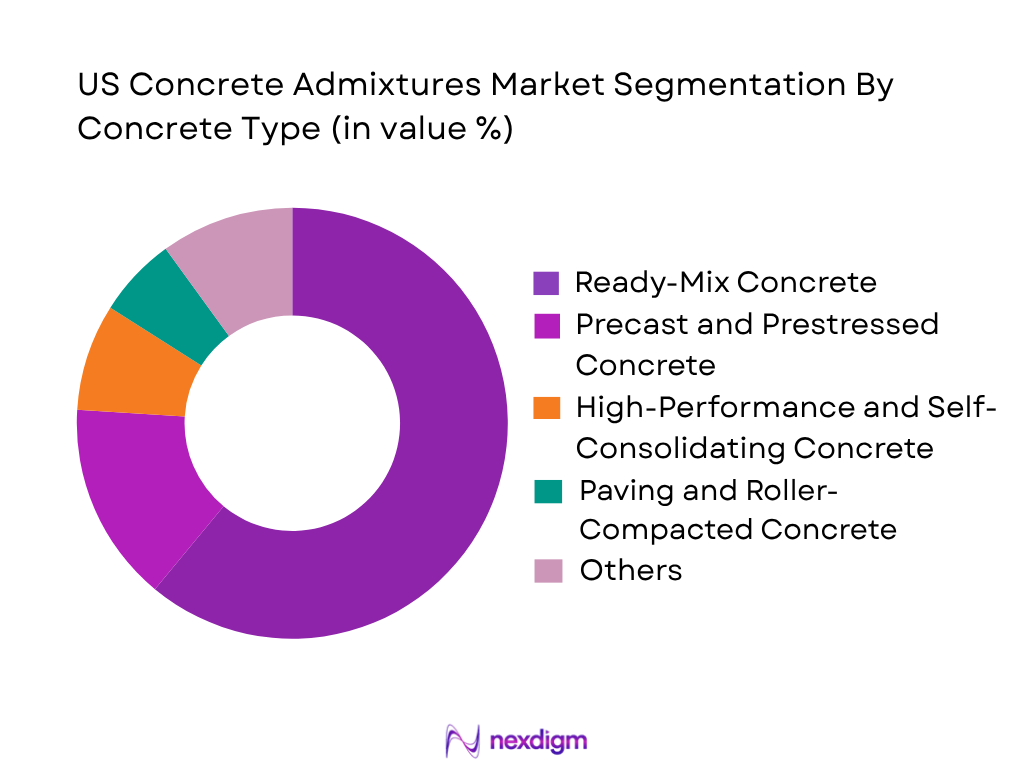
The US Concrete Admixtures Market is segmented into ready-mix concrete, precast concrete, prestressed concrete, self-consolidating concrete, high-performance concrete, ultra-high-performance concrete, shotcrete, roller-compacted concrete, mass concrete and specialty concrete. Ready-mix concrete represents the dominant modeled sub-segment, reflecting its extensive use across residential, commercial, manufacturing and infrastructure construction. USGS indicates that ready-mixed concrete producers receive roughly 70–75% of U.S. cement sales, establishing a large underlying base for chemical admixture consumption. Ready-mix producers routinely use water reducers, air entrainers, retarders, hydration stabilizers and accelerators to manage haul distance, seasonal temperature conditions, pumping, finishing and strength development. The operating complexity is increasing as producers incorporate Portland-limestone cement, fly ash, slag, natural pozzolans and other alternative cementitious materials. Admixture suppliers therefore compete not only on chemical products but on mix-design support, compatibility testing, automated dosing, plant troubleshooting and field service. Returned-concrete treatment also creates a specialist application because unused concrete can be chemically stabilized or processed instead of being immediately discarded.
Competitive Landscape
The US Concrete Admixtures Market is characterized by large global construction-chemical suppliers alongside established North American concrete-technology companies. Sika, Master Builders Solutions, GCP/Saint-Gobain, Euclid Chemical and MAPEI maintain strong positions through broad admixture portfolios, regional production infrastructure, technical laboratories and relationships with ready-mix and precast producers. Competition increasingly centers on PCE chemistry, slump retention, cement-SCM compatibility, low-carbon concrete optimization, field service and proximity of manufacturing to major concrete-producing regions.
| Major Player | Establishment Year | Headquarters | Core Admixture Portfolio | PCE / Water-Reduction Capability | Low-Carbon & SCM Capability | US Manufacturing Presence | Ready-Mix / Precast Capability | Technical & Digital Support |
| Sika | 1910 | Baar, Switzerland | ~ | ~ | ~ | ~ | ~ | ~ |
| Master Builders Solutions | 1909 | Mannheim, Germany | ~ | ~ | ~ | ~ | ~ | ~ |
| GCP Applied Technologies / Saint-Gobain | 2016 | Alpharetta, Georgia | ~ | ~ | ~ | ~ | ~ | ~ |
| Euclid Chemical | Over 100 years | Cleveland, Ohio | ~ | ~ | ~ | ~ | ~ | ~ |
| MAPEI Corporation | 1983 in US | Deerfield Beach, Florida | ~ | ~ | ~ | ~ | ~ | ~ |
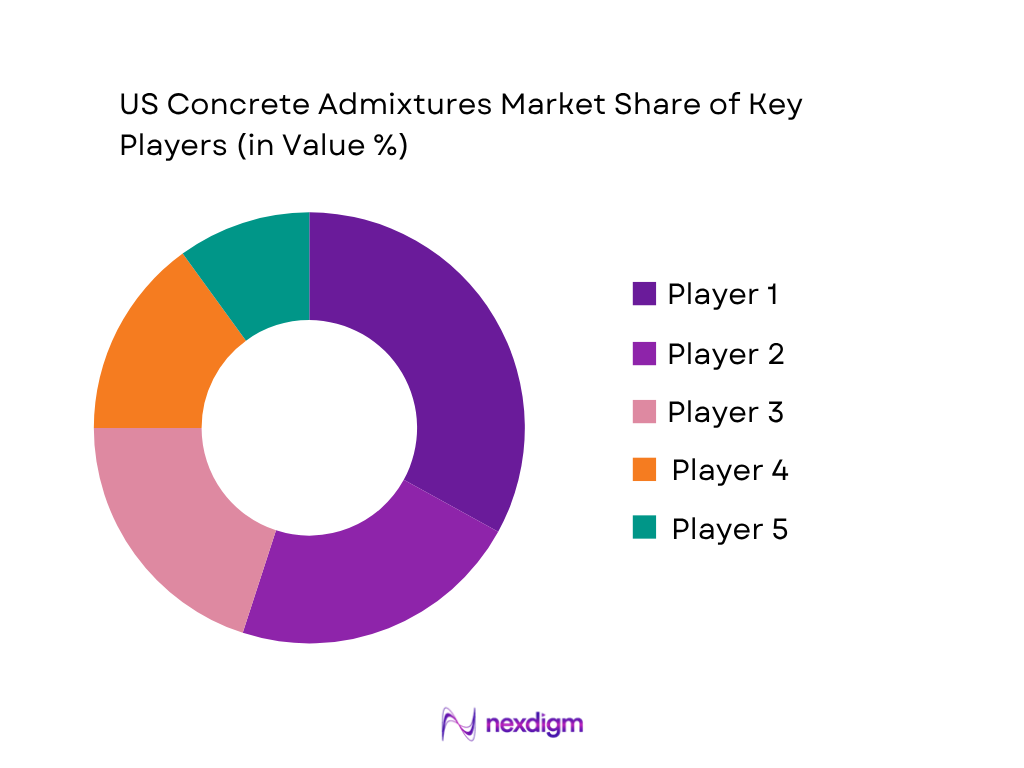
US Concrete Admixtures Market Analysis
Growth Drivers
Infrastructure Modernization Increasing Demand for High-Performance Concrete Admixtures
Federal and state infrastructure activity is a direct growth driver for the US Concrete Admixtures Market because bridge decks, pavements, tunnels and transportation structures require air entrainment, water reduction, set control, corrosion resistance and permeability reduction. The U.S. Census Bureau recorded USD 492.7 billion of public construction in 2024, including USD 142.7 billion in highway and street construction and USD 105.2 billion in educational construction. FHWA separately provided USD 5.5 billion through the Bridge Formula Program for fiscal 2024 and approximately USD 2.497 billion through the Bridge Investment Program. Large projects awarded in 2024 included the USD 5.792 billion Interstate Bridge Replacement project, the USD 2.670 billion Mobile River Bridge project and the USD 2.144 billion Sagamore Bridge project. Such structures consume performance concrete requiring superplasticizers, air-entraining agents, corrosion inhibitors and hydration-control chemistry. USGS recorded 110 million metric tons of cement shipments to final customers during 2024, confirming the scale of the concrete-production base supporting admixture demand. At the macroeconomic level, World Bank data place U.S. GDP at USD 28.751 trillion and GDP per capita at USD 84,534 in 2024, providing substantial capacity for infrastructure investment and material-intensive construction.
Large Ready-Mix and Non-Residential Construction Base Supporting Admixture Consumption
The scale of U.S. ready-mix and non-residential construction supports recurring consumption of water reducers, PCE superplasticizers, retarders, accelerators, air entrainers and hydration stabilizers. USGS reported 84 million metric tons of Portland and blended cement production and 2.2 million metric tons of masonry cement production in 2024, while shipments to final customers reached 110 million metric tons. Cement was manufactured at 99 plants across 34 states and Puerto Rico, creating a geographically dispersed supply base serving thousands of concrete-producing locations. The U.S. Census Bureau recorded USD 588.821 billion of private non-residential construction put in place during 2024, supporting concrete demand across industrial buildings, warehouses, commercial projects, data infrastructure and other large structures. Ready-mix producers rely on chemical admixtures to maintain slump during transport, control setting under seasonal temperatures, enable pumping, reduce water demand and achieve specified strength with different cementitious combinations. The material base is also becoming more complex as producers adjust to imported cement, Portland-limestone cement and supplementary cementitious materials. World Bank data record a 2024 U.S. population of 340,110,988 alongside GDP of USD 28.751 trillion, providing a large underlying construction economy and end-use base for chemically optimized concrete production.
Market Challenges
Cement Source and Cementitious Material Variability Complicating Admixture Performance
Variation in cement chemistry, clinker source and supplementary cementitious material composition creates a technical challenge for U.S. admixture suppliers because identical admixture formulations can produce different slump retention, setting time, air content and strength responses across concrete plants. USGS recorded 84 million metric tons of Portland and blended cement production in 2024, 73 million metric tons of clinker production and 24 million metric tons of hydraulic cement imports. Cement was produced at 99 domestic plants across 34 states and Puerto Rico, meaning admixture manufacturers must support multiple regional cement sources while also accounting for imported material. This diversity is particularly important for polycarboxylate ether systems because adsorption behavior can change with cement fineness, sulfate balance, alkali content and supplementary material chemistry. Concrete producers may therefore require laboratory compatibility testing, plant trials and formulation adjustment rather than standardized dosing across their network. The same issue becomes more complicated in ternary mixtures containing fly ash, slag or silica fume, where different combinations affect rheology and setting behavior. World Bank data show the U.S. economy generated USD 28.751 trillion in GDP in 2024 with GDP per capita of USD 84,534, demonstrating that this challenge exists within a very large and technically sophisticated construction economy where consistency requirements are high.
Supplementary Cementitious Material Supply Creates Mix-Design and Formulation Uncertainty
The changing availability of supplementary cementitious materials creates another challenge for concrete admixture formulation, particularly for producers using fly ash to lower clinker content and control heat development. U.S. Energy Information Administration data show coal-fired electricity generation totaled 652,156 GWh in 2024, while coal consumed for electricity generation totaled 372.931 million short tons. Coal use subsequently reached 416.693 million short tons in 2025, illustrating year-to-year variation in a sector that supplies combustion by-products used in cementitious systems. Concrete producers therefore face uncertainty in the volume, source, carbon content and mineral characteristics of available fly ash, requiring admixture suppliers to compensate through PCE chemistry, air-control systems, accelerators and strength-enhancing formulations. At the same time, USGS reported 110 million metric tons of U.S. cement shipments in 2024 and 73 million metric tons of clinker output, showing the much larger scale of cement demand that alternative cementitious materials must supplement. Variability in SCM supply can alter water demand, setting response and air stability, increasing technical-service requirements at ready-mix plants. World Bank data record U.S. GDP at USD 28.751 trillion and population at 340,110,988 in 2024, underscoring the scale of construction activity affected by these material-supply constraints.
Market Opportunities
Low-Carbon Concrete Procurement Creating Demand for Advanced Admixture Chemistry
Federal procurement and transportation programs are creating a significant future opportunity for admixtures that enable lower-clinker concrete, higher SCM loading and reduced embodied carbon while maintaining strength and workability. FHWA awarded USD 1.2 billion to 39 state departments of transportation under the Low Carbon Transportation Materials Program in 2024 and separately opened an additional USD 800 million funding opportunity for cities, tribes, metropolitan planning organizations and other agencies. The broader program provides USD 2 billion for lower-carbon materials including concrete, cement, steel and asphalt. EPA also selected 38 recipients for nearly USD 160 million in grants to improve reporting and reduction of emissions associated with construction materials. These current programs can increase demand for admixture technologies that improve dispersion, early strength, slump retention and rheology in mixes containing Portland-limestone cement, slag, fly ash, natural pozzolans and other clinker-reducing materials. USGS recorded 110 million metric tons of cement shipments in 2024, showing a large addressable concrete base where incremental mix optimization can have substantial volume implications. World Bank data place 2024 U.S. GDP at USD 28.751 trillion, providing the macroeconomic scale necessary for federal, state and private adoption of advanced low-carbon concrete technologies.
Bridge Rehabilitation and High-Durability Concrete Expanding Specialty Admixture Demand
The U.S. bridge-rehabilitation pipeline creates a future opportunity for corrosion inhibitors, air-entraining admixtures, high-range water reducers, shrinkage reducers and permeability-control systems designed to extend concrete service life. FHWA’s Bridge Formula Program provides USD 5.5 billion for fiscal 2024, while the Bridge Investment Program carried approximately USD 2.497 billion in fiscal 2024 funding and rises to USD 2.547 billion in fiscal 2026. Individual 2024 awards illustrate the concrete-intensive scale of the program: the Interstate Bridge Replacement project carries an estimated USD 5.792 billion project value, the Mobile River Bridge and Bayway project USD 2.670 billion, the Sagamore Bridge project USD 2.144 billion, and the I-83 South Bridge replacement USD 1.272 billion. Bridge decks, piers and substructures must withstand deicing salts, freeze-thaw cycles, chloride exposure and repeated loading, creating demand for admixture packages that improve durability rather than only fresh-concrete workability. Census Bureau data recorded USD 142.7 billion of highway construction activity in 2024, giving suppliers a substantial current infrastructure base from which future specialty-admixture adoption can expand. World Bank data record U.S. GDP at USD 28.751 trillion and GDP per capita at USD 84,534, supporting continued investment in technically demanding infrastructure renewal.
Future Outlook
The US Concrete Admixtures Market is forecast to expand at approximately ~X.X% CAGR during 2026–2035 as concrete producers increasingly require chemistry capable of delivering performance with lower-clinker cement systems, variable supplementary cementitious materials and demanding construction schedules. Infrastructure renewal, data-center construction, advanced manufacturing and public works should maintain a large concrete-consumption base. Infrastructure is expected to remain a central demand platform. Federal Highway Administration funding under the Bridge Investment Program reaches USD 2.547 billion in fiscal 2026, supporting rehabilitation and replacement projects where durable, low-permeability and corrosion-resistant concrete is important. Bridge applications commonly require air entrainment, high-range water reduction, corrosion protection, controlled setting and reduced permeability.
Public construction is similarly important. U.S. Census Bureau data show public construction expenditures of USD 492.7 billion, including USD 142.7 billion for highway construction and USD 105.2 billion for educational construction. Such projects create recurring demand for admixtures used in pavements, bridge decks, foundations, structural concrete and precast elements.
Major Players
- Sika Corporation
- Master Builders Solutions
- GCP Applied Technologies / Saint-Gobain Construction Chemicals
- Euclid Chemical
- Chryso / Saint-Gobain
- MAPEI Corporation
- Fritz-Pak Corporation
- Cortec Corporation
- CEMEX Admixtures
- RPM International
- Arkema
- Kao Chemicals
- BASF
- W. R. Meadows
- Concrete Sealants, Inc.
Key Target Audience
- Concrete Admixture and Construction Chemical Manufacturers
- Ready-Mix Concrete Producers
- Precast and Prestressed Concrete Manufacturers
- Cement and Supplementary Cementitious Material Producers
- General Contractors and Concrete Contractors
- Infrastructure Developers and Asset Owners
- Investments and Venture Capitalist Firms
- Government and Regulatory Bodies (Federal Highway Administration, General Services Administration, Environmental Protection Agency, State Departments of Transportation, Federal Transit Administration)
Research Methodology
Step 1: Identification of Key Variables
The initial phase involves constructing an ecosystem map of the US Concrete Admixtures Market encompassing admixture manufacturers, raw-material suppliers, cement producers, ready-mix companies, precast manufacturers and infrastructure contractors. Secondary and proprietary databases are used to identify critical variables including concrete production, admixture dosage, chemistry type, cement system, SCM usage, construction application and regional production patterns.
Step 2: Market Analysis and Construction
Historical market demand is evaluated using top-down and bottom-up approaches. Top-down analysis considers cement shipments, construction spending, infrastructure activity and concrete-consuming end markets. Bottom-up analysis models admixture demand according to representative concrete volumes, dosage rates, ready-mix versus precast production, admixture combinations, performance requirements and adoption of specialty products.
Step 3: Hypothesis Validation and Expert Consultation
Market hypotheses are validated through computer-assisted telephone interviews with admixture manufacturers, ready-mix producers, precast companies, cement suppliers, concrete technologists and contractors. These consultations validate product penetration, PCE adoption, air-entrainment requirements, regional formulation differences, SCM compatibility, producer purchasing criteria, technical-service requirements and competitive positioning.
Step 4: Research Synthesis and Final Output
The final phase triangulates U.S. Census construction data, USGS cement statistics, supplier disclosures, infrastructure indicators and primary interviews. Bottom-up admixture-consumption estimates are reconciled against top-down concrete and cement activity. The resulting model provides segmentation by admixture type and concrete application while assessing supplier positioning, regional demand, low-carbon concrete adoption and future technology opportunities.

- Executive Summary
- Research Methodology (Market Definitions and Assumptions, US Concrete Admixtures Market Classification, Chemical Admixture Scope, ASTM C494 Chemical Admixture Mapping, ASTM C260 Air-Entraining Admixture Assessment, ASTM C1582 Corrosion-Inhibiting Admixture Assessment, Water-Reducing Admixture Assessment, High-Range Water Reducer Assessment, Polycarboxylate Ether Chemistry Assessment, Lignosulfonate Chemistry Assessment, Set Retarding Admixture Assessment, Set Accelerating Admixture Assessment, Air-Entraining Admixture Assessment, Shrinkage-Reducing Admixture Assessment, Corrosion-Inhibiting Admixture Assessment, Viscosity-Modifying Admixture Assessment, Hydration Stabilizer Assessment, Waterproofing Admixture Assessment, Low-Carbon Concrete Admixture Assessment, Ready-Mix Concrete Assessment, Precast and Prestressed Concrete Assessment, Paving Concrete Assessment, Shotcrete Assessment, Cement and SCM Compatibility Mapping, Supplementary Cementitious Material Assessment, Supply-Side Assessment, Demand-Side Assessment, Top-Down Market Sizing, Bottom-Up Market Sizing, Primary Industry Interviews, Construction Project Pipeline Assessment, Data Triangulation, Forecasting Framework)

- Definition and Scope
- US Concrete Admixture Industry Evolution and Development of Conventional Water Reducers, Lignosulfonate Admixtures, Naphthalene-Based Superplasticizers, Polycarboxylate Ether Superplasticizers, Air-Entraining Admixtures, Set Accelerators, Retarders, Hydration Stabilizers, Shrinkage Reducers, Corrosion Inhibitors, Viscosity Modifiers, Self-Consolidating Concrete Admixtures, Fiber-Compatible Admixture Systems, Low-Carbon Concrete Chemistry, SCM-Optimized Admixtures, Carbon-Curing-Compatible Admixture Systems, High-Early-Strength Precast Chemistry, Digital Dosing Systems
- Concrete Admixtures Value Chain Analysis
- Concrete Admixtures Supply Chain Analysis
- Petrochemical Feedstock Suppliers, Polycarboxylate Ether Raw Material Suppliers, Lignosulfonate Suppliers, Surfactant Manufacturers, Specialty Polymer Producers, Admixture Manufacturers, Bulk Storage and Blending Facilities, Chemical Distributors, Ready-Mix Concrete Producers, Precast and Prestressed Concrete Producers, Cement Producers, Supplementary Cementitious Material Suppliers, Concrete Contractors, General Contractors, State DOT Agencies, Infrastructure Owners, Structural Engineers, Testing Laboratories

- Growth Drivers (Infrastructure Modernization, Highway and Bridge Construction, Data Centre Construction, Ready-Mix Concrete Demand, Precast and Prestressed Concrete Expansion, Portland-Limestone Cement Adoption, Low-Carbon Concrete Requirements, High-Performance Concrete Adoption, Labor Productivity Requirements, Extreme-Weather Concrete Placement)
- Market Challenges (Cement and SCM Variability, PCE-Cement Compatibility, Fly Ash Availability Constraints, Slag Availability Constraints, Raw Material Cost Volatility, Regional Formulation Differences, Admixture Overdose Risk, Concrete Air-Content Variability, Field Quality-Control Requirements, Complex Multi-Admixture Interactions)
- Market Opportunities (Low-Carbon Concrete Admixtures, SCM Optimization Chemistry, Portland-Limestone Cement Admixture Systems, Returned Concrete Stabilization, Data Centre Concrete, UHPC Admixtures, Precast Cycle-Time Reduction, Corrosion-Inhibiting Admixtures, Shrinkage-Control Solutions, Digital Concrete Dosing and Quality Monitoring)
- Market Trends (Polycarboxylate Ether Penetration, Extended Slump Retention, High-SCM Concrete, Portland-Limestone Cement Optimization, Carbon Reduction in Concrete, AI-Assisted Mix Optimization, Digital Dosing Systems, Returned Concrete Reuse, High-Early-Strength Precast Chemistry, Sustainable Biobased Admixtures, Performance-Based Concrete Specifications)
- Government Regulations and Standards (ASTM C494/C494M Chemical Admixtures for Concrete, ASTM C260 Air-Entraining Admixtures, ASTM C1582 Corrosion-Inhibiting Admixtures, ASTM C595 Blended Hydraulic Cements, AASHTO M194 Chemical Admixtures, ACI 212 Admixture Guidance, ACI 318 Structural Concrete Requirements, State DOT Approved Product Lists, Buy America Requirements, Infrastructure Material Compliance Requirements)
- SWOT Analysis
- Porter’s Five Forces Analysis
- PESTLE Analysis
- Stakeholder Ecosystem
- Concrete Production and Construction Ecosystem

- By Market Value (2020-2025)
- By Admixture Consumption Volume (2020-2025)
- By Water-Reducing Admixture Consumption (2020-2025)
- By High-Range Water-Reducing Admixture Consumption (2020-2025)
- By Air-Entraining Admixture Consumption (2020-2025)
- By Accelerator Consumption (2020-2025)
- By Retarder Consumption (2020-2025)
- By Corrosion-Inhibiting Admixture Consumption (2020-2025)
- By Shrinkage-Reducing Admixture Consumption (2020-2025)
- By Ready-Mix Concrete Admixture Consumption (2020-2025)
- By Precast and Prestressed Concrete Admixture Consumption (2020-2025)
- By Infrastructure Concrete Admixture Consumption (2020-2025)

- By Admixture Type (In Value %)
Water-Reducing Admixtures
High-Range Water-Reducing Admixtures
Polycarboxylate Ether Superplasticizers
Lignosulfonate-Based Water Reducers
Set Retarding Admixtures
Set Accelerating Admixtures
Non-Chloride Accelerators
Air-Entraining Admixtures
Viscosity-Modifying Admixtures
Shrinkage-Reducing Admixtures
Corrosion-Inhibiting Admixtures
Hydration-Stabilizing Admixtures
Permeability-Reducing Admixtures
Waterproofing Admixtures
Specialty Low-Carbon Concrete Admixtures - By Chemistry Type (In Value %)
Polycarboxylate Ether
Lignosulfonates
Sulfonated Naphthalene Formaldehyde
Sulfonated Melamine Formaldehyde
Calcium Nitrate-Based Systems
Calcium Nitrite-Based Systems
Organic Non-Chloride Accelerators
Amine-Based Corrosion Inhibitors
Air-Entraining Surfactants
Polymeric Viscosity Modifiers
Shrinkage-Reducing Glycol-Based Chemistry
Hydration-Control Polymers
Crystalline Waterproofing Chemistry
Biobased and Renewable Chemistry - By Concrete Type (In Value %)
Ready-Mix Concrete
Precast Concrete
Prestressed Concrete
Self-Consolidating Concrete
High-Performance Concrete
Ultra-High-Performance Concrete
Pervious Concrete
Roller-Compacted Concrete
Shotcrete
Mass Concrete
Fiber-Reinforced Concrete
Flowable Fill
Architectural Concrete
3D-Printed Concrete - By Application (In Value %)
Residential Construction
Commercial Buildings
Industrial Facilities
Data Centres
Roads and Highways
Bridges and Flyovers
Airports
Rail and Transit Infrastructure
Water and Wastewater Infrastructure
Marine and Coastal Structures
Power Plants and Energy Infrastructure
Warehouses and Logistics Facilities
Parking Structures
Tunnels and Underground Construction
Repair and Rehabilitation Concrete - By End-Use Construction Type (In Value %)
New Construction
Infrastructure Expansion
Concrete Repair and Rehabilitation
Bridge Deck Replacement
Pavement Reconstruction
Industrial Facility Expansion
Data Centre Construction
Public-Sector Construction
Residential Development
Commercial Redevelopment - By Performance Requirement (In Value %)
High Workability
Extended Slump Retention
Rapid Strength Development
Cold-Weather Concreting
Hot-Weather Concreting
Freeze-Thaw Durability
Reduced Permeability
Corrosion Resistance
Reduced Shrinkage
High Early Strength
Pumpability
Self-Consolidation
Low-Carbon Mix Optimization - By Region (In Value %)
Northeast
Midwest
Southeast
South Central
Texas
Florida
California
Pacific Northwest
Mountain States
Great Lakes
Mid-Atlantic
Other United States

- Market Share of Major Players (By US Revenue, Admixture Volume, Ready-Mix Segment, Precast Segment, Infrastructure Segment, Water Reducer Portfolio, PCE Portfolio, Air-Entraining Portfolio, Accelerator Portfolio, Low-Carbon Concrete Capability, Manufacturing Footprint, Regional Distribution Network, Technical Service Coverage, DOT Specification Presence)
- Cross Comparison Parameters (Concrete Admixture Portfolio Breadth, Polycarboxylate Ether and Slump-Retention Technology Capability, Portland-Limestone Cement and SCM Compatibility Capability, Low-Carbon Concrete Optimization Capability, US Manufacturing and Blending Footprint, Ready-Mix and Precast Technical Service Coverage, State DOT and Infrastructure Specification Capability, Digital Dosing and Concrete Performance Support)
- SWOT Analysis of Major Players
- Competitive Positioning Matrix
- Major Companies
Sika Corporation
Master Builders Solutions
GCP Applied Technologies / Saint-Gobain Construction Chemicals
Euclid Chemical
Chryso / Saint-Gobain
MAPEI Corporation
Fritz-Pak Corporation
Cortec Corporation
CEMEX Admixtures
RPM International
Arkema
Kao Chemicals
BASF
W. R. Meadows
Concrete Sealants, Inc.

- Ready-Mix Producer Requirement Assessment
- Precast Producer Requirement Assessment
- Prestressed Concrete Producer Requirement Assessment
- Concrete Contractor Requirement Assessment
- General Contractor Requirement Assessment
- State DOT Requirement Assessment
- Infrastructure Owner Requirement Assessment
- Structural Engineer Specification Assessment
- Concrete Mix Designer Requirement Assessment
- Data Centre Contractor Requirement Assessment
- Low-Carbon Concrete Requirement Assessment
- Technical Service Requirement Assessment
- Product Consistency Requirement Assessment
- Supply Reliability Assessment

- By Market Value (2026-2035)
- By Admixture Consumption Volume (2026-2035)
- By Water-Reducing Admixture Consumption (2026-2035)
- By High-Range Water-Reducing Admixture Consumption (2026-2035)
- By Air-Entraining Admixture Consumption (2026-2035)
- By Accelerator Consumption (2026-2035)
- By Retarder Consumption (2026-2035)
- By Corrosion-Inhibiting Admixture Consumption (2026-2035)
- By Shrinkage-Reducing Admixture Consumption (2026-2035)
- By Ready-Mix Concrete Admixture Consumption (2026-2035)
- By Precast and Prestressed Concrete Admixture Consumption (2026-2035)
- By Infrastructure Concrete Admixture Consumption (2026-2035)


 Request a Sample
 Ask for Customization
 Get a Quote
 Enquire Now
