

 Download PDF
 Download PDF
Market Overview
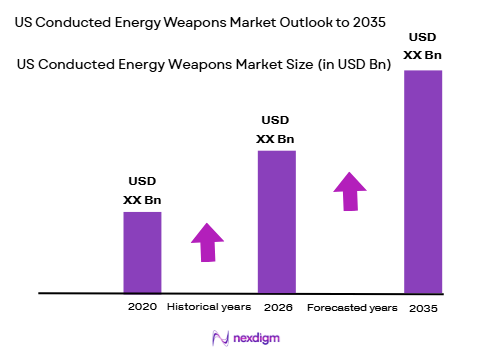
The US Conducted Energy Weapons market is valued at USD ~ billion, driven by advances in directed energy technologies, increased defense budgets, and the demand for non-lethal military solutions. This market is gaining traction due to the growing interest in non-lethal weapons that can control crowds, incapacitate targets, and provide precision without causing long-term harm. The defense sector’s continuous focus on enhancing security systems, especially for military and law enforcement, supports the market’s growth.
The United States remains a dominant force in the conducted energy weapons market due to its advanced technological infrastructure and military capabilities. Major defense contractors based in cities like Washington D.C., Los Angeles, and Huntsville play a crucial role in the development and deployment of directed energy systems. The US government’s significant investment in defense technology and its strategic military operations contribute to the country’s leadership in this market, driving the demand for such advanced weaponry.
Market Segmentation
By Product Type
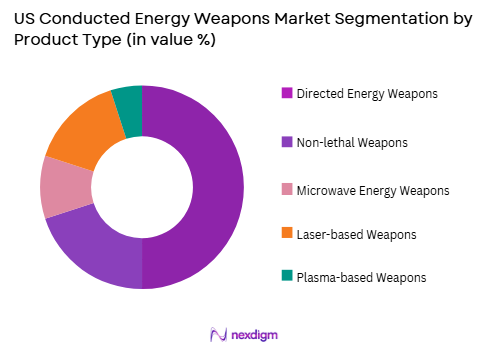
The US Conducted Energy Weapons market is segmented by product type into non-lethal weapons, directed energy weapons, microwave energy weapons, laser-based weapons, and plasma-based weapons. Among these, directed energy weapons (DEWs) have become the dominant sub-segment, driven by advancements in technology, particularly in military applications. DEWs, which include high-powered microwave and laser systems, are capable of incapacitating electronic systems or personnel without permanent damage. The increasing adoption of DEWs by military forces, law enforcement, and homeland security agencies due to their precision, efficiency, and non-lethal nature has led to their leading position in the market.
By Platform Type
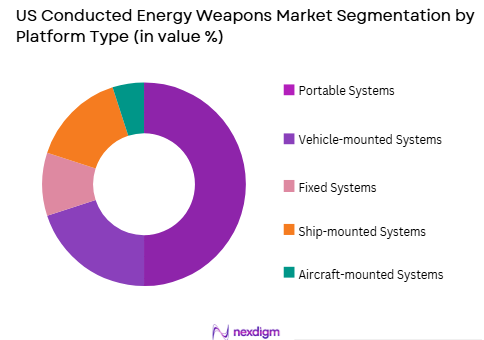
The market is segmented by platform type into portable systems, vehicle-mounted systems, fixed systems, ship-mounted systems, and aircraft-mounted systems. Portable systems currently dominate the market due to their versatility, ease of use, and wide-ranging applications for both military and law enforcement. These systems offer operational flexibility, enabling deployment in various situations, from crowd control to tactical military operations. Portable conducted energy weapons provide enhanced mobility and rapid deployment, which is why they are increasingly favored in both military and civilian security applications.
Competitive Landscape
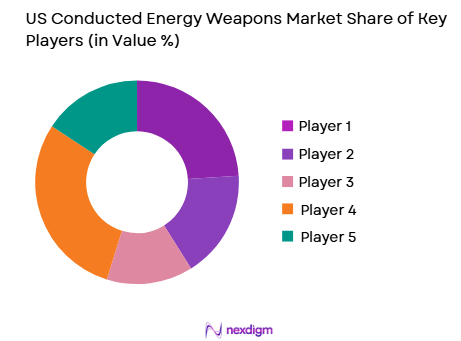
The competitive landscape of the US Conducted Energy Weapons market is characterized by significant consolidation, with leading defense contractors and technology firms driving innovation. Major players continue to dominate through extensive research and development, strategic partnerships with government agencies, and advancements in directed energy technologies. Market participants are increasingly focusing on the miniaturization of energy weapon systems and their integration into various platforms. These innovations are critical in maintaining competitive positioning as demand for non-lethal and precision-targeted energy weapons increases.
| Company Name | Establishment Year | Headquarters | Technology Focus | Market Reach | Key Products | Revenue (USD Billion) | Additional Market-Specific Parameter |
| Lockheed Martin | 1912 | Bethesda, MD | ~ | ~ | ~ | ~ | ~ |
| Boeing | 1916 | Chicago, IL | ~ | ~ | ~ | ~ | ~ |
| Raytheon Technologies | 1922 | Waltham, MA | ~ | ~ | ~ | ~ | ~ |
| Northrop Grumman | 1939 | Falls Church, VA | ~ | ~ | ~ | ~ | ~ |
| BAE Systems | 1999 | London, UK | ~ | ~ | ~ | ~ | ~ |
US Conducted Energy Weapons Market Analysis
Growth Drivers
Technological Advancements in Directed Energy Weapons
Technological advancements in directed energy weapons (DEWs) are a significant growth driver for the US market. These innovations enable the development of high-powered microwave and laser systems capable of disabling electronic systems or incapacitating personnel. The shift towards more precise and controlled weapons, which cause minimal permanent damage, is gaining traction among military and law enforcement agencies. DEWs offer the capability to target specific threats, reduce collateral damage, and provide non-lethal solutions, making them highly desirable for a range of applications. The growing demand for advanced, non-lethal defense mechanisms is driving significant investment in research and development, accelerating the deployment of DEWs across various platforms, including portable systems, vehicles, and aircraft. As defense budgets continue to grow, further advancements in DEW technologies will continue to contribute to the market’s expansion.
Government Investment and Support for Non-lethal Weapons
Increased government investment and support for non-lethal weapons are pivotal growth drivers in the US Conducted Energy Weapons market. With rising concerns over civilian casualties during military operations and public unrest, governments are increasingly investing in non-lethal weapons that provide a more controlled approach to security. Directed energy weapons, with their precision and ability to incapacitate targets without causing lasting harm, are gaining favor in military, law enforcement, and homeland security sectors. Governments are allocating substantial funds for the development and deployment of these weapons, driven by the need to enhance security while minimizing collateral damage. Additionally, the growing interest in using DEWs for crowd control and border security has further fueled the demand for these technologies. As regulatory bodies embrace the use of non-lethal weapons, market growth will continue to be supported by government contracts and defense funding.
Market Challenges
High Development and Operational Costs
One of the key challenges in the US Conducted Energy Weapons market is the high development and operational costs associated with DEWs. Research and development for directed energy technologies require significant investment in advanced materials, testing, and integration into various platforms. The complexity of creating highly reliable and efficient energy weapons that can function in diverse environments adds to the costs. Additionally, operational costs, including maintenance, training, and energy consumption, further increase the financial burden on military and law enforcement agencies. While DEWs offer long-term cost savings through reduced ammunition costs, the high upfront costs can be a barrier to broader adoption, particularly for smaller defense contractors or governments with limited defense budgets. The high development and operational expenses remain a significant challenge for market participants, affecting both the pace of innovation and adoption across different sectors.
Regulatory and Ethical Concerns
Regulatory and ethical concerns surrounding the use of conducted energy weapons present another major challenge in the market. As directed energy weapons are increasingly deployed in military and law enforcement applications, concerns regarding their ethical implications and the potential for misuse have arisen. International regulations governing the use of such weapons, particularly in conflict zones or for crowd control, are still evolving, creating uncertainties for developers and users alike. Ethical debates over the non-lethal nature of DEWs and their impact on human health also contribute to resistance in some quarters. These regulatory and ethical concerns can delay the adoption of DEWs, as companies must navigate complex legal frameworks and ensure compliance with international humanitarian laws and human rights standards. Addressing these challenges will be crucial for the widespread deployment and acceptance of directed energy weapons.
Opportunities
Integration of Directed Energy Weapons in Space and Air Defense Systems
One of the major opportunities in the US Conducted Energy Weapons market is the integration of directed energy weapons in space and air defense systems. The ability to use DEWs for missile defense, satellite protection, and airspace security is garnering attention due to the precision and rapid response capabilities they offer. As space becomes an increasingly critical domain for both military and civilian operations, the demand for robust space defense systems is growing. DEWs can be used to neutralize incoming threats like missiles, drones, or hostile satellites, providing a cost-effective and scalable solution for modern defense needs. The integration of DEWs into air defense systems can also enhance the capability to protect high-value assets, including military aircraft and critical infrastructure. As technological advancements make DEWs more efficient and versatile, the market for these systems in space and air defense will continue to expand, providing significant opportunities for companies in the sector.
Emerging Use in Civilian Applications
Another key opportunity for the US Conducted Energy Weapons market lies in their emerging use in civilian applications, particularly for crowd control and law enforcement. As societal concerns regarding public safety and civilian casualties grow, there is an increasing demand for non-lethal weapons that can incapacitate suspects or manage large crowds without causing permanent harm. Directed energy weapons provide an effective solution for law enforcement agencies, offering a way to control situations while minimizing the risk of injury or death. The use of DEWs in civilian applications such as border control, airport security, and disaster management is expected to increase, driven by advancements in technology and growing regulatory support. As public perception of DEWs improves and their effectiveness in various civilian applications is proven, the market will continue to expand, creating new opportunities for growth.
Future Outlook
The future outlook for the US Conducted Energy Weapons market is optimistic, with strong growth expected over the next five years. Advances in technology, particularly in directed energy systems, are expected to drive market expansion, alongside increasing demand for non-lethal, precision-targeted weapons. Government support, growing defense budgets, and the demand for safer, more effective weaponry in military and law enforcement sectors will further fuel market growth. As directed energy weapons become more sophisticated and cost-effective, their deployment across various platforms, including portable, vehicle-mounted, and airborne systems, will continue to rise, expanding the market’s potential.
Major Players
- Lockheed Martin
- Boeing
- Raytheon Technologies
- Northrop Grumman
- BAE Systems
- General Dynamics
- Thales Group
- Leonardo
- L3 Technologies
- Kratos Defense
- Rheinmetall
- Textron
- Elbit Systems
- Saab Group
- Intevac
Key Target Audience
- Investments and venture capitalist firms
- Government and regulatory bodies
- Military and defense contractors
- Law enforcement agencies
- Security firms
- Research institutions
- Aerospace manufacturers
- Private defense technology companies
Research Methodology
Step 1: Identification of Key Variables
Identification of market drivers, challenges, and emerging technologies that impact the Conducted Energy Weapons market.
Step 2: Market Analysis and Construction
Gathering of primary and secondary research data to construct a comprehensive market analysis, focusing on segmentation and growth patterns.
Step 3: Hypothesis Validation and Expert Consultation
Engagement with industry experts and stakeholders to validate research findings and ensure accuracy in market projections.
Step 4: Research Synthesis and Final Output
Consolidation of research data into a final report, providing actionable insights and strategic recommendations for market participants.

- Executive Summary
- Research Methodology (Definitions, Scope, Industry Assumptions, Market Sizing Approach, Primary & Secondary Research Framework, Data Collection & Verification Protocol, Analytic Models & Forecast Methodology, Limitations & Research Validity Checks)

- Market Definition and Scope
- Value Chain & Stakeholder Ecosystem
- Regulatory / Certification Landscape
- Sector Dynamics Affecting Demand
- Strategic Initiatives & Infrastructure Growth

- Growth Drivers
Technological Advancements in Directed Energy Weapons
Increased Military and Law Enforcement Budget Allocations
Growing Demand for Non-lethal Crowd Control Solutions - Market Challenges
High Development and Operational Costs
Regulatory Barriers to Weapon Deployment
Public Perception and Ethical Concerns - Market Opportunities
Expansion in Non-lethal Weapons Market
Government Adoption for Border and Crowd Control
Emerging Use in Space and Air Defense Systems - Trends
Rising Interest in Electric and Directed Energy Systems
Integration of AI in Energy Weapon Systems
Miniaturization of Energy Weapons for Tactical Use - Government regulations
Regulations on the Use of Non-lethal Weapons
Compliance with International Weapon Laws
Government Funding for Directed Energy Technologies - SWOT analysis
- Porters five forces

- By Market Value, 2020-2025
- By Installed Units, 2020-2025
- By Average System Price, 2020-2025
- By System Complexity Tier, 2020-2025

- By System Type (In Value%)
Non-lethal Weapons
Directed Energy Weapons
Microwave Energy Weapons
Laser-based Weapons
Plasma-based Weapons - By Platform Type (In Value%)
Portable Systems
Vehicle-mounted Systems
Fixed Systems
Ship-mounted Systems
Aircraft-mounted Systems - By Fitment Type (In Value%)
On-vehicle Fitments
On-foot Fitments
On-ship Fitments
On-aircraft Fitments
Stand-alone Systems - By End User Segment (In Value%)
Military
Law Enforcement
Homeland Security
Private Security Firms
Research Institutions - By Procurement Channel (In Value%)
Direct Procurement
Government Contracts
Defense and Security Equipment Suppliers
Online Bidding Platforms
Third-party Distributors

- Market Share Analysis
- Cross Comparison Parameters (System Type, Platform Type, Procurement Channel, End User Segment, Fitment Type, Energy Source, Integration with AI, Operational Range, System Mobility, Regulatory Compliance)
- SWOT Analysis of Key Competitors
- Pricing & Procurement Analysis
- Key Players
Raytheon Technologies
Lockheed Martin
Boeing
Northrop Grumman
L3 Technologies
Leonardo
General Dynamics
Elbit Systems
SAAB
Rheinmetall
Thales Group
BAE Systems
Textron Systems
Intevac
Kratos Defense & Security Solutions

- Military’s Growing Demand for Tactical Non-lethal Weapons
- Law Enforcement’s Interest in Reducing Civilian Casualties
- Homeland Security Agencies Seeking Effective Border Control
- Research Institutions Exploring Advanced Directed Energy Weapons

- Forecast Market Value, 2026-2035
- Forecast Installed Units, 2026-2035
- Price Forecast by System Tier, 2026-2035
- Future Demand by Platform, 2026-2035


 Request a Sample
 Ask for Customization
 Get a Quote
 Enquire Now