

 Download PDF
Market Overview
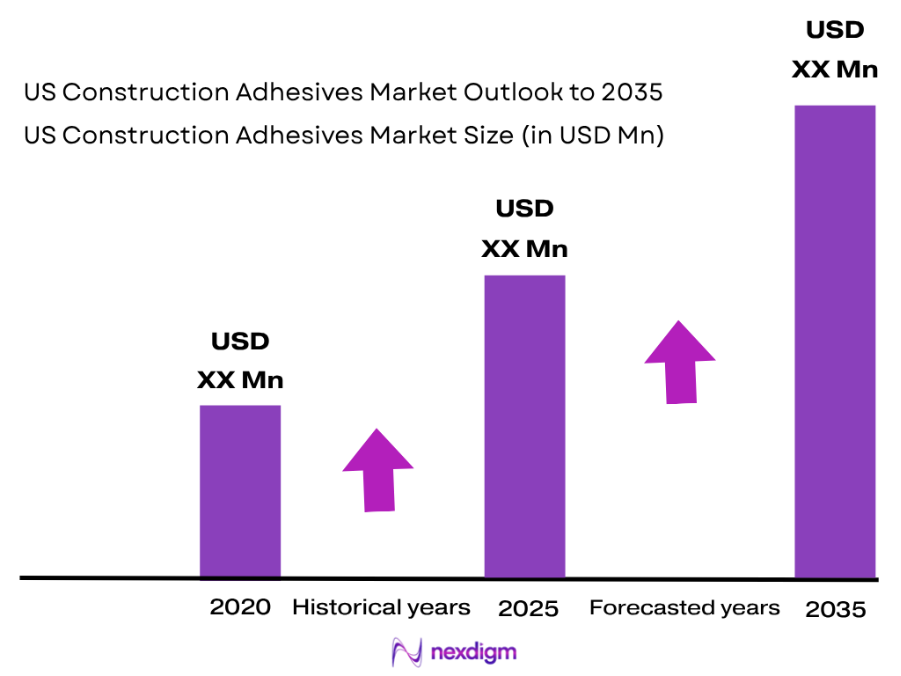
The US Construction Adhesives Market is valued at approximately ~USD XX million, supported by residential building, non-residential construction, repair activity, flooring installation and roofing applications. U.S. housing starts moved from 1,420,000 units to 1,364,100 units, while building permits moved from 1,511,100 to 1,471,200 units across the two latest annual observations. Construction adhesives remain embedded in subfloors, panels, flooring, insulation, roofing assemblies and interior installation because they reduce mechanical fastening and support faster installation.
Texas, Florida, California and the broader Southern United States are major demand centers because they combine substantial residential construction, manufacturing investment, warehouses, data centres and commercial development. National residential and non-residential construction together exceeded USD 1.8 trillion through the first ten months of the latest historical comparison, versus approximately USD 1.69 trillion in the preceding comparable period. Large, growing metros in these states support continuous demand for flooring, subfloor, panel, roofing, insulation and multi-purpose construction adhesives.
Market Segmentation
By Resin and Chemistry Type
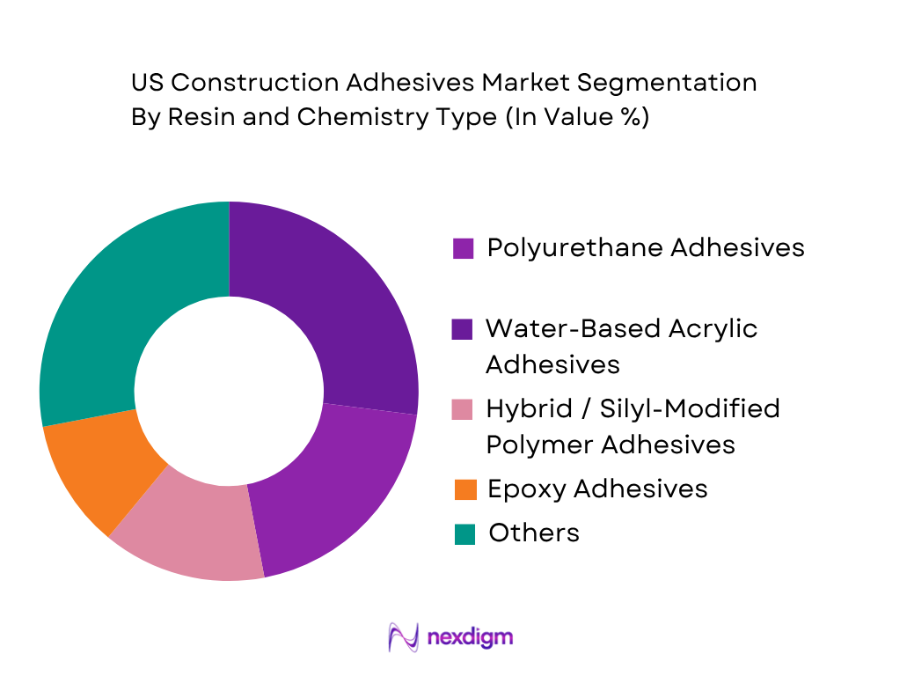
The US Construction Adhesives Market is segmented into polyurethane, water-based acrylic, epoxy, hybrid polymer, silyl-modified polymer, solvent-based, PVA, construction mastic, hot-melt and reactive acrylic systems. Polyurethane and hybrid polymer adhesives represent the dominant modeled technology group because they combine strong adhesion, elasticity, moisture resistance and multi-substrate performance across wood, concrete, masonry, metal and engineered building products. They are particularly relevant for flooring, subfloors, general construction and building-envelope applications where rigid adhesives may not accommodate movement. Sika’s U.S. flooring portfolio includes one-component polyurethane and hybrid wood-flooring adhesives, with selected systems providing moisture-vapor control, crack bridging and elastic bonding. Hybrid systems also support zero-VOC formulations without water, solvent or isocyanates, aligning with the shift toward lower-emission indoor construction products. Their versatility across both new construction and renovation enables contractors to reduce SKU complexity while addressing changing substrate conditions and faster jobsite schedules.
By Application
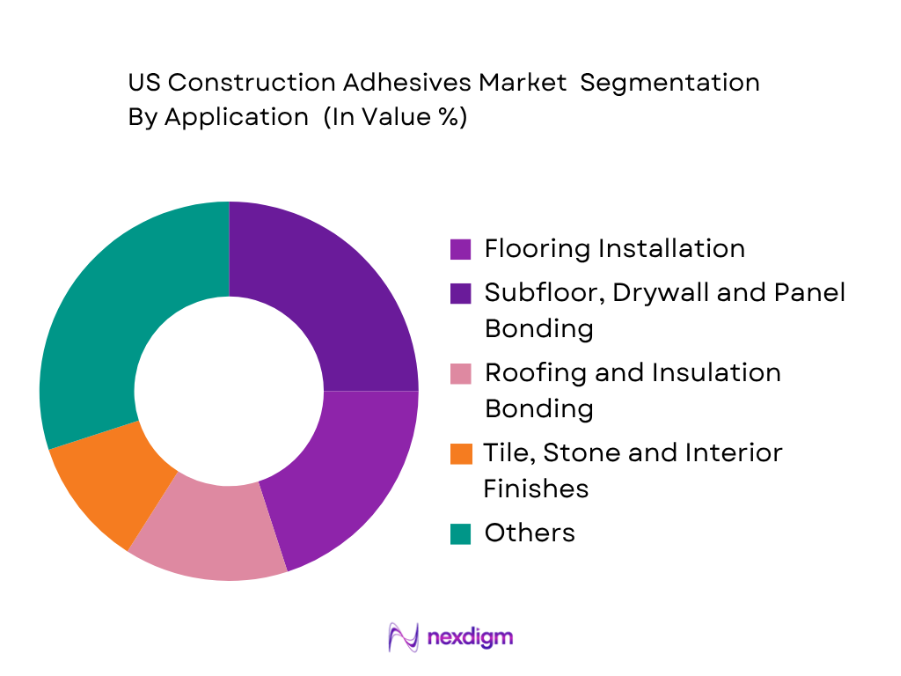
The US Construction Adhesives Market is segmented into flooring, subfloor bonding, drywall and wall panels, roofing, insulation, tile and stone, structural anchoring, building envelopes, millwork and other interior construction applications. Flooring and subfloor applications represent the dominant modeled segment because a broad range of hardwood, resilient flooring, carpet tile, LVT and engineered wood installations rely on adhesives to provide long-term bond strength, dimensional stability and moisture tolerance. Subfloor construction also uses polyurethane and high-solids adhesives to reduce squeaks and complement mechanical fastening. Sika’s flooring portfolio illustrates the technology breadth, covering polyurethane, hybrid, acrylic and pressure-sensitive adhesives with products designed for wood, resilient coverings, moisture-vapor control and sound reduction. Flooring installations also generate recurring renovation demand because finished surfaces are replaced more frequently than structural building elements. This gives flooring adhesives exposure to both new construction and the large installed stock of existing commercial, residential, healthcare, hospitality and educational properties.
Competitive Landscape
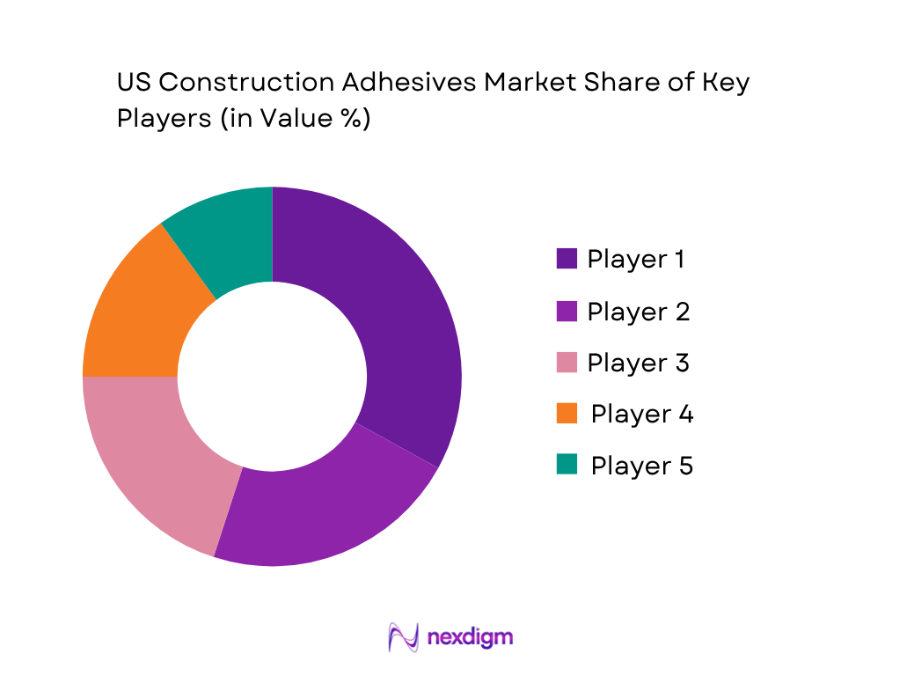
The US Construction Adhesives Market is characterized by global adhesive specialists, construction-chemical groups and strong retail-oriented brands. H.B. Fuller, Henkel, Sika, 3M and Bostik compete through polyurethane, hybrid, flooring, roofing, anchoring and multi-purpose technologies. Competitive differentiation increasingly depends on low-VOC chemistry, moisture tolerance, multi-substrate adhesion, cure speed, contractor distribution and specification support rather than commodity bond strength alone.
| Major Player | Establishment Year | Headquarters | Core Construction Adhesive Portfolio | Flooring Capability | Roofing / Envelope Capability | Structural Bonding | Low-VOC / Sustainable Technology | US Distribution & Technical Support |
| H.B. Fuller | 1887 | St. Paul, Minnesota, USA | ~ | ~ | ~ | ~ | ~ | ~ |
| Henkel / LOCTITE | 1876 | Düsseldorf, Germany | ~ | ~ | ~ | ~ | ~ | ~ |
| Sika Corporation | 1910 | Baar, Switzerland | ~ | ~ | ~ | ~ | ~ | ~ |
| 3M | 1902 | St. Paul, Minnesota, USA | ~ | ~ | ~ | ~ | ~ | ~ |
| Bostik / Arkema | 1889 | Colombes, France | ~ | ~ | ~ | ~ | ~ | ~ |
US Construction Adhesives Market Analysis
Growth Drivers
Residential and Non-Residential Construction Sustain Adhesive Consumption
U.S. construction activity continues to support demand for flooring adhesives, subfloor bonding systems, panel adhesives, roofing adhesives and multi-purpose construction products. Census Bureau data show total construction put in place reached USD 1.815 trillion through October 2024, including USD 792.260 billion of residential construction and USD 1.023 trillion of non-residential construction. Housing activity also remained substantial, with 1,364,100 privately owned housing units started and 1,471,200 units authorized by building permits during 2024. Every new residential unit creates adhesive applications across subfloors, hardwood flooring, resilient flooring, drywall, millwork, cabinets and insulation, while commercial and industrial structures require roofing, flooring, envelope and anchoring systems. Larger non-residential projects also favor higher-performance polyurethane, epoxy and hybrid chemistries because substrates and service requirements are more complex. The wider economic base remains supportive: World Bank data place U.S. GDP at USD 28.75 trillion, GDP per capita at USD 84,534, and population at 340,110,988 in 2024. IMF data subsequently recorded real GDP growth of 2.8 in 2024, demonstrating the scale of economic activity underpinning construction-material consumption.
Data Centre, Manufacturing and Large Building Projects Expand Specialty Adhesive Use
The expansion of data centres, manufacturing facilities, logistics buildings and other technically intensive structures is strengthening demand for specialty construction adhesives used in flooring systems, insulation, roof assemblies, envelope components and interior fit-outs. Census Bureau data show non-residential construction reached USD 1.023 trillion through October 2024, compared with USD 952.363 billion in the comparable prior period, demonstrating the substantial physical construction base available to adhesive suppliers. These projects often require moisture-tolerant flooring adhesives, high-strength anchoring systems, insulation-board bonding and multi-substrate products capable of joining concrete, steel, gypsum, composites and engineered panels. Data centres add particularly demanding flooring and envelope requirements because raised floors, resilient finishes, roof insulation and moisture protection must perform reliably around mission-critical infrastructure. Manufacturing construction likewise creates large areas of flooring, wall systems and roof assemblies requiring chemically resistant or high-strength bonding systems. The macroeconomic environment also supports capital-intensive development: World Bank data record U.S. GDP at USD 28.75 trillion and GDP per capita at USD 84,534 in 2024, while the IMF reported 16 million new jobs created since the end of 2020, supporting broader business investment and building utilization.
Market Challenges
VOC Compliance Increases Formulation and Product Qualification Complexity
VOC regulation creates a technical challenge for U.S. construction adhesive manufacturers because products must deliver bond strength, open time and cure performance while meeting increasingly restrictive emissions requirements. South Coast AQMD Rule 1168 regulates adhesive and sealant applications and requires manufacturers and private-label suppliers to report product VOC content in grams per liter, including whether products are waterborne or solvent-based. The current compliant-product list demonstrates how low manufacturers must go in several categories: one pressure-sensitive flooring adhesive is listed at 0 g/L, a carpet-pad adhesive at less than 1 g/L, a building-envelope membrane adhesive at 19 g/L, and several roofing structural adhesives at 0 g/L. These limits push suppliers toward water-based acrylics, hybrid polymers and solvent-free technologies, but reformulation can alter initial grab, wet tack, moisture tolerance and cold-weather cure. Manufacturers must therefore balance compliance with contractor expectations and substrate performance across different climates. This challenge exists within a very large economy: World Bank data record 2024 U.S. GDP of USD 28.75 trillion and GDP per capita of USD 84,534, while IMF data record a 2024 federal funds rate of 4.4, adding financing discipline across construction and manufacturing investment decisions.
Multi-Substrate Construction and Moisture Conditions Raise Failure Risk
Construction adhesives increasingly need to bond dissimilar and variable substrates, creating a performance challenge across flooring, panels, structural anchoring and envelope applications. A single project may require adhesion to concrete, plywood, OSB, gypsum, metal, PVC, rubber flooring and engineered wood, each with different porosity, movement and surface-energy characteristics. Moisture adds further complexity, particularly for flooring installed over concrete slabs where residual water vapor can weaken conventional acrylic or pressure-sensitive products. Housing and commercial construction volumes amplify the scale of this issue: the United States recorded 1,364,100 housing starts in 2024, while residential construction totaled USD 792.260 billion through October and non-residential construction reached USD 1.023 trillion over the same period. These volumes mean even small incompatibility or surface-preparation failures can translate into extensive remedial work across flooring, subfloor and interior installation. Contractors must therefore manage substrate testing, primer selection, adhesive coverage, cure time and jobsite temperature rather than treating adhesives as interchangeable commodities. The World Bank recorded a U.S. population of 340,110,988 and GDP of USD 28.75 trillion in 2024, while the IMF reported unemployment at 4.1 in the fourth quarter, highlighting a large construction economy where installation productivity and skilled-labor efficiency remain important.
Market Opportunities
Low-VOC Hybrid and Solvent-Free Adhesives Offer a Clear Growth Path
Low-VOC and solvent-free technologies represent a strong future opportunity because regulatory requirements are already pushing U.S. construction toward water-based acrylic, hybrid polymer and other lower-emission adhesive systems. South Coast AQMD’s compliant-product database lists pressure-sensitive flooring adhesives at 0 g/L VOC, carpet-pad adhesives below 1 g/L, building-envelope adhesives at 19 g/L, and roofing structural adhesives at 0 g/L, proving that very low-emission performance is technically achievable across several construction categories. The opportunity is not limited to California because national architects, contractors and building owners increasingly standardize product specifications across multiple states. Suppliers capable of matching traditional polyurethane or solvent-based products on grab, moisture resistance and cure speed while reducing emissions can target flooring, roofing, envelope and interior-fit-out applications. The current construction base supports continued product adoption: Census Bureau data show USD 1.815 trillion of construction put in place through October 2024, including USD 792.260 billion in residential work. At the macro level, World Bank data record U.S. GDP at USD 28.75 trillion and GDP per capita at USD 84,534, while IMF data show real GDP growth of 2.8 in 2024, providing a substantial economic platform for higher-specification construction materials.
Prefabrication, Roofing and Structural Bonding Can Expand High-Value Adhesive Applications
Prefabrication, modular assembly, roofing systems and structural anchoring offer future growth opportunities because adhesives can reduce mechanical fastening, speed installation and support joining of dissimilar building materials. The current construction base is large enough to support wider adoption: through October 2024, U.S. non-residential construction reached USD 1.023 trillion, while residential construction reached USD 792.260 billion. Off-site manufacturers can use fast-curing polyurethane, epoxy, methacrylate and hybrid systems for panel bonding, floor modules, wall assemblies and manufactured housing, where repeatable factory conditions improve adhesive quality control. Roofing is similarly attractive because adhesives can bond insulation boards, cover boards and membranes while reducing penetrations associated with mechanical fasteners. Structural anchoring systems provide another high-value niche for threaded rods, rebar doweling and post-installed reinforcement in concrete and masonry. Current regulatory product data already show roofing structural adhesives available at 0 g/L VOC, indicating that performance and emission reduction can coexist. World Bank data place 2024 U.S. GDP at USD 28.75 trillion, population at 340,110,988, and GDP per capita at USD 84,534; IMF data record real GDP growth of 2.8, supporting continued investment in advanced construction methods and labor-saving building technologies.
Future Outlook
The US Construction Adhesives Market is expected to expand at approximately ~X.X% CAGR during 2026–2035, supported by renovation, housing turnover, non-residential construction, modular building, roofing replacement and increasing substitution of mechanical fastening with adhesive bonding. Product development is likely to favor hybrid polymers, moisture-tolerant flooring systems, high-grab formulations and lower-emission technologies. Residential construction will remain an important demand platform despite fluctuations in housing starts. The U.S. Census Bureau recorded 1,364,100 housing starts and 1,471,200 permits in the latest complete annual residential dataset. Each home incorporates adhesives in subfloor assemblies, wall panels, flooring, trim, cabinets, insulation and specialty installation.
Major Players
- H.B. Fuller
- Henkel / LOCTITE
- Sika Corporation
- 3M
- Bostik / Arkema
- MAPEI Corporation
- Franklin International / Titebond
- DAP Products
- PPG / Liquid Nails
- Tremco CPG
- The Gorilla Glue Company
- ARDEX Americas
- LATICRETE International
- Custom Building Products
- Saint-Gobain Construction Chemicals
Key Target Audience
- Construction Adhesive and Specialty Chemical Manufacturers
- Flooring and Roofing Material Manufacturers
- Building Product and Prefabricated Component Manufacturers
- General Contractors and Specialty Installation Contractors
- Building Material Distributors and Home Improvement Retailers
- Real Estate Developers and Building Owners
- Investments and Venture Capitalist Firms
- Government and Regulatory Bodies (U.S. Environmental Protection Agency, Occupational Safety and Health Administration, California Air Resources Board, South Coast Air Quality Management District, General Services Administration)
Research Methodology
Step 1: Identification of Key Variables
The initial phase involves constructing an ecosystem map covering construction adhesive manufacturers, resin suppliers, distributors, contractors, flooring installers, roofing contractors and building-product OEMs. Desk research identifies critical variables including resin chemistry, application type, substrate, cure profile, packaging, VOC classification, construction activity and replacement demand.
Step 2: Market Analysis and Construction
Historical demand is analyzed through top-down and bottom-up approaches. Top-down analysis considers housing starts, construction spending, renovation activity and key building end uses, while bottom-up analysis models adhesive consumption by installed flooring area, subfloor construction, roofing assemblies, wall-panel applications, structural anchoring and typical adhesive coverage.
Step 3: Hypothesis Validation and Expert Consultation
Market hypotheses are validated through computer-assisted telephone interviews with adhesive producers, distributors, flooring contractors, roofers, builders and building-product manufacturers. These interactions validate polyurethane and hybrid adoption, moisture tolerance, VOC requirements, packaging preferences, cure-time requirements, contractor brand selection and channel dynamics.
Step 4: Research Synthesis and Final Output
The final phase triangulates U.S. Census construction indicators, manufacturer disclosures, regulatory requirements and primary research. Bottom-up adhesive-consumption estimates are reconciled against construction and renovation activity. The resulting model evaluates resin technologies, applications, competitive positioning, professional versus retail channels and future opportunities across low-VOC, modular, roofing, flooring and structural-bonding applications.

- Executive Summary
- Research Methodology (Market Definitions and Assumptions, US Construction Adhesives Market Boundary, Construction Adhesive versus Sealant Classification, Structural versus Non-Structural Bonding Assessment, Solvent-Based Adhesive Assessment, Water-Based Adhesive Assessment, Polyurethane Adhesive Assessment, Hybrid Polymer Adhesive Assessment, Epoxy Adhesive Assessment, Acrylic Adhesive Assessment, Construction Mastic Assessment, Hot-Melt Adhesive Assessment, Pressure-Sensitive Adhesive Assessment, Flooring Adhesive Assessment, Wall Panel Adhesive Assessment, Drywall Adhesive Assessment, Roofing Adhesive Assessment, Insulation Adhesive Assessment, Subfloor Adhesive Assessment, Tile Adhesive Assessment, Anchoring Adhesive Assessment, Building Envelope Bonding Assessment, Engineered Wood and Mass Timber Adhesive Assessment, VOC Compliance Mapping, ASTM C557 Assessment, ASTM D3498 Assessment, SCAQMD Rule 1168 Assessment, LEED Low-Emitting Material Assessment, Supply-Side Assessment, Demand-Side Assessment, Top-Down Market Sizing, Bottom-Up Market Sizing, Primary Industry Interviews, Construction Pipeline Assessment, Distribution Channel Mapping, Data Triangulation, Forecasting Framework)

- Definition and Scope
- Evolution of Construction Adhesive Technology in the United States, Transition from Solvent-Based Construction Mastics to Water-Based and Low-VOC Systems, Development of Polyurethane Construction Adhesives, Hybrid Polymer Grab Adhesives, Advanced Acrylic Bonding Systems, Flooring Adhesive Technologies, Subfloor Adhesives, Panel and Drywall Adhesives, Roofing Insulation Adhesives, Structural Anchoring Adhesives, Engineered Wood Bonding, Prefabrication and Modular Construction Adhesives, Moisture-Tolerant Adhesives, Green-Concrete Bonding Systems, Fast-Cure Construction Adhesives, Bio-Based Adhesive Technologies
- Construction Adhesives Industry Value Chain Analysis
- Construction Adhesives Supply Chain Analysis
- Petrochemical Feedstock Suppliers, Polyurethane Raw Material Suppliers, Acrylic Polymer Suppliers, Epoxy Resin Suppliers, Silane-Terminated Polymer Suppliers, Tackifier Suppliers, Fillers and Rheology Modifier Suppliers, Adhesive Manufacturers, Cartridge and Sausage Packaging Suppliers, Private-Label Manufacturers, Building Material Distributors, Flooring Distributors, Roofing Distributors, Home Improvement Retailers, Lumberyards, Specialty Contractors, General Contractors, Modular Building Manufacturers, Prefabricated Component Producers, Architects and Specifiers

- Growth Drivers (Residential Construction Activity, Non-Residential Construction Spending, Repair and Remodeling Demand, Data Centre Construction, Warehouse and Logistics Development, Flooring Replacement, Roofing Renovation, Modular and Prefabricated Construction, Labor-Saving Adhesive Systems, Lightweight Building Materials, Building Envelope Upgrades, Adhesive-Based Mechanical Fastener Reduction)
- Market Challenges (Raw Material Volatility, Isocyanate and Resin Supply Exposure, VOC Regulatory Compliance, Adhesive-Substrate Compatibility, Moisture-Related Flooring Failures, Cold-Weather Application Constraints, Surface Preparation Variability, Contractor Installation Errors, Cure-Time Requirements, Product Substitution Risk, Private-Label Price Competition, Multi-Material Bonding Complexity)
- Market Opportunities (Hybrid Polymer Construction Adhesives, Low-VOC and Solvent-Free Systems, Bio-Based Flooring Adhesives, Modular Construction Bonding, Mass Timber Adhesives, Data Centre Flooring Systems, Roofing Insulation Adhesives, Building Envelope Bonding, Fast-Cure Grab Adhesives, Green-Concrete-Compatible Adhesives, Moisture-Tolerant Flooring Adhesives, Structural Anchoring Systems, Digital Specification and Contractor Training)
- Market Trends (Silyl-Modified Polymer Adoption, One-Component Polyurethane Adhesives, High-Initial-Grab Products, Low-Odor Formulations, Water-Based Flooring Adhesives, Pressure-Sensitive Flooring Adhesives, Bio-Based Adhesive Content, Fast-Curing Systems, Cartridge-Based Installation, Multi-Substrate Adhesives, Green-Concrete Bonding, Adhesive-Based Prefabrication, Online Contractor Distribution)
- Government Regulations and Standards (ASTM C557 Construction Adhesive Requirements, ASTM D3498 Field-Gluing Plywood Requirements, SCAQMD Rule 1168 Adhesive and Sealant VOC Limits, California Air Resources Board Requirements, EPA VOC and Chemical Requirements, OSHA Hazard Communication Requirements, TSCA Chemical Compliance, LEED Low-Emitting Material Requirements, Green Building Product Disclosure Requirements, State and Local VOC Regulations)
- SWOT Analysis
- Porter’s Five Forces Analysis
- PESTLE Analysis
- Stakeholder Ecosystem

- By Market Value (2020-2025)
- By Construction Adhesive Consumption Volume (2020-2025)
- By Polyurethane Adhesive Consumption (2020-2025)
- By Water-Based Adhesive Consumption (2020-2025)
- By Hybrid Polymer Adhesive Consumption (2020-2025)
- By Acrylic Adhesive Consumption (2020-2025)
- By Epoxy Adhesive Consumption (2020-2025)
- By Flooring Adhesive Consumption (2020-2025)

- By Resin and Chemistry Type (In Value %)
Polyurethane Adhesives
Water-Based Acrylic Adhesives
Solvent-Based Adhesives
Epoxy Adhesives
Silyl-Modified Polymer Adhesives
Hybrid Polymer Adhesives
Vinyl Acetate and PVA Adhesives
Construction Mastics
Hot-Melt Adhesives
Pressure-Sensitive Adhesives
Reactive Acrylic Adhesives
Methacrylate Adhesives
Specialty Bio-Based Adhesives - By Application (In Value %)
Flooring Installation
Hardwood Flooring Bonding
Resilient Flooring Installation
Carpet and Carpet Tile Installation
Subfloor Bonding
Drywall and Gypsum Board Bonding
Wall Panel Installation
Wood Trim and Molding Bonding
Cabinet and Millwork Installation
Roofing Insulation Bonding
Single-Ply Roofing Applications
Thermal Insulation Board Bonding
Structural Anchoring
Building Envelope Bonding
Concrete and Masonry Bonding - By Construction Component (In Value %)
Floors
Walls and Partitions
Roofs
Subfloors
Ceilings
Building Envelope
Windows and Doors
Insulation Systems
Interior Finishes
Wood Framing Components
Concrete and Masonry Elements
Prefabricated Panels - By End-Use Building Type (In Value %)
Single-Family Residential Buildings
Multi-Family Residential Buildings
Commercial Offices
Retail Buildings
Hotels and Hospitality Buildings
Healthcare Facilities
Educational Buildings
Data Centres - By Construction Activity (In Value %)
New Residential Construction
New Non-Residential Construction
Repair and Remodeling
Tenant Improvement
Building Envelope Retrofit
Roof Replacement
Interior Renovation
Building Restoration
Infrastructure Repair - By Performance Requirement (In Value %)
High Initial Grab
Fast Cure
High Bond Strength
Elastic Bonding
Moisture Resistance
Waterproof Bonding
Low-VOC Performance - By Substrate Type (In Value %)
Wood
Plywood and OSB
Concrete
Masonry
Gypsum Board
Fiber Cement
Metal
Glass

- Market Share of Major Players (By US Revenue, Construction Adhesive Volume, Polyurethane Portfolio, Hybrid Polymer Portfolio, Water-Based Portfolio, Flooring Adhesive Exposure, Roofing Adhesive Exposure, Subfloor and Panel Adhesive Exposure, Structural Anchoring Exposure, Residential Construction Exposure, Non-Residential Construction Exposure, Manufacturing Footprint, Retail Distribution, Professional Distributor Network, Technical Service Coverage)
- Cross Comparison Parameters (Construction Adhesive Technology Portfolio Breadth, Flooring Roofing Subfloor and Panel Application Coverage, Polyurethane Hybrid Polymer and Low-VOC Technology Capability, Structural Anchoring and High-Strength Bonding Capability, US Manufacturing and Formulation Footprint, Professional Distribution Retail and Contractor Reach, ASTM VOC and Green-Building Compliance Capability, Technical Specification Training and Jobsite Support Capability)
- SWOT Analysis of Major Players (Technology Portfolio, Manufacturing, Distribution, Brand Strength, Contractor Reach)
- Major Companies
H.B. Fuller
Henkel / LOCTITE
Sika Corporation
3M
MAPEI Corporation
Franklin International / Titebond
DAP Products
PPG / Liquid Nails
Tremco CPG
The Gorilla Glue Company
ARDEX Americas
LATICRETE International
Custom Building Products
Saint-Gobain Construction Chemicals

- General Contractor Requirement Assessment
- Flooring Contractor Requirement Assessment
- Roofing Contractor Requirement Assessment
- Carpenter and Framing Contractor Requirement Assessment
- Drywall Contractor Requirement Assessment
- Modular Building Manufacturer Requirement Assessment
- Prefab Component Manufacturer Requirement Assessment
- Mass Timber Fabricator Requirement Assessment
- Architect and Specification Requirement Assessment
- Building Product OEM Requirement Assessment

- By Market Value (2026-2035)
- By Construction Adhesive Consumption Volume (2026-2035)
- By Polyurethane Adhesive Consumption (2026-2035)
- By Water-Based Adhesive Consumption (2026-2035)
- By Hybrid Polymer Adhesive Consumption (2026-2035)
- By Acrylic Adhesive Consumption (2026-2035)
- By Epoxy Adhesive Consumption (2026-2035)
- By Flooring Adhesive Consumption (2026-2035)


 Request a Sample
 Ask for Customization
 Get a Quote
 Enquire Now