

 Download PDF
Market Overview
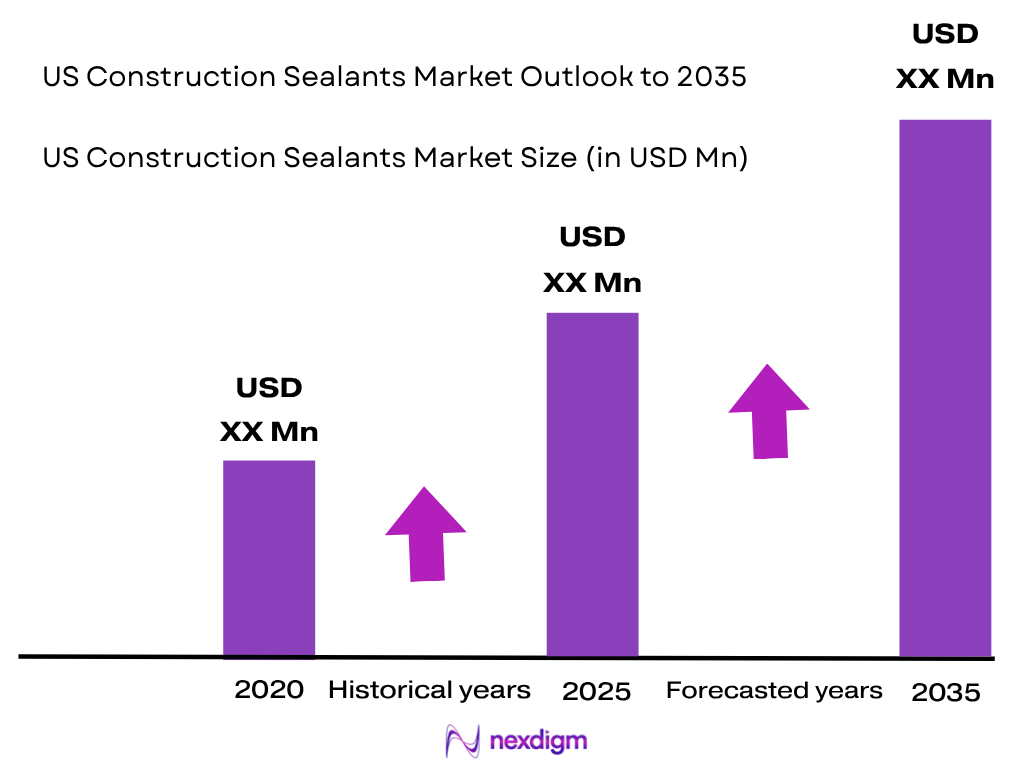
The US Construction Sealants Market is valued at approximately USD ~XX billion, supported by construction spending rising from USD 2,023.7 billion in the preceding annual observation to USD 2,154.4 billion in the latest observation. Private residential construction increased from USD 866.9 billion to USD 917.9 billion, while private non-residential construction moved from USD 706.1 billion to USD 743.8 billion, sustaining demand for façade, glazing, concrete-joint and perimeter-sealing products.
Texas, Florida, California and major Sun Belt metropolitan areas dominate US construction-sealant demand because they combine high housing construction, large commercial pipelines, harsh weather exposure and substantial window, façade and joint-sealing requirements. Texas authorized 225,756 housing units, Florida 173,326 and California 101,545, while Dallas authorized 71,788 units, Houston 65,747, New York 57,929 and Phoenix 45,884, supporting concentrated professional sealant consumption.
Market Segmentation
By Sealant Chemistry
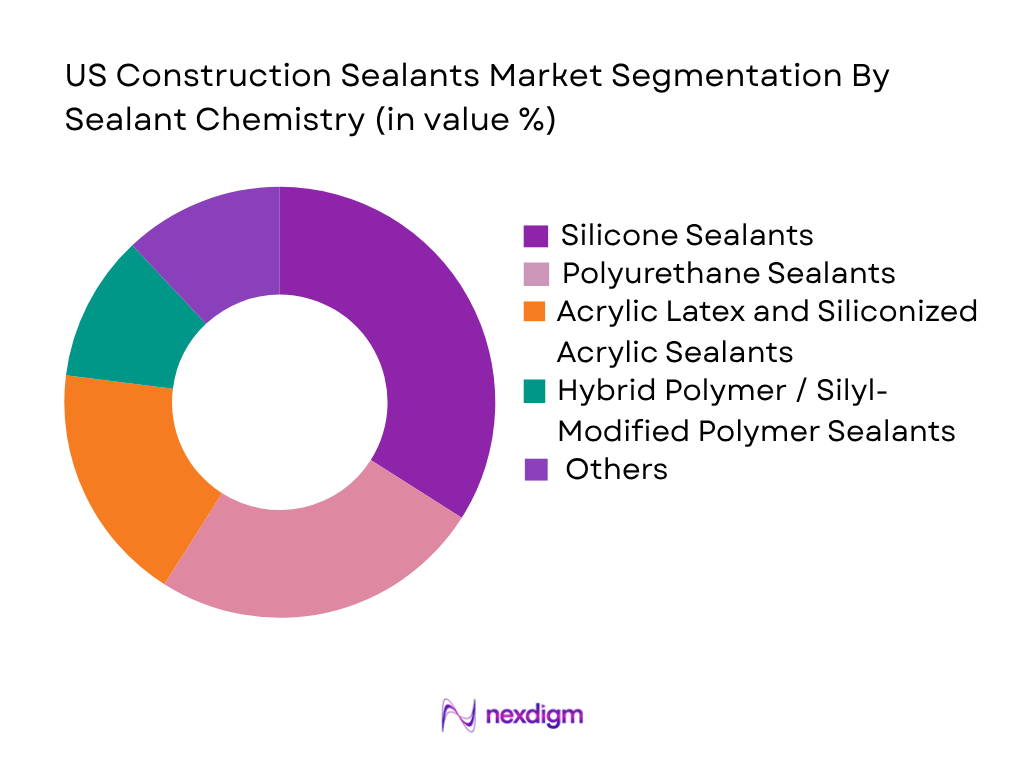
The US Construction Sealants Market is segmented into silicone sealants, polyurethane sealants, hybrid polymer and silyl-modified polymer sealants, acrylic latex sealants, butyl sealants, polysulfide sealants and other specialty products. Silicone sealants hold the dominant market share because their UV resistance, weatherability, movement capability and long-term elasticity make them particularly suitable for commercial façades, curtain walls, glazing, window perimeters and exterior building-envelope joints. Structural silicone systems can provide ±50% movement capability while bonding glass, aluminum, coated metal, concrete and other construction substrates. Silicone also performs effectively where exposure to sunlight, rain, temperature cycling and moisture places significant durability demands on joint materials. Polyurethane remains important for concrete, masonry and traffic-bearing applications due to paintability and strong adhesion, while hybrid polymer systems are gaining relevance where contractors seek primerless adhesion, lower VOC profiles and multi-substrate compatibility.
By Application
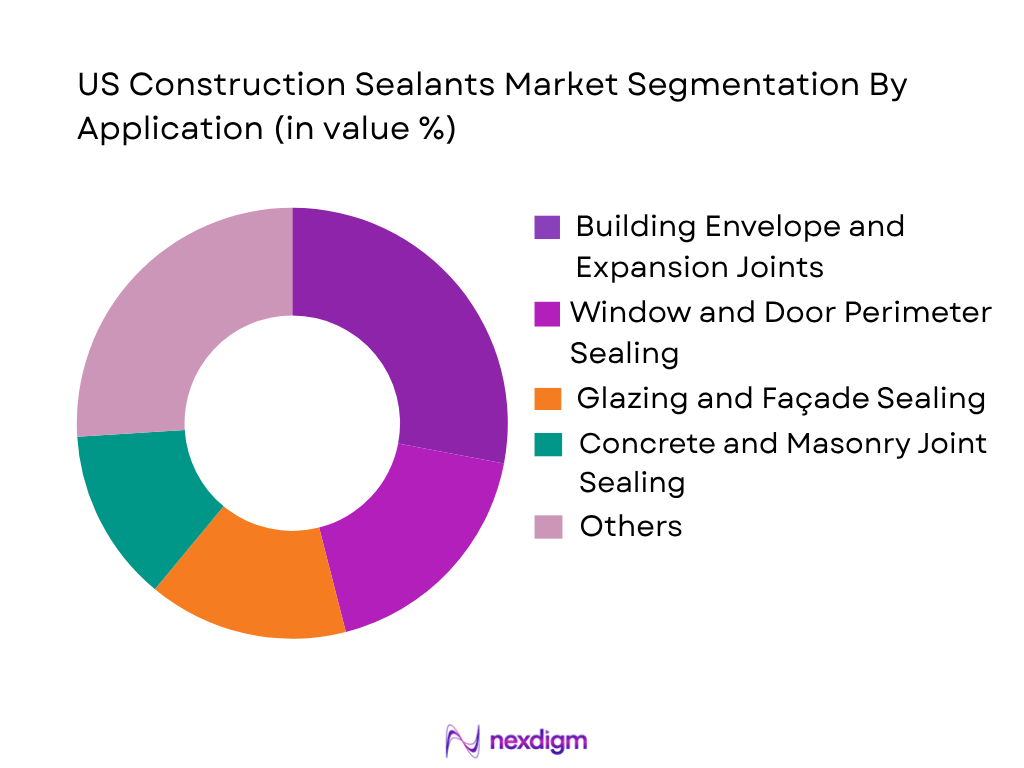
The US Construction Sealants Market is segmented into building envelope and expansion joints, windows and doors, glazing and façades, concrete and masonry joints, roofing, infrastructure, firestopping and acoustic sealing, and interior applications. Building envelope and expansion-joint sealing holds the dominant share because modern US buildings increasingly depend on continuous air- and water-management systems across interfaces between concrete, glazing, metal panels, windows, EIFS and roofing assemblies. Construction activity reached USD 2,154.4 billion, including USD 1,224.8 billion in non-residential construction, creating substantial exposure for weathersealing and movement joints. High-performance products are frequently specified to ASTM C920 movement requirements, with commercial systems capable of Class 35, Class 50 and higher movement performance. Window replacement, façade restoration and re-caulking further expand demand beyond new construction because sealants have finite service lives and must maintain adhesion through repeated thermal cycling. Infrastructure joints represent another important application due to highways, parking decks, airports and concrete rehabilitation.
Competitive Landscape
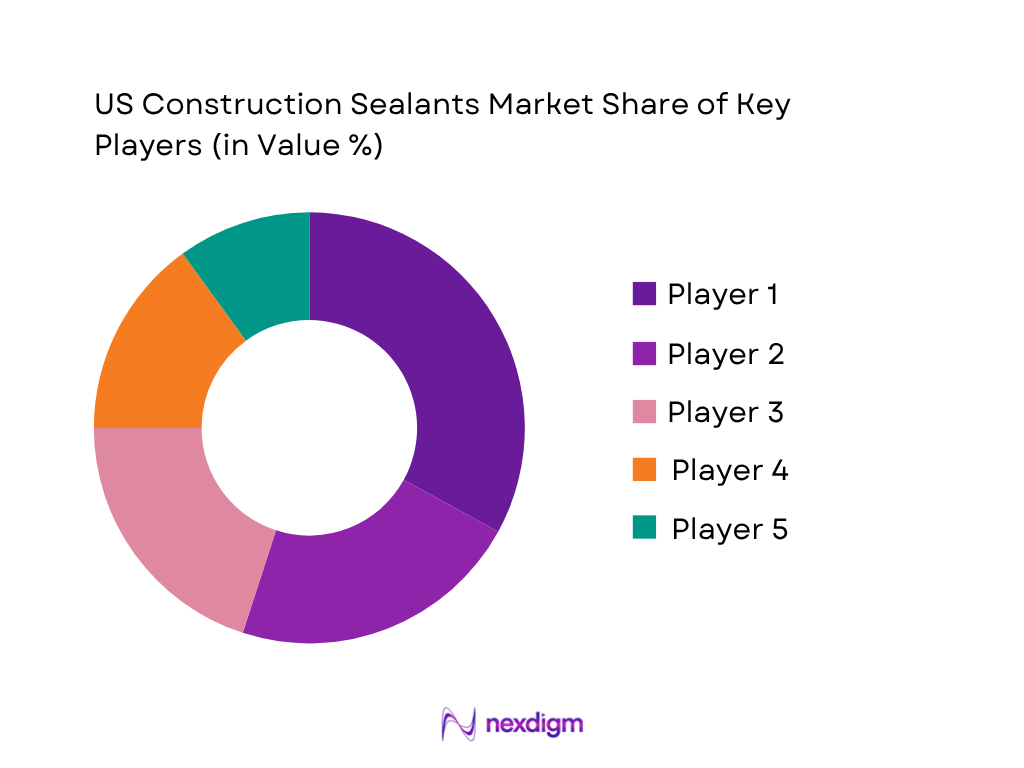
The US Construction Sealants Market is characterized by a combination of global construction-chemical groups, dedicated architectural weatherproofing companies and strong retail caulk brands. Sika, Tremco, Dow, Pecora and DAP represent different competitive strengths: Sika has broad polyurethane and hybrid systems, Tremco is strongly positioned in commercial building envelopes, Dow is prominent in silicone glazing technology, Pecora focuses heavily on architectural weatherproofing, while DAP has strong professional and retail exposure. Competition centers on movement capability, ASTM compliance, structural glazing expertise, substrate adhesion, building-envelope integration and technical specification support.
| Major Player | Establishment Year | Headquarters | Silicone / Weatherseal Capability | Polyurethane / Hybrid Capability | Structural Glazing Capability | Building Envelope Systems | Infrastructure Joint Capability | Technical & Specification Support |
| Sika | 1910 | Baar, Switzerland | ~ | ~ | ~ | ~ | ~ | ~ |
| Tremco Commercial Sealants & Waterproofing | 1928 | Beachwood, Ohio, US | ~ | ~ | ~ | ~ | ~ | ~ |
| Dow | 1897 | Midland, Michigan, US | ~ | ~ | ~ | ~ | ~ | ~ |
| Pecora Corporation | 1862 | Harleysville, Pennsylvania, US | ~ | ~ | ~ | ~ | ~ | ~ |
| DAP Global Inc. | 1865 | Baltimore, Maryland, US | ~ | ~ | ~ | ~ | ~ | ~ |
US Construction Sealants Market Analysis
Growth Drivers
Large Construction Activity Sustaining Building-Envelope and Joint-Sealing Demand
The US Construction Sealants Market is supported by the country’s exceptionally large construction base, which generates recurring consumption of silicone, polyurethane, acrylic and hybrid sealants across façades, windows, doors, concrete joints and roofing interfaces. U.S. Census Bureau data show USD 2,154.4 billion of construction put in place in 2024, including USD 1,661.7 billion of private construction, USD 917.9 billion of private residential construction and USD 743.8 billion of private non-residential construction. New residential development also remained substantial, with 1,471,200 housing units authorized and 1,364,100 housing units started during 2024. Every new building creates perimeter joints, glazing interfaces, façade transitions, penetrations and movement joints requiring weatherproof sealing. Commercial and institutional projects further require higher-performance ASTM C920 systems capable of accommodating substrate movement and prolonged weather exposure. The macroeconomic backdrop supports this construction intensity: World Bank data place US GDP at USD 28.75 trillion in 2024, with GDP per capita at USD 84,534 and a population of 340,110,988. This scale of construction activity supports broad recurring demand for construction sealants across both new-build and repair applications.
Federal Highway and Bridge Programs Supporting Infrastructure Sealant Applications
Federal infrastructure activity is strengthening demand for construction sealants used in bridge joints, concrete pavements, parking structures, transportation facilities and civil-engineering rehabilitation. The Federal Highway Administration calculated USD 54,608,583,217 in authorized apportioned highway funds for fiscal 2024, creating a substantial pipeline of state-administered road and bridge work. The Bridge Formula Program separately received USD 5.5 billion for bridge replacement, rehabilitation, preservation, protection and construction. Bridge Investment Program awards announced during 2024 added USD 634,810,399 across 22 projects, covering structures in multiple states including Texas, New York, Michigan, Minnesota and Missouri. These projects create applications for traffic-grade polyurethane sealants, polysulfide systems, expansion-joint sealants and products engineered for water, deicing chemicals and cyclic movement. Infrastructure work also generates recurring replacement demand because deteriorated joint materials must be removed and resealed during rehabilitation. The macroeconomic environment remains supportive, with World Bank data showing US GDP of USD 28.75 trillion in 2024, GDP per capita of USD 84,534, and a national population of 340,110,988. The combination of federal allocations and a large economic base therefore supports technically demanding infrastructure sealant applications.
Market Challenges
Residential Construction Moderation Creating Uneven New-Build Sealant Demand
The US Construction Sealants Market faces a challenge from moderation in portions of new residential construction, which can reduce incremental demand for window, door, siding, roofing and perimeter sealants even when total construction activity remains high. U.S. Census Bureau and HUD data show 1,364,100 privately owned housing units started in 2024 and 1,471,200 units authorized by permits. Final revised permitting data subsequently placed authorized units at 1,478,000, while permits declined to 1,425,200 units in 2025. December 2025 permitting ran at an annualized 1,448,000 units, demonstrating that the residential construction pipeline remained sizeable but did not expand uniformly. Sealant producers exposed heavily to new single-family and multifamily construction therefore need to balance new-build demand with renovation, re-caulking and replacement applications. Production planning is further complicated because different housing formats consume different quantities of acrylic, silicone, hybrid and polyurethane sealants. The challenge exists within a large economy: World Bank data record US GDP of USD 28.75 trillion in 2024, GDP per capita of USD 84,534, and population of 340,110,988. Market participants therefore need diversified exposure across residential, commercial and retrofit channels rather than dependence on housing starts alone.
Application-Sensitive Installation and Construction Labor Requirements Increasing Execution Risk
Construction sealants are highly dependent on correct joint preparation, substrate cleaning, backer-rod placement, primer selection and application depth, making field execution an important challenge for the US market. Bureau of Labor Statistics data show 5,269,500 employees in specialty trade contracting in December 2024, including 2,418,100 in residential specialty trades and 2,851,400 in non-residential specialty trades. Production and nonsupervisory employment included approximately 48,100 workers in glass and glazing contracting, 192,700 in roofing contracting and 791,300 across foundation, structure and building-exterior contractors. At the same time, the construction industry recorded 217,000 job openings, 301,000 hires and 279,000 separations in December 2024, illustrating substantial workforce movement across construction activities. For sealants, workforce turnover can complicate consistent adherence to joint geometry, tooling, cure conditions and manufacturer-specific installation requirements, particularly on façade and glazing work where improper installation can lead to air or water intrusion. World Bank data show a USD 28.75 trillion US GDP in 2024, GDP per capita of USD 84,534, and population of 340,110,988, indicating the scale of construction activity requiring trained field execution.
Market Opportunities
Bridge Rehabilitation Pipeline Expanding Demand for High-Performance Joint Sealants
The US bridge rehabilitation pipeline creates a significant opportunity for construction sealant manufacturers because bridge decks, approach slabs, expansion joints and concrete interfaces require products capable of handling movement, moisture, traffic and chemical exposure. The Federal Highway Administration allocated USD 5.5 billion in fiscal 2024 through the Bridge Formula Program for bridge replacement, rehabilitation, preservation, protection and construction. Separately, Bridge Investment Program awards announced in 2024 totalled USD 634,810,399 across 22 projects in 19 states. Individual grants included USD 47 million for rehabilitation of the Helena Bridge across the Mississippi River, USD 32 million for the Barton Springs Road Bridge in Texas and USD 23 million for preservation work on the Gardner River Bridge in Wyoming. These existing investments create future installation opportunities for polyurethane, polysulfide and specialized elastomeric sealants used in traffic-bearing joints and water-exposed concrete structures. World Bank data show US GDP at USD 28.75 trillion in 2024, GDP per capita at USD 84,534, and population at 340,110,988, supporting continued infrastructure investment capacity. Suppliers with DOT-compliant products and field technical support are positioned to address this expanding rehabilitation channel.
Manufacturing and Advanced-Facility Construction Creating High-Specification Sealant Opportunities
Expanding manufacturing construction creates a future growth opportunity for US construction sealants because semiconductor plants, battery facilities, advanced manufacturing buildings and supporting utility structures require extensive exterior-envelope, floor-joint, glazing, roofing and penetration sealing. U.S. Census Bureau data recorded manufacturing construction running at a seasonally adjusted annual rate of approximately USD 235.5 billion in June 2024, including approximately USD 234.8 billion in private manufacturing construction. The same period recorded total non-residential construction activity of approximately USD 1,208.6 billion, transportation construction of about USD 67.1 billion, power construction of USD 143.9 billion, highway and street construction of USD 144.5 billion, and water-supply construction of USD 31.3 billion. These projects create specification opportunities for chemical-resistant joint sealants, high-movement silicone weatherseals, fire-rated products, hybrid polymers and industrial-floor joint systems. Current construction activity therefore provides an installed project pipeline from which future sealing and maintenance demand can develop without relying on forecast statistics. World Bank data place US GDP at USD 28.75 trillion in 2024, GDP per capita at USD 84,534, and population at 340,110,988, providing a substantial macroeconomic platform for technically advanced construction.
Future Outlook
The US Construction Sealants Market is projected to expand at approximately ~XX% CAGR during 2026-2035, supported by continued building-envelope modernization, infrastructure rehabilitation, façade restoration and higher-performance joint specifications. Silicone and hybrid polymer technologies are expected to gain importance where long weatherability, high joint movement and multi-substrate adhesion are required. Demand should also shift toward systems rather than standalone caulking products. Architects and envelope consultants increasingly evaluate sealants alongside air barriers, glazing components, flashing and waterproofing systems, raising the importance of compatibility testing and single-source specifications.
Infrastructure rehabilitation offers another long-term demand base. Public construction expenditure reached USD 492.7 billion, including USD 142.7 billion for highway construction and USD 105.2 billion for educational construction, supporting concrete-joint, traffic-grade and perimeter-sealing requirements. Hybrid sealants are expected to expand where contractors require paintability, low VOC content, weather resistance and adhesion to multiple substrates without extensive priming. High-movement silicone systems will remain important in high-rise façades, curtain walls, precast panels and window-perimeter applications.
Major Players
- Sika Corporation
- Tremco Commercial Sealants & Waterproofing
- Dow Inc.
- Pecora Corporation
- DAP Global Inc.
- W. R. Meadows, Inc.
- Bostik, Inc.
- Henkel Corporation / OSI
- H.B. Fuller Company
- MAPEI Corporation
- Master Builders Solutions
- Euclid Chemical
- Momentive Performance Materials
- Geocel / The Sherwin-Williams Company
- Franklin International / Titebond
Key Target Audience
- Construction Sealant and Construction Chemical Manufacturers
- Building Envelope and Waterproofing Contractors
- Glass, Glazing and Façade Contractors
- General Contractors and Infrastructure Contractors
- Architects, Building Owners and Real Estate Developers
- Construction Material and Specialty Building Product Distributors
- Investments and Venture Capitalist Firms
- Government and Regulatory Bodies (US Environmental Protection Agency, Occupational Safety and Health Administration, Federal Highway Administration, General Services Administration, State Departments of Transportation)
Research Methodology
Step 1: Identification of Key Variables
The initial phase involves constructing an ecosystem map covering sealant manufacturers, polymer suppliers, glazing contractors, waterproofing contractors, distributors, general contractors, architects and building owners. Critical variables include construction spending, joint density, chemistry mix, movement-class requirements, building-envelope exposure, infrastructure activity, repair cycles, packaging format and regional construction concentration.
Step 2: Market Analysis and Construction
Historical information for the US Construction Sealants Market is compiled from residential, commercial and infrastructure construction indicators. Bottom-up calculations assess sealant consumption by joint length, application, chemistry and typical product yield, while top-down analysis evaluates construction expenditure and construction-chemical intensity. The two approaches are reconciled to establish market values and segment-level consumption patterns.
Step 3: Hypothesis Validation and Expert Consultation
Market hypotheses are validated through computer-assisted telephone interviews with sealant manufacturers, distributors, glazing contractors, façade specialists, waterproofing contractors and specification professionals. Consultations evaluate silicone versus polyurethane usage, hybrid polymer adoption, ASTM movement classes, joint-design requirements, primer usage, application productivity, packaging preferences and project-specific technical support.
Step 4: Research Synthesis and Final Output
Primary insights are triangulated with US Census construction statistics, ASTM-based product specifications, federal infrastructure indicators and manufacturer technical documentation. The final market framework reconciles top-down and bottom-up results and incorporates façade construction, residential demand, infrastructure rehabilitation, re-caulking cycles, sealant chemistry migration and building-envelope performance requirements into the forecast model.

- Executive Summary
- Research Methodology (Market Definitions and Assumptions, US Construction Sealants Market Classification, Silicone Sealant Scope, Polyurethane Sealant Assessment, Hybrid Polymer Sealant Assessment, Acrylic Latex Sealant Assessment, Butyl Sealant Assessment, Polysulfide Sealant Assessment, Structural Glazing Sealant Assessment, Weatherseal Sealant Assessment, Window and Door Sealant Assessment, Concrete Joint Sealant Assessment, Traffic-Grade Sealant Assessment, Fire-Rated Sealant Assessment, Acoustic Sealant Assessment, Roofing Sealant Assessment, Building Envelope Assessment, ASTM C920 Assessment, ASTM C719 Movement Capability Assessment, ASTM C834 Latex Sealant Assessment, ASTM C1184 Structural Silicone Assessment, ASTM C1248 Staining Assessment, Joint Movement Assessment, Substrate Compatibility Assessment)

- Definition and Scope
- US Construction Sealants Industry Evolution and Development of Oil-Based Caulks, Acrylic Latex Caulks, Butyl Sealants, Polysulfide Joint Sealants, One-Component Polyurethane Sealants, Two-Component Polyurethane Sealants, Acetoxy Silicone Sealants, Neutral-Cure Silicone Sealants, Structural Silicone Glazing Systems, Low-Modulus Weatherseal Silicones, Hybrid Polymer Sealants, Silyl-Modified Polymer Sealants, Firestop Sealants, Acoustic Sealants, Traffic-Grade Joint Sealants, Concrete Pavement Sealants, Window and Door Sealants, Roofing Sealants, Air-Barrier Transition Sealants, Low-VOC Sealants and High-Movement ASTM C920 Sealant Systems
- Construction Sealants Value Chain Analysis
- Construction Sealants Supply Chain Analysis
- Silicone Polymer Suppliers, Polyurethane Prepolymer Suppliers, Acrylic Polymer Suppliers, Silane-Modified Polymer Suppliers, Plasticizer Suppliers, Mineral Filler Suppliers, Catalyst Suppliers, Pigment Suppliers, Packaging Suppliers, Construction Sealant Manufacturers, Private-Label Producers, Building Product Distributors

- Growth Drivers (Commercial Construction Activity, Data Center Construction, Multifamily Residential Development, Building Envelope Modernization, Window and Door Replacement, Infrastructure Rehabilitation, High-Performance Façade Specifications, Energy-Efficient Building Envelopes, Expansion Joint Requirements, Weatherproofing Demand, Repair and Re-Caulking Activity, Contractor Productivity Requirements)
- Market Challenges (Silicone and Polyurethane Feedstock Volatility, Skilled Applicator Availability, Joint Preparation Errors, Sealant-Substrate Compatibility Failures, Plasticizer Migration, Natural Stone Staining Risk, Adhesion Failure, Premature Joint Failure, Weather-Dependent Installation, Specification Complexity, VOC Compliance Requirements, Chemistry Substitution)
- Market Opportunities (Hybrid Polymer Sealants, Low-VOC Sealants, Primerless Technologies, Green-Concrete-Compatible Sealants, High-Movement Silicone Systems, Façade Restoration, Data Center Building Envelopes, Infrastructure Joint Rehabilitation, Parking Structure Repair, Preformed Silicone Seals, Air-Barrier Transition Sealants, Fire-Rated Sealants, High-Performance Window Perimeter Sealing)
- Market Trends (Neutral-Cure Silicone Adoption, Hybrid SMP Technology, High-Movement Class 50 Systems, Low-Modulus Weatherseal Silicone, Faster Skin Formation, All-Weather Application, Green-Concrete Adhesion, Primerless Substrate Bonding, Low-Staining Façade Sealants, Color-Matched Sealants, Low-VOC Formulations, Preformed Silicone Joint Systems, Sausage Packaging, Digital Joint Calculators)
- Government Regulations and Standards (ASTM C920 Elastomeric Joint Sealants, ASTM C719 Cyclic Movement Testing, ASTM C834 Latex Sealants, ASTM C1184 Structural Silicone Sealants, ASTM C1248 Staining of Porous Substrates, ASTM C1401 Structural Sealant Glazing Guidance, International Building Code Requirements, International Energy Conservation Code Requirements, EPA VOC Requirements, State and Regional VOC Requirements, OSHA Chemical Safety Requirements, Build America Buy America Requirements, State DOT Joint Sealant Specifications)
- SWOT Analysis
- Porter’s Five Forces Analysis
- PESTLE Analysis
- Stakeholder Ecosystem
- Construction Sealants Manufacturing and Project Ecosystem

- By Market Value (2020-2025)
- By Sealant Consumption Volume (2020-2025)
- By Silicone Sealant Consumption (2020-2025)
- By Polyurethane Sealant Consumption (2020-2025)
- By Hybrid Polymer Sealant Consumption (2020-2025)
- By Acrylic Latex Sealant Consumption (2020-2025)
- By Building Envelope Sealant Consumption (2020-2025)
- By Window and Door Sealant Consumption (2020-2025)
- By Glazing and Façade Sealant Consumption (2020-2025)
- By Concrete and Masonry Joint Sealant Consumption (2020-2025)
- By Infrastructure and Pavement Sealant Consumption (2020-2025)
- By Fire-Rated and Acoustic Sealant Consumption (2020-2025)
- By Residential Construction Sealant Consumption (2020-2025)
- By Commercial Construction Sealant Consumption (2020-2025)

- By Sealant Chemistry (In Value %)
Silicone Sealants
Polyurethane Sealants
Hybrid Polymer and Silyl-Modified Polymer Sealants
Acrylic Latex Sealants
Siliconized Acrylic Sealants
Butyl Sealants
Polysulfide Sealants
Polyether Sealants
Other Specialty Construction Sealants - By Product Type (In Value %)
One-Component Sealants
Two-Component Sealants
Non-Sag Gun-Grade Sealants
Self-Leveling Sealants
Pourable Joint Sealants
Structural Glazing Sealants
Weatherseal Sealants
Traffic-Grade Sealants
Fire-Rated Sealants
Acoustic Sealants
Window and Door Sealants
Roofing Sealants
Sanitary Sealants
Preformed Silicone Seals
Sealant Tapes and Butyl Tapes - By Application (In Value %)
Building Expansion and Control Joints
Window and Door Perimeter Sealing
Curtain Wall Weathersealing
Structural Silicone Glazing
Precast Concrete Panel Joints
Tilt-Up Concrete Joints
EIFS and Stucco Joints
Masonry and Brick Joints
Roofing and Flashing Sealing
Concrete Floor and Plaza Joints
Parking Structure Joints
Highway and Bridge Joints
Airport Pavement Joints
Firestopping
Acoustic Sealing
Interior Wet-Area Sealing - By Performance Requirement (In Value %)
High-Movement ±50 Sealants
Medium-Movement ±25 Sealants
Low-Movement Sealants
Low-Modulus Sealants
High-Modulus Sealants
Structural Glazing Performance
Non-Staining Performance
Traffic-Grade Performance
Immersion Resistance
Fire Resistance
Acoustic Performance
Low-VOC Performance
Paintability
Primerless Adhesion - By Region (In Value %)
Northeast
Midwest
South
West
New England
Mid-Atlantic
East North Central
West North Central
South Atlantic
East South Central
West South Central
Mountain
Pacific

- Market Share of Major Players (By US Revenue, Sealant Consumption Volume, Silicone Sealant Portfolio, Polyurethane Sealant Portfolio, Hybrid Polymer Portfolio, Building Envelope Exposure, Structural Glazing Exposure, Infrastructure Project Exposure, Firestop and Acoustic Portfolio, Residential Retail Exposure, Commercial Contractor Coverage, US Manufacturing Capacity, Technical Laboratory Capability, Distributor Network, Specification Support)
- Cross Comparison Parameters (Architectural Silicone and Weatherseal Portfolio Breadth, ASTM C920 High-Movement Sealant Capability, Structural Glazing and Façade Sealant Capability, Polyurethane and Hybrid Polymer Technology Breadth, Building Envelope and Air-Barrier Interface Capability, Concrete Pavement and Infrastructure Joint Sealant Capability, US Manufacturing and Distribution Network Reach, Specification Engineering and Field Technical Support)
- SWOT Analysis of Major Players
- Competitive Positioning Matrix
- Major Companies
Sika Corporation
Tremco Commercial Sealants & Waterproofing
Dow Inc.
Pecora Corporation
DAP Global Inc.
W. R. Meadows, Inc.
Bostik, Inc.
Henkel Corporation / OSI
H.B. Fuller Company
MAPEI Corporation
Master Builders Solutions
Euclid Chemical
Momentive Performance Materials
Geocel / The Sherwin-Williams Company
Franklin International / Titebond

- Glazing Contractor Requirement Assessment
- Building Envelope Contractor Requirement Assessment
- Waterproofing Contractor Requirement Assessment
- General Contractor Procurement Assessment
- Concrete and Infrastructure Contractor Requirement Assessment
- Window and Door Installer Requirement Assessment
- Roofing Contractor Requirement Assessment
- Architect and Façade Consultant Specification Assessment
- Building Owner and Facility Manager Requirement Assessment
- DOT Contractor Requirement Assessment
- Sealant Replacement Contractor Requirement Assessment
- Technical Service and Field Support Requirement Assessment

- By Market Value (2026-2035)
- By Sealant Consumption Volume (2026-2035)
- By Silicone Sealant Consumption (2026-2035)
- By Polyurethane Sealant Consumption (2026-2035)
- By Hybrid Polymer Sealant Consumption (2026-2035)
- By Acrylic Latex Sealant Consumption (2026-2035)
- By Building Envelope Sealant Consumption (2026-2035)
- By Window and Door Sealant Consumption (2026-2035)
- By Glazing and Façade Sealant Consumption (2026-2035)
- By Concrete and Masonry Joint Sealant Consumption (2026-2035)
- By Infrastructure and Pavement Sealant Consumption (2026-2035)
- By Fire-Rated and Acoustic Sealant Consumption (2026-2035)
- By Residential Construction Sealant Consumption (2026-2035)
- By Commercial Construction Sealant Consumption (2026-2035)


 Request a Sample
 Ask for Customization
 Get a Quote
 Enquire Now
