
 Download PDF
Market Overview
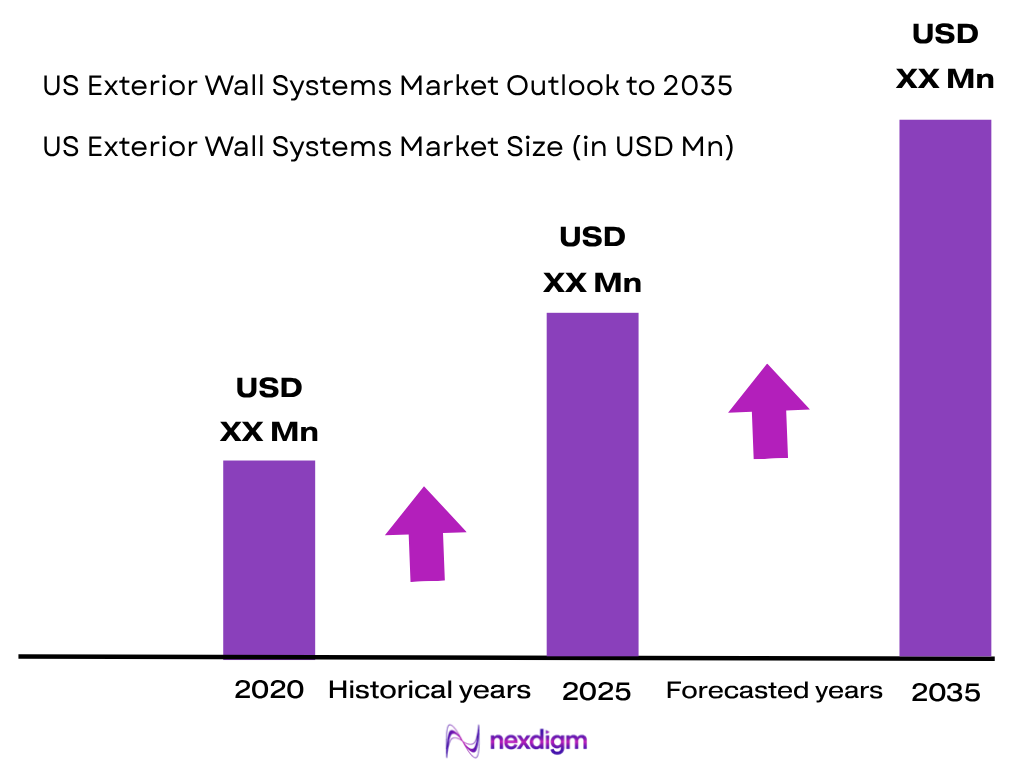
The US Exterior Wall Systems Market was valued at approximately USD ~ billion, using the requested placeholder for the 2024 market value, and is projected to expand at a CAGR of approximately ~% during 2026–2035. Demand is supported by a large construction base: annual US construction spending reached USD 2,154.4 billion, compared with USD 2,023.7 billion in the preceding period. Private residential construction accounted for USD 917.9 billion, compared with USD 866.9 billion, while private non-residential construction reached USD 743.8 billion, compared with USD 706.1 billion. These construction volumes sustain requirements for siding, rainscreens, EIFS, curtain walls, insulation, weather barriers and other exterior-envelope systems.
Texas, Florida, California and major metropolitan construction hubs such as Dallas, Houston, New York, Phoenix and Atlanta represent important demand centers for US exterior wall systems because of their high levels of residential development, population concentration and commercial construction. Texas authorized 225,756 housing units, Florida 173,326, and California 101,545, while Dallas authorized 71,788 units, Houston 65,747, New York 57,929, Phoenix 45,884 and Atlanta 40,687. Different climatic conditions across these locations also create requirements for moisture management, thermal insulation, hurricane resistance, drainage and durable exterior cladding.
Market Segmentation
By Exterior Cladding Material
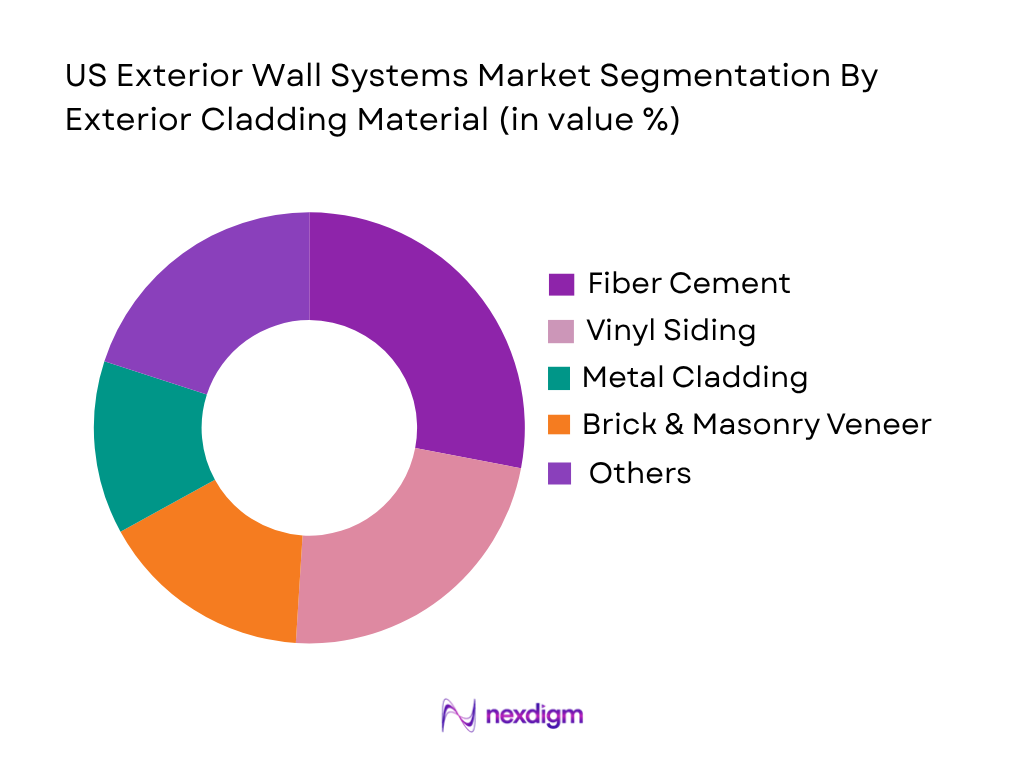
The US Exterior Wall Systems Market is segmented into fiber cement, vinyl siding, metal cladding, brick and masonry veneer, stucco, stone veneer, glass systems, wood and engineered wood, and composite panels. Fiber cement is represented as the leading sub-segment in the placeholder segmentation below, supported by its combination of durability, noncombustibility, moisture resistance and suitability for residential and commercial applications. Major manufacturers offer lap siding, vertical panels and architectural wall panels, expanding the material’s applicability from single-family housing to multifamily and commercial façades. James Hardie states that its fiber-cement products are installed on more than 10 million homes, demonstrating a substantial installed base. Nichiha’s systems add integrated rainscreen functionality, moisture management and clip-based installation, supporting architectural applications. Fiber cement also provides alternatives to traditional wood aesthetics while addressing rot, pest and weather-exposure considerations. These characteristics make the material particularly relevant in high-construction states where exterior walls must accommodate differing temperature, precipitation, wind and wildfire conditions.
By Building Type
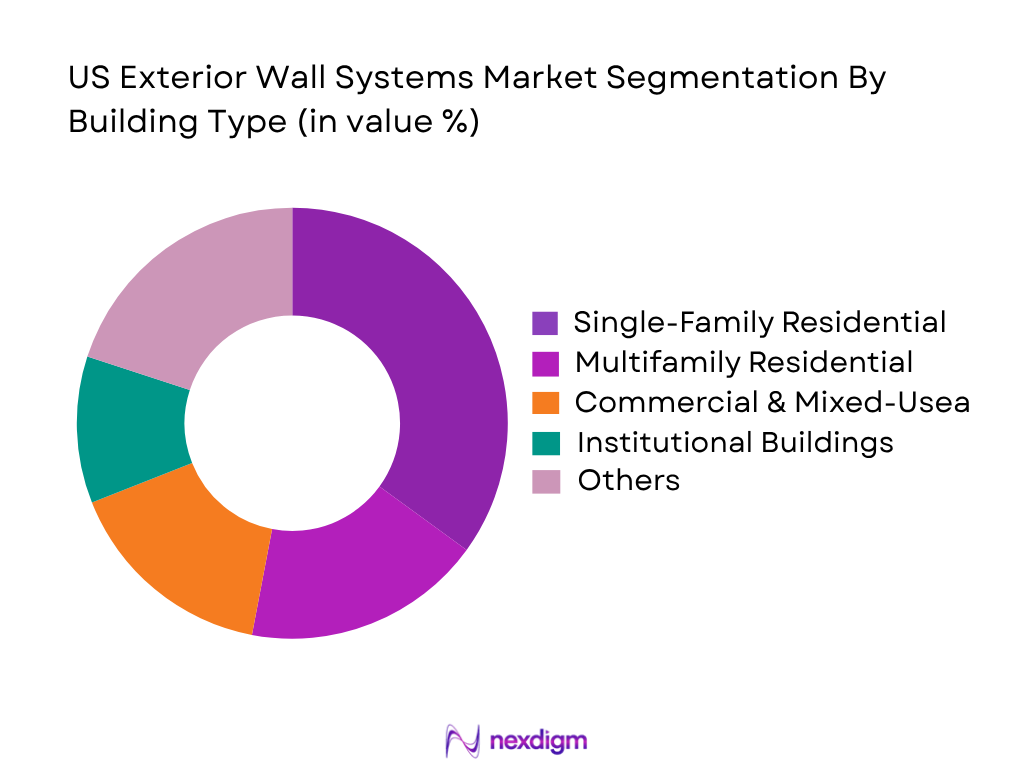
The US Exterior Wall Systems Market is segmented into single-family residential, multifamily residential, offices, retail and mixed-use buildings, hospitality, healthcare, educational buildings, warehouses, industrial facilities and government buildings. Single-family residential is represented as the dominant placeholder segment because detached housing generates extensive siding, sheathing, weather-barrier, insulation and exterior finishing requirements. The US authorized 1,471,200 privately owned housing units and started 1,364,100 units in the referenced annual period. Census.gov Single-family construction is particularly relevant to vinyl, fiber cement, engineered wood, stucco and masonry veneer systems, while renovation creates an additional recladding demand pool. Geographic expansion strengthens this segment: Texas had a population of 31,290,831, Florida 23,372,215, North Carolina 11,046,024, and Georgia 11,180,878, with each recording population gains that support continuing housing requirements. Census.gov Exterior-system suppliers therefore compete on durability, installation productivity, moisture protection, regional climate performance and architectural flexibility.
Competitive Landscape
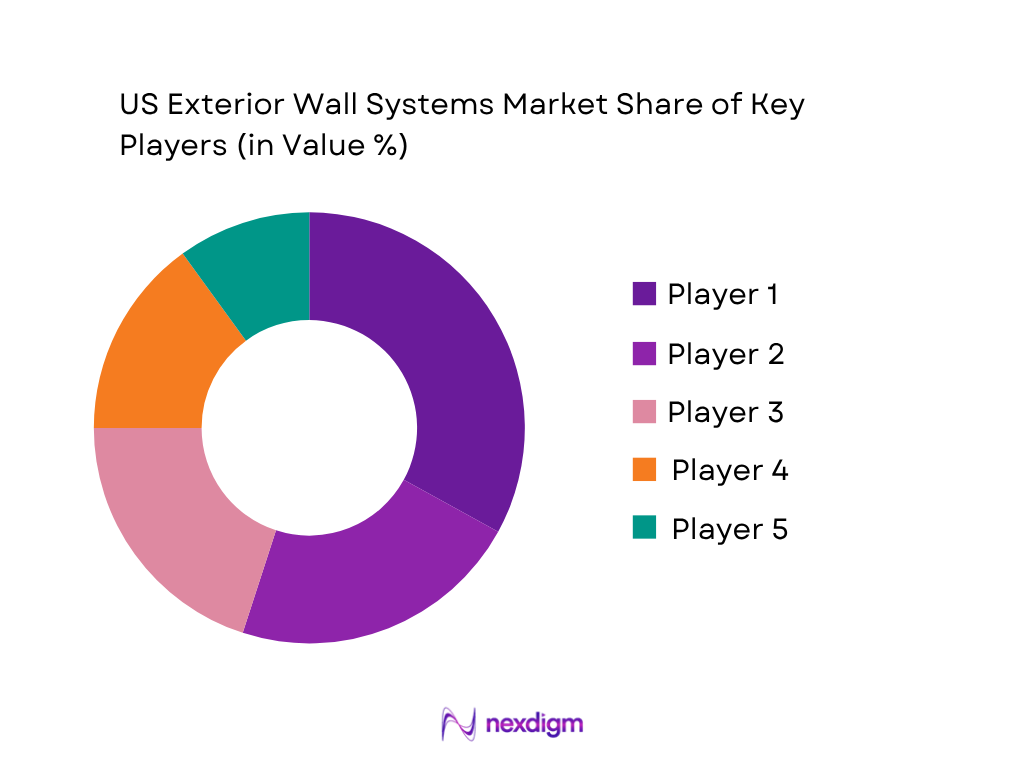
The US Exterior Wall Systems Market combines specialized cladding producers with diversified building-envelope manufacturers. Competition increasingly extends beyond the visible façade material into complete assemblies integrating continuous insulation, air and water barriers, drainage planes, attachment systems and prefabricated panels. Sto, for example, offers EIFS with drainage, rainscreens and prefabricated wall panels, while Nichiha and James Hardie have strong fiber-cement offerings.
| Company | Established Year | Headquarters | Key Exterior Wall Systems | Core Material Technology | Primary Building Segment | Thermal & Envelope Capability | Distribution Approach | Key Application Strength |
| James Hardie Industries | 1888 | Dublin, Ireland | ~ | ~ | ~ | ~ | ~ | ~ |
| Cornerstone Building Brands | 1984 | Cary, North Carolina, USA | ~ | ~ | ~ | ~ | ~ | ~ |
| Kingspan Group | 1965 | Kingscourt, Ireland | ~ | ~ | ~ | ~ | ~ | ~ |
| Etex Group | 1905 | Brussels, Belgium | ~ | ~ | ~ | ~ | ~ | ~ |
| Nichiha Corporation | 1956 | Nagoya, Japan | ~ | ~ | ~ | ~ | ~ | ~ |
US Exterior Wall Systems Market Analysis
Growth Drivers
Large Residential Construction Base Sustaining Exterior Wall Installation Demand
The US exterior wall systems market is supported by the scale of residential construction, where every new dwelling requires exterior cladding, weather-resistant barriers, insulation, sheathing and moisture-management assemblies. The US Census Bureau recorded 1,471,200 housing units authorized, 1,364,100 housing units started, and approximately 1,627,900 housing units completed during 2024. Residential construction expenditure reached USD 917.9 billion, compared with USD 866.9 billion in 2023, creating substantial installation activity for fiber-cement siding, vinyl siding, stucco, masonry veneer, engineered wood and rainscreen systems. The demand base is geographically concentrated in construction-intensive states: Texas authorized 225,756 housing units, Florida 173,326, California 101,545, North Carolina 95,163, Georgia 68,367, and Arizona 59,616 during 2024. These states also expose building envelopes to markedly different heat, humidity, precipitation, hurricane, wildfire and thermal conditions, supporting differentiated exterior-wall specifications. At the macroeconomic level, World Bank data places US GDP at USD 29.298 trillion in 2024, demonstrating the scale of economic activity supporting construction investment. The combination of high residential completion volumes and extensive regional building activity creates recurring demand for complete exterior-wall assemblies rather than standalone decorative cladding.
Non-Residential and Public Construction Supporting High-Performance Wall Systems
Commercial, institutional, manufacturing and public construction provides another major demand engine for US exterior wall systems because larger buildings require engineered façades with defined thermal, moisture, fire and structural performance. US construction put in place reached USD 2,154.4 billion in 2024, increasing from USD 2,023.7 billion in 2023. Private non-residential construction accounted for USD 743.8 billion, including approximately USD 120.9 billion in commercial construction and USD 232.3 billion in manufacturing construction. Public construction reached USD 492.7 billion, providing additional demand from schools, healthcare facilities, government buildings and infrastructure-associated structures. This activity directly supports curtain walls, insulated metal panels, architectural metal façades, EIFS, fiber-cement panels, air barriers and continuous-insulation assemblies. Labor statistics further demonstrate the operating scale of the construction ecosystem: US construction employment reached approximately 8.242 million workers in December 2024, while construction-of-buildings employment stood at approximately 1.883 million. World Bank data records national GDP at USD 29.298 trillion in 2024. This combination of construction expenditure, building-sector employment and industrial investment provides a broad project pipeline for exterior-wall manufacturers supplying performance-oriented commercial and institutional building envelopes.
Market Challenges
Housing Starts and Permit Contraction Creating Pressure on New-Build Demand
A key challenge for exterior wall system suppliers is the contraction in portions of the new residential pipeline, because fewer starts directly reduce near-term façade installation opportunities. US Census Bureau data recorded 1,471,200 housing units authorized in 2024, compared with 1,511,100 units in 2023, representing 39,900 fewer permitted units. Housing starts declined from 1,420,000 units to 1,364,100 units, removing another 55,900 units from annual starting activity. Regional data indicate similar pressures in several high-volume markets when comparing subsequent permitting activity: Texas moved from 225,756 permitted units in 2024 to 210,217 in 2025, North Carolina from 95,163 to 86,167, Georgia from 68,367 to 61,196, and Arizona from 59,616 to 51,532. These reductions matter directly to siding, sheathing, insulation, stucco, fiber-cement and masonry suppliers because exterior-wall material consumption occurs relatively late in the building cycle and depends on projects progressing beyond permitting and foundations. The wider economy remained large, with World Bank reporting USD 29.298 trillion of GDP in 2024, but housing-unit contraction creates uneven demand within that economy. Suppliers therefore face greater exposure to project timing, geographic differences and the balance between new construction and replacement demand.
Installation Labor and Building-Envelope Complexity Constraining Project Execution
Exterior wall systems increasingly combine cladding, continuous insulation, flashing, drainage cavities, air barriers, water-resistive barriers and attachment systems, making qualified installation capacity critical to market expansion. US Bureau of Labor Statistics data show construction employment at approximately 8.242 million workers in December 2024, including 1.883 million workers in construction of buildings and approximately 960,400 workers in residential building construction. Residential remodelers accounted for approximately 463,700 workers, illustrating the labor base serving renovation and exterior replacement activity. Despite this large workforce, façade installation must compete for specialized trades across a construction economy that delivered USD 2,154.4 billion of work during 2024. Building-envelope failures can arise from incorrectly detailed penetrations, joints, flashing, drainage paths or interfaces between cladding and weather barriers, increasing contractor training and quality-control requirements. The challenge is amplified by geographic diversity: exterior walls installed in Florida may require hurricane and moisture performance, while assemblies in northern states require thermal continuity and freeze-thaw durability. With World Bank reporting US GDP at USD 29.298 trillion in 2024, construction activity occurs at enormous scale, making installation productivity, workforce capability and assembly simplification important competitive factors for manufacturers seeking nationwide adoption.
Market Opportunities
Weather-Resilient Exterior Wall Systems Creating a Larger Replacement and Retrofit Pipeline
Increasing exposure of buildings to severe weather creates a substantial future opportunity for impact-resistant cladding, rainscreens, moisture-control systems, durable siding and integrated exterior envelopes. NOAA recorded 27 separate weather and climate disasters during 2024 in which losses exceeded USD 1 billion per event. Combined losses reached approximately USD 182.7 billion, while 568 fatalities were associated with these events. Hurricane Helene alone generated approximately USD 78.7 billion in losses in NOAA’s initial annual assessment, while Hurricane Milton generated approximately USD 34.3 billion. The year included 17 severe-storm events, 5 tropical cyclones, 2 winter storms, 1 flooding event, 1 drought/heat event and 1 wildfire event, illustrating the range of stresses placed on US buildings. This environment strengthens the business case for exterior systems engineered for wind resistance, drainage, impact performance, moisture management and thermal durability. The opportunity extends beyond disaster reconstruction because building owners can incorporate resilient envelope components during routine recladding and renovation cycles. US GDP stood at USD 29.298 trillion in 2024, providing a large economic base supporting property reinvestment. Manufacturers capable of integrating cladding, insulation, drainage and weather protection can therefore address both replacement construction and preventive resilience upgrades.
High-Activity Southern Housing Markets Supporting Advanced Envelope Expansion
The concentration of residential development in southern and Sun Belt states creates a forward opportunity for exterior-wall manufacturers to expand systems designed for heat, humidity, storms and high construction throughput. During 2024, Texas authorized 225,756 housing units, Florida 173,326, North Carolina 95,163, Georgia 68,367, Arizona 59,616, South Carolina 47,072, and Tennessee 46,549. Metropolitan concentration was equally significant: Dallas authorized 71,788 units, Houston 65,747, Phoenix 45,884, Atlanta 40,687, Austin 32,294, Charlotte 25,935, Orlando 24,135, and Tampa 20,950. These volumes establish concentrated installation territories where manufacturers can develop distributor inventories, contractor networks and specification support for fiber cement, stucco, insulated panels, rainscreens, weather barriers and continuous insulation. The opportunity is strengthened by the overall residential construction base, with 1,627,900 housing units completed nationally during 2024 and residential construction expenditure reaching USD 917.9 billion. World Bank data places US GDP at USD 29.298 trillion for the same period. Rather than relying solely on national construction growth, exterior-wall suppliers can use these geographically concentrated construction corridors to scale climate-specific systems, contractor training and integrated envelope solutions across some of the country’s most active building markets.
Future Outlook
The US Exterior Wall Systems Market is expected to expand at approximately ~% CAGR during 2026–2035, using the requested placeholder forecast. Growth is expected to increasingly reflect building-envelope performance rather than façade aesthetics alone. Manufacturers are developing systems combining continuous insulation, drainage, air and water resistance, fire performance and simplified installation. Rainscreen adoption should create opportunities in commercial, multifamily and institutional buildings because ventilated wall assemblies provide drainage and moisture-management functionality. Nichiha, for example, integrates rainscreen functionality into architectural fiber-cement panels, while Sto markets complete rainscreen assemblies with insulation and envelope components.
Prefabricated exterior walls are another important development area. Factory-integrated panels can reduce field operations and improve assembly consistency, particularly on projects facing skilled-trade constraints. Sto introduced its prefabricated wall-panel technology in 2016 and subsequently expanded façade options through partnerships involving metal, fiber cement and window systems.
Major Players
- Owens Corning
- James Hardie Building Products
- Saint-Gobain
- Sto Corp.
- Kingspan Group
- Carlisle Construction Materials
- Sika
- Cornerstone Building Brands
- Nichiha USA
- Tremco Construction Products Group
- DuPont
- LP Building Solutions
- Westlake Royal Building Products
- Petersen Aluminum / PAC-CLAD
- ATAS International
Key Target Audience
- Exterior Wall System Manufacturers
- Cladding and Siding Manufacturers
- Building Envelope and Insulation Manufacturers
- Façade Contractors, Applicators and General Contractors
- Real Estate Developers and Building Owners
- Building Material Distributors and Specialty Façade Distributors
- Investments and Venture Capitalist Firms
- Government and Regulatory Bodies (US Department of Housing and Urban Development, US Department of Energy, Federal Emergency Management Agency, National Institute of Standards and Technology)
Research Methodology
Step 1: Identification of Key Variables
The initial phase constructs the US Exterior Wall Systems Market ecosystem across cladding manufacturers, insulation suppliers, membrane producers, distributors, architects, façade engineers, contractors, developers and building owners. Key variables include exterior wall installation area, building starts, retrofit activity, wall-system type, cladding material, building type, insulation configuration, regional construction intensity and code requirements.
Step 2: Market Analysis and Construction
Historical demand is analyzed through residential and non-residential construction activity, building permits, construction spending, exterior-wall material penetration and renovation demand. Top-down analysis connects national construction indicators with addressable exterior-envelope applications, while bottom-up analysis assesses manufacturer portfolios, product categories, distribution presence and application-level demand.
Step 3: Hypothesis Validation and Expert Consultation
Market hypotheses are validated through computer-assisted telephone interviews with exterior-wall manufacturers, façade contractors, architects, distributors, building-envelope specialists and procurement professionals. Interviews assess material preference, rainscreen adoption, continuous-insulation requirements, specification patterns, contractor availability, installation complexity, regional climatic requirements and substitution among fiber cement, vinyl, metal, masonry, stucco and composite systems.
Step 4: Research Synthesis and Final Output
Primary findings are triangulated with construction statistics, manufacturer information, regulatory requirements and application-level demand indicators. Final estimates reconcile new construction with renovation and recladding activity and distinguish residential from non-residential demand. The forecasting framework incorporates construction activity, building-envelope regulation, material substitution, prefabrication, energy efficiency, resilience requirements and technology adoption.

- Executive Summary
- Research Methodology (Market Definition and Scope, Exterior Wall System Classification, Building Envelope Technology Mapping, Cladding Material Assessment, Continuous Insulation Assessment, Air and Water-Resistive Barrier Evaluation, Rainscreen System Assessment, EIFS Assessment, Curtain Wall Assessment, Panelized Wall System Analysis, Exterior Siding Assessment, Thermal Performance Mapping, Fire Performance Assessment, Moisture Management Assessment, Wind-Load Performance Assessment, New Construction Demand Assessment, Retrofit and Recladding Demand Assessment, Residential and Non-Residential Demand Mapping, Contractor and Applicator Assessment, Manufacturer Capacity Assessment, Distribution Channel Mapping, Supply-Side Assessment, Demand-Side Assessment, Top-Down Market Sizing, Bottom-Up Market Sizing, Primary Industry Interviews, Data Triangulation, Forecasting Framework, Scenario Analysis)

- Definition and Scope
- US Exterior Wall Systems Industry Evolution and Development of Building Envelope Systems, Rainscreen Façades, Exterior Insulation and Finish Systems, Curtain Walls, Fiber Cement Cladding, Metal Panel Systems, Vinyl Siding, Brick Veneer Systems, Stucco Systems, Stone Veneer Systems, Prefabricated Exterior Wall Panels, Continuous Insulation Systems, Air and Water-Resistive Barriers, High-Performance Building Envelopes, Energy-Efficient Façade Systems
- Exterior Wall Systems Value Chain Analysis
- Exterior Wall Systems Supply Chain Analysis
- Raw Material Suppliers, Insulation Manufacturers, Glass Manufacturers, Aluminum and Steel Suppliers, Fiber Cement Producers, Vinyl Resin Suppliers, Membrane Manufacturers, Exterior Wall System Manufacturers, Panel Fabricators, Building Envelope Contractors, Façade Engineering Companies, Distributors, Architects and Specifiers, General Contractors, Property Developers, Building Owners

- Growth Drivers (Expansion of Energy-Efficient Building Envelopes, Increasing Continuous Insulation Adoption, Residential Renovation and Recladding Activity, Commercial Building Retrofit Requirements, Demand for Moisture-Resistant Façades, Growth of Rainscreen Construction, Prefabricated Wall System Adoption, Weather-Resilient Building Envelope Requirements)
- Market Challenges (Skilled Façade Installer Availability, Multi-Layer Wall Assembly Complexity, Fire-Test Compliance Requirements, Moisture Intrusion and Installation Risks, Raw Material Supply Volatility, Building Code Variation Across Jurisdictions, Compatibility Between Wall Components, Existing Building Retrofit Complexity)
- Market Opportunities (Rainscreen Façade Expansion, Building Envelope Retrofit, High-Performance Continuous Insulation Systems, Prefabricated Exterior Wall Panels, Fiber Cement Cladding Adoption, Low-Carbon Façade Materials, Hurricane-Resistant Exterior Wall Systems, Integrated Air-Water-Thermal Envelope Solutions)
- Market Trends (Ventilated Rainscreen Adoption, Continuous Exterior Insulation, Prefabricated Façade Assemblies, Fiber Cement Architectural Panels, Insulated Metal Panels, Multi-Cladding Façades, Building Envelope Digital Design, Low-Carbon Exterior Materials, High-Performance Air and Water Barriers, Single-Source Exterior Wall Assemblies)
- Government Regulations and Standards (International Building Code Exterior Wall Requirements, International Residential Code Exterior Covering Requirements, International Energy Conservation Code, NFPA 285 Exterior Wall Fire Testing, ASTM E331 Water Penetration Testing, ASTM E84 Surface Burning Testing, ASHRAE 90.1 Building Envelope Requirements, State Energy Codes, Local Façade Ordinances, Wind and Hurricane Resistance Requirements) ICC Codes
- SWOT Analysis
- Porter’s Five Forces Analysis
- PESTLE Analysis
- Stakeholder Ecosystem
- Competition Ecosystem

- By Market Value (2020-2025)
- By Exterior Wall System Installation Volume (2020-2025)
- By Cladding Installation Area (2020-2025)
- By New Construction Demand (2020-2025)
- By Renovation and Recladding Demand (2020-2025)
- By Residential Exterior Wall Installation Volume (2020-2025)
- By Commercial Exterior Wall Installation Volume (2020-2025)
- By Institutional Exterior Wall Installation Volume (2020-2025)
- By Industrial Exterior Wall Installation Volume (2020-2025)
- By Average Exterior Wall System Installation Value per Square Foot (2020-2025)

- By Wall System Type (In Value %)
Ventilated Rainscreen Systems
Exterior Insulation and Finish Systems
Curtain Wall Systems
Panelized Exterior Wall Systems
Cavity Wall Systems
Barrier Wall Systems
Stucco Wall Systems
Masonry Veneer Wall Systems
Precast Exterior Wall Systems
Siding Systems - By Exterior Cladding Material (In Value %)
Fiber Cement Cladding
Metal Cladding
Vinyl Siding
Brick and Masonry Veneer
Stucco and Render
Stone and Manufactured Stone Veneer
Glass Façade Systems
Wood and Engineered Wood Siding
High-Pressure Laminate Panels
Composite Cladding Panels - By Construction Type (In Value %)
New Residential Construction
New Commercial Construction
New Institutional Construction
New Industrial Construction
Residential Renovation and Recladding
Commercial Façade Renovation
Institutional Building Retrofit
Industrial Building Retrofit - By Building Type (In Value %)
Single-Family Residential Buildings
Multifamily Residential Buildings
Office Buildings
Retail and Mixed-Use Buildings
Hospitality Buildings
Healthcare Facilities
Educational Buildings
Warehouses and Distribution Centers
Industrial and Manufacturing Facilities
Government and Public Buildings - By Distribution Channel (In Value %)
Direct Manufacturer Sales
Building Material Distributors
Specialty Façade Distributors
Contractor and Applicator Networks
Architectural Specification Channels
Home Improvement and Building Supply Retailers - By Region (In Value %)
Northeast US
Midwest US
South US
West US
Pacific Coast
Mountain States
Gulf Coast
Southeast US

- Market Share of Major Players (By US Revenue, Wall System Type, Cladding Material, Building Type, New Construction Presence, Retrofit Presence, Distribution Coverage, Specification Presence)
- Cross Comparison Parameters (Exterior Wall System Portfolio Breadth, Continuous Insulation Capability, Rainscreen System Capability, NFPA 285 Tested Assembly Portfolio, Air and Water-Resistive Barrier Integration, Prefabricated Wall System Capability, Cladding Material Diversity, Building Envelope Warranty Coverage)
- SWOT Analysis of Major Players
- Competitive Positioning Matrix
- Exterior Wall System Technology Benchmarking
- Cladding Material Benchmarking
- Building Envelope Integration Assessment
- Rainscreen and Drainage Technology Assessment
- Prefabrication and Panelization Capability Assessment
- Distribution and Contractor Network Assessment
- Major Companies
Owens Corning
James Hardie Building Products
Saint-Gobain
Sika
Sto Corp.
Kingspan Group
Carlisle Construction Materials
Cornerstone Building Brands
Nichiha USA
Tremco Construction Products Group
DuPont
LP Building Solutions
Westlake Royal Building Products
PAC-CLAD Petersen
ATAS International

- Architect and Specifier Requirement Assessment
- General Contractor Procurement Assessment
- Building Owner Requirement Assessment
- Residential Builder Demand Assessment
- Commercial Developer Demand Assessment
- Institutional Building Requirement Assessment
- Façade Contractor Requirement Assessment
- Retrofit and Recladding Customer Assessment
- Exterior Wall Performance Requirement Assessment
- Product Selection Criteria Assessment

- By Market Value (2026-2035)
- By Exterior Wall System Installation Volume (2026-2035)
- By Cladding Installation Area (2026-2035)
- By New Construction Demand (2026-2035)
- By Renovation and Recladding Demand (2026-2035)
- By Residential Exterior Wall Installation Volume (2026-2035)
- By Commercial Exterior Wall Installation Volume (2026-2035)
- By Rainscreen System Installation Volume (2026-2035)
- By Continuous Insulation Wall System Volume (2026-2035)
- By Prefabricated Exterior Wall System Volume (2026-2035)


 Request a Sample
 Ask for Customization
 Get a Quote
 Enquire Now