
 Download PDF
Market Overview
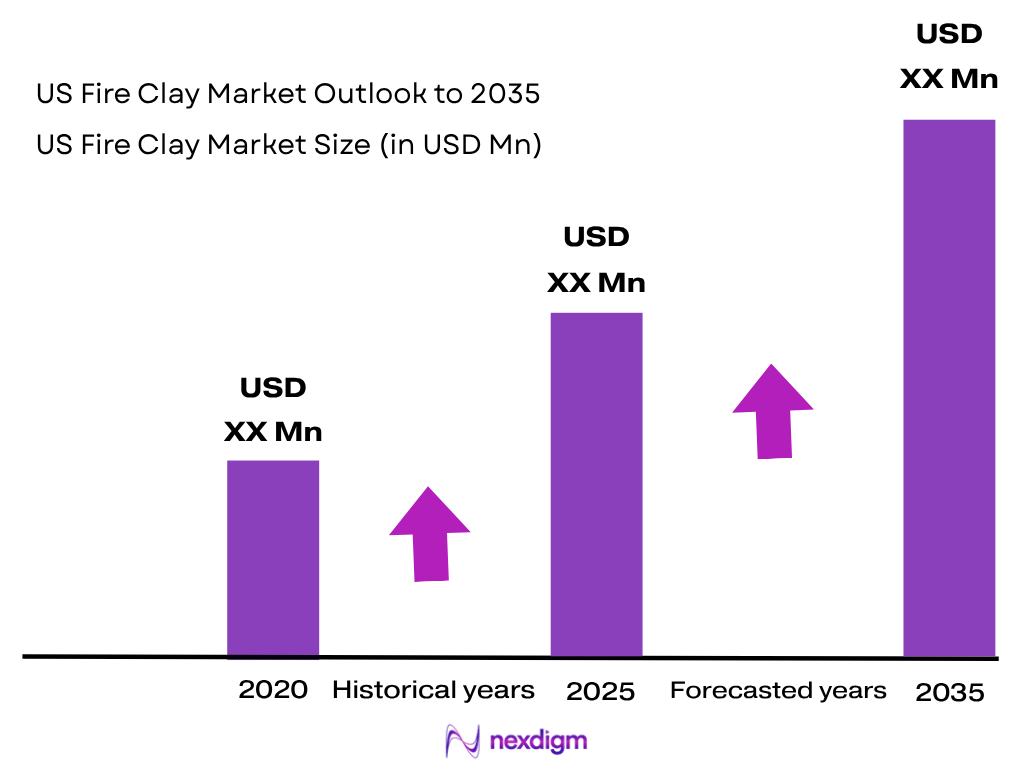
The US Fire Clay Market is valued at approximately USD ~XX million, with commercial value retained as a placeholder because publicly available government statistics report mineral production rather than a standalone market valuation. Domestic fire-clay production increased from 685,000 metric tons to 688,000 metric tons across the latest two completed reporting periods. Demand is supported by refractory applications, ceramics, firebrick, refractory grogs and calcines, and other high-temperature industrial applications requiring alumina-silica materials.
Missouri and the Ohio-Appalachian refractory corridor represent historically important areas within the US Fire Clay Market because of established refractory-clay deposits and proximity to refractory manufacturing and heavy industrial customers. Missouri has historically been a leading fire-clay-producing state, while Southern Ohio contains established clay mining and processing operations. Pittsburgh, Columbus and other Midwest/Appalachian industrial locations additionally support refractory manufacturing and distribution serving steel, foundry, glass, cement, lime, refining and other thermal-processing industries.
Market Segmentation
By Product Form
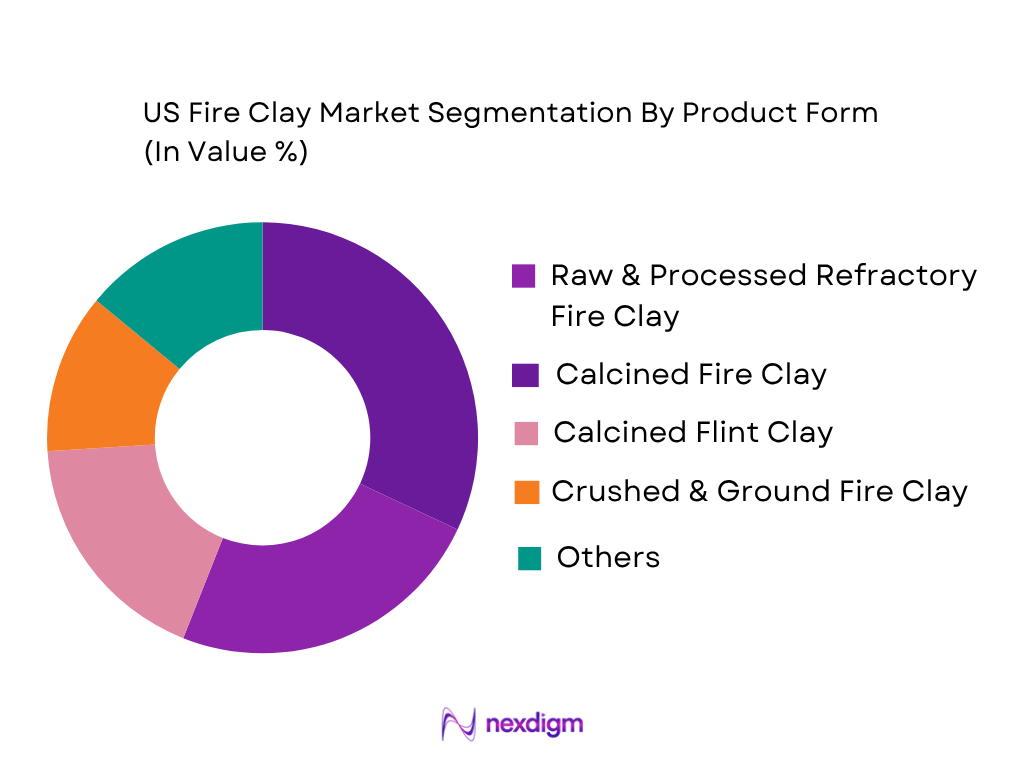
The US Fire Clay Market is segmented into raw fire clay, crushed and ground fire clay, calcined fire clay, calcined flint clay, graded refractory fire clay and specialty processed fire clay. Raw and processed refractory-grade fire clay is assigned the dominant placeholder share because it provides the feedstock base for firebrick, refractory grogs, ceramic formulations and monolithic refractory systems. Fire clay is distinguished by mineral composition, plasticity and firing behavior, while downstream processors modify particle size, moisture, calcination and chemistry according to furnace requirements. Domestic production of fire clay stood at 688,000 metric tons, demonstrating an established mineral supply base. Calcined material remains particularly important where refractory manufacturers require improved dimensional stability and controlled firing behavior. The segment also benefits from vertically integrated producers: Resco’s Cedar Heights operation mines and processes refractory clay in Southern Ohio and supplies industrial and ceramic fire clays. Product differentiation increasingly depends on alumina-silica composition, iron content, particle-size distribution, plasticity, firing shrinkage and refractory performance rather than merely mined tonnage.
By End-Use Application
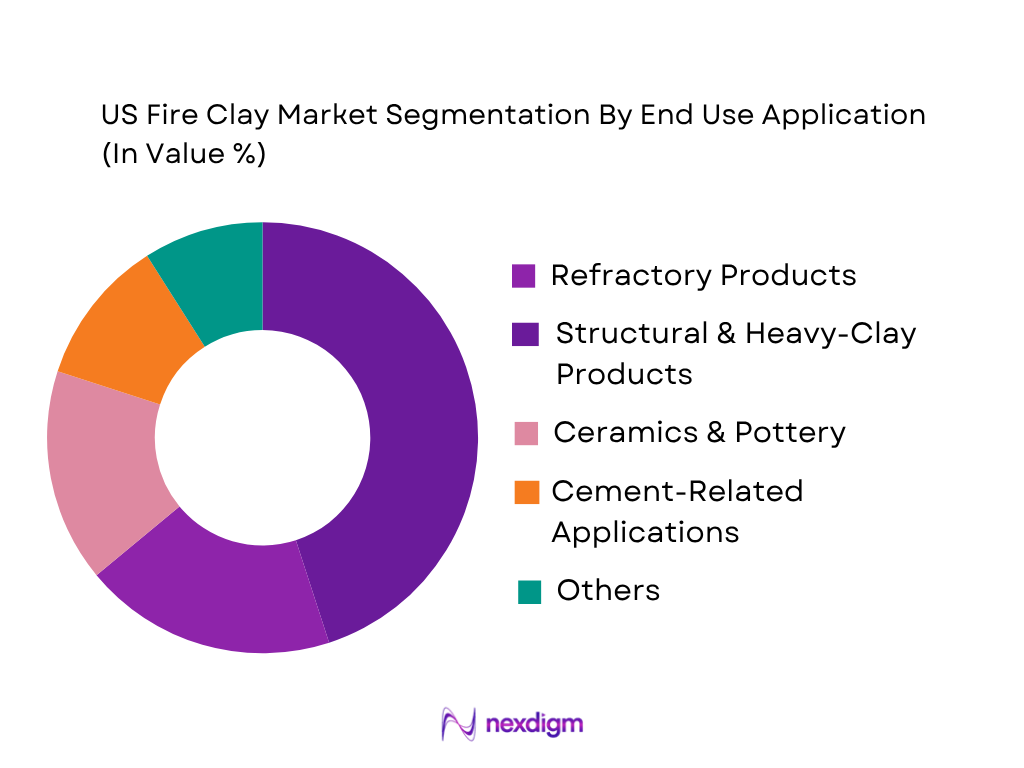
The US Fire Clay Market is segmented into refractory products, structural and heavy-clay products, ceramics and pottery, cement-related applications and other industrial uses. Refractory applications are assigned the dominant placeholder share because USGS identifies refractories as the principal domestic market associated with fire clay, while manufacturers use refractory clay in firebrick and high-temperature ceramic systems. Fireclay-based products serve steelmaking, foundries, glass furnaces, boilers, kilns, incinerators and other thermal-processing equipment. This demand base is reinforced by the scale of downstream heavy industry: U.S. raw steel production totaled approximately 88 million net tons, while domestic steel-mill shipments reached 87 million net tons in the latest completed reporting period. These operations contain furnaces, heating equipment and thermal-processing systems requiring refractory installation, maintenance and periodic replacement. Fire clay also competes with higher-alumina, silica, magnesia, mullite and engineered monolithic refractories, meaning its strongest applications are those where alumina-silica chemistry, thermal stability, installation practicality and economic service performance remain suitable.
Competitive Landscape
The US Fire Clay Market operates through a specialized ecosystem of clay miners, refractory raw-material processors, firebrick manufacturers and monolithic refractory producers. Competition extends beyond raw mineral availability to control of clay deposits, beneficiation and calcination capability, alumina-silica formulations, firebrick manufacturing, monolithic refractory technology, technical services and proximity to heavy-industry customers. HarbisonWalker International, Resco Products, Allied Mineral Products, Plibrico and Alsey Refractories represent important participants in the broader U.S. refractory ecosystem relevant to fire-clay demand and processing.
| Major Player | Establishment Year | Headquarters | Fireclay/Alumina-Silica Capability | Firebrick Capability | Monolithic Refractories | Precast/Specialty Shapes | Key End-Use Exposure | US Manufacturing/Technical Presence |
| HarbisonWalker International | 1865 heritage | Pittsburgh, Pennsylvania | ~ | ~ | ~ | ~ | ~ | ~ |
| Resco Products | 1946 | Pittsburgh, Pennsylvania | ~ | ~ | ~ | ~ | ~ | ~ |
| Allied Mineral Products | 1961 | Columbus, Ohio | ~ | ~ | ~ | ~ | ~ | ~ |
| Plibrico Company | 1914 | Northbrook, Illinois | ~ | ~ | ~ | ~ | ~ | ~ |
| Alsey Refractories | 1906 | Alsey, Illinois | ~ | ~ | ~ | ~ | ~ | ~ |
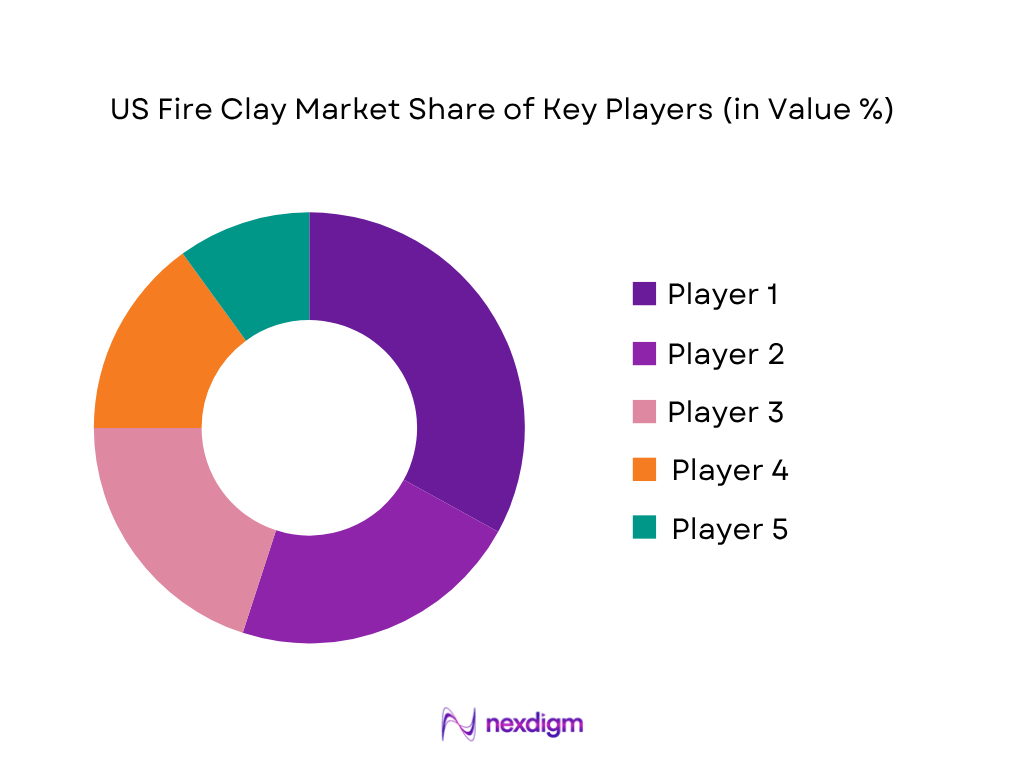
US Fire Clay Market Analysis
Growth Drivers
Industrial Furnace Relining and Steel & Foundry Refractory Consumption
The US fire clay market is supported by the large installed base of high-temperature equipment requiring refractory linings, scheduled maintenance and replacement firebrick. U.S. raw steel production reached 88 million net tons in 2024, while domestic steel-mill shipments totaled 87 million net tons, according to the American Iron and Steel Institute. This industrial throughput sustains refractory consumption across reheating furnaces, heat-treatment units, foundries, coke-related equipment and auxiliary thermal systems where alumina-silica refractory products are applicable. The broader macroeconomic environment also remained supportive: World Bank data place U.S. GDP at approximately USD 29.18 trillion in 2024, while the U.S. population reached 340,110,988, providing a substantial industrial and construction consumption base. USGS subsequently reported domestic fire-clay production of 688,000 metric tons for 2024, demonstrating continued availability of domestic feedstock for refractory manufacturing. Fire-clay refractories are exposed to repeated heating, cooling, abrasion and chemical attack during industrial operations, eventually necessitating patching, partial replacement or complete relining. Consequently, furnace utilization and steel production translate into recurring demand for firebrick, fireclay mortars, castables, plastics and other alumina-silica refractory systems rather than solely one-time demand associated with construction of new furnaces.
Cement, Lime, Glass and High-Temperature Process Operations
Fire clay demand extends beyond steel into cement, lime, glass, ceramics, boilers and other thermal-processing industries where refractory linings protect structural equipment from sustained high-temperature exposure. USGS recorded approximately 86 million metric tons of portland and masonry cement production in 2024, with clinker produced at 96 plants in 34 states, illustrating the scale of kiln-based industrial infrastructure requiring refractory maintenance. U.S. fire-clay production itself reached 688,000 metric tons in 2024, providing an established domestic raw-material base for refractory and ceramic applications. The macroeconomic setting reinforces the scale of downstream activity: World Bank data record U.S. GDP at approximately USD 29.18 trillion in 2024 and population at 340,110,988. EPA regulations explicitly recognize refractory manufacturing as a distinct industrial source category encompassing both clay and non-clay refractories, demonstrating the continuing presence of domestic refractory production. Cement rotary kilns, lime kilns, glass furnaces, boilers and industrial heating systems operate under demanding thermal conditions where refractory linings undergo thermal cycling, abrasion and chemical exposure. This creates recurring requirements for fireclay brick, insulating firebrick, castables, mortars and repair materials, particularly during scheduled shutdowns when operators undertake lining inspection and replacement.
Market Challenges
Competition from Advanced Refractories and Changing Furnace Requirements
Traditional fire-clay products face substitution pressure as industrial operators adopt higher-alumina, mullite, magnesia, silicon-carbide and engineered monolithic refractories in applications requiring greater temperature capability, abrasion resistance or chemical stability. This challenge is material because U.S. fire-clay production totaled 688,000 metric tons in 2024, meaning a substantial domestic mineral stream depends on maintaining viable refractory and ceramic outlets. Simultaneously, U.S. raw steel production stood at 88 million net tons and steel-mill shipments reached 87 million net tons, but modern steel facilities increasingly optimize furnace campaigns around longer lining life and lower maintenance downtime. EPA’s refractory-products framework covers both clay and non-clay refractories, reflecting the broad material competition confronting fire-clay systems. The U.S. economy generated approximately USD 29.18 trillion of GDP in 2024, according to World Bank data, creating a large industrial base but also encouraging investment in higher-productivity equipment and engineered materials. Longer-lived refractory systems can reduce the frequency with which conventional firebrick is replaced, while monolithic castables can substitute brick in selected furnace zones. Fire-clay suppliers therefore face pressure to improve alumina-silica formulations, firing consistency, thermal-shock performance, particle packing and installation characteristics instead of relying primarily on traditional commodity-grade fire clay.
Energy-Intensive Processing, Environmental Compliance and Domestic Production Constraints
Fire clay moves through extraction, drying, crushing, grinding, calcination and, for refractory brick, high-temperature firing, making energy and environmental compliance important operational constraints. USGS reports domestic fire-clay production of 688,000 metric tons in 2024, highlighting the physical volume requiring extraction and processing infrastructure. EPA specifically regulates new calciners and dryers at mineral-processing plants under Clean Air Act New Source Performance Standards and explicitly includes fire clay among covered earth-bound materials. Refractory manufacturing is additionally subject to federal hazardous-air-pollutant requirements addressing emissions including hydrogen fluoride, hydrochloric acid, formaldehyde, methanol, phenol and polycyclic organic matter. Ceramic manufacturing facilities can also fall under federal greenhouse-gas reporting requirements when they annually consume at least 2,000 tons of carbonates and operate qualifying kilns, dryers or ovens. These requirements increase the technical complexity of operating and modernizing mineral-processing and refractory facilities. At the macroeconomic level, the United States recorded approximately USD 29.18 trillion in GDP in 2024, according to World Bank data, while the population reached 340,110,988. Maintaining domestic fire-clay supply within this industrial economy therefore requires continued investment in compliant mines, dryers, calciners, kilns, dust collection and emissions-control infrastructure.
Market Opportunities
Premium Calcined Fire Clay, Insulating Firebrick and Customized Alumina-Silica Products
The opportunity for US fire-clay producers increasingly lies in converting domestic mineral output into differentiated refractory feedstocks and engineered thermal products rather than relying exclusively on untreated clay. USGS reports 688,000 metric tons of domestic fire-clay production in 2024, providing an established feedstock base for calcined fire clay, flint clay, refractory grog and customized alumina-silica blends. Downstream industrial activity provides a substantial addressable customer base: U.S. raw steel production reached 88 million net tons, while steel-mill shipments totaled 87 million net tons in 2024. Cement production added approximately 86 million metric tons of portland and masonry cement, supported by clinker production infrastructure spanning 96 plants across 34 states. These current operating assets contain kilns, furnaces and thermal-processing equipment requiring refractory insulation and maintenance. World Bank data place U.S. GDP at approximately USD 29.18 trillion in 2024, demonstrating the scale of the industrial economy supporting specialized material demand. Producers can use this installed base to develop low-iron grades, calcined materials, controlled particle-size blends, super-duty fireclay products and insulating firebrick feedstocks. Greater processing and formulation capability can position fire clay as an engineered performance material serving specific thermal, mechanical and chemical conditions rather than merely a mined commodity.
Refractory Recycling, Precast Shapes and Rapid-Installation Monolithic Systems
The US fire clay industry has an opportunity to participate in the shift toward refractory systems designed around shorter maintenance shutdowns, material recovery and application-specific installation. Current industrial throughput provides the foundation: U.S. steel mills produced 88 million net tons of raw steel and shipped 87 million net tons in 2024, while approximately 86 million metric tons of portland and masonry cement were produced domestically. These operations maintain substantial inventories of furnaces, kilns and associated thermal equipment that periodically generate spent refractory material while requiring replacement linings. Domestic fire-clay production of 688,000 metric tons provides a raw-material stream that can be combined with processed or reclaimed refractory aggregate in suitable formulations. EPA’s ceramics-manufacturing framework recognizes refractory products among clay-based ceramic products and applies greenhouse-gas reporting requirements to qualifying facilities consuming at least 2,000 tons of carbonates annually, strengthening the operational rationale for material and energy efficiency. World Bank data record a U.S. population of 340,110,988 and GDP of approximately USD 29.18 trillion in 2024, indicating the scale of the domestic industrial ecosystem. Suppliers can target precast shapes, low-cement castables, rapid-repair monolithics, recycled refractory aggregates and customized alumina-silica systems that reduce installation complexity and improve material utilization during scheduled furnace maintenance.
Future Outlook
The US Fire Clay Market is forecast to expand at approximately ~XX% CAGR during 2026-2035, with the rate retained as a placeholder pending validated market modeling. Future development will be shaped by refractory replacement cycles, U.S. steel and foundry operations, glass and cement furnace maintenance, industrial reshoring, domestic raw-material security and technological changes in refractory formulations. The market is expected to shift progressively toward engineered fire-clay and alumina-silica solutions rather than undifferentiated raw mineral supply. Customers increasingly require consistent chemistry, controlled particle-size distribution, predictable firing behavior, thermal-shock resistance and stable physical properties. This creates opportunities for calcined fire clay, flint clay, customized refractory blends and processed grades.
Major Players
- HarbisonWalker International / Calderys
- Resco Products, Inc.
- Allied Mineral Products, LLC
- Plibrico Company, LLC
- Alsey Refractories Company
- BNZ Materials, Inc.
- Christy Refractories
- Reno Refractories, Inc.
- Mt. Savage Specialty Refractories
- RHI Magnesita North America
- Vesuvius USA
- Shinagawa Advanced Materials Americas
- Morgan Advanced Materials
- PRCO America, Inc.
- Old Hickory Clay Company
Key Target Audience
- Fire Clay Mining and Processing Companies
- Refractory Brick and Monolithic Refractory Manufacturers
- Steel, Foundry, Glass, Cement and Lime Producers
- Industrial Furnace and Kiln Operators
- Refractory Raw Material Distributors and Installation Contractors
- Investments and Venture Capitalist Firms
- Government and Regulatory Bodies (U.S. Geological Survey, Mine Safety and Health Administration, Occupational Safety and Health Administration, U.S. Environmental Protection Agency)
- Ceramic, Firebrick and High-Temperature Material Manufacturers
Research Methodology
Step 1: Identification of Key Variables
The initial phase constructs the US Fire Clay Market ecosystem covering mines, beneficiation and processing facilities, refractory manufacturers, firebrick producers, distributors, refractory contractors and industrial end users. Variables include mine output, clay chemistry, alumina and silica content, particle size, calcination, firebrick consumption, monolithic consumption, furnace installed base, relining frequency and regional industrial concentration.
Step 2: Market Analysis and Construction
Historical market construction combines top-down analysis of U.S. fire-clay production and refractory-consuming industries with bottom-up analysis of mine output and downstream material consumption. Production tonnage, processing yields, refractory formulations, industrial furnace activity and replacement cycles are triangulated to construct product-form and application-level demand while avoiding double counting between raw clay and processed refractory products.
Step 3: Hypothesis Validation and Expert Consultation
Market hypotheses are validated through computer-assisted telephone interviews with fire-clay miners, refractory manufacturers, plant procurement managers, furnace operators, refractory installers and distributors. Discussions test assumptions concerning clay specifications, consumption per refractory formulation, qualification requirements, calcined-versus-raw material preference, replacement cycles, substitute materials, regional procurement and supplier-selection criteria.
Step 4: Research Synthesis and Final Output
The final phase integrates USGS mineral statistics, downstream industrial indicators, manufacturer information and primary interviews. Top-down mineral availability is reconciled with bottom-up consumption across firebrick, monolithic refractories, ceramics and other applications. The resulting framework establishes market size, competitive positioning, segment allocation and long-term demand scenarios for the US Fire Clay Market.

- Executive Summary
- Research Methodology (Market Definition and Assumptions, Fire Clay versus Ball Clay/Common Clay/Kaolin Delineation, Refractory-Grade Clay Classification, Mine-Level Production Mapping, Fire Clay Reserve Assessment, Alumina-Silica Chemistry Mapping, Refractoriness Assessment, Plasticity Analysis, Calcined versus Raw Fire Clay Assessment, Firebrick Production Mapping, Refractory Manufacturer Mapping, Furnace and Kiln Installed-Base Assessment, End-Use Industry Mapping, Replacement Lining Cycle Assessment, Top-Down Market Sizing, Bottom-Up Mine-Level Market Sizing, Bottom-Up Refractory Consumption Analysis, Demand-Side Assessment, Supply-Side Assessment, Primary Interviews, Data Triangulation, Forecasting Framework, Limitations and Future Conclusions)

- Definition and Scope
- Market Evolution and Industry Genesis
- Development of US Fire Clay Mining and Refractory Manufacturing
- US Fire Clay Industry Value Chain Analysis
- US Fire Clay Supply Chain Analysis
- US Fire Clay Mineralogy and Deposit Characteristics

- Growth Drivers (Industrial Furnace Relining Demand, Steel and Foundry Refractory Consumption, Glass Furnace Maintenance, Cement and Lime Kiln Operations, Petrochemical Furnace Requirements, Firebrick Replacement Cycles, Domestic Refractory Manufacturing, Demand for Thermal Shock Resistance, Industrial Boiler Maintenance, High-Temperature Process Expansion)
- Market Challenges (Declining Domestic Fire Clay Production Base, Competition from High-Alumina Refractories, Alternative Monolithic Refractories, Energy-Intensive Calcination and Firing, Mine Permitting Requirements, Clay Deposit Quality Variability, Industrial Furnace Efficiency Improvements, Longer Refractory Service Life, Environmental Compliance, End-Use Cyclicality)
- Market Opportunities (Premium Super-Duty Fire Clay, Low-Iron Fire Clay, Calcined Flint Clay, Energy-Efficient Insulating Firebrick, Low-Cement Fireclay Castables, Rapid-Installation Monolithics, Precast Refractory Shapes, Domestic Supply Security, Refractory Recycling, Customized Alumina-Silica Blends)
- Market Trends (High-Fired Super-Duty Brick, Low-Cement Castables, Reduced Furnace Downtime, Engineered Particle-Size Distribution, Precast Refractory Adoption, Automated Installation, Lightweight Insulating Refractories, Longer Campaign Life, Refractory Recycling, Digital Furnace Condition Monitoring)
- Government Regulations and Standards (MSHA Mine Safety Requirements, EPA Clean Air Act Requirements, Mine Permitting, Silica Exposure Requirements, OSHA Occupational Exposure Requirements, ASTM C27 Fireclay Brick Classification, ASTM C155 Insulating Firebrick Classification, ASTM C1655 Fireclay Mortar Classification, ASTM C673 Plastic Refractory Classification, ASTM Refractory Test Methods)
- SWOT Analysis
- Porter’s Five Forces Analysis
- PESTLE Analysis
- Stakeholder Ecosystem
- Competition Ecosystem

- By Market Value (2020-2025)
- By Production Volume (2020-2025)
- By Domestic Consumption Volume (2020-2025)
- By Average Unit Value (2020-2025)
- By Raw Fire Clay Consumption (2020-2025)
- By Calcined Fire Clay Consumption (2020-2025)

- By Product Form (In Value %)
Raw Fire Clay
Crushed Fire Clay
Ground and Pulverized Fire Clay
Calcined Fire Clay
Calcined Flint Clay
Graded Refractory Fire Clay
Blended Fire Clay
Specialty Processed Fire Clay - By Refractory Product Application (In Value %)
Dense Fireclay Brick
Super-Duty Fireclay Brick
High-Fired Fireclay Brick
Insulating Firebrick
Fireclay Castables
Low-Cement Fireclay Castables
Fireclay Gunning Mixes
Plastic Refractories and Ramming Mixes
Fireclay Mortars
Precast Refractory Shapes - By Grade (In Value %)
Low-Duty Fire Clay
Medium-Duty Fire Clay
High-Duty Fire Clay
Super-Duty Fire Clay
High-Fired Super-Duty Fire Clay
Low-Iron Fire Clay
Specialty Refractory-Grade Fire Clay - By Chemical Composition (In Value %)
Low-Alumina Fire Clay
Standard Alumina-Silica Fire Clay
High-Alumina Fire Clay
Low-Iron Fire Clay
Low-Alkali Fire Clay
High-Purity Fire Clay
Specialty Blended Alumina-Silica Clay - By End-Use Industry (In Value %)
Iron and Steel
Foundries
Glass Manufacturing
Cement Manufacturing
Lime Production
Non-Ferrous Metals
Petroleum Refining
Petrochemicals and Chemicals
Power Generation
Ceramics
Industrial Boilers
Heat Treatment Furnaces
Brick Ovens and Artisan Furnaces
Other High-Temperature Industries - By Refractory Installation Form (In Value %)
Firebrick Linings
Cast-in-Place Refractory Linings
Gunned Refractory Linings
Rammed and Plastic Linings
Mortared Brick Systems
Precast Refractory Shapes
Insulating Backup Linings
Patch and Repair Systems - By Sales Channel (In Value %)
Direct Mine-to-Manufacturer Sales
Direct Refractory Manufacturer Sales
Clay Mineral Distributors
Refractory Raw Material Distributors
Industrial Material Distributors
Contract-Based Bulk Supply
Spot Market Sales
Specialty Refractory Dealers - By Customer Type (In Value %)
Refractory Brick Manufacturers
Monolithic Refractory Manufacturers
Insulating Firebrick Manufacturers
Ceramic Manufacturers
Refractory Contractors
Industrial Furnace Operators
Refractory Distributors
Specialty Ceramic Producers

- Market Share of Major Players (By Value, Production Volume, Refractory Product Type, End-Use Industry, Region, Sales Channel)
- Cross Comparison Parameters (Fire Clay/Refractory Product Portfolio, Alumina-Silica Grade Range, Firebrick & Monolithic Manufacturing Capability, Maximum Service Temperature Coverage, Domestic Manufacturing & Raw Material Integration, Steel/Glass/Cement End-Use Coverage, Distribution & Inventory Network, Application Engineering & Refractory Installation Support)
- SWOT Analysis of Major Players
- Detailed Profiles of Major Companies
HarbisonWalker International / Calderys
Resco Products, Inc.
Allied Mineral Products, LLC
Plibrico Company, LLC
Alsey Refractories Company
BNZ Materials, Inc.
Christy Industrial Holdings / Christy Refractories
Reno Refractories, Inc.
Mt. Savage Specialty Refractories
RHI Magnesita North America
Vesuvius USA
Shinagawa Advanced Materials Americas
Morgan Advanced Materials
PRCO America, Inc.
Old Hickory Clay Company

- Refractory Manufacturer Procurement Criteria
- Firebrick Manufacturer Procurement Criteria
- Monolithic Producer Procurement Criteria
- Insulating Firebrick Producer Procurement Criteria
- Industrial Furnace Operator Requirements
- Raw Clay Qualification Process
- Supplier Approval Process

- By Market Value (2026-2035)
- By Production Volume (2026-2035)
- By Domestic Consumption Volume (2026-2035)
- By Average Unit Value (2026-2035)
- By Raw Fire Clay Consumption (2026-2035)
- By Calcined Fire Clay Consumption (2026-2035)


 Request a Sample
 Ask for Customization
 Get a Quote
 Enquire Now