

 Download PDF
Market Overview
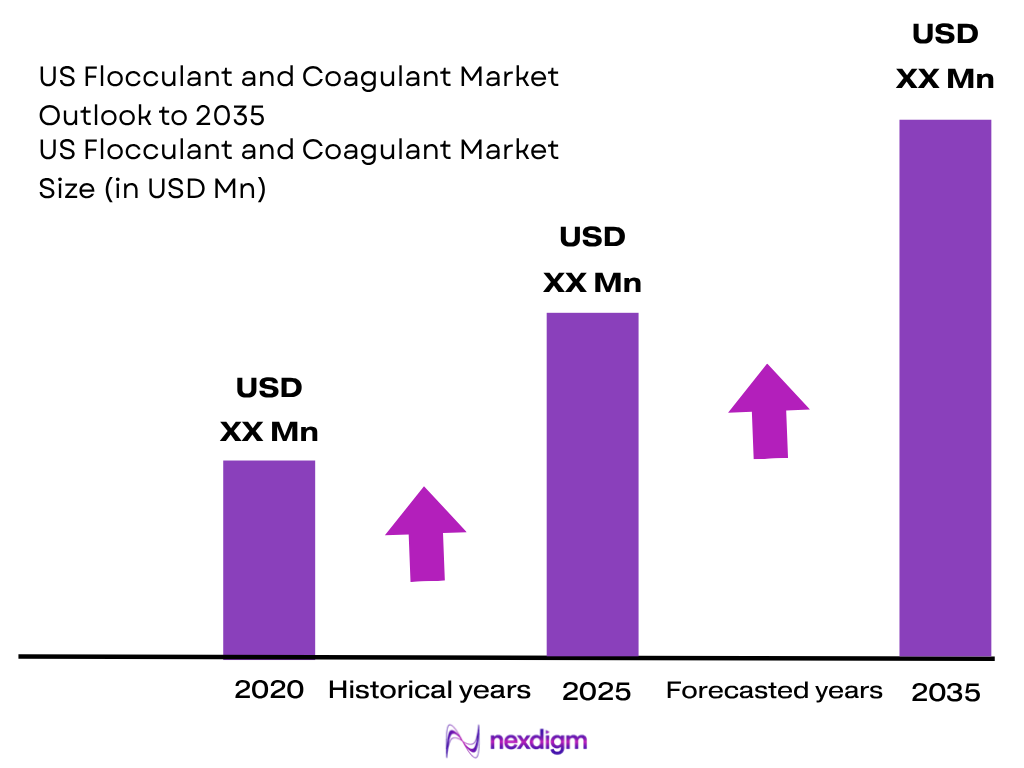
The US Flocculant and Coagulant Market is valued at ~USD X.X billion, supported by municipal drinking-water treatment, wastewater treatment, industrial effluent management, sludge dewatering and solid-liquid separation requirements. The market is reinforced by substantial public investment in water infrastructure, with the US EPA reporting more than USD 11.5 billion in State Revolving Fund water infrastructure funding and USD 7.5 billion in WIFIA financing availability across the latest reported period. The EPA also identified at least USD 630 billion in clean-water infrastructure needs over 20 years, sustaining demand for treatment chemicals.
The US Flocculant and Coagulant Market is concentrated around major metropolitan and industrial regions including Texas, California, Ohio, Pennsylvania and the Great Lakes region, where large municipal systems and industrial wastewater generators create recurring chemical-treatment requirements. Texas received approximately USD 358.98 million in water infrastructure funding, while Ohio received more than USD 210 million under the federal infrastructure program, illustrating the scale of regional investment. Public-supply water withdrawals account for approximately 14% of total US water withdrawals, reinforcing the importance of municipal treatment infrastructure and associated coagulation and flocculation processes.
Market Segmentation
By Product Type
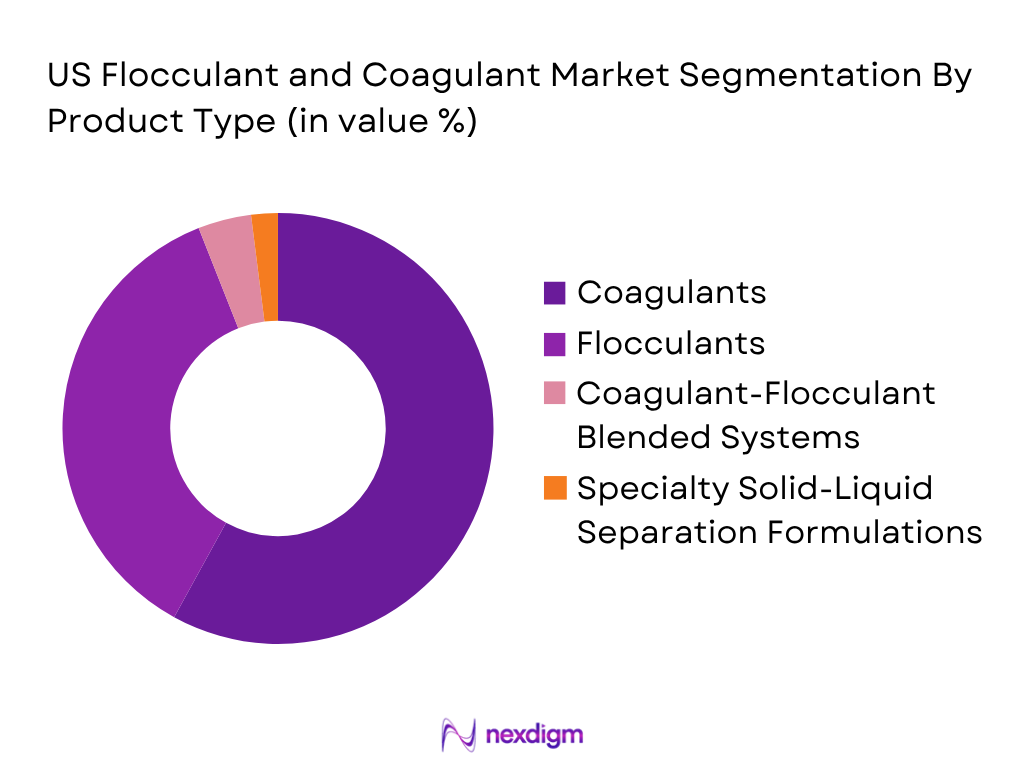
The US Flocculant and Coagulant Market is segmented by product type into flocculants, coagulants, coagulant-flocculant blended systems and specialty solid-liquid separation formulations. Coagulants represent the dominant sub-segment, supported by extensive use in municipal drinking-water clarification, primary wastewater treatment, industrial effluent treatment and suspended-solids removal. Aluminum sulfate, ferric chloride, ferric sulfate and polyaluminum chloride are widely used to destabilize colloidal particles before sedimentation or subsequent flocculation. The large installed base of municipal treatment facilities and continuing infrastructure modernization reinforce recurring coagulant demand. EPA funding programs are addressing aging water infrastructure, wastewater treatment plants, lead-service-line replacement and emerging contaminants, creating continued requirements for treatment chemicals. Flocculants remain important for sludge thickening, dewatering, mining, pulp and paper and industrial wastewater applications, particularly where polymer-assisted separation is required. The US market’s broad municipal and industrial treatment base therefore supports both categories, although coagulants maintain the wider application footprint across conventional water clarification and primary treatment processes.
By End-Use Industry
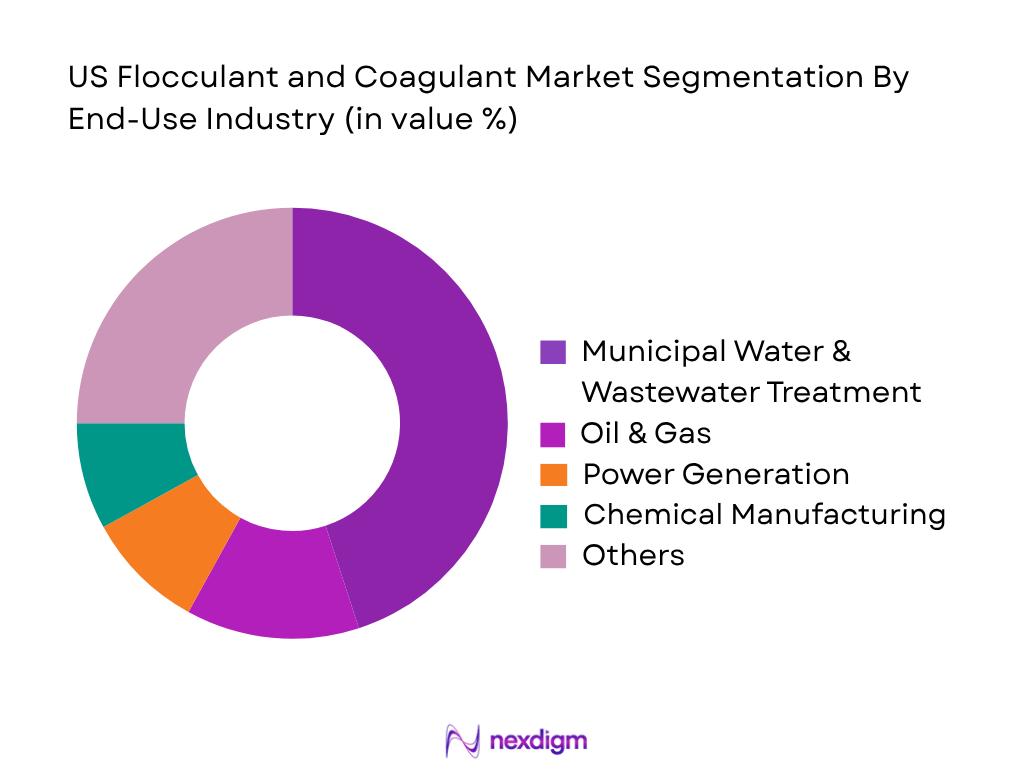
The US Flocculant and Coagulant Market is segmented by end-use industry into municipal water and wastewater treatment, oil and gas, mining and mineral processing, power generation, chemical manufacturing, food and beverage, pulp and paper, pharmaceutical manufacturing, metal processing and other industrial applications. Municipal water and wastewater treatment represents the dominant sub-segment because coagulation and flocculation are fundamental stages in drinking-water clarification and wastewater treatment. Federal infrastructure investment is supporting upgrades to aging treatment plants, stormwater systems and drinking-water infrastructure, while emerging-contaminant programs are adding treatment requirements. The EPA’s Clean Watersheds Needs Survey identified at least USD 630 billion of clean-water infrastructure investment requirements, demonstrating the scale of infrastructure modernization supporting treatment-chemical demand. Industrial applications provide an additional demand base, particularly across oil and gas, mining, power and chemical processing, where treatment systems handle suspended solids, process contaminants and sludge streams. Public-supply withdrawals represent approximately 14% of total US water withdrawals, further demonstrating the importance of municipal water systems. Demand therefore spans both centralized public utilities and specialized industrial treatment facilities.
Competitive Landscape
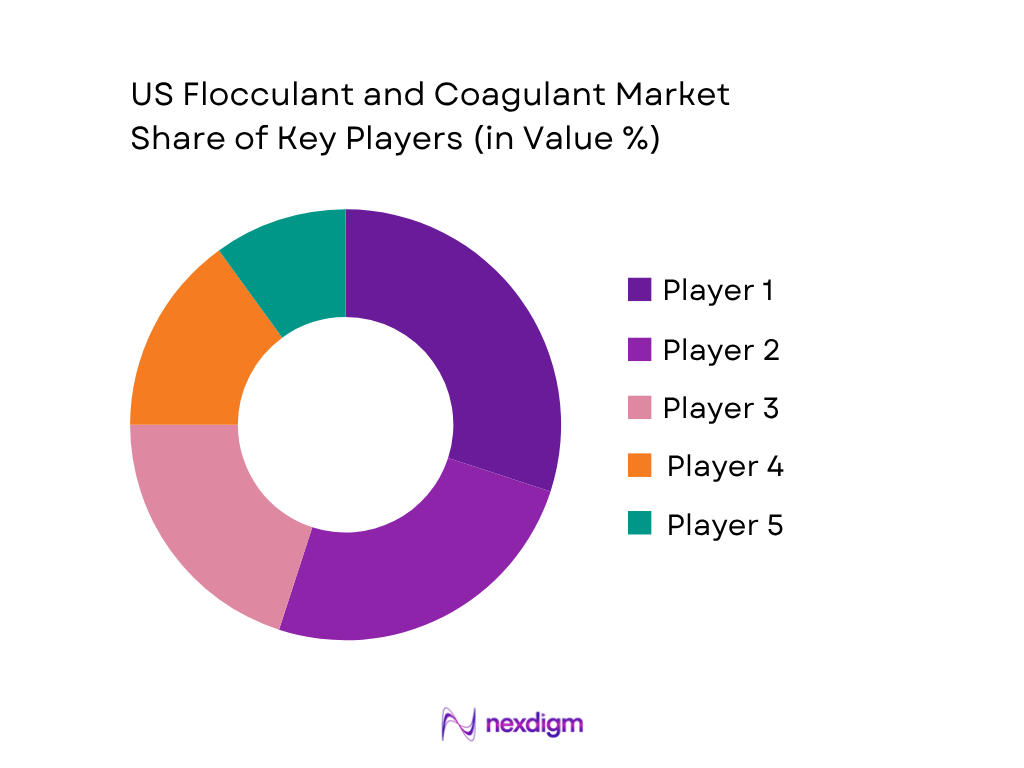
The US Flocculant and Coagulant Market comprises global water-treatment chemical manufacturers, specialty polymer producers and inorganic coagulant suppliers serving municipal utilities and industrial customers. Key participants compete through polymer chemistry, coagulant portfolios, treatment-process expertise, manufacturing capacity, technical service and distribution coverage. The competitive environment includes suppliers with broad water-treatment portfolios as well as specialists focused on polyacrylamide flocculants, aluminum-based coagulants, iron-based coagulants and sludge-dewatering chemicals.
| Company | Established | Headquarters | Major Product Portfolio | Municipal Treatment Capability | Industrial Wastewater Capability | Flocculant Technology | Coagulant Technology | US Distribution Coverage |
| SNF Holding Company | 1978 | Riceboro, Georgia, US | ~ | ~ | ~ | ~ | ~ | ~ |
| Kemira Oyj | 1920 | Helsinki, Finland | ~ | ~ | ~ | ~ | ~ | ~ |
| Ecolab Inc. | 1923 | St. Paul, Minnesota, US | ~ | ~ | ~ | ~ | ~ | ~ |
| Solenis LLC | 1907 | Wilmington, Delaware, US | ~ | ~ | ~ | ~ | ~ | ~ |
| USALCO LLC | 1931 | Baltimore, Maryland, US | ~ | ~ | ~ | ~ | ~ | ~ |
US Flocculant and Coagulant Market Analysis
Growth Drivers
Aging Water Infrastructure and Expansion of Municipal Treatment Investment
The modernization of US drinking-water and wastewater infrastructure is creating sustained demand for coagulants and flocculants used in clarification, sedimentation, sludge conditioning and solids removal. The US Environmental Protection Agency reported that the Bipartisan Infrastructure Law provides USD 50 billion for water infrastructure over 5 years, including funding for drinking water, wastewater, water reuse and related infrastructure. The EPA also announced USD 5.8 billion for drinking-water, wastewater and stormwater infrastructure upgrades in February 2024 and another USD 3.6 billion in October 2024, bringing the latter fiscal-year announcement to USD 6.2 billion. The EPA’s WIFIA program additionally closed 18 loans during 2024, representing nearly USD 2 billion in financing for projects exceeding USD 4 billion in total value. These investments directly support treatment-plant rehabilitation, capacity improvements and process modernization, creating recurring requirements for aluminum- and iron-based coagulants and polymeric flocculants. USGS data further show that public-supply withdrawals represent 14% of withdrawals in the conterminous United States and supply fresh water to approximately 87% of the population. This large public-treatment infrastructure base supports continued consumption of coagulation and flocculation chemicals across municipal drinking-water and wastewater facilities.
Expansion of Industrial Manufacturing, Energy and Process-Water Treatment
Expansion of industrial activity supports demand for flocculants and coagulants because manufacturing facilities require treatment of process water, wastewater, suspended solids and sludge streams before discharge or reuse. The US Census Bureau’s 2024 Annual Integrated Economic Survey recorded USD 6.98 trillion in manufacturing sales, value of shipments or revenue and approximately 12.01 million employees across US manufacturing establishments. Chemical manufacturing alone generated USD 918.2 billion in 2024, while transportation-equipment manufacturing generated approximately USD 1.10 trillion and machinery manufacturing generated approximately USD 473.9 billion. These industries generate diverse wastewater streams requiring chemical clarification and solid-liquid separation. Energy production provides another substantial treatment application. According to the US Energy Information Administration, domestic crude-oil production averaged a record 13.2 million barrels per day in 2024, with the Permian region alone accounting for 48% of US production. Oil and gas operations generate produced water requiring treatment, separation and solids management. USGS estimates also show that thermoelectric power accounted for approximately 82,656 million gallons per day of freshwater withdrawals during the 2010-2020 assessment period. This combination of manufacturing output, energy production and large-scale industrial water use creates a broad application base for coagulants and flocculants across industrial wastewater treatment, process-water clarification, sludge dewatering and water-reuse systems.
Market Challenges
Raw Material Supply Exposure and Chemical Manufacturing Constraints
The US Flocculant and Coagulant Market faces supply-side challenges associated with availability of polymers, monomers, inorganic salts and specialty chemical inputs used in treatment formulations. Polyacrylamide flocculants depend on acrylamide-based chemistry, while inorganic coagulants require aluminum- and iron-based feedstocks. The broader US chemical manufacturing sector generated USD 918.2 billion in sales, value of shipments or revenue in 2024 and employed approximately 872,837 people, demonstrating the scale of the upstream chemical ecosystem but also its exposure to energy, feedstock and logistics conditions. The USGS reported that domestic nonfuel mineral production was valued at USD 106 billion in 2024, while the country remained 100% import-reliant for 12 of the 50 minerals on the federal critical-minerals list and more than 50% import-reliant for 28 minerals. Although these minerals are not direct proxies for flocculant or coagulant inputs, the figures illustrate the broader exposure of US industrial supply chains to imported mineral and chemical feedstocks. Treatment-chemical manufacturers must consequently manage inventory, supplier diversification and production continuity. This challenge is particularly relevant for municipal and industrial customers operating continuous treatment processes, where interruptions in chemical availability can affect clarification, sludge handling and discharge compliance.
Increasing Treatment Complexity and Regulatory Requirements
Increasingly complex water-quality requirements are creating technical and operational challenges for flocculant and coagulant suppliers. Treatment plants must address suspended solids alongside nutrients, metals, organic contaminants and emerging contaminants, requiring careful chemical selection and process optimization. The EPA’s infrastructure programs are directing substantial investment toward drinking-water and wastewater systems, with the Bipartisan Infrastructure Law providing more than USD 50 billion for water infrastructure over 5 years and more than USD 35 billion specifically allocated to safe drinking-water initiatives, including lead-service-line replacement and PFAS-related activities. The EPA’s 2024 WIFIA program selected 25 projects requesting USD 4.5 billion to support USD 7.7 billion in projects and closed 18 loans supporting more than USD 4 billion in projects. As treatment infrastructure is upgraded, operators increasingly require chemicals capable of achieving specified treatment performance while controlling residuals, sludge generation and downstream disposal requirements. USGS water-use analysis indicates that public supply represents 14% of total withdrawals in the conterminous United States and serves approximately 87% of the population, highlighting the scale of systems potentially affected by evolving treatment requirements. Suppliers therefore need stronger application engineering, jar-testing capabilities, dosage optimization and process-specific formulations to address increasingly demanding treatment conditions.
Market Opportunities
Expansion of Water Reuse, PFAS Treatment and Advanced Municipal Water Infrastructure
Growing investment in water reuse, emerging-contaminant treatment and municipal infrastructure creates opportunities for advanced flocculant and coagulant formulations. The US EPA’s Bipartisan Infrastructure Law provides more than USD 50 billion for water infrastructure over 5 years, representing a large investment base for treatment-plant modernization. Within this framework, more than USD 35 billion is dedicated to safe drinking-water initiatives, including PFAS-related activities and lead-service-line replacement. The EPA’s WIFIA program also reported 25 projects selected during 2024, with requested financing of USD 4.5 billion supporting projects valued at USD 7.7 billion. Such investments create opportunities for suppliers capable of improving particle destabilization, clarification, sludge conditioning and downstream filtration performance. PFAS treatment itself can require pretreatment and solids-management stages where coagulation and flocculation may support removal of particulate-associated contaminants and treatment residuals. USGS data indicate that public-supply withdrawals supply approximately 87% of the population in the conterminous United States, establishing a large installed infrastructure base for treatment-chemical applications. Water reuse is also becoming increasingly relevant as utilities and industrial operators seek to reduce freshwater withdrawals and improve system resilience. Suppliers can therefore expand through low-residual coagulants, optimized polyacrylamide systems, specialty polymers, automated dosing programs and formulations designed for integration with advanced filtration and reuse processes.
Growth of Industrial Water Recycling and High-Efficiency Sludge Dewatering
Industrial water recycling and more efficient sludge management provide opportunities for specialized flocculant and coagulant technologies across manufacturing, energy, mining and processing industries. US manufacturing establishments generated USD 6.98 trillion in sales, value of shipments or revenue in 2024, with transportation equipment manufacturing generating approximately USD 1.10 trillion, machinery manufacturing approximately USD 473.9 billion, and chemical manufacturing approximately USD 918.2 billion. These industrial operations generate wastewater streams containing suspended solids, process residues and treatment sludges requiring chemical separation before discharge or reuse. Energy-related treatment requirements are similarly substantial: EIA reported US crude-oil production of 13.2 million barrels per day in 2024, while USGS water-use analysis estimated average thermoelectric freshwater withdrawals at 82,656 million gallons per day during the assessed period. These conditions create opportunities for high-charge-density polymers, customized cationic and anionic formulations, automated dosing systems and products optimized for sludge dewatering. Industrial operators can use improved coagulation and flocculation to increase solids capture, reduce water content in sludge and improve water recovery. Suppliers with application-specific formulations and technical service capabilities can therefore target manufacturing, oil and gas, power generation, mining and food-processing facilities. The opportunity is particularly relevant where customers seek to increase treatment throughput, recover process water and reduce the operational burden associated with sludge handling.
Future Outlook
The US Flocculant and Coagulant Market is expected to expand through continued modernization of drinking-water and wastewater infrastructure, increasing industrial wastewater treatment requirements and growing adoption of water reuse technologies. Demand for high-performance polymers is expected to increase as treatment operators seek improved clarification, sludge dewatering and solids separation efficiency.
PFAS treatment requirements, aging municipal infrastructure and tighter discharge standards will encourage investment in treatment-process optimization. Industrial sectors including oil and gas, mining, power generation, food processing and chemical manufacturing will continue requiring specialized coagulation and flocculation systems.
The market is also expected to move toward automated chemical dosing, online water-quality monitoring, customized polymer formulations and lower-residual treatment chemistries as utilities and industrial operators focus on treatment efficiency and operating performance.
Major Players
- SNF Holding Company
- Kemira Oyj
- Ecolab Inc.
- Solenis LLC
- BASF Corporation
- USALCO LLC
- Kronos Worldwide, Inc.
- Kuraray America, Inc.
- Feralco Group
- Chemtrade Logistics Inc.
- GEO Specialty Chemicals, Inc.
- Aries Chemical, Inc.
- Avista Technologies, Inc.
- Harcros Chemicals Inc.
- Polydyne Inc.
Key Target Audience
- Municipal Water and Wastewater Utilities
- Industrial Wastewater Treatment Operators
- Oil and Gas Companies
- Mining and Mineral Processing Companies
- Power Generation Companies
- Chemical and Manufacturing Companies
- Investments and Venture Capitalist Firms
- Government and Regulatory Bodies (US Environmental Protection Agency, US Department of Energy, US Geological Survey, state environmental protection agencies)
Research Methodology
Step 1: Identification of Key Variables
The initial phase involves constructing a comprehensive ecosystem map encompassing chemical feedstock suppliers, inorganic coagulant manufacturers, polymer producers, formulators, distributors, municipal utilities, industrial wastewater operators and treatment-equipment providers. Secondary research is used to identify critical variables covering product chemistry, charge type, application, treatment process, end-use industry, production capacity and distribution structure.
Step 2: Market Analysis and Construction
In this phase, historical and current information is compiled across municipal water treatment, wastewater treatment and industrial applications. The analysis evaluates coagulant and flocculant consumption, product chemistry, treatment applications, domestic manufacturing, imports, exports and regional demand. Bottom-up calculations are constructed from end-user requirements, treatment applications and supplier-level information.
Step 3: Hypothesis Validation and Expert Consultation
Market hypotheses are developed and validated through consultations with water-treatment chemical manufacturers, municipal treatment operators, industrial users, distributors and application specialists. Discussions focus on product selection, dosage requirements, procurement cycles, treatment performance, polymer preferences and evolving regulatory requirements. Expert inputs are used to validate assumptions and refine market segmentation.
Step 4: Research Synthesis and Final Output
The final phase integrates secondary research, industry interviews and supply-side and demand-side analysis to produce the US Flocculant and Coagulant Market assessment. Market estimates are cross-checked against company-level information, treatment infrastructure indicators and application-specific consumption patterns. The resulting analysis provides market sizing, segmentation, competitive assessment and future market projections.

- Executive Summary
- Research Methodology (Market Definition and Scope, US Flocculant and Coagulant Market Classification, Flocculant and Coagulant Product Mapping, Chemistry-Level Assessment, Polymer-Level Assessment, Charge-Type Assessment, Form-Level Assessment, Application-Level Demand Analysis, End-Use Industry Assessment, Water Treatment Process Mapping, Production Capacity Mapping, Domestic Manufacturing Assessment, Import and Export Trade Analysis, Raw Material Supply Assessment, Municipal Demand Assessment, Industrial Demand Assessment, Demand-Side Assessment, Supply-Side Assessment, Top-Down Market Sizing, Bottom-Up Market Sizing, Primary Industry Interviews, Data Triangulation, Forecasting Framework, Market Share Validation, Limitations and Future Conclusions)

- Definition and Scope
- US Flocculant and Coagulant Industry Evolution and Development of Municipal Water Treatment, Industrial Wastewater Treatment, Advanced Solid-Liquid Separation Technologies and Specialty Water Treatment Chemical Manufacturing
- Flocculant and Coagulant Value Chain Analysis
- Flocculant and Coagulant Supply Chain Analysis
- Chemical Feedstock Suppliers, Polymer Manufacturers, Coagulant Manufacturers, Flocculant Formulators, Water Treatment Chemical Suppliers, Distributors, Municipal Water Utilities, Wastewater Treatment Operators, Engineering and EPC Companies, Industrial End Users, Mining Companies, Oil and Gas Operators, Pulp and Paper Manufacturers
- Flocculant Integration Across Drinking Water Treatment, Municipal Wastewater Treatment, Industrial Effluent Treatment, Mining and Mineral Processing, Oil and Gas Produced Water, Pulp and Paper, Food and Beverage, Chemical Processing and Power Generation

- Growth Drivers (Aging Drinking Water and Wastewater Infrastructure, Expansion of Municipal Water Treatment Capacity, Industrial Wastewater Treatment Requirements, Increasing Water Reuse and Recycling, Mining and Mineral Processing Activity, Oil and Gas Produced Water Treatment, Pulp and Paper Process Water Demand, Increasing Sludge Dewatering Requirements, Demand for High-Efficiency Solid-Liquid Separation)
- Market Challenges (Raw Material Price Volatility, Energy-Intensive Chemical Manufacturing, Stringent Water Quality Regulations, Sludge Disposal Constraints, Supply Chain Disruptions, Product Qualification Requirements, Environmental Concerns Associated with Synthetic Polymers, Municipal Budget Constraints, Skilled Water Treatment Operator Requirements)
- Market Opportunities (Advanced Polyacrylamide Formulations, PFAS-Related Water Treatment Applications, Water Reuse and Recycling Systems, Low-Residual Coagulant Technologies, Bio-Based and Biodegradable Flocculants, Industrial Wastewater Treatment Expansion, Produced Water Treatment Solutions, Mining Tailings Treatment, High-Efficiency Sludge Dewatering Systems)
- Market Trends (High-Performance Polymer Flocculants, Water Reuse Technologies, Advanced Sludge Dewatering, Low-Residual Coagulants, Automated Chemical Dosing, Digital Water Treatment Monitoring, Specialty Industrial Wastewater Formulations, Sustainable Flocculant Development, Online Process Monitoring)
- Government Regulations and Standards (Safe Drinking Water Act Requirements, Clean Water Act Requirements, National Pollutant Discharge Elimination System Standards, National Primary Drinking Water Regulations, PFAS Drinking Water Requirements, Industrial Effluent Discharge Requirements, Resource Conservation and Recovery Act Requirements, State-Level Water Quality Standards, Chemical Reporting and Product Safety Requirements)
- SWOT Analysis
- Porter’s Five Forces Analysis
- PESTLE Analysis
- Stakeholder Ecosystem
- Competition Ecosystem

- By Market Value (2020-2025)
- By Market Volume (2020-2025)
- By Flocculant Consumption Volume (2020-2025)
- By Coagulant Consumption Volume (2020-2025)
- By Organic Flocculant Consumption Volume (2020-2025)
- By Inorganic Coagulant Consumption Volume (2020-2025)
- By Domestic Production Volume (2020-2025)
- By Import Volume (2020-2025)
- By Export Volume (2020-2025)
- By Average Selling Price (2020-2025)

- By Product Type (In Value %)
Flocculants
Coagulants
Coagulant-Flocculant Blended Systems
Specialty Solid-Liquid Separation Formulations - By Flocculant Type (In Value %)
Polyacrylamide Flocculants
Cationic Flocculants
Anionic Flocculants
Nonionic Flocculants
Amphoteric Flocculants
Natural Flocculants
Biopolymer-Based Flocculants
Other Specialty Flocculants - By Coagulant Type (In Value %)
Aluminum Sulfate
Ferric Chloride
Ferric Sulfate
Polyaluminum Chloride
Polyaluminum Sulfate
Sodium Aluminate
Organic Coagulants
Other Inorganic Coagulants - By Form (In Value %)
Liquid Products
Dry Powder Products
Emulsion Products
Granular Products
Solution Products - By Charge Type (In Value %)
Cationic
Anionic
Nonionic
Amphoteric - By Application Type (In Value %)
Coagulation
Flocculation
Clarification
Sedimentation
Sludge Thickening
Sludge Dewatering
Dissolved Air Flotation
Tailings Treatment
Solid-Liquid Separation
Water Recycling and Reuse - By End-Use Industry (In Value %)
Municipal Water and Wastewater Treatment
Oil and Gas
Mining and Mineral Processing
Power Generation
Chemical Manufacturing
Food and Beverage
Pulp and Paper
Pharmaceutical Manufacturing
Metal Processing
Other Industrial Applications - By Water Treatment Application (In Value %)
Drinking Water Treatment
Municipal Wastewater Treatment
Industrial Wastewater Treatment
Process Water Treatment
Produced Water Treatment
Cooling Water Treatment
Boiler Water Treatment
Water Reuse and Recycling
Sludge Treatment - By Distribution Channel (In Value %)
Direct Industrial Sales
Direct Municipal Utility Sales
Authorized Water Treatment Distributors
Specialty Chemical Distributors
Water Treatment Service Companies
Engineering and EPC Procurement
Industrial Supply Networks
Online Industrial Platforms - By Region (In Value %)
Northeast US
Midwest US
South US
West US

- Market Share of Major Players (By US Revenue, Flocculant Sales Volume, Coagulant Sales Volume, Product Chemistry Portfolio, Polymer Production Capacity, End-Use Industry Exposure, Municipal Customer Coverage, Industrial Customer Coverage, Distribution Network Coverage, Regional Presence, Water Treatment Application Coverage, Technical Service Capability, R&D and Application-Laboratory Capability)
- Cross Comparison Parameters (Flocculant and Coagulant Revenue, Organic and Inorganic Product Portfolio Breadth, Polyacrylamide Technology Coverage, Municipal Water Treatment Capability, Industrial Wastewater Treatment Coverage, Sludge Dewatering Technology Capability, Mining and Oil and Gas Application Coverage, US Distribution Network Reach)
- SWOT Analysis of Major Players
- Competitive Positioning Matrix
- Flocculant Product Portfolio and Application Benchmarking
- Industrial Wastewater Treatment Technology Assessment
- Sludge Dewatering and Solid-Liquid Separation Technology Assessment
- Detailed Profiles of Major Companies
SNF Holding Company
Kemira Oyj
Ecolab Inc.
Solenis LLC
BASF Corporation
USALCO LLC
Kronos Worldwide, Inc.
Kuraray America, Inc.
Feralco Group
Chemtrade Logistics Inc.
GEO Specialty Chemicals, Inc.
Aries Chemical, Inc.
Avista Technologies, Inc.
Harcros Chemicals Inc.
Polydyne Inc.

- Municipal Drinking Water Utility Procurement Assessment
- Municipal Wastewater Treatment Plant Chemical Requirement Analysis
- Industrial Wastewater Treatment Operator Assessment
- Oil and Gas Produced Water Treatment Requirement Analysis
- Mining and Mineral Processing Flocculant Requirement Assessment
- Power Generation Water Treatment Chemical Procurement Analysis
- Pulp and Paper Mill Coagulant Requirement Assessment
- Food and Beverage Wastewater Treatment Assessment
- Chemical Manufacturing Effluent Treatment Analysis
- Sludge Dewatering Chemical Procurement Assessment
- Water Treatment Engineering and EPC Procurement Analysis

- By Market Value (2026-2035)
- By Market Volume (2026-2035)
- By Flocculant Consumption Volume (2026-2035)
- By Coagulant Consumption Volume (2026-2035)
- By Organic Flocculant Consumption Volume (2026-2035)
- By Inorganic Coagulant Consumption Volume (2026-2035)
- By Domestic Production Volume (2026-2035)
- By Import Volume (2026-2035)
- By Export Volume (2026-2035)
- By Average Selling Price (2026-2035)


 Request a Sample
 Ask for Customization
 Get a Quote
 Enquire Now