
 Download PDF
Market Overview
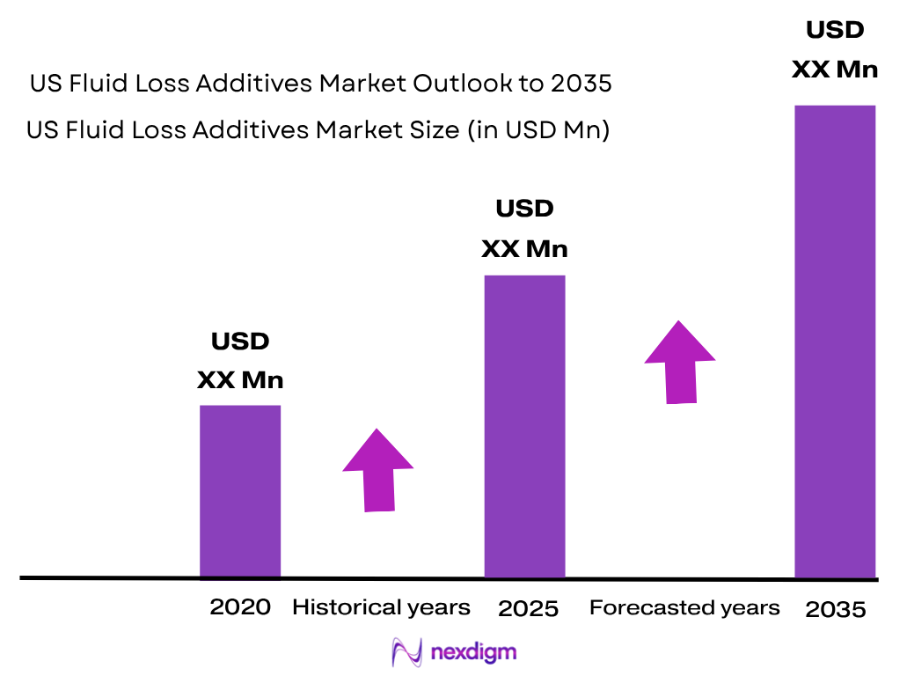
The US Fluid Loss Additives Market is valued at approximately ~USD ~ billion, with the forecast CAGR for the 2026–2035 period represented as ~%. Demand is closely connected to drilling-fluid consumption, well complexity and filtration-control requirements. The United States produced a record 13.2 million barrels of crude oil per day in 2024, compared with the previous record in 2023, with most production growth originating from the Permian region. Associated natural-gas production also averaged 18.5 Bcf/d in 2024, supporting continued drilling-fluid requirements across oil and gas operations.
Texas, New Mexico, Louisiana, Oklahoma and North Dakota represent the principal demand centers for US Fluid Loss Additives because they combine large drilling programs, shale activity, oilfield-service infrastructure and established drilling-fluid supply networks. Baker Hughes reported an average North American rig count of 787 rigs in 2024, compared with 864 in 2023; its February 2024 data recorded 303 rigs in Texas, 98 in New Mexico, 42 in Louisiana, 42 in Oklahoma and 32 in North Dakota. The Permian Basin is particularly important because it spans Texas and New Mexico and accounted for most US crude-production growth.
Market Segmentation
By Additive Type
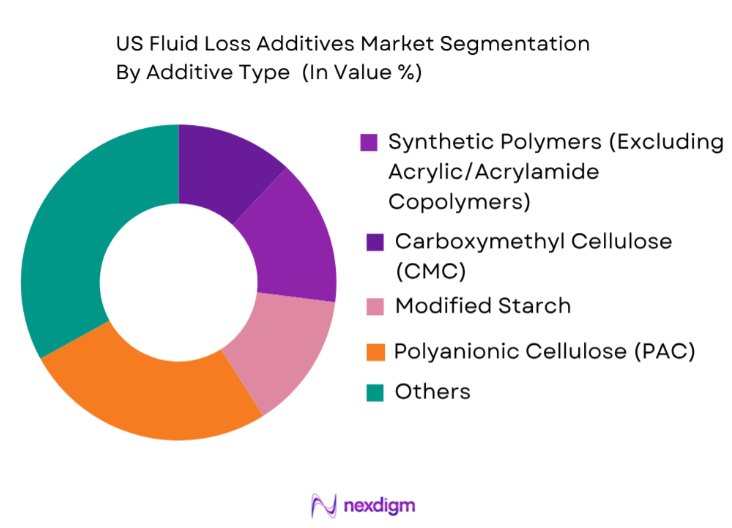
The US Fluid Loss Additives Market is segmented by additive type into polyanionic cellulose, carboxymethyl cellulose, modified starch, synthetic polymers, acrylic and acrylamide copolymers, natural polymer-based additives, cellulose derivatives, high-temperature polymer additives and hybrid filtration-control systems. Polyanionic cellulose is positioned as the leading sub-segment, with its 2024 share represented by ~%. Its relevance comes from its ability to reduce filtration while supporting rheological control in water-based drilling-fluid systems. Cellulose-derived additives are particularly relevant to shale and conventional drilling applications where maintaining filter-cake quality and limiting filtrate invasion are critical. The market is also moving toward more specialized polymer systems because deeper, hotter and more technically complex wells require performance beyond conventional filtration reduction. SLB’s current portfolio demonstrates this progression, including filtration-control products designed for water- and nonaqueous-based drilling fluids, with specific products providing HPHT control at temperatures reaching 500°F (260°C). This supports continued differentiation between standard filtration reducers and high-performance polymer systems.
By Application
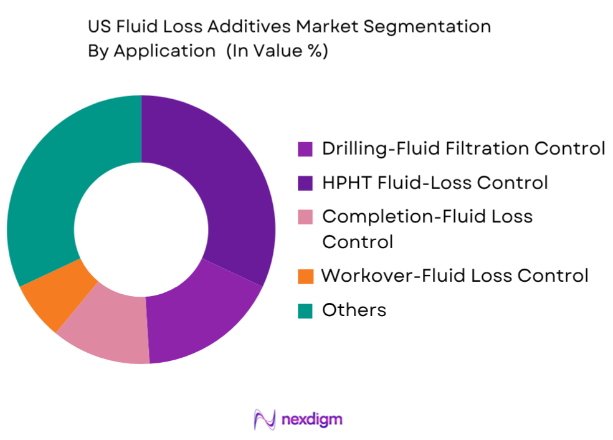
The US Fluid Loss Additives Market is segmented by application into drilling-fluid filtration control, HPHT fluid-loss control, completion-fluid loss control, workover-fluid loss control, well-cement fluid-loss control, reservoir drill-in fluids, formation-damage mitigation and filter-cake quality improvement. Drilling-fluid filtration control is positioned as the dominant application, with a 2024 share represented by ~%. Its dominance reflects the fundamental role of filtration control throughout drilling operations, particularly where permeable formations can allow excessive filtrate invasion and destabilize the wellbore. Horizontal and shale wells require carefully engineered filter cakes because drilling through long lateral sections increases exposure to formation interfaces. HPHT wells further increase additive-performance requirements because conventional polymers can lose effectiveness under severe temperature and pressure conditions. Completion and reservoir-drill-in applications add another demand layer because fluid systems must balance filtration control with formation compatibility. SLB describes filtration reducers as chemicals designed to reduce drilling-fluid filtration and improve filter-cake quality, while its reservoir drill-in systems emphasize minimizing formation damage and maintaining completion compatibility.
Competitive Landscape
The US Fluid Loss Additives Market is characterized by major integrated oilfield-service companies alongside specialized drilling-fluid and chemical suppliers. Competition is shaped by drilling-fluid formulation expertise, polymer chemistry, HPHT performance, technical field support, laboratory capabilities and relationships with oil and gas operators. SLB’s M-I SWACO business provides filtration reducers for both water- and nonaqueous-based drilling fluids, while Halliburton and Baker Hughes maintain broad oilfield-service portfolios. Newpark focuses specifically on drilling, drill-in, completion and stimulation fluids, while CES provides drilling-fluid systems and operates across major US basins.
| Company | Established | Headquarters | Fluid-Loss Capability | Drilling Fluid Portfolio | HPHT Capability | US Basin Coverage | Technical Support | Application Focus |
| SLB / M-I SWACO | 1926 / 1940 | Houston, Texas / Houston, Texas | ~ | ~ | ~ | ~ | ~ | ~ |
| Halliburton / Baroid | 1919 | Houston, Texas | ~ | ~ | ~ | ~ | ~ | ~ |
| Baker Hughes | 1907 | Houston, Texas | ~ | ~ | ~ | ~ | ~ | ~ |
| Newpark Fluids Systems | ~1932 | Katy, Texas | ~ | ~ | ~ | ~ | ~ | ~ |
| CES Energy Solutions | 2006 IPO | Calgary, Alberta | ~ | ~ | ~ | ~ | ~ | ~ |
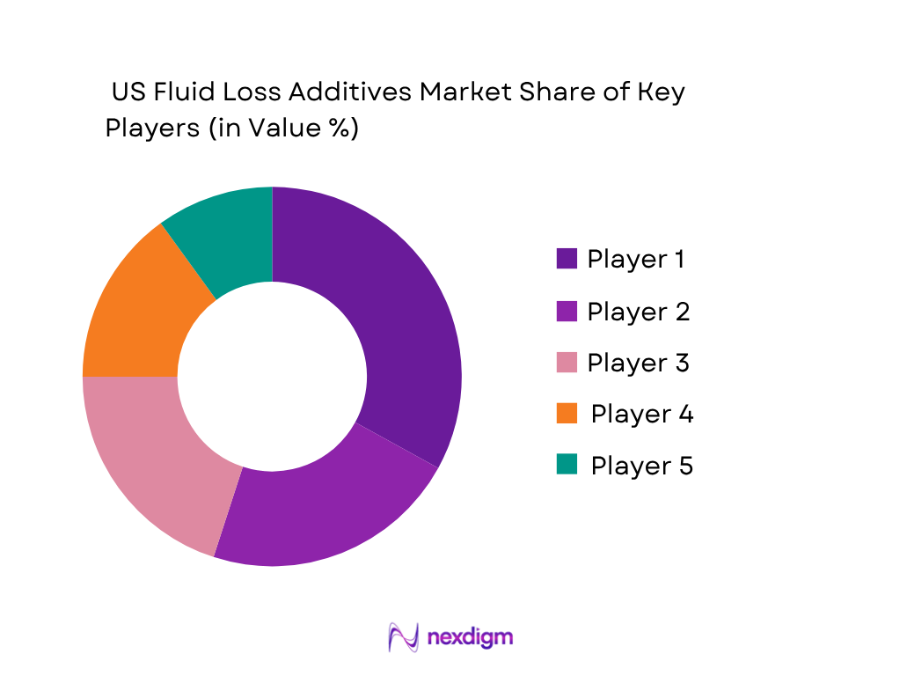
US Fluid Loss Additives Market Analysis
Growth Drivers
Expansion of Horizontal and Shale Drilling
The US Fluid Loss Additives Market is strongly supported by continued unconventional oil and gas production, particularly where horizontal wells require drilling fluids capable of maintaining filtration control across long laterals and heterogeneous formations. The U.S. Energy Information Administration reported that US crude oil production reached a record 13.2 million barrels per day in 2024, while Permian production averaged 6.3 million barrels per day. Tight-oil production from the Lower 48 reached 8.9 million barrels per day, with horizontally drilled wells representing the principal production mechanism for tight oil. Permian production reached 5.6 million barrels per day in December 2024, demonstrating the continued intensity of unconventional drilling activity. EIA also reported that the Permian averaged 308 active drilling rigs in 2024, while Eagle Ford and Bakken averaged 54 and 34 rigs, respectively. These drilling conditions increase the importance of fluid-loss-control packages that maintain thin, low-permeability filter cakes and limit filtrate invasion while preserving rheological performance. Longer laterals, tighter formations, higher differential pressures and repeated hydraulic-fracturing activity create additional formulation requirements for polymers, cellulose derivatives and other filtration-control additives. EIA’s 2026 analysis also confirms that operators continue to drill increasingly long horizontal wells, including super-laterals exceeding 15,000 feet, reinforcing the technical relevance of high-performance fluid-loss additives in US drilling operations.
Increasing HPHT, Deepwater and Complex Well Development
Increasing well complexity is strengthening demand for fluid-loss additives capable of maintaining filtration control under elevated temperature, pressure, salinity and differential-pressure conditions. US offshore activity provides an important application base: the U.S. Energy Information Administration reported that Federal Gulf of Mexico crude oil production was expected at approximately 1.8 million barrels per day in 2024, compared with 1.9 million barrels per day in 2023, while natural-gas production was expected at approximately 1.8 billion cubic feet per day. The Bureau of Safety and Environmental Enforcement recorded 43 approved new deepwater well permits and 376 revised new-well permits in 2024, alongside 100 approved deepwater sidetrack permits. These figures demonstrate the continuing engineering intensity of offshore well construction. The Gulf of Mexico also contained 371 manned production platforms, according to BSEE operational information released during 2024. Such environments require drilling and completion fluids that remain stable during temperature and pressure changes and that control filtrate movement without creating excessive formation damage. Fluid-loss additives therefore become an important formulation component for high-density, high-salinity and HPHT systems. The requirement becomes more pronounced as operators seek to maintain wellbore integrity, control filtration, protect productive intervals and manage complex drilling trajectories. Current offshore activity, combined with advanced onshore drilling, supports continued technical demand for higher-performance polymeric, PAC, CMC and synthetic fluid-loss-control technologies.
Market Challenges
HPHT Stability and Complex Formulation Requirements
The US Fluid Loss Additives Market faces significant technical challenges because drilling-fluid formulations increasingly operate under conditions where conventional filtration-control materials may lose performance. US drilling activity provides evidence of the increasingly demanding operating environment. EIA reported 13.2 million barrels per day of US crude oil production in 2024 and 6.3 million barrels per day of Permian production, while the Permian averaged 308 active drilling rigs. The same production environment is increasingly characterized by longer horizontal wells and more technically complex completion programs. In fluid systems, elevated temperature can accelerate polymer degradation, while high pressure and high-density formulations can change filtration behavior and interaction between fluid-loss additives, viscosifiers, shale inhibitors and weighting materials. High salinity and divalent-ion exposure can further affect polymer hydration and adsorption characteristics. Calcium sensitivity is particularly important because ionic interactions can reduce the effectiveness of certain cellulose-based and polymeric filtration-control materials. The challenge is therefore not simply selecting an additive with high API filtration performance; operators need formulations that maintain filtration control while preserving rheology, solids tolerance and compatibility with the complete drilling-fluid package. The increasing use of longer horizontal wells also raises the consequences of inconsistent filtration control because extended wellbore exposure creates greater opportunity for filtrate invasion and filter-cake instability. These requirements increase formulation and application-engineering complexity for suppliers serving US drilling contractors and operators.
Environmental Compliance and Supply-Chain Complexity
Environmental requirements and raw-material dependencies create another challenge for the US Fluid Loss Additives Market because suppliers must balance technical performance with increasingly demanding operating and regulatory requirements. US offshore operations illustrate the scale of the compliance environment. BSEE reported 371 manned production platforms in the Gulf of Mexico in 2024, requiring continuous operational oversight and environmental management. The agency also recorded 43 approved new deepwater well permits and 100 approved deepwater sidetrack permits during 2024, illustrating the number of technically regulated drilling activities requiring qualified fluid systems. Fluid-loss additives must perform without creating unacceptable environmental characteristics, while drilling-fluid formulations must remain compatible with disposal, treatment and operational requirements. Raw-material availability is another constraint because many high-performance fluid-loss products rely on specialized polymers, cellulose derivatives and chemically modified materials that require controlled manufacturing and consistent specifications. Variability in polymer molecular weight, substitution characteristics, hydration behavior or purity can change filtration performance from one batch to another. The challenge becomes more significant when formulations are exposed to high salinity, elevated temperature or calcium-rich environments. Suppliers therefore need stronger qualification procedures, application testing and technical support. The US drilling market’s combination of onshore scale and offshore regulatory complexity increases the importance of reliable supply, formulation consistency and environmental compatibility rather than simply maximizing filtration-control performance.
Market Opportunities
High-Performance HPHT Polymers and Advanced PAC/CMC Formulations
The continued technical development of US oil and gas wells creates an opportunity for advanced fluid-loss additives that deliver stronger filtration control at lower dosage while maintaining compatibility with complex drilling-fluid systems. The opportunity is supported by the scale and technical intensity of current drilling activity. EIA reported record US crude oil production of 13.2 million barrels per day in 2024, with the Permian averaging 6.3 million barrels per day and 308 active drilling rigs. Tight-oil production from the Lower 48 reached 8.9 million barrels per day, demonstrating the continuing dependence on technically sophisticated unconventional wells. The growing use of longer laterals increases the requirement for stable filter cakes and controlled filtrate invasion over extended well sections. This creates room for high-performance PAC, CMC, synthetic polymer and modified-cellulose formulations engineered for temperature, salinity and pressure tolerance. EIA’s 2026 assessment of Permian drilling also identifies continued movement toward super-lateral wells exceeding 15,000 feet, reinforcing the need for fluid systems capable of maintaining performance across extended horizontal intervals. Advanced additives can target lower fluid-loss values while reducing undesirable rheology changes and minimizing formation damage. Suppliers can differentiate through molecular design, controlled substitution, improved salt tolerance, enhanced thermal stability and compatibility with high-density water-based systems. The combination of sustained US unconventional production and increasingly demanding well geometries provides a current operational foundation for developing premium HPHT fluid-loss technologies.
Deepwater, Shale and Digital Fluid-Loss Optimization
The US Fluid Loss Additives Market also has an opportunity to expand through application-specific additive packages supported by automated mud monitoring, digital formulation management and real-time drilling-fluid optimization. The opportunity is grounded in continuing US drilling activity rather than a projected market statistic. EIA reported 1.8 million barrels per day of expected Federal Gulf of Mexico crude oil production in 2024 and approximately 1.8 billion cubic feet per day of natural-gas production. BSEE recorded 376 approved revised new-well permits, 100 approved deepwater sidetrack permits and 43 approved new deepwater well permits during 2024. These operations require drilling-fluid systems that can respond to changing formation pressure, temperature, salinity and permeability conditions. Onshore, the Permian produced an average 6.3 million barrels per day and operated an average of 308 active drilling rigs during 2024. Such a large operating base creates demand for standardized but customizable fluid-loss-control packages that can be adjusted according to formation and well conditions. Digital mud monitoring can connect filtration measurements, rheology data, density and solids-control information to formulation decisions, allowing operators to optimize additive concentration and reduce unnecessary treatment. Suppliers can therefore move beyond standalone PAC, CMC or synthetic-polymer products toward integrated fluid-loss packages combining filtration control, compatibility testing and digital performance monitoring. This creates opportunities in deepwater drilling, shale reservoirs, reservoir drill-in fluids and completion-fluid applications where precise filtration management is operationally important.
Future Outlook
The US Fluid Loss Additives Market is expected to maintain a positive long-term trajectory as drilling increasingly moves toward technically demanding horizontal, shale, deepwater and HPHT applications. Growth will be supported by the continued importance of the Permian Basin and other major US producing regions, alongside requirements for better filter-cake quality and formation protection. Product development is likely to focus on high-temperature stability, high-salinity compatibility, lower dosage requirements and environmentally preferred chemistries. Digital drilling-fluid monitoring and customized well-specific formulations should further differentiate suppliers.
Major Players
- SLB / M-I SWACO
- Halliburton / Baroid
- Baker Hughes
- Newpark Fluids Systems
- CES Energy Solutions
- Nouryon
- Elementis
- Ashland
- Innospec
- Clariant
- BASF
- Lubrizol
- Solvay
- Dorf Ketal
- TETRA Technologies
Key Target Audience
- Oil and Gas Exploration & Production Companies
- Drilling Fluid Service Providers
- Oilfield Chemical Manufacturers and Formulators
- Drilling Contractors and Well-Service Companies
- Completion and Workover Service Providers
- Investments and Venture Capitalist Firms (Energy-Focused Private Equity, Infrastructure Investors, Oilfield-Service Investors)
- Government and Regulatory Bodies (U.S. Environmental Protection Agency, Bureau of Safety and Environmental Enforcement, Bureau of Ocean Energy Management, Occupational Safety and Health Administration)
- Oilfield Chemical Distributors and Specialty Chemical Suppliers
Research Methodology
Step 1: Identification of Key Variables
The initial phase involves mapping the US Fluid Loss Additives ecosystem across additive manufacturers, drilling-fluid service providers, oil and gas operators, drilling contractors and chemical distributors. The assessment identifies variables such as additive chemistry, filtration-control performance, drilling-fluid system, well type, application, basin and operating conditions. Secondary information is used to establish the market’s structural framework.
Step 2: Market Analysis and Construction
Historical market information is compiled by evaluating drilling activity, fluid-system consumption, additive applications and operator requirements across major US oil and gas basins. Production and drilling indicators are cross-checked against authoritative industry datasets, including EIA production information and Baker Hughes rig-count data. Application-level analysis is then used to construct the market model.
Step 3: Hypothesis Validation and Expert Consultation
Market hypotheses are validated against technical information from drilling-fluid specialists, oilfield-service providers and additive manufacturers. Particular attention is given to polymer chemistry, HPHT filtration performance, filter-cake quality, salinity tolerance and compatibility with water-based and nonaqueous drilling fluids. API testing frameworks are incorporated to maintain consistency in technical interpretation. API’s SC13 committee maintains standards covering drilling fluids, completion fluids, heavy brines and related testing.
Step 4: Research Synthesis and Final Output
The final stage integrates supply-side and demand-side findings into a market-specific assessment of additive types, applications, drilling-fluid systems, well types and geographic demand centers. Company-level capabilities are benchmarked using product portfolios, technical specifications, laboratory infrastructure and US operating presence. The resulting analysis is triangulated before final market conclusions are prepared.

- Executive Summary
- Research Methodology (Market Definition and Scope, Fluid Loss Additive Classification, Filtration-Control Mechanism Mapping, Polymer Chemistry Assessment, Drilling Fluid System Assessment, Well Cement Fluid-Loss Control Assessment, Completion Fluid Loss Control Assessment, API Filtration Testing Framework, HPHT Performance Assessment, Filter-Cake Quality Evaluation, Rheology Compatibility Assessment, Salinity and Hardness Tolerance Assessment, Formation-Damage Risk Assessment, Supply-Side Assessment, Demand-Side Assessment, Top-Down Analysis, Bottom-Up Analysis, Primary Industry Interviews, Data Triangulation, Forecasting Framework, Market Limitations)

- Definition and Scope
- Fluid Loss Additive Industry Evolution and Development of Polyanionic Cellulose, Carboxymethyl Cellulose, Modified Starch, Synthetic Polymers, Copolymer Filtration Reducers, High-Temperature Fluid-Loss Systems, HPHT Filtration Control, Non-Aqueous Filtration Reducers, Completion Fluid Loss Control, Cement-Slurry Fluid Loss Control and Formation-Sealing Technologies
- Fluid Loss Additive Value Chain Analysis
- Fluid Loss Additive Supply Chain Analysis
- Cellulose and Starch Feedstock Suppliers, Specialty Polymer Manufacturers, Synthetic Polymer Producers, Chemical Additive Manufacturers, Drilling Fluid Additive Developers, Oilfield Chemical Formulators, Drilling Fluid Service Providers, Cementing Service Providers, Completion Fluid Specialists, Oilfield Chemical Distributors, Drilling Contractors, Well-Service Companies, Oil and Gas Operators and Formation-Evaluation Specialists

- Growth Drivers (Expansion of Horizontal and Shale Drilling, Increasing HPHT Well Development, Deepwater and Offshore Drilling Activity, Greater Demand for Wellbore Stability, Formation-Damage Prevention Requirements, Advanced Water-Based Drilling Fluid Adoption, High-Performance Drilling Fluid Formulation, Completion Fluid Optimization, Increasing Drilling Complexity, Demand for Thin Low-Permeability Filter Cakes)
- Market Challenges (Raw Material Availability, Polymer Performance Variability, HPHT Stability Requirements, High-Salinity Compatibility Constraints, Calcium Sensitivity, Formation-Damage Risks, Rheology Interaction, Additive Qualification Requirements, Complex Formulation Requirements, Environmental Compliance Requirements, Supply Chain Volatility, Application Engineering Complexity)
- Market Opportunities (High-Performance HPHT Polymers, Advanced PAC and CMC Formulations, Environmentally Preferred Cellulose Derivatives, Deepwater Fluid Loss Control, Shale Reservoir Filtration Management, Completion Fluid Loss Control, Automated Drilling Fluid Optimization, Digital Mud Monitoring, Customized Fluid-Loss Packages, High-Salinity Drilling Solutions, Reservoir Drill-In Fluid Technologies, Low-Dosage Synthetic Polymers)
- Market Trends (Advanced Synthetic Polymer Systems, HPHT Filtration Control, Low-Dosage Additive Formulation, High-Salinity Fluid Compatibility, Environmentally Preferred Cellulose Derivatives, Smart Drilling Fluid Monitoring, Customized Filter-Cake Design, Formation-Damage Reduction, Integrated Drilling Fluid Systems, Digital Fluid Performance Analytics)
- Government Regulations and Standards (API Drilling Fluid Testing Standards, API Filtration Testing, EPA Chemical Requirements, OSHA Oilfield Chemical Safety Requirements, Federal Offshore Drilling Requirements, Bureau of Safety and Environmental Enforcement Requirements, Bureau of Ocean Energy Management Requirements, State Oilfield Chemical Regulations, Chemical Reporting Requirements, Environmental Discharge Requirements)
- SWOT Analysis
- Porter’s Five Forces Analysis
- PESTLE Analysis
- Stakeholder Ecosystem
- Competition Ecosystem

- By Market Value (2020-2025)
- By Consumption Volume (2020-2025)
- By Fluid Loss Additive Consumption Volume (2020-2025)
- By Drilling Fluid Consumption Volume (2020-2025)
- By Fluid Loss Additive Application Volume (2020-2025)
- By Water-Based Drilling Fluid Consumption (2020-2025)

- By Additive Type (In Value %)
Polyanionic Cellulose
Carboxymethyl Cellulose
Modified Starch
Synthetic Polymers
Acrylic and Acrylamide Copolymers
Natural Polymer-Based Fluid Loss Additives
Cellulose Derivatives
High-Temperature Polymer Fluid Loss Additives
Hybrid Polymer Fluid Loss Systems - By Drilling Fluid System (In Value %)
Water-Based Drilling Fluids
Oil-Based Drilling Fluids
Synthetic-Based Drilling Fluids
High-Salinity Water-Based Fluids
Low-Solids Water-Based Fluids
Reservoir Drill-In Fluids
HPHT Drilling Fluids
Shale- and Clay-Controlled Drilling Fluids - By Application (In Value %)
Drilling Fluid Filtration Control
HPHT Fluid Loss Control
Completion Fluid Loss Control
Workover Fluid Loss Control
Well Cement Fluid Loss Control
Reservoir Drill-In Fluid Control
Formation-Damage Mitigation
Filter-Cake Quality Improvement - By Well Type (In Value %)
Conventional Oil Wells
Conventional Gas Wells
Shale Oil Wells
Shale Gas Wells
Ultra-Deepwater Wells
Horizontal Wells
Extended-Reach Wells
HPHT Wells - By End-Use (In Value %)
Onshore Oil and Gas
Offshore Oil and Gas
Shale Exploration and Production
Deepwater Exploration and Production
Well Completion and Workover
Well Cementing
Reservoir Drill-In Operations
Enhanced Wellbore Stability Operations - By Chemistry Performance (In Value %)
Standard-Temperature Fluid Loss Additives
High-Temperature Fluid Loss Additives
High-Pressure Fluid Loss Additives
High-Salinity Resistant Additives
Calcium-Tolerant Additives
Low-Viscosity Filtration Reducers
High-Performance Filter-Cake Additives
Environmentally Preferred Polymer Systems - By Region (In Value %)
Texas
Oklahoma
Louisiana
New Mexico
North Dakota
Colorado
Wyoming
Alaska
Gulf of Mexico
Rest of United States

- Market Share of Major Players (By US Revenue, Fluid Loss Additive Portfolio, PAC and CMC Portfolio, Synthetic Polymer Capability, HPHT Product Capability, Water-Based Fluid Coverage, Non-Aqueous Fluid Coverage, Completion Fluid Capability, Cementing Additive Capability, Shale Application Coverage, Deepwater Application Capability, Manufacturing Footprint, Distribution Network, Oilfield Service Integration, Operator Relationships)
- Cross Comparison Parameters (Fluid Loss Reduction Performance, HPHT Filtration Control Capability, Polymer Chemistry Breadth, PAC and CMC Grade Portfolio, High-Salinity Compatibility, Calcium Tolerance, Filter-Cake Quality Performance, US Oilfield Technical-Service and Formulation Capability)
- SWOT Analysis of Major Players
- Detailed Profiles of Major Companies
SLB / M-I SWACO
Halliburton / Baroid
Baker Hughes
Newpark Resources
CES Energy Solutions
TETRA Technologies
Nouryon
Elementis
Ashland
Innospec
Clariant
BASF
Lubrizol
Solvay
Dorf Ketal

- Oil and Gas Operator Fluid-Performance Requirements
- Drilling Contractor Additive Selection Assessment
- Drilling Fluid Service Provider Demand Analysis
- Completion Fluid Requirement Assessment
- Well Cementing Fluid-Loss Control Requirement Analysis
- Shale Operator Filtration-Control Assessment
- Deepwater Operator Fluid-Loss Management Assessment
- HPHT Well Fluid Formulation Requirement Analysis

- By Market Value (2026-2035)
- By Consumption Volume (2026-2035)
- By Fluid Loss Additive Consumption Volume (2026-2035)
- By Drilling Fluid Consumption Volume (2026-2035)
- By Fluid Loss Additive Application Volume (2026-2035)
- By Water-Based Drilling Fluid Consumption (2026-2035)


 Request a Sample
 Ask for Customization
 Get a Quote
 Enquire Now