

 Download PDF
Market Overview
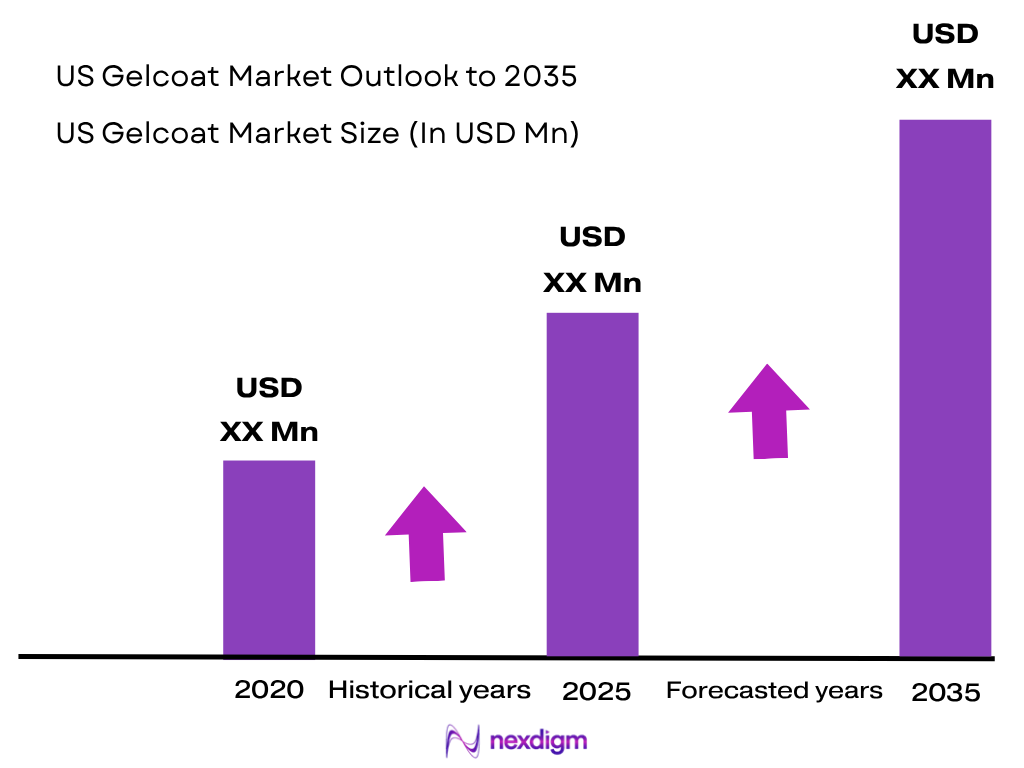
The US Gelcoat Market is valued at approximately ~USD XX million, based on historical demand from marine, transportation, construction, cast-polymer and industrial FRP applications. Published country-level research places the US market at USD 395.77 million in its latest base period. Demand is particularly linked to recreational marine manufacturing: US recreational marine expenditures moved from USD 57.7 billion in the preceding annual observation to USD 55.6 billion in the latest observation, with 238,117 new boats sold in the latter period.
Florida, Texas, California, the Great Lakes states and the Southeast form important US demand clusters for gelcoats because they combine boat ownership, recreational marine activity, fiberglass boat production, composite fabrication and warm-weather pool and spa applications. Florida, Michigan, Minnesota, California and Ohio were the leading states for boat registrations in the preceding annual dataset, which recorded 11.6 million registered or documented boats nationally. Fiberglass jet-boat demand was particularly strong in Florida, Texas and California, reinforcing regional requirements for durable marine composite surfaces.
Market Segmentation
By Resin Type
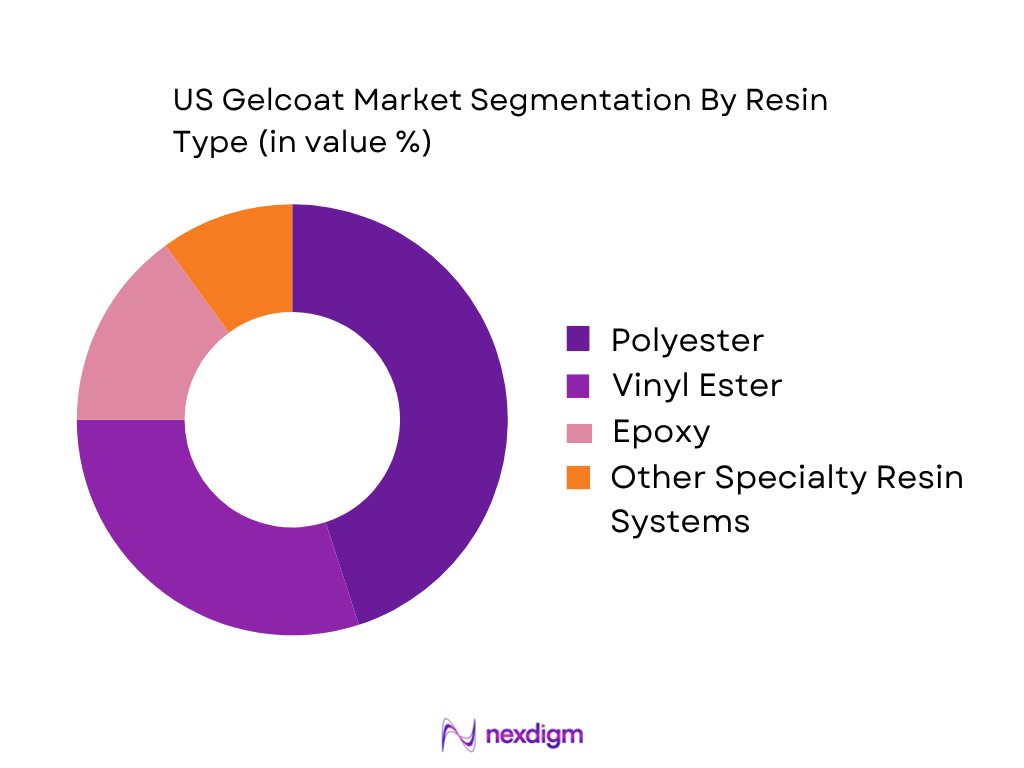
The US Gelcoat Market is segmented by resin type into polyester, vinyl ester, epoxy and other specialty resin systems. Polyester resin holds the dominant market share due to its extensive use in fiberglass-reinforced composite production, particularly for recreational boats, swimming pools, sanitary ware, transportation parts and general-purpose molded components. Polyester-based gelcoats combine established processing behavior with fast curing, corrosion resistance, weatherability and compatibility with widely used unsaturated polyester laminating systems. Isophthalic and ISO-NPG polyester formulations further improve hydrolysis resistance, UV stability, gloss retention and outdoor durability, making them particularly important for marine and pool applications. Industry suppliers including HK Research, Scott Bader and BÜFA maintain broad polyester and ISO-NPG gelcoat portfolios spanning marine, transportation and general composite applications. Polyester also benefits from a mature US composites processing infrastructure built around open molding, spray-up and hand lay-up techniques. These characteristics support its continued leadership despite increasing demand for vinyl ester and specialized low-emission formulations.
By End-Use Industry
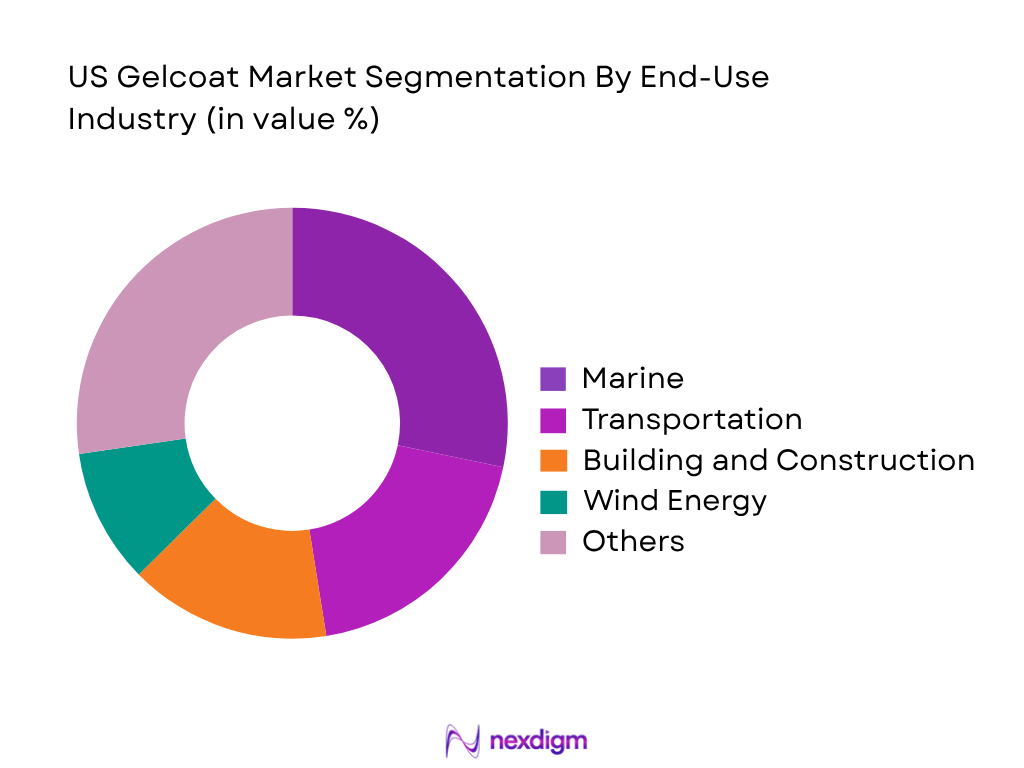
The US Gelcoat Market is segmented by end-use industry into marine, transportation, building and construction, wind energy and other composite applications. Marine represents the dominant end-use segment because fiberglass hulls, decks, consoles, liners and molded boat components require a surface layer that simultaneously provides aesthetics, water resistance, UV protection and resistance to environmental degradation. The US supports a large recreational boating ecosystem, with 238,117 new boats sold in the latest annual dataset and 141,590 units represented by outboard boats. Gelcoat is particularly suited to marine composites because the coating becomes the visible exterior surface during molding rather than requiring a separate finishing operation. The EPA specifically regulates fiberglass resin and gelcoat operations under its Boat Manufacturing NESHAP, demonstrating the scale and established industrial role of gelcoat application in US boat production. High-performance ISO-NPG formulations are additionally designed for hydrolysis, weathering and blister resistance required in prolonged marine service.
Competitive Landscape
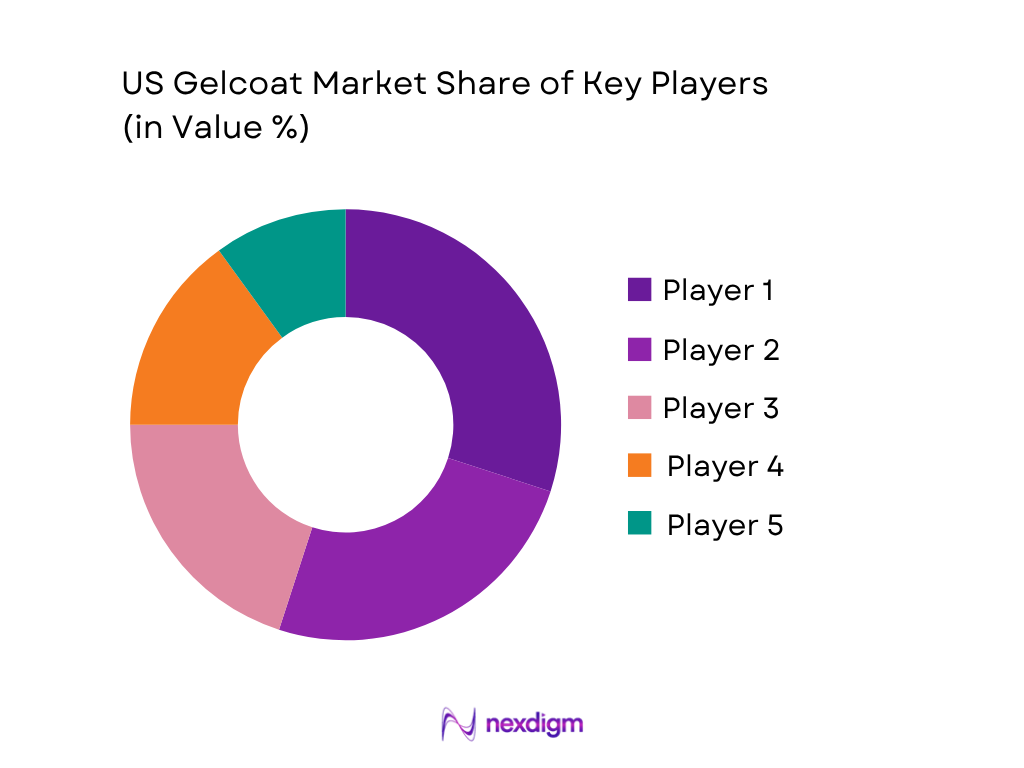
The US Gelcoat Market is characterized by established specialty resin formulators, dedicated gelcoat manufacturers and diversified composites-material companies. Competition is influenced by marine OEM approvals, ISO-NPG and vinyl ester chemistry, low-HAP formulations, custom color matching, batch-to-batch consistency, spray processability, technical service and distribution coverage. Polynt, Interplastic, HK Research, AOC and Scott Bader represent important competitive participants, while specialist distributors extend supplier access to fragmented fiberglass fabricators. Regulatory compliance is also a differentiator because US boat and reinforced-plastic composite operations are subject to EPA hazardous-air-pollutant controls covering gelcoat operations.
| Company | Establishment Year | Headquarters | Key Gelcoat Chemistry | Major US Applications | Low-Emission Capability | Marine Exposure | Tooling/Specialty Capability | Technical & Distribution Position |
| Polynt Composites | 1950s | Scanzorosciate, Italy; US composites operations in Illinois | ~ | ~ | ~ | ~ | ~ | ~ |
| Interplastic Corporation | 1959 | St. Paul, Minnesota, USA | ~ | ~ | ~ | ~ | ~ | ~ |
| HK Research | 1980 | Hickory, North Carolina, USA | ~ | ~ | ~ | ~ | ~ | ~ |
| AOC | 1994 | Tennessee, USA | ~ | ~ | ~ | ~ | ~ | ~ |
| Scott Bader | 1921 | Wollaston, Northamptonshire, UK | ~ | ~ | ~ | ~ | ~ | ~ |
US Gelcoat Market Analysis
Growth Drivers
Strong Marine and Recreational Boating Manufacturing Base
The US gelcoat market is supported by a large marine economy where fiberglass hulls, decks, consoles, liners, hatches and molded interior components require water-resistant, UV-stable and visually consistent surface finishes. The US Bureau of Economic Analysis reported that boating and fishing generated USD 38.4 billion in current-dollar value added in 2024, making it the country’s largest conventional outdoor-recreation activity. Florida contributed USD 4.4 billion, California USD 3.3 billion, and Texas USD 3.0 billion, identifying three particularly important regional demand centres for marine composite surfaces. The broader US outdoor-recreation economy generated USD 696.7 billion in value added during 2024, providing a substantial downstream ecosystem for boat ownership, maintenance and marine manufacturing. The Bureau of Labor Statistics recorded approximately 41,800 employees in boat building in December 2024, demonstrating the continued industrial scale of NAICS 336612. From a macroeconomic perspective, the World Bank recorded US GDP at USD 28.75 trillion and GDP per capita at USD 84,534 in 2024, supporting discretionary marine consumption and capital-intensive manufacturing. These conditions directly support ISO-NPG polyester, marine-grade polyester, barrier and specialty gelcoats designed for hydrolysis resistance, gloss retention, color stability and prolonged outdoor exposure.
Large Composite-Intensive Manufacturing and Transportation Ecosystem
The US gelcoat market also benefits from the scale of domestic composite-intensive manufacturing, particularly transportation equipment, recreational vehicles, industrial FRP products and molded structures requiring an in-mold decorative and protective surface. The Bureau of Economic Analysis reported that manufacturing associated with the outdoor-recreation economy generated USD 91.3 billion in value added in 2024, with Texas contributing USD 13.1 billion, California USD 11.6 billion, and Indiana USD 9.1 billion. RVing alone generated USD 27.5 billion in value added, with Indiana accounting for USD 5.2 billion, Texas USD 2.7 billion, and California USD 2.1 billion. These manufacturing clusters are relevant to gelcoat suppliers because fiberglass-reinforced panels, molded exterior components, sanitary structures and specialty transportation parts require surface systems offering weatherability, abrasion resistance, color retention and compatibility with polyester or vinyl-ester laminates. The World Bank recorded a US population of 340,110,988 in 2024, alongside GDP of USD 28.75 trillion, providing a large domestic base for transportation, recreational and construction-related manufactured products. This manufacturing depth supports demand not only for conventional polyester gelcoats but also fire-retardant, abrasion-resistant, low-emission and specialty formulations tailored to transportation and industrial composite processing.
Market Challenges
Softness in Boat-Building Employment and Production Capacity Utilization
A major challenge for the US gelcoat market is the pressure visible within domestic boat-building activity, because recreational marine manufacturing remains one of the most gelcoat-intensive downstream industries. The Bureau of Labor Statistics recorded approximately 41,800 boat-building employees in December 2024 under NAICS 336612. By June 2025, employment stood at approximately 41,100, while the January 2026 dataset showed approximately 40,400 employees. The contraction in the industry’s workforce indicates a more cautious operating environment for boat manufacturers and their fiberglass supply chains, potentially affecting gelcoat application volumes, production scheduling and inventory requirements. The challenge is material-specific because marine gelcoats are applied directly during fiberglass molding of hulls, decks, consoles and other exterior components; weaker production throughput therefore has a direct effect on resin and gelcoat consumption rather than only an indirect macroeconomic impact. At the same time, the World Bank places the US economy at USD 28.75 trillion in GDP and USD 84,534 GDP per capita in 2024, meaning suppliers operate in a large but mature economy where discretionary durable-goods demand can fluctuate independently of overall economic scale. Gelcoat producers must consequently diversify beyond new-boat manufacturing into repair, pools, transportation, industrial FRP and specialty composite applications to reduce dependence on marine OEM production cycles.
Tightening Environmental Compliance Around Styrene-Containing Composite Processes
Environmental and occupational compliance represents a structural challenge for the US gelcoat market because conventional unsaturated polyester gelcoats commonly operate within manufacturing processes involving styrene and other regulated hazardous air pollutants. In January 2026, the US Environmental Protection Agency proposed amendments covering 2 major NESHAP source categories—Boat Manufacturing and Reinforced Plastic Composites Manufacturing. The regulated processes specifically include fiberglass resin and gelcoat operations, while the reinforced-plastics category includes thermoset resin and gelcoat manufacturing activities. EPA’s action also proposed electronic submission of compliance reports and performance-test results, increasing the importance of documented process control for composite manufacturers. This regulatory exposure matters commercially because the US boat-building workforce still represented approximately 40,400 employees in January 2026, according to the Bureau of Labor Statistics, indicating a sizable manufacturing base subject to emission-management requirements. The macroeconomic context is equally substantial: the World Bank recorded USD 28.75 trillion of US GDP in 2024 and a population of 340,110,988, illustrating the scale of industrial and consumer activity surrounding regulated composite products. Gelcoat formulators therefore face the technical challenge of lowering styrene and hazardous-emission profiles while preserving spray viscosity, cure characteristics, pigment consistency, surface gloss, hydrolysis resistance and mechanical performance demanded by marine and industrial OEMs.
Market Opportunities
Expansion into Wind-Energy Composite Surface and Protection Applications
Wind-energy infrastructure presents a future-oriented opportunity for US gelcoat and composite-surface suppliers because turbine blades, nacelles and associated fiberglass-reinforced structures require protection against moisture, ultraviolet exposure, erosion and demanding outdoor conditions. Current operating data demonstrate the size of the underlying composite asset base. The US Energy Information Administration recorded 451,904 thousand megawatt-hours of utility-scale wind generation in 2024. The Department of Energy also announced USD 20 million in December 2024 specifically to advance recycling technologies for wind-energy materials, including difficult-to-recycle fiber-reinforced composites used in turbine blades and nacelles. Earlier during 2024, DOE selected 20 projects across 15 states, with each project receiving USD 75,000 during the first phase of its Wind Turbine Materials Recycling Prize, demonstrating active federal attention to composite-material technology. These investments create an ecosystem where longer-lasting surface systems, repair coatings, recyclable composite-compatible technologies and specialized erosion-resistant formulations can gain relevance. The opportunity is supported by a large macroeconomic base: the World Bank reported US GDP of USD 28.75 trillion in 2024 and a population of 340,110,988. Gelcoat manufacturers capable of developing high-weatherability, erosion-resistant and low-emission solutions for large composite structures can consequently diversify beyond their traditional reliance on marine and recreational applications.
Premium Marine, Repair and High-Performance Gelcoat Formulations
Premium marine and aftermarket applications provide a significant growth avenue for the US gelcoat market because the country already supports a large boating and fishing economy that continuously requires surface protection, refurbishment, color restoration and fiberglass repair. The US Bureau of Economic Analysis recorded USD 38.4 billion in boating and fishing value added in 2024, with the activity ranking as the largest conventional outdoor-recreation category nationally. Florida alone contributed USD 4.4 billion, followed by California at USD 3.3 billion and Texas at USD 3.0 billion, creating geographically concentrated markets for marine-grade gelcoats, repair systems, clear coats, barrier layers and color-matched products. The wider outdoor-recreation economy generated USD 696.7 billion in value added, while retail trade connected with outdoor recreation contributed USD 169.1 billion, providing a large commercial channel for maintenance and aftermarket products. The World Bank recorded US GDP at USD 28.75 trillion, GDP per capita at USD 84,534, and population at 340,110,988 in 2024, indicating considerable purchasing power and an extensive consumer base. Future gelcoat growth can therefore come from higher-performance ISO-NPG, vinyl-ester, low-styrene, UV-resistant, blister-resistant and custom-color products rather than relying solely on incremental volume from new fiberglass boat construction.
Future Outlook
The US Gelcoat Market is projected to expand at approximately ~XX% CAGR during 2026-2035, supported by sustained use of fiber-reinforced composites in marine products, pools and spas, transportation, building products and industrial equipment. Growth is expected to increasingly favor differentiated formulations offering improved UV resistance, hydrolysis resistance, chemical durability, low emissions and processing efficiency. Marine applications should remain structurally important because boats represent one of the most established markets for molded fiberglass components. US recreational marine spending reached USD 55.6 billion in the latest full annual industry dataset, with aftermarket accessory expenditure of USD 12.4 billion and boat-use spending of USD 12.1 billion. These activity levels support both OEM gelcoat consumption and downstream repair, restoration and refinishing demand.
Environmental regulation will increasingly influence formulation strategies. EPA’s Boat Manufacturing NESHAP covers fiberglass resin and gelcoat operations and controls hazardous air pollutants including styrene and methyl methacrylate. EPA’s latest review continues to address boat manufacturing and reinforced plastic composite production under these air-toxics standards. This regulatory environment creates incentives for formulators to develop low-HAP, lower-styrene and higher-solids products without compromising cure performance, color stability or surface quality.
Major Players
- Polynt Composites USA
- Interplastic Corporation
- HK Research
- AOC
- allnex
- Scott Bader
- BÜFA Composites
- ITW Evercoat
- Fibre Glast Developments Corporation
- Composites One
- Hawkeye Industries
- ALTA Performance Materials
- Spoke Materials
- Sika
- Mankiewicz
Key Target Audience
- Gelcoat and Unsaturated Polyester Resin Manufacturers
- Fiberglass and FRP Composite Component Manufacturers
- Marine, Boat and Personal Watercraft OEMs
- Swimming Pool, Spa and Cast Polymer Manufacturers
- Transportation, Recreational Vehicle and Specialty Vehicle Manufacturers
- Composite Material Distributors and Chemical Raw Material Suppliers
- Investments and Venture Capitalist Firms
- Government and Regulatory Bodies (US Environmental Protection Agency, Occupational Safety and Health Administration, Consumer Product Safety Commission, Department of Commerce, National Institute of Standards and Technology)
Research Methodology
Step 1: Identification of Key Variables
The initial phase involves developing an ecosystem map for the US Gelcoat Market covering unsaturated polyester and vinyl ester resin producers, pigment and additive suppliers, gelcoat formulators, composite distributors, fiberglass fabricators and OEM customers. Key variables include resin chemistry, gelcoat consumption, marine exposure, domestic manufacturing capacity, application technology, product performance, environmental compliance and channel structure. Secondary research establishes the market definitions and boundaries required for subsequent sizing.
Step 2: Market Analysis and Construction
Historical US Gelcoat Market demand is assessed through both top-down and bottom-up frameworks. The top-down analysis examines production and activity in marine, transportation, construction, pools, cast polymer and industrial composites, while the bottom-up model reviews manufacturer gelcoat sales, product portfolios, facility footprints, distributor activity and end-user consumption. Resin-specific and application-specific demand is reconciled to prevent double counting between manufacturers, distributors and downstream composite processors.
Step 3: Hypothesis Validation and Expert Consultation
Market hypotheses are validated through CATIs and structured discussions with gelcoat formulators, composite fabricators, distributors, boat manufacturers, pool manufacturers, application-equipment providers and resin specialists. Primary discussions assess formulation preferences, ISO-NPG penetration, spray versus brush usage, customer qualification criteria, color requirements, regulatory compliance and material substitution. The resulting qualitative and operational observations are cross-checked against published company information, government regulation and industry production indicators.
Step 4: Research Synthesis and Final Output
The final phase combines supply-side and demand-side evidence to establish the US Gelcoat Market structure, segmentation, competitive landscape and long-term outlook. Supplier revenues, product positioning, end-use demand and application technologies are triangulated to develop a consistent market model. Forecast assumptions incorporate marine manufacturing, composite substitution, pool and spa demand, environmental regulations, low-HAP innovation, automation and changes in polyester and vinyl ester gelcoat adoption.

- Executive Summary
- Research Methodology (Market Definition and Scope, US Gelcoat Market Classification, Gelcoat Demand Assessment, Unsaturated Polyester and Vinyl Ester Resin Feedstock Mapping, Gelcoat Manufacturing Industry Assessment, Marine and Composite Application Analysis, Surface Performance Requirement Evaluation, Domestic Production and Import-Export Analysis, End-Use Industry Demand Mapping, Gelcoat Application Technology Assessment)

- Definition and Scope
- US Gelcoat Industry Evolution and Development of Marine, Composite Manufacturing and High-Performance Surface Coating Ecosystem
- Gelcoat Manufacturing, Resin Formulation Distribution and Composite Processing Industry Structure
- US Gelcoat Value Chain Analysis
- US Gelcoat Supply Chain Analysis
- Resin Producer, Styrene Supplier, Pigment and Additive Supplier, Gelcoat Formulator, Composite Material Distributor, FRP Fabricator, OEM and Aftermarket Ecosystem Analysis
- Gelcoat Manufacturing and Application Integration Assessment Across Marine, Transportation, Construction, Pool and Spa, Cast Polymer and Industrial Composite Applications

- Growth Drivers (Large Recreational Boat Manufacturing Base, Expansion of Fiberglass Pool and Spa Applications, Growth of FRP Composite Manufacturing, Demand for High-Gloss In-Mold Surface Finishes, Increasing Use of Corrosion-Resistant Composite Equipment, Transportation Lightweighting, Growth of Cast Polymer Applications, Demand for UV- and Hydrolysis-Resistant Surfaces)
- Market Challenges (Styrene and Hazardous Air Pollutant Emission Requirements, Volatility in Polyester and Vinyl Ester Resin Feedstocks, Gelcoat Cracking and Blistering Risk, Color Consistency Requirements, Overspray and Material Transfer Losses, Skilled Spray Operator Dependence, Surface Porosity and Sagging Defects, Competition from Paint and Alternative In-Mold Coating Technologies)
- Market Opportunities (Low-HAP Gelcoat Formulations, Styrene-Reduced and Styrene-Free Systems, Premium Marine Gelcoats, High-Performance Pool and Spa Gelcoats, Fire-Retardant Transportation Gelcoats, Automated Gelcoat Application, Vinyl Ester Tooling Gelcoats, High-UV-Stability Gelcoats, Sustainable Resin Chemistry)
- Market Trends (Low-HAP Formulation Adoption, Higher-Solids Gelcoats, ISO-NPG Chemistry Adoption, Improved Color and Gloss Retention, Automated Spray Application, Custom Color Matching, Vinyl Ester Tooling Systems, Improved Blister Resistance, Low-Styrene Processing)
- Regulatory and Standards Landscape (EPA Reinforced Plastic Composites Production NESHAP, EPA Boat Manufacturing NESHAP, Clean Air Act Hazardous Air Pollutant Requirements, Styrene and Methyl Methacrylate Emission Controls, OSHA Styrene Workplace Exposure Requirements, VOC Compliance Requirements, ASTM Composite and Gelcoat Testing Standards, State-Level Air Quality Regulations)
- SWOT Analysis
- Porter’s Five Forces Analysis
- PESTLE Analysis
- Stakeholder Ecosystem
- Competition Ecosystem

- By Market Value (2020-2025)
- By Gelcoat Consumption Volume (2020-2025)
- By Domestic Gelcoat Production Volume (2020-2025)
- By Marine Gelcoat Consumption Volume (2020-2025)
- By Industrial and Composite Gelcoat Consumption Volume (2020-2025)
- By Gelcoat Import Volume (2020-2025)
- By Gelcoat Export Volume (2020-2025)

- By Resin Type (In Value %)
Orthophthalic Polyester Gelcoat
Isophthalic Polyester Gelcoat
Isophthalic-NPG Gelcoat
Neopentyl Glycol Polyester Gelcoat
Vinyl Ester Gelcoat
Hybrid Polyester-Vinyl Ester Gelcoat
Modified Polyester Gelcoat
Styrene-Reduced and Styrene-Free Gelcoat - By Product Type (In Value %)
General-Purpose Gelcoat
Marine Gelcoat
Tooling Gelcoat
Clear Gelcoat
Pigmented Gelcoat
Fire-Retardant Gelcoat
Low-HAP Gelcoat
Low-VOC Gelcoat
Abrasion-Resistant Gelcoat
Chemical-Resistant Gelcoat
UV-Resistant and Weatherable Gelcoat
Barrier Coat and Specialty Surface Systems - By Application Type (In Value %)
Marine Hull and Deck Applications
Swimming Pool and Spa Applications
Cast Polymer and Sanitary Ware Applications
Transportation Composite Applications
Industrial FRP Applications
Construction Composite Applications
Composite Tooling and Mold Applications
Wind Energy Composite Applications
Automotive and Specialty Vehicle Applications
Repair and Refinishing Applications - By Application Technology (In Value %)
Manual Spray Application
Automated Spray Application
Air-Assisted Spray Application
Catalyst Injection Application
Brush Application
Roller Application
In-Mold Gelcoat Application
Plural-Component Spray Application
Open-Mold Gelcoat Application
Automated Composite Production Integration - By End-Use Industry (In Value %)
Marine and Boat Manufacturing
Swimming Pools and Spas
Building and Construction
Transportation and Recreational Vehicles
Industrial and Chemical Processing Equipment
Cast Polymer and Sanitary Ware
Automotive and Specialty Vehicles
Wind Energy
Aerospace and High-Performance Composites
Composite Tooling and Mold Manufacturing - By Functional Performance (In Value %)
UV and Weather Resistance
Hydrolysis and Water Resistance
Chemical and Corrosion Resistance
Abrasion Resistance
Fire and Flame Resistance
High-Gloss and Color Retention
Blister and Osmosis Resistance
Thermal-Shock Resistance
Crack and Impact Resistance
High-Temperature Tooling Performance

- Market Share of Major Players (By Revenue, Gelcoat Volume, Resin and Product Portfolio, End-Use Industry, Application Technology, Manufacturing Footprint, Distribution Network, Customer Segment Distribution)
- Cross Comparison Parameters (US Gelcoat Revenue, Gelcoat Production Capacity, ISO-NPG and Vinyl Ester Gelcoat Portfolio Breadth, Low-HAP and Low-VOC Formulation Capability, Marine and Pool-Spa Application Coverage, Custom Color-Matching and Pigmentation Capability, US Manufacturing and Distribution Footprint, Gelcoat Application Technical-Service Capability)
- SWOT Analysis of Major Players
- Competitive Positioning Matrix
- Gelcoat Resin and Product Portfolio Benchmarking
- Pricing and Gelcoat Category Benchmarking
- Manufacturing and Formulation Technology Assessment
- Customer Industry and Regional Distribution Assessment
- Detailed Profiles of Major Companies
Polynt Composites USA
Interplastic Corporation
HK Research
AOC
allnex
Scott Bader
BÜFA Composites
ITW Evercoat
Fibre Glast Developments Corporation
Composites One
Hawkeye Industries
ALTA Performance Materials
Spoke Materials
Sika
Mankiewicz

- Marine and Boat OEM Gelcoat Procurement Assessment
- Swimming Pool and Spa Manufacturer Gelcoat Requirement Analysis
- Transportation and Recreational Vehicle Manufacturer Surface Material Assessment
- Cast Polymer and Sanitary Ware Manufacturer Gelcoat Requirement Analysis
- Industrial FRP Fabricator Gelcoat Procurement Assessment
- Construction Composite Manufacturer Surface Performance Analysis
- Composite Tooling Manufacturer Tooling Gelcoat Requirement Assessment
- Automotive and Specialty Vehicle Manufacturer Gelcoat Application Analysis
- Aftermarket Repair and Refinishing Customer Assessment

- By Market Value (2026-2035)
- By Gelcoat Consumption Volume (2026-2035)
- By Domestic Gelcoat Production Volume (2026-2035)
- By Marine Gelcoat Consumption Volume (2026-2035)
- By Industrial and Composite Gelcoat Consumption Volume (2026-2035)
- By Gelcoat Import Volume (2026-2035)
- By Gelcoat Export Volume (2026-2035)


 Request a Sample
 Ask for Customization
 Get a Quote
 Enquire Now