
 Download PDF
Market Overview
The US Hollow Concrete Blocks Market is valued at approximately USD ~ billion, based on a five-year historical analysis. Demand is supported by residential, commercial, industrial and institutional construction, alongside fire-resistant and resilient masonry requirements. US construction spending moved from approximately USD 2.0 trillion to USD 2.15 trillion, while privately owned housing starts moved from approximately 1.42 million units to 1.37 million units, sustaining demand for structural and architectural concrete masonry units.
Texas, Florida, California, Arizona and North Carolina represent important demand centers for the US Hollow Concrete Blocks Market because of extensive residential and non-residential construction, population concentration and established masonry supply chains. The South recorded approximately 765,000 housing starts compared with 832,000 previously, while the West recorded approximately 328,000 compared with 341,000. Warm-climate construction practices, durability requirements, hurricane exposure and extensive commercial development support concrete masonry utilization across these markets.
Market Segmentation
By Product Type
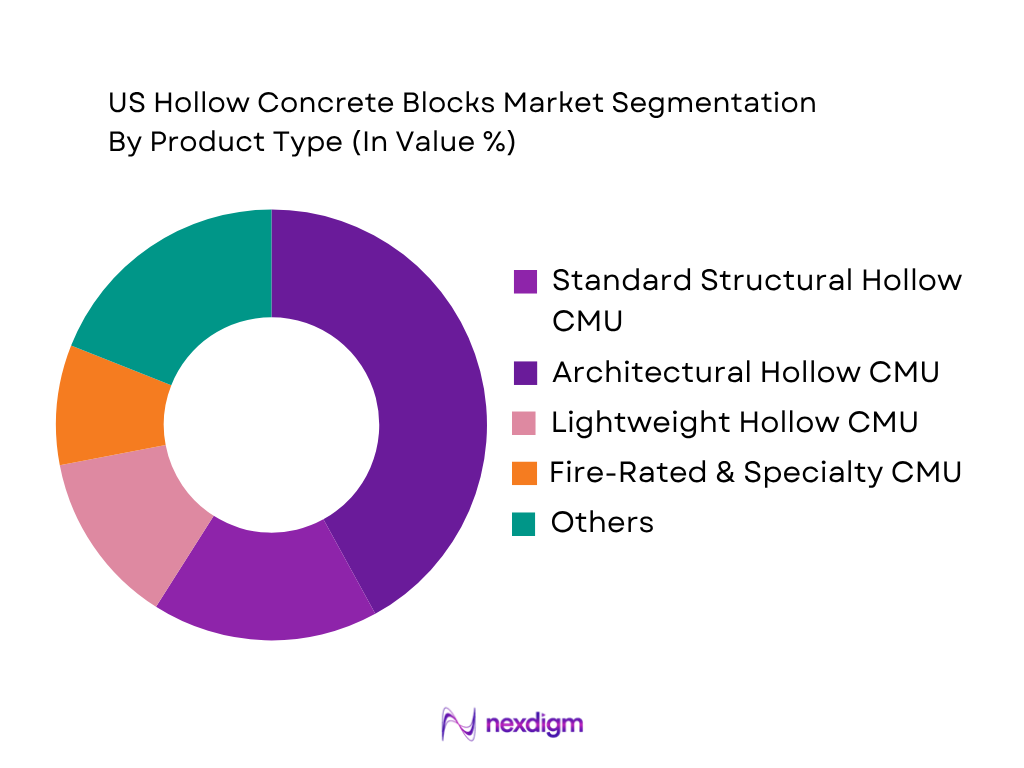
The US Hollow Concrete Blocks Market is segmented into standard structural hollow CMU, architectural hollow CMU, lightweight CMU, insulated CMU, fire-rated CMU, split-face blocks and other specialty units. Recently, standard structural hollow CMU has a dominant market share in the US under product-type segmentation in this report framework because it serves a broad range of load-bearing and non-load-bearing wall applications. Standard units are extensively specified for commercial buildings, warehouses, schools, industrial facilities, multifamily developments, utility structures and institutional buildings. Their standardized dimensions allow integration with reinforcement, grout, mortar and modular masonry design. ASTM C90 provides a widely recognized specification framework for load-bearing concrete masonry units, supporting predictable dimensional and performance characteristics. Architectural CMU provides additional value through split-face, ground-face, scored and integral-color surfaces, while lightweight units can improve mason handling and provide different thermal and density characteristics.
By Application
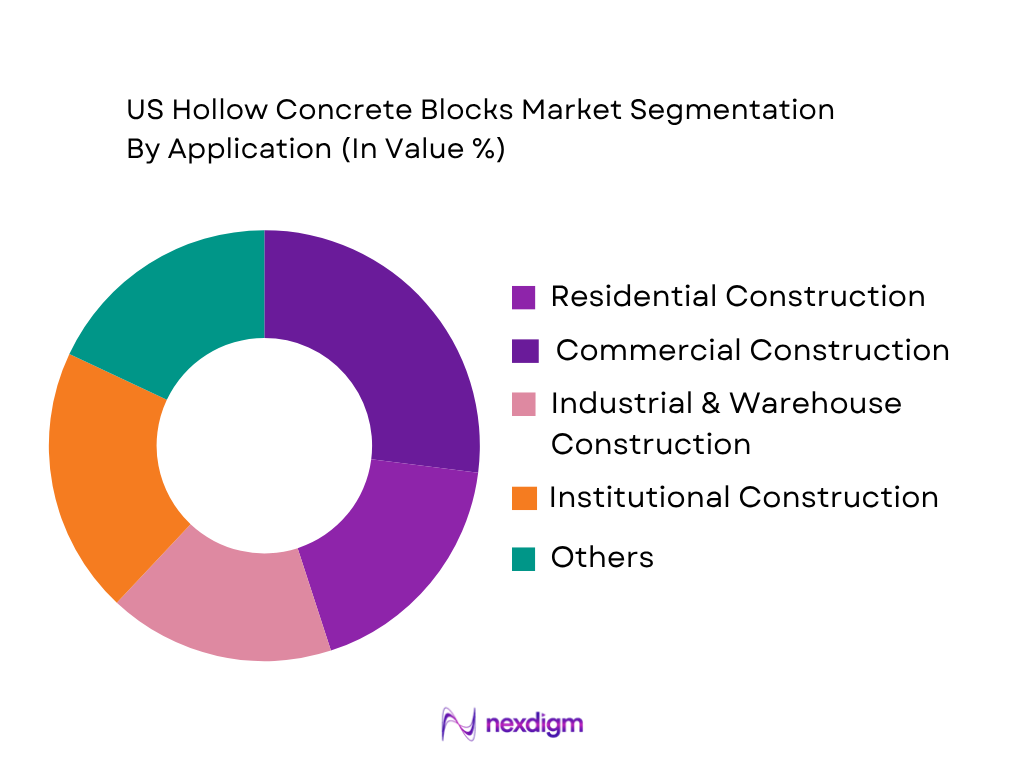
The US Hollow Concrete Blocks Market is segmented by application into commercial construction, residential construction, industrial and warehouse construction, institutional buildings, infrastructure and utilities, and other applications. Recently, commercial and institutional construction has a dominant market share in the US under application segmentation in this report framework because concrete masonry combines structural capability, fire resistance, impact resistance, acoustic performance and long service life. Hollow CMU is widely applicable to retail facilities, schools, hospitals, municipal buildings, stair and elevator shafts, mechanical rooms and fire-separation walls. Industrial buildings and warehouses also provide substantial applications for partitions, utility enclosures and durable perimeter walls. Residential use is more geographically concentrated, particularly in states where concrete and masonry construction is established. Data centers represent an emerging specification opportunity because secure equipment areas, utility spaces and fire-separated zones can benefit from noncombustible masonry assemblies.
Competitive Landscape
The US Hollow Concrete Blocks Market is characterized by large multi-state building-material groups alongside strong regional concrete masonry manufacturers. Oldcastle APG, Best Block, Basalite, Angelus Block and Mutual Materials maintain significant positions across structural, architectural and specialty masonry categories. Competition is highly regional because hollow concrete blocks are heavy products, making plant location, distribution coverage, contractor relationships and efficient truck delivery important alongside product performance and manufacturing capacity.
| Major Player | Establishment Year | Headquarters | Structural CMU Portfolio | Architectural CMU | Lightweight CMU Capability | Specialty Shapes | Low-Carbon/Sustainability Capability |
| Oldcastle APG | 1991 | Atlanta, Georgia | ~ | ~ | ~ | ~ | ~ |
| Best Block / QUIKRETE | 1940* | Atlanta, Georgia | ~ | ~ | ~ | ~ | ~ |
| Basalite Concrete Products | 1936 | Dixon, California | ~ | ~ | ~ | ~ | ~ |
| Angelus Block | 1946 | Sun Valley, California | ~ | ~ | ~ | ~ | ~ |
| Mutual Materials | 1900 | Bellevue, Washington | ~ | ~ | ~ | ~ | ~ |
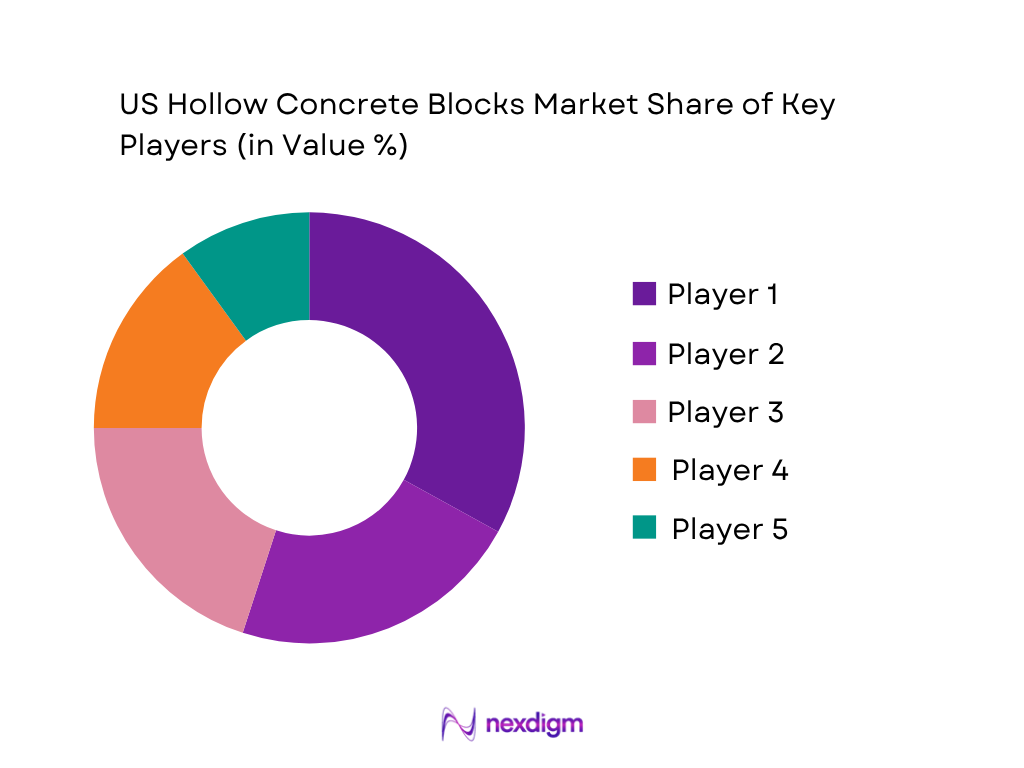
US Hollow Concrete Blocks Market Analysis
Growth Drivers
Commercial and Institutional Construction
The US Hollow Concrete Blocks Market is supported by sustained demand from commercial buildings, schools, healthcare facilities, warehouses, municipal facilities and industrial structures. Hollow CMUs are particularly relevant where developers require durable, noncombustible and impact-resistant walls for high-traffic environments. Standard structural blocks can serve exterior and interior walls, while reinforced and grouted units support load-bearing and lateral-load applications. Institutional construction additionally favors CMU for corridors, stairwells, mechanical rooms, gymnasiums and fire-separated spaces because masonry combines structural functionality with long service life. Architectural CMUs, including split-face, ground-face and integral-color products, broaden this demand by allowing exposed masonry to function as both the wall system and finished surface. Warehouse and distribution-center development provides further applications in utility areas, partitions and fire separation. Data-center construction is also creating specification opportunities for robust masonry walls around equipment, mechanical and secure spaces. These characteristics position commercial and institutional construction as a core demand base for structural and architectural hollow concrete blocks.
Fire Resistance, Severe-Weather Resilience and Masonry Durability
Fire-resistant and resilient construction requirements support the US Hollow Concrete Blocks Market because concrete masonry is noncombustible and can be engineered into reinforced wall assemblies for demanding building conditions. Hollow blocks can accommodate vertical and horizontal reinforcement and grout, enabling designers to increase structural capacity where required. This makes CMU particularly relevant for hurricane-exposed markets in Florida and other southeastern states, as well as institutional, industrial and public-safety buildings requiring durable envelope and interior wall systems. Concrete masonry is also resistant to rot and termite-related deterioration, supporting its use in climates where moisture and biological exposure influence material selection. Fire separation is another important application across schools, warehouses, multifamily buildings, hospitals, data centers and industrial facilities. Producers can further enhance performance through integral water repellents, lightweight aggregates and specialized unit configurations. The combination of structural strength, noncombustibility, moisture management and long service life therefore supports continued specification of hollow CMU despite competition from alternative wall systems.
Market Challenges
Heavy Logistics, Regional Manufacturing Economics and Masonry Labor
Transportation and installation economics remain significant constraints for the US Hollow Concrete Blocks Market because CMUs are heavy, relatively low-value-per-weight construction products. Manufacturing plants therefore tend to compete within practical regional delivery areas, making plant location, truck utilization, pallet configuration and distributor coverage critical to profitability and product availability. Long-distance transportation can weaken the economics of standard gray block, particularly when comparable products are available from a closer manufacturer. Jobsite productivity creates another constraint because conventional CMU construction requires skilled masons to place blocks, mortar joints, reinforcement and grout according to structural specifications. Masonry therefore competes with construction systems designed around larger prefabricated components and faster installation cycles. Lightweight CMUs can partly address handling requirements, while automated block production can improve factory productivity, but neither eliminates site labor requirements. Manufacturers consequently need dense regional plant networks, dependable masonry distributors and contractor relationships to maintain competitiveness across geographically fragmented US construction markets.
Alternative Wall Systems and Embodied Carbon Pressure
Hollow concrete blocks face competition from wood framing, steel framing, tilt-up concrete, precast concrete and insulated concrete forms across US building applications. The competitive intensity differs by building type and region: wood framing is deeply established in low-rise residential construction, while tilt-up concrete is extensively used for large warehouses and distribution facilities. Hollow CMU therefore needs to compete on fire resistance, durability, structural functionality, architectural finish and lifecycle performance rather than solely on initial construction considerations. Environmental performance adds another challenge because conventional CMU manufacturing depends on cementitious binders whose production contributes materially to embodied carbon. Architects, developers and public-sector purchasers increasingly evaluate environmental product declarations and whole-building carbon performance when specifying materials. CMU manufacturers must consequently improve mix designs while maintaining compressive strength, absorption, dimensional tolerances and durability requirements. Portland-limestone cement, supplementary cementitious materials, optimized cement content and carbon-curing approaches provide potential responses, but their implementation requires technical validation and reliable material availability.
Market Opportunities
Low-Carbon, Lightweight and High-Performance CMU
Product innovation creates a significant opportunity for the US Hollow Concrete Blocks Market as manufacturers develop blocks with lower embodied carbon, reduced unit weight and improved building-envelope performance. Low-carbon CMUs can incorporate Portland-limestone cement, supplementary cementitious materials, optimized aggregate grading and carbon-curing technologies to reduce dependence on conventional cement while maintaining required structural performance. Lightweight CMUs offer another pathway because expanded shale, clay and similar aggregates can lower block density and improve handling characteristics for masonry contractors. Insulated concrete masonry systems can address building-envelope requirements by integrating insulation with the structural masonry assembly, while integral water repellents can strengthen moisture resistance. Manufacturers can also develop EPD-backed products to support architects and developers evaluating embodied-carbon performance. These innovations shift competition away from commodity gray blocks toward differentiated masonry systems combining structural capacity, thermal performance, durability, handling efficiency and environmental documentation, creating opportunities for higher-value product portfolios.
Data Centers, Resilient Buildings and Architectural CMU
Expanding data-center, institutional and resilience-focused construction creates opportunities for specialized hollow concrete masonry systems. Data centers require durable building envelopes, fire separation, secure equipment spaces, mechanical rooms and utility enclosures, providing applications where noncombustible masonry can deliver functional advantages. Severe-weather markets provide another opportunity because reinforced and grouted CMU systems can be engineered for demanding wind and impact conditions when incorporated into appropriately designed assemblies. Public-safety buildings, healthcare facilities, schools and municipal structures similarly value durability, fire performance and resistance to intensive use. Architectural CMU extends the opportunity into visible building surfaces through split-face, ground-face, burnished, scored, fluted and integral-color blocks. These products can combine enclosure or structural functions with a finished appearance, reducing the need for separate finish materials in appropriate designs. Manufacturers that integrate architectural options with lightweight units, water repellents, insulation and lower-carbon concrete mixes can address both performance-oriented and design-oriented construction specifications.
Future Outlook
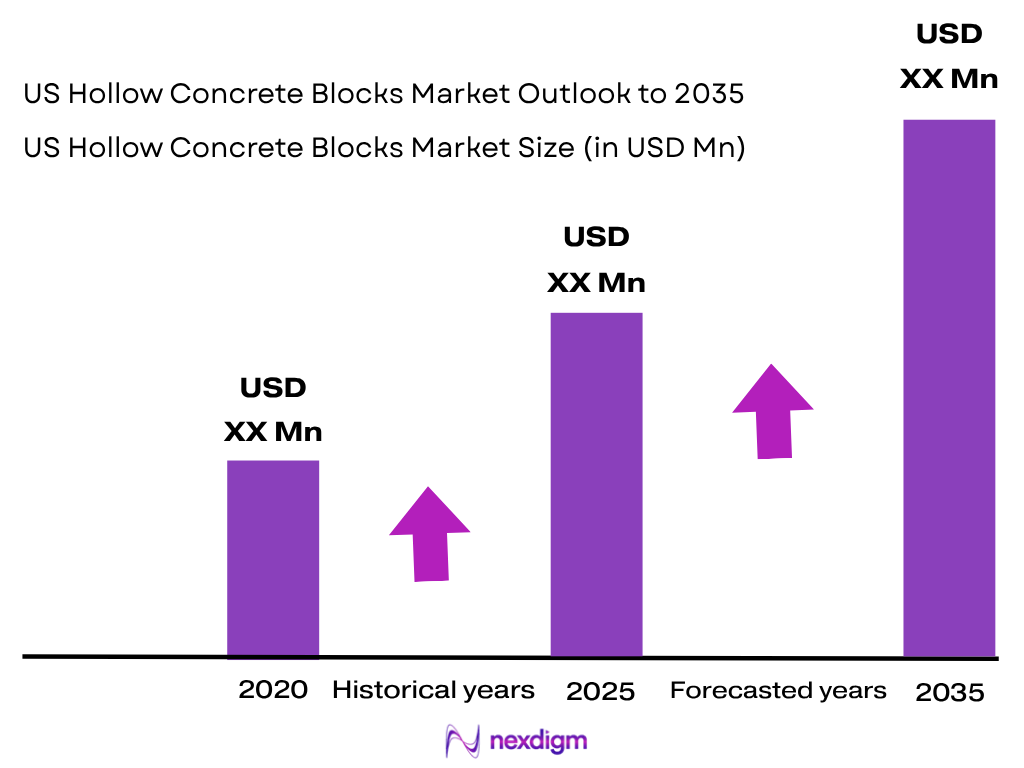
The US Hollow Concrete Blocks Market is expected to expand at approximately ~% CAGR during 2026–2035, based on the report framework. Market development will be supported by commercial and institutional construction, industrial facilities, data centers and resilient building requirements. Future competition should increasingly focus on low-carbon CMU, lightweight products, architectural surfaces and improved thermal performance. Automated manufacturing and digital product documentation are also expected to influence producer competitiveness. Commercial and institutional construction should remain central to hollow CMU demand because masonry provides noncombustibility, durability and impact resistance in applications where wall assemblies experience intensive use. Schools, hospitals, municipal facilities, warehouses and public-safety buildings provide particularly relevant applications for concrete masonry.
Major Players
- Oldcastle APG
- The QUIKRETE Companies / Best Block
- Basalite Concrete Products
- Angelus Block Company
- Mutual Materials
- ORCO Block & Hardscape
- York Building Products
- Ernest Maier / EM Block
- County Materials Corporation
- Jandris Block
- Fizzano Brothers Concrete Products
- Taylor Concrete Products
- RCP Block & Brick
- State Block
- Texas Building Products
Key Target Audience
- Hollow Concrete Block and CMU Manufacturers
- Cement and Aggregate Producers
- Masonry Contractors and General Contractors
- Building Material Distributors and Masonry Supply Dealers
- Commercial, Industrial and Residential Developers
- Architectural, Engineering and Design-Build Companies
- Investments and Venture Capitalist Firms
- Government and Regulatory Bodies (US Department of Commerce, US Department of Housing and Urban Development, Occupational Safety and Health Administration, National Institute of Standards and Technology)
Research Methodology
Step 1: Identification of Key Variables
The initial phase involves constructing an ecosystem map covering cement producers, aggregate suppliers, CMU manufacturers, masonry distributors, contractors, developers and building owners within the US Hollow Concrete Blocks Market. Critical variables include manufacturing capacity, density classification, block dimensions, structural applications, architectural finishes, regional construction activity, plant locations and distribution coverage.
Step 2: Market Analysis and Construction
Historical US Hollow Concrete Blocks Market information is analyzed through construction spending, housing activity, non-residential construction, CMU shipments and manufacturer production indicators. Top-down analysis evaluates the broader US construction and masonry ecosystem, while bottom-up analysis assesses manufacturing plants, product portfolios, regional producers, production capabilities and downstream applications to establish the market structure.
Step 3: Hypothesis Validation and Expert Consultation
Market hypotheses are validated through CATIs and structured discussions with CMU manufacturers, masonry contractors, distributors, architects, developers and construction-material suppliers. Consultations assess plant utilization, product demand, density preferences, block dimensions, architectural finishes, contractor requirements, regional delivery constraints and specification trends to validate assumptions developed through secondary research.
Step 4: Research Synthesis and Final Output
The final phase triangulates construction indicators, manufacturer information, regional supply conditions and primary industry findings. Bottom-up manufacturer and plant assessments are reconciled with top-down construction demand to establish the US Hollow Concrete Blocks Market framework. Forecast assumptions incorporate commercial construction, industrial facilities, institutional buildings, resilient masonry, low-carbon CMU, lightweight blocks and manufacturing automation.

- Executive Summary
- Research Methodology (Market Definitions and Assumptions, Hollow Concrete Block and CMU Classification, ASTM Product Mapping, Load-Bearing and Non-Load-Bearing Unit Assessment, Normal-Weight and Lightweight CMU Assessment, Nominal Size Mapping, Concrete Block Production Assessment, Manufacturing Plant Capacity Assessment, Cement Consumption Assessment, Aggregate Consumption Assessment, Construction Spending Assessment, Housing Starts Assessment, Commercial Construction Assessment, Institutional Construction Assessment, Masonry Wall System Assessment, Regional Demand Mapping, Producer Shipment Assessment, Supply-Side Assessment, Demand-Side Assessment, Top-Down Market Sizing, Bottom-Up Market Sizing, Mason Contractor Interviews, Manufacturer Interviews, Data Triangulation, Forecasting Framework)

- Definition and Scope
- US Hollow Concrete Block Industry Evolution and Development of Concrete Masonry Units, Structural CMU, Architectural CMU, Lightweight Blocks, Fire-Rated Masonry, Insulated CMU, Split-Face Blocks, Ground-Face Blocks and Low-Carbon CMU
- Hollow Concrete Block Industry Value Chain Analysis
- Hollow Concrete Block Supply Chain Analysis

- Growth Drivers (Commercial Construction Activity, Warehouse and Distribution Center Construction, Institutional Building Demand, Multifamily Construction, School Construction, Fire-Resistant Wall Requirements, Hurricane and Severe-Weather Resilience, Masonry Durability, Data Center Construction, Industrial Building Demand, Noncombustible Construction, Regional Masonry Construction Practices)
- Market Challenges (Cement Input Exposure, Aggregate Availability, Masonry Labor Availability, CMU Transportation Radius, Heavy Product Logistics, Wood-Framing Competition, Tilt-Up Concrete Competition, Insulated Concrete Form Competition, Construction Cyclicality, Plant Energy Requirements, Regional Capacity Utilization, Embodied Carbon Pressure)
- Market Opportunities (Low-Carbon CMU, Portland-Limestone Cement Blocks, Carbon-Cured Concrete Blocks, Insulated CMU, High-R-Value Masonry Systems, Lightweight CMU, Fire-Resistant Data Center Walls, Resilient Housing, Architectural CMU, Integral Water-Repellent Blocks, High-Recycled-Content Blocks, Carbon-Sequestering CMU)
- Market Trends (Lower-Cement Block Mixes, Environmental Product Declarations, Portland-Limestone Cement Adoption, Supplementary Cementitious Material Integration, Lightweight Aggregates, Integral Water Repellents, Architectural Split-Face Finishes, Burnished CMU, BIM-Ready Masonry Products, Automated Block Plants, Carbon Accounting, Resilient Masonry Design)
- Government Regulations and Standards (ASTM C90 Load-Bearing CMU Requirements, ASTM C129 Non-Load-Bearing CMU Requirements, ASTM C140 Testing Requirements, TMS 402 Building Code Requirements for Masonry Structures, TMS 602 Masonry Construction Specifications, International Building Code Requirements, International Energy Conservation Code, NFPA Fire-Safety Requirements, State Building Codes, Buy America Requirements for Applicable Public Projects, OSHA Masonry Construction Requirements, Environmental Product Declaration Requirements)
- SWOT Analysis
- Porter’s Five Forces Analysis
- PESTLE Analysis

- By Market Value (2020-2025)
- By Hollow Concrete Block Shipment Volume (2020-2025)
- By Concrete Masonry Unit Production Volume (2020-2025)
- By Installed CMU Manufacturing Capacity (2020-2025)
- By Plant Capacity Utilization (2020-2025)
- By Load-Bearing CMU Volume (2020-2025)

- By Product Type (In Value %)
Standard Hollow Structural CMU
Architectural Hollow CMU
Lightweight Hollow Concrete Blocks
Medium-Weight Hollow Concrete Blocks
Normal-Weight Hollow Concrete Blocks
Split-Face Hollow Blocks
Ground-Face and Burnished Blocks
Slump Blocks
Screen and Breeze Blocks
Integral Water-Repellent CMU
Insulated Concrete Masonry Units
Fire-Rated Hollow CMU
Low-Carbon Hollow CMU
Specialty Shapes and Bond-Beam Units - By Structural Application (In Value %)
Load-Bearing Exterior Walls
Load-Bearing Interior Walls
Non-Load-Bearing Partitions
Shear Walls
Fire Separation Walls
Foundation and Basement Walls
Elevator and Stairwell Shafts
Mechanical and Utility Enclosures
Masonry Fence Walls
Backup Wall Systems - By Nominal Block Size (In Value %)
4-Inch CMU
6-Inch CMU
8-Inch CMU
10-Inch CMU
12-Inch CMU
14-Inch and Larger CMU
Half Blocks and Modular Units
Special Shapes and Custom Dimensions - By Density Classification (In Value %)
Normal-Weight CMU
Medium-Weight CMU
Lightweight CMU - By Surface Finish (In Value %)
Standard Gray Precision Finish
Split-Face
Ground-Face
Burnished Finish
Shot-Blasted Finish
Slump Finish
Fluted and Scored Finish
Glazed Finish
Integral-Color Finish
Architectural Textured Finish
Decorative Screen and Breeze Block - By Building Type (In Value %)
Single-Family Residential
Multifamily Residential
Retail and Commercial Buildings
Warehouses and Distribution Centers
Manufacturing Facilities
Schools and Universities
Healthcare Facilities
Government and Municipal Buildings
Data Centers
Hotels and Hospitality Buildings
Correctional Facilities
Fire Stations and Emergency Facilities

- Market Share of Major Players (By Revenue, CMU Shipment Volume, Manufacturing Capacity, Plant Footprint, Structural CMU Volume, Architectural CMU Volume, Lightweight CMU Volume, Regional Distribution Reach)
- Cross Comparison Parameters (Installed CMU Manufacturing Capacity, Hollow Structural Block Product Breadth, Normal-Medium-Lightweight CMU Capability, ASTM C90 and C129 Product Coverage, Architectural Finish and Specialty Shape Capability, Low-Carbon and EPD-Backed CMU Portfolio, Manufacturing Plant and Distribution Footprint, Commercial-Institutional-Residential Project Coverage)
- SWOT Analysis of Major Players (Manufacturing Scale, Geographic Footprint, Product Breadth, Architectural Portfolio, Distribution Network, Sustainability Capability)
- Detailed Profiles of Major Companies
Oldcastle APG
The QUIKRETE Companies / Best Block
Basalite Concrete Products
Angelus Block Company
Mutual Materials
ORCO Block & Hardscape
York Building Products
Ernest Maier / EM Block
County Materials Corporation
Jandris Block
Fizzano Brothers Concrete Products
Taylor Concrete Products
RCP Block & Brick
State Block
Texas Building Products

- Mason Contractor Requirement Assessment
- Commercial Developer Requirement Assessment
- Warehouse and Industrial Building Assessment
- Institutional Building Assessment
- School and University Demand Assessment
- Healthcare Facility Demand Assessment

- By Market Value (2026-2035)
- By Hollow Concrete Block Shipment Volume (2026-2035)
- By Concrete Masonry Unit Production Volume (2026-2035)
- By Installed CMU Manufacturing Capacity (2026-2035)
- By Plant Capacity Utilization (2026-2035)
- By Load-Bearing CMU Volume (2026-2035)


 Request a Sample
 Ask for Customization
 Get a Quote
 Enquire Now
