
 Download PDF
Market Overview
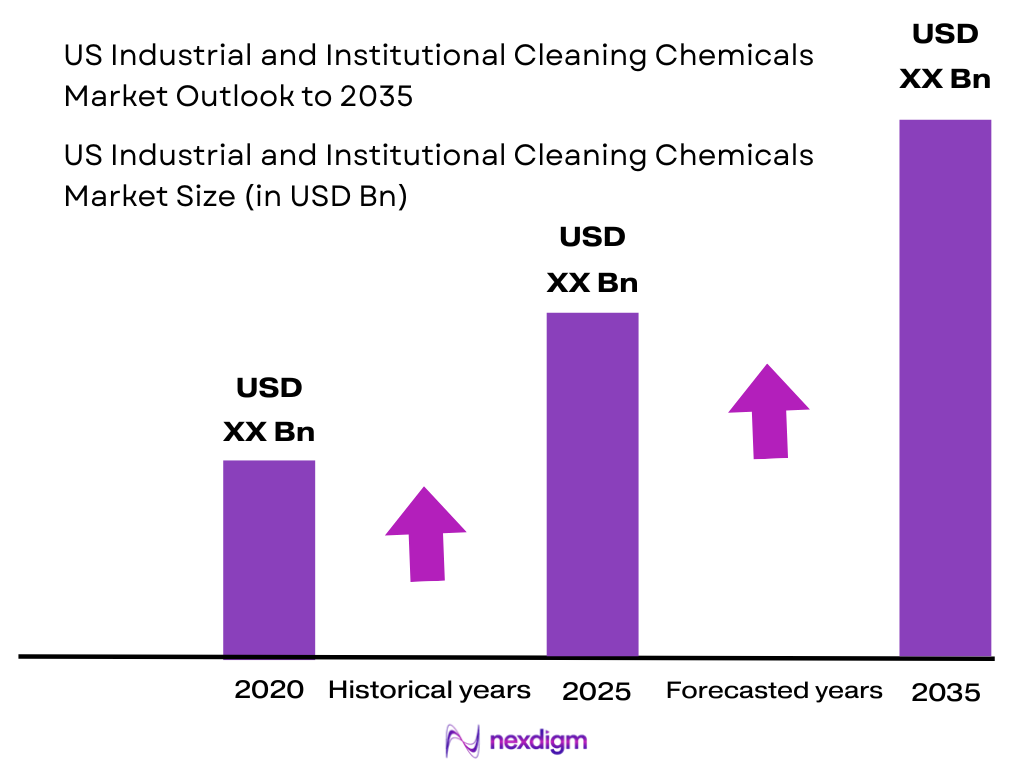
The US Industrial and Institutional Cleaning Chemicals Market is valued at ~USD XX billion in 2024, with the market supported by healthcare sanitation, food-processing hygiene, hospitality, commercial facility maintenance, manufacturing operations and professional janitorial services. The US economy generated USD 28.75 trillion in GDP in 2024, compared with USD 27.29 trillion in 2023, while GDP growth reached 2.8 in 2024. Healthcare spending reached USD 5.3 trillion, creating a substantial institutional environment for disinfectants, sanitizers, surface cleaners and specialized cleaning chemistry.
The market’s industrial demand base is also supported by manufacturing activity. US manufacturers recorded USD 7.045 trillion in shipments in 2024, compared with USD 6.932 trillion in 2023, demonstrating the scale of industrial facilities requiring machinery cleaners, degreasers, process-area sanitation chemicals and maintenance products. Food manufacturing alone generated USD 970.468 billion in shipments in 2024, while beverage and tobacco manufacturing recorded USD 233.964 billion, reinforcing recurring requirements for food-contact sanitation, clean-in-place chemistry, equipment cleaning and facility hygiene.
Market Segmentation
By Product Type
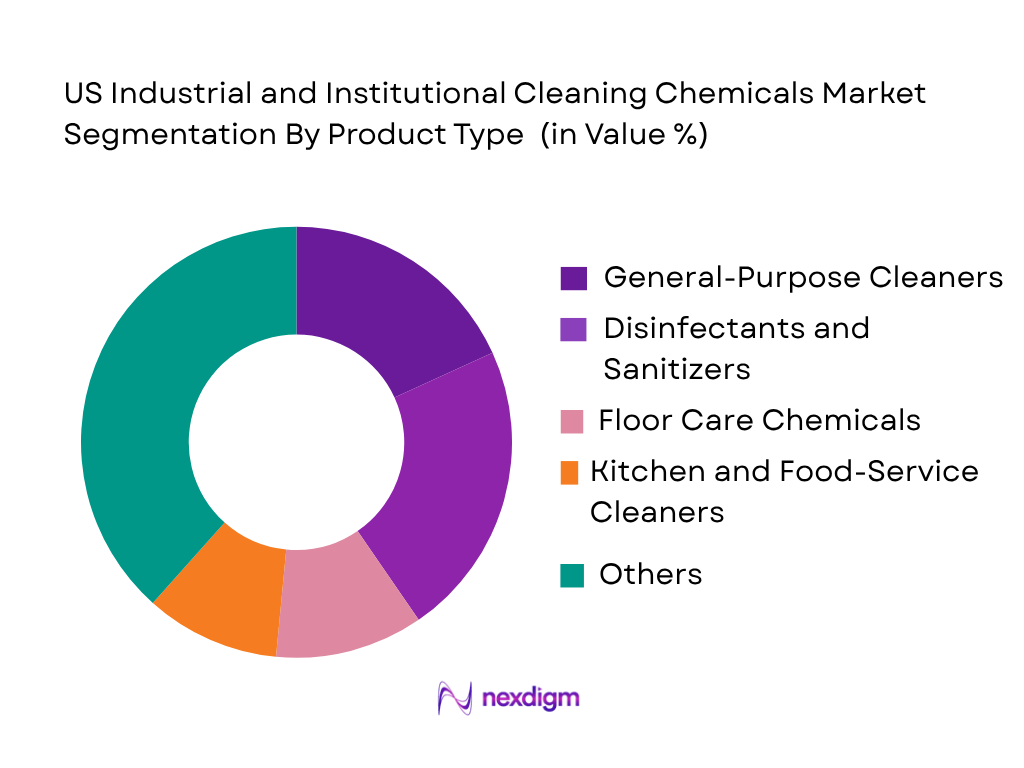
The US Industrial and Institutional Cleaning Chemicals Market is segmented by product type into general-purpose cleaners, disinfectants and sanitizers, floor-care chemicals, kitchen and food-service cleaners, laundry chemicals, dishwashing chemicals, industrial degreasers, restroom cleaners, glass and surface cleaners, carpet and upholstery cleaners, and specialty cleaners. Disinfectants and sanitizers are positioned as the dominant sub-segment, supported by persistent infection-control requirements across healthcare facilities, food-service operations, hospitality properties, commercial buildings and institutional environments. US healthcare spending reached USD 5.3 trillion in 2024, while hospital care alone reached USD 1.6 trillion, illustrating the scale of facilities requiring structured sanitation protocols. Food manufacturing shipments also reached USD 970.468 billion, creating extensive requirements for food-contact surface sanitation and production-area cleaning.
By End-Use Industry
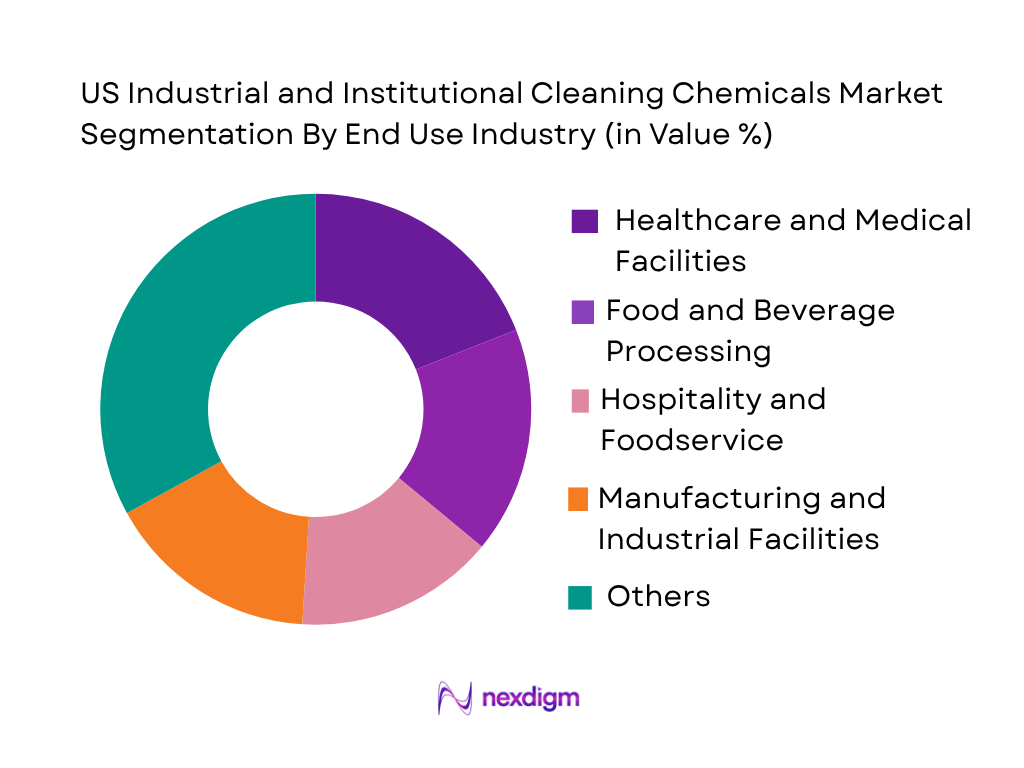
The market is segmented by end-use industry into healthcare and medical facilities, food and beverage processing, hospitality and foodservice, manufacturing and industrial facilities, commercial offices, retail facilities, education and institutional facilities, transportation and logistics, government facilities, and sports and recreation facilities. Healthcare and medical facilities represent the leading application environment because cleaning chemistry is embedded in infection-prevention protocols, patient-room sanitation, operating-room cleaning, surface disinfection and equipment maintenance. Healthcare spending reached USD 5.3 trillion in 2024, while private health-insurance enrollment increased from 207.0 million in 2023 to 214.3 million in 2024. Food and beverage processing is another high-intensity application, with food-product manufacturing shipments reaching USD 970.468 billion and beverage and tobacco shipments reaching USD 233.964 billion.
Competitive Landscape
The US Industrial and Institutional Cleaning Chemicals Market is characterized by multinational cleaning-chemistry suppliers, professional janitorial-product manufacturers and specialized sanitation companies competing across disinfectants, floor care, institutional cleaning, food-processing sanitation and industrial maintenance chemistry. Major companies differentiate through product breadth, regulatory capabilities, professional distribution networks, formulation technology, sustainability credentials, dispenser systems and technical support. Ecolab and Diversey have particularly broad professional-cleaning portfolios, while Clorox Professional, Zep, Betco and other suppliers maintain strong positions across institutional and commercial applications.
| Company | Established | Headquarters | Product Portfolio | Core I&I Focus | Distribution Model | Specialty Capability | Sustainability Focus | Professional Service Capability |
| Ecolab Inc. | 1923 | St. Paul, Minnesota | ~ | ~ | ~ | ~ | ~ | ~ |
| Diversey Holdings | 1923 | Fort Mill, South Carolina | ~ | ~ | ~ | ~ | ~ | ~ |
| The Clorox Company | 1913 | Oakland, California | ~ | ~ | ~ | ~ | ~ | ~ |
| Zep Inc. | 1937 | Atlanta, Georgia | ~ | ~ | ~ | ~ | ~ | ~ |
| Betco Corporation | 1950 | Toledo, Ohio | ~ | ~ | ~ | ~ | ~ | ~ |
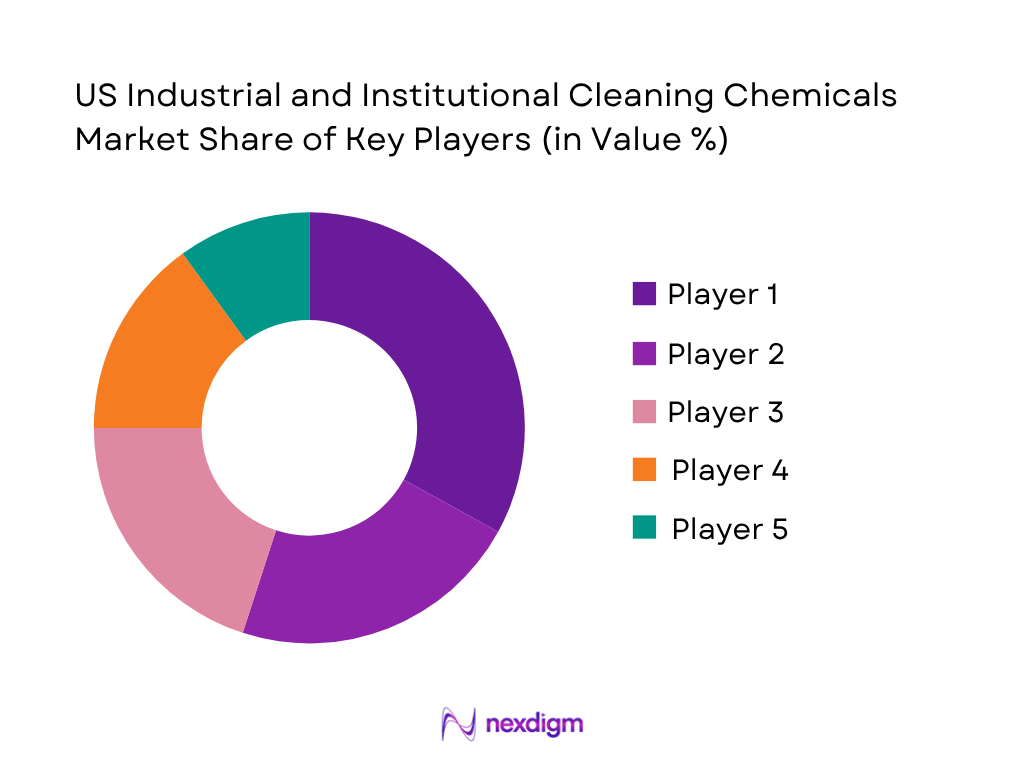
US Industrial and Institutional Cleaning Chemicals Market Analysis
Growth Drivers
Healthcare Infection-Control Requirements
Healthcare remains one of the strongest structural demand generators for industrial and institutional cleaning chemicals because hospitals, outpatient facilities, nursing facilities and other healthcare environments require recurring surface cleaning, disinfection and sanitation. US national health expenditures reached USD 5.3 trillion in 2024, while hospital expenditures reached USD 1.6347 trillion and physician and clinical services expenditures reached USD 1.1097 trillion, according to the Centers for Medicare & Medicaid Services. Private health-insurance enrollment also reached 214.3 million people, compared with 207.0 million in the preceding year. These figures indicate the scale of the healthcare operating environment in which disinfectants, surface cleaners, floor-care chemicals, restroom cleaners and specialized sanitation formulations are consumed repeatedly. The US macroeconomic environment further supports institutional demand, with national GDP reaching approximately USD 29.2 trillion in 2024, according to the World Bank, providing a large economic base for healthcare, commercial and public-service activities. Cleaning chemicals are required across patient rooms, operating areas, laboratories, diagnostic facilities, cafeterias and common areas, while infection-control protocols require products with validated efficacy and controlled application procedures. Rising healthcare utilization therefore translates into recurring rather than one-time chemical consumption. The combination of USD 1.6347 trillion in hospital expenditure, USD 5.3 trillion in total healthcare expenditure and 214.3 million privately insured people creates a substantial institutional customer base for professional cleaning and disinfection chemistry.
Food Processing Sanitation Intensity
Food and beverage manufacturing creates a high-frequency requirement for industrial cleaning, sanitation and disinfectant chemistry because production equipment, processing lines, food-contact surfaces, floors, drains and packaging areas must be cleaned according to established hygiene procedures. US food-product manufacturing generated approximately USD 970.468 billion in shipments in 2024, while beverage and tobacco-product manufacturing generated approximately USD 233.964 billion, according to the US Census Bureau. The scale of these operations supports recurring demand for alkaline cleaners, acid cleaners, degreasers, sanitizers, foam cleaners, clean-in-place chemistry and specialized surface-treatment products. The broader US manufacturing sector recorded approximately USD 7.045 trillion in shipments in 2024, demonstrating the size of the industrial operating base requiring professional cleaning chemistry. The World Bank places US GDP at approximately USD 29.2 trillion in 2024, reinforcing the purchasing and production capacity underpinning industrial and institutional demand. Food-processing facilities typically operate multiple cleaning cycles across production areas, equipment and food-contact surfaces, making chemical consumption closely linked to production activity rather than discretionary household behavior. Growth in processed-food output therefore expands the number of cleaning events, equipment sanitation requirements and chemical-dosing applications. The presence of large meat, dairy, bakery, beverage, prepared-food and packaged-food operations further broadens the application base. Consequently, the combination of USD 970.468 billion in food-product shipments, USD 233.964 billion in beverage and tobacco shipments and USD 7.045 trillion in total manufacturing shipments provides a strong quantitative foundation for professional cleaning-chemical demand.
Market Challenges
Volatile Specialty Chemical Inputs
Industrial and institutional cleaning-chemical manufacturers remain exposed to fluctuations in the availability of surfactants, solvents, builders, chelating agents, enzymes, fragrances, specialty additives and antimicrobial actives because these inputs are connected to global chemical and manufacturing supply chains. The scale of the US industrial base magnifies the consequences of supply interruptions. US manufacturing shipments reached approximately USD 7.045 trillion in 2024, according to the US Census Bureau, while the US economy generated approximately USD 29.2 trillion in GDP, according to the World Bank. Cleaning-chemical suppliers therefore operate within a very large industrial ecosystem where demand for chemical feedstocks competes with requirements from coatings, plastics, pharmaceuticals, agriculture, personal care and other downstream industries. The challenge is particularly relevant for formulations using specialized enzymes, high-purity surfactants, antimicrobial actives and performance additives that cannot always be replaced without reformulation or efficacy testing. Food manufacturing alone represented approximately USD 970.468 billion in shipments in 2024, creating stringent requirements for consistent sanitation chemistry while increasing the operational consequences of supply disruption. Healthcare expenditure of USD 5.3 trillion further illustrates the scale of institutional demand requiring dependable supplies of disinfectants and cleaning products. Manufacturers must therefore maintain qualified suppliers, alternative raw-material specifications, inventory buffers and formulation flexibility. However, excessive inventory can create shelf-life and working-capital pressures, particularly for specialty ingredients. The combination of a USD 7.045 trillion manufacturing base and USD 5.3 trillion healthcare system makes supply continuity strategically important to the cleaning-chemicals industry.
Stringent Product Registration Requirements
Regulatory compliance presents a significant challenge because professional cleaning chemicals are used across healthcare, food processing, hospitality, manufacturing and public facilities, with different performance, labeling, worker-safety and environmental requirements applying to different product categories. Disinfectant products making antimicrobial claims can fall under EPA FIFRA requirements, while chemical ingredients and manufacturing activities can also interact with TSCA, OSHA hazard-communication requirements and food-contact considerations administered by the FDA. The scale of the regulated end-use environment is substantial: US healthcare spending reached USD 5.3 trillion in 2024, with hospital expenditure at USD 1.6347 trillion, while food-product manufacturing shipments reached USD 970.468 billion, according to CMS and the US Census Bureau. These large end-use sectors require products that demonstrate appropriate efficacy, labeling and safety characteristics. Registration, notification, testing, documentation and formulation changes can lengthen product-development cycles, particularly when manufacturers introduce new active ingredients, alter concentrations or make broader antimicrobial claims. Compliance also extends beyond federal requirements because state-level chemical-disclosure, VOC and environmental rules can affect formulation and commercialization. Manufacturers consequently face technical requirements that extend beyond basic cleaning performance. Products must balance efficacy, contact time, worker exposure, surface compatibility, residue characteristics and environmental considerations while maintaining regulatory eligibility. The challenge is particularly significant for smaller formulators that may lack dedicated regulatory teams. With healthcare and food processing representing major institutional consumption environments, compliance failures can restrict product placement and delay commercial deployment.
Market Opportunities
Enzymatic Cleaning Chemistry
Enzymatic cleaning chemistry represents an opportunity for the US Industrial and Institutional Cleaning Chemicals Market because professional facilities increasingly require application-specific products capable of addressing protein, carbohydrate, lipid and other organic soils while reducing reliance on highly aggressive conventional chemistry. Healthcare, food processing, hospitality and institutional facilities provide particularly relevant applications. US healthcare expenditure reached USD 5.3 trillion in 2024, including USD 1.6347 trillion in hospital expenditure, while food-product manufacturing shipments reached USD 970.468 billion, according to CMS and the US Census Bureau. These figures indicate large operating environments in which cleaning performance, contact time, surface compatibility and chemical efficiency remain important procurement considerations. Enzymatic products can be formulated for equipment, food-processing surfaces, healthcare environments, laundry applications and specialty cleaning where organic soils are difficult to remove. Their application can complement conventional alkaline, acidic and disinfectant chemistry rather than replace every existing product category. The opportunity is strengthened by the scale of US manufacturing, which recorded approximately USD 7.045 trillion in shipments in 2024. Manufacturing facilities require cleaning solutions for machinery, production areas, components and maintenance operations, creating additional opportunities for enzyme-based formulations targeted toward specific soil profiles. Product developers can differentiate through enzyme combinations, temperature stability, formulation compatibility, low-residue performance and concentrated dosing formats. The current economic scale therefore provides multiple routes for commercialization across healthcare, food production and industrial maintenance.
Bio-Based Surfactants and Sustainable Cleaning Chemistry
Bio-based surfactants, low-VOC formulations, concentrated cleaning systems and water-efficient chemistry provide opportunities as institutional and industrial buyers increasingly evaluate environmental performance alongside cleaning efficacy and regulatory compliance. The opportunity is supported by the scale of the US economy and its major institutional consumption bases. US GDP reached approximately USD 29.2 trillion in 2024, according to the World Bank, while national health expenditures reached USD 5.3 trillion, according to CMS. Manufacturing shipments reached approximately USD 7.045 trillion, creating a large industrial environment where reductions in water consumption, chemical volume, packaging and waste can have operational relevance. Food-product manufacturing shipments reached USD 970.468 billion, providing another substantial environment for concentrated and water-efficient cleaning systems. Sustainable formulations can target hospitals, food plants, hotels, commercial buildings, industrial facilities and professional janitorial operations through products designed around lower VOC content, biodegradable ingredients, reduced packaging, higher active concentration and controlled dilution. Automated dispensing can strengthen this opportunity by improving dilution consistency and reducing unnecessary chemical consumption. The combination of concentrated chemistry and automated dosing is particularly relevant for large multi-site organizations that manage numerous facilities and seek standardized cleaning protocols. Bio-based surfactants can also provide formulation developers with alternatives for selected petroleum-derived inputs while maintaining required cleaning performance. The commercial opportunity therefore extends beyond environmentally positioned products into operational efficiency, controlled dosing and supply-chain optimization. Current economic activity across healthcare, manufacturing and food processing provides a broad customer base for these next-generation formulations.
Future Outlook
The US Industrial and Institutional Cleaning Chemicals Market is expected to maintain expansion as healthcare facilities, food processors, manufacturers, hospitality properties and commercial buildings continue to require specialized sanitation and maintenance chemistry. Growth is expected to favor concentrated formulations, automated dispensing, enzymatic cleaners, low-VOC products, bio-based ingredients and advanced disinfection technologies. The scale of underlying demand is substantial, with US GDP at USD 28.75 trillion and healthcare expenditure at USD 5.3 trillion in 2024.
Manufacturing and food processing should remain important demand generators. US manufacturing shipments reached USD 7.045 trillion in 2024, while food-product shipments reached USD 970.468 billion, creating continued requirements for equipment cleaning, degreasing, food-contact sanitation and process-area hygiene. Future competitive differentiation is expected to increasingly depend on cleaning performance per dose, regulatory compliance, worker safety, environmental characteristics, automated chemical dispensing and application-specific formulation technology.
Major Players
- Ecolab Inc.
- Diversey Holdings, Ltd.
- The Clorox Company
- Zep Inc.
- Betco Corporation
- 3M Company
- Reckitt
- Procter & Gamble
- SC Johnson Professional
- Spartan Chemical Company
- GOJO Industries
- Kimberly-Clark Professional
- Solenis LLC
- BASF SE
- Kärcher North America
Key Target Audience
- Industrial and institutional cleaning chemical manufacturers
- Janitorial and sanitation product distributors
- Healthcare facility procurement and environmental-services departments
- Food and beverage processing sanitation managers
- Facility management and contract-cleaning companies
- Industrial maintenance and plant-operations departments
- Investments and venture capitalist firms
- Government and regulatory bodies (US Environmental Protection Agency, Occupational Safety and Health Administration, Food and Drug Administration)
Research Methodology
Step 1: Identification of Key Variables
The initial phase establishes the US Industrial and Institutional Cleaning Chemicals Market ecosystem across manufacturers, distributors, facility managers, sanitation contractors and industrial end users. Product categories, application areas, formulation technologies and procurement channels are mapped. Secondary research incorporates government, regulatory and industry datasets to identify the variables affecting product demand.
Step 2: Market Analysis and Construction
Historical market information is organized by product type, end-use industry, formulation, application and distribution channel. Demand intensity is assessed using indicators such as manufacturing shipments, healthcare expenditure, food-processing activity and institutional facility requirements. The bottom-up model evaluates product consumption across major end-use environments and reconciles demand with supplier-side information.
Step 3: Hypothesis Validation and Expert Consultation
Market hypotheses are validated through structured discussions with cleaning-chemical manufacturers, distributors, facility-management professionals, sanitation managers and industrial procurement personnel. Interviews assess product selection, formulation preferences, procurement structures, regulatory requirements, application intensity and technology adoption. Findings are cross-checked against publicly available government and company information.
Step 4: Research Synthesis and Final Output
The final stage triangulates demand-side, supply-side and regulatory information to construct the market assessment. Segment-level estimates are reconciled against end-use indicators and supplier positioning. Competitive analysis evaluates product breadth, distribution capabilities, formulation technology and professional-service offerings, producing a consolidated outlook for the US Industrial and Institutional Cleaning Chemicals Market.

- Executive Summary
- Research Methodology (Market Definition and Scope, Product Boundary and Inclusion Criteria, Market Sizing Framework, Top-Down Market Assessment, Bottom-Up Market Assessment, Demand-Side Analysis, Supply-Side Analysis, Primary Industry Interviews, Distributor and Facility-Manager Validation, Consumption-Intensity Mapping, Data Triangulation, Forecasting Framework, Assumptions and Limitations)

- Definition and Scope
- Market Evolution and Development of Professional Cleaning Chemistry
- US Industrial and Institutional Cleaning Chemicals Industry Ecosystem
- Industrial and Institutional Cleaning Chemicals Value Chain

- Growth Drivers (Healthcare Infection-Control Requirements, Food Processing Sanitation Intensity, Expansion of Commercial Facilities, Manufacturing Activity, Hospitality and Foodservice Operations, Professional Janitorial Services, Increased Demand for Concentrated Formulations, Automated Cleaning Systems)
- Market Challenges (Volatile Specialty Chemical Inputs, Stringent Product Registration Requirements, Worker Chemical-Exposure Controls, Environmental Compliance, Formulation Complexity, Disinfectant Efficacy Requirements, Water and Wastewater Management, Skilled Cleaning Workforce Availability)
- Market Opportunities (Enzymatic Cleaning Chemistry, Bio-Based Surfactants, Low-VOC Formulations, Concentrated Cleaning Systems, Automated Dosing Technologies, Electrostatic Disinfection Solutions, Precision Cleaning for Advanced Manufacturing, Sustainable Packaging, Water-Efficient Cleaning Chemistry)
- Market Trends (Green Cleaning, Safer Ingredients, Low-Residual Chemistry, Enzymatic Formulations, Microfiber-Compatible Chemistry, Automated Dilution Systems, IoT-Enabled Chemical Dispensing, Closed-Loop Cleaning Systems, Water-Saving Formulations, High-Concentration Products)
- Government Regulations and Compliance (EPA FIFRA Registration, EPA Safer Choice, EPA Design for the Environment, TSCA Chemical Requirements, OSHA Hazard Communication Standard, FDA Food-Contact Requirements, USDA Food-Processing Sanitation Requirements, State Chemical Disclosure Requirements, California Proposition 65, VOC Regulations)
- SWOT Analysis
- Porter’s Five Forces Analysis
- PESTLE Analysis

- By Market Value (2020-2025)
- By Volume Consumption (2020-2025)
- By Product Category (2020-2025)
- By Raw Material Consumption (2020-2025)
- By End-Use Industry (2020-2025)
- By Distribution Channel (2020-2025)
- By Formulation Type (2020-2025)
- By Facility Type (2020-2025)

- By Product Type (In Value %)
General-Purpose Cleaners
Disinfectants and Sanitizers
Floor Care Chemicals
Carpet and Upholstery Cleaners
Kitchen and Food-Service Cleaners
Laundry Chemicals
Dishwashing Chemicals
Industrial Degreasers
Restroom and Washroom Cleaners
Glass and Surface Cleaners
Specialty and Precision Cleaners - By Raw Material Type (In Value %)
Surfactants
Solvents
Builders and Water Softeners
Biocides and Antimicrobial Actives
Chelating Agents
Enzymes
Acids and Alkalis
Fragrances
Specialty Additives - By Formulation Type (In Value %)
Ready-to-Use Formulations
Concentrated Formulations
Powder Formulations
Liquid Formulations
Gel Formulations
Foam Formulations
Tablet and Solid Dose Formulations - By End-Use Industry (In Value %)
Healthcare and Medical Facilities
Food and Beverage Processing
Hospitality and Foodservice
Manufacturing and Industrial Facilities
Commercial Offices and Buildings
Retail and Shopping Facilities
Education and Institutional Facilities
Transportation and Logistics
Government and Public Facilities
Sports, Entertainment and Recreation Facilities - By Cleaning Application (In Value %)
Hard-Surface Cleaning
Floor Cleaning and Maintenance
Equipment and Machinery Cleaning
Clean-in-Place Systems
Manual Dishwashing
Automatic Warewashing
Industrial Parts Cleaning
Laundry and Textile Cleaning
Restroom Sanitation
High-Touch Surface Disinfection
Precision and Electronic Equipment Cleaning - By Distribution Channel (In Value %)
Direct Manufacturer Sales
Janitorial and Sanitation Distributors
Industrial Chemical Distributors
Wholesale Distribution
Facility Management Procurement
Online B2B Distribution
Retail and Club-Based Professional Supply

- Market Share Analysis of Major Players (By Value, Product Category, End-Use Industry, Distribution Channel)
- Cross Comparison Parameters (Product Portfolio Breadth, Professional SKU Coverage, EPA-Registered Disinfectant Portfolio, Safer-Chemistry Portfolio, Automated Dosing Capability, Industrial Cleaning Technology Breadth, Distribution Network Reach, Facility-Service Partnerships)
- SWOT Analysis of Major Players
- Detailed Profiles of Major Companies
Ecolab Inc.
Diversey Holdings, Ltd.
The Procter & Gamble Company
The Clorox Company
Reckitt Benckiser Group plc
3M Company
Solenis LLC
BASF SE
Zep Inc.
SC Johnson Professional
Betco Corporation
Kimberly-Clark Professional
GOJO Industries, Inc.
Spartan Chemical Company, Inc.
Kärcher North America

- Institutional and Industrial Buyer Profile
- Procurement Decision-Making Analysis
- Cleaning Chemical Consumption Behavior
- Product Selection Criteria
- End-User Application Preferences

- By Market Value (2026-2035)
- By Volume Consumption (2026-2035)
- By Product Category (2026-2035)
- By Raw Material Consumption (2026-2035)
- By End-Use Industry (2026-2035)
- By Distribution Channel (2026-2035)
- By Formulation Type (2026-2035)
- By Facility Type (2026-2035)


 Request a Sample
 Ask for Customization
 Get a Quote
 Enquire Now