

 Download PDF
Market Overview
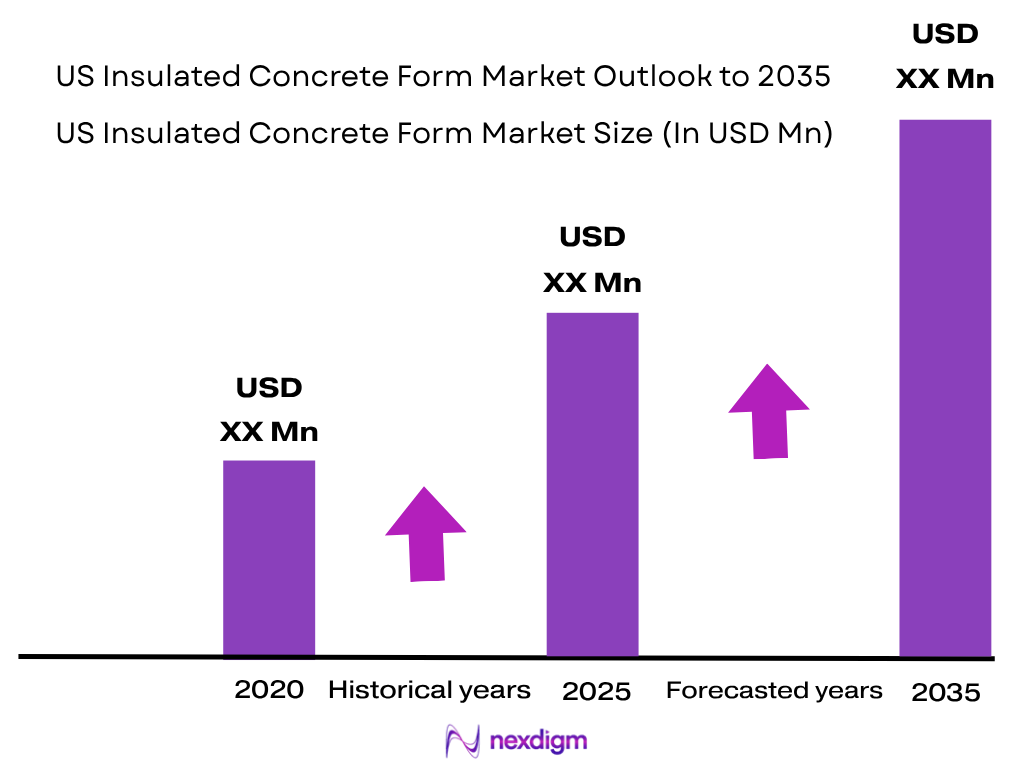
The US Insulated Concrete Form Market is valued at approximately ~USD XX million, based on historical market assessment, and is supported by a large residential and non-residential construction base. US construction spending increased from USD 2,023.7 billion to USD 2,154.4 billion, while residential construction spending increased from USD 866.9 billion to USD 917.9 billion. This construction intensity supports ICF adoption in foundations, basements, above-grade walls and resilient building envelopes, particularly where thermal insulation and structural strength are required.
Florida, Texas, California, North Carolina and other southern and western construction markets are important US ICF demand centers because they combine significant new-building activity with exposure to hurricanes, tornadoes, wildfire risk and demanding energy-performance requirements. The US recorded 27 billion-dollar weather and climate disasters, generating USD 182.7 billion in damages, while Hurricane Helene produced 140 mph sustained winds and Hurricane Milton made Florida landfall with 120 mph winds. These conditions strengthen demand for reinforced concrete building envelopes and resilient wall systems.
Market Segmentation
By ICF System Type
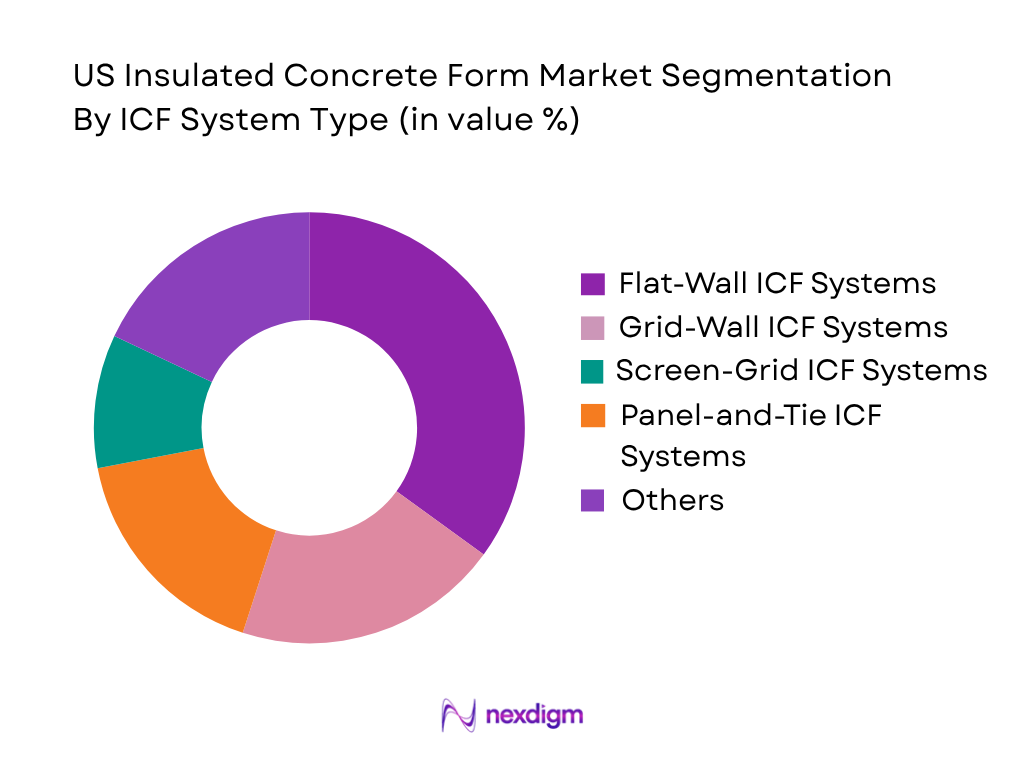
The US Insulated Concrete Form Market is segmented into flat-wall ICF systems, grid-wall systems, screen-grid systems, post-and-beam systems, panel-and-tie systems, vertical systems and composite form systems. Flat-wall ICF systems dominate the market because they create a continuous reinforced concrete core while providing permanent insulation on both sides of the wall. This configuration is widely suited to single-family homes, multifamily structures, schools, commercial buildings, foundations and storm-resilient construction. Major manufacturers including Fox Blocks, BuildBlock, Nudura and SuperForm center substantial portions of their portfolios on flat-wall systems, strengthening product availability and contractor familiarity. Flat-wall blocks are also compatible with conventional reinforcing practices and allow contractors to vary concrete-core thickness according to structural requirements. Their combination of EPS insulation, reinforced concrete and integrated attachment surfaces enables one wall assembly to address structural support, continuous insulation and building-envelope requirements, supporting their broader specification relative to more specialized grid or composite alternatives.
By End-Use Construction
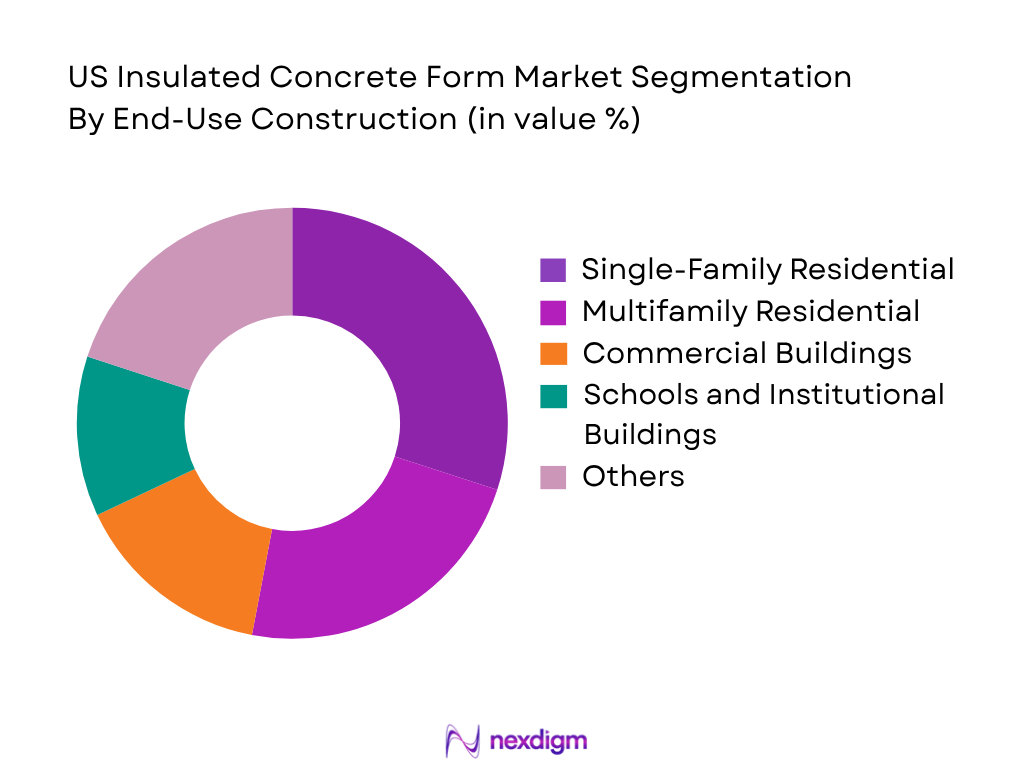
The US Insulated Concrete Form Market is segmented into single-family residential, multifamily residential, commercial buildings, schools and institutional buildings, hospitality, healthcare, government buildings and industrial applications. Single-family residential construction represents the dominant end-use segment because ICF systems are particularly suited to foundations, basements and whole-house exterior walls where homeowners seek thermal efficiency, low air infiltration, durability, sound attenuation and resistance to extreme weather. US residential construction spending increased from USD 866.9 billion to USD 917.9 billion, creating a substantial underlying construction pool for alternative wall technologies. ICF manufacturers have also developed extensive homeowner, contractor and dealer programs specifically around residential construction. BuildBlock maintains a manufacturing network serving the entire United States, while Fox Blocks provides regional manufacturing and a broad dealer network. Residential adoption is additionally supported in hurricane-, tornado- and wildfire-exposed states where reinforced concrete walls can provide a differentiated resilience proposition compared with conventional light-frame wall assemblies.
Competitive Landscape
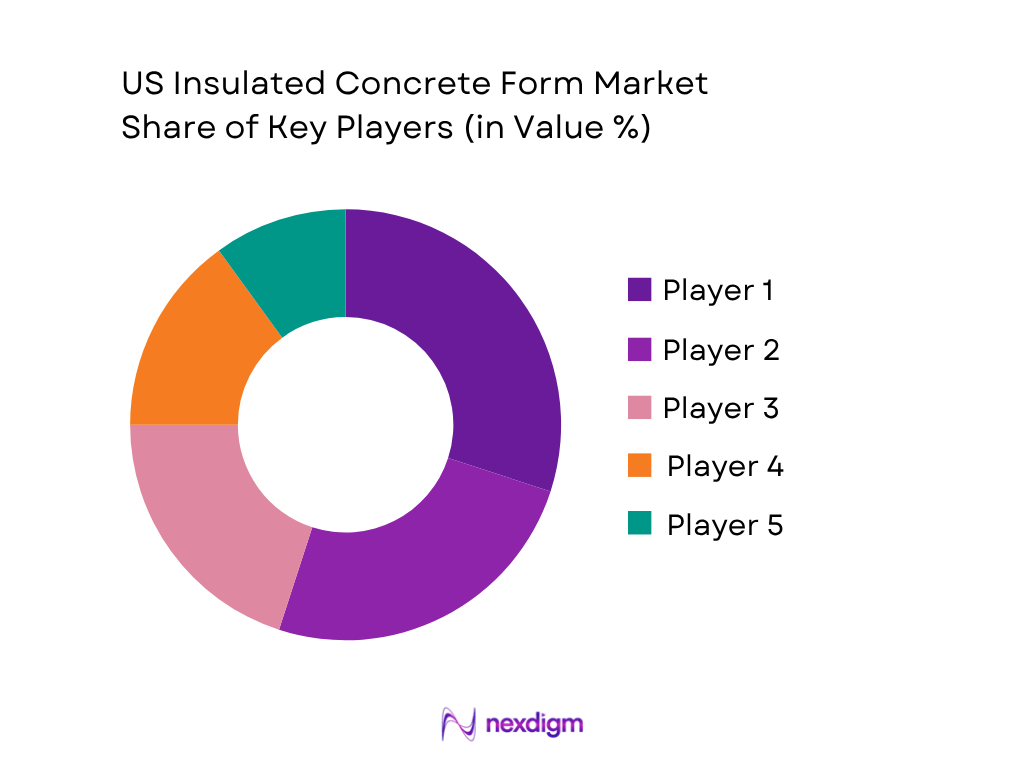
The US Insulated Concrete Form Market is characterized by specialized ICF manufacturers with differentiated block geometry, EPS manufacturing capabilities, concrete-core configurations, regional production footprints and contractor-support programs. Fox Blocks, BuildBlock, Nudura, LiteForm and SuperForm are among the prominent participants serving US residential and commercial construction. Competition extends beyond the physical form itself to dealer availability, BIM and engineering resources, installation training, specialty corners and radius forms, floor and roof integration, high-R insulation options and technical support for architects, contractors and building owners.
| Company | Establishment Year | Headquarters | ICF System Portfolio | EPS / Insulation Capability | Concrete Core Flexibility | Major Applications | US Manufacturing / Distribution | Contractor & Technical Support |
| Fox Blocks | 2005 | Omaha, Nebraska, US | ~ | ~ | ~ | ~ | ~ | ~ |
| BuildBlock Building Systems | 2004 | Oklahoma City, Oklahoma, US | ~ | ~ | ~ | ~ | ~ | ~ |
| Nudura | 2001 | Beachwood, Ohio, US | ~ | ~ | ~ | ~ | ~ | ~ |
| LiteForm Technologies | 1986 | South Sioux City, Nebraska, US | ~ | ~ | ~ | ~ | ~ | ~ |
| SuperForm Products | 1998 | Pincher Creek, Alberta, Canada; US manufacturing in Ohio | ~ | ~ | ~ | ~ | ~ | ~ |
US Insulated Concrete Form Market Analysis
Growth Drivers
Expanding Residential and Non-Residential Construction Base
The US Insulated Concrete Form Market is supported by the country’s large construction pipeline, which creates a substantial addressable base for ICF foundations, basements, exterior structural walls, multifamily buildings and institutional projects. The US Census Bureau reported USD 2,154.4 billion of construction put in place during 2024, compared with USD 2,023.7 billion in 2023. Private construction accounted for USD 1,661.7 billion, including USD 917.9 billion of residential construction and USD 743.8 billion of private non-residential activity. Separately, Census and HUD recorded 1,364,100 housing starts and 1,471,200 housing units authorized by permits during 2024, demonstrating a sizeable annual flow of projects where ICF systems can compete with conventional wood framing and removable concrete forms. This construction activity operates within a US economy with USD 28.75 trillion GDP, USD 84,534 GDP per capita and a population of 340,110,988 in 2024, according to the World Bank. The scale of building investment therefore supports wider specification of energy-efficient, continuously insulated reinforced-concrete wall systems across residential, commercial and institutional construction.
Growing Requirement for Disaster-Resilient Concrete Building Envelopes
The US Insulated Concrete Form Market is being strengthened by heightened requirements for buildings capable of withstanding hurricanes, severe storms, tornadoes, wildfire exposure and other destructive events. NOAA’s National Centers for Environmental Information recorded 27 billion-dollar weather and climate disasters in 2024, comprising 17 severe storms, 5 tropical cyclones, 2 winter storms, 1 flooding event, 1 drought and heat event, and 1 wildfire event. These disasters generated USD 182.7 billion in damages and were associated with 568 fatalities, demonstrating the substantial physical risks confronting US buildings. Reinforced-concrete ICF walls combine a structural concrete core with permanent insulation and can therefore address resilience and building-envelope performance simultaneously, making them particularly relevant for Florida, the Gulf Coast, Tornado Alley and wildfire-exposed western states. FEMA also made USD 750 million available through its FY2024 Building Resilient Infrastructure and Communities program for hazard-mitigation activities, reinforcing public-sector emphasis on resilient infrastructure. The World Bank recorded US GDP at USD 28.75 trillion and GDP per capita at USD 84,534 in 2024, providing a large economic base for investment in higher-performance construction and reconstruction solutions.
Market Challenges
Specialized Installer and Construction-Labor Capability Requirements
Expansion of the US Insulated Concrete Form Market is constrained by the need for contractors familiar with form stacking, reinforcing placement, bracing, concrete pumping, consolidation, window and door bucks, penetrations and controlled concrete lifts. ICF installation differs materially from conventional wood framing, meaning market growth depends not only on total construction labor but also on trained crews and specialized subcontractors. The US Bureau of Labor Statistics recorded 8,242,000 construction employees in December 2024, including approximately 1,883,400 employees in construction of buildings and 960,400 in residential building construction. At the same time, BLS reported 217,000 construction job openings, 301,000 construction hires and 279,000 separations in December 2024, illustrating continuing labor movement within the construction workforce. Annual construction hires reached 4,115,000 during 2024, indicating significant workforce turnover that can complicate retention of specialized ICF installation expertise. This challenge is relevant within a national economy generating USD 28.75 trillion GDP and supporting 340,110,988 people, according to the World Bank, because the enormous construction base creates competition for skilled trades. Manufacturers therefore require installer training, field technical support and regional dealer-contractor development to convert broader construction activity into completed ICF projects.
Residential Construction Volatility and Project-Pipeline Sensitivity
The US Insulated Concrete Form Market remains exposed to fluctuations in new-home construction because single-family homes, basements and residential exterior walls represent major application areas for ICF systems. Census and HUD recorded 1,364,100 privately owned housing starts in 2024, compared with 1,420,000 during 2023, while building permits totaled 1,471,200 units, compared with 1,511,100 previously. These numbers indicate that manufacturers and ICF installers were competing within a residential pipeline that had fewer starts and authorizations even as construction expenditure remained substantial. The same Census data show that residential construction spending totaled USD 917.9 billion, while overall construction put in place reached USD 2,154.4 billion in 2024, meaning the market opportunity remained large but uneven between expenditure and unit activity. ICF suppliers are particularly sensitive to this dynamic because projects require early design specification, concrete coordination, reinforcement planning and installer availability rather than simple material substitution at the final procurement stage. World Bank data places US GDP at USD 28.75 trillion, GDP per capita at USD 84,534, and population at 340,110,988 in 2024. Consequently, the underlying economy is substantial, but short-term housing-unit fluctuations can still affect ICF order visibility and contractor utilization.
Market Opportunities
High-Performance Wall Systems Supported by Updated Energy Codes
The US Insulated Concrete Form Market has a significant opportunity in high-performance residential and commercial construction as states review increasingly stringent model energy codes. The US Department of Energy issued its determination for the 2024 International Energy Conservation Code on December 20, 2024, confirming that the new residential model code improves building energy efficiency relative to the previous edition. Under federal statutory requirements, states must review their residential energy codes following this determination, with the certification deadline established as December 30, 2026. This creates an expanding specification environment for wall assemblies that integrate structural capacity with continuous insulation and reduced thermal bridging, both fundamental characteristics of ICF construction. Current adoption activity is already visible: Rhode Island adopted the 2024 IECC on November 14, 2024, while New York adopted the 2024 IECC on July 25, 2025, with implementation following later in 2025. The opportunity is supported by USD 2,154.4 billion in US construction spending during 2024 and a national GDP of USD 28.75 trillion, according to the Census Bureau and World Bank respectively. ICF manufacturers can use this code transition to deepen engagement with architects, energy consultants, homebuilders and institutional project teams.
Resilient Housing, Safe Rooms and Hazard-Mitigation Construction
The US Insulated Concrete Form Market has a strong opportunity to expand into resilient homes, storm shelters, safe rooms and public buildings in regions repeatedly affected by severe weather. NOAA recorded 27 billion-dollar disasters during 2024, with 17 severe storm events and 5 tropical cyclones, while total losses reached USD 182.7 billion and fatalities totaled 568. This current hazard exposure strengthens the future case for reinforced-concrete wall technologies in Florida, Texas, Louisiana, the Carolinas, Oklahoma and other storm-prone locations. FEMA’s FY2024 Building Resilient Infrastructure and Communities program made USD 750 million available to states, communities, tribes and territories for hazard-mitigation activities, including projects intended to reduce natural-hazard risk and improve infrastructure resilience. ICF manufacturers can use this policy and risk environment to expand beyond conventional energy-efficiency positioning toward safe rooms, schools, emergency facilities, municipal buildings and whole-house hardened envelopes. The broader construction base is also substantial: Census reported 1,364,100 housing starts and USD 917.9 billion of residential construction spending during 2024. World Bank data records US GDP of USD 28.75 trillion and population of 340,110,988, supporting a large long-term addressable base for resilience-oriented construction investment.
Future Outlook
The US Insulated Concrete Form Market is expected to expand at approximately ~XX% CAGR during 2026-2035, supported by demand for energy-efficient, resilient and long-service-life building envelopes. Adoption is likely to broaden beyond custom single-family homes into multifamily, schools, hospitality, institutional facilities and commercial construction. Building-energy regulations will remain an important structural influence because US model energy codes are updated through the International Energy Conservation Code and ASHRAE Standard 90.1 frameworks, while adoption occurs at state and local levels. ICF walls combine reinforced concrete with continuous insulation, positioning the technology for projects where designers need to address both structural and envelope performance.
Resilience is also expected to become a stronger specification factor. NOAA recorded 27 billion-dollar weather and climate disasters in the United States, including 17 severe storms and 5 tropical cyclones. Reinforced concrete ICF systems can therefore gain greater consideration for hurricane, tornado, wildfire and high-wind construction where building owners increasingly evaluate durability alongside energy performance.
Major Players
- Nudura
- Fox Blocks
- BuildBlock Building Systems
- Amvic Building System
- Logix Brands / Element ICF
- Quad-Lock Building Systems
- SuperForm Products
- LiteForm Technologies
- IntegraSpec
- RASTRA
- Polycrete International
- Faswall
- Hobbs Vertical ICF
- The Perfect Block
- Mikey Block
Key Target Audience
- Insulated Concrete Form Manufacturers
- EPS Foam and Construction Insulation Manufacturers
- Residential, Multifamily and Commercial Developers
- General Contractors and Specialized ICF Installers
- Architectural, Structural Engineering and Building Design Firms
- Building Material Distributors and Construction Supply Companies
- Investments and Venture Capitalist Firms
- Government and Regulatory Bodies (US Department of Energy, Federal Emergency Management Agency, US Department of Housing and Urban Development, International Code Council, State Energy Offices and Local Building Code Authorities)
Research Methodology
Step 1: Identification of Key Variables
The initial phase involves constructing a comprehensive ecosystem map of the US Insulated Concrete Form Market covering EPS suppliers, ICF manufacturers, concrete producers, reinforcement suppliers, distributors, contractors, architects, developers and building owners. Secondary databases and manufacturer disclosures are analyzed to identify variables including installed wall area, concrete-core width, insulation configuration, application mix, construction type, regional demand, manufacturing footprint and code requirements.
Step 2: Market Analysis and Construction
Historical market performance is assessed through both top-down and bottom-up methodologies. Top-down analysis evaluates US residential and non-residential construction activity, building permits, resilient-construction requirements and energy-code adoption. Bottom-up assessment evaluates manufacturer shipments, ICF block volumes, wall-area coverage, product configurations, distributor activity and installation intensity across residential, commercial and institutional projects to construct a consistent market model.
Step 3: Hypothesis Validation and Expert Consultation
Market hypotheses are validated through computer-assisted telephone interviews and structured discussions with ICF manufacturers, EPS processors, distributors, specialized installers, concrete contractors, architects and developers. Primary discussions focus on system preference, typical core widths, installation productivity, above-grade versus below-grade usage, contractor availability, regional demand, project specifications, competitive positioning and the adoption barriers influencing conversion from conventional wood-frame and concrete-forming methods.
Step 4: Research Synthesis and Final Output
The final phase triangulates manufacturer shipment estimates with construction-sector indicators and downstream installation demand. Residential, multifamily, commercial, institutional and resilience-driven construction are assessed independently before being consolidated. Company-level supply analysis is reconciled with dealer footprints, manufacturing networks and contractor feedback to validate the market structure and create final segmentation, competitive analysis and long-term forecasts for the US Insulated Concrete Form Market.

- Executive Summary
- Research Methodology (Market Definition and Scope, US Insulated Concrete Form Market Classification, ICF System Demand Assessment, EPS Foam and Concrete Core Material Assessment, ICF Wall Installation Mapping, Residential and Non-Residential Construction Assessment, Energy-Efficient Building Envelope Evaluation, Disaster-Resilient Construction Assessment, Domestic ICF Manufacturing Capacity Assessment, Distributor and Installer Network Mapping, State-Level Construction Demand Assessment, Building Code Adoption Mapping, Primary Industry Interviews, Top-Down Market Sizing, Bottom-Up Company Revenue and Shipment Assessment, Data Triangulation, Pricing Assessment, Forecasting Framework)

- Definition and Scope
- US Insulated Concrete Form Industry Evolution and Development of Energy-Efficient, Disaster-Resilient and High-Performance Concrete Construction Ecosystem
- ICF Block Manufacturing, EPS Molding, Concrete Supply, Reinforcement and Installation Industry Structure
- US Insulated Concrete Form Value Chain Analysis
- US Insulated Concrete Form Supply Chain Analysis
- EPS Resin Supplier, ICF Manufacturer, Concrete Producer, Reinforcement Supplier, Distributor, Installer, General Contractor, Architect and Building Owner Ecosystem Analysis
- ICF Construction Integration Across Foundations, Basements, Above-Grade Walls, Multi-Story Structures, Safe Rooms and High-Performance Building Envelopes

- Growth Drivers (Stricter Building Energy Performance Requirements, Demand for High-R Resilient Wall Assemblies, Expansion of Hurricane-Resistant Construction, Increasing Concrete Home Adoption, Residential Energy-Efficiency Requirements, Growth of Net-Zero Buildings, Demand for Continuous Insulation, Fire and Wildfire Resilience, Increasing Adoption of Airtight Building Envelopes)
- Market Challenges (ICF Installer Availability, Contractor Learning Requirements, Concrete Placement and Bracing Complexity, Competition from Wood Framing and Structural Insulated Panels, EPS Material Handling Requirements, Limited Design Familiarity Among Architects, Electrical and Plumbing Coordination Complexity, Regional Variability in Distributor and Installer Networks, Concrete Supply and Placement Scheduling)
- Market Opportunities (Hurricane-Prone Residential Construction, Wildfire-Resistant Housing, Net-Zero Homes, Multifamily ICF Buildings, Schools and Safe-Room Construction, Passive-House Applications, ICF Basement Replacement of Conventional Formwork, High-Performance Commercial Buildings, Insulated Concrete Floor and Roof Systems, Low-Carbon Concrete Integration)
- Market Trends (Graphite-Enhanced EPS Forms, Wider Concrete Core Configurations, Integrated Form Accessories, Reversible ICF Blocks, Larger Folding Forms, Preassembled ICF Systems, BIM-Compatible ICF Design, High-R Wall Assemblies, Low-Carbon Concrete Integration, Whole-Building ICF Envelopes)
- Regulatory and Standards Landscape (International Residential Code ICF Provisions, International Building Code Requirements, International Energy Conservation Code, ASHRAE Building Energy Requirements, ACI Structural Concrete Requirements, ASTM EPS Material Standards, FEMA Safe-Room Guidance, ICC-ES Evaluation Requirements, State and Municipal Energy-Code Adoption)
- SWOT Analysis
- Porter’s Five Forces Analysis
- PESTLE Analysis
- Stakeholder Ecosystem
- Competition Ecosystem

- By Market Value (2020-2025)
- By ICF Form Shipment Volume (2020-2025)
- By Installed ICF Wall Area (2020-2025)
- By Domestic ICF Production Volume (2020-2025)
- By Residential ICF Installation Volume (2020-2025)
By Commercial and Institutional ICF Installation Volume (2020-2025) - By Above-Grade ICF Wall Installation Volume (2020-2025)
By Average Selling Price (2020-2025)

- By ICF System Type (In Value %)
Flat-Wall ICF Systems
Grid-Wall ICF Systems
Screen-Grid ICF Systems
Post-and-Beam ICF Systems
Panel-and-Tie ICF Systems
Block-Type ICF Systems
Vertical ICF Systems
Composite Cementitious ICF Systems - By Insulating Material (In Value %)
Expanded Polystyrene Foam
Graphite-Enhanced Expanded Polystyrene
Polyurethane Foam
Cement-Bonded Wood Fiber
Cement-Bonded Polystyrene
Composite Insulating Form Materials
Other Specialty Insulating Form Materials - By Building Application (In Value %)
Foundations and Basements
Above-Grade Exterior Walls
Load-Bearing Structural Walls
Interior Fire-Separation Walls
Safe Rooms and Storm Shelters
Multi-Story Building Walls
Retaining and Specialty Concrete Walls
ICF Floor and Roof Integration - By End-Use Construction (In Value %)
Single-Family Residential
Multifamily Residential
Hotels and Hospitality
Schools and Educational Buildings
Healthcare Facilities
Commercial Buildings
Government and Municipal Buildings
Religious and Community Buildings
Warehouses and Industrial Buildings
Military and Protective Structures - By Region (In Value %)
Northeast
Midwest
South
West
Gulf Coast High-Wind Construction Corridor
Florida and Southeast Hurricane-Resilient Construction Cluster
Texas Residential and Commercial Construction Cluster
Mountain and Cold-Climate Energy-Efficient Construction Cluster

- Market Share of Major Players (By US Revenue, ICF Form Shipment Volume, Installed Wall Area, ICF System Portfolio, Concrete Core Width, Residential and Commercial Application Exposure, Manufacturing and Distribution Footprint, Contractor and Installer Network)
- Cross Comparison Parameters (US ICF Revenue, ICF Block and Panel System Portfolio Breadth, Available Concrete Core Width Range, Nominal Wall R-Value and Insulation Configuration, Manufacturing and EPS Molding Footprint, US Distributor and Dealer Network Coverage, Residential-Commercial-Institutional Project Exposure, Contractor Training and Technical Design Support Capability)
- SWOT Analysis of Major Players
- Pricing and ICF System Category Benchmarking
- Detailed Profiles of Major Companies
Nudura – Folding Flat-Wall ICF Systems, High-R Wall Assemblies, Specialty Forms and Building Envelope Accessories
Fox Blocks – Flat-Wall ICF Blocks, Compact Forms, Radius Blocks, Taper-Top Forms and ICF Accessories
BuildBlock Building Systems – Reversible ICF Blocks, KnockDown Forms, Radius Forms and Insulated Concrete Wall Systems
Amvic Building System – ICF Wall Systems, High-R Insulated Forms, Insulated Floor Systems and Construction Accessories
Logix Brands – ICF Wall Systems, High-R Assemblies, Radius Forms and Integrated Building Envelope Solutions
Quad-Lock Building Systems – Panel-and-Tie ICF Systems, Adjustable Wall Assemblies, High-R Panels and Insulated Floors
SuperForm Products – Expanded Polystyrene ICF Forms, Multi-Core Wall Systems and Residential-Commercial Concrete Construction Solutions
LiteForm Technologies – ICF Wall Systems, LiteDeck Floor and Roof Systems and Concrete Construction Accessories
IntegraSpec – Flat-Wall ICF Panels, High-Performance EPS Forms and Residential-Commercial Wall Systems
RASTRA – Composite Insulating Concrete Forms, Cement-Bonded EPS Wall Systems and High-Performance Building Envelopes
Polycrete International – Modular ICF Wall Systems, Reinforced Concrete Construction Forms and Multi-Story Building Solutions
Faswall – Cement-Bonded Wood-Fiber Insulated Concrete Forms, Vapor-Open Wall Systems and High-Thermal-Mass Construction
Hobbs Vertical ICF – Vertical Insulated Concrete Form Systems, Wall Panels and Concrete Building Envelope Solutions
The Perfect Block – Composite ICF Blocks, Recycled EPS-Cement Forms and Fire-Resistant Wall Systems
Mikey Block – Insulated Concrete Form Systems, EPS Concrete Forms and Residential-Commercial Wall Construction Solutions

- Single-Family Homebuilder ICF Adoption Assessment
- Custom Homebuilder ICF Specification Analysis
- Multifamily Developer ICF Requirement Assessment
- Commercial Contractor ICF Procurement Analysis
- Architect and Structural Engineer ICF Specification Assessment
- School and Institutional Building ICF Requirement Analysis
- Hospitality Developer ICF Adoption Assessment
- Disaster-Resilient Building Contractor Analysis
- ICF Distributor and Building Material Dealer Assessment
- Concrete Contractor and ICF Installer Requirement Analysis

- By Market Value (2026-2035)
- By ICF Form Shipment Volume (2026-2035)
- By Installed ICF Wall Area (2026-2035)
- By Domestic ICF Production Volume (2026-2035)
- By Residential ICF Installation Volume (2026-2035)
- By Commercial and Institutional ICF Installation Volume (2026-2035)
- By Above-Grade ICF Wall Installation Volume (2026-2035)
- By Average Selling Price (2026-2035)


 Request a Sample
 Ask for Customization
 Get a Quote
 Enquire Now