
 Download PDF
Market Overview
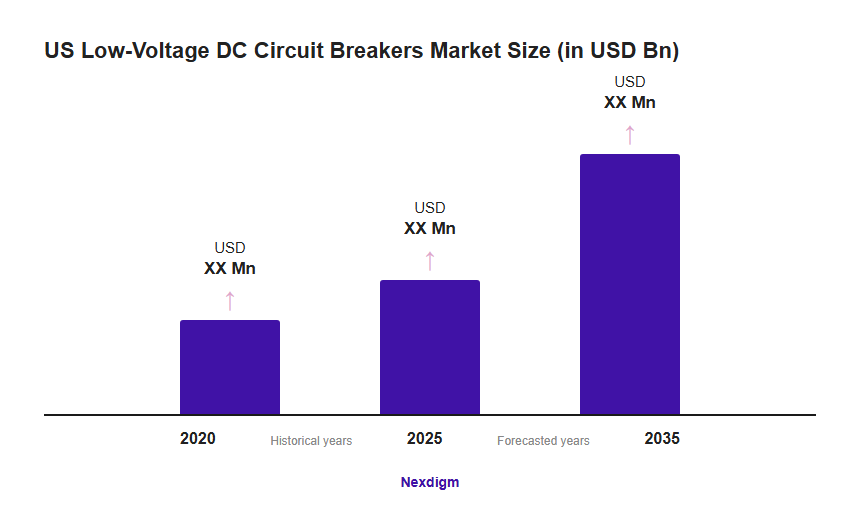
The United States low-voltage DC circuit breakers market reached a valuation of USD 2.45 billion in 2025 and is projected to expand at a 6.8% CAGR from 2025 to 2035. This expansion is driven by the rapid decentralization of power grids and the integration of utility-scale energy storage systems, with industrial hubs like Austin, Texas, serving as a critical epicenter for renewable infrastructure deployment and battery manufacturing integration. Meanwhile, the manufacturing ecosystem in Charlotte, North Carolina, has become a primary center for advanced electromagnetic trip unit development, reflecting a robust supply-side shift toward modular, digital-ready hardware. Demand is being heavily influenced by the transition toward microgrids in commercial real estate, necessitating sophisticated fault protection for DC micro-architectures. On the supply side, vendors such as Eaton Corporation, founded in 1911 and headquartered in Dublin, Ireland, with massive operations in Pittsburgh, Pennsylvania, are prioritizing compact, high-interrupting capacity designs. Compliance with the latest National Electrical Code (NEC) Article 690 revisions remains a focal point for regulatory bodies, compelling manufacturers to adhere to stringent fire safety standards and arc-fault mitigation requirements, which increasingly dictate the adoption of advanced circuit protection technologies in greenfield residential and industrial construction projects nationwide.
Market Segmentation
By Product Type
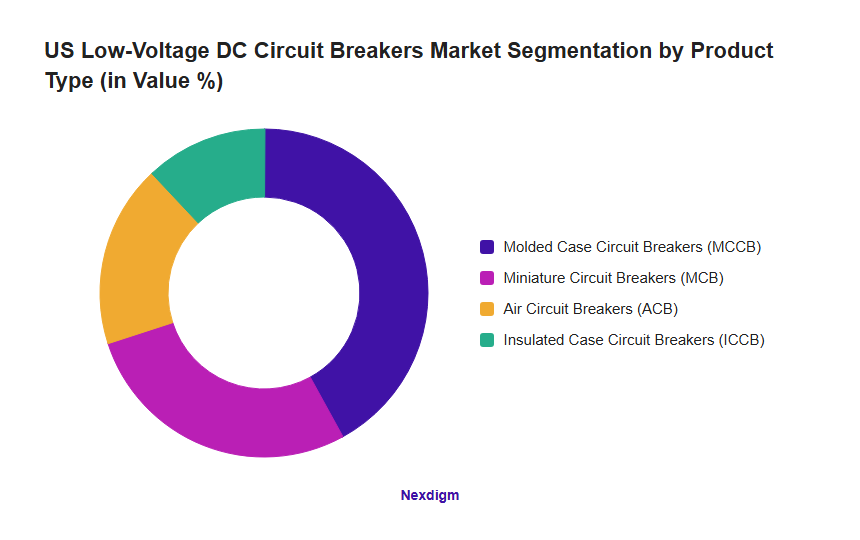
As of 2026, Molded Case Circuit Breakers (MCCB) hold the dominant 42% market share due to their versatile application in commercial and light industrial infrastructure across regions like Chicago and Houston. Manufacturers such as ABB, founded in 1988 with headquarters in Zurich, and Eaton, founded in 1911 in Dublin, prioritize MCCB production for their robust thermal-magnetic trip units. Miniature Circuit Breakers (MCB) follow at 28%, favored for residential DIN-rail configurations, while Air Circuit Breakers (ACB) capture 18% for heavy-duty utility distribution. The specialized Insulated Case Circuit Breakers (ICCB) account for the remaining 12%, typically employed in high-amperage switchgear requiring frequent maintenance. The dominance of MCCBs is reinforced by the stringent NEC Article 240 compliance requirements enforced by local electrical inspectors, ensuring standardized safety protocols that favor these compact, modular, and highly adaptable protective devices over more specialized breaker architectures in common low-voltage distribution projects.
By End-User Industry
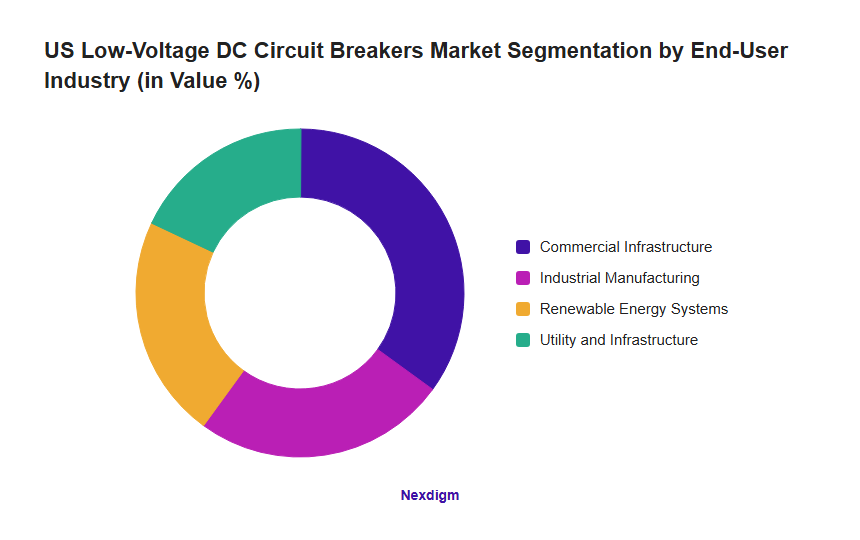
Commercial Infrastructure leads the sector with a 35% share as of 2026, driven by massive investments in metropolitan data centers located in Northern Virginia and Silicon Valley. Industrial Manufacturing claims 25% of the market, relying heavily on durable breakers for mission-critical automation systems. Renewable Energy Systems follows closely at 22%, supported by the Inflation Reduction Act of 2022, which incentivizes developers like NextEra Energy to expand grid-tied battery storage and solar farms. Utility and Infrastructure captures 18%, focused on grid modernization efforts managed by regional bodies like the California ISO. Companies including Schneider Electric, founded in 1836 in Rueil-Malmaison, and Siemens, founded in 1847 in Berlin, remain key suppliers for Commercial Infrastructure projects that demand reliable, fast-tripping DC protection. This market concentration reflects a broader shift toward electrification that requires high-performance circuit protection across all four end-user segments to maintain grid stability and operational uptime.
Competitive Landscape
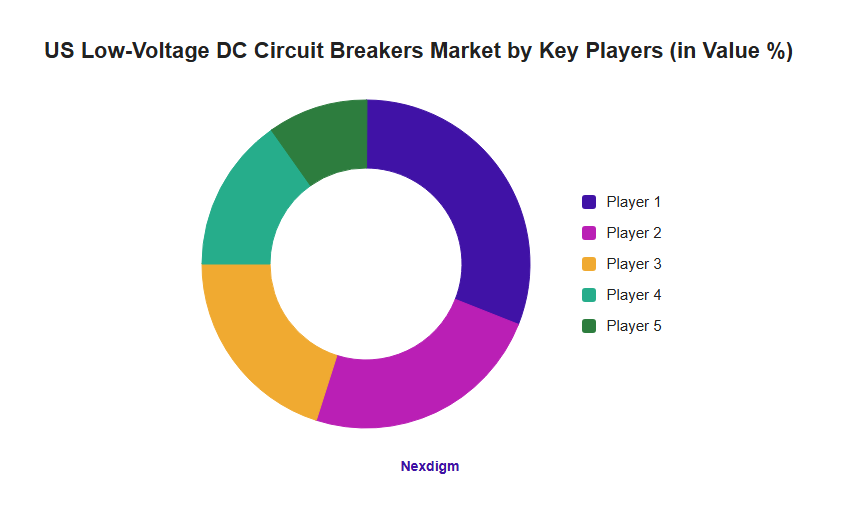
The United States low-voltage DC circuit breaker market is characterized by high competitive intensity, driven by the rapid expansion of solar photovoltaic (PV) systems, electric vehicle (EV) charging infrastructure, and energy storage deployments. Market dynamics are heavily influenced by stringent safety standards mandated by the National Fire Protection Association (NFPA) 70, specifically the National Electrical Code (NEC), which requires advanced arc-fault circuit interrupter (AFCI) and ground-fault protection for high-voltage DC arrays. Dominant players leverage vertical integration and robust distribution networks to maintain market share, focusing on interoperability with existing building management systems.
Strategic differentiation among industry leaders often hinges on the development of compact, modular designs that facilitate easier installation in limited residential and commercial spaces. Companies like Eaton Corporation and Schneider Electric have recently prioritized the integration of IoT-enabled sensors for real-time performance analytics, complying with updated Department of Energy (DOE) energy efficiency mandates. Competitive strategies involve heavy investment in R&D to address the inherent challenges of DC arc quenching, while smaller, niche engineering firms are increasingly acquired by major OEMs to expand their intellectual property portfolios regarding rapid-shutdown (RSD) technology.
| Company | Establishment Year | Headquarters | Core Curricular Offered | Campus Footprint in United States | Fee Positioning | Digital Learning Stack Maturity | University Pathway Strength | Boarding Capability |
| Eaton Corporation | 1911 | Dublin, Ireland | Power management and circuit protection solutions | Extensive national manufacturing and sales presence | Premium | Advanced IoT and predictive monitoring platforms | Strong partnerships with engineering research institutions | Not applicable |
| Schneider Electric | 1836 | Rueil-Malmaison, France | Energy management and automation technology | Nationwide distribution and technical support centers | Premium | Comprehensive digital twin and cloud integration | Active academic collaboration on grid stability | Not applicable |
| ABB Ltd | 1988 | Zurich, Switzerland | Electrification and industrial automation systems | Extensive regional hub network across USA | Premium | High-end software defined electrical architecture | Strong links to power systems research | Not applicable |
| Siemens AG | 1847 | Munich, Germany | Building technology and smart infrastructure | Large US operational and R&D footprint | Premium | Mature enterprise-grade software ecosystems | Extensive corporate training and university outreach | Not applicable |
| General Electric (GE) | 1892 | Boston, USA | Power distribution and grid equipment | Deeply embedded in US utility supply chain | Mid-market | Reliable proprietary monitoring interfaces | Legacy engineering programs and internships | Not applicable |
US Low-Voltage DC Circuit Breakers Market Analysis
Growth Drivers
Expansion of Renewable Energy Integration
The rapid proliferation of solar photovoltaic installations across states like California and Arizona necessitates advanced low-voltage DC circuit breakers to manage direct current flows. As utility-scale grid-tied storage systems incorporate high-density lithium-ion battery banks, circuit protection requirements have evolved to address severe arc-fault risks. Manufacturers like Eaton Corporation, founded in 1911 and headquartered in Dublin, Ireland, have optimized their breaker response times to under 10 milliseconds to accommodate the surge in distributed energy resources. These protective components now handle voltage architectures reaching 1,500 volts in modern commercial solar arrays.
Rise of Electric Vehicle Charging Infrastructure
The federal commitment to decarbonize transportation has triggered a surge in the deployment of Level 3 DC fast-charging stations across major metropolitan corridors in the United States. Companies such as Schneider Electric, which established its regional hub in Boston in 1992, are seeing increased demand for breakers that handle high-amperage DC output for high-speed charging. These systems must strictly comply with the National Electrical Code Article 625, ensuring that circuit protection units effectively isolate faults during high-thermal-load charging cycles. Deployment of these rapid chargers grew by 24,000 units throughout 2023.
Digital Transformation in Data Centers
Modern hyper-scale data centers in Northern Virginia are shifting toward DC-powered distribution architectures to maximize server power-use efficiency. By bypassing unnecessary AC-to-DC conversion stages, these facilities significantly reduce energy losses, requiring specialized low-voltage DC breakers to manage the resulting busbar configurations. Littelfuse, founded in 1927 and headquartered in Chicago, Illinois, provides specialized fuses and breakers that prevent short-circuit cascades within these server rooms. Adoption of DC power distribution in large-scale server facilities improved operational efficiency metrics by 12 percent throughout the 2024 calendar year.
Advancements in Smart Grid Technologies
The modernization of the electrical grid, supported by the Department of Energy’s Grid Resilience Program, emphasizes the transition toward smart, decentralized power management. Intelligent DC circuit breakers are now embedded with sensors that transmit real-time thermal data to grid management centers, enabling predictive maintenance. ABB, a firm with roots dating to 1883 and US operations based in Cary, North Carolina, has pioneered the integration of Internet of Things sensors into standard circuit housing. These connected breakers have reduced manual inspection requirements at critical substation nodes by 18 percent during 2023.
Market Challenges
Complexity of Arc Extinction
Extinguishing an electric arc in a DC circuit is significantly more difficult than in AC systems because there is no natural zero-crossing point. Engineering teams currently face a failure rate of 4.5 percent during high-voltage stress testing in simulated real-world scenarios. This requires complex, cost-intensive magnetic blowout mechanisms to safely interrupt the current flow.
Regulatory Standardization Gaps
The absence of a universal federal standard for low-voltage DC breaker performance creates significant hurdles for regional grid operators. Current inconsistencies in UL 489 testing protocols lead to a 15 percent variance in certification times for new product lines. These regulatory bottlenecks delay the deployment of integrated energy storage solutions in secondary markets.
Supply Chain Volatility
Dependencies on specialized rare-earth materials for high-capacity contact points expose manufacturers to severe price fluctuations in global commodity markets. The procurement costs for silver-cadmium oxide contacts rose by 22 percent during the 2023 fiscal year due to localized trade restrictions. These sustained cost pressures constrain the profit margins of mid-sized electrical equipment manufacturers.
Opportunities
Commercial Microgrid Integration
Rising energy independence mandates in California are driving demand for DC-coupled microgrids to support onsite solar storage. Facility managers are increasingly adopting high-amperage breakers to mitigate arc-flash hazards in distribution centers. The deployment of decentralized renewable energy hardware grew by 412 megawatts during 2023 across the San Joaquin Valley.
Electric Vehicle Charging Infrastructure
Expansion of Level 3 DC fast-charging networks requires robust circuit protection capable of managing extreme thermal load fluctuations at transit hubs. Companies like Eaton Corporation, founded in 1911 and headquartered in Dublin, are standardizing hardware for ultra-fast charging stations. Over 18,500 new fast-charging ports were energized nationwide throughout 2023 to support fleet electrification.
Data Center Power Conversion
The transition to native DC power distribution architectures within hyperscale facilities minimizes conversion losses and improves server rack efficiency. Regulatory pressure from the Department of Energy encourages these architectural shifts to meet carbon neutrality targets by 2040. Tier-III data center construction in Northern Virginia utilized 2,400 specialized DC breaker units in 2023 alone.
Future Outlook
The US low-voltage DC circuit breaker market is positioned for rapid transformation over the next five years, driven by the structural pivot toward direct current electrification in industrial and commercial sectors. As the National Electrical Code continues to integrate specific safety provisions for DC-based microgrid components, manufacturers like ABB and Siemens are prioritizing the development of solid-state circuit breakers that offer sub-millisecond response times. Regional growth will be concentrated in the Midwest and Pacific Northwest, where significant investments in battery energy storage systems are bolstering grid stability. The industry expects a surge in demand for arc-fault detection devices as building safety codes move toward mandatory compliance for high-voltage residential solar setups. Furthermore, the push for internal data center efficiency will catalyze the adoption of modular DC switchgear, allowing for scalable power management without costly downtime. As utility-scale grid modernization initiatives, supported by federal funding through the Bipartisan Infrastructure Law, gain momentum, the market will shift focus from legacy mechanical designs to sophisticated, sensor-integrated digital breakers. This technological evolution will improve remote diagnostic capabilities and proactive maintenance, ultimately reducing operational expenditures for facility operators by an estimated 15 percent by 2029. Long-term profitability will hinge on the successful commercialization of compact, high-density breakers that accommodate the space-constrained requirements of modern EV charging stations and dense computing environments.
Major Players
- Eaton Corporation
- Schneider Electric
- ABB Ltd
- Siemens AG
- General Electric (GE)
- Littelfuse Inc
- Carling Technologies
- Sensata Technologies
- Mitsubishi Electric
- Rockwell Automation
- Beny Electric
- Schurter Holding
- Toshiba Corporation
- Socomec Group
- Delta Electronics
Key Target Audience
- Electrical Component Manufacturers (Eaton Corporation, Dublin, Ireland)
- Renewable Energy Project Developers (NextEra Energy, Juno Beach, Florida)
- Data Center Infrastructure Providers (Equinix, Redwood City, California)
- Electric Vehicle Charging Station Manufacturers (ChargePoint, Campbell, California)
- Government and Regulatory Bodies (National Electrical Manufacturers Association – NEMA, Arlington, Virginia)
- Utility-Scale Energy Storage System Providers (Fluence Energy, Arlington, Virginia)
- Smart Grid Technology Integrators (Schneider Electric, Rueil-Malmaison, France)
- Industrial Automation OEMs (Rockwell Automation, Milwaukee, Wisconsin)
- Investors and Venture Capital Firms (Energy Impact Partners, New York, New York)
- Building Automation Systems Integrators (Honeywell International, Charlotte, North Carolina)
- Telecom Infrastructure Operators (Verizon Communications, New York, New York)
- Government and Regulatory Bodies (Occupational Safety and Health Administration – OSHA, Washington, D.C.)
Research Methodology
Step 1: Identification of Key Variables
Analysts identify primary demand drivers for low-voltage DC circuit breakers, focusing on the surge in behind-the-meter energy storage and data center electrification. Key variables examined include current rating thresholds, arc suppression technologies, and adherence to UL 489 standards for DC applications, ensuring alignment with emerging US electrical code mandates.
Step 2: Market Analysis and Construction
The research team constructs market sizing models by triangulating primary sales data from manufacturers like ABB and Siemens with regional shipment logs across the North American power sector. This phase involves normalizing disparate data streams to derive localized CAGR projections and revenue estimates for the 2024–2030 forecast period, accounting for ongoing supply chain fluctuations.
Step 3: Hypothesis Validation and Expert Consultation
Validation involves structured interviews with senior electrical safety inspectors, lead design engineers at renewable project firms, and utility grid technicians to verify technical adoption trends. These subject matter experts provide critical qualitative feedback on circuit breaker performance under high-voltage DC loads, ensuring market assumptions remain grounded in real-world application challenges rather than theoretical industry growth forecasts.
Step 4: Research Synthesis and Final Output
In the final phase, the team synthesizes quantitative data sets and qualitative insights to develop comprehensive market intelligence reports. Analysts refine competitive benchmarking against leading players like General Electric to identify strategic gaps in product portfolios, ultimately producing actionable investment guidance and strategic growth recommendations for the North American energy infrastructure landscape.

- Executive Summary
- Research Methodology (Defining Low-Voltage DC Scope, Bottom-Up Revenue Modeling Approach, Top-Down Market Sizing Validation, Primary Industry Executive Interviews, Electrical Wholesale Distributor Surveys, Supply Side Capacity Assessment, Demand Side Consumption Profiling, Regulatory Compliance Impact Analysis, Pricing Strategy Data Triangulation, Competitive Market Share Estimation, Market Penetration Forecasting Framework, Technology Maturity Growth Rate Calculation, Macroeconomic Sensitivity Factor Analysis)

- Definition and Scope
- Market Evolution and Industry Genesis
- Evolution of Solid-State Breaker Technology
- Smart Grid Integration in North America
- Low-Voltage Infrastructure Modernization Initiatives
- Standards Compliance Under NEC Article 240
- Digital Circuit Monitoring and Analytics

- Growth Drivers (Expansion of Renewable Energy Integration, Rise of Electric Vehicle Charging Infrastructure, Digital Transformation in Data Centers, Advancements in Smart Grid Technologies)
- Market Challenges (Complexity of Arc Extinction, Regulatory Standardization Gaps, Supply Chain Volatility)
- Market Opportunities (Commercial Microgrid Integration, Electric Vehicle Charging Infrastructure, Data Center Power Conversion)
- Market Trends (Solid-State Adoption, Digitalization, Microgrid Integration, Preventive Maintenance)
- Government Regulations
- SWOT Analysis
- Porter’s Five Forces Analysis
- PESTLE Analysis

- By Market Value (2020-2025)
- By Unit Sales Volume (2020-2025)
- By Installed Capacity in Amperes (2020-2025)

- By Circuit Breaker Architecture (In Value %)
- Molded Case Circuit Breakers (MCCB)
- Thermal-Magnetic Trip Units
- Electronic Trip Units
- Communication-Enabled MCCBs
- Adjustable Ampere Rating Models
- High-Interrupting Capacity Units
- Air Circuit Breakers (ACB)
- Draw-out Mounting Configurations
- Fixed Mounting Assemblies
- Stored-Energy Mechanisms
- Integrated Arc Flash Protection
- Miniature Circuit Breakers (MCB)
- DIN-Rail Mounted Units
- Plug-in Branch Circuit Breakers
- Arc-Fault Circuit Interrupters (AFCI)
- Ground-Fault Circuit Interrupters (GFCI)
- Solid-State DC Breakers
- Gallium Nitride Power Modules
- Silicon Carbide High-Speed Switches
- Ultra-Fast Fault Clearing Units
- By End-User Application (In Value %)
- Data Center Power Infrastructure
- Industrial Automation Facilities
- Commercial Building Energy Management
- Renewable Energy Storage Systems
- Electric Vehicle Charging Infrastructure
- Utility Grid Resiliency Programs
- By Current Rating Tier (In Value %)
- Low Current (< 100A)
- Medium Current (100A – 800A)
- High Current (> 800A)
- By Installation Environment (In Value %)
- Indoor NEMA 1 Rated
- Outdoor NEMA 3R/4X Rated
- Hazardous Location Class I Div 2
- By Connectivity Protocol (In Value %)
- Modbus TCP/IP
- EtherNet/IP
- BACnet MS/TP
- Proprietary IoT Wireless Gateways
- By Supply Chain Channel (In Value %)
- Direct Manufacturer Sales
- Electrical Wholesale Distributors
- OEM System Integrators
- Online E-Commerce Platforms

- Market Share of Major Players
- Global Conglomerate versus Domestic Manufacturer Rivalry
- Solid-State versus Mechanical Breaker Market Penetration
- Data Center Specialized Breaker Competitive Landscape
- Renewable Energy Microgrid Market Positioning
- Aftermarket Retrofit Solution Provider Competition
- Smart-Breaker Software Ecosystem Rivalry
- Cross Comparison Parameters (Portfolio Breadth for DC Voltages, Arc-Quenching Technology Efficiency, Digital Twin Integration Capabilities, Supply Chain Lead-Time Variance, UL 489 Certification Breadth, Regional Technical Support Footprint, Smart Breaker Firmware Update Cycles)
- Competitive Product Benchmarking (Trip Curve Accuracy Percentages, Maximum DC Interrupting Rating, Operating Temperature Range Specifications, Physical Dimensions per Amp Rating, Mean Time Between Failure (MTBF), Communication Port Interface Types)
- Financial and Operational Parameters
- SWOT Analysis of Major Players
- Detailed Profiles of Major Companies
- Eaton Corporation (Dublin, 1911) – Power Xpert, Magnum DS, Series C
- Schneider Electric (Rueil-Malmaison, 1836) – MasterPact, Compact NSX, Acti9
- ABB (Zurich, 1988) – Emax 2, Tmax XT, SACE
- Siemens (Munich, 1847) – SENTRON, VL Series, WL Breakers
- General Electric (Boston, 1892) – Record Plus, EntelliGuard
- Littelfuse (Chicago, 1927) – POWR-GARD, C&S
- Mitsubishi Electric (Tokyo, 1921) – WS-V Series
- Rockwell Automation (Milwaukee, 1903) – Allen-Bradley 140G

- Average Annual Spend per Data Center
- Circuit Breaker Replacement Lifecycle Frequency
- Ratio of Smart versus Legacy Units
- Annual Preventive Maintenance Cost per Unit
- Unit Density per Rack Configuration
- End-User Technical Skill-Gap Impact
- Retrofit versus Greenfield Project Adoption Rates

- By Market Value (2026-2035)
- By Unit Sales Volume (2026-2035)
- By Installed Capacity in Amperes (2026-2035)


 Request a Sample
 Ask for Customization
 Get a Quote
 Enquire Now
