

 Download PDF
 Download PDF
Market Overview
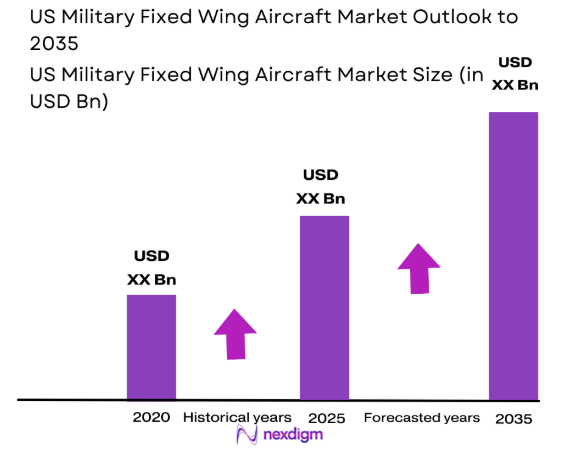
The US Military Fixed Wing Aircraft market is valued at approximately USD ~ billion, driven by ongoing investments in national defense and military modernization programs. These investments focus on enhancing operational efficiency, extending aircraft lifecycles, and integrating advanced technologies like stealth, avionics, and autonomous systems. The demand is significantly shaped by geopolitical tensions, the need for advanced surveillance and reconnaissance, and increasing defense budgets across the country. The market is further supported by the adoption of new aircraft platforms, including multi-role and stealth variants, as the military seeks greater operational flexibility.
The dominant players in the US Military Fixed Wing Aircraft market are primarily located in the United States, with regions such as Washington D.C., Texas, and California hosting significant manufacturing and operational hubs. These locations benefit from proximity to key defense contractors, access to government defense budgets, and a robust network of military bases and research facilities. Moreover, these regions serve as central points for government decision-making, military testing, and the development of cutting-edge defense technologies.
Market Segmentation
By Product Type
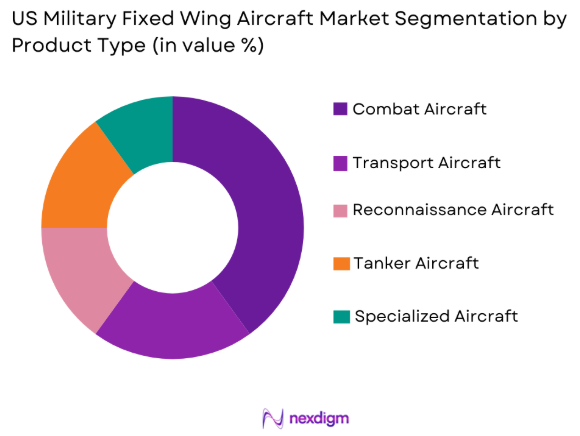
The US Military Fixed Wing Aircraft market is segmented by product type into transport aircraft, combat aircraft, reconnaissance aircraft, tanker aircraft, and specialized aircraft. Recently, combat aircraft dominated the market share due to the increased focus on modernizing air defense capabilities and the growing requirement for versatile platforms capable of performing multiple roles. Combat aircraft, including advanced stealth fighters and bombers, are highly demanded for their strategic importance in various defense operations. Additionally, technological advancements in stealth technology, avionics, and weaponry integration have contributed to the increased procurement of combat aircraft in recent years, aligning with the need for enhanced security in volatile geopolitical environments.
By Platform Type
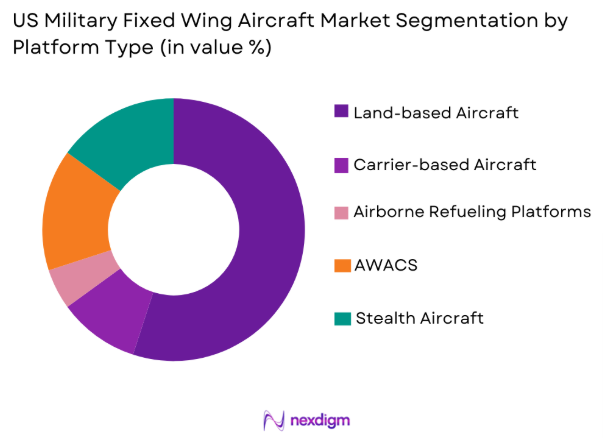
The US Military Fixed Wing Aircraft market is segmented by platform type into land-based aircraft, carrier-based aircraft, airborne refueling platforms, AWACS, and stealth aircraft. Recently, land-based aircraft have had a dominant market share due to their versatility and cost-effectiveness in various military operations. Land-based platforms are critical for ensuring strategic air superiority, providing rapid deployment, and supporting operations over a vast range of areas, including domestic and international engagements. Furthermore, land-based aircraft are favored for their operational flexibility and capacity for rapid deployment, aligning with the increasing need for combat readiness in diverse theaters of operation.
Competitive Landscape
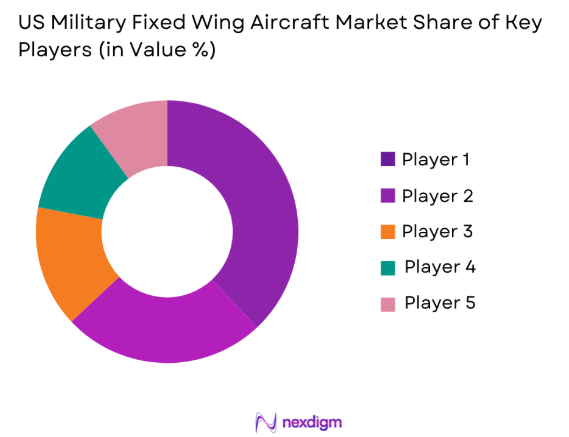
The US Military Fixed Wing Aircraft market is characterized by strong competition among global defense contractors. Major players are consolidating their positions through mergers, acquisitions, and strategic partnerships to leverage technological advancements and expand their market reach. The market is driven by key players like Lockheed Martin, Boeing, and Northrop Grumman, which hold considerable influence due to their extensive product offerings and long-term relationships with the US government. These companies are focusing on enhancing their aircraft’s capabilities with innovations in stealth, avionics, and mission-specific modifications.
| Company Name | Establishment Year | Headquarters | Technology Focus | Market Reach | Key Products | Revenue (USD) | R&D Investment |
| Lockheed Martin | 1912 | Bethesda, MD | ~ | ~ | ~ | ~ | ~ |
| Boeing | 1916 | Chicago, IL | ~ | ~ | ~ | ~ | ~ |
| Northrop Grumman | 1939 | Falls Church, VA | ~ | ~ | ~ | ~ | ~ |
| Raytheon Technologies | 2020 | Waltham, MA | ~ | ~ | ~ | ~ | ~ |
| General Dynamics | 1952 | Falls Church, VA | ~ | ~ | ~ | ~ | ~ |
US Military Fixed Wing Aircraft Market Analysis
Growth Drivers
Increased Defense Budget Allocation
The continuous increase in defense budgets by the US government is a key driver of the growth in the US Military Fixed Wing Aircraft market. The US military continues to prioritize technological advancement and readiness, allocating substantial resources to modernize its fleet of fixed-wing aircraft. This includes investments in advanced stealth technologies, next-generation avionics, and enhanced operational capabilities. As a result, the demand for high-performance aircraft has surged, with a focus on multi-role platforms that can support a wide range of missions, from combat to surveillance. Furthermore, the defense budget ensures that procurement processes remain strong, supporting the manufacturing of advanced fixed-wing aircraft for both the Air Force and Navy. The market’s growth is expected to continue as geopolitical tensions and national security concerns remain at the forefront of US defense priorities.
Technological Advancements in Aircraft Systems
Technological advancements in military aviation are crucial drivers for the growth of the US Military Fixed Wing Aircraft market. Continuous developments in stealth technology, avionics, radar systems, and weapon integration have led to the creation of next-generation fixed-wing aircraft capable of providing superior performance in combat. Aircraft such as the F-35 fighter jet showcase the integration of cutting-edge technologies that increase combat effectiveness and survivability. These innovations are not only driving demand for new aircraft but also creating a competitive edge for manufacturers who are able to offer more efficient, versatile, and mission-capable platforms. As these technologies evolve, they will continue to be a significant factor in the expansion of the US Military Fixed Wing Aircraft market.
Market Challenges
High Capital Expenditure on Aircraft Acquisition
One of the major challenges faced by the US Military Fixed Wing Aircraft market is the high capital expenditure required for the acquisition of advanced aircraft systems. Fixed-wing aircraft, particularly those with cutting-edge technologies such as stealth and enhanced avionics, require significant investment for research, development, and manufacturing. The high costs of these platforms, combined with the ongoing need for maintenance and upgrades, place a substantial financial burden on the US government and defense contractors. The costliness of procurement also leads to longer procurement cycles and a need for stringent budget planning, which can slow the adoption of new technologies in military aviation. Moreover, this challenge limits the ability of certain defense sectors to meet modernization targets and maintain fleet readiness.
Technological Integration and Maintenance Costs
The integration of new technologies into existing aircraft platforms presents a significant challenge in the US Military Fixed Wing Aircraft market. While newer technologies like advanced radar, avionics, and weapon systems offer enhanced capabilities, they often require complex integration into older aircraft platforms, leading to costly upgrades and maintenance efforts. Furthermore, maintaining these advanced systems over the aircraft’s lifecycle adds additional costs, as specialized maintenance and repair procedures are needed. This challenge is exacerbated by the need to balance technological innovation with operational efficiency, as defense contractors must ensure that aircraft remain mission-ready without exceeding budget constraints. The complexity of maintaining a fleet of technologically advanced fixed-wing aircraft continues to be a significant hurdle for market stakeholders.
Opportunities
Emerging Demand for UAV Integration in Military Operations
A significant opportunity in the US Military Fixed Wing Aircraft market lies in the growing demand for the integration of Unmanned Aerial Vehicles (UAVs) into military operations. UAVs are increasingly being used for surveillance, reconnaissance, and even combat operations, providing critical intelligence and enhancing operational efficiency. As UAV technology advances, there is a shift toward developing hybrid systems that combine manned and unmanned capabilities in a single platform, offering greater flexibility and reducing operational costs. This integration allows the military to extend the range of their fixed-wing aircraft, increase mission effectiveness, and reduce the risk to personnel. As UAVs become more advanced, their integration with manned aircraft will create a substantial growth opportunity for the US Military Fixed Wing Aircraft market, enabling more efficient and cost-effective operations.
Partnerships Between Defense Contractors and Tech Firms
Partnerships between defense contractors and technology firms present a significant growth opportunity in the US Military Fixed Wing Aircraft market. Collaborations between established defense companies and tech firms specializing in AI, cybersecurity, and data analytics are leading to the development of more advanced and intelligent aircraft systems. By integrating these technologies, the market is witnessing the emergence of next-generation fixed-wing aircraft capable of autonomous operations, advanced threat detection, and real-time data analysis. These partnerships also facilitate the development of aircraft platforms that can be continuously updated with the latest technological advancements, ensuring that the fleet remains at the cutting edge. As these collaborations expand, they will continue to play a key role in the modernization of the US military fleet.
Future Outlook
The US Military Fixed Wing Aircraft market is expected to continue its growth over the next five years, driven by increasing defense budgets, the need for advanced capabilities, and the modernization of military fleets. Technological developments in stealth, avionics, and autonomous systems are expected to shape the next generation of aircraft. Along with regulatory support for defense spending, demand from the US military will continue to propel market expansion. The increasing focus on multi-role aircraft and UAV integration is also expected to drive future innovation, ensuring that the market remains robust throughout the forecast period.
Major Players
- Lockheed Martin
- Boeing
- Northrop Grumman
- Raytheon Technologies
- General Dynamics
- Textron
- Sikorsky Aircraft
- Airbus
- Dassault Aviation
- Saab Group
- Leonardo
- BAE Systems
- Harris Corporation
- L3 Technologies
- Honeywell Aerospace
Key Target Audience
- Investments and venture capitalist firms
- Government and regulatory bodies
- US Air Force
- US Navy
- Defense contractors
- Aircraft manufacturers
- Aerospace and defense technology firms
- Military technology suppliers
Research Methodology
Step 1: Identification of Key Variables
The first step involves identifying the key variables that influence the US Military Fixed Wing Aircraft market, including defense budget allocation, technological advancements, and procurement cycles.
Step 2: Market Analysis and Construction
This step focuses on analyzing market trends, examining historical data, and constructing an accurate model to assess the market size and segmentation.
Step 3: Hypothesis Validation and Expert Consultation
Market hypotheses are validated through consultations with industry experts, including government officials, defense contractors, and military personnel, to ensure accurate market predictions.
Step 4: Research Synthesis and Final Output
The final step involves synthesizing all collected data, performing detailed analysis, and presenting the final market insights and forecasts in a comprehensive report.

- Executive Summary
- Research Methodology (Definitions, Scope, Industry Assumptions, Market Sizing Approach, Primary & Secondary Research Framework, Data Collection & Verification Protocol, Analytic Models & Forecast Methodology, Limitations & Research Validity Checks)

- Market Definition and Scope
- Value Chain & Stakeholder Ecosystem
- Regulatory / Certification Landscape
- Sector Dynamics Affecting Demand
- Strategic Initiatives & Infrastructure Growth

- Growth Drivers
Increased Defense Budget Allocation
Advancements in Stealth and Aviation Technology
Rising Geopolitical Tensions and National Security Concerns
Growing Demand for Multi-Role Aircraft
Government Initiatives for Military Modernization - Market Challenges
High Capital Expenditure on Aircraft Acquisition
Technological Integration and Maintenance Costs
Regulatory and Compliance Hurdles
Cybersecurity Threats to Aviation Systems
Long Development and Production Cycles - Market Opportunities
Emerging Demand for UAV Integration in Military Operations
Partnerships Between Defense Contractors and Tech Firms
Shift Towards Sustainable Aviation Technologies - Trends
Integration of AI and Machine Learning in Aircraft Operations
Increased Focus on Autonomous and Unmanned Systems
Growing Investment in Cybersecurity for Aviation
Rising Demand for Multi-Role Aircraft
Development of Next-Generation Combat Aircraft - Government Regulations & Defense Policy
Export Control and Compliance Policies
Sustainability Initiatives in Defense Aircraft Production
US Military Funding and Grants for Aircraft Technologies

- By Market Value, 2020-2025
- By Installed Units, 2020-2025
- By Average System Price, 2020-2025
- By System Complexity Tier, 2020-2025

- By System Type (In Value%)
Transport Aircraft
Combat Aircraft
Reconnaissance Aircraft
Tanker Aircraft
Specialized Aircraft - By Platform Type (In Value%)
Land-Based Aircraft
Carrier-Based Aircraft
Airborne Refueling Platforms
AWACS (Airborne Warning and Control Systems)
Stealth Aircraft - By Fitment Type (In Value%)
Retrofit Solutions
OEM Solutions
Upgraded Solutions
Mission-Specific Modifications
Integrated Solutions - By End User Segment (In Value%)
US Air Force
US Navy
US Marine Corps
Department of Homeland Security
Other Defense Contractors - By Procurement Channel (In Value%)
Direct Procurement
Government Tenders
Private Sector Procurement
Online Bidding Platforms
Third-Party Distributors - By Material / Technology (in Value %)
Carbon Fiber
Aluminum Alloys
Composite Materials
Stealth Coating Technologies
Advanced Avionics

- Market structure and competitive positioning
- Market share snapshot of major players
- Cross Comparison Parameters (System Type, Platform Type, Procurement Channel, End User Segment, Fitment Type, Material / Technology, Price Tier, Aircraft Age, Operational Capabilities, R&D Investment)
- SWOT Analysis of Key Players
- Pricing & Procurement Analysis
- Porter’s Five Forces
- Key Players
Lockheed Martin
Northrop Grumman
Boeing
General Dynamics
Raytheon Technologies
Textron
Sikorsky Aircraft
Airbus
Dassault Aviation
Saab Group
Leonardo
BAE Systems
Harris Corporation
L3 Technologies
Honeywell Aerospace

- US Air Force’s Expansion of Aircraft Fleet
- Role of the US Navy in Aircraft Procurement
- Technological Advancements Impacting Marine Corps Aircraft
- Increased Demand for Specialized Aircraft by Homeland Security

- Forecast Market Value, 2026-2035
- Forecast Installed Units, 2026-2035
- Price Forecast by System Tier, 2026-2035
- Future Demand by Platform, 2026-2035


 Request a Sample
 Ask for Customization
 Get a Quote
 Enquire Now