

 Download PDF
 Download PDF
Market Overview
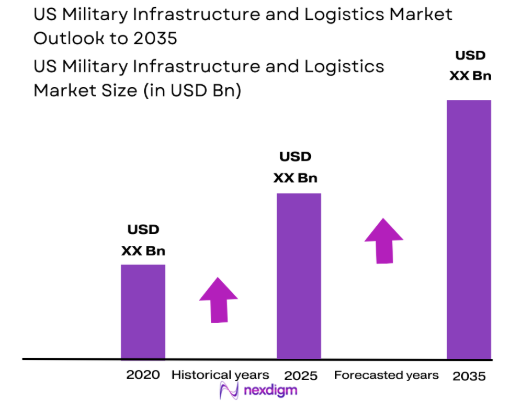
The US Military Infrastructure and Logistics Market is valued at approximately USD ~ billion, driven by significant investments in defense technologies, national security, and military modernization. The ongoing focus on advanced logistics capabilities, such as automation and artificial intelligence, is expected to propel market growth, addressing the needs of military forces for enhanced operational efficiency. This market is primarily driven by the U.S. government’s commitment to strengthening its military readiness, infrastructure, and logistics capabilities, in line with defense strategies and international defense partnerships.
The market is dominated by the United States, particularly in key defense hubs such as Washington D.C., Virginia, and California, due to the presence of major defense contractors, government agencies, and military installations. The U.S. military’s global presence and its significant defense budget allocation make it the primary driver for growth in military infrastructure and logistics. As the largest defense spender, the U.S. sets the tone for technological innovations, strategic military planning, and global defense collaborations.
Market Segmentation
By Product Type
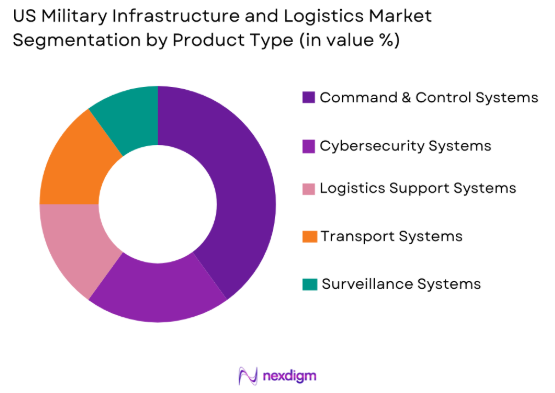
The US Military Infrastructure and Logistics Market is segmented by product type into command and control systems, cybersecurity systems, logistics support systems, transport systems, and surveillance systems. Recently, logistics support systems have dominated the market share due to the increasing demand for automation in military supply chains, the enhancement of operational efficiency, and the optimization of resources. As military operations increasingly require rapid and secure movement of troops and equipment, logistics systems have evolved to incorporate advanced technologies like AI, robotics, and autonomous vehicles, making them critical for meeting the needs of modern warfare.
By Platform Type
The US Military Infrastructure and Logistics Market is segmented by platform type into land platforms, airborne platforms, naval platforms, space platforms, and integrated platforms. Recently, land platforms have dominated the market share due to their extensive use in military ground operations and combat support. The U.S. military’s focus on fortifying its ground forces through advanced land-based systems such as armored vehicles, command centers, and logistics platforms has propelled the demand for land platforms. Furthermore, land platforms serve as critical enablers of military readiness and tactical advantage in diverse combat scenarios, making them an indispensable component of the defense infrastructure.
Competitive Landscape
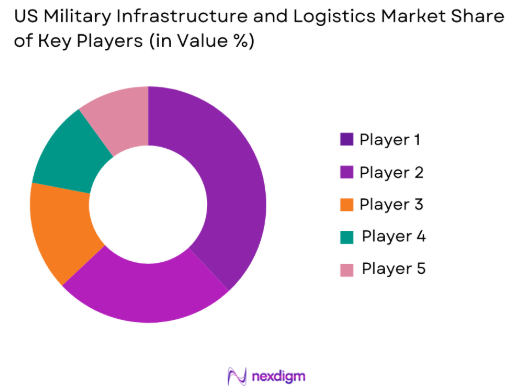
The competitive landscape of the US Military Infrastructure and Logistics Market is characterized by a combination of major defense contractors, technology firms, and government agencies. The market has experienced consolidation with key players expanding their offerings through strategic mergers and partnerships. Companies such as Lockheed Martin, Northrop Grumman, and BAE Systems hold significant influence due to their advanced technological capabilities and government contracts. The strong presence of these players ensures that competition remains intense, with a focus on technological advancements, cost-effective solutions, and long-term military partnerships.
| Company Name | Establishment Year | Headquarters | Technology Focus | Market Reach | Key Products | Revenue | Military Logistics Focus |
| Lockheed Martin | 1912 | Bethesda, Maryland | ~ | ~ | ~ | ~ | ~ |
| Northrop Grumman | 1939 | Falls Church, Virginia | ~ | ~ | ~ | ~ | ~ |
| BAE Systems | 1999 | London, UK | ~ | ~ | ~ | ~ | ~ |
| General Dynamics | 1952 | Reston, Virginia | ~ | ~ | ~ | ~ | ~ |
| Raytheon Technologies | 2020 | Waltham, Massachusetts | ~ | ~ | ~ | ~ | ~ |
US Military Infrastructure and Logistics Market Analysis
Growth Drivers
Increased Government Investment in National Security
The growing emphasis on national security and defense spending has significantly boosted the demand for military infrastructure and logistics solutions. The U.S. government continues to allocate substantial resources to modernize military facilities, logistics networks, and defense technologies to maintain its global military dominance. This investment is particularly evident in the expansion of military bases, advanced cybersecurity measures, and the development of automated logistics systems to enhance operational efficiency. With a projected increase in the defense budget, this trend is expected to continue, driving demand for robust infrastructure and logistics solutions across the defense sector. Moreover, the integration of new technologies, such as artificial intelligence and machine learning, into military logistics will play a crucial role in optimizing supply chain management and transportation operations.
Technological Advancements in Military Logistics
Technological innovation in military logistics has become a critical growth driver, enabling enhanced efficiency, reduced operational costs, and improved readiness. The adoption of cutting-edge technologies such as automation, robotics, and AI has revolutionized logistics support systems, making them more adaptive and responsive to real-time military needs. Autonomous vehicles, drones, and smart warehouses are increasingly utilized to streamline military logistics operations, reducing human error and speeding up decision-making processes. As these technologies evolve, their integration into military infrastructure will continue to expand, enhancing supply chain visibility, reducing delivery times, and ultimately improving the operational readiness of armed forces worldwide.
Market Challenges
High Capital Expenditure in Military Projects
A significant challenge in the US Military Infrastructure and Logistics Market is the high capital expenditure required to develop and maintain advanced defense systems. The construction of military infrastructure, including bases, command centers, and logistical networks, demands significant financial investments from the government and private sector. This expenditure often leads to budget constraints and delays in implementing new projects. While long-term contracts with the government can ensure steady revenue streams, the initial investment remains a major hurdle, particularly for smaller contractors or firms entering the market. The complexity and scale of these projects further exacerbate financial challenges, requiring careful planning and resource allocation.
Cybersecurity Threats and Vulnerabilities
As the reliance on digital infrastructure increases, the risk of cyber threats targeting military logistics and command systems also rises. Cybersecurity vulnerabilities present a critical challenge to the integrity of military operations, as hackers can exploit weaknesses in the defense supply chain, communication networks, and surveillance systems. Ensuring robust cybersecurity measures is an ongoing challenge, especially as adversaries develop increasingly sophisticated tools and techniques to disrupt military operations. Moreover, maintaining compliance with stringent cybersecurity regulations and staying ahead of potential threats requires significant investment in advanced technologies and skilled personnel, making it a persistent challenge in the defense sector.
Opportunities
Expansion of Autonomous Logistics Solutions
The increasing demand for autonomous vehicles and robots presents a significant opportunity for growth in the US Military Infrastructure and Logistics Market. Autonomous systems can significantly reduce human labor costs, improve operational efficiency, and enhance mission success rates in dangerous or remote environments. With the U.S. military actively pursuing autonomous vehicles for logistics, transportation, and surveillance, companies developing these technologies stand to benefit from lucrative government contracts and partnerships. The adoption of autonomous systems in military logistics will further streamline supply chain management, enhance readiness, and reduce the risk to personnel.
Growth of Artificial Intelligence in Military Logistics
The integration of artificial intelligence (AI) into military logistics systems offers immense potential for optimizing resource management and operational efficiency. AI can enable predictive maintenance, optimize route planning, and enhance inventory management by analyzing vast amounts of data in real time. As the U.S. military continues to modernize its logistics operations, AI-driven solutions will play an essential role in improving supply chain visibility, reducing operational bottlenecks, and enabling more effective decision-making. Companies specializing in AI and machine learning technologies have an opportunity to capitalize on the growing demand for these solutions within the defense sector.
Future Outlook
The future outlook for the US Military Infrastructure and Logistics Market is highly positive, with expected growth driven by technological advancements, increasing defense budgets, and the need for more efficient logistics operations. The next five years will see continued investments in automation, AI, and cybersecurity to modernize defense logistics. Furthermore, geopolitical tensions and the need for rapid military mobilization will drive demand for more advanced infrastructure. The growing emphasis on sustainability in military logistics, such as the integration of green technologies and energy-efficient solutions, will also play a pivotal role in shaping the market landscape.
Major Players
- Lockheed Martin
- Northrop Grumman
- BAE Systems
- General Dynamics
- Raytheon Technologies
- L3 Technologies
- Leonardo
- Harris Corporation
- Boeing
- Saab Group
- Rheinmetall AG
- Elbit Systems
- Hewlett Packard Enterprise
- Boeing
- Sikorsky Aircraft
Key Target Audience
- Investments and venture capitalist firms
- Government and regulatory bodies
- Military procurement departments
- Defense contractors
- Supply chain and logistics managers
- Aerospace & defense consultants
- Infrastructure development agencies
- Research and development firms
Research Methodology
Step 1: Identification of Key Variables
Key variables affecting the US Military Infrastructure and Logistics Market are identified through industry analysis, historical trends, and expert consultations.
Step 2: Market Analysis and Construction
Detailed market data is collected and analyzed through primary and secondary research, including government reports and defense industry publications.
Step 3: Hypothesis Validation and Expert Consultation
Expert insights are gathered through interviews with defense industry leaders, military procurement professionals, and technology developers to validate hypotheses and refine models.
Step 4: Research Synthesis and Final Output
The final output is synthesized by integrating research findings, market trends, and expert opinions into a comprehensive report with actionable insights.

- Executive Summary
- Research Methodology (Definitions, Scope, Industry Assumptions, Market Sizing Approach, Primary & Secondary Research Framework, Data Collection & Verification Protocol, Analytic Models & Forecast Methodology, Limitations & Research Validity Checks)

- Market Definition and Scope
- Value Chain & Stakeholder Ecosystem
- Regulatory / Certification Landscape
- Sector Dynamics Affecting Demand
- Strategic Initiatives & Infrastructure Growth

- Growth Drivers
Increased Government Investment in National Security
Technological Advancements in AI and Robotics
Rising Geopolitical Tensions
Growing Military Modernization Programs
Integration of Commercial Technologies into Defense Systems - Market Challenges
High Capital Expenditure in Defense Projects
Cybersecurity Threats and Vulnerabilities
Regulatory and Compliance Barriers
Technological Integration and Interoperability Issues
Political and Social Resistance to Military Expansion - Market Opportunities
Expansion in Autonomous Vehicles for Logistics
Partnerships with Private Tech Firms for Cybersecurity
Emerging Demand for AI-Driven Command Systems - Trends
Increase in Use of Autonomous Systems
Integration of AI and Robotics in Defense Logistics
Surge in Cybersecurity Investments for Military Systems
Growth of Sustainable Military Technologies
Integration of Commercial Technologies into Military Systems - Government Regulations & Defense Policy
Data Protection and Privacy Regulations
Export Control and Compliance Policies
Government Funding and Grants for Defense Technologies

- By Market Value, 2020-2025
- By Installed Units, 2020-2025
- By Average System Price, 2020-2025
- By System Complexity Tier, 2020-2025

- By System Type (In Value%)
Command & Control Systems
Cybersecurity Systems
Logistics Support Systems
Transport Systems
Surveillance Systems - By Platform Type (In Value%)
Land Platforms
Airborne Platforms
Naval Platforms
Space Platforms
Integrated Platforms - By Fitment Type (In Value%)
On-premise Solutions
Cloud-based Solutions
Hybrid Solutions
Modular Solutions
Integrated Solutions - By End User Segment (In Value%)
Military Forces
Defense Contractors
Government Agencies
Security Services
Private Sector / Technology Firms - By Procurement Channel (In Value%)
Direct Procurement
Government Tenders
Private Sector Procurement
Online Bidding Platforms
Third-party Distributors - By Material / Technology (In Value%)
AI Technologies
Robotic Systems
Communication Networks
Sensor Technology
Autonomous Vehicles

- Market structure and competitive positioning
- Market share snapshot of major players
- Cross Comparison Parameters (System Type, Platform Type, Procurement Channel, End User Segment, Fitment Type, Material / Technology, Installed Units, Average System Price, Future Forecast, Government Funding)
- SWOT Analysis of Key Players
- Pricing & Procurement Analysis
- Porter’s Five Forces
- Key Players
Lockheed Martin
Northrop Grumman
General Dynamics
BAE Systems
Raytheon Technologies
L3 Technologies
Leonardo
Harris Corporation
Boeing
Saab Group
Rheinmetall AG
Elbit Systems
Hewlett Packard Enterprise
Boeing
Sikorsky Aircraft

- Military Forces’ Increasing Demand for Logistics Solutions
- Defense Contractors’ Role in Supplying and Innovating
- Government Agencies’ Role in Regulating and Procuring
- Private Sector’s Growing Interest in Cybersecurity Solutions

- Forecast Market Value, 2026-2035
- Forecast Installed Units, 2026-2035
- Price Forecast by System Tier, 2026-2035
- Future Demand by Platform, 2026-2035


 Request a Sample
 Ask for Customization
 Get a Quote
 Enquire Now