
 Download PDF
 Download PDF
Market Overview
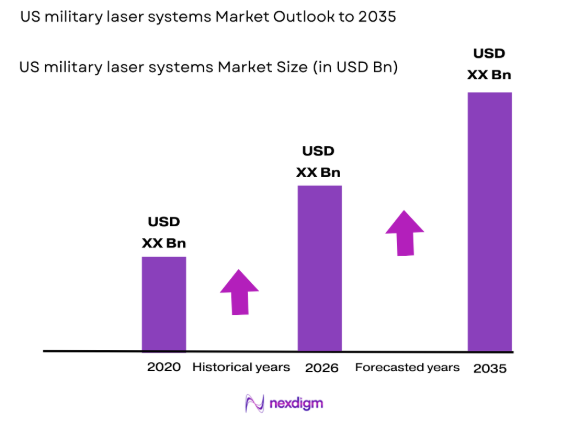
The US military laser systems market reached approximately USD ~ billion based on a recent historical assessment derived from consolidated defense budget allocations and procurement disclosures by the US Department of Defense and Congressional Research Service. Growth is driven by accelerating directed-energy weapon deployment across air, naval, and land platforms, rising counter-drone and missile defense requirements, and sustained investment in high-energy laser development programs by prime contractors and federal laboratories supporting modernization initiatives.
Dominance is concentrated in the United States due to its integrated defense industrial base spanning California, Virginia, Alabama, and Texas, where major contractors, research laboratories, and testing ranges are co-located with military procurement commands. Strong federal funding pipelines, advanced optics and photonics manufacturing clusters, and operational testing infrastructure enable rapid prototyping and deployment of laser weapon systems across multiple service branches, reinforcing national leadership in directed-energy military technologies.
Market Segmentation
By Product Type
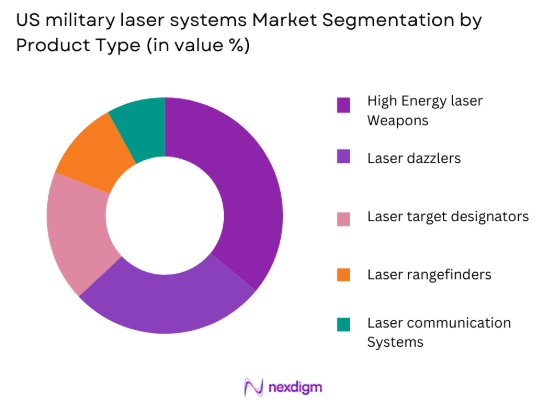
US military laser systems market is segmented by product type into high-energy laser weapons, laser dazzlers, laser target designators, laser rangefinders, and laser communication systems. Recently, high-energy laser weapons has a dominant market share due to factors such as demand patterns, brand presence, infrastructure availability, or consumer preference. The US Department of Defense has prioritized scalable directed-energy weapons for counter-UAS, missile defense, and shipborne protection missions, leading to large procurement programs and integration into operational platforms. High-energy laser programs receive the majority of research and acquisition funding, with established contractors providing mature beam control, power scaling, and thermal management technologies. Extensive testing across naval destroyers, armored vehicles, and airborne demonstrators has accelerated readiness and procurement, while other laser categories remain largely sensor or support functions with lower contract values and slower modernization cycles.
By Platform Type
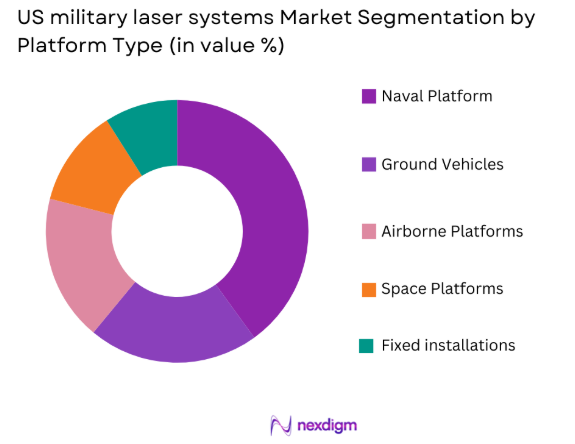
US military laser systems market is segmented by platform into naval platforms, ground vehicles, airborne platforms, space platforms, and fixed installations. Recently, naval platforms has a dominant market share due to factors such as demand patterns, brand presence, infrastructure availability, or consumer preference. The US Navy has operationalized shipborne laser weapon systems to counter drones and small boats, supported by substantial fleet integration budgets and deployment programs. Naval vessels offer greater onboard power availability and cooling capacity compared with other platforms, enabling higher-energy laser integration and sustained firing capability. Continuous sea trials and field deployments have accelerated procurement volumes, while ground and airborne laser programs remain partly in demonstration or limited deployment stages. As a result, naval integration commands the largest share of contracts and delivered systems within the US military laser ecosystem.
Competitive Landscape
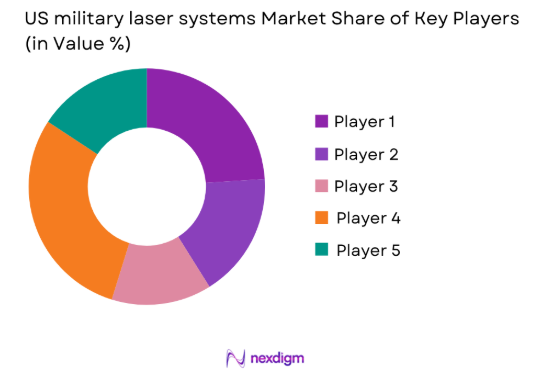
The US military laser systems market exhibits moderate consolidation with a small group of prime defense contractors controlling system integration, beam control, and power scaling technologies, supported by specialized photonics and optics suppliers. Federal research laboratories and defense agencies play a central role in technology maturation and contracting, while long-term procurement programs reinforce incumbent advantages and high barriers to entry.
| Company Name | Establishment Year | Headquarters | Technology Focus | Market Reach | Key Products | Revenue | Directed-Energy Capability Level |
| Lockheed Martin | 1995 | Bethesda, USA | ~ | ~ | ~ | ~ | ~ |
| Northrop Grumman | 1994 | Falls Church, USA | ~ | ~ | ~ | ~ | ~ |
| Raytheon Technologies | 1922 | Arlington, USA | ~ | ~ | ~ | ~ | ~ |
| Boeing | 1916 | Arlington, USA | ~ | ~ | ~ | ~ | ~ |
| General Atomics | 1955 | San Diego, USA | ~ | ~ | ~ | ~ | ~ |
US military laser systems Market Analysis
Growth Drivers
Rising demand for counter-drone and missile defense directed-energy systems
The increasing prevalence of low-cost drones, cruise missiles, and asymmetric aerial threats has compelled the US military to adopt scalable and cost-effective interception technologies, positioning laser weapons as a critical component of layered air defense architectures. Directed-energy systems provide deep magazines, low cost per engagement, and rapid target acquisition, enabling sustained defensive operations against swarm threats that overwhelm kinetic interceptors. Operational testing has demonstrated effectiveness against unmanned aerial vehicles, rockets, and small surface threats, accelerating transition from prototype to procurement across service branches. Integration programs across naval destroyers, ground vehicles, and tactical bases have validated platform compatibility and mission versatility. Defense budgets increasingly allocate funding toward directed-energy research, prototyping, and acquisition lines supporting counter-UAS initiatives. Advances in beam control, thermal management, and fiber laser scaling have improved reliability and lethality thresholds required for operational deployment. Combatant commands emphasize persistent air defense coverage in contested environments where resupply constraints favor reusable energy weapons. As a result, directed-energy laser adoption is expanding from experimental deployments to sustained procurement and operational doctrine integration across US forces.
Advancements in high-energy laser power scaling and thermal management technologies
Continuous improvements in solid-state and fiber laser architectures have enabled higher power output, improved beam quality, and compact form factors necessary for military deployment across multiple platforms. Breakthroughs in spectral beam combining and coherent beam combining techniques allow modular scaling of laser power without compromising beam coherence or efficiency. Enhanced thermal management systems, including advanced heat exchangers and adaptive cooling architectures, address sustained firing requirements and environmental stresses in operational theaters. Miniaturization of power conditioning and energy storage components supports integration into mobile and airborne platforms previously constrained by size and weight limitations. Federal research laboratories and defense contractors collaborate on materials science innovations improving optical coatings, gain media durability, and efficiency under high-energy loads. These technological advances reduce system size, weight, and power consumption while increasing lethality and engagement range. Improved reliability and maintainability lower lifecycle costs and enhance mission readiness metrics demanded by procurement authorities. Consequently, technological maturation has transformed high-energy laser weapons from experimental demonstrators into deployable, scalable, and economically viable military systems across US defense platforms.
Market Challenges
High integration complexity and platform power constraints for laser deployment
Integrating high-energy laser systems into existing military platforms requires significant redesign of power generation, storage, cooling, and structural components, creating engineering and cost challenges that slow widespread adoption across fleets. Many legacy ground vehicles and aircraft lack sufficient onboard electrical capacity or thermal dissipation capability to sustain high-power laser firing cycles, necessitating extensive retrofits or platform redesign. Naval vessels provide more favorable integration environments, but even shipborne deployment demands modifications to power distribution and combat system interfaces. Environmental factors such as vibration, dust, humidity, and salt corrosion affect optical alignment and component longevity, increasing maintenance requirements in operational conditions. Achieving precise beam control on moving platforms introduces stabilization and targeting complexities requiring advanced sensors and control algorithms. Certification and safety protocols for high-energy directed-energy systems impose additional testing timelines and regulatory oversight. Integration programs often involve multiple contractors and subsystems, complicating schedule coordination and cost control. These technical and operational constraints extend development cycles and delay procurement scaling for certain platform categories within the US military laser ecosystem.
Atmospheric attenuation and environmental performance limitations affecting laser effectiveness
Laser weapon performance is inherently influenced by atmospheric conditions including turbulence, aerosols, humidity, and precipitation, which degrade beam propagation, reduce energy on target, and limit engagement range in real-world operational environments. Battlefield conditions such as dust, smoke, and maritime spray introduce scattering and absorption effects that diminish laser lethality against distant or hardened targets. Adaptive optics and beam compensation technologies mitigate some degradation but add complexity and cost to system design. Weather variability imposes operational constraints compared with kinetic interceptors that remain effective across broader environmental conditions. Engagement planning must account for line-of-sight requirements and atmospheric modeling, complicating tactical deployment in cluttered or obscured environments. High-energy requirements to overcome attenuation increase power demand and thermal load, exacerbating integration challenges. Testing under diverse environmental conditions is resource intensive and time consuming, affecting certification timelines. Consequently, atmospheric sensitivity remains a key technical limitation influencing mission suitability, procurement decisions, and doctrine integration for US military laser weapon systems.
Opportunities
Expansion of naval directed-energy deployments for fleet protection missions
The US Navy’s emphasis on layered ship defense against drones, missiles, and small boats creates substantial opportunity for large-scale deployment of high-energy laser systems across surface combatants and amphibious vessels. Naval platforms offer sufficient onboard power generation and cooling infrastructure to support higher-energy lasers with sustained firing capability, enabling reliable operational performance. Fleet modernization programs prioritize integration of directed-energy weapons to reduce reliance on costly kinetic interceptors and expand defensive capacity. Operational demonstrations have validated effectiveness in maritime environments, accelerating procurement confidence and budget allocation. Shipborne laser installations enhance close-in defense and complement radar and missile systems within integrated combat architectures. Modular laser designs allow incremental power upgrades aligned with evolving threat profiles and technology maturation. Domestic shipyards and defense contractors possess established integration expertise, reducing deployment risk and schedule uncertainty. As fleet protection requirements expand in contested maritime regions, naval directed-energy adoption is expected to represent the most scalable and near-term growth pathway within the US military laser systems market.
Emergence of airborne and space-based laser applications for strategic defense
Advancements in compact high-power lasers and energy storage technologies are enabling renewed development of airborne and potential space-based directed-energy systems for missile defense, surveillance, and precision engagement missions. Airborne platforms offer extended line-of-sight and rapid response capabilities against high-altitude threats, enhancing layered defense architectures. Ongoing research into lightweight laser modules and efficient power systems is reducing size and weight constraints that historically limited airborne deployment feasibility. Space-based laser concepts supported by defense agencies aim to provide persistent global coverage and rapid interception capability against ballistic threats. Integration with satellite sensors and tracking networks could enable precise targeting and coordinated engagement. Strategic defense initiatives and modernization programs are allocating research funding toward these advanced directed-energy applications. Collaboration between aerospace contractors, photonics firms, and federal laboratories is accelerating prototype development and testing. Although operational deployment remains longer term, technological convergence and defense priorities position airborne and space-based lasers as transformative opportunities shaping the future trajectory of the US military laser systems market.
Future Outlook
The US military laser systems market is expected to expand steadily as directed-energy weapons transition from demonstration to operational deployment across naval, ground, and airborne platforms. Technological maturation in power scaling and beam control will enable higher lethality and broader mission integration. Federal defense modernization priorities and counter-drone requirements will sustain procurement momentum. Regulatory and doctrinal integration will support adoption across services. Increasing platform compatibility and modular architectures will accelerate fielding over the next five years.
Major Players
- Lockheed Martin
- Raytheon Technologies
- Northrop Grumman
- Boeing
- BAE Systems
- L3Harris Technologies
- General Atomics
- Kratos Defense & Security Solutions
- Leonardo DRS
- Elbit Systems of America
- Leidos
- Huntington Ingalls Industries
- nLIGHT
- Honeywell
- AeroVironment
Key Target Audience
- Investments and venture capitalist firms
- Government and regulatory bodies
- Defense contractors and suppliers
- Aerospace and defense manufacturers
- Military research institutions
- Technology and systems integrators
- Law enforcement agencies
- Defense procurement agencies
Research Methodology
Step 1: Identification of Key Variables
Key market variables including defense procurement spending, directed-energy program funding, platform integration trends, and contractor capabilities were identified through analysis of federal budget documents, congressional reports, and defense agency publications. Technology readiness levels, deployment status, and platform compatibility factors were mapped to define market structure.
Step 2: Market Analysis and Construction
Market sizing and segmentation were constructed using procurement allocations, contract disclosures, and program funding distribution across product and platform categories. Integration timelines, deployment status, and technology maturity were analyzed to estimate relative market shares and competitive positioning within the US military laser ecosystem.
Step 3: Hypothesis Validation and Expert Consultation
Findings were validated through consultation with defense technology experts, photonics engineers, and military procurement analysts. Program data from federal laboratories, contractor briefings, and defense publications were cross-referenced to confirm technology maturity, deployment status, and market concentration assumptions.
Step 4: Research Synthesis and Final Output
Validated insights were synthesized into structured market analysis covering segmentation, competitive landscape, growth drivers, challenges, and opportunities. Quantitative and qualitative data were integrated to produce a coherent outlook reflecting procurement trends, technological evolution, and strategic defense priorities shaping the US military laser systems market.

- Executive Summary
- Research Methodology (Definitions, Scope, Industry Assumptions, Market Sizing Approach, Primary & Secondary Research Framework, Data Collection & Verification Protocol, Analytic Models & Forecast Methodology, Limitations & Research Validity Checks)

- Market Definition and Scope
- Value Chain & Stakeholder Ecosystem
- Regulatory / Certification Landscape
- Sector Dynamics Affecting Demand
- Strategic Initiatives & Infrastructure Growth

- Growth Drivers
Expansion of directed energy weapon deployment programs
Advancement in solid state and fiber laser technologies
Rising demand for counter drone and missile defense - Market Challenges
High power generation and thermal management constraints
Integration complexity with military platforms
Stringent defense testing and qualification requirements - Market Opportunities
Development of high power tactical laser weapons
Integration of lasers in missile defense architectures
Growth in compact and mobile laser systems - Trends
Shift toward high energy solid state lasers
Integration with air and missile defense systems
Miniaturization and power scaling of laser weapons - Government regulations
Defense acquisition and export control regulations
Directed energy weapon testing standards
Military safety and operational compliance frameworks - SWOT analysis
- Porter’s five forces

- By Market Value 2020-2025
- By Installed Units 2020-2025
- By Average System Price 2020-2025
- By System Complexity Tier 2020-2025

- By System Type (In Value%)
High Energy Laser Weapon Systems
Laser Directed Energy Defense Systems
Laser Target Designation Systems
Laser Rangefinding Systems
Laser Countermeasure Systems - By Platform Type (In Value%)
Ground Based Laser Systems
Naval Laser Weapon Systems
Airborne Laser Systems
Space Based Laser Platforms
Vehicle Mounted Tactical Lasers - By Fitment Type (In Value%)
Integrated Platform Mounted Systems
Pod Mounted Laser Systems
Turreted Laser Modules
Handheld and Portable Laser Devices
Modular Directed Energy Payloads - By EndUser Segment (In Value%)
Army Directed Energy Programs
Naval Warfare Systems
Air Force Laser Defense Programs
Missile Defense Agencies
Special Operations Forces - By Procurement Channel (In Value%)
Direct Department of Defense Contracts
Prime Defense Integrator Programs
Defense Research and Development Agencies
Foreign Military Sales Programs
Defense Technology Partnerships

- Market Share Analysis
- Cross Comparison Parameters (Laser Power Output Level, Beam Quality and Range, Platform Integration Capability, Thermal Management Efficiency, Target Tracking and Fire Control Integration)
- SWOT Analysis of Key Competitors
- Pricing & Procurement Analysis
- Key Players
Lockheed Martin
Northrop Grumman
Raytheon Technologies
L3Harris Technologies
Boeing Defense
General Atomics
BAE Systems
Leonardo DRS
Rafael Advanced Defense Systems
MBDA
Textron Systems
Coherent Defense
IPG Photonics Defense
nLIGHT Defense Systems
Kratos Defense

- Army expanding ground laser defense systems
- Navy deploying shipborne laser weapons
- Air Force integrating airborne laser defenses
- Missile defense agencies funding laser interceptors

- Forecast Market Value 2026-2035
- Forecast Installed Units 2026-2035
- Price Forecast by System Tier 2026-2035
- Future Demand by Platform 2026-2035


 Request a Sample
 Ask for Customization
 Get a Quote
 Enquire Now