

 Download PDF
Market Overview
The US Mining Drill Bits Market is driven by the scale and diversity of domestic mining operations, particularly gold, copper, iron ore, zinc, molybdenum, aggregates, and critical minerals. USGS reported USD 106 billion in total US mine production of nonfuel mineral commodities, including USD 33.5 billion from metal mines. Gold represented 35%, copper 30%, iron ore 16%, zinc 7%, and molybdenum 5% of metal mine production value. The breadth of these extraction activities creates recurring requirements for blast-hole, production, exploration, and development drilling consumables.
Nevada, Arizona, Texas, Alaska, Minnesota, Utah, and other mineral-intensive states form important demand centers for US Mining Drill Bits Market participants because their mining operations require continuous rock penetration, blasting, exploration, and mine-development activities. Nevada and Arizona are particularly important for gold and copper extraction, while Minnesota contributes to iron ore production and Texas has extensive mineral and energy-related drilling activity. USGS recorded USD 33.5 billion of US metal mine production and identified gold, copper, iron ore, zinc, and molybdenum as the leading contributors, creating concentrated requirements for rotary, DTH, and specialized drilling technologies.
Market Segmentation
By Drill Bit Type
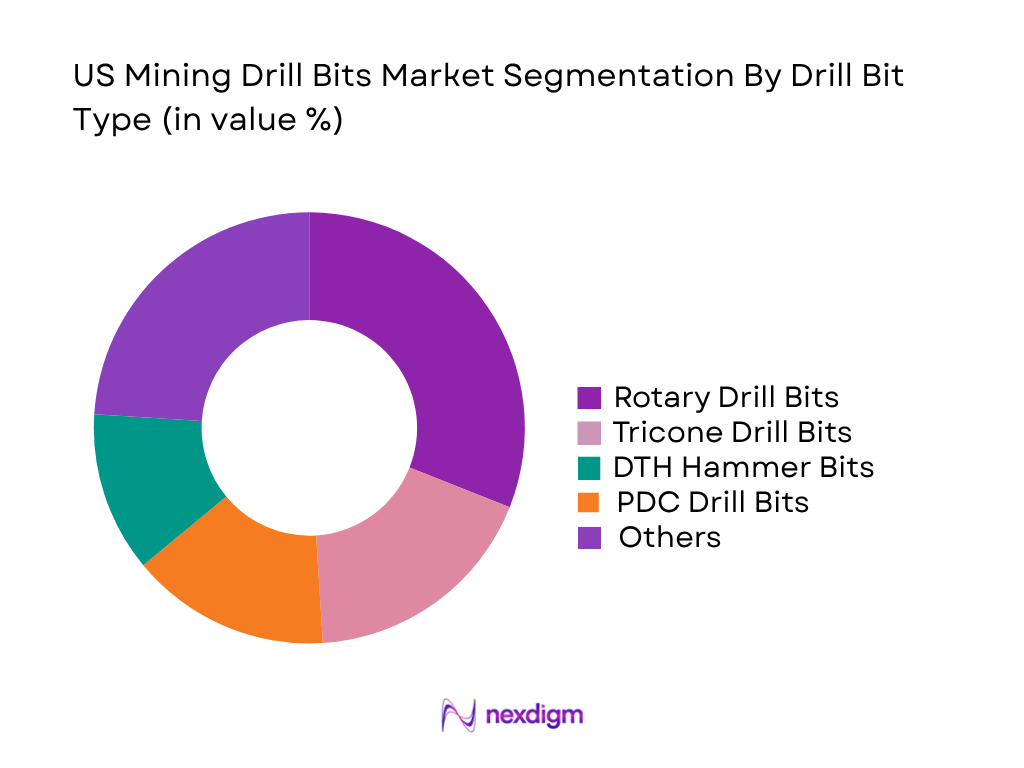
The US Mining Drill Bits Market is segmented by drill bit type into rotary drill bits, tricone drill bits, roller cone drill bits, fixed cutter bits, PDC drill bits, DTH hammer bits, top-hammer bits, button bits, drag bits, diamond core bits, and specialty mining drill bits. Rotary and tricone configurations are expected to represent the dominant application base because of their extensive use in production drilling and blast-hole drilling across large surface mines. Their suitability for high-volume drilling operations, compatibility with large rotary blasthole rigs, and ability to operate across different rock formations support recurring replacement demand. USGS reported USD 33.5 billion in metal mine production and USD 72.1 billion in industrial mineral production, demonstrating the broad base of mineral extraction operations requiring drilling equipment. The US also produced 512.5 million short tons of coal, with 524 producing coal mines, reinforcing the relevance of durable drilling consumables across remaining coal operations.
By Mining Application
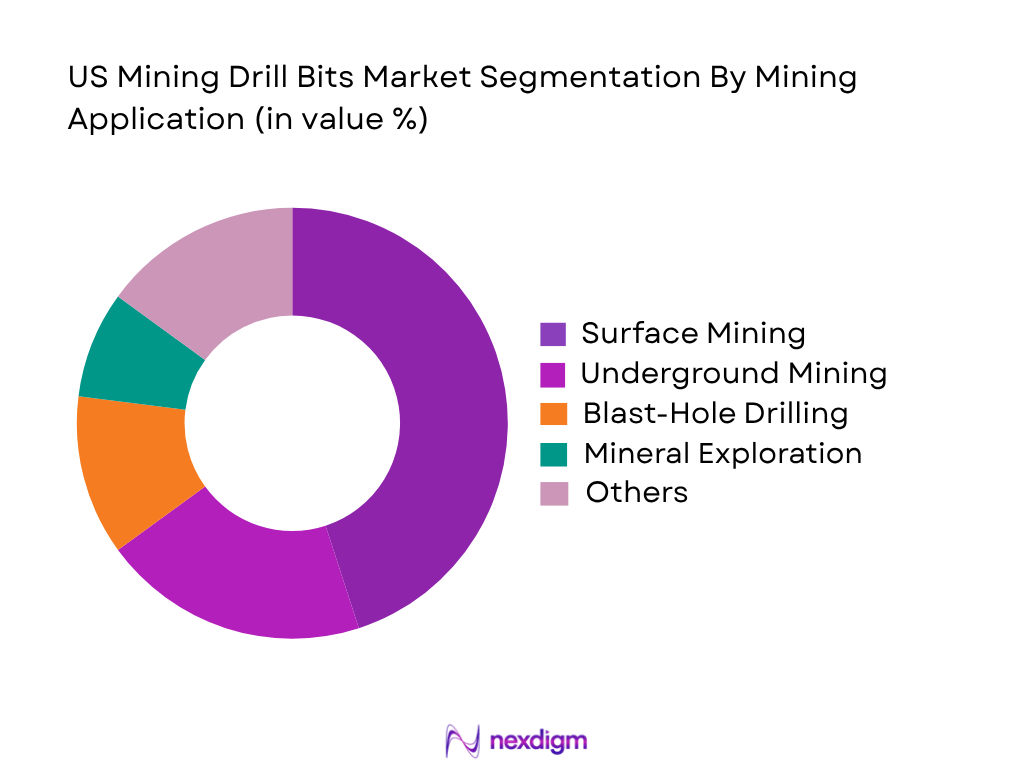
The US Mining Drill Bits Market is segmented by mining application into surface mining, underground mining, mineral exploration, blast-hole drilling, production drilling, grade-control drilling, mine-development drilling, quarrying and aggregates drilling, and controlled-blasting drilling. Surface mining is expected to represent the dominant application because large open-pit and quarry operations require extensive drilling for blasting, fragmentation, production sequencing, and bench development. USGS recorded USD 106 billion in total nonfuel mineral mine production, while industrial minerals alone accounted for USD 72.1 billion, illustrating the scale of surface-oriented extraction and quarrying activity. The EIA also reported 512.5 million short tons of US coal production and 832.8 million short tons of productive coal-mine capacity. These operations require repeated drilling cycles and replacement of wear-intensive bits, particularly where hard or abrasive formations increase bit consumption.
Competitive Landscape
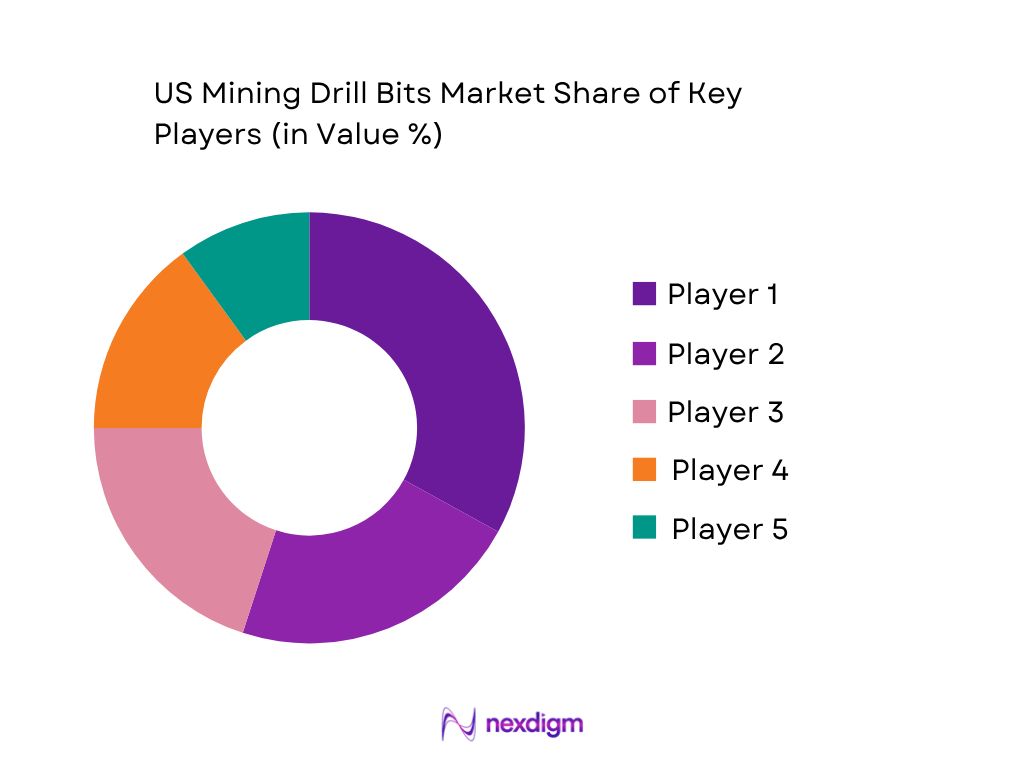
The US Mining Drill Bits Market comprises global mining-equipment and rock-tool manufacturers alongside specialized drill-bit producers. Competition is shaped by cutting-structure technology, penetration performance, bit durability, drill-rig compatibility, technical support, aftermarket availability, and ability to customize products for particular geological formations. Major suppliers such as Sandvik, Epiroc, Boart Longyear, Caterpillar, Komatsu, Mincon, Rockmore, Brunner & Lay, and Center Rock participate across different combinations of rotary, DTH, top-hammer, exploration, and specialty drilling applications. The competitive environment is closely connected with mine automation because drilling operators increasingly evaluate consumables based on drilling productivity, meters drilled per bit, downtime, and compatibility with automated equipment.
| Company | Establishment | Headquarters | Core Mining Drill-Bit Focus | Key Technology | Primary Application | US Market Capability | Aftermarket Focus |
| Sandvik Mining and Rock Solutions | 1862 | Stockholm, Sweden | ~ | ~ | ~ | ~ | ~ |
| Epiroc | 2018 | Stockholm, Sweden | ~ | ~ | ~ | ~ | ~ |
| Boart Longyear | 1890 | Salt Lake City, USA | ~ | ~ | ~ | ~ | ~ |
| Caterpillar | 1925 | Irving, USA | ~ | ~ | ~ | ~ | ~ |
| Komatsu | 1921 | Tokyo, Japan | ~ | ~ | ~ | ~ | ~ |
| Mincon Group | 1977 | Shannon, Ireland | ~ | ~ | ~ | ~ | ~ |
| Rockmore International | 1948 | Portland, USA | ~ | ~ | ~ | ~ | ~ |
US Mining Drill Bits Market Analysis
Growth Drivers
Expansion of Domestic Mineral Production and Critical-Mineral Development
The US Mining Drill Bits Market is supported by the scale of domestic mineral extraction, mine development, exploration, and critical-mineral activity, all of which require drilling across exploration, blasting, grade control, production, and geological characterization. The U.S. Geological Survey reported that U.S. nonfuel mineral production reached USD 106 billion in 2024, compared with USD 105 billion in 2023, while metal mine production reached USD 33.5 billion, up from USD 33 billion. Industrial-mineral production was USD 72.1 billion, providing an extensive base of quarrying, aggregates, construction-material, and industrial-mineral operations requiring drilling consumables. The domestic mining base included 14 mineral commodities with production values exceeding USD 1 billion, including crushed stone, construction sand and gravel, gold, copper, iron ore, industrial sand and gravel, zinc, phosphate rock, and molybdenum. This commodity diversity creates demand for different drilling configurations according to rock hardness, abrasiveness, borehole diameter, penetration requirements, and operating conditions. The critical-mineral dimension further strengthens the opportunity: the United States was 100% net import reliant for 12 of 50 critical minerals and had import reliance above 50% for another 28. Consequently, domestic exploration and resource-development priorities can support requirements for DTH bits, rotary bits, tricone bits, diamond-core bits, carbide-insert bits, and other specialized drilling products.
Increasing Geological Exploration, Resource Mapping, and Mine Development Activity
Increasing geological exploration and resource characterization is creating a broader requirement for mining drill bits because drilling remains fundamental to identifying mineralized zones, collecting core samples, defining ore bodies, determining geological structures, and evaluating potential mine-development sites. The U.S. Geological Survey reported that its Earth Mapping Resources Initiative distributed more than USD 57 million in fiscal 2024 across 39 states for geoscience data collection, geological mapping, data preservation, and scientific interpretation focused partly on identifying areas with potential critical-mineral occurrences. The program complements exploration by improving geological information available for domestic mineral-resource development. The USGS also reported that USD 106 billion of nonfuel minerals were produced domestically in 2024, including USD 33.5 billion from metal mines and USD 72.1 billion from industrial minerals. The breadth of this production base means drilling requirements extend from metallic-mineral exploration to aggregates, industrial minerals, quarrying, and mine-development projects. In addition, USGS data coverage expanded through approximately 368,000 square kilometers of new hyperspectral coverage in 2024, while cumulative coverage exceeded 802,000 square kilometers. Greater geological intelligence can support identification and prioritization of exploration targets, subsequently generating requirements for exploration drilling contractors and specialized core-drilling consumables. This creates opportunities for suppliers offering formation-specific diamond bits, reverse-circulation solutions, DTH products, and high-wear-resistance drilling systems.
Market Challenges
High Technical Requirements Across Hard-Rock and Variable Geological Formations
The US Mining Drill Bits Market faces significant technical requirements because domestic mining operations encompass highly diverse geological conditions, ranging from hard and abrasive metallic formations to softer industrial-mineral and aggregate deposits. The U.S. Geological Survey reported USD 33.5 billion in U.S. metal mine production in 2024, with gold, copper, iron ore, zinc, and molybdenum representing major contributors, while industrial-mineral production reached USD 72.1 billion. These commodities involve different drilling environments, requiring drill-bit manufacturers to optimize cutter geometry, carbide composition, diamond configuration, hydraulic performance, impact resistance, and wear characteristics for specific formations. Mining contractors must also maintain borehole quality and penetration performance as geological conditions change with depth and across mineralized zones. The challenge is particularly important in exploration drilling, where unexpected changes in lithology can affect penetration rate, bit wear, vibration, and core recovery. The breadth of the U.S. mineral base is reflected in the USGS database covering more than 88 nonfuel mineral commodities, while the broader critical-mineral framework encompasses 50 minerals in the 2022 list. Consequently, suppliers cannot rely on a single standardized bit configuration across the market. They need application engineering, formation-specific product development, field support, and continuous performance optimization, increasing technical complexity for both manufacturers and distributors.
Exposure to Mining Investment Cycles and Commodity-Market Volatility
The US Mining Drill Bits Market is exposed to fluctuations in mineral production, exploration activity, mine-development schedules, and investment decisions because drill-bit consumption is closely linked to the level of drilling undertaken by mining companies and contractors. USGS reported that U.S. nonfuel mineral production reached USD 106 billion in 2024, while metal mine production stood at USD 33.5 billion and industrial-mineral production at USD 72.1 billion. Although these figures demonstrate a substantial mining base, drilling requirements vary according to whether operations are conducting exploration, resource definition, mine construction, expansion, or routine production. Commodity conditions can therefore influence the timing of drilling programs and replacement requirements. The critical-mineral segment illustrates this volatility: USGS reported that the value of domestic primary critical-mineral mine production declined from USD 4.1 billion in 2023 to USD 3.3 billion in 2024, with lower commodity prices contributing to delayed new production and postponed project activity. Such fluctuations can affect demand for exploration-oriented drill bits and equipment consumables. At the same time, the United States remained 100% net import reliant for 12 critical minerals, maintaining strategic pressure to strengthen domestic supply chains. Drill-bit suppliers therefore need to serve multiple mineral categories and customer types to reduce dependence on individual commodity cycles while maintaining inventory and technical capabilities across exploration, quarrying, production drilling, and mine-development applications.
Market Opportunities
Expansion of Critical-Mineral Exploration and Domestic Resource Development
The increasing strategic importance of domestic critical minerals creates opportunities for mining drill-bit manufacturers to expand across exploration, resource delineation, mine development, and production applications. The USGS identified 50 critical minerals in its established critical-mineral framework, with the United States remaining 100% net import reliant for 12 and more than 50% reliant on imports for another 28. This supply-chain exposure supports continued attention toward identifying and developing domestic resources. Earth MRI provides a direct geological-development pathway: the initiative distributed more than USD 57 million across 39 states in fiscal 2024 for mapping, geoscience data collection, preservation, and interpretation associated with potential critical-mineral resources. As geological targets move from mapping into exploration, drilling becomes necessary for subsurface verification, core recovery, resource definition, and geological modeling. This creates potential demand for diamond-core bits, reverse-circulation bits, DTH products, rotary drilling tools, and specialized consumables engineered for hard-rock formations. The opportunity also extends beyond initial discovery because successful exploration can progress into resource delineation, feasibility assessment, mine construction, and production. Suppliers can strengthen their position by combining high-wear-resistance cutting structures with application-specific engineering, drilling-performance monitoring, and field support. The increasing focus on domestic mineral supply chains therefore provides a pathway for drill-bit suppliers to participate across multiple stages of the U.S. mining development cycle.
Development of Advanced Drill-Bit Technologies for Automated and Hard-Rock Mining Applications
The increasing technical sophistication of U.S. mining operations creates opportunities for advanced drill-bit technologies designed to improve penetration performance, wear life, drilling consistency, and compatibility with automated drilling systems. U.S. metal mine production reached USD 33.5 billion in 2024, while industrial-mineral production reached USD 72.1 billion, indicating a broad operating environment spanning metallic mines, quarries, aggregates, and industrial-mineral facilities. The market also encompasses 14 mineral commodities whose annual domestic production values exceeded USD 1 billion, creating multiple drilling applications with different formation and operating requirements. Advanced drill-bit manufacturers can respond through optimized cutter placement, improved carbide grades, engineered diamond layouts, enhanced hydraulic pathways, and wear-resistant materials. Digital drilling systems provide another opportunity because automated rigs can generate operating information that supports analysis of penetration rate, torque, vibration, bit wear, and drilling efficiency. The expanding geological-information base further supports this technology transition. Earth MRI activities generated new coverage of approximately 368,000 square kilometers in 2024, while cumulative hyperspectral coverage exceeded 802,000 square kilometers, strengthening geological characterization capabilities. As mining operators increasingly integrate geological intelligence, automated equipment, and performance monitoring, drill-bit suppliers can position products as part of a broader drilling-performance solution rather than as standalone consumables. This supports opportunities in exploration, production drilling, hard-rock mining, and technologically advanced mine-development operations.
Future Outlook
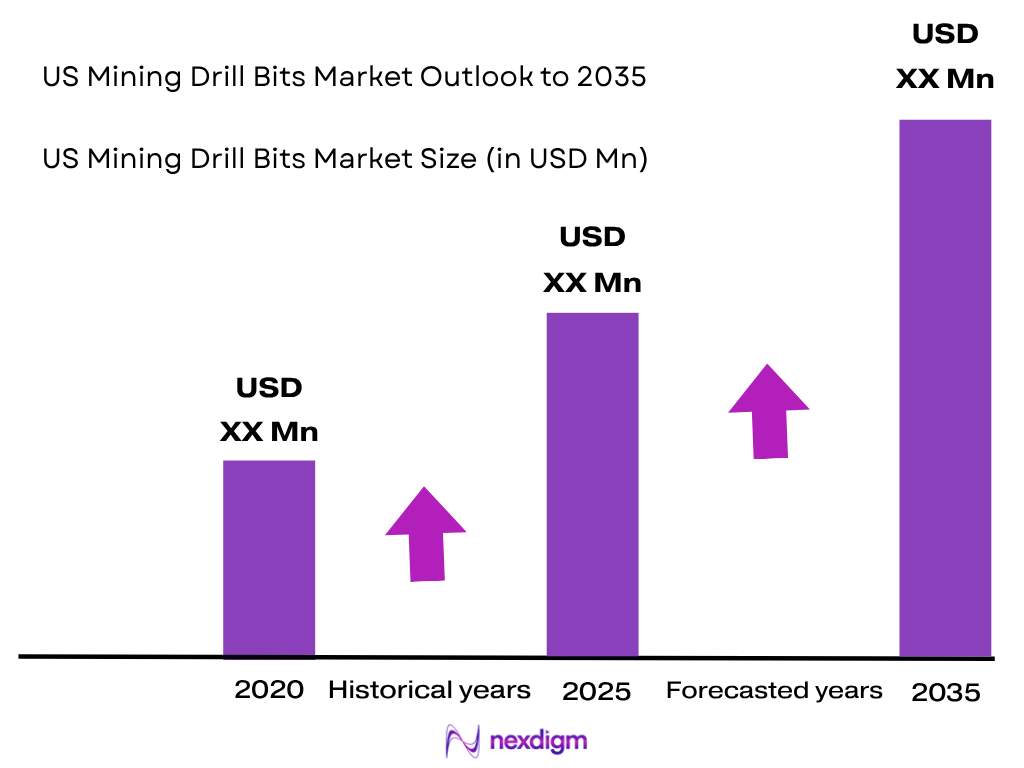
Over the forecast period, the US Mining Drill Bits Market is expected to be influenced by continued mineral extraction, critical-mineral exploration, mine modernization, drilling automation, and demand for higher drilling productivity. USGS reported that 12 of the 50 critical minerals were subject to 100% import reliance in its 2024 assessment, while another 28 critical mineral commodities had import reliance exceeding 50%. USGS also distributed more than USD 57 million through the Earth Mapping Resources Initiative across 39 states for geoscience data collection and mapping. These activities support exploration intensity and create opportunities for specialized drill bits designed for variable geology, deeper targets, and hard-rock formations.
Automation is another important direction. Mining operators are increasingly connecting drill rigs with fleet-management, positioning, remote-operation, and production-monitoring systems. This increases the importance of drill bits that deliver consistent penetration characteristics and predictable wear behavior. Demand is also expected to become more application-specific, with manufacturers developing bit configurations according to rock hardness, abrasiveness, hole diameter, drilling method, and required penetration performance.
Major Players
- Sandvik Mining and Rock Solutions
- Epiroc
- Boart Longyear
- Caterpillar
- Komatsu
- Mincon Group
- Rockmore International
- Brunner & Lay
- Center Rock
- Numa
- Western Drilling Tools
- Drill King International
- Varel Energy Solutions
- Kymera International
- Mitsubishi Materials
Key Target Audience
- Mining Equipment Manufacturers and Drill-Rig OEMs
- Large Mining Companies and Mine Operators
- Mineral Exploration and Drilling Contractors
- Mining Equipment Distributors and Aftermarket Service Providers
- Investments and Venture Capitalist Firms
- Government and Regulatory Bodies (Mine Safety and Health Administration, U.S. Geological Survey, Bureau of Land Management)
- Critical Mineral Development and Processing Companies
- Quarrying, Aggregates and Industrial Mineral Producers
Research Methodology
Step 1: Identification of Key Variables
The initial phase establishes the US Mining Drill Bits Market ecosystem covering drill-bit manufacturers, drill-rig OEMs, mining operators, exploration contractors, distributors, material suppliers, and aftermarket service providers. Variables include bit type, cutting material, diameter, drilling method, mine type, mineral application, replacement cycle, penetration performance, and meters drilled. USGS, EIA, BLS, and regulatory datasets are mapped against market-specific demand indicators.
Step 2: Market Analysis and Construction
Historical market information is structured through a top-down assessment of US mining activity and a bottom-up assessment of drill-bit consumption across surface mining, underground mining, exploration, quarrying, and mineral-specific applications. Production volumes, mine counts, drilling requirements, equipment utilization, bit replacement patterns, and application-specific consumption are evaluated. Segment-level calculations are reconciled against aggregate market values.
Step 3: Hypothesis Validation and Expert Consultation
Market hypotheses are validated through discussions with mining operators, drilling contractors, drill-rig manufacturers, distributors, rock-tool specialists, and technical personnel. Interviews focus on bit selection criteria, drilling conditions, penetration performance, wear mechanisms, replacement intervals, automation adoption, and procurement practices. Qualitative inputs are used to challenge assumptions and identify differences between commodity and geological applications.
Step 4: Research Synthesis and Final Output
The final stage triangulates primary findings with government production statistics, mining activity indicators, company disclosures, technical documentation, and industry data. Bottom-up consumption estimates are compared with top-down market calculations to identify inconsistencies. The resulting framework provides market segmentation, competitive benchmarking, growth-driver analysis, challenge assessment, opportunity mapping, and the forecast model for the US Mining Drill Bits Market.

- Executive Summary
- Research Methodology (Market Definition and Scope, US Mining Drill Bits Market Classification, Drill Bit Technology Mapping, Rotary Drill Bit Assessment, Tricone Bit Evaluation, Roller Cone Bit Analysis, Fixed Cutter Bit Assessment, Polycrystalline Diamond Compact (PDC) Bit Evaluation, Down-the-Hole (DTH) Hammer Bit Assessment, Top-Hammer Bit Analysis, Button Bit Evaluation, Drag Bit Assessment, Diamond Core Bit Evaluation, Tungsten Carbide Cutting Structure Assessment, Diamond Cutting Technology Evaluation, Bit Body Material Analysis, Bearing and Seal Technology Assessment, Drill String Compatibility Evaluation, Drilling Performance Assessment, Penetration Rate Analysis, Bit Life and Wear Analysis, Cost-per-Meter Evaluation, Surface Mining Drilling Assessment, Underground Mining Drilling Assessment, Mineral-Specific Drilling Requirement Mapping, Supply-Side Assessment, Demand-Side Assessment, Primary Industry Interviews, Data Triangulation, Forecasting Framework)

- Definition and Scope
- US Mining Drill Bits Industry Evolution and Development of Rotary Drilling Technology, Down-the-Hole Drilling Adoption, Top-Hammer Drilling Development, Open-Pit Mining Expansion, Underground Mining Technology Advancement, Mineral Exploration Drilling Development, Hard-Rock Drilling Applications, Automated Drilling Systems, Digital Drill Monitoring, Autonomous Mining Equipment Integration and Advanced Rock Tool Development
- Mining Drill Bits Value Chain Analysis
- Mining Drill Bits Supply Chain Analysis
- Tungsten Carbide Suppliers, Synthetic Diamond Suppliers, Steel and Alloy Producers, Cutting Element Manufacturers, Bearing and Seal Suppliers, Drill Bit Manufacturers, Rock Tool Manufacturers, Drill Rig OEMs, Mining Equipment Distributors, Drilling Contractors, Mineral Exploration Companies, Open-Pit Mining Operators, Underground Mining Operators, Aggregates and Quarrying Companies, Copper and Gold Mining Companies, Iron Ore Producers, Coal Mining Companies and Industrial End Users

- Growth Drivers (Expansion of Critical Mineral Exploration, Increasing Mine Automation, Rising Drilling Intensity in Open-Pit Mining, Growth of Copper and Battery-Mineral Development, Increasing Demand for High-Penetration Drill Bits, Expansion of Underground Mining Technology, Adoption of Digital Drill Monitoring, Demand for Longer Bit Life and Higher Meters-per-Bit)
- Market Challenges (High Wear Rates in Hard-Rock Formations, Volatility in Mining Capital Expenditure, High Tungsten and Diamond Material Dependency, Complex Geology and Variable Rock Hardness, Drill Bit Failure and Unplanned Downtime, Skilled Drilling Workforce Requirements, Equipment-Bit Compatibility Constraints, Supply Chain Exposure for Specialized Components)
- Market Opportunities (Critical Mineral Exploration, High-Performance PDC and Diamond Cutting Structures, Autonomous Drilling Integration, Digital Bit Performance Monitoring, Predictive Bit Replacement Systems, Advanced Tungsten Carbide Formulations, High-Durability DTH Bit Development, Mine-Specific Bit Design Optimization, Electrification of Mining Equipment and Expansion of Deep Underground Mining)
- Market Trends (Increasing Automation of Blast-Hole Drilling, Growth of Autonomous Drill Rigs, Development of High-Durability Cutting Structures, Increasing Adoption of DTH Technology, Digital Monitoring of Bit Performance, Data-Driven Bit Selection, Demand for Higher Penetration Rates, Development of Single-Seal Rotary Bits, Increased Focus on Cost per Meter, Custom-Engineered Drill Bits and Sustainable Rock Tool Manufacturing)
- Government Regulations and Standards (Mine Safety and Health Administration Requirements, Mine Safety and Health Administration Drilling and Blasting Requirements, Occupational Safety and Health Administration Requirements, Bureau of Land Management Mining Requirements, U.S. Forest Service Mining Regulations, Environmental Protection Agency Mining Requirements)
- Porter’s Five Forces Analysis
- PESTLE Analysis
- Stakeholder Ecosystem
- Competition Ecosystem

- By Market Value (2020-2025)
- By Drill Bit Consumption Volume (2020-2025)
- By Average Selling Price (2020-2025)
- By Rotary Drill Bit Consumption Volume (2020-2025)
- By DTH Hammer Bit Consumption Volume (2020-2025)
- By Top-Hammer Bit Consumption Volume (2020-2025)
- By PDC Drill Bit Consumption Volume (2020-2025)
- By Tungsten Carbide Drill Bit Consumption Volume (2020-2025)
- By Diamond Core Bit Consumption Volume (2020-2025)
- By Surface Mining Drill Bit Consumption Volume (2020-2025)
- By Underground Mining Drill Bit Consumption Volume (2020-2025)
- By Mineral Exploration Drill Bit Consumption Volume (2020-2025)

- By Drill Bit Type (In Value %)
Rotary Drill Bits
Tricone Drill Bits
Roller Cone Drill Bits
Fixed Cutter Drill Bits
PDC Drill Bits
DTH Hammer Bits
Top-Hammer Bits
Button Bits
Drag Bits
Diamond Core Bits
Specialty Mining Drill Bits - By Material Type (In Value %)
Tungsten Carbide
Polycrystalline Diamond Compact (PDC)
Synthetic Diamond
Natural Diamond
Hardened Steel
Alloy Steel
Carbide-Enhanced Cutting Structures
Diamond-Impregnated Materials
Composite Cutting Materials - By Bit Size (In Value %)
Below 5 Inches
5–8 Inches
8–11 Inches
11–14 Inches
Above 14 Inches
Large-Diameter Production Bits
Specialty Exploration Bit Sizes - By Mining Application (In Value %)
Surface Mining
Underground Mining
Mineral Exploration
Blast-Hole Drilling
Production Drilling
Grade-Control Drilling
Geotechnical and Mine Development Drilling
Quarrying and Aggregates Drilling
Pre-Split and Controlled Blasting Drilling - By Mineral and Resource Type (In Value %)
Coal Mining
Copper Mining
Gold Mining
Iron Ore Mining
Lithium and Battery Minerals
Rare Earth Minerals
Uranium Mining
Zinc and Lead Mining
Nickel Mining
Industrial Minerals
Aggregates and Quarry Materials - By Drilling Technology (In Value %)
Rotary Drilling
Rotary-Percussive Drilling
Down-the-Hole Drilling
Top-Hammer Drilling
Reverse Circulation Drilling
Diamond Core Drilling
Automated Drilling
Autonomous Drilling Systems - By End-User Type (In Value %)
Large Mining Companies
Mid-Sized Mining Operators
Junior Mining and Exploration Companies
Mining Contractors
Drilling Contractors
Quarry Operators
Aggregates Producers
Government-Owned Mining Enterprises
Mineral Exploration Contractors - By Region (In Value %)
Western United States
Southwestern United States
Southern United States
Midwestern United States
Northern United States
Alaska
Mountain West
Appalachian Mining Region

- Market Share of Major Players (By US Revenue, Drill Bit Product Portfolio, Rotary Bit Portfolio, DTH Bit Portfolio, Top-Hammer Bit Coverage, PDC Technology Capability, Tungsten Carbide Technology Coverage, Diamond Drilling Capability, Bit Size Range, Mining Application Coverage, Mineral Application Coverage, Production Capacity, Distribution Network Coverage, Technical Service Network, Mining Customer Base, R&D Capability, Product Innovation Pipeline, Regional Presence and Aftermarket Support Capability)
- Cross Comparison Parameters (Drill Bit Portfolio Breadth, Rotary and Tricone Bit Manufacturing Capability, DTH and Top-Hammer Technology Coverage, PDC and Diamond Cutting Technology Expertise, Tungsten Carbide Cutting Structure Capability, Bit Size and Configuration Range, Mining Application and Mineral Coverage, US Technical Service and Distribution Network Reach)
- SWOT Analysis of Major Players
- Competitive Positioning Matrix
- Mining Drill Bit Product and Technology Benchmarking
- Rotary and Tricone Drill Bit Performance Assessment
- DTH and Top-Hammer Bit Technology Assessment
- PDC and Diamond Cutting Structure Innovation Assessment
- Bit Wear, Penetration and Meters-per-Bit Performance Assessment
- Mining Automation and Drill Bit Digitalization Assessment
- Detailed Profiles of Major Companies
Sandvik Mining and Rock Solutions
Epiroc USA
Boart Longyear Corporation
Caterpillar Inc.
Komatsu Ltd.
Varel Energy Solutions
Kymera International
Drillco Mining and Exploration
Mincon Group plc
Rockmore International Inc.
Drill King International Inc.
Western Drilling Tools Inc.
Center Rock Inc.
Brunner & Lay Inc.
Numa Inc.

- Open-Pit Mining Drill Bit Requirement Assessment
- Underground Mining Drill Bit Demand Analysis
- Mineral Exploration Drilling Requirement Assessment
- Copper and Gold Mining Drilling Assessment
- Coal Mining Drill Bit Requirement Analysis
- Critical Mineral Exploration Demand Assessment
- Mining Contractor Procurement Assessment
- Drilling Contractor Bit Selection Analysis
- Quarry and Aggregates Drilling Requirement Assessment
- Blast-Hole Drilling Performance Assessment
- Automated Drill Rig Compatibility Assessment
- Drill Bit Replacement Cycle Analysis
- Meters-per-Bit Performance Assessment
- Cost-per-Meter Procurement Evaluation
- Drill Bit Technical Specification Preference Assessment

- By Market Value (2026-2035)
- By Drill Bit Consumption Volume (2026-2035)
- By Average Selling Price (2026-2035)
- By Rotary Drill Bit Consumption Volume (2026-2035)
- By DTH Hammer Bit Consumption Volume (2026-2035)
- By Top-Hammer Bit Consumption Volume (2026-2035)
- By PDC Drill Bit Consumption Volume (2026-2035)
- By Tungsten Carbide Drill Bit Consumption Volume (2026-2035)
- By Diamond Core Bit Consumption Volume (2026-2035)
- By Surface Mining Drill Bit Consumption Volume (2026-2035)
- By Underground Mining Drill Bit Consumption Volume (2026-2035)
- By Mineral Exploration Drill Bit Consumption Volume (2026-2035)


 Request a Sample
 Ask for Customization
 Get a Quote
 Enquire Now