

 Download PDF
Market Overview
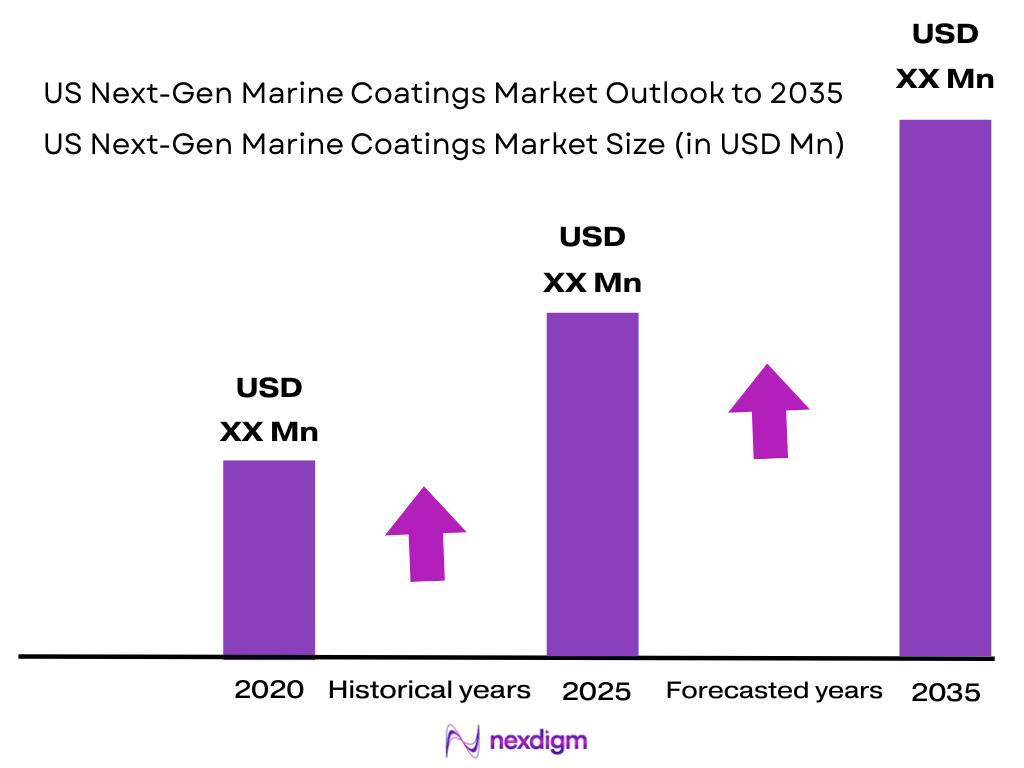
The US Next-Gen Marine Coatings Market is valued at ~USD 1.85 billion in 2024 and is projected to grow at a CAGR of ~7.4% during 2026-2035. The market includes advanced marine coating technologies such as bio-based antifouling coatings, self-healing coatings, low-friction hull coatings, nanotechnology-based coatings and smart functional protection systems. Demand is supported by US naval fleet modernization, commercial vessel maintenance, offshore energy development and increasing environmental requirements for low-emission marine operations. The broader marine coatings market was valued at approximately USD 6.3 billion globally in 2024, supported by ship maintenance demand, environmental regulations and adoption of advanced protective coating systems. The US market is expected to experience increasing adoption of next-generation solutions due to the need for improved fuel efficiency, corrosion protection and reduced environmental impact.
The US Next-Gen Marine Coatings Market is concentrated across major maritime regions including California, Texas, Florida, Virginia, Washington and Louisiana due to their extensive shipbuilding, naval, offshore energy and port infrastructure activities. The Gulf Coast region represents a major demand center because of offshore energy operations, ship repair facilities and industrial marine assets. Virginia benefits from naval shipbuilding and maintenance activities associated with major defense facilities, while California and Washington support commercial shipping, naval operations and Pacific maritime trade. The United States maintains one of the world’s largest maritime transportation and defense ecosystems, creating demand for advanced coatings used in vessels, offshore structures, ports and marine equipment. Growth is further supported by environmental compliance requirements encouraging adoption of low-VOC, antifouling and fuel-efficiency-enhancing coating technologies.
Market Segmentation
By Coating Technology Type
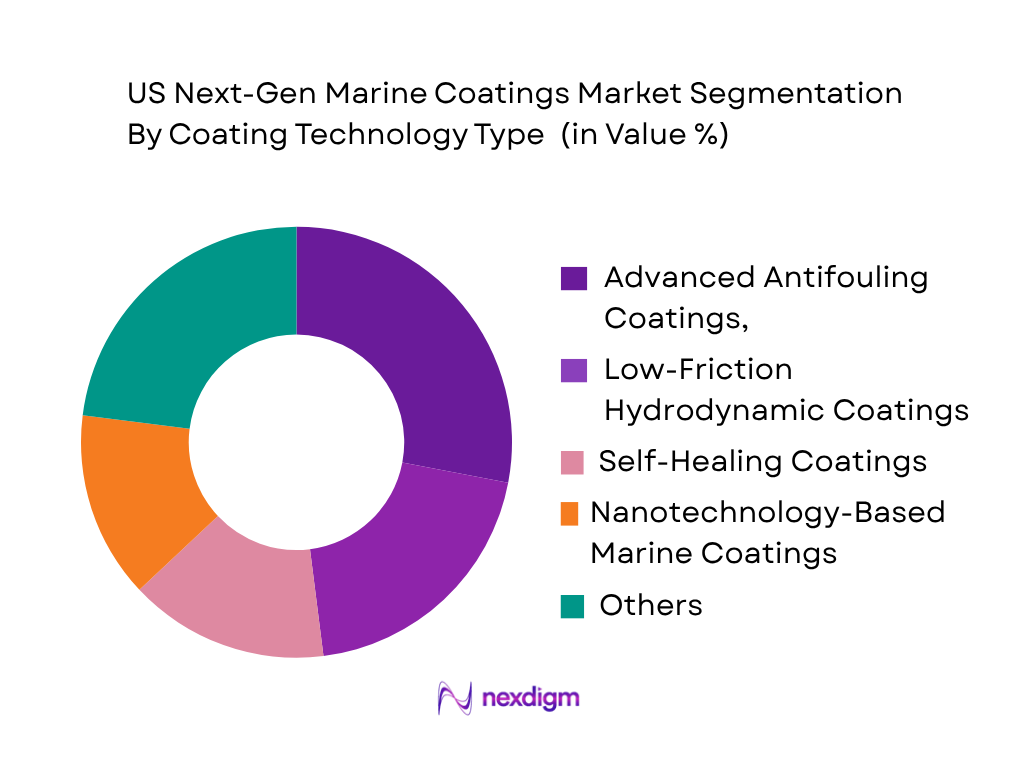
The US Next-Gen Marine Coatings Market is segmented by coating technology type into advanced antifouling coatings, low-friction hydrodynamic coatings, self-healing coatings, nanotechnology-based coatings, smart functional coatings and bio-based coatings. Advanced antifouling coatings dominate this segment with approximately 28% market share in 2024 due to their critical role in preventing marine organism attachment, reducing hull drag and improving vessel operating efficiency. Commercial shipping operators, naval organizations and offshore asset owners increasingly require antifouling technologies to reduce maintenance requirements and improve fuel performance. The adoption of next-generation antifouling systems is also influenced by environmental regulations limiting harmful biocidal substances and encouraging safer alternatives. Silicone-based foul-release coatings, advanced polymer systems and environmentally compliant antifouling technologies are gaining traction among ship operators seeking longer service intervals.
By Resin Chemistry
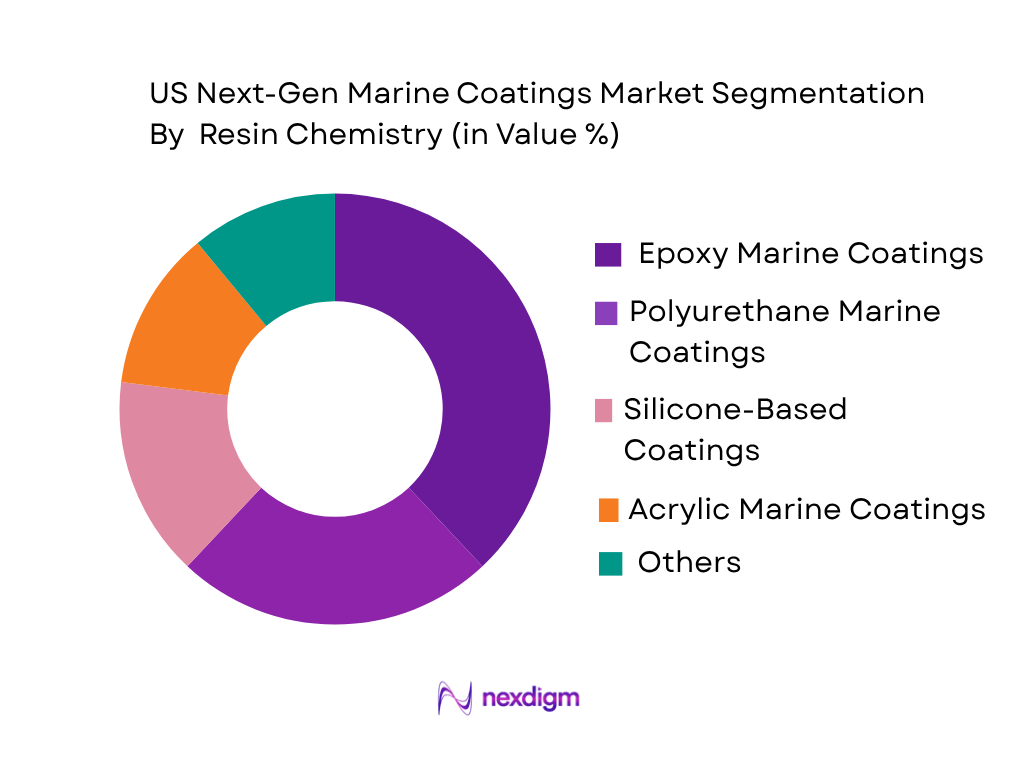
The US Next-Gen Marine Coatings Market is segmented by resin chemistry into epoxy, polyurethane, silicone-based, acrylic, fluoropolymer and hybrid resin systems. Epoxy marine coatings hold the largest share at approximately 38% in 2024 due to their superior adhesion, chemical resistance, mechanical strength and corrosion protection capabilities. Epoxy systems remain essential for naval vessels, commercial ships, offshore platforms and marine infrastructure where long-term protection against seawater exposure is required. The technology is widely used for ballast tanks, hull structures, decks and industrial marine equipment because of its durability under harsh operating conditions. Increasing investment in vessel maintenance and repair activities supports continued demand for epoxy-based systems. Advanced epoxy formulations are also evolving through improved curing technologies, enhanced barrier performance and compatibility with environmentally compliant topcoats.
Competitive Landscape
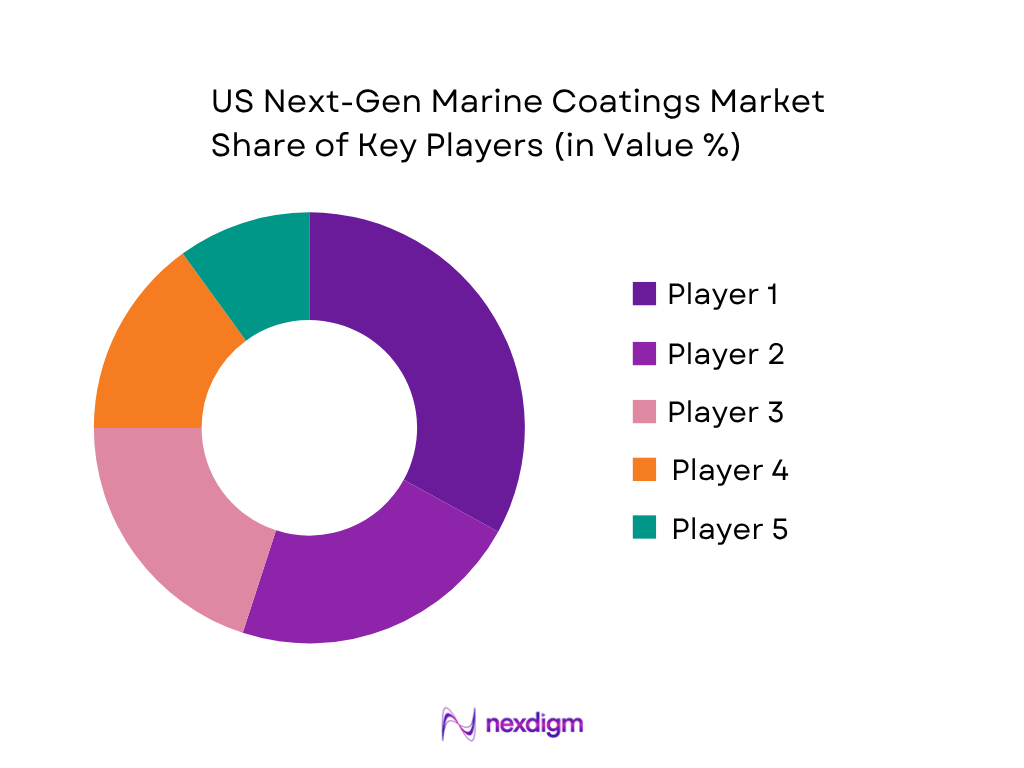
The US Next-Gen Marine Coatings Market is characterized by the presence of global coatings manufacturers, specialized marine coating suppliers and technology-focused innovators developing advanced antifouling, corrosion-resistant, low-friction and environmentally compliant coating solutions. Major companies compete through product innovation, naval and commercial vessel approvals, global distribution networks, sustainability-focused formulations and partnerships with shipbuilders and marine operators. Leading participants include AkzoNobel, PPG Industries, Jotun, Hempel, Sherwin-Williams, Nippon Paint Marine and Chugoku Marine Paints, which maintain strong positions due to extensive marine coating portfolios and advanced R&D capabilities.
| Company | Establishment Year | Headquarters | Key Marine Coating Portfolio | Next-Gen Technology Focus | Major End Users | Geographic Strength | Sustainability Initiatives | Strategic Advantage |
| PPG Industries | 1883 | Pittsburgh, Pennsylvania, USA | ~ | ~ | ~ | ~ | ~ | ~ |
| AkzoNobel | 1792 | Amsterdam, Netherlands | ~ | ~ | ~ | ~ | ~ | ~ |
| Jotun | 1926 | Sandefjord, Norway | ~ | ~ | ~ | ~ | ~ | ~ |
| Hempel | 1915 | Lyngby, Denmark | ~ | ~ | ~ | ~ | ~ | ~ |
| The Sherwin-Williams Company | 1866 | Cleveland, Ohio, USA | ~ | ~ | ~ | ~ | ~ | ~ |
US Next-Gen Marine Coatings Market Analysis
Growth Drivers
US Naval Fleet Modernization and Commercial Vessel Maintenance Demand
The US Next-Gen Marine Coatings Market is strongly supported by naval fleet modernization programs and continuous maintenance requirements for commercial vessels operating in corrosive marine environments. The United States Navy operates approximately 296 deployable battle force ships, creating continuous demand for advanced corrosion protection, stealth coatings and high-performance surface technologies. The US Department of Defense allocated approximately USD 849 billion for national defense activities in fiscal spending, supporting naval modernization, shipbuilding and maintenance programs. In addition, the US commercial maritime sector handles significant cargo movement through coastal ports, requiring regular vessel maintenance and protective coating applications. The US Bureau of Transportation Statistics reported that the US marine transportation system supports the movement of billions of tons of domestic and international cargo annually through more than 300 coastal and inland ports. These operational requirements increase demand for next-generation epoxy coatings, antifouling systems, corrosion barriers and low-maintenance marine coating technologies. Growing ship repair activities, fleet life extension programs and increasing requirements for longer service intervals are accelerating adoption of advanced marine coatings across naval, commercial and offshore applications.
Maritime Decarbonization Initiatives and Fuel Efficiency Requirements
The transition toward lower-emission maritime operations is creating demand for advanced marine coatings designed to improve vessel efficiency and reduce fuel consumption. International maritime regulations and US environmental initiatives are encouraging ship operators to adopt technologies that reduce operational emissions. The International Maritime Organization has established carbon intensity reduction requirements for global shipping, increasing focus on solutions such as low-friction hull coatings, silicone foul-release systems and advanced antifouling technologies. The US Energy Information Administration reported that transportation activities remain one of the largest contributors to petroleum consumption, with marine transportation requiring continuous efficiency improvements. Advanced hull coatings reduce underwater resistance by minimizing marine organism attachment and surface friction, supporting lower fuel consumption during vessel operation. The expansion of sustainability-focused maritime investments is also supported by US renewable energy development, including offshore wind projects requiring specialized marine protection systems. According to the US Department of Energy, offshore wind leasing activities have expanded across multiple coastal regions, increasing demand for durable coatings capable of protecting marine structures against corrosion, saltwater exposure and extreme weather conditions.
Market Challenges
High Technology Development Costs and Complex Marine Testing Procedures
The US Next-Gen Marine Coatings Market faces challenges due to high research requirements, extensive testing procedures and long qualification cycles associated with advanced coating technologies. Marine environments expose coatings to continuous saltwater corrosion, temperature variation, UV radiation and mechanical abrasion, requiring extensive performance validation before commercial adoption. The US National Oceanic and Atmospheric Administration reported that US coastal regions experience significant exposure to changing ocean conditions, including temperature fluctuations and corrosive marine environments, increasing the technical requirements for protective coating systems. Development of self-healing coatings, smart marine coatings and bio-based antifouling technologies requires advanced material science capabilities and specialized testing infrastructure. Naval applications require additional qualification procedures due to strict durability, safety and performance requirements. The US Department of Defense operates extensive procurement and testing standards for military equipment, creating longer approval timelines for advanced marine technologies. These factors increase development complexity for coating manufacturers and slow the adoption of emerging technologies compared with conventional marine coating systems.
Raw Material Supply Constraints and Skilled Application Requirements
The US Next-Gen Marine Coatings Market experiences challenges related to specialty chemical availability, advanced resin dependency and requirements for highly skilled coating application professionals. Modern marine coatings increasingly require specialized materials including high-performance polymers, fluorinated compounds, silicone technologies and advanced additives. The US chemical manufacturing sector depends on complex global supply chains for several specialty chemical inputs, creating exposure to supply disruptions and logistics constraints. According to the US Census Bureau, the chemical manufacturing sector represents a significant component of domestic industrial activity, but specialized material production remains concentrated among limited suppliers. Marine coating application also requires trained professionals capable of achieving precise surface preparation, thickness control and environmental compliance. The Occupational Safety and Health Administration maintains strict requirements for industrial coating operations due to exposure risks associated with solvents, chemicals and confined marine environments. Shipyard labor availability remains a challenge as advanced coating systems require specialized technical expertise, increasing project complexity and extending maintenance timelines for commercial vessels, naval assets and offshore structures.
Market Opportunities
AI-Enabled Smart Marine Coatings and Autonomous Vessel Protection Systems
The US Next-Gen Marine Coatings Market is expected to benefit from increasing adoption of digital technologies, artificial intelligence and smart monitoring systems integrated with marine protection solutions. Smart coatings capable of monitoring corrosion progression, surface degradation and environmental exposure are gaining attention among vessel operators seeking predictive maintenance capabilities. The US maritime sector is undergoing digital transformation, supported by increasing automation across ports, shipping operations and vessel management systems. The US Department of Transportation has invested in improving maritime technology infrastructure through initiatives supporting advanced transportation systems. Autonomous vessel development is also creating demand for protective technologies capable of reducing maintenance requirements without frequent human intervention. The US Maritime Administration has highlighted the importance of technology modernization within the maritime transportation system to improve efficiency and reliability. AI-enabled marine coatings combined with sensor technologies can support real-time asset monitoring, optimized maintenance scheduling and improved vessel lifecycle management. These developments create opportunities for coating manufacturers to develop multifunctional solutions integrating corrosion protection, performance monitoring and operational intelligence.
Bio-Based Antifouling Technologies and Fuel-Saving Low-Friction Coatings
The increasing focus on environmental compliance and maritime efficiency is creating opportunities for bio-based antifouling technologies, low-friction coatings and carbon reduction solutions within the US Next-Gen Marine Coatings Market. Traditional antifouling coatings containing harmful substances face increasing regulatory scrutiny, encouraging development of environmentally safer alternatives. The US Environmental Protection Agency regulates marine coating chemicals and supports reduced environmental impact from industrial applications. Growing demand for fuel efficiency is also increasing interest in advanced hull coatings that reduce drag and improve vessel performance. The US Energy Information Administration reported continued importance of petroleum efficiency improvements across transportation sectors, including marine operations. Offshore renewable energy development further expands opportunities for specialized coatings, as offshore wind structures require long-lasting protection against seawater corrosion and biological growth. The US Department of Energy reported continued expansion of offshore wind deployment initiatives along US coastal areas, increasing demand for durable marine protection systems. These trends support future adoption of sustainable antifouling coatings, thermal barrier technologies and advanced protective surfaces designed for commercial vessels, naval assets and offshore infrastructure.
Future Outlook
The US Next-Gen Marine Coatings Market is expected to experience significant technological transformation driven by stricter environmental regulations, maritime decarbonization initiatives and increasing demand for fuel-efficient vessel operations. Future growth will be supported by adoption of advanced antifouling systems, smart monitoring-enabled coatings, bio-based formulations and low-VOC protective technologies. Increasing investments in naval modernization, offshore renewable energy infrastructure and commercial fleet maintenance will continue creating opportunities for high-performance marine coating suppliers. The market is expected to shift from conventional protective coatings toward multifunctional solutions combining corrosion resistance, environmental compliance and operational efficiency.
Major Players
- PPG Industries
- AkzoNobel
- Jotun
- Hempel
- The Sherwin-Williams Company
- Nippon Paint Holdings
- Chugoku Marine Paints
- Kansai Paint
- Axalta Coating Systems
- BASF
- KCC Corporation
- RPM International
- Carboline Company
- Teknos Group
- Tnemec Company
Key Target Audience
- Marine coating manufacturers and technology developers
- Shipbuilding companies and naval shipyards
- Commercial shipping operators and fleet management companies
- Offshore oil, gas and renewable energy operators
- Port authorities and marine infrastructure developers
- Investments and venture capitalist firms (maritime technology funds, industrial technology investors)
- Government and regulatory bodies (United States Coast Guard, Environmental Protection Agency, Maritime Administration, Department of Defense)
- Marine equipment suppliers and maintenance service providers
Research Methodology
Step 1: Identification of Key Variables
The research process begins with defining the US Next-Gen Marine Coatings ecosystem, including coating manufacturers, shipbuilders, vessel operators, offshore asset owners, regulatory agencies and technology providers. Secondary research is conducted using marine industry databases, regulatory publications, trade statistics and technical documents to identify major market variables such as coating technologies, resin systems, applications and demand drivers.
Step 2: Market Analysis and Construction
Historical market information is analyzed through assessment of vessel fleets, shipbuilding activities, marine repair cycles, offshore infrastructure development and coating technology adoption. The analysis incorporates demand-side and supply-side factors including coating consumption patterns, application requirements, regulatory compliance needs and technological developments.
Step 3: Hypothesis Validation and Expert Consultation
Market assumptions are validated through discussions with industry professionals including coating manufacturers, marine engineers, shipyard specialists and vessel operators. Expert inputs help evaluate technology adoption trends, competitive positioning, application challenges and future demand opportunities within marine coating segments.
Step 4: Research Synthesis and Final Output
The final research output integrates quantitative analysis, industry validation and competitive intelligence. Data from manufacturers, marine operators and regulatory sources is consolidated to provide insights into market segmentation, competitive landscape, growth opportunities and future technology trends.

- Executive Summary
- Research Methodology (Market Definition and Scope, Next-Generation Marine Coatings Classification, Technology Mapping, Market Sizing Framework, Top-Down Analysis, Bottom-Up Analysis, Supply-Side Assessment, Demand-Side Assessment, Primary Interviews with Marine Coating Manufacturers and Shipbuilders, Industry Data Validation, Forecasting Methodology, Data Triangulation, Research Limitations)

- Definition and Scope
- Evolution of Marine Coatings Industry
- Transition from Conventional Marine Coatings to Next-Generation Coating Technologies
- Marine Coatings Value Chain Analysis
- Marine Coatings Supply Chain Analysis
- Marine Asset Protection Ecosystem

- Growth Drivers (US Naval Fleet Modernization, Commercial Vessel Maintenance Demand, Maritime Decarbonization Initiatives, Fuel Efficiency Requirements, Offshore Wind Expansion, Shipbuilding Industry Recovery, Port Infrastructure Modernization, Anti-Biofouling Regulations)
- Market Challenges (High Technology Development Costs, Regulatory Approval Requirements, Complex Marine Testing Procedures, Limited Adoption of Novel Coating Technologies, Raw Material Supply Constraints, Skilled Application Requirements, Long Qualification Cycles, Performance Validation Challenges)
- Market Opportunities (AI-Enabled Smart Marine Coatings, Bio-Based Antifouling Technologies, Fuel-Saving Low-Friction Coatings, Autonomous Vessel Protection Systems, Offshore Wind Turbine Coatings, Naval Advanced Protection Systems, Carbon Reduction Coating Solutions, Self-Healing Marine Surfaces)
- Market Trends (Environmentally Friendly Antifouling Systems, PFAS-Free Marine Coatings, Nanotechnology Integration, Low-VOC Coating Adoption, Digital Monitoring Coatings, Autonomous Maintenance Technologies, Lightweight Performance Coatings, Sustainable Marine Materials)
- Government Regulations (Environmental Protection Agency Marine Coating Regulations, IMO Biofouling Guidelines, VOC Emission Standards, Antifouling Paint Restrictions, US Navy Coating Specifications, Offshore Wind Environmental Standards)
- SWOT Analysis
- Porter’s Five Forces Analysis
- PESTLE Analysis

- By Market Value (2020-2025)
- By Coating Volume Consumption (2020-2025)
- By Vessel Application Demand (2020-2025)
- By Average Selling Price Analysis (2020-2025)
- By Technology Adoption Level (2020-2025)

- By Coating Technology Type (In Value %)
Antifouling Coatings
Self-Healing Coatings
Low-Friction and Hydrodynamic Efficiency Coatings
Nanotechnology-Based Marine Coatings
Smart Functional Coatings
Bio-Based Marine Coatings
Ice-Resistant Marine Coatings
Thermal Barrier Marine Coatings - By Resin Chemistry (In Value %)
Epoxy Marine Coatings
Polyurethane Marine Coatings
Acrylic Marine Coatings
Silicone-Based Marine Coatings
Fluoropolymer Marine Coatings
Hybrid Resin Systems - By Application Area (In Value %)
Hull Protection Coatings
Underwater Ship Coatings
Deck and Superstructure Coatings
Ballast Tank Coatings
Cargo Tank Coatings
Engine Room Protective Coatings
Offshore Platform Protective Coatings - By Vessel Type (In Value %)
Commercial Shipping Vessels
Naval and Defense Vessels
Offshore Support Vessels
Cruise and Passenger Ships
Recreational Boats
Fishing and Workboats - By End User (In Value %)
Shipbuilding Companies
Naval Defense Organizations
Commercial Fleet Operators
Offshore Energy Companies
Port and Marine Infrastructure Operators
Boat Manufacturers - By Application Technology (In Value %)
Spray Application
Brush and Roller Application
Electrochemical Coating Systems
Automated Robotic Coating Application
Immersion Coating Technology

- Market Positioning of Major Players (By Technology Portfolio, Application Segment, Vessel Type, Distribution Network)
- Cross Comparison Parameters (Next-Generation Coating Technology Portfolio, Antifouling Technology Capability, Smart Coating Development Capability, Marine Certification Portfolio, Naval Defense Application Experience, Shipyard Partnership Network, Sustainability and Low-VOC Product Portfolio, R&D Investment Capability)
- SWOT Analysis of Major Players
- Detailed Profiles of Major Companies
Jotun
Akzo Nobel
PPG Industries
The Sherwin-Williams Company
Hempel
Kansai Paint Marine Coatings
Chugoku Marine Paints
Nippon Paint Marine Coatings
RPM International
Axalta Coating Systems
Advanced Technology and Specialty Coating Companies
Eagle Specialty Coatings
AquaGuard Coatings
Nanovere Technologies
NEI Corporation
BioSpan Technologies

- Commercial Shipping Industry Analysis
- Naval Defense Sector Analysis
- Offshore Energy Sector Analysis
- Shipbuilding Industry Analysis
- Recreational Marine Industry Analysis

- By Market Value (2026-2035)
- By Coating Volume Consumption ((2026-2035)
- By Vessel Application Demand (2026-2035)
- By Average Selling Price Analysis (2026-2035)
- By Technology Adoption Level (2026-2035)


 Request a Sample
 Ask for Customization
 Get a Quote
 Enquire Now