
 Download PDF
Market Overview
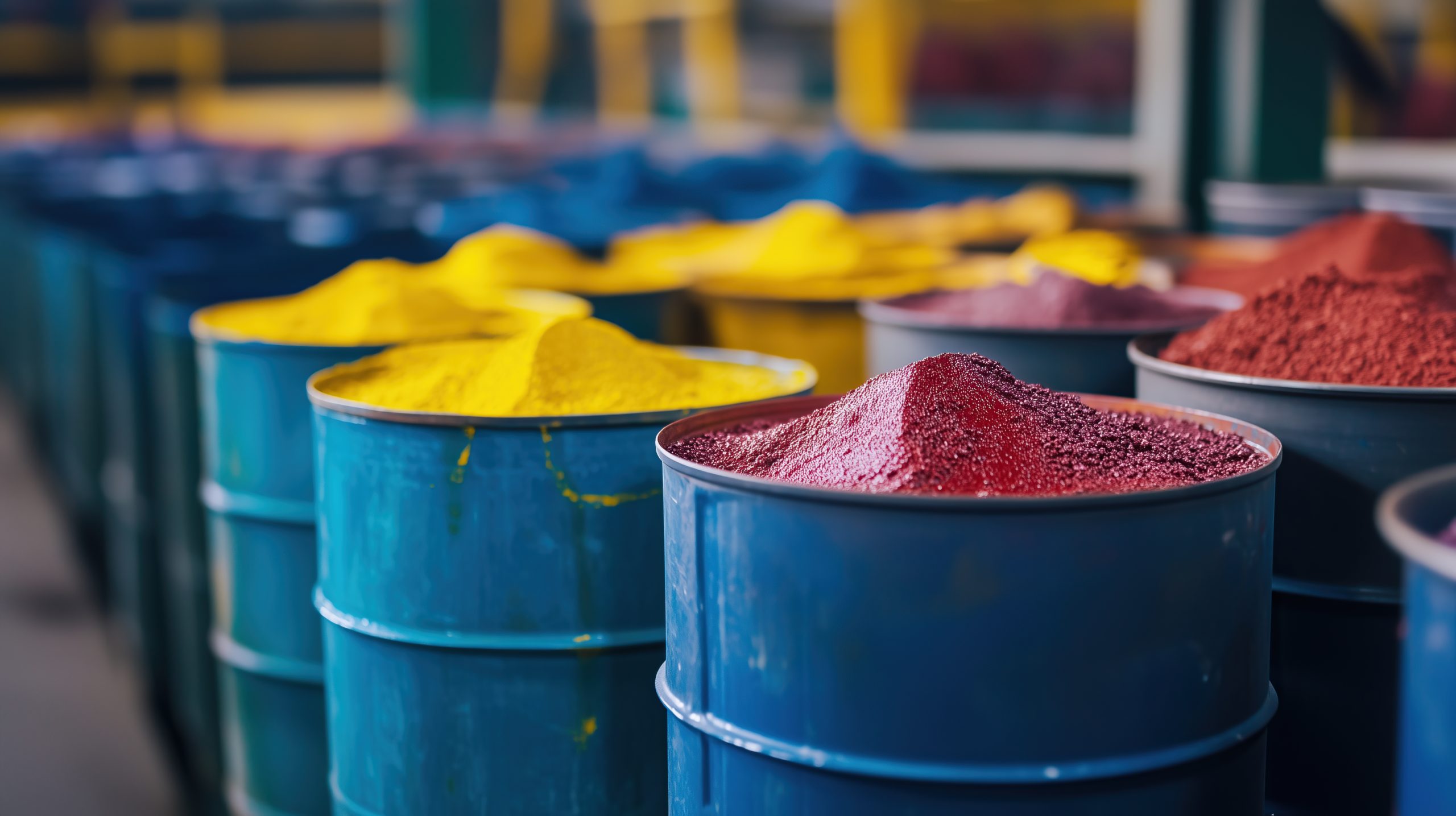
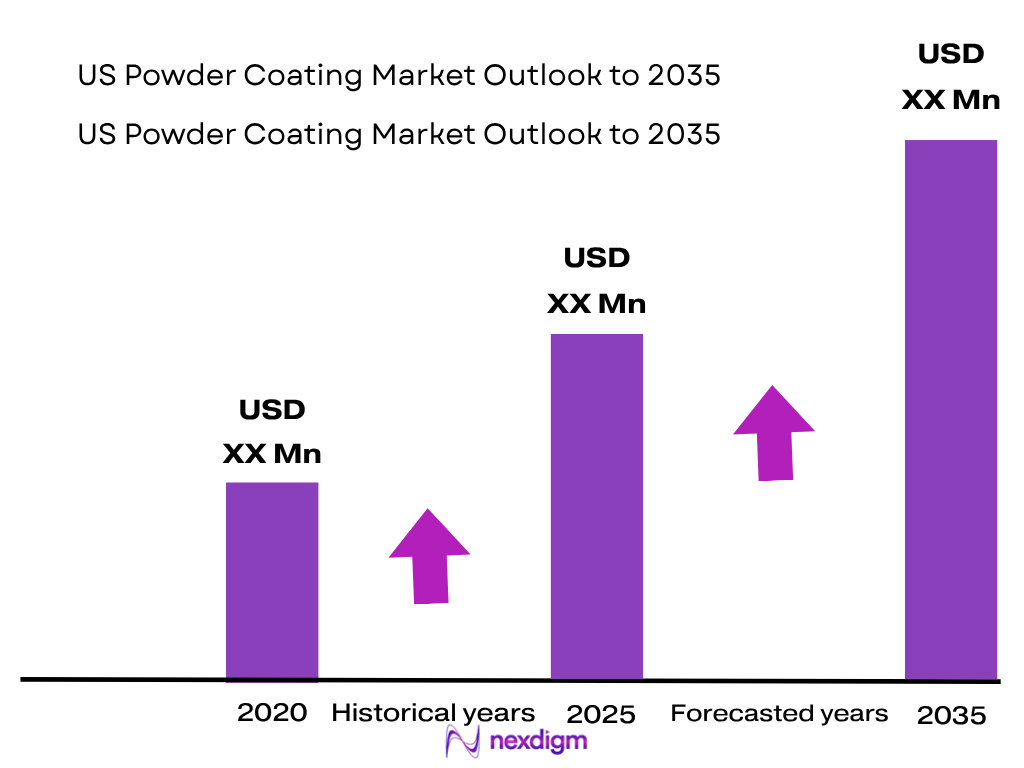
The US Powder Coating Market is valued at approximately USD ~XX billion, supported by durable-goods manufacturing, fabricated metals, automotive components, appliances, architectural aluminum and industrial equipment. Public construction spending increased from USD 450.7 billion to USD 492.7 billion, while educational construction moved from USD 97.0 billion to USD 105.2 billion. Powder coatings benefit from this manufacturing and construction base because they provide durable, solvent-free finishes with recoverable overspray across metal-intensive applications.
Ohio, Michigan, Illinois, Indiana, Texas, Tennessee, Kentucky, Georgia and the Carolinas are major demand centers because they combine automotive production, fabricated-metal manufacturing, appliances, agricultural equipment and custom coating operations. Federal Reserve industrial-production weights show fabricated metal products accounting for 6.15 index-weight units, primary metals 2.69, nonmetallic mineral products 2.30, and wood products 1.63 in the manufacturing structure, underpinning concentrated demand for polyester, epoxy, hybrid and functional powder coatings across these industrial regions.
Market Segmentation
By Resin Chemistry
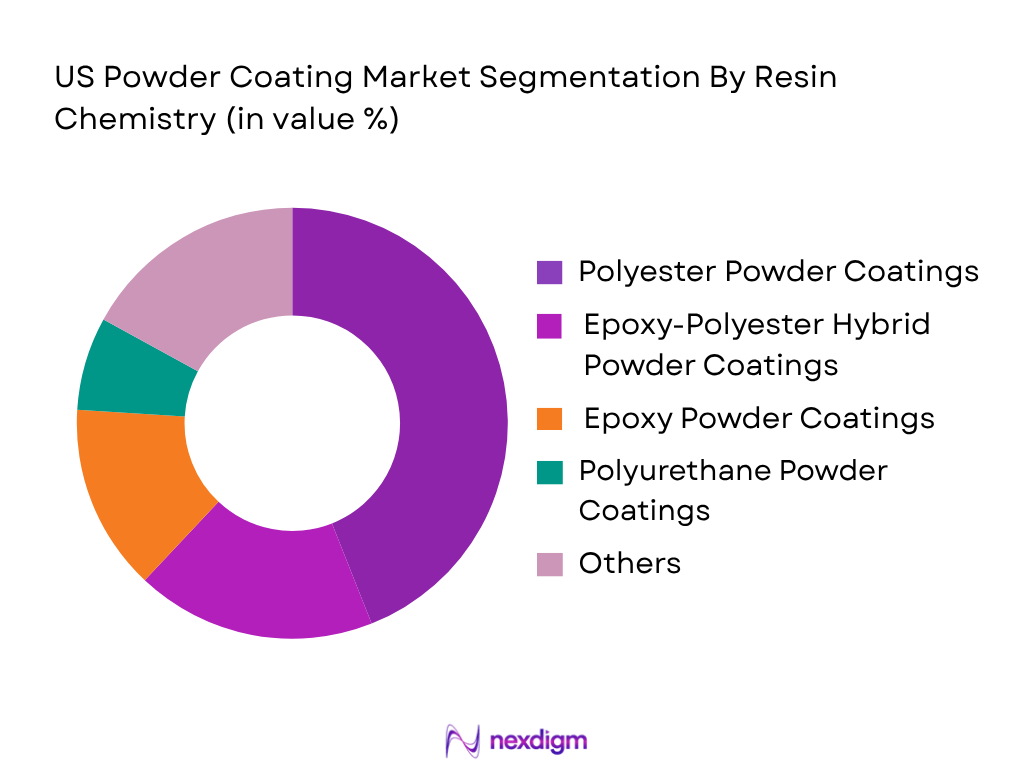
The US Powder Coating Market is segmented into polyester, epoxy, epoxy-polyester hybrid, polyurethane, acrylic, fluoropolymer and thermoplastic powder coatings. Polyester powder coatings hold the dominant position because their balance of outdoor durability, color retention, processing flexibility and cost effectiveness makes them suitable for general industrial equipment, architectural components, furniture, automotive parts, HVAC systems and fabricated metal products. Polyester technology also supports several performance tiers, including TGIC, TGIC-free and super-durable formulations. Major manufacturers maintain broad polyester portfolios alongside lower-volume specialty chemistries; Sherwin-Williams, for example, offers TGIC-free polyester technologies for architectural applications, while Axalta markets conventional, low-energy, high-temperature and weather-resistant polyester systems. Epoxy powders remain important for interior and corrosion-protection applications, while hybrids provide appearance and mechanical balance. Fluoropolymer technologies serve demanding architectural exposure, and thermoplastics address niche applications requiring thicker, highly durable films.
By End-Use Industry
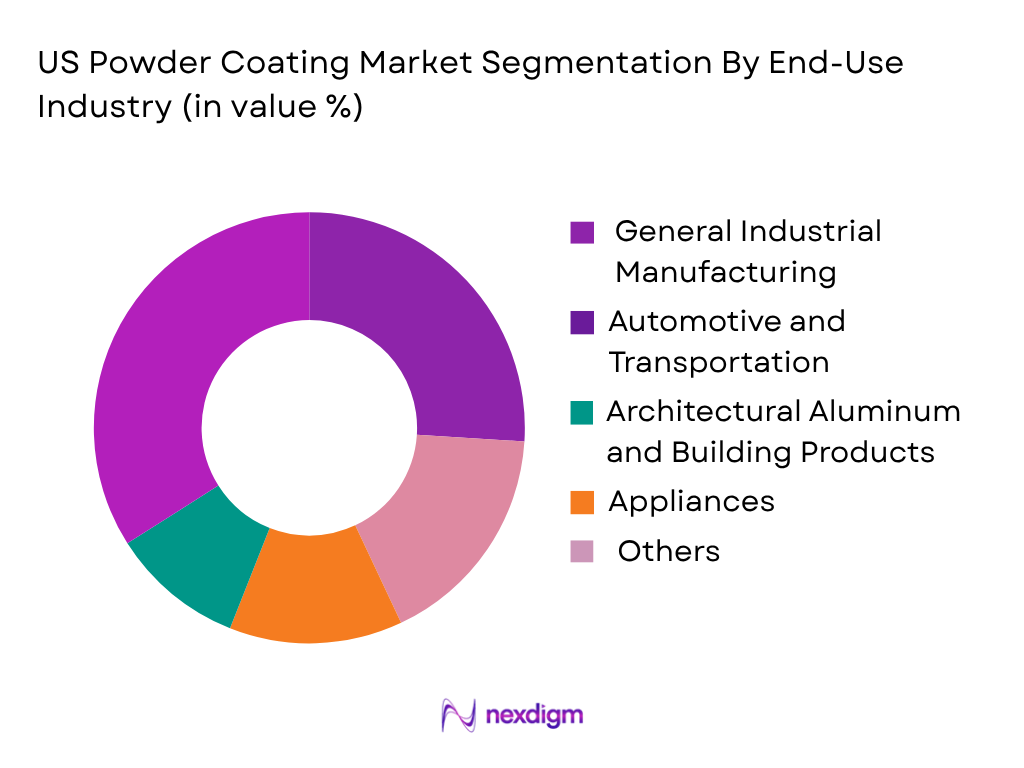
The US Powder Coating Market is segmented into general industrial manufacturing, automotive and transportation, appliances, architectural aluminum and building products, furniture, agricultural and construction equipment, electrical equipment, HVAC, pipelines, renewable energy and specialty industrial applications. General industrial manufacturing represents the dominant end-use segment because powder coating is extensively used across fabricated metal parts, shelving, machinery housings, material-handling equipment, structural components and miscellaneous durable goods. PPG identifies applications spanning heavy-duty equipment, furniture, automotive, electric vehicles, architectural extrusion and general finishing, illustrating the technology’s broad industrial applicability. Powder systems are especially attractive to manufacturers running repetitive finishing lines because overspray can often be recovered, film build can be achieved in one application cycle and solvent emissions are minimal. Automotive, appliances and architectural applications remain strategically important because they impose stricter corrosion, appearance and weathering specifications and therefore support greater use of premium and functional powder formulations.
Competitive Landscape
The US Powder Coating Market is characterized by large global coatings groups, specialized domestic manufacturers and regional custom-formulation companies. PPG, Sherwin-Williams, Axalta, AkzoNobel and IFS Coatings combine broad resin portfolios with technical service and industrial customer relationships. Competitive differentiation increasingly depends on low-temperature cure technology, architectural specifications, color-matching speed, functional powder development, domestic production footprint and the ability to support OEM line trials rather than merely supplying standard color powders.
| Company | Establishment Year | Headquarters | Resin Chemistry Breadth | Key Powder Technologies | Major End Uses | US Manufacturing / Supply | Technical Service | Sustainability / Low-Energy Capability |
| PPG Industries | 1883 | Pittsburgh, Pennsylvania | ~ | ~ | ~ | ~ | ~ | ~ |
| The Sherwin-Williams Company | 1866 | Cleveland, Ohio | ~ | ~ | ~ | ~ | ~ | ~ |
| Axalta Coating Systems | 2013* | Philadelphia, Pennsylvania | ~ | ~ | ~ | ~ | ~ | ~ |
| AkzoNobel – Interpon | 1994** | Amsterdam, Netherlands | ~ | ~ | ~ | ~ | ~ | ~ |
| IFS Coatings | 1999 | Gainesville, Texas | ~ | ~ | ~ | ~ | ~ |
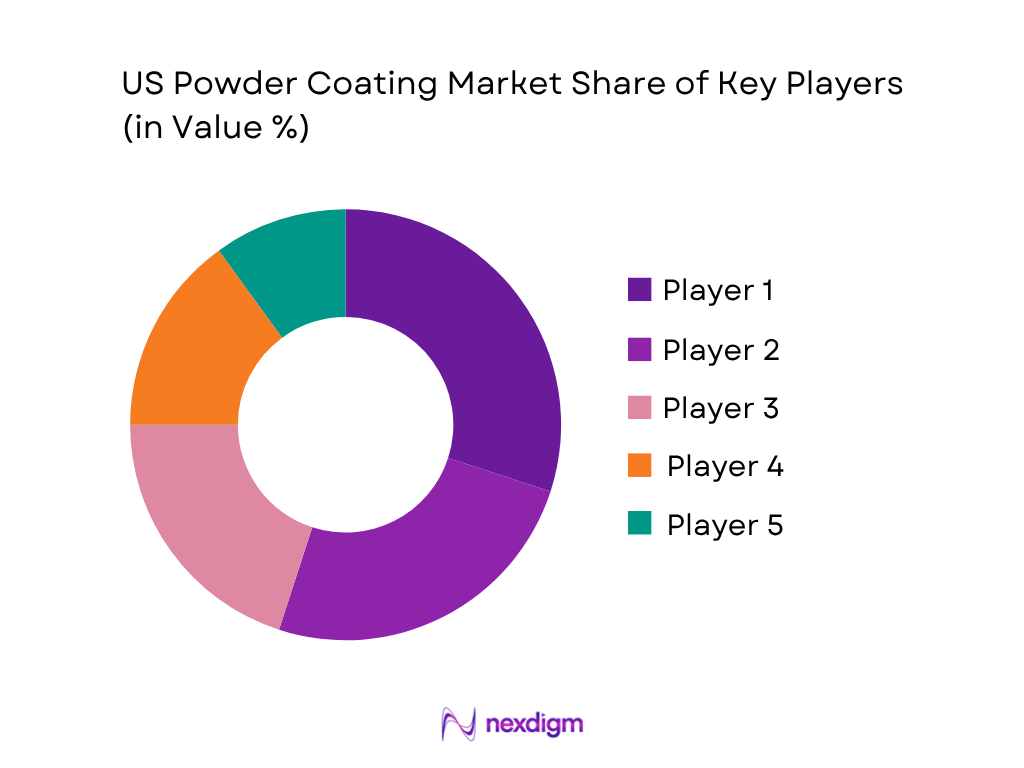
US Powder Coating Market Analysis
Growth Drivers
Expansion of Metal-Intensive Manufacturing and Durable-Goods Production
The US Powder Coating Market is supported by a large manufacturing base that continuously consumes polyester, epoxy, hybrid and functional powder coatings for fabricated metal products, machinery, electrical equipment, appliances and transportation components. Fabricated metal products have an industrial-production weight of 6.14, while machinery carries a weight of 5.68 and motor vehicles and parts 5.36 in the 2025 production framework. Computer and electronic products account for another 4.43, demonstrating the breadth of downstream industries requiring protective and decorative surface finishing. The industrial-production index for fabricated metal products stood at 94.2, while machinery recorded 90.5 during early 2025 and computer and electronic products reached 124.9. These industries use powder coatings on cabinets, frames, racks, housings, motors, equipment components and fabricated assemblies because coatings provide corrosion resistance, controlled film thickness and repeatable appearance. The underlying macroeconomic environment remains substantial, with US GDP reaching USD 28.75 trillion in 2024 and GDP per capita standing at USD 84,534. These industrial and economic fundamentals sustain a broad recurring application base for industrial powder-coating systems.
Construction and Architectural Metal Finishing Activity
Construction activity provides another significant growth driver for the US Powder Coating Market because architectural aluminum, railings, fencing, lighting systems, HVAC housings, doors, windows and other fabricated building products frequently require durable surface finishes. Public construction spending reached USD 492.7 billion in 2024, compared with USD 450.7 billion in the preceding period. Educational construction accounted for USD 105.2 billion, while highway construction reached USD 142.7 billion. Manufacturing construction also remained substantial, recording approximately USD 192.4 billion of spending during the first ten months of 2024, compared with USD 157.1 billion during the corresponding preceding period. These projects expand demand for coated structural components, equipment enclosures, architectural extrusions and industrial fixtures. Powder coatings are particularly relevant where manufacturers require exterior durability, color consistency and resistance to abrasion or corrosion. The broader economic foundation remains strong, with US GDP standing at USD 28.75 trillion in 2024 and GDP per capita reaching USD 84,534. This combination of construction investment and manufacturing infrastructure supports continued coating-line utilization.
Market Challenges
Energy-Intensive Thermal Curing and Finishing-Line Constraints
A major challenge for the US Powder Coating Market is the thermal curing requirement associated with conventional thermoset powder systems. Powder finishing commonly requires pretreatment, dry-off, electrostatic application and oven curing, making throughput dependent on oven capacity, substrate temperature and energy availability. The challenge becomes significant across heavy fabricated components, machinery and transportation products because thicker metal substrates require additional thermal energy before the coating reaches its specified cure window. Fabricated metal products carry an industrial-production weight of 6.14, machinery 5.68, and motor vehicles and parts 5.36 in the 2025 framework, illustrating the scale of metal-intensive industries where curing efficiency matters commercially. During 2025, fabricated-metal production indexes remained around 93–95, while machinery remained around 90–92, indicating substantial ongoing line utilization. Manufacturers therefore need to balance powder throughput with oven dwell time, color-change requirements and equipment bottlenecks. US GDP stood at USD 28.75 trillion in 2024, while GDP per capita reached USD 84,534, demonstrating the scale of the industrial economy in which these productivity constraints operate and increasing the importance of low-bake, fast-cure and infrared-assisted powder technologies.
Pretreatment Consistency, Coating Qualification and Process-Control Complexity
Powder coating performance depends heavily on surface preparation, grounding, film build and cure consistency, creating operational challenges for OEM finishers and custom coaters. A powder formulation may satisfy technical specifications yet fail adhesion or corrosion requirements when pretreatment chemistry, rinsing, surface cleanliness or substrate condition varies. This is especially relevant across fabricated metals, automotive components and electrical equipment. Fabricated metal products account for an industrial-production weight of 6.14, motor vehicles and parts 5.36, and electrical equipment, appliances and components 2.19 in the 2025 framework. Production indices during 2025 included readings near 94 for fabricated metals, 106 for motor vehicles and approximately 96–99 for electrical equipment, illustrating the scale of production dependent on repeatable finishing quality. Requalifying a powder formulation can involve color matching, adhesion testing, salt-spray evaluation, impact testing and customer line trials before commercial adoption. The broader US economy recorded GDP of USD 28.75 trillion in 2024 and GDP per capita of USD 84,534, supporting sophisticated manufacturing standards while simultaneously raising expectations around production reliability, quality consistency and coating performance.
Market Opportunities
Low-Temperature Cure and Liquid-to-Powder Conversion
The US Powder Coating Market has a substantial opportunity in lower-temperature and faster-curing technologies because current industrial activity provides a large base of coating lines where energy efficiency and productivity improvements can generate operational benefits. Fabricated metal products carry an industrial-production weight of 6.14, machinery 5.68, electrical equipment and appliances 2.19, and motor vehicles and parts 5.36, representing a broad universe of potential powder-coating users. Powder coatings provide manufacturers with a pathway to replace certain conventional liquid coating processes where substrate geometry, performance requirements and curing conditions permit. The opportunity is strengthened by US manufacturing construction activity, which reached approximately USD 192.4 billion during the first ten months of 2024, indicating significant investment in new and expanded production facilities. US GDP reached USD 28.75 trillion in 2024, while GDP per capita stood at USD 84,534. These current industrial and macroeconomic indicators provide a strong foundation for future adoption of low-bake powders, fast-cure chemistries, improved transfer-efficiency technologies, automated application equipment and efficient powder-recovery systems across newly installed or modernized industrial finishing lines.
Electrical Equipment, Electronics and Functional Powder Coatings
Functional powder coatings present a strong future opportunity as US production expands across electrical equipment, electronics and other technically demanding applications. Computer and electronic products carry an industrial-production weight of 4.43 in the 2025 framework, while electrical equipment, appliances and components represent 2.19. The computer and electronics production index reached approximately 125 during 2025 and moved above 130 later in the period, while the electrical-equipment index remained around the mid-90s. These production levels create an addressable application base for dielectric powders, electrically insulating formulations, heat-resistant coatings, corrosion-resistant systems and coatings used on enclosures, busbars, motors, electrical housings and fabricated components. Functional powders can provide both surface protection and engineered performance characteristics, enabling suppliers to move beyond conventional decorative finishing applications. The wider economic environment provides additional support, with US GDP reaching USD 28.75 trillion in 2024 and GDP per capita standing at USD 84,534. These manufacturing and macroeconomic conditions create opportunities for higher-value powder technologies serving electrification, industrial automation, electrical infrastructure and advanced electronic equipment.
Future Outlook
The US Powder Coating Market is expected to expand at approximately ~X.X% CAGR during 2026–2035, with the final forecast retained as a placeholder for the proprietary market model. Future growth will increasingly be driven by low-temperature curing, functional powder technologies, architectural durability requirements, EV components and conversions from conventional liquid finishing systems. Low-temperature and fast-cure technologies will be particularly important because conventional thermal curing can create high oven-energy requirements and restrict powder application on heat-sensitive substrates. Manufacturers are therefore developing powders that cure at reduced metal temperatures or shorter dwell times. Axalta already offers low-energy and ultra-low-bake powder technologies, while PPG markets low-cure systems designed for industrial efficiency.
Architectural applications should continue moving toward higher durability classes. Sherwin-Williams markets powder systems aligned with AAMA 2603, 2604 and 2605 requirements, including humidity testing ranging from 1,500 hours to 4,000 hours depending on product tier. This creates a pathway for premium powder technologies on aluminum extrusions, façades, windows, doors and monumental building systems.
Major Players
- PPG Industries, Inc.
- The Sherwin-Williams Company
- Axalta Coating Systems
- AkzoNobel – Interpon Powder Coatings
- IFS Coatings
- TIGER Drylac U.S.A., Inc.
- Cardinal Paint & Powder
- Hentzen Coatings, Inc.
- Diamond Vogel
- American Powder Coatings, Inc.
- Prismatic Powders
- Protech Group / Oxyplast
- Erie Powder Coatings Inc.
- Teknos Group
- Rapid Coat Powder Coatings
Key Target Audience
- Powder Coating Manufacturers
- Powder Coating Resin, Pigment and Additive Suppliers
- Custom Powder Coaters and Surface Finishing Companies
- Automotive, Appliance, Architectural and Industrial OEMs
- Powder Application Equipment and Finishing System Manufacturers
- Industrial Coatings Distributors and Powder Stocking Companies
- Investments and Venture Capitalist Firms
- Government and Regulatory Bodies (US Environmental Protection Agency, Occupational Safety and Health Administration, National Institute for Occupational Safety and Health, US Department of Commerce, National Institute of Standards and Technology)
Research Methodology
Step 1: Identification of Key Variables
The initial stage involves constructing an ecosystem map covering powder manufacturers, resin and pigment suppliers, application-equipment companies, custom coaters, OEM finishers and industrial distributors. Secondary research identifies variables including resin chemistry, powder consumption volume, film thickness, cure temperature, substrate mix, application method, transfer efficiency, reclaim rate, domestic production and end-use exposure.
Step 2: Market Analysis and Construction
Historical market demand is developed using both top-down and bottom-up models. The top-down assessment evaluates fabricated metal production, automotive components, appliances, architectural construction and industrial equipment activity. Bottom-up analysis estimates powder manufacturer revenues, consumption volumes, distributor throughput, custom-coater powder usage and captive OEM coating-line demand across major resin chemistries and applications.
Step 3: Hypothesis Validation and Expert Consultation
Market hypotheses are validated through CATI and structured interviews with powder formulators, custom coaters, finishing-line operators, equipment suppliers, distributors and OEM procurement teams. Discussions evaluate product consumption, transfer efficiency, reclaim practices, color-change frequency, cure constraints, supplier qualification and resin preferences. Primary findings are used to reconcile manufacturer-side estimates with coating-line and end-user demand assumptions.
Step 4: Research Synthesis and Final Output
The final phase triangulates government manufacturing data, supplier information, industry standards, application benchmarks and primary interviews. Powder consumption is cross-checked against coated surface area, film thickness, utilization efficiency and production throughput. Forecast scenarios incorporate manufacturing activity, architectural construction, environmental regulation, low-temperature cure adoption, electrification and conversion from liquid to powder finishing to produce the final market outlook.

- Executive Summary
- Research Methodology (Market Definition and Scope, US Powder Coating Taxonomy, Thermoset and Thermoplastic Powder Classification, Resin Chemistry Mapping, Functional and Decorative Powder Classification, Substrate Mapping, Surface Pretreatment Assessment, Electrostatic Application Technology Assessment, Cure Technology Assessment, Film Thickness Assessment, Powder Recovery and Reclaim Assessment, Market Sizing Framework)

- Definition and Scope
- US Powder Coating Industry Evolution and Technology Development
- Powder Coating Manufacturing and Formulation Process
- Powder Coating Value Chain Analysis
- US Powder Coating Supply Chain Analysis
- Resin, Pigment, Additive and Filler Ecosystem Analysis
- US Powder Coating Import Dependency and Localization Assessment
- OEM Powder Coating Application Architecture and Custom Coater Solution Framework

- Growth Drivers (Expansion of Durable Goods Manufacturing, Increased Powder Adoption over Liquid Coatings, Automotive Component Coating Demand, Architectural Aluminum Finishing, Custom Coater Expansion, VOC and HAP Reduction Requirements, High Transfer Efficiency, Powder Reclaim and Material Utilization)
- Market Challenges (Polyester and Epoxy Resin Volatility, Cure Energy Requirements, Color Change Downtime, Complex Geometry Faraday Cage Effects, Heat-Sensitive Substrate Limitations, Pretreatment Quality Variability, Metallic Powder Reclaim Complexity, Skilled Finishing Workforce Constraints)
- Market Opportunities (Low-Temperature Cure Powders, EV Battery and Electrical Insulation Powders, Hyper-Durable Architectural Coatings, Powder-on-Wood Applications, High-Edge-Build Corrosion Protection, Antimicrobial Powder Coatings, Fast Color-Change Systems, Conversion from Liquid to Powder Finishing)
- Market Trends (TGIC-Free Polyester Adoption, Ultra-Low-Bake Powders, Thin-Film Powders, One-Cure Primer-Topcoat Systems, Super-Durable Architectural Powders, Metallic and Special-Effect Finishes, Dense-Phase Application, Digital Color and Finish Visualization)
- Regulatory and Standards Landscape (EPA Clean Air Act Surface Coating Requirements, EPA Miscellaneous Metal Parts and Products NESHAP, OSHA Hazard Communication Requirements, OSHA Combustible Dust Requirements, NFPA Powder Coating Application Requirements, TSCA Chemical Substance Requirements, AAMA 2603/2604/2605 Performance Requirements, ASTM Powder Coating Test Standards)
- SWOT Analysis
- Porter’s Five Forces Analysis
- PESTLE Analysis
- Stakeholder Ecosystem
- Competition Ecosystem

- By Market Value (2020-2025)
- By Powder Coating Consumption Volume (2020-2025)
- By Coated Surface Area (2020-2025)
- By Domestic Production Volume (2020-2025)
- By Import Volume (2020-2025)
- By Export Volume (2020-2025)
- By Average Selling Price (2020-2025)
- By Thermoset Powder Consumption (2020-2025)
- By Thermoplastic Powder Consumption (2020-2025)

- By Resin Chemistry (In Value %)
Polyester Powder Coatings
TGIC Polyester Powder Coatings
TGIC-Free Polyester Powder Coatings
Super-Durable Polyester Powder Coatings
Epoxy Powder Coatings
Epoxy-Polyester Hybrid Powder Coatings
Polyurethane Powder Coatings
Acrylic Powder Coatings
Fluoropolymer Powder Coatings
Silicone Polyester Powder Coatings
Nylon Powder Coatings
Polyethylene Powder Coatings
PVC Powder Coatings - By Coating Technology (In Value %)
Thermosetting Powder Coatings
Thermoplastic Powder Coatings
UV-Curable Powder Coatings
Low-Temperature Cure Powder Coatings
Ultra-Low-Bake Powder Coatings
Fast-Cure Powder Coatings
Thin-Film Powder Coatings
High-Temperature Resistant Powder Coatings - By Functional Performance (In Value %)
Decorative Powder Coatings
Corrosion-Resistant Powder Coatings
Weather-Resistant Powder Coatings
Super-Durable Architectural Powders
High-Temperature Powders
Electrical Insulation and Dielectric Powders
Antimicrobial Powder Coatings
Anti-Graffiti Powder Coatings
Scratch-Resistant Powder Coatings
Chemical-Resistant Powder Coatings
Low-Friction Powder Coatings
Thermal Management Powder Coatings
Electrostatic Dissipative Powder Coatings
Zinc-Rich and Zinc-Free Powder Primers - By End-Use Industry (In Value %)
General Industrial Manufacturing
Automotive and Transportation
Automotive Components and Wheels
Appliances
Architectural Aluminum and Building Products
Furniture and Office Equipment
Agricultural and Construction Equipment
Electrical Equipment
Electronics and Data Infrastructure
HVAC and Refrigeration Equipment
Lawn and Garden Equipment
Metal Fabrication
Pipes and Pipelines
Oil and Gas Equipment
Material Handling Equipment
Renewable Energy Equipment
Medical and Healthcare Equipment
Military and Defense Equipment - By Distribution Channel (In Value %)
Direct Powder Manufacturer-to-OEM Sales
Direct Manufacturer-to-Custom Coater Sales
Authorized Powder Coating Distributors
Industrial Coatings Distributors
Regional Stocking Warehouses
Equipment and Powder Bundled Distribution
Online Powder Coating Platforms
Custom Color and Small-Batch Channels - By Region (In Value %)
Northeast US
Pennsylvania
New York
New Jersey
New England
Midwest US
Ohio
Michigan
Illinois
Indiana

- Market Share of Major Players (By Revenue, Volume, Resin Chemistry, Powder Technology, End-Use Industry, Application Type, Market Type, Distribution Channel)
- Cross Comparison Parameters (Resin Chemistry and Powder Technology Breadth, US Powder Manufacturing and Extrusion Capacity, Low-Temperature and Fast-Cure Technology Capability, Architectural AAMA 2603/2604/2605 Portfolio Strength, Functional and High-Performance Powder Capability, Custom Color Matching and Small-Batch Formulation Flexibility, National Distribution and Technical Application Support, Sustainable and Low-Energy Powder Portfolio)
- SWOT Analysis of Major Players
- Competitive Positioning Matrix
- Product and Technology Portfolio Benchmarking
- Pricing and Distribution Network Benchmarking
- Market Entry Strategy Assessment
- Detailed Profiles of Major Companies
PPG Industries, Inc.
The Sherwin-Williams Company
Axalta Coating Systems
AkzoNobel – Interpon Powder Coatings
IFS Coatings
TIGER Drylac U.S.A., Inc.
Cardinal Paint & Powder
Hentzen Coatings, Inc.
Diamond Vogel
American Powder Coatings, Inc.
Prismatic Powders
Protech Group / Oxyplast
Erie Powder Coatings Inc.
Teknos Group
Rapid Coat Powder Coatings

- Buyer Segmentation
- OEM Procurement Behaviour
- Supplier Selection Criteria
- Buyer Pain Points
- Technology Adoption Assessment
- Replacement and Repurchase Behaviour

- By Market Value (2026-2035)
- By Powder Coating Consumption Volume (2026-2035)
- By Coated Surface Area (2026-2035)
- By Domestic Production Volume (2026-2035)
- By Import Volume (2026-2035)
- By Export Volume (2026-2035)
- By Average Selling Price (2026-2035)
- By Thermoset Powder Consumption (2026-2035)
- By Thermoplastic Powder Consumption (2026-2035)


 Request a Sample
 Ask for Customization
 Get a Quote
 Enquire Now