

 Download PDF
Market Overview
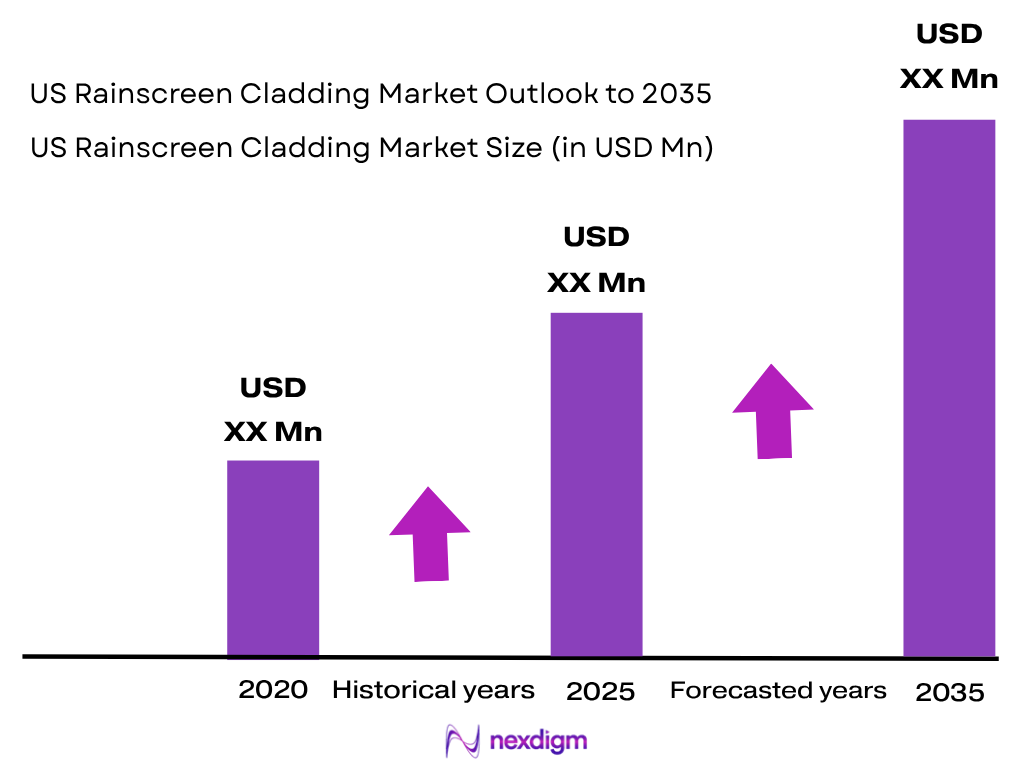
The US Rainscreen Cladding Market is valued at approximately ~USD XX million, supported by a construction base whose seasonally adjusted annual spending moved from USD 2.096 trillion to USD 2.192 trillion across the two latest annual observations. New privately owned housing authorizations simultaneously moved from 1,511,102 units to 1,478,000 units, while the latter represented USD 384.62 billion in permitted residential construction. These volumes support demand for rainscreen panels, continuous insulation, subframing and moisture-managed exterior wall assemblies.
New York, Houston, Dallas-Fort Worth, Miami, Washington, Phoenix and Atlanta are important demand centers because population growth, multifamily construction and commercial development continually add façade-addressable buildings. New York metro population moved from 19,726,871 to 19,940,274, Houston from 7,598,011 to 7,796,182, and Dallas-Fort Worth from 8,166,110 to 8,344,032 across the two latest observations. These metros combine high-rise density, climate-driven envelope requirements and large contractor ecosystems that favor engineered rainscreen systems.
Market Segmentation
By Material Type
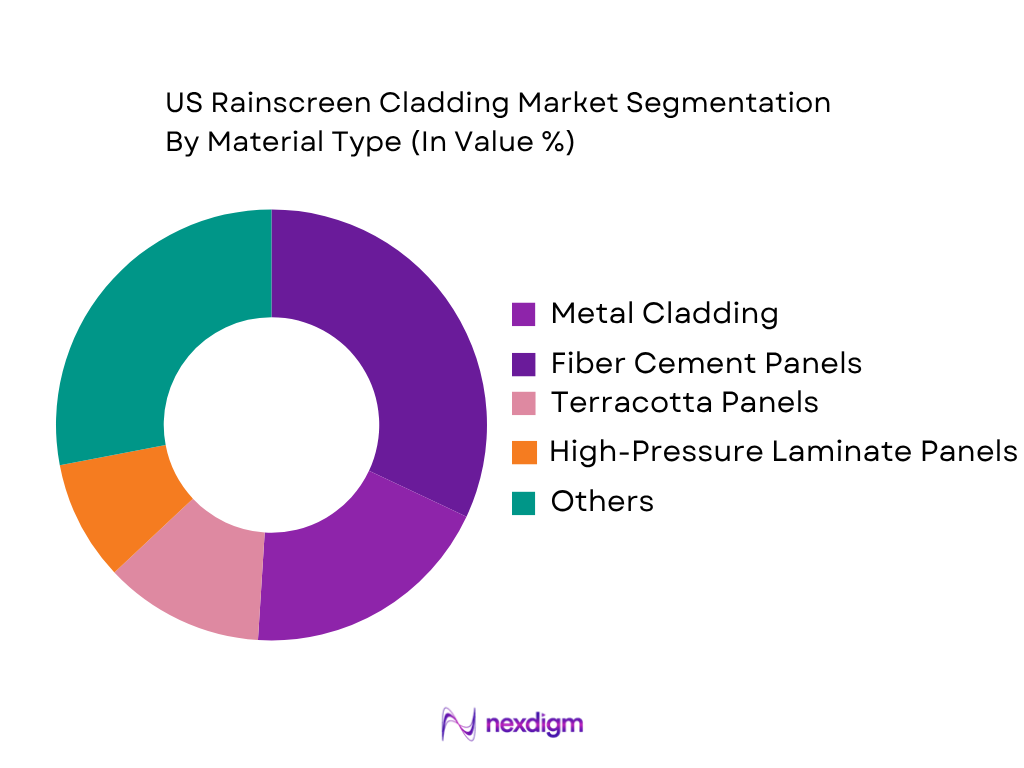
The US Rainscreen Cladding Market is segmented into metal cladding, fiber cement, terracotta, high-pressure laminate, natural stone, ceramic and porcelain, GFRC, engineered composites, wood and other architectural rainscreen materials. Metal cladding holds the dominant modeled market share because aluminum, steel, zinc and related panel systems are compatible with large-format façade design, cassette fabrication, open-joint and closed-joint configurations, thermally isolated attachment systems and continuous exterior insulation. Metal systems are also widely specified across commercial offices, multifamily towers, institutional buildings, data centers and transportation projects where low panel weight, recyclability, dimensional flexibility and high-wind attachment performance are important. Architectural metal panels can be integrated with mineral wool, air-water barriers and engineered clip-and-rail systems to meet increasingly demanding envelope specifications. Fire performance also supports noncombustible metal systems in projects where exterior wall assemblies are evaluated under NFPA 285. The standard specifically addresses fire propagation characteristics of exterior wall assemblies containing combustible components, making system-level testing and compatible material selection important in U.S. high-rise and commercial construction.
By Building Type
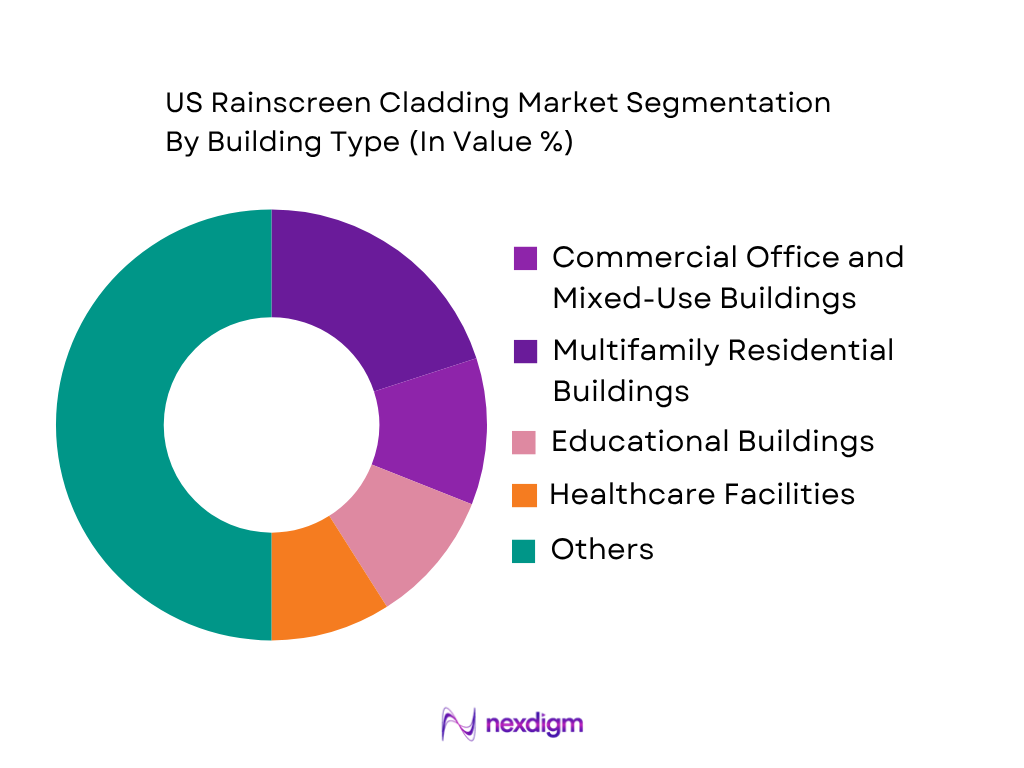
The US Rainscreen Cladding Market is segmented into commercial offices, multifamily residential buildings, healthcare facilities, educational buildings, retail properties, hotels, data centers, government buildings, industrial facilities, transportation buildings and mixed-use developments. Commercial and institutional buildings represent the dominant modeled demand cluster, driven by the scale of the U.S. nonresidential building stock and stricter requirements for energy performance, moisture control and lifecycle durability. The Department of Energy estimates that businesses and governments own, operate or use approximately 93 billion square feet of commercial real estate, while commercial buildings consume approximately 13.6 quadrillion Btu of electricity-equivalent energy and generate around USD 190 billion in annual energy expenditures. These buildings include offices, hospitals, schools, hotels, warehouses and data centers, all of which are relevant for high-performance exterior wall retrofits. Rainscreen systems are particularly attractive where owners combine façade renewal with continuous insulation, air-water barrier replacement, thermal-bridge reduction and long-life architectural finishes.
Competitive Landscape
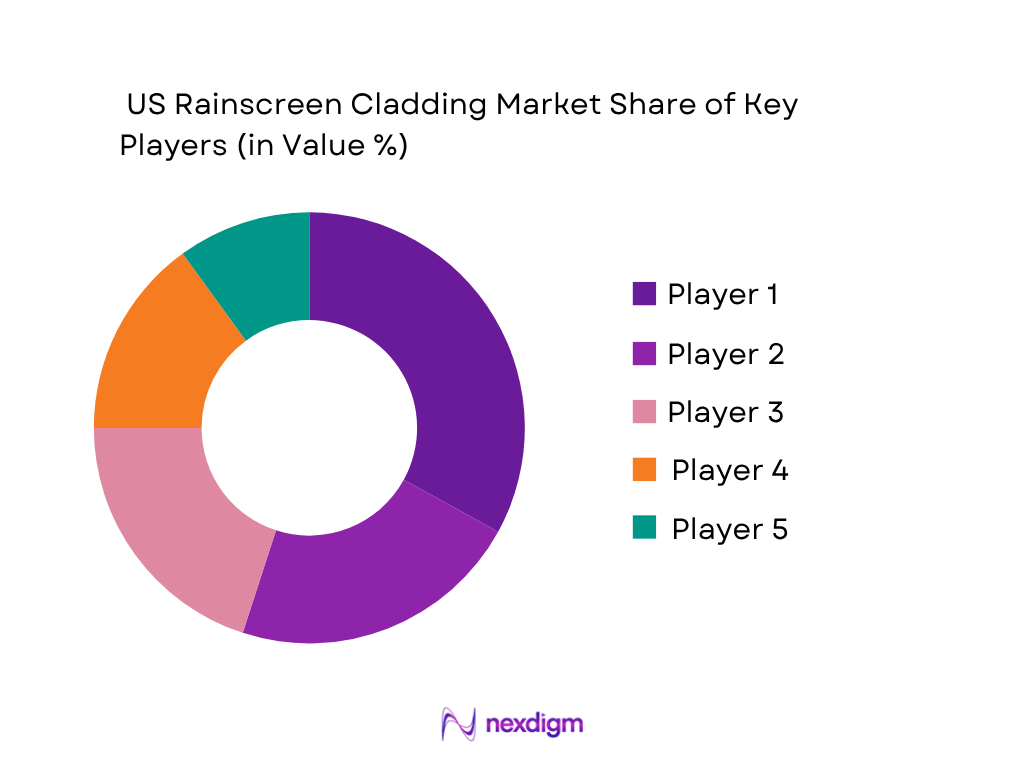
The US Rainscreen Cladding Market is fragmented across integrated building-envelope suppliers, metal-panel specialists, fiber-cement manufacturers, insulation companies and attachment-system providers. Competition is increasingly based on complete wall-assembly capability rather than cladding aesthetics alone. Manufacturers that can support NFPA 285 documentation, continuous-insulation integration, thermal-bridge reduction, wind-load engineering, moisture management, BIM specification and nationwide contractor support are positioned more strongly for institutional and high-performance commercial projects.
| Major Player | Establishment Year | Headquarters | Primary Rainscreen Offering | Material Specialization | Fire / Code Capability | Continuous Insulation Compatibility | Engineering / Specification Support | US Manufacturing / Distribution Presence |
| Sto Corp. | 1989 | Atlanta, Georgia | ~ | ~ | ~ | ~ | ~ | ~ |
| Nichiha USA | 1998 | Johns Creek, Georgia | ~ | ~ | ~ | ~ | ~ | ~ |
| James Hardie | 1888 | Dublin, Ireland / Chicago US operations | ~ | ~ | ~ | ~ | ~ | ~ |
| Dri-Design | 1995 | Holland, Michigan | ~ | ~ | ~ | ~ | ~ | ~ |
| ROCKWOOL North America | 1937 | Milton, Ontario / North American operations | ~ | ~ | ~ | ~ | ~ | ~ |
US Rainscreen Cladding Market Analysis
Growth Drivers
Commercial Building Renovation and High-Performance Envelope Modernization
Commercial and institutional construction activity is creating a substantial pipeline for U.S. rainscreen cladding systems because owners increasingly combine façade renewal with continuous insulation, air-water barriers, moisture drainage and durable architectural finishes. U.S. Census Bureau data show total construction put in place reached USD 2.154 trillion in 2024, including USD 1.225 trillion in nonresidential construction. Within this base, office construction accounted for USD 101.118 billion, educational facilities USD 130.307 billion, healthcare buildings USD 68.622 billion, and commercial construction USD 126.504 billion. These building categories are directly relevant to rainscreen applications because façade rehabilitation can address thermal bridging, water intrusion, aging exterior materials and long-term maintenance simultaneously. The Department of Energy also continues to support retrofit strategies for existing commercial buildings, including envelope improvements and whole-building efficiency measures. The macroeconomic environment provides significant capacity for such capital projects: World Bank data place U.S. GDP at USD 28.751 trillion, GDP per capita at USD 84,534, and population at 340,110,988 in 2024. This combination of large nonresidential construction volumes and a mature existing-building stock supports demand for metal, fiber-cement, terracotta and other engineered rainscreen assemblies.
Multifamily Construction and Continuous Exterior Insulation Adoption
Multifamily development remains an important driver for the U.S. rainscreen cladding market because apartment buildings require extensive exterior-wall area and increasingly incorporate drainage cavities, continuous insulation, air-water barriers and thermally improved attachment systems. The U.S. Census Bureau recorded 1,478,000 privately owned housing units authorized by building permits in 2024 with an aggregate permitted valuation of USD 384.62 billion. Approximately 440,000 units were authorized in buildings containing five units or more, creating a large pipeline of multifamily façades where rainscreen systems can support moisture control and code-compliant insulation strategies. Housing starts totaled 1,364,100 units during the same period, while December alone recorded an annualized rate of 418,000 starts in buildings containing five units or more. These projects are especially relevant in dense metropolitan markets where larger façade areas, complex wall interfaces and long-term asset ownership increase the value of durable exterior-wall assemblies. World Bank figures show U.S. GDP of USD 28.751 trillion, GDP per capita of USD 84,534, and a population of 340,110,988 in 2024, providing a large economic and demographic base for multifamily investment and envelope modernization.
Market Challenges
NFPA 285 Compliance and Multi-Layer Exterior Wall Coordination
Fire-performance compliance creates a major technical challenge for U.S. rainscreen cladding because exterior-wall assemblies must often be evaluated as complete systems rather than as isolated panels. NFPA 285 addresses vertical and lateral flame propagation in exterior non-load-bearing wall assemblies containing combustible components, meaning the interaction of cladding, insulation, air-water barriers, cavity configurations, attachment systems and substrates can influence compliance. This becomes significant given the scale of façade-addressable construction: U.S. nonresidential construction reached USD 1.225 trillion in 2024, including USD 101.118 billion in offices, USD 68.622 billion in healthcare buildings and USD 130.307 billion in educational facilities. Many such projects require detailed envelope specifications, tested wall configurations and careful substitution management. A change in insulation, membrane, panel core or attachment design can trigger additional engineering review, complicating procurement and installation. This challenge exists within a very large economy, with World Bank data recording U.S. GDP at USD 28.751 trillion, GDP per capita at USD 84,534, and population at 340,110,988 in 2024. For rainscreen suppliers, competitive success therefore depends on documented assembly compatibility, technical engineering support and code-oriented project coordination rather than panel supply alone.
Regional Climate Exposure and High-Wind Envelope Engineering Complexity
Regional climate exposure makes rainscreen design difficult to standardize across the United States because façade systems must respond to hurricanes, wind-driven rain, freeze-thaw cycling, coastal corrosion, heat and other environmental loads. NOAA recorded 27 billion-dollar weather and climate disasters in 2024, including 5 tropical cyclones, 17 severe storms, 2 winter storms, 1 flooding event, 1 drought and heat event, and 1 wildfire event. Combined losses reached USD 182.7 billion. Hurricane Helene alone generated approximately USD 78.7 billion in losses, while Hurricane Milton generated approximately USD 34.3 billion. These conditions are highly relevant to rainscreen suppliers because panel anchorage, subframe design, drainage, fastener corrosion resistance and air-water barrier continuity must be tailored to local wind and moisture exposure. Projects in Florida and the Gulf Coast can therefore require materially different engineering from buildings in the Northeast or Pacific Northwest. World Bank data show the United States had 340,110,988 residents, GDP of USD 28.751 trillion, and GDP per capita of USD 84,534 in 2024, meaning climate-resilient façade requirements apply across an exceptionally large and economically significant building stock.
Market Opportunities
Existing-Building Energy Retrofits and Recladding
Energy-oriented renovation creates a substantial future opportunity for U.S. rainscreen cladding because existing commercial buildings can be reclad while simultaneously improving insulation continuity, water management and envelope durability. The Department of Energy specifically identifies renovation and refurbishment of existing commercial buildings as opportunities to improve building energy performance and provides retrofit guidance for offices, retail properties, schools and healthcare facilities. Current construction activity demonstrates a large addressable modernization base: U.S. nonresidential construction reached USD 1.225 trillion in 2024, including USD 130.307 billion in educational projects, USD 101.118 billion in offices and USD 68.622 billion in healthcare facilities. Federal policy also strengthened the efficiency focus in 2024 through requirements covering new and majorly renovated federal buildings, with the Department of Energy estimating its final rule could avoid 2 million metric tons of emissions. These current conditions support future adoption of rainscreen systems that accommodate continuous insulation, thermally broken clips and replaceable cladding panels. World Bank data place U.S. GDP at USD 28.751 trillion, GDP per capita at USD 84,534, and population at 340,110,988 in 2024, providing a substantial financial and building-ownership base for phased façade modernization.
Hurricane-Resistant and Climate-Resilient Rainscreen Systems
Climate-resilient façades represent a strong future opportunity for rainscreen manufacturers capable of supplying high-wind attachment systems, corrosion-resistant subframes, drained cavities and durable noncombustible panels. NOAA recorded 27 major weather and climate disasters in the United States during 2024, generating USD 182.7 billion in losses. The year included 5 tropical cyclones, with Hurricane Helene producing approximately USD 78.7 billion in damage and Hurricane Milton approximately USD 34.3 billion. Helene made landfall as a Category 4 storm with sustained winds of roughly 140 miles per hour, demonstrating the structural loads and water exposure that exterior wall assemblies can face in hurricane-prone regions. These current conditions create a rationale for future specification of pressure-equalized or drained rainscreens incorporating engineered clips, tested anchors, corrosion-resistant fasteners and robust water-resistive barriers. Such systems can also support post-storm recladding when damaged conventional façades require replacement. The opportunity sits within a national economy valued by the World Bank at USD 28.751 trillion in 2024, with 340,110,988 residents and GDP per capita of USD 84,534, supporting ongoing investment in resilient commercial, multifamily, healthcare and institutional buildings.
Future Outlook
The US Rainscreen Cladding Market is forecast to expand at approximately ~X.X% CAGR during 2026–2035, with growth increasingly linked to building-envelope performance rather than decorative façade replacement alone. Energy-code adoption, commercial retrofit activity, higher expectations for water management, continuous insulation and stronger fire-performance documentation should broaden the role of engineered rainscreen assemblies across both new construction and renovation. Energy performance will remain an important demand catalyst. The Department of Energy identifies the IECC and ASHRAE 90.1 as the principal model energy codes used for commercial and residential buildings, while the current ASHRAE 90.1 framework applies minimum energy-efficiency requirements to most commercial buildings and large multifamily developments. Rainscreen systems support these objectives by providing space for continuous exterior insulation and reducing direct exposure of the primary weather barrier.
Major Players
- CENTRIA
- Sto Corp.
- Cladding Corp
- ECO Cladding
- Dri-Design
- James Hardie Building Products
- Nichiha USA
- ROCKWOOL North America
- Kingspan Insulated Panels North America
- Fundermax North America
- Trespa North America
- Swisspearl North America
- SFS Group USA
- DuPont
- Ludowici / Terreal North America
Key Target Audience
- Rainscreen Cladding and Architectural Panel Manufacturers
- Rainscreen Attachment and Subframing System Manufacturers
- Insulation and Building-Envelope Material Manufacturers
- Property Developers, REITs and Commercial Building Owners
- General Contractors and Facade Installation Companies
- Architectural, Building-Envelope Engineering and Specification Firms
- Investments and Venture Capitalist Firms
- Government and Regulatory Bodies (US Department of Energy, US Department of Housing and Urban Development, Federal Emergency Management Agency, General Services Administration, State and Local Building Code Authorities)
Research Methodology
Step 1: Identification of Key Variables
The initial phase involves building a complete ecosystem map of the US Rainscreen Cladding Market covering panel manufacturers, attachment suppliers, insulation manufacturers, distributors, façade contractors, architects, envelope consultants and building owners. Secondary research identifies variables including installed façade area, material penetration, project type, insulation configuration, fire testing, wind exposure, regional construction activity and retrofit intensity.
Step 2: Market Analysis and Construction
Historical market demand is constructed using both top-down and bottom-up approaches. Top-down analysis examines U.S. construction spending, residential permits, nonresidential development, energy-code adoption and building retrofit activity. Bottom-up analysis converts representative commercial, multifamily, institutional and industrial projects into addressable façade area and evaluates typical material, attachment, insulation and installation requirements.
Step 3: Hypothesis Validation and Expert Consultation
Market hypotheses are validated through computer-assisted telephone interviews and direct consultations with rainscreen manufacturers, distributors, façade contractors, architects, envelope consultants and insulation suppliers. These discussions validate material preferences, regional demand, NFPA 285 requirements, attachment-system selection, thermal-bridge considerations, specification practices, lead times and contractor adoption of open-joint and pressure-equalized systems.
Step 4: Research Synthesis and Final Output
The final phase triangulates U.S. Census construction indicators, Department of Energy building information, code requirements, company disclosures and primary research. Supplier-level information is reconciled with project-level façade calculations and construction-sector indicators. The final model evaluates material shares, building applications, regional demand, competitive positioning, new construction, recladding and energy-efficiency-driven rainscreen adoption.

- Executive Summary
- Research Methodology (Market Definitions and Assumptions, US Rainscreen Cladding Market Classification, Building-Envelope Scope, Drained and Back-Ventilated Rainscreen Assessment, Pressure-Equalized Rainscreen Assessment, Open-Joint Rainscreen Assessment, Closed-Joint Rainscreen Assessment, Metal Panel Assessment, Terracotta Assessment, Fiber Cement Assessment, HPL Assessment, Natural Stone Assessment, Composite Panel Assessment, Ceramic Assessment, Subframing Assessment, Cladding Attachment Assessment, Continuous Insulation Assessment, Air and Water-Resistive Barrier Assessment, NFPA 285 Assessment, ASTM E84 Assessment, ASTM E119 Assessment, Wind-Load Assessment, Hurricane Exposure Assessment, Thermal-Bridging Assessment, Moisture-Management Assessment, Top-Down Market Sizing, Bottom-Up Market Sizing, Demand-Side Assessment, Supply-Side Assessment, Primary Industry Interviews, Construction Pipeline Mapping, Retrofit Pipeline Assessment, Data Triangulation, Forecasting Framework)

- Definition and Scope
- US Building-Envelope Industry Evolution and Development of Drained and Back
- Ventilated Rainscreens, Pressure-Equalized Rainscreens, Open-Joint Facades, Closed-Joint Facades, Metal Panel Rainscreens, Terracotta Facades, Fiber Cement Cladding, HPL Cladding, Natural Stone Rainscreens, Ceramic Panels, ACM/MCM Facades, Insulated Rainscreen Systems, Thermally Broken Attachment Systems, Continuous Exterior Insulation, Non-Combustible Assemblies, Prefabricated Facade Panels, Building-Integrated Photovoltaic Facades
- Rainscreen Cladding Value Chain Analysis
- Rainscreen Cladding Supply Chain Analysis

- Growth Drivers (Commercial Building Renovation, Multifamily Construction, Continuous Exterior Insulation Adoption, Energy-Code Compliance, Moisture-Control Requirements, Building Envelope Modernization, High-Performance Facade Demand, Hurricane-Resilient Construction, Institutional Building Upgrades, Data Center Construction)
- Market Challenges (High Installed System Complexity, Skilled Installer Availability, NFPA 285 Assembly Compliance, Thermal-Bridge Control, Multi-Layer Envelope Coordination, Long Lead Times, Regional Code Variation, High-Rise Installation Complexity, Moisture Detailing Failures, Attachment Engineering Requirements)
Market Opportunities (Energy-Efficiency Retrofits, Existing-Building Recladding, Non-Combustible Rainscreens, Thermally Broken Attachment Systems, Hurricane-Resistant Facades, Data Center Building Envelopes, Prefabricated Rainscreen Panels, Low-Carbon Cladding Materials, Building-Integrated Photovoltaic Facades, Circular and Demountable Systems) - Market Trends (Mineral-Wool Continuous Insulation, Open-Joint Rainscreens, Thermally Isolated Clips, Large-Format Panels, Concealed Fixings, Prefabricated Facade Assemblies, BIM-Based Envelope Coordination, High-Durability Coatings, Low-Carbon Aluminum, EPD-Based Specification, Building Envelope Commissioning, BIPV Integration)
- Government Regulations and Standards (International Building Code, International Energy Conservation Code, NFPA 285 Exterior Wall Assembly Testing, ASTM E84 Surface Burning Characteristics, ASTM E119 Fire Resistance, ASCE 7 Wind Loads, ASTM E330 Structural Performance, AAMA 509 Drained and Back-Ventilated Rainscreen Testing, AAMA 508 Pressure-Equalized Rainscreen Testing, State Energy Codes, California Title 24, Florida Building Code, New York City Building Code)
- SWOT Analysis
- Porter’s Five Forces Analysis
- PESTLE Analysis

- By Market Value (2020-2025)
- By Installed Rainscreen Cladding Area (2020-2025)
- By New Construction Installation Area (2020-2025)
- By Retrofit and Recladding Installation Area (2020-2025)
- By Commercial Building Installation Area (2020-2025)
- By Residential Building Installation Area (2020-2025)

- By Material Type (In Value %)
Metal Cladding
Aluminum Panels and Cassettes
Aluminum Composite Material Panels
Steel Panels
Zinc Cladding
Copper Cladding
Terracotta Panels
Fiber Cement Panels
High-Pressure Laminate Panels
Natural Stone Panels
Ceramic and Porcelain Panels
Glass Fiber Reinforced Concrete Panels
Engineered Composite Panels
Wood and Modified Wood Cladding
Other Architectural Rainscreen Materials - By Rainscreen Configuration (In Value %)
Drained and Back-Ventilated Rainscreens
Pressure-Equalized Rainscreens
Open-Joint Rainscreens
Closed-Joint Rainscreens
Cassette Panel Systems
Plank and Lap Systems
Large-Format Panel Systems
Panelized Prefabricated Rainscreens
Insulated Rainscreen Assemblies
Building-Integrated Photovoltaic Rainscreens - By Application (In Value %)
New Building Construction
Facade Replacement
Building Recladding
Energy-Efficiency Retrofit
Moisture and Water-Intrusion Remediation
Fire-Safety Facade Remediation
Architectural Facade Modernization
Continuous Insulation Upgrade
Storm and Hurricane Resilience Upgrade
Historic Building Rehabilitation - By Building Type (In Value %)
Commercial Office Buildings
Multifamily Residential Buildings
Single-Family Residential Buildings
Retail and Shopping Centers
Hotels and Hospitality Buildings
Healthcare Facilities
Educational Buildings
Government and Civic Buildings
Data Centers
Industrial and Manufacturing Buildings
Warehouses and Logistics Facilities
Airports and Transportation Buildings
Mixed-Use Developments - By Construction Type (In Value %)
New Construction
Major Renovation
Facade Recladding
Building Envelope Retrofit
Adaptive Reuse
Vertical Expansion
Historic Renovation
Post-Storm Reconstruction

- Market Share of Major Players (By US Revenue, Installed Area, Material Category, Commercial Projects, Residential Projects, Institutional Projects, Retrofit Projects, Regional Presence, Specification Presence, Distribution Network, Technical Support, Attachment Capability, NFPA 285 Assembly Portfolio, Continuous Insulation Compatibility)
- Cross Comparison Parameters (Rainscreen Material Portfolio Breadth, NFPA 285 Tested Assembly Capability, Thermally Broken Attachment System Capability, Continuous Insulation Compatibility, Hurricane and High-Wind Performance Capability, Building Envelope Engineering and Specification Support, US Distribution and Installer Network, EPD and Low-Carbon Product Documentation)
- SWOT Analysis of Major Players (Product Breadth, Code Compliance, Engineering Capability, Distribution Reach, Contractor Network, Sustainability Credentials, Retrofit Capability, Innovation)
- Detailed Profiles of Major Companies
CENTRIA
Sto Corp.
Cladding Corp
ECO Cladding
Dri-Design
James Hardie Building Products
Nichiha USA
ROCKWOOL North America
Kingspan Insulated Panels North America
Fundermax North America
Trespa North America
Swisspearl North America
SFS Group USA
DuPont
Ludowici / Terreal North America

- Developer Facade Requirement Assessment
- REIT and Institutional Owner Requirement Assessment
- General Contractor Procurement Assessment
- Facade Contractor Material Preference Assessment
- Public-Sector Procurement Assessment
- Code Official Approval Considerations
- NFPA 285 Documentation Requirement
- Thermal Performance Decision Factors
- Warranty and Technical Support Assessment
- EPD and Sustainability Documentation Assessment
- Project Reference Influence
- Approved-Equal and Substitution Assessment

- By Market Value (2026-2035)
- By Installed Rainscreen Cladding Area (2026-2035)
- By New Construction Installation Area (2026-2035)
- By Retrofit and Recladding Installation Area (2026-2035)
- By Commercial Building Installation Area (2026-2035)
- By Residential Building Installation Area (2026-2035)


 Request a Sample
 Ask for Customization
 Get a Quote
 Enquire Now