
 Download PDF
Market Overview
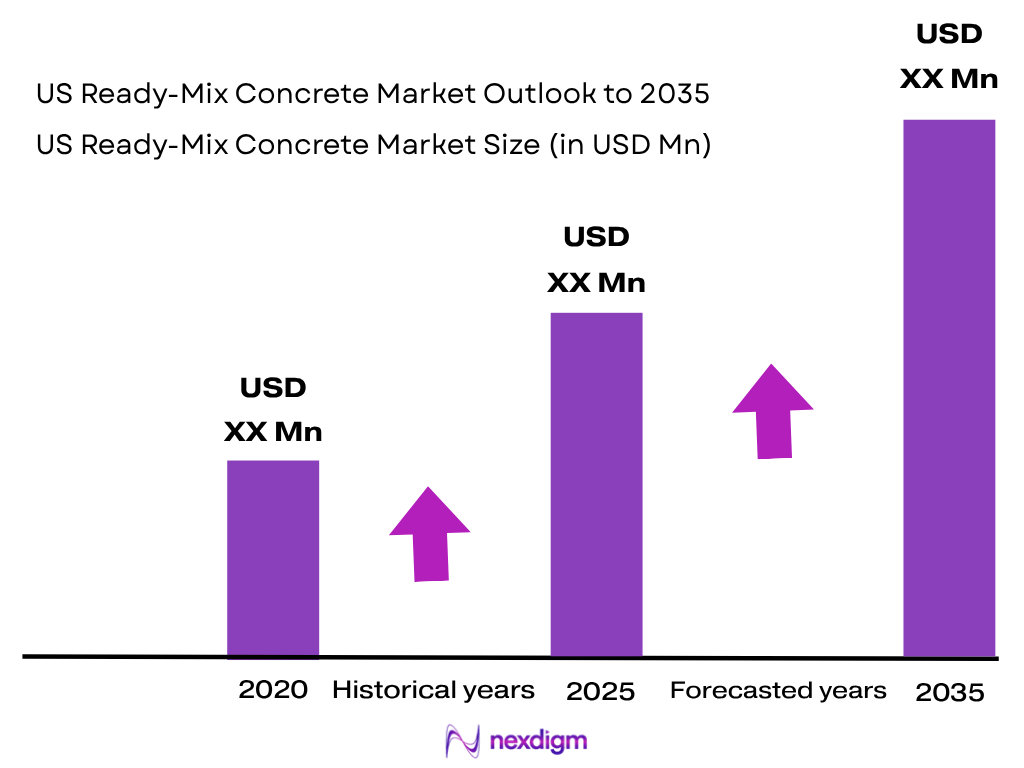
The US Ready-Mix Concrete Market represents a major downstream segment of the construction-materials industry, supplying fresh concrete directly to residential, commercial, industrial and infrastructure projects. The market-size placeholder for 2024 is USD ~XX billion, while the forecast CAGR for 2026–2035 is ~XX%. The underlying physical market is substantial: estimated US ready-mixed concrete production reached 379.149 million cubic yards, equivalent to 289.898 million cubic meters. Demand is supported by highway construction, bridge rehabilitation, commercial buildings, housing, industrial facilities and large-scale infrastructure projects.
California, Texas, Florida, Georgia, North Carolina and other high-construction states form important demand centres for the US Ready-Mix Concrete Market because they combine large construction pipelines, population concentrations, infrastructure requirements and extensive concrete-consuming development. California alone recorded approximately 33.138 million cubic yards of ready-mixed concrete production, while Arizona produced 11.550 million cubic yards and Colorado produced 7.397 million cubic yards. These markets benefit from highway, residential, commercial, industrial and infrastructure construction requiring locally produced concrete because ready-mix delivery is highly time-sensitive.
Market Segmentation
By Concrete Product Type
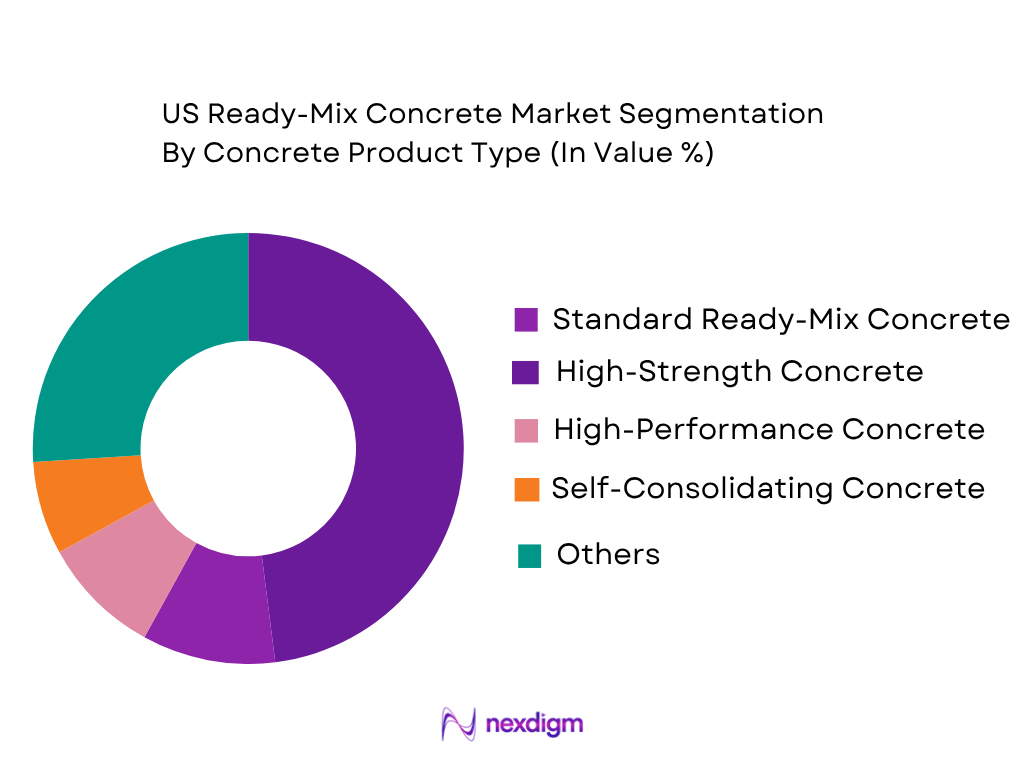
The US Ready-Mix Concrete Market is segmented by concrete product type into standard ready-mix concrete, high-strength concrete, high-performance concrete, self-consolidating concrete, fiber-reinforced concrete, lightweight concrete, rapid-setting concrete, pervious concrete, decorative concrete and low-carbon concrete. Standard ready-mix concrete represents the leading segment in the market model because it serves the broadest range of construction requirements, including foundations, slabs, columns, pavements, sidewalks, commercial structures and general infrastructure. Its extensive applicability allows producers to supply large volumes through established batch-plant and mixer-truck networks. The physical scale of the market reinforces this position, with US ready-mixed concrete production estimated at 379.149 million cubic yards. Large regional production bases also support standard mixes because contractors can obtain them from nearby plants while meeting concrete placement schedules. California produced 33.138 million cubic yards, while Texas and other large construction states provide additional demand centres. Specialized products such as high-performance, self-consolidating and low-carbon concrete are expanding their application bases, particularly where structural performance or sustainability specifications require customized formulations. Nevertheless, standard mixes remain central to the market because they can be adapted through strength grades, admixtures and supplementary cementitious materials for diverse project requirements.
By Application
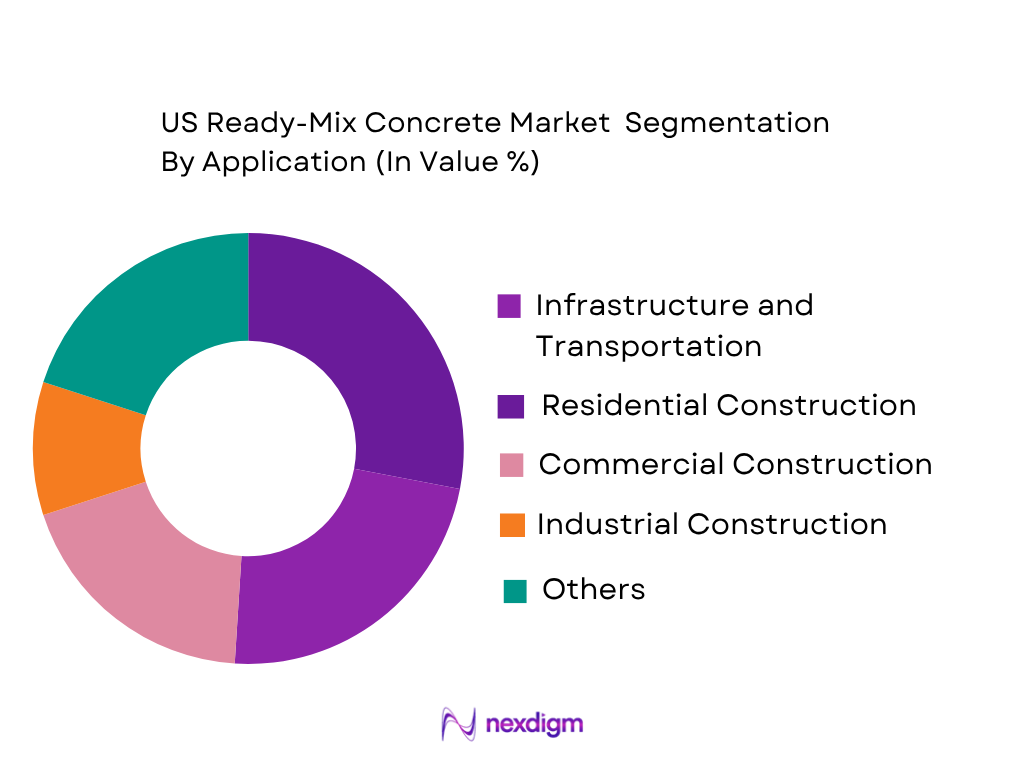
The US Ready-Mix Concrete Market is segmented by application into residential construction, commercial construction, industrial construction, roads and highways, bridges and tunnels, airports and ports, utility and energy infrastructure, data centers, institutional construction and other infrastructure applications. Infrastructure and transportation construction represents a leading application category in the market model because roads, bridges, highways and associated structures consume substantial quantities of concrete across new construction, rehabilitation and replacement projects. Federal infrastructure programs provide a continuing project pipeline: the Federal Highway Administration’s fiscal-year funding included $5.5 billion for the Bridge Formula Program, while the Bridge Investment Program provided $1.847 billion in advance appropriations. The 2024 Bridge Investment Program awards also included $634.81 million across projects announced during the year. Large projects such as bridge replacement, highway expansion and transportation modernization require substantial concrete volumes and therefore generate recurring demand for regional ready-mix suppliers. Residential and commercial construction remain major complementary applications, while industrial facilities and data centers can require specialized concrete formulations and large-volume placements. Ready-mix concrete’s short delivery window also favors local plants positioned close to major infrastructure and construction corridors, reinforcing the importance of regional production networks.
Competitive Landscape
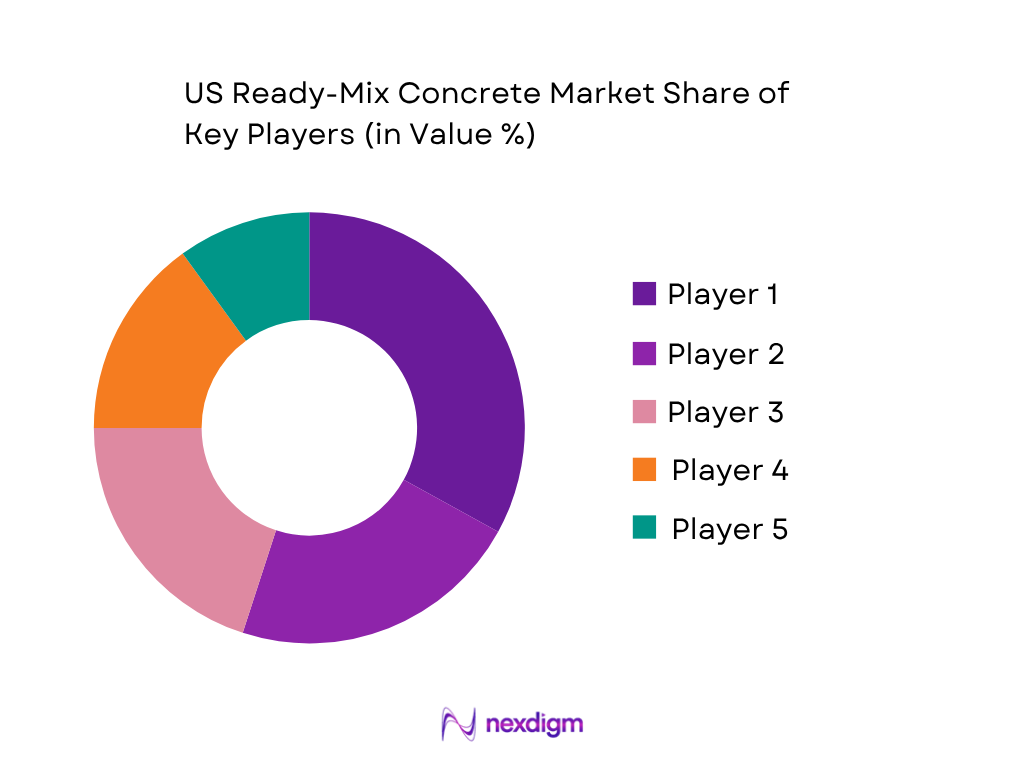
The US Ready-Mix Concrete Market is characterized by a combination of large integrated building-material companies, regional producers and independent ready-mix operators. Competition is influenced by plant density, geographic coverage, aggregate availability, production capacity, mixer-truck fleets, dispatch efficiency and proximity to construction sites. Major companies such as CEMEX USA, CRH Americas Materials, Vulcan Materials, Heidelberg Materials North America and Holcim US participate across extensive construction-material ecosystems. The market’s geographic structure is particularly important because ready-mix concrete has a limited practical delivery radius, making local production capacity and logistics critical competitive variables. Industry production reached 379.149 million cubic yards, underscoring the scale of the supplier ecosystem.
| Company | Establishment Year | Headquarters | Ready-Mix Capability | Plant Network | Aggregate Integration | Infrastructure Exposure | Digital / Dispatch Capability |
| CEMEX USA | 1906 | Houston, Texas | ~ | ~ | ~ | ~ | ~ |
| CRH Americas Materials | 1970 | Atlanta, Georgia | ~ | ~ | ~ | ~ | ~ |
| Vulcan Materials Company | 1909 | Birmingham, Alabama | ~ | ~ | ~ | ~ | ~ |
| Heidelberg Materials North America | 1874 | Irving, Texas | ~ | ~ | ~ | ~ | ~ |
| Holcim US | 1912 | Chicago, Illinois | ~ | ~ | ~ | ~ | ~ |
US Ready-Mix Concrete Market Analysis
Growth Drivers
Federal Infrastructure Investment
Federal infrastructure investment remains a major demand catalyst for the US Ready-Mix Concrete Market as transportation, bridge, water, and public construction programs require large volumes of concrete-intensive materials. The Infrastructure Investment and Jobs Act (IIJA) allocated USD 550 billion in new federal infrastructure spending, including major allocations for roads, bridges, public transit, rail, and water infrastructure. The Federal Highway Administration reported that the National Highway System covers more than 164,000 miles of roadway, creating continuous requirements for pavement repair, bridge rehabilitation, and structural upgrades. The US Department of Transportation also announced significant bridge funding through programs such as the Bridge Investment Program, supporting concrete-intensive replacement and rehabilitation projects. The US Census Bureau reported construction spending remained above USD 2 trillion annually, reflecting continued activity across public and private construction segments. Ready-mix concrete benefits directly from these investments because bridges, highways, retaining structures, foundations, and transportation facilities require high-volume concrete placement. The increasing focus on infrastructure resilience, replacement of aging assets, and modernization of transportation networks supports sustained demand for ready-mix suppliers operating near major construction corridors.
Data-Center Construction and Large-Scale Industrial Development
Expansion of data centers, semiconductor facilities, logistics hubs, and advanced manufacturing plants is increasing demand for specialized ready-mix concrete applications in the United States. Data-center projects require substantial concrete volumes for foundations, equipment pads, structural elements, and cooling infrastructure. The US Department of Energy reported that data centers consumed approximately 176 terawatt-hours of electricity in 2023, highlighting the rapid expansion of digital infrastructure requiring additional facilities and construction activity. The US Census Bureau recorded private manufacturing construction spending exceeding USD 200 billion, reflecting increased investment in industrial facilities. Semiconductor and advanced manufacturing investments supported by federal industrial policies have further accelerated construction activity. Large industrial projects typically require high-performance concrete mixes with enhanced durability, strength, and placement efficiency. Ready-mix producers located near industrial clusters benefit from demand generated by these projects because transportation limitations make local production capacity essential. The combination of digital infrastructure expansion, manufacturing investment, and industrial redevelopment creates additional opportunities for concrete suppliers providing customized mixes, high-volume deliveries, and project-specific technical support.
Market Challenges
Cement Supply Constraints and Raw Material Availability
The US Ready-Mix Concrete Market faces supply-chain challenges related to cement availability, aggregates, and supplementary materials required for concrete production. Cement manufacturing depends on limestone resources, energy availability, transportation networks, and regulatory compliance. The US Geological Survey reported that domestic cement production was approximately 93 million metric tons, while cement consumption remained dependent on both domestic production and imports. Aggregate availability is also regionally constrained because sand, gravel, and crushed stone resources require local extraction permits and transportation infrastructure. The US Geological Survey reported that construction aggregates represented one of the largest mineral commodity categories, with production exceeding 2 billion metric tons annually across the country. Ready-mix concrete production is highly localized because concrete must generally be delivered within limited timeframes after batching. Supply disruptions, quarry permitting delays, transportation constraints, and regional shortages can affect production schedules. Increasing demand from infrastructure, housing, and industrial projects can intensify pressure on cement and aggregate supply chains, requiring producers to optimize sourcing strategies, maintain supplier relationships, and adopt alternative materials such as supplementary cementitious materials.
Transportation Limitations and Operational Variability
Transportation constraints remain a significant challenge for the US Ready-Mix Concrete Market because ready-mix concrete requires rapid delivery from batch plants to construction sites. Mixer-truck availability, driver shortages, fuel exposure, traffic conditions, and regional construction cycles directly influence delivery efficiency. The American Trucking Associations reported that the US trucking industry moved approximately 11.5 billion tons of freight, demonstrating the critical role of road transportation in construction-material logistics. Ready-mix producers must maintain specialized mixer fleets and skilled operators to ensure consistent delivery schedules. Weather conditions also create operational uncertainty because extreme heat, freezing temperatures, storms, and precipitation can delay concrete placement activities. The US Bureau of Labor Statistics reported millions of workers employed in transportation and material-moving occupations, reflecting the importance of logistics labor availability across industries. Construction activity fluctuations can also create uneven plant utilization, affecting operational efficiency. These challenges require ready-mix companies to improve dispatch management, optimize delivery routes, maintain fleet availability, and adopt digital scheduling systems to reduce operational disruptions.
Market Opportunities
Low-Carbon Concrete and Sustainable Construction Solutions
Growing emphasis on sustainable construction creates opportunities for low-carbon concrete, supplementary cementitious materials, recycled aggregates, and alternative mix designs in the US Ready-Mix Concrete Market. The construction sector is increasingly focused on reducing embodied carbon associated with cement production. The US Environmental Protection Agency reported that the construction and demolition sector generated approximately 600 million tons of debris annually, creating opportunities for recycled concrete aggregate utilization. The Department of Energy has also highlighted industrial decarbonization as a priority area, with cement identified as an energy-intensive industry requiring emissions reduction solutions. Ready-mix producers are increasingly adopting materials such as fly ash, slag cement, and limestone calcined clay alternatives to optimize environmental performance. Federal sustainability initiatives and green-building requirements are supporting demand for environmentally optimized construction materials. Large infrastructure projects, commercial developments, and corporate construction programs increasingly require environmental documentation and lower-carbon material options. This creates opportunities for suppliers capable of producing certified sustainable concrete mixes while maintaining strength, durability, and construction performance.
Digitalization and Automated Ready-Mix Delivery Optimization
Digital technologies provide significant opportunities for improving efficiency in the US Ready-Mix Concrete Market through automated dispatch systems, AI-based route optimization, digital ordering platforms, and fleet management solutions. Ready-mix operations involve complex coordination between batching plants, mixer trucks, drivers, contractors, and project schedules. The US Department of Transportation has emphasized the importance of intelligent transportation systems and digital logistics technologies for improving freight efficiency. The Federal Highway Administration manages more than 46,000 miles of Interstate Highway System, creating a large transportation network where logistics optimization can improve construction-material delivery performance. Digital ordering platforms allow contractors to schedule concrete deliveries more accurately, while automated dispatch systems can reduce idle time and improve truck utilization. Electrification of construction fleets is also gaining attention as manufacturers develop lower-emission heavy-duty vehicles. The adoption of connected fleet technologies, telematics, predictive maintenance, and automated scheduling can help ready-mix producers improve operational reliability, reduce delivery delays, and support increasingly complex construction projects requiring precise concrete placement coordination.
Future Outlook
The US Ready-Mix Concrete Market is expected to continue developing through infrastructure rehabilitation, transportation construction, residential development, commercial projects, industrial expansion and emerging high-volume applications such as data centers. Federal transportation programs continue to create construction opportunities, while bridge and highway programs require significant quantities of concrete. The Bridge Investment Program alone has dedicated billions of dollars across multiple fiscal years, creating a sustained pipeline of bridge rehabilitation and replacement projects. Future demand is also expected to increasingly emphasize low-carbon mix designs, supplementary cementitious materials, optimized cement content, recycled aggregates, digital dispatch, automated batching and fleet-management technologies. Producers with geographically dense plant networks can benefit from reduced delivery distances and greater scheduling flexibility.
Major Players
- CEMEX USA
- CRH Americas Materials
- Vulcan Materials Company
- Heidelberg Materials North America
- Holcim US
- Martin Marietta Materials
- Knife River Corporation
- SRM Concrete
- Titan America
- Argos USA
- Buzzi Unicem USA
- Rogers Group
- Thomas Concrete Group
- Vicat
- GCC USA
Key Target Audience
- Ready-Mix Concrete Producers and Plant Operators
- Cement and Aggregate Producers
- Construction and Infrastructure Contractors
- Residential and Commercial Developers
- Data-Center and Industrial Facility Developers
- Investments and Venture Capitalist Firms
- Government and Regulatory Bodies (Federal Highway Administration, US Department of Transportation, state Departments of Transportation, Environmental Protection Agency)
- Concrete Equipment, Admixture and Construction-Technology Suppliers
Research Methodology
Step 1: Identification of Key Variables
The initial phase involves mapping the US Ready-Mix Concrete Market ecosystem across cement suppliers, aggregate producers, admixture companies, ready-mix plants, mixer-truck operators, contractors and end-use construction sectors. Key variables include production volume, plant capacity, delivery radius, concrete type, application, customer type and regional demand.
Step 2: Market Analysis and Construction
Historical production and construction indicators are compiled and evaluated using government statistics, industry production records, infrastructure-program data and company disclosures. The analysis incorporates ready-mix production volumes, plant networks, construction activity and application-level consumption to establish the market baseline.
Step 3: Hypothesis Validation and Expert Consultation
Market hypotheses are validated through consultations with ready-mix producers, batch-plant managers, concrete contractors, infrastructure specialists and construction-material suppliers. Discussions focus on mix specifications, procurement patterns, plant utilization, delivery logistics, customer requirements and technology adoption.
Step 4: Research Synthesis and Final Output
The final analysis triangulates production volumes, construction indicators, company capabilities and regional demand patterns. Bottom-up plant and application assessments are cross-checked against top-down construction activity before preparing the final market segmentation, competitive landscape and forecast framework.

- Executive Summary
- Research Methodology (Market Definition and Scope, Ready-Mix Concrete Classification, Market Sizing Framework, Top-Down Market Reconstruction, Bottom-Up Plant-Level Assessment, Production-Volume Validation, Demand-Side Assessment, Supply-Side Assessment, Concrete Plant Mapping, Industry Interviews, Data Triangulation, Forecasting Framework, Regional Validation, Limitations and Assumptions)

- Definition and Scope
- Ready-Mix Concrete Industry Evolution
- Ready-Mix Concrete Value Chain Analysis
- Ready-Mix Concrete Supply Chain Analysis

- Growth Drivers (Federal Infrastructure Investment, Highway and Bridge Construction, Data-Center Construction, Residential Development, Commercial Construction, Industrial Facility Expansion, Infrastructure Rehabilitation, Transportation Investment, Urban Development, Concrete Demand from Large-Scale Projects)
- Market Challenges (Cement Supply Constraints, Aggregate Availability, Ready-Mix Transportation Radius, Mixer-Truck Availability, Driver Shortages, Fuel Exposure, Construction-Cycle Volatility, Weather Disruptions, Plant Utilization Variability, Local Permitting Requirements)
- Market Opportunities (Low-Carbon Concrete, Supplementary Cementitious Materials, Carbon-Cured Concrete, Data-Center Construction, Infrastructure Modernization, Automated Dispatch Systems, AI-Based Delivery Optimization, Electrification of Mixer Fleets, Recycled Concrete Aggregate, High-Performance Concrete, Digital Concrete Ordering)
- Market Trends (Low-Carbon Mix Design, Increased SCM Utilization, Carbon-Cured Concrete, Automated Batching, AI-Enabled Dispatch, Real-Time Fleet Tracking, Digital Ordering Platforms, High-Performance Concrete Adoption, Data-Center Concrete Demand, Prefabrication and Modular Construction)
- Government Regulations and Standards (FHWA Buy Clean Requirements, EPA Construction Materials Guidance, ASTM Concrete Standards, ACI Specifications, State DOT Concrete Specifications, Environmental Product Declarations, Low-Carbon Concrete Procurement Requirements, OSHA Requirements, Federal Infrastructure Procurement Standards, State-Level Air-Quality Regulations)
- SWOT Analysis
- Porter’s Five Forces Analysis
- PESTLE Analysis
- Stakeholder Ecosystem
- Competition Ecosystem

- By Market Value (2020-2025)
- By Production Volume (2020-2025)
- By Concrete Shipments Volume (2020-2025)
- By Average Revenue per Cubic Yard (2020-2025)
- By Number of Ready-Mix Concrete Plants (2020-2025)

- By Concrete Product Type (In Value %)
Standard Ready-Mix Concrete
High-Strength Concrete
High-Performance Concrete
Self-Consolidating Concrete
Fiber-Reinforced Concrete
Lightweight Concrete
Decorative and Architectural Concrete
Rapid-Setting Concrete
Pervious Concrete
Low-Carbon Concrete - By Application (In Value %)
Residential Construction|
Commercial Construction
Industrial Construction
Infrastructure and Transportation
Roads and Highways
Bridges and Tunnels
Airports and Ports
Utility and Energy Infrastructure
Data Centers
Institutional and Government Construction - By Construction Project Type (In Value %)
New Construction
Renovation and Reconstruction
Large-Scale Infrastructure Projects
Commercial Development Projects
Residential Development Projects
Industrial Facilities
Public Infrastructure Projects - By Delivery Method (In Value %)
Transit-Mixed Concrete
Central-Mixed Concrete
Shrink-Mixed Concrete
Volumetric and Mobile Mixing - By Customer Type (In Value %)
General Contractors
Ready-Mix Concrete Subcontractors
Residential Builders
Commercial Developers
Infrastructure Contractors
Government Agencies
Industrial Contractors
Specialty Concrete Contractors - By Region (In Value %)
Northeast US
Midwest US
South US
West US

- Market Share of Major Players (By Revenue, Production Volume, Geographic Presence, Concrete Plant Footprint, Customer Segment, Application, Regional Coverage)
- Cross Comparison Parameters (Ready-Mix Production Capacity, Number of Concrete Plants, Mixer-Truck Fleet Scale, Geographic Distribution Reach, Concrete Product Portfolio, Low-Carbon Concrete Capability, Digital Dispatch and Fleet Management, Infrastructure Project Coverage)
- SWOT Analysis of Major Players
- Detailed Profiles of Major Companies
CEMEX USA
CRH Americas Materials
Vulcan Materials Company
Heidelberg Materials North America
Holcim US
Martin Marietta Materials
Knife River Corporation
SRM Concrete
Titan America
Argos USA
Buzzi Unicem USA
Rogers Group
Thomas Concrete Group
Vicat
GCC USA

- Residential Builder Concrete Procurement Assessment
- Commercial Developer Procurement Analysis
- Infrastructure Contractor Demand Assessment
- State Department of Transportation Concrete Procurement Analysis
- Federal Infrastructure Project Demand Assessment
- Data-Center Construction Concrete Requirement Analysis

- By Market Value (2026-2035)
- By Production Volume (2026-2035)
- By Concrete Shipments Volume (2026-2035)
- By Average Revenue per Cubic Yard (2026-2035)
- By Number of Ready-Mix Concrete Plants (2026-2035)


 Request a Sample
 Ask for Customization
 Get a Quote
 Enquire Now