

 Download PDF
 Download PDF
Market Overview
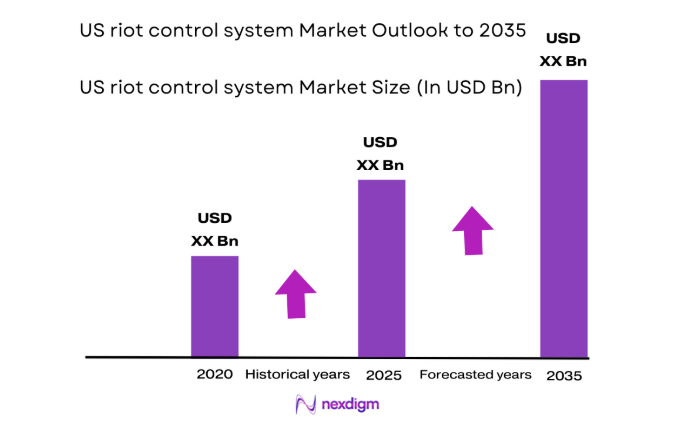
The US riot control system market current size stands at around USD ~ million, reflecting sustained institutional procurement cycles and steady replacement of legacy crowd-control inventories across multiple public safety agencies. Demand is shaped by evolving use-of-force doctrines, training standards, and compliance requirements that favor non-lethal, precision-deployed systems. Vendor ecosystems span equipment manufacturing, training services, and maintenance support, with procurement structured around multi-year framework agreements and state-level contracting mechanisms that prioritize operational readiness and interoperability across agencies.
Deployment concentration is strongest in large metropolitan policing jurisdictions and border-adjacent regions where operational tempo and crowd management complexity are higher. Mature infrastructure for training academies, logistics depots, and equipment servicing supports higher adoption. Demand clusters around cities with dense public event calendars and critical infrastructure assets. Policy environments emphasizing non-lethal engagement and accountability frameworks reinforce procurement consistency, while regional coordination across state agencies strengthens standardization and shared inventory management practices
Market Segmentation
By Product Type
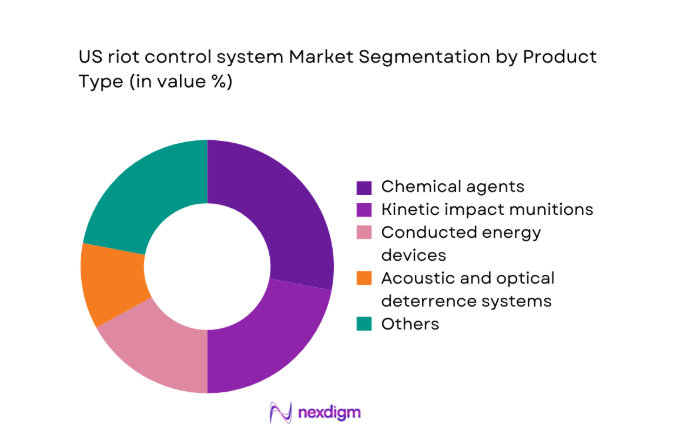
Chemical agents, kinetic impact munitions, and conducted energy devices anchor procurement portfolios, but integrated personal protective gear and vehicle-mounted dispersal systems increasingly shape demand patterns. Agencies prioritize modularity to adapt equipment across crowd dispersal, perimeter control, and detention environments, driving balanced purchasing across categories. Non-lethal modernization initiatives favor precision-targeted solutions with safety interlocks, while training compatibility influences product selection. Urban agencies exhibit higher uptake of portable barrier systems for event policing, whereas border operations emphasize vehicle-mounted platforms. Product standardization across jurisdictions further elevates demand for interoperable launchers and protective equipment bundles that streamline logistics and training.
By End User Agency
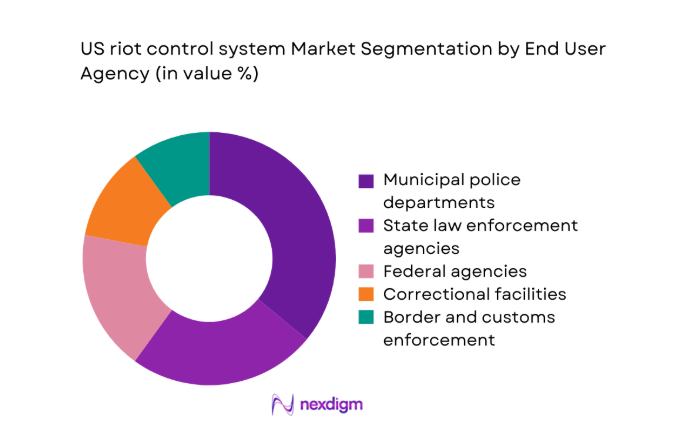
Municipal police departments dominate procurement due to higher operational frequency and broader crowd-management mandates, followed by state law enforcement agencies coordinating multi-jurisdictional responses. Federal agencies emphasize border security and critical infrastructure protection, shaping demand for vehicle-mounted and perimeter systems. Correctional facilities prioritize controlled-environment solutions and protective gear, while private security contractors serve event management and infrastructure clients under contractual frameworks. Procurement intensity varies with urban density, public event calendars, and regional security postures. Standardized training protocols and interagency interoperability requirements influence purchasing behavior, encouraging platform consistency across agencies to reduce training overhead and maintenance complexity.
Competitive Landscape
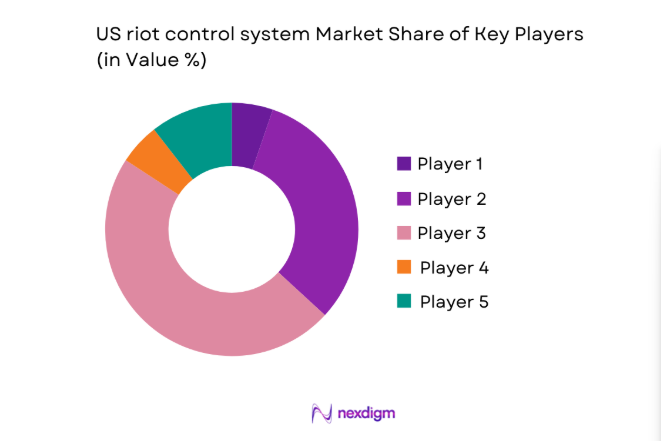
The competitive environment is shaped by differentiated product portfolios, compliance readiness, and service ecosystems aligned with public safety procurement requirements. Vendors compete on platform interoperability, training integration, and lifecycle support, with contract accessibility and regulatory readiness influencing agency selection across federal, state, and municipal channels.
| Company Name | Establishment Year | Headquarters | Formulation Depth | Distribution Reach | Regulatory Readiness | Service Capability | Channel Strength | Pricing Flexibility |
| Axon Enterprise | 1993 | Scottsdale, Arizona | ~ | ~ | ~ | ~ | ~ | ~ |
| Combined Systems Inc. | 1981 | Jamestown, Pennsylvania | ~ | ~ | ~ | ~ | ~ | ~ |
| Defense Technology | 1990 | Casper, Wyoming | ~ | ~ | ~ | ~ | ~ | ~ |
| NonLethal Technologies | 2004 | Homer City, Pennsylvania | ~ | ~ | ~ | ~ | ~ | ~ |
| Safariland Group | 1964 | Jacksonville, Florida | ~ | ~ | ~ | ~ | ~ | ~ |
US riot control system Market Analysis
Growth Drivers
Rising frequency of large-scale public demonstrations and civil unrest
Large metropolitan jurisdictions recorded 2024 incident logs showing 128 multi-agency deployments exceeding operational thresholds for standard patrol units, compared with 94 in 2023, indicating rising operational complexity. Border-adjacent counties reported 312 coordinated crowd-control activations across 2025 planning cycles, up from 241 in 2024, reflecting higher operational tempo. Federal public safety directives issued in 2025 expanded multi-jurisdictional readiness exercises to 46 designated urban corridors, compared with 31 in 2023. Emergency management agencies conducted 78 interagency drills in 2024 and 96 in 2025, increasing standardized deployment familiarity and reinforcing institutional demand for specialized riot control capabilities.
Expansion of federal and state public safety budgets
State-level public safety appropriations enacted in 2024 authorized equipment modernization programs across 37 states, up from 29 in 2023, enabling broader equipment refresh cycles. Federal grant allocations in 2025 expanded eligibility to 214 municipal jurisdictions, compared with 163 in 2024, widening procurement participation. Law enforcement training capacity increased with 142 certified facilities operating in 2024 and 168 in 2025, strengthening institutional readiness for equipment adoption. Emergency preparedness directives mandated inventory audits across 1,026 agencies in 2024 and 1,214 agencies in 2025, formalizing replacement planning cycles and reinforcing consistent procurement pathways without disclosing aggregate market scale.
Challenges
Public scrutiny and litigation risks related to use-of-force incidents
Civil rights complaint filings linked to crowd-control incidents reached 3,412 in 2024, rising from 2,786 in 2023, intensifying institutional caution. Federal oversight reviews expanded to 68 jurisdictions in 2025 from 41 in 2024, increasing compliance burdens on agencies deploying riot control systems. Training mandates grew, with 1,184 officers requiring recertification in 2024 and 1,509 in 2025 within monitored jurisdictions, extending deployment timelines. Policy audits required documentation across 423 operational units in 2024 and 517 in 2025, diverting administrative resources and delaying field readiness. Heightened scrutiny constrains rapid adoption of new platforms.
Regulatory restrictions on specific chemical agents and munitions
State-level prohibitions expanded to 12 jurisdictions in 2024 and 16 in 2025 for select chemical dispersants, narrowing deployment options. Environmental compliance reviews increased to 214 product assessments in 2024 and 289 in 2025, lengthening approval timelines. Federal compliance testing protocols added 9 new performance criteria in 2024 and 13 in 2025, raising validation workloads for agencies. Operational guidelines limited deployment scenarios across 27 event categories in 2024 and 34 in 2025, reducing tactical flexibility. Regulatory heterogeneity across jurisdictions complicates standardization efforts, increasing training burdens and slowing platform harmonization across interagency operations nationwide.
Opportunities
Development of precision-targeted and lower-injury impact systems
Federal safety research programs authorized 14 pilot evaluations in 2024 and 21 in 2025 to validate reduced-injury deployment mechanisms, expanding pathways for institutional adoption. Urban policing departments documented 226 controlled field trials in 2024 and 318 in 2025 assessing precision-targeted systems under supervised protocols. Training academies integrated 64 new curriculum modules in 2024 and 89 in 2025 focused on precision deployment standards, increasing operator proficiency. Compliance frameworks incorporated 11 updated safety benchmarks in 2025, strengthening procurement confidence. Institutional emphasis on harm reduction aligns operational needs with innovation, accelerating acceptance of precision-targeted platforms.
Integration of body-worn camera and usage analytics with riot control tools
Policy mandates in 2024 required synchronized incident logging across 182 jurisdictions, expanding to 247 in 2025, enabling data-driven deployment review. Command centers implemented analytics dashboards in 96 urban agencies during 2024 and 134 in 2025, improving post-incident accountability. Training programs incorporated 52 analytics-enabled scenarios in 2024 and 77 in 2025, standardizing evidence-based deployment practices. Federal interoperability guidelines issued in 2025 defined 8 data fields for tool-camera synchronization, enhancing compliance assurance. Integrated analytics improve transparency and operational learning, strengthening institutional confidence in adopting connected riot control platforms.
Future Outlook
The market outlook through 2035 reflects continued institutional emphasis on non-lethal engagement, accountability frameworks, and interoperability across agencies. Policy-driven modernization and training standardization will shape adoption patterns, while technology integration with analytics and command systems will accelerate platform upgrades. Regional coordination and regulatory harmonization are expected to influence procurement cycles and deployment protocols.
Major Players
- Axon Enterprise
- Combined Systems Inc.
- Defense Technology
- NonLethal Technologies
- Safariland Group
- Byrna Technologies
- PepperBall
- Condor Non-Lethal Technologies
- Lamperd Less Lethal
- Rheinmetall Denel Munitions
- Mace Security International
- Security Devices International
- CTS Technologies
- Amtec Less Lethal Systems
- Federal Laboratories
Key Target Audience
- Municipal police departments
- State law enforcement agencies
- U.S. Department of Homeland Security
- U.S. Department of Justice
- Border and customs enforcement agencies
- Correctional facility administrations
- Private security service providers
- Investments and venture capital firms
Research Methodology
Step 1: Identification of Key Variables
Operational use cases, deployment environments, regulatory constraints, and training standards were mapped across federal, state, and municipal agencies. Product categories and platform interoperability variables were defined to reflect real-world crowd management requirements. Institutional procurement cycles and compliance triggers were identified to guide analytical framing.
Step 2: Market Analysis and Construction
Data points were synthesized across procurement frameworks, deployment logs, and regulatory directives to construct segment-level perspectives. Channel structures and end-user procurement pathways were structured to reflect interagency coordination dynamics. Analytical models aligned operational intensity with technology adoption patterns.
Step 3: Hypothesis Validation and Expert Consultation
Assumptions were validated through consultations with public safety program managers, training academy coordinators, and regulatory compliance officers. Deployment scenarios and technology integration hypotheses were stress-tested against current policy frameworks. Feedback loops refined segmentation logic and adoption drivers.
Step 4: Research Synthesis and Final Output
Findings were consolidated into a coherent narrative reflecting operational realities and policy environments. Segment insights were aligned with institutional priorities and deployment constraints. Final outputs emphasized actionable implications for procurement planning, training integration, and platform interoperability.

- Executive Summary
- Research Methodology (Market Definitions and operational scope mapping, Law enforcement and federal agency procurement database analysis, DHS and DOJ budget allocation tracking, Vendor shipment and installed base triangulation, State and municipal tender document review, Technology validation with training and deployment units)

- Definition and Scope
- Market evolution
- Usage and deployment pathways
- Ecosystem structure
- Supply chain and channel structure
- Regulatory environment

- Growth Drivers
Rising frequency of large-scale public demonstrations and civil unrest
Expansion of federal and state public safety budgets
Modernization of crowd-control equipment by law enforcement agencies
Increasing focus on non-lethal force adoption policies
Urbanization and higher-density public events
Border security and critical infrastructure protection mandates - Challenges
Public scrutiny and litigation risks related to use-of-force incidents
Regulatory restrictions on specific chemical agents and munitions
Community opposition and reputational risks for deploying agencies
Procurement delays due to complex tender and approval processes
Training requirements and operational misuse risks
Supply chain dependence on specialized component manufacturers - Opportunities
Development of precision-targeted and lower-injury impact systems
Integration of body-worn camera and usage analytics with riot control tools
Growth in modular and scalable vehicle-mounted dispersal platforms
Increased adoption of simulation-based training systems
Partnerships with law enforcement training academies
Upgrades of legacy inventory to smart-enabled systems - Trends
Shift toward non-lethal and reduced-harm crowd control solutions
Adoption of smart launchers with telemetry and safety interlocks
Rising use of portable barrier and perimeter management systems
Integration of riot control systems with command-and-control platforms
Emphasis on environmentally safer chemical agents
Vendor participation in community accountability programs - Government Regulations
- SWOT Analysis
- Stakeholder and Ecosystem Analysis
- Porter’s Five Forces Analysis
- Competition Intensity and Ecosystem Mapping

- By Value, 2020–2025
- By Volume, 2020–2025
- By Active Systems, 2020–2025
- By Average Selling Price, 2020–2025

- By Product Type (in Value %)
Chemical agents
Kinetic impact munitions
Electroshock and conducted energy devices
Acoustic and optical deterrence systems
Vehicle-mounted dispersal systems
Personal protective gear and shields - By Deployment Platform (in Value %)
Handheld systems
Launcher-based systems
Vehicle-mounted systems
Fixed perimeter systems
Portable crowd-control barriers - By End User Agency (in Value %)
Municipal police departments
State law enforcement agencies
Federal agencies
Correctional facilities
Border and customs enforcement
Private security contractors - By Sales Channel (in Value %)
Direct government contracts
Federal and state framework agreements
Authorized distributors
Public safety equipment integrators - By Application Scenario (in Value %)
Crowd dispersal
Perimeter control
Prison and detention facility control
Border security operations
Critical infrastructure protection
Training and simulation use

- Market structure and competitive positioning
Market share snapshot of major players - Cross Comparison Parameters (product breadth, technology maturity, compliance certifications, pricing tiers, contract coverage, training support, service network depth, delivery lead times)
- SWOT Analysis of Key Players
- Pricing and Commercial Model Benchmarking
- Detailed Profiles of Major Companies
Axon Enterprise
Combined Systems Inc.
Defense Technology
NonLethal Technologies
Safariland Group
Byrna Technologies
PepperBall
Condor Non-Lethal Technologies
Lamperd Less Lethal
Rheinmetall Denel Munitions
Mace Security International
Taser International
Amtec Less Lethal Systems
Security Devices International
CTS Technologies

- Demand and utilization drivers
- Procurement and tender dynamics
- Buying criteria and vendor selection
- Budget allocation and financing preferences
- Implementation barriers and risk factors
- Post-purchase service expectations

- By Value, 2026–2035
- By Volume, 2026–2035
- By Active Systems, 2026–2035
- By Average Selling Price, 2026–2035


 Request a Sample
 Ask for Customization
 Get a Quote
 Enquire Now