

 Download PDF
 Download PDF
Market Overview
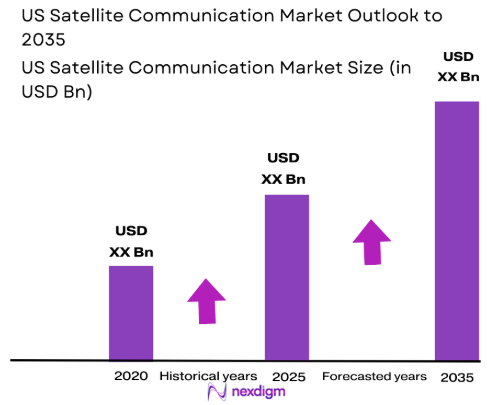
The US Satellite Communication Market has seen steady growth in recent years, reaching a market size of approximately USD ~ billion, driven by the increasing demand for broadband satellite services, military satellite systems, and government investments. The rise of low-earth orbit (LEO) satellites, coupled with advancements in satellite technology, has significantly enhanced communication services for remote areas and military applications. This growth is further fueled by increased reliance on satellite communication for national security and defense purposes, particularly as defense agencies expand their reliance on secure satellite systems.
Dominant countries in the US Satellite Communication Market include the United States, driven by technological advancements and significant investments in space infrastructure. The US has maintained leadership through key players like SpaceX, Lockheed Martin, and Boeing, whose innovative approaches to satellite launches and operations have set the industry standard. Additionally, the country’s regulatory framework and large-scale government projects further support its dominance. Global players are increasingly entering the US market, capitalizing on the country’s defense spending and demand for commercial satellite services.
Market Segmentation
By Product Type
US Satellite Communication Market is segmented by product type into broadband satellite communication systems, military satellite communication systems, commercial satellite communication systems, government satellite communication systems, and hybrid satellite communication systems. Recently, broadband satellite communication systems have a dominant market share due to the increasing demand for global high-speed internet connectivity, particularly in underserved and rural areas. These systems offer enhanced reliability and cost-effective solutions for delivering internet and communications, positioning them as a preferred choice across both commercial and government sectors.

By Platform Type
US Satellite Communication Market is segmented by platform type into geostationary orbit (GEO), low earth orbit (LEO), medium earth orbit (MEO), hybrid satellite systems, and terrestrial-satellite integrated systems. Recently, GEO satellites dominate the market due to their long-established infrastructure, higher coverage capacity, and their role in providing stable communication services. These satellites have been integral in commercial and government applications due to their established reliability in delivering broadband services, weather monitoring, and global communications.

Competitive Landscape
The competitive landscape of the US Satellite Communication Market is shaped by both established players and new entrants seeking to expand their market presence. Major players such as SpaceX, Lockheed Martin, and Boeing have consolidated their positions by investing in cutting-edge satellite technologies and securing long-term government contracts. The influence of large corporations has made it difficult for smaller players to compete at the same level, though technological innovation remains a key factor for differentiation. Government support and funding, along with growing demand for broadband solutions, further fuel market competitiveness.
| Company Name | Establishment Year | Headquarters | Technology Focus | Market Reach | Key Products | Revenue | Key Project or Investment Area |
| SpaceX | 2002 | Hawthorne, CA | ~ | ~ | ~ | ~ | ~ |
| Lockheed Martin | 1912 | Bethesda, MD | ~ | ~ | ~ | ~ | ~ |
| Boeing | 1916 | Chicago, IL | ~ | ~ | ~ | ~ | ~ |
| Viasat | 1986 | Carlsbad, CA | ~ | ~ | ~ | ~ | ~ |
| Hughes Network Systems | 1971 | Germantown, MD | ~ | ~ | ~ | ~ | ~ |

US Satellite Communication Market Analysis
Growth Drivers
Government Investment in Satellite Infrastructure
Government funding has been a significant growth driver for the US Satellite Communication Market. Agencies such as NASA, the Department of Defense, and the Federal Communications Commission (FCC) have continuously invested in space infrastructure and satellite communications to enhance national security and improve broadband accessibility in underserved areas. This investment not only supports military satellite communication systems but also expands commercial and government access to advanced satellite communication technologies. The government’s commitment to space exploration and the development of new satellite technologies ensures continued growth in the market, as new ventures and initiatives are launched regularly. Furthermore, the increasing adoption of satellite communication systems in remote areas to bridge the digital divide contributes to overall market expansion, ensuring that the market will experience sustained demand.
Technological Advancements in Satellite Systems
Technological advancements in satellite communication systems have significantly contributed to the market’s growth. Innovations such as high-throughput satellites (HTS), improved antenna technologies, and advanced encryption methods have enhanced communication speed, security, and data handling capacity. These advancements enable better broadband coverage in rural and hard-to-reach areas, ensuring more equitable access to high-speed internet services. Additionally, the rise of low-earth orbit (LEO) satellite constellations has introduced a more affordable and effective means of providing global communication, creating new growth opportunities for satellite service providers. As satellite communication systems continue to evolve, their applications in defense, telecommunications, and commercial sectors grow, further propelling the market.
Market Challenges
High Launch and Maintenance Costs
The high cost of launching and maintaining satellites remains a key challenge in the US Satellite Communication Market. Satellite launches require significant investment in rocket technology, fuel, and infrastructure, while maintaining satellite systems involves ongoing costs for operation, management, and troubleshooting. These costs are exacerbated by the need for robust security measures to protect satellite systems from cyber threats, which adds another layer of complexity and expense. The capital-intensive nature of satellite deployment and operations means that market players, particularly smaller firms, face barriers to entry and profitability. Furthermore, satellite manufacturers and service providers must ensure that systems are continually upgraded and maintained to stay competitive, contributing to the high cost structure that persists across the market.
Space Debris and Regulatory Compliance
Space debris and regulatory compliance represent another significant challenge in the US Satellite Communication Market. The accumulation of defunct satellites and space junk in low-earth orbit presents a growing risk to active satellite systems, as collisions with debris could disrupt services and result in costly repairs. Regulatory frameworks surrounding satellite launches, debris mitigation, and environmental impact must be adhered to, creating additional operational hurdles for market participants. With more players entering the market and launching constellations of satellites, the risk of space congestion and regulatory compliance issues increases, requiring companies to invest in debris-tracking systems and advanced collision-avoidance technologies. Managing space debris and ensuring regulatory compliance are therefore critical challenges that players in the market must navigate to ensure long-term growth and sustainability.
Opportunities
Expansion of Satellite Internet Access in Rural Areas
One of the most promising opportunities for the US Satellite Communication Market is the expansion of satellite internet access in rural and remote areas. The increasing demand for high-speed internet in underserved regions presents a substantial opportunity for satellite service providers to offer cost-effective, reliable communication services. Government initiatives, such as the Rural Digital Opportunity Fund (RDOF), further incentivize the deployment of broadband infrastructure in rural areas, enabling service providers to tap into new markets. The flexibility of satellite broadband, especially LEO constellations like Star link, is particularly advantageous for expanding connectivity in hard-to-reach locations, driving long-term growth in the satellite communication sector. Additionally, the COVID-19 pandemic has underscored the importance of reliable internet services, creating a lasting demand for satellite broadband solutions.
Satellite-Enabled 5G Connectivity
The integration of satellite communication systems with 5G networks presents a major opportunity for growth. As 5G networks continue to roll out globally, the need for seamless, reliable communication solutions across land, sea, and air has increased. Satellite-based 5G connectivity is expected to enable ubiquitous coverage, especially in remote areas where terrestrial infrastructure is limited. Satellite providers are actively partnering with telecommunications companies to integrate satellite networks with 5G, enabling low-latency, high-speed connectivity across multiple platforms. As 5G adoption accelerates, satellite communication systems will play a critical role in supporting the global connectivity demands of consumers, businesses, and governments. This convergence of satellite and 5G technologies presents a significant growth opportunity for the market over the next decade.
Future Outlook
The US Satellite Communication Market is expected to experience continued growth over the next five years, driven by ongoing technological advancements, increased investment from both government and private sectors, and rising demand for connectivity in remote areas. The market will witness further expansion of LEO and MEO satellite constellations, offering enhanced broadband coverage and low-latency communication solutions. Government support, coupled with the rapid rollout of 5G networks, will create a favorable environment for satellite providers, leading to widespread adoption of satellite-enabled 5G connectivity. The market will also face challenges related to space debris and regulatory compliance, requiring innovative solutions and close collaboration between stakeholders to ensure long-term sustainability.
Major Players
- SpaceX
- Lockheed Martin
- Boeing
- Viasat
- Hughes Network Systems
- SES S.A.
- Inmarsat
- Telesat
- Iridium Communications
- Northrop Grumman
- Thales Group
- Eutelsat
- Globalstar
- OneWeb
- L3 Technologies
Key Target Audience
- Investments and venture capitalist firms
- Government and regulatory bodies
- Military and defense agencies
- Aerospace manufacturers
- Satellite communication providers
- Telecommunications operators
- Internet service providers
- Remote connectivity service providers
Research Methodology
Step 1: Identification of Key Variables
The first step in the research methodology involves identifying key variables that impact the market, such as satellite communication technologies, market demand patterns, and regulatory policies.
Step 2: Market Analysis and Construction
Market analysis is conducted through a combination of primary and secondary research, focusing on satellite system types, platform types, and end-user demand. Data is collected from trusted sources and market reports to construct a comprehensive market framework.
Step 3: Hypothesis Validation and Expert Consultation
The identified hypotheses are validated through consultations with industry experts, key stakeholders, and technology providers. Expert insights help ensure accuracy and relevance in the market analysis.
Step 4: Research Synthesis and Final Output
Finally, the research findings are synthesized into a comprehensive report, with a clear presentation of market trends, growth drivers, challenges, and forecasts. The final output is reviewed for accuracy and presented to stakeholders.

- Executive Summary
- Research Methodology (Definitions, Scope, Industry Assumptions, Market Sizing Approach, Primary & Secondary Research Framework, Data Collection & Verification Protocol, Analytic Models & Forecast Methodology, Limitations & Research Validity Checks)

- Market Definition and Scope
- Value Chain & Stakeholder Ecosystem
- Regulatory / Certification Landscape
- Sector Dynamics Affecting Demand
- Strategic Initiatives & Infrastructure Growth

- Growth Drivers
Government investment in satellite infrastructure
Increased demand for broadband in remote areas
Technological advancements in satellite communication
Expansion of 5G and satellite integration
Rise in satellite communication for military and defense purposes - Market Challenges
High capital investment for satellite launches
Regulatory challenges and licensing issues
Cybersecurity threats to satellite communications
Technological limitations in satellite network coverage
Environmental impact and space debris concerns - Market Opportunities
Rising demand for satellite broadband in underserved regions
Partnerships with private technology firms for innovation
Integration of satellite communication with IoT and 5G networks - Trends
Growth of LEO and MEO satellites
Advancements in satellite-based broadband services
Increase in demand for secure satellite communications
Emergence of commercial satellite constellations
Shift toward hybrid satellite and terrestrial networks - Government Regulations & Defense Policy
Regulations on satellite spectrum allocation
Government funding for satellite infrastructure
Compliance with space debris mitigation policies

- By Market Value, 2020-2025
- By Installed Units, 2020-2025
- By Average System Price, 2020-2025
- By System Complexity Tier, 2020-2025

- By System Type (In Value%)
Broadband Satellite Communication Systems
Military Satellite Communication Systems
Commercial Satellite Communication Systems
Government Satellite Communication Systems
Hybrid Satellite Communication Systems - By Platform Type (In Value%)
Geostationary Orbit (GEO)
Low Earth Orbit (LEO)
Medium Earth Orbit (MEO)
Hybrid Satellite Systems
Terrestrial and Satellite Integrated Systems - By Fitment Type (In Value%)
On-premise Solutions
Cloud-based Solutions
Hybrid Solutions
Mobile Solutions
Integrated Solutions - By End User Segment (In Value%)
Government Agencies
Military Forces
Commercial Enterprises
Telecommunications Providers
Aerospace & Aviation - By Procurement Channel (In Value%)
Direct Procurement
Government Tenders
Private Sector Procurement
Online Bidding Platforms
Third-party Distributors - By Material / Technology (in Value%)
Advanced Antenna Technologies
High-throughput Satellites
Satellite Manufacturing Materials
Communication Technologies (RF, Optical)
Network Management and Encryption Technologies

- Market structure and competitive positioning
- Market share snapshot of major players
- Cross Comparison Parameters (System Type, Platform Type, Procurement Channel, End User Segment, Fitment Type, Material/Technology, Geographic Region, Regulatory Compliance)
- SWOT Analysis of Key Players
- Pricing & Procurement Analysis
- Porter’s Five Forces
- Key Players
SpaceX
Lockheed Martin
Viasat
OneWeb
Intelsat
Hughes Network Systems
SES S.A.
Iridium Communications
Eutelsat
Thales Group
Telesat
Inmarsat
Globalstar
Boeing
L3 Technologies

- Government agencies’ increased reliance on satellite systems for national security
- Military forces’ growing adoption of advanced satellite communication systems
- Telecommunications providers’ demand for expanded coverage and high-speed communication
- Aerospace and aviation industries’ integration of satellite communication for navigation and operational efficiency

- Forecast Market Value, 2026-2035
- Forecast Installed Units, 2026-2035
- Price Forecast by System Tier, 2026-2035
- Future Demand by Platform, 2026-2035


 Request a Sample
 Ask for Customization
 Get a Quote
 Enquire Now