
 Download PDF
Market Overview
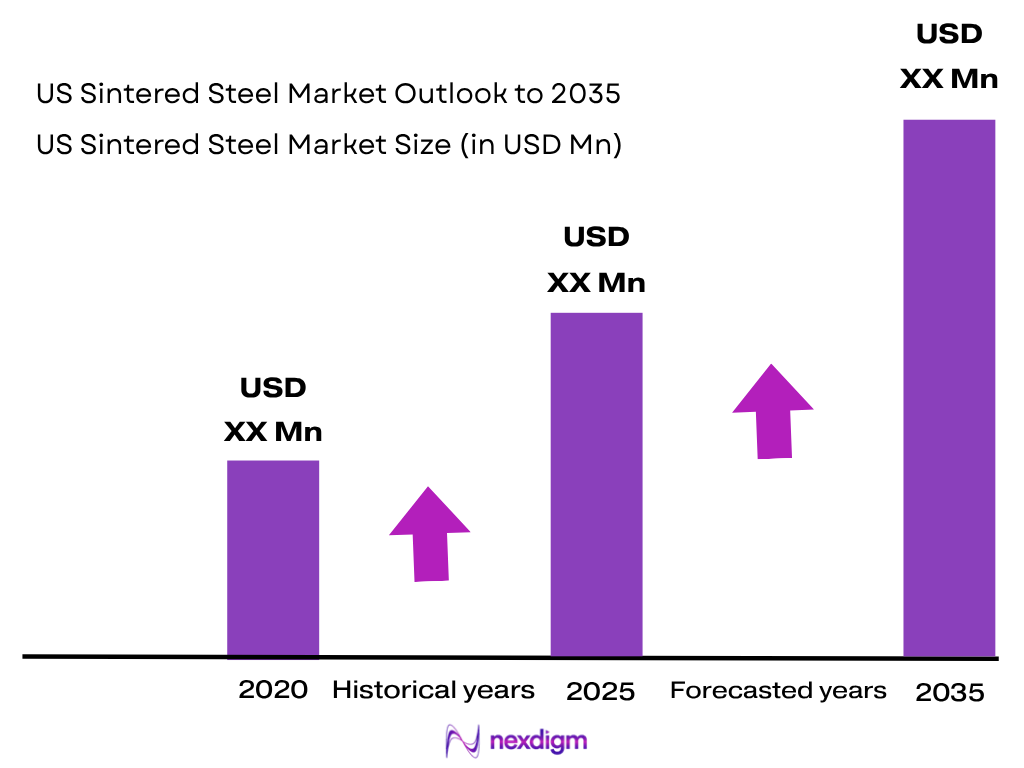
The US Sintered Steel Market is estimated at USD ~X billion in 2024, with the market supported by the country’s exceptionally large automotive, machinery, aerospace, electrical and industrial manufacturing base. US durable-goods manufacturing generated approximately USD 1.525 trillion of economic output in the latest annual data, compared with about USD 1.493 trillion in the preceding period, supporting demand for precision metal components and near-net-shape manufacturing. The US automotive industry produced 10.6 million vehicles and recorded 16.3 million vehicle sales, creating substantial downstream requirements for gears, bushings, structural parts and powertrain components.
The principal US manufacturing centers for sintered steel demand are concentrated around the Midwest, Southeast, Texas and California, reflecting automotive assembly, industrial machinery, aerospace and electronics clusters. Michigan, Ohio, Indiana, Kentucky, Tennessee, Alabama and South Carolina are particularly relevant because of their automotive and component manufacturing ecosystems. The broader aerospace sector generated approximately USD 246.97 billion in shipments and employed 458,799 workers, while machinery manufacturing generated approximately USD 473.89 billion in sales. These industrial concentrations support demand for high-precision, wear-resistant and material-efficient sintered components.
Market Segmentation
By Product Type
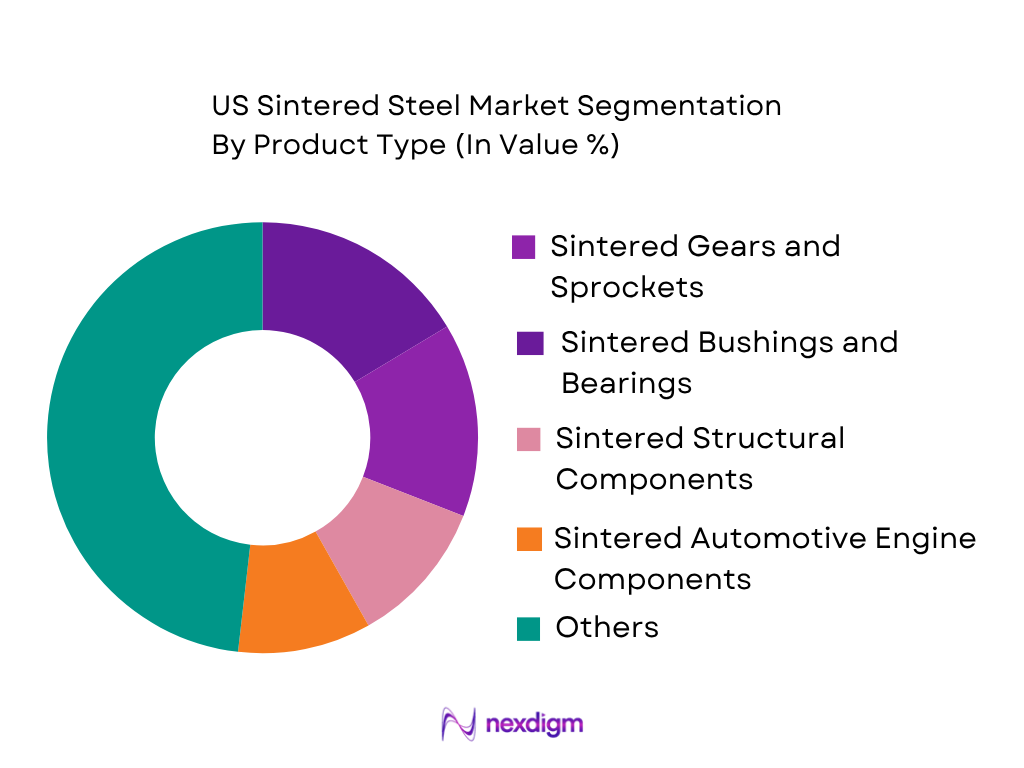
The US Sintered Steel Market is segmented by product type into sintered gears and sprockets, sintered bushings and bearings, sintered structural components, automotive engine components, transmission components, chassis and suspension components, electrical and magnetic components, oil-pump components, compressor components, power-tool components, agricultural equipment components and other precision sintered steel components. Sintered gears and sprockets represent a major application category because powder metallurgy enables repeatable production of complex geometries while reducing material waste and secondary machining requirements. Automotive powertrain and motion-transfer systems require high-volume components with controlled dimensional accuracy, wear resistance and consistent density. The US produced 10.6 million motor vehicles and recorded 16.3 million vehicle sales, establishing a substantial downstream customer base for engineered metal components. Electric motors, industrial machinery, pumps and power tools further broaden demand. The increasing emphasis on near-net-shape manufacturing also supports gears, sprockets, rotors and other geometrically complex components where powder metallurgy can provide manufacturing efficiencies.
By End-Use Industry
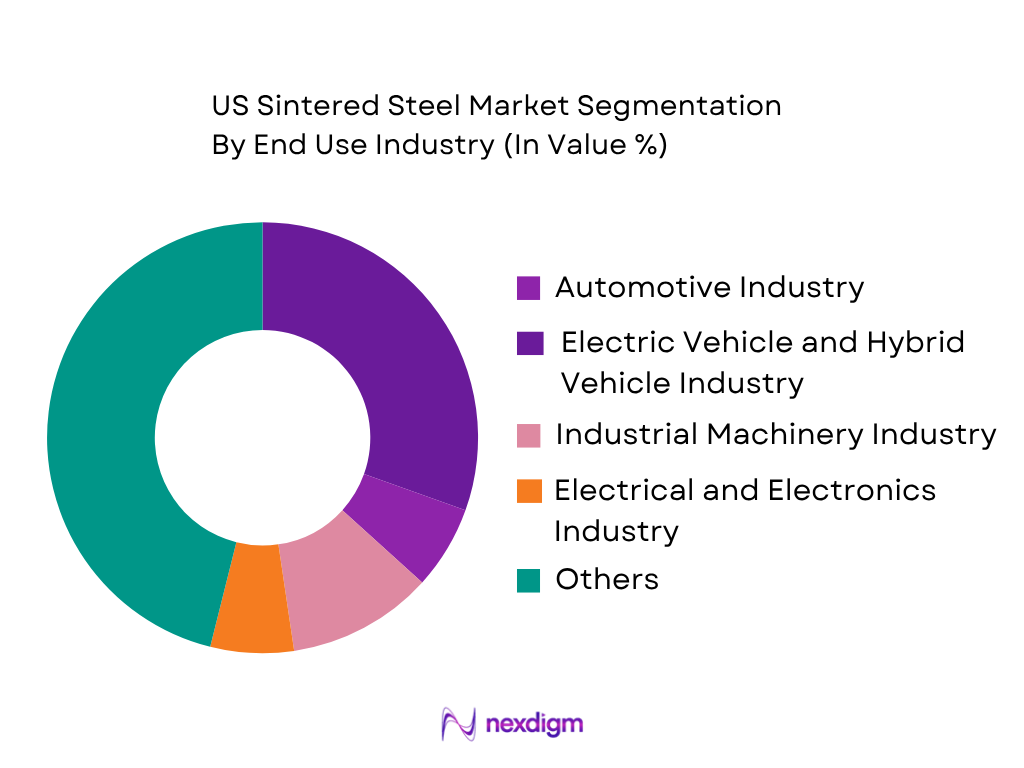
The US Sintered Steel Market is segmented by end-use industry into automotive, electric vehicle and hybrid vehicle, industrial machinery, electrical and electronics, HVAC and refrigeration, power tools, agricultural equipment, aerospace and defense, medical equipment, consumer appliances, energy equipment and precision engineering. Automotive represents a leading application because the US combines high vehicle production with an extensive Tier-1 and Tier-2 component manufacturing ecosystem. Vehicle production reached 10.6 million units, while vehicle sales reached 16.3 million units, supporting recurring requirements for gears, sprockets, bearings, bushings and structural components. Electrification is also expanding the addressable application base: US electric-car sales reached approximately 1.6 million units, with 24 new electric models introduced during the period. Industrial machinery adds another significant demand channel, with US machinery manufacturing recording approximately USD 473.9 billion in sales. Aerospace provides an additional high-value application pathway, with aerospace product and parts manufacturing generating approximately USD 247.0 billion in shipments.
Competitive Landscape
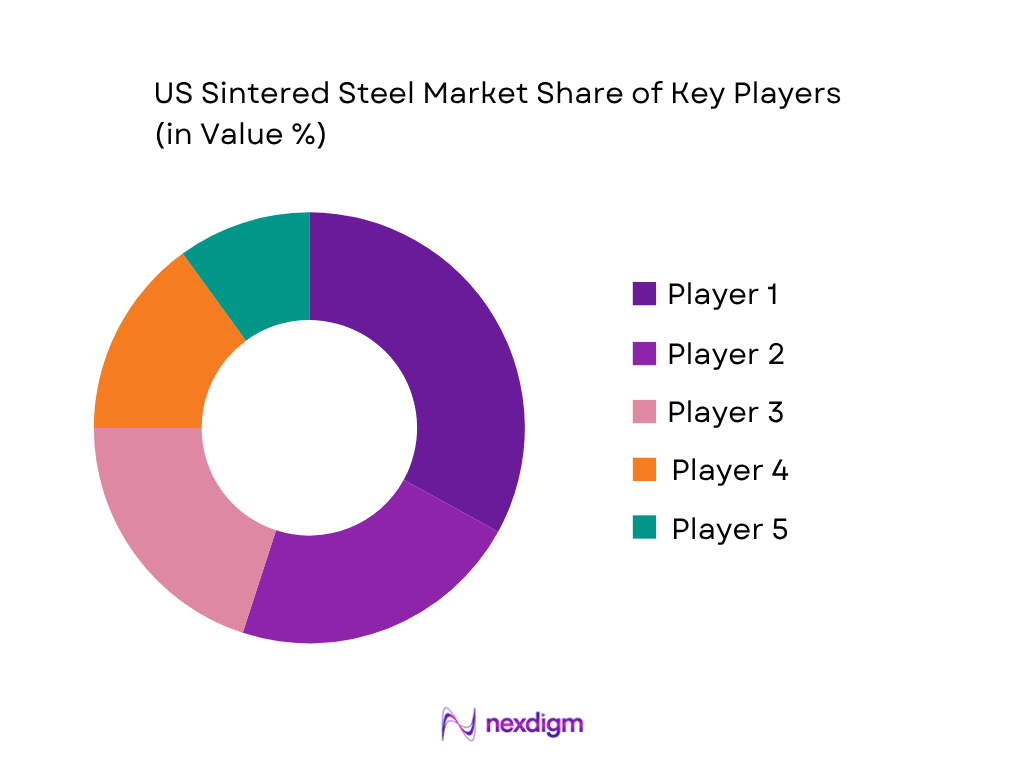
The US Sintered Steel Market comprises specialized powder-metallurgy manufacturers, global engineered-component groups, metal-powder suppliers and precision manufacturing companies serving automotive, industrial, electrical, aerospace and power-tool customers. Competitive differentiation is influenced by component portfolio breadth, powder-material capabilities, compaction technology, sintering capacity, secondary machining, heat treatment and relationships with OEM and Tier-1 customers. The presence of major automotive and industrial manufacturing clusters gives suppliers with domestic production and engineering capabilities access to diverse application markets.
| Company | Establishment Year | Headquarters | Product Portfolio | Automotive Capability | Powder Metallurgy Capability | Secondary Processing | Key End Markets | US Manufacturing Presence |
| Keystone Powdered Metal Company | 1927 | St. Marys, Pennsylvania | ~ | ~ | ~ | ~ | ~ | ~ |
| GKN Powder Metallurgy | 1938 | Birmingham, UK | ~ | ~ | ~ | ~ | ~ | ~ |
| MPP | 1941 | Noblesville, Indiana | ~ | ~ | ~ | ~ | ~ | ~ |
| Burgess-Norton | 1953 | Geneva, Illinois | ~ | ~ | ~ | ~ | ~ | ~ |
| Capstan | 1943 | Los Angeles, California | ~ | ~ | ~ | ~ | ~ | ~ |
US Sintered Steel Market Analysis
Growth Drivers
Expansion of Automotive Production
The expansion of US automotive production is a direct demand driver for sintered steel components because powder metallurgy is extensively used for gears, sprockets, bushings, rotors, structural parts, transmission components, and other near-net-shape automotive applications. US motor-vehicle production reached approximately 10.56 million units in 2024, creating a substantial manufacturing base for engineered metal components. The powder-metallurgy industry reported 246,109 metric tons of iron powder shipments for PM and friction applications in 2024, demonstrating the scale of powder-based component manufacturing across North America. Automotive applications remain particularly important because PM enables repeatable dimensional control and efficient production of complex components at high volumes. The US manufacturing sector also recorded an annual industrial-production index of 96.382 in 2024, compared with 97.268 in 2023, indicating continued large-scale industrial activity despite cyclical pressures. In addition, manufacturing capacity utilization remained around 76% during late 2024, supporting continued utilization of established production infrastructure. These conditions support demand for sintered steel components across conventional vehicles, transmissions, engines, braking systems, and auxiliary systems. As automotive manufacturers continue redesigning components for efficiency, weight reduction, and electrification, sintered steel producers can address both established and emerging component requirements.
Increasing Powder Metal Content in Vehicle Components
Increasing powder-metal content in vehicle components is supported by the manufacturing advantages of sintered steel, particularly material efficiency, dimensional consistency, and the ability to produce complex geometries with limited material waste. North American iron and steel powder shipments reached 273,121 metric tons in 2024, while iron powder directed toward powder-metallurgy and friction applications reached 246,109 metric tons, according to the Metal Powder Industries Federation. The organization also identifies automotive manufacturing as a major outlet for powder-metallurgy components, with automotive applications spanning powertrain, transmission, chassis, body, and other systems. The scale of the downstream automotive industry reinforces this opportunity: US motor-vehicle production was approximately 10.56 million units in 2024, while manufacturing remained a major component of domestic industrial activity. The Federal Reserve reported manufacturing capacity utilization of approximately 76% in late 2024, indicating substantial continuing use of production infrastructure. Sintered steel can support manufacturers seeking near-net-shape production because components can be consolidated into geometries that would otherwise require multiple machining operations. Growth in vehicle electrification also creates opportunities for PM components in electric motors, actuators, thermal-management systems, and other assemblies, allowing powder-metal suppliers to extend beyond traditional internal-combustion applications.
Market Challenges
Volatility in Metal Powder Inputs
Volatility in metal powder inputs represents a significant challenge for the US sintered steel market because production economics depend on consistent availability of iron, steel, nickel, copper, chromium, molybdenum, tungsten, and other alloying materials. North American iron and steel powder shipments were 273,121 metric tons in 2024, down from 290,452 metric tons in 2023, while PM and friction-grade iron powder shipments reached 246,109 metric tons. The same industry data recorded 2024 shipments of 8,614 metric tons of copper and copper-base powders, 3,719 metric tons of nickel powders, 895 metric tons of molybdenum powders, and 2,494 metric tons of tungsten powders, demonstrating the breadth of material inputs used across powder-based manufacturing. Dependence on specialized powders can expose manufacturers to changes in raw-material availability, international supply conditions, transportation disruptions, and alloy-specific qualification requirements. The challenge is particularly relevant for higher-performance sintered steel components where controlled chemistry and powder characteristics are essential to achieving required density, strength, wear resistance, and dimensional stability. Manufacturers therefore need robust supplier qualification, inventory planning, powder characterization, and process-control systems. These requirements can become more important as automotive, aerospace, defense, medical, and industrial customers increasingly require consistent component performance across large production volumes.
High Tooling and Press Investment Requirements
High tooling and press investment requirements can constrain new capacity additions and make market entry more difficult for smaller US sintered steel manufacturers. Conventional press-and-sinter production requires specialized compaction presses, precision tooling, furnaces, powder handling systems, atmosphere controls, sizing equipment, and inspection infrastructure. The importance of this equipment base is reflected in the scale of North American PM activity: total metal-powder shipments reached 325,457 metric tons in 2024, including 273,121 metric tons of iron and steel powders. Manufacturing facilities must maintain sufficient equipment utilization to justify investments while meeting increasingly demanding dimensional and metallurgical specifications. Federal Reserve data show US manufacturing capacity utilization at approximately 76% during late 2024, illustrating that industrial producers were operating below full theoretical capacity. This creates an important investment consideration because additional presses and sintering equipment must be matched with dependable customer demand and production volumes. Qualification requirements can further increase the time and resources needed before newly installed equipment reaches commercial utilization, particularly for automotive, aerospace, defense, and other safety-critical applications. Consequently, established producers with existing tooling libraries, qualified processes, production engineering capabilities, and automated equipment can have structural advantages when customers require rapid component industrialization and consistent high-volume output.
Market Opportunities
Electric Motor and EV Components
Electric motor and EV components represent an important future opportunity for the US sintered steel market because electrification is creating new requirements for compact, efficient, and precisely manufactured magnetic and structural components. The US automotive manufacturing base produced approximately 10.56 million motor vehicles in 2024, providing a large engineering ecosystem through which powder-metallurgy technologies can be adapted to electrified platforms. North American PM and friction applications consumed 246,109 metric tons of iron powder in 2024, confirming the established availability of powder-processing capabilities that can support development of additional applications. Sintered materials can be used in selected motor, actuator, pump, gearing, and structural applications where controlled geometry and material efficiency are important. The opportunity extends beyond complete electric vehicles to hybrid platforms, charging equipment, thermal-management systems, auxiliary motors, and electronically controlled mechanical systems. The US manufacturing sector also maintained substantial production infrastructure, with the Federal Reserve reporting manufacturing capacity utilization around 76% during late 2024. This provides an existing industrial foundation for companies developing new PM applications without relying exclusively on greenfield manufacturing. As vehicle architectures evolve, component suppliers can work with automakers and Tier-1 manufacturers to redesign conventional components for electrified systems, creating additional application pathways for sintered steel, soft-magnetic materials, and advanced powder-based manufacturing processes.
Advanced Powder Metallurgy Materials
Advanced powder-metallurgy materials create opportunities for the US sintered steel market by enabling manufacturers to address applications requiring higher strength, wear resistance, dimensional accuracy, magnetic performance, or improved material utilization. North American shipments in 2024 included 5,225 metric tons of tungsten-carbide powder, 2,494 metric tons of tungsten powder, 895 metric tons of molybdenum powder, 3,719 metric tons of nickel powder, and 5,086 metric tons of stainless-steel powder, demonstrating an established ecosystem of specialized powder materials. Total iron and steel powder shipments reached 273,121 metric tons, providing a substantial base for conventional and advanced PM production. The development of lean-alloy systems, soft-magnetic materials, improved binders, and enhanced powder characteristics can expand the range of components manufactured through sintering. Applications can include automotive actuators, electric-motor components, industrial machinery, energy equipment, aerospace systems, and specialized medical components. Industry developments are also incorporating automated process controls, intelligent equipment, hybrid manufacturing, and AI-assisted process optimization, which can improve consistency and enable more demanding geometries. The combination of established powder availability and technological development provides a pathway for US manufacturers to move into higher-value applications rather than relying solely on traditional commodity-oriented sintered components.
Future Outlook
Over the next decade, the US Sintered Steel Market is expected to be shaped by automotive electrification, continued domestic manufacturing investment, industrial automation and demand for material-efficient component production. Sintered components can support compact designs and repeatable high-volume manufacturing across gears, bearings, magnetic components, structural parts and electric-motor systems. The presence of 1.6 million electric-car sales provides an expanding application environment, while machinery manufacturing generated USD 473.9 billion in sales and aerospace product and parts manufacturing generated approximately USD 247.0 billion in shipments. These conditions create opportunities for higher-performance alloys, greater-density components, advanced sintering and integrated secondary processing.
Major Players
- Keystone Powdered Metal Company
- GKN Powder Metallurgy
- Metal Powder Products Company
- Burgess-Norton
- MPP Corporation
- Phoenix Sintered Metals
- FMS Corporation
- Symmco Inc.
- Atlas Pressed Metals
- Metco Industries
- Sintergy Inc.
- Capstan Inc.
- Dorst America
- Kymera International
- North American Höganäs
Key Target Audience
- Automotive OEMs and Tier-1 Component Manufacturers
- Electric Vehicle and Electric Motor Component Manufacturers
- Industrial Machinery and Power Transmission Manufacturers
- Powder Metallurgy and Sintered Component Manufacturers
- Aerospace and Defense Component Manufacturers
- Investments and Venture Capitalist Firms
- Government and Regulatory Bodies (U.S. Department of Energy, U.S. Department of Commerce, U.S. Department of Defense)
- Metal Powder, Alloy and Advanced Materials Suppliers
Research Methodology
Step 1: Identification of Key Variables
The initial phase involves constructing a comprehensive ecosystem of the US Sintered Steel Market covering metal-powder producers, powder metallurgy manufacturers, tooling suppliers, equipment providers, component manufacturers and downstream OEMs. Variables include powder consumption, component production, material grades, manufacturing processes, application penetration and end-use demand.
Step 2: Market Analysis and Construction
This phase involves compiling historical and current information on US powder-metallurgy production, automotive manufacturing, machinery production, aerospace manufacturing and industrial component demand. Top-down analysis evaluates downstream manufacturing activity, while bottom-up analysis assesses component applications, production volumes, manufacturing capacity and supplier-level activity.
Step 3: Hypothesis Validation and Expert Consultation
Market hypotheses are validated through consultations with powder-metallurgy manufacturers, automotive component suppliers, industrial equipment producers, material suppliers and manufacturing specialists. Interviews are used to examine component adoption, production processes, material preferences, qualification requirements, capacity utilization and technology-development priorities.
Step 4: Research Synthesis and Final Output
The final stage triangulates government statistics, industry production information, company disclosures and primary industry insights. Supply-side and demand-side findings are reconciled to establish market segmentation, competitive positioning, application-level analysis and the forecast framework for the US Sintered Steel Market.

- Executive Summary
- Research Methodology (Market Definition and Scope, US Sintered Steel Market Classification, Powder Metallurgy Process Mapping, Ferrous Powder Material Assessment, Compaction Technology Evaluation, Sintering Furnace Technology Assessment, Secondary Processing Analysis, Heat Treatment Evaluation, Surface Densification Assessment, Metal Injection Molding Assessment, Sintered Steel Component Application Mapping, Automotive Component Assessment, Industrial Component Evaluation, Electric Motor Component Assessment, Aerospace Component Assessment, Medical Component Evaluation, Market Sizing Framework, Top-Down Analysis, Bottom-Up Analysis, Demand-Side Assessment, Supply-Side Assessment, Primary Industry Interviews, Data Triangulation, Forecasting Framework)

- Definition and Scope
- US Sintered Steel Industry Evolution
- Sintered Steel Value Chain Analysis
- Sintered Steel Supply Chain Analysis

- Growth Drivers (Expansion of Automotive Production, Increasing Powder Metal Content in Vehicle Components, Growth of Electric Motor Applications, Rising Demand for Lightweight Components, Expansion of Industrial Machinery Manufacturing, Increasing Automation in Manufacturing, Demand for Material-Efficient Production, Growth of Precision Engineered Components, Expansion of Domestic Manufacturing Capacity)
- Market Challenges (Volatility in Metal Powder Inputs, High Tooling and Press Investment Requirements, Energy Requirements for Sintering, Material Qualification Requirements, Manufacturing Yield Management, Competition from Machining and Forging, Technical Expertise Requirements, Dependence on Specialized Equipment, Component Design Limitations, Qualification Requirements for Safety-Critical Applications)
- Market Opportunities (Electric Motor and EV Components, Advanced Powder Metallurgy Materials, High-Performance Automotive Components, Aerospace Powder Metal Applications, Medical and Healthcare Components, Industrial Automation Components, Soft Magnetic Components, Sustainable Material-Efficient Manufacturing, Advanced Sintering Technologies, Powder-Based Additive Manufacturing)
- Market Trends (High-Density Powder Metal Components, Greater Alloying of Ferrous Powders, Electrification of Automotive Systems, Powder Metallurgy for Electric Motors, Advanced Sintering Furnace Technology, Increased Secondary Processing, Digital Process Monitoring, Near-Net-Shape Manufacturing, Sustainable Powder Utilization, Integration of Additive Manufacturing)
- Government Regulations and Standards (US EPA Environmental Requirements, OSHA Manufacturing Safety Requirements, ASTM Powder Metallurgy Standards, MPIF Material Standards, SAE Automotive Material Standards, ASME Industrial Component Standards, Federal Acquisition Requirements, EPA Air Emissions Requirements, Hazard Communication Standards, Occupational Exposure Requirements)
- SWOT Analysis
- Porter’s Five Forces Analysis
- PESTLE Analysis
- Stakeholder Ecosystem
- Competition Ecosystem

- By Market Value (2020-2025)
- By Production Volume (2020-2025)
- By Sintered Steel Component Volume (2020-2025)
- By Ferrous Metal Powder Consumption Volume (2020-2025)
- By Press-and-Sinter Production Volume (2020-2025)

- By Product Type (In Value %)
Sintered Bushings and Bearings
Sintered Structural Components
Sintered Automotive Engine Components
Sintered Transmission Components
Sintered Chassis and Suspension Components
Sintered Electrical and Magnetic Components
Sintered Oil Pump Components
Sintered Compressor Components
Sintered Power Tool Components
Sintered Agricultural Equipment Components
Other Precision Sintered Steel Components - By Material Grade (In Value %)
Iron-Carbon Sintered Steel
Low-Alloy Sintered Steel
Nickel-Alloy Sintered Steel
Copper-Alloy Sintered Steel
Chromium-Molybdenum Sintered Steel
Stainless Sintered Steel
High-Strength Low-Alloy Sintered Steel
Nickel-Copper-Molybdenum Sintered Steel
Diffusion-Alloyed Sintered Steel
Soft Magnetic Sintered Steel - By Manufacturing Process (In Value %)
Conventional Press-and-Sinter
High-Velocity Compaction
Warm Compaction
Double-Press Double-Sinter
Metal Injection Molding
Hot Isostatic Pressing
Cold Isostatic Pressing
Additive Manufacturing and Powder-Based Processing
Secondary Machining and Finishing - By Application Area (In Value %)
Automotive Powertrain
Automotive Chassis and Suspension
Electric Motor and Actuator Systems
Industrial Machinery
HVAC and Refrigeration
Power Tools
Agricultural Equipment
Aerospace and Defense
Medical and Healthcare Equipment
Consumer Appliances
Electrical and Electronics
Energy and Power Equipment - By End-Use Industry (In Value %)
Automotive Industry
Electric Vehicle and Hybrid Vehicle Industry
Industrial Machinery Industry
Electrical and Electronics Industry
HVAC and Refrigeration Industry
Power Tools Industry
Agricultural Equipment Industry
Aerospace and Defense Industry
Medical Equipment Industry
Consumer Appliances Industry
Energy Equipment Industry
Precision Engineering Industry - By Region (In Value %)
Midwest USA
Southeast USA
Northeast USA
Southwest USA
West Coast USA
Mountain States
Central Plains
Other US Regions

- Market Share of Major Players (By US Revenue, Production Capacity, Sintered Component Portfolio, Automotive Component Coverage, Industrial Component Coverage, Material Grade Portfolio, Press-and-Sinter Capability, Secondary Processing Capability, Manufacturing Footprint, Customer Base, OEM Relationships, Quality Certifications, Technology Portfolio, R&D Capability, Regional Presence)
- Cross Comparison Parameters (Sintered Component Portfolio Breadth, Press-and-Sinter Production Capability, Ferrous Powder Material Technology, Automotive Component Manufacturing Capability, High-Density Component Capability, Secondary Machining and Heat Treatment Capability, Electric Motor Component Expertise, Advanced Sintering Technology Capability)
- SWOT Analysis of Major Players
- Detailed Profiles of Major Companies
Keystone Powdered Metal Company
GKN Powder Metallurgy / GKN Hoeganaes Corporation
Metal Powder Products Company
Burgess-Norton Mfg. Co.
MPP Corporation
Phoenix Sintered Metals LLC
FMS Corporation
Symmco Inc.
Atlas Pressed Metals
Metco Industries Inc.
Sintergy Inc.
Capstan Inc.
Dorst America Inc.
Kymera International
North American Höganäs Co.

- Automotive OEM Procurement Assessment
- Electric Vehicle Component Requirement Assessment
- Industrial Machinery Procurement Assessment
- Electrical Motor Manufacturer Requirement Analysis
- Power Tool Manufacturer Demand Assessment
- HVAC and Compressor Component Requirement Assessment

- By Market Value (2026-2035)
- By Production Volume (2026-2035)
- By Sintered Steel Component Volume (2026-2035)
- By Ferrous Metal Powder Consumption Volume (2026-2035)
- By Press-and-Sinter Production Volume (2026-2035)


 Request a Sample
 Ask for Customization
 Get a Quote
 Enquire Now