
 Download PDF
 Download PDF
Market Overview
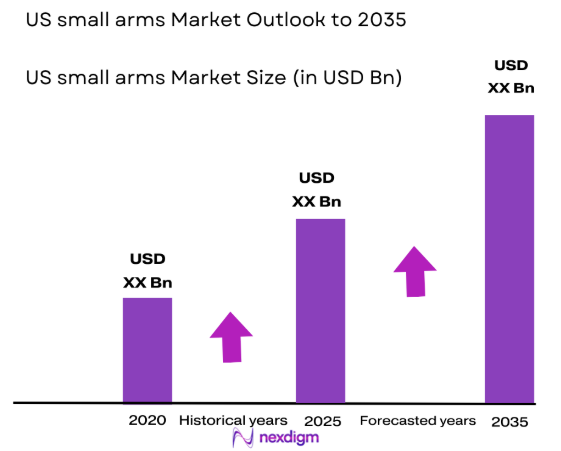
The US small arms market reached USD ~ billion based on a recent historical assessment, supported by sustained civilian firearm purchases, federal and state law enforcement procurement cycles, and military modernization programs emphasizing modular rifles and sidearms. Demand has been reinforced by domestic manufacturing capacity, strong brand loyalty among consumers, and accessory ecosystem expansion. Government contracts for standard service weapons and ammunition compatibility upgrades further contribute to steady revenue generation across commercial and defense supply chains nationwide.
The United States dominates the global small arms ecosystem through concentrated manufacturing clusters in states such as New Hampshire, Massachusetts, Connecticut, and Arizona, supported by legacy firearms engineering expertise and advanced machining infrastructure. Federal procurement hubs in Virginia and Maryland and large civilian distribution networks across Texas and Florida reinforce demand concentration. Strong sporting culture, widespread licensed retail networks, and established defense contractors ensure sustained domestic leadership in production, innovation, and distribution scale across military, law enforcement, and civilian segments.
Market Segmentation
By Product Type
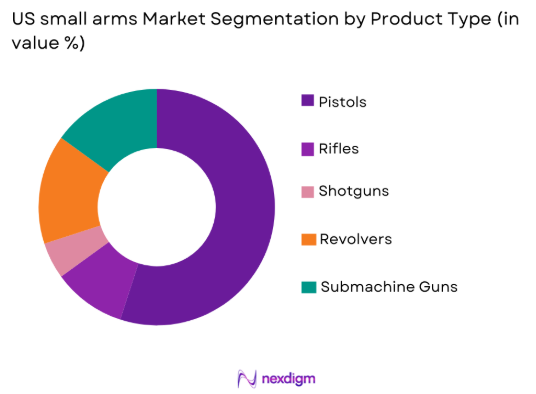
US Small Arms market is segmented by product type into pistols, revolvers, rifles, shotguns, and submachine guns. Recently, pistols has a dominant market share due to factors such as demand patterns, brand presence, infrastructure availability, or consumer preference. Pistols dominate because they serve the largest civilian self-defense segment and standard law enforcement sidearm requirements, supported by extensive domestic production and aftermarket accessories. Concealed carry adoption and ergonomic polymer-frame designs increased consumer accessibility and replacement cycles. Military transition toward modular handgun systems further expanded procurement. Retail distribution networks favor compact handguns with high turnover rates. Ammunition standardization around common calibers improves affordability and training compatibility. Established manufacturers maintain strong brand loyalty and continuous model refreshes. Competitive pricing across entry-level to premium tiers widens adoption. Law enforcement contracts create stable baseline demand volumes.
By Platform Type
US Small Arms market is segmented by platform type into military platforms, law enforcement platforms, civilian sporting platforms, private security platforms, and special operations platforms. Recently, civilian sporting platforms has a dominant market share due to factors such as demand patterns, brand presence, infrastructure availability, or consumer preference. Civilian sporting platforms lead because recreational shooting, hunting, and personal defense collectively represent the largest ownership base nationwide. Extensive licensed dealer networks and shooting ranges support continuous purchases and upgrades. Consumer preferences favor modular rifles and handguns adaptable to multiple sporting applications. Marketing, brand communities, and accessory customization ecosystems reinforce repeat purchases. Federal procurement cycles are periodic, whereas civilian demand remains continuous. Cultural acceptance and regulatory frameworks enable widespread ownership across states. Competitive pricing tiers and financing options increase accessibility. Seasonal hunting cycles sustain recurring equipment sales.

Competitive Landscape
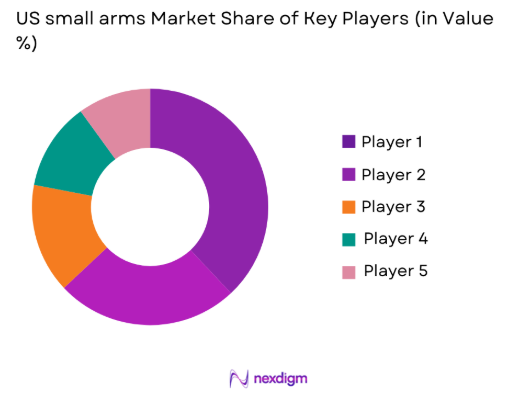
The US small arms market is moderately consolidated, with several long-established domestic manufacturers controlling core handgun and rifle segments while niche precision and tactical producers serve specialized military and enthusiast markets. Vertical integration in machining, barrel production, and assembly strengthens cost control and quality assurance. Major players maintain extensive distribution and government procurement channels, reinforcing brand dominance. Continuous product innovation, ergonomic improvements, and modular accessory compatibility sustain competitive differentiation across civilian, law enforcement, and defense customer groups.
| Company Name | Establishment Year | Headquarters | Technology Focus | Market Reach | Key Products | Revenue | Primary End-User Segment |
| Smith & Wesson Brands Inc. | 1852 | Springfield, Massachusetts | ~ | ~ | ~ | ~ | ~ |
| Sturm Ruger & Co Inc. | 1949 | Southport, Connecticut | ~ | ~ | ~ | ~ | ~ |
| SIG Sauer Inc. | 1853 | Newington, New Hampshire | ~ | ~ | ~ | ~ | ~ |
| Glock Inc. | 1963 | Smyrna, Georgia | ~ | ~ | ~ | ~ | ~ |
| FN America LLC | 1889 | McLean, Virginia | ~ | ~ | ~ | ~ | ~ |
US Small Arms Market Analysis
Growth Drivers
Military and Law Enforcement Modernization Programs
Replacement of legacy service pistols and rifles with modular platforms is driving sustained procurement cycles across federal and state agencies. Standardization initiatives prioritize interoperability, accessory compatibility, and improved ergonomics, accelerating adoption of new weapon generations. Domestic defense spending stability ensures multi-year procurement contracts that secure baseline manufacturer revenues. Training doctrine updates emphasizing optics and suppressor readiness necessitate equipment upgrades. Homeland security initiatives expand armament requirements across border and tactical units. Special operations modernization influences broader procurement specifications. Domestic manufacturing mandates favor local suppliers, reinforcing industry growth. Lifecycle replacement policies ensure recurring demand beyond initial acquisition.
Civilian Personal Defense and Sporting Demand Expansion
Rising personal safety concerns and recreational shooting participation sustain firearm purchases across multiple demographics. Concealed carry licensing growth increases handgun ownership among first-time buyers. Competitive shooting sports popularity drives upgrades and accessory purchases. Hunting traditions maintain steady rifle and shotgun demand across states. Retail financing options improve affordability for consumers. Online communities and brand loyalty encourage repeat purchases and product diversification. Extensive dealer networks ensure widespread availability and service support. Aftermarket customization culture expands overall spending per firearm owner.
Market Challenges
Stringent Regulatory and Compliance Environment
Federal licensing requirements, state restrictions, and evolving compliance standards create operational complexity for manufacturers and distributors. Regulatory uncertainty influences product design and marketing strategies. Compliance costs increase administrative overhead and certification timelines. Interstate sales regulations complicate distribution logistics. Export control frameworks restrict international market expansion. Liability concerns and litigation risks affect brand reputation and insurance costs. Background check systems impact retail transaction speed and conversion rates. Policy debates introduce periodic demand volatility.
Market Saturation and Replacement Cycle Extension
High firearm ownership levels in mature civilian segments reduce first-time buyer growth potential. Durable product lifespans extend replacement intervals, limiting repeat sales frequency. Secondary resale markets absorb demand that might otherwise support new production. Economic fluctuations influence discretionary sporting purchases. Inventory overhang during demand surges leads to later contraction phases. Price competition compresses margins in entry-level categories. Consumer preference stability slows product differentiation impact. Retail channel consolidation reduces shelf space for smaller manufacturers.
Opportunities
Integration of Smart Safety and Tracking Technologies
Development of biometric authentication and digital tracking systems enables differentiation in regulated environments and institutional procurement. Law enforcement agencies seek accountability and asset management capabilities for issued weapons. Smart safety features can address accidental discharge concerns and liability risks. Integration with training analytics platforms enhances user performance monitoring. Government funding for safety innovation supports research investments. Premium technology features create higher-margin product segments. International export markets with stricter regulations favor smart-enabled firearms. Partnerships with electronics suppliers accelerate innovation cycles.
Expansion of Modular Accessory and Upgrade Ecosystems
Modular rail systems and interchangeable components allow manufacturers to generate recurring revenue beyond initial firearm sales. Consumers increasingly customize optics, grips, triggers, and suppressor interfaces to meet specific use cases. Accessory ecosystems strengthen brand loyalty and cross-selling opportunities. Military procurement trends toward modular rifles reinforce civilian adoption patterns. Aftermarket compatibility encourages third-party supplier participation and platform standardization. Retailers benefit from higher transaction values through bundled sales. Digital configuration tools enhance consumer engagement and product differentiation.
Future Outlook
The US small arms market is expected to maintain steady expansion supported by modernization procurement, sustained civilian ownership, and continued domestic manufacturing leadership. Technological developments in modular design, lightweight materials, and smart safety integration will shape product evolution. Regulatory stability and defense funding continuity will support institutional demand, while sporting and personal defense segments sustain commercial sales. Accessory ecosystems and premium product tiers will drive value growth across the next five-year horizon.
Major Players
- Smith & Wesson Brands Inc.
- Sturm Ruger & Co Inc.
- SIG Sauer Inc.
- Glock Inc.
- FN America LLC
- Colt’s Manufacturing Company LLC
- Heckler & Koch USA Inc.
- Daniel Defense LLC
- Barrett Firearms Manufacturing Inc.
- Springfield Armory Inc.
- Kimber Manufacturing Inc.
- Savage Arms Inc.
- Beretta USA Corp.
- Bushmaster Firearms International LLC
- Remington Arms Company LLC
Key Target Audience
- Military procurement agencies
- Federal law enforcement agencies
- State and local police departments
- Firearms distributors and retailers
- Shooting sports organizations
- Private security firms
- Investments and venture capitalist firms
- Government and regulatory bodies
Research Methodology
Step 1: Identification of Key Variables
The research identified critical variables including product categories, end-user segments, procurement channels, and pricing structures across civilian, law enforcement, and military markets. Regulatory frameworks and manufacturing capacity indicators were incorporated. Demand drivers such as personal defense trends and procurement modernization were assessed. Data normalization ensured comparability across sources.
Step 2: Market Analysis and Construction
Market size and segmentation were constructed using shipment volumes, manufacturer revenues, and procurement records synthesized into unified estimates. Segment shares were derived from product mix distributions and sales channel data. Historical patterns and institutional procurement cycles informed structural modeling. Cross-validation ensured internal consistency across segments.
Step 3: Hypothesis Validation and Expert Consultation
Assumptions regarding demand drivers, regulatory effects, and technology adoption were tested against expert interviews and industry publications. Manufacturer disclosures and procurement data provided validation checkpoints. Scenario comparisons assessed sensitivity to regulatory and economic factors. Adjustments refined segment dominance conclusions.
Step 4: Research Synthesis and Final Output
Validated datasets were consolidated into a structured analytical framework aligning segmentation, competitive landscape, and market dynamics. Findings were synthesized into narrative insights and quantitative tables. Consistency checks ensured methodological transparency and reproducibility. Final outputs were formatted to standardized market reporting conventions.

- Executive Summary
- Research Methodology (Definitions, Scope, Industry Assumptions, Market Sizing Approach, Primary & Secondary Research Framework, Data Collection & Verification Protocol, Analytic Models & Forecast Methodology, Limitations & Research Validity Checks)

- Market Definition and Scope
- Value Chain & Stakeholder Ecosystem
- Regulatory / Certification Landscape
- Sector Dynamics Affecting Demand
- Strategic Initiatives & Infrastructure Growth

- Growth Drivers
Rising modernization programs across military and law enforcement agencies
Increased civilian demand for personal defense firearms
Advancements in lightweight materials and modular weapon design
Expanding homeland security and border protection initiatives
Growth of shooting sports and recreational firearms ownership - Market Challenges
Stringent federal and state firearm regulations affecting sales channels
Supply chain constraints in ammunition and component sourcing
Public policy scrutiny and litigation risks for manufacturers
High compliance costs for safety and export control standards
Market saturation in certain civilian firearm categories - Market Opportunities
Integration of smart weapon safety and tracking technologies
Expansion in modular upgrade kits and accessory ecosystems
Export growth through allied defense procurement partnerships - Trends
Shift toward modular and multi-caliber weapon platforms
Adoption of optics-ready and suppressor-compatible designs
Increasing use of polymer and hybrid material frames
Growth in compact concealed carry firearm segment
Digital manufacturing and precision machining adoption - Government Regulations & Defense Policy
Federal Firearms Act compliance and ATF oversight evolution
State-level firearm control legislation and licensing frameworks
Defense procurement standards and export control regulations

- By Market Value, 2020-2025
- By Installed Units, 2020-2025
- By Average System Price, 2020-2025
- By System Complexity Tier, 2020-2025

- By System Type (In Value%)
Pistols
Revolvers
Rifles
Shotguns
Submachine Guns - By Platform Type (In Value%)
Infantry Platforms
Law Enforcement Patrol Platforms
Special Forces Platforms
Civilian Sporting Platforms
Private Security Platforms - By Fitment Type (In Value%)
Standard Issue Weapons
Modular Accessory Ready Weapons
Suppressor Ready Weapons
Optics Ready Weapons
Compact Concealed Carry Weapons - By End User Segment (In Value%)
Military Forces
Federal Law Enforcement Agencies
State and Local Police
Civilian Consumers
Private Security Contractors - By Procurement Channel (In Value%)
Direct Government Contracts
Authorized Defense Distributors
Commercial Firearms Retailers
Online Licensed Dealers
Law Enforcement Procurement Programs - By Material / Technology (in Value %)
Polymer Frame Systems
Steel Frame Systems
Aluminum Alloy Systems
Modular Rail Integration
Electronic Smart Fire Control

- Market structure and competitive positioning
- Market share snapshot of major players
- Cross Comparison Parameters (Caliber Range, Effective Range, Weight, Magazine Capacity, Fire Mode, Material Construction, Accessory Compatibility, Unit Cost, Compliance Standards)
- SWOT Analysis of Key Players
- Pricing & Procurement Analysis
- Porter’s Five Forces
- Key Players
Smith & Wesson Brands Inc.
Sturm Ruger & Co Inc.
Colt’s Manufacturing Company LLC
Remington Arms Company LLC
SIG Sauer Inc.
Glock Inc.
FN America LLC
Daniel Defense LLC
Heckler & Koch USA Inc.
Barrett Firearms Manufacturing Inc.
Bushmaster Firearms International LLC
Savage Arms Inc.
Kimber Manufacturing Inc.
Springfield Armory Inc.
Beretta USA Corp.

- Military demand driven by standardization and lifecycle replacement programs
- Law enforcement focus on reliability, ergonomics, and interoperability
- Civilian market shaped by personal defense and recreational usage trends
- Private security sector emphasizing compact and low-recoil platforms

- Forecast Market Value, 2026-2035
- Forecast Installed Units, 2026-2035
- Price Forecast by System Tier, 2026-2035
- Future Demand by Platform, 2026-2035


 Request a Sample
 Ask for Customization
 Get a Quote
 Enquire Now