

 Download PDF
 Download PDF
Market Overview
The US Small UAV market is poised to grow significantly, driven by the rising demand for unmanned aerial systems across various industries. Based on a recent historical assessment, the market size for small UAVs in the US is expected to surpass USD ~ billion in value. This growth is fueled by technological advancements in drone systems, increased demand in sectors like agriculture, logistics, and defense, and evolving regulations that promote UAV usage. UAVs are being increasingly employed for applications such as surveillance, aerial imaging, and delivery services, contributing to their widespread adoption. The market is also expected to be shaped by the growing integration of AI and automation, improving operational efficiency and functionality.
The US Small UAV market is dominated by several key regions, including California, Texas, and Florida, which are at the forefront of UAV adoption. These areas benefit from a strong tech infrastructure, access to venture capital funding, and a conducive regulatory environment that promotes innovation. Silicon Valley remains a significant hub for drone startups, attracting investments that fuel technological advancements and support growing demand across industries. Government agencies, such as the Federal Aviation Administration (FAA), are also playing a critical role by establishing clear frameworks that govern UAV operations. The proliferation of UAVs in these regions is a direct reflection of a combination of innovation, regulatory support, and industry demand.

Market Segmentation
By Product Type
The US Small UAV market is segmented by product type into fixed-wing, rotary-wing, hybrid, nano, and tethered UAVs. Recently, fixed-wing UAVs have dominated the market share, mainly due to their ability to cover larger areas and provide longer flight durations compared to other types. These UAVs are highly favored for applications in surveillance, agriculture, and mapping, where longer operational times and more extensive coverage are essential. Furthermore, the continuous technological innovations in battery life and flight capabilities have enhanced their performance, further solidifying their dominance in the market. Their versatility across different sectors and improved cost-effectiveness contribute significantly to their market-leading position.

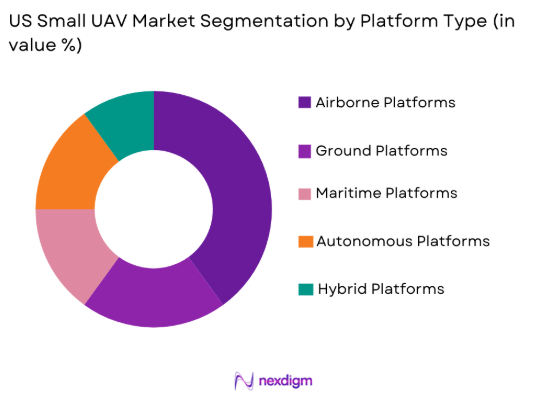
By Platform Type
The US Small UAV market is segmented by platform type into airborne, ground, maritime, autonomous, and hybrid platforms. Recently, airborne platforms have taken the lead in market share due to their significant demand in commercial, defense, and security applications. Airborne UAVs offer high versatility and operational flexibility for surveillance, reconnaissance, and delivery purposes, making them indispensable in industries like logistics and defense. Their ability to cover large areas at high altitudes has further increased their utility, driving demand across various sectors. The continuing advancements in drone technology, particularly in terms of payload capacity and flight stability, continue to strengthen airborne UAVs’ position as the dominant platform type.
Competitive Landscape
The US Small UAV market is characterized by high competition, with major players vying for market share through continuous innovation, product launches, and strategic partnerships. The market is becoming increasingly consolidated, with several companies focusing on technological advancements such as improved battery life, automation, and AI integration. The competition is mainly between well-established firms and emerging startups, leading to a dynamic market environment. Key players are not only focused on expanding their product portfolios but are also exploring regulatory compliance and infrastructure development to maintain their market position.
| Company Name | Establishment Year | Headquarters | Technology Focus | Market Reach | Key Products | Revenue | Additonal Parameters |
| AeroVironment | 1971 | Simi Valley, CA | ~ | ~ | ~ | ~ | ~ |
| DJI | 2006 | Shenzhen, China | ~ | ~ | ~ | ~ | ~ |
| Parrot | 1994 | Paris, France | ~ | ~ | ~ | ~ | ~ |
| Northrop Grumman | 1939 | Falls Church, VA | ~ | ~ | ~ | ~ | ~ |
| Textron Systems | 1947 | Providence, RI | ~ | ~ | ~ | ~ | ~ |

US Small UAV Market Analysis
Growth Drivers
Increased adoption of UAVs in defense and surveillance
The US Small UAV market is driven by the growing use of UAVs in military applications, particularly in surveillance and reconnaissance missions. UAVs provide tactical advantages, offering surveillance capabilities without risking human life. As defense spending increases, military agencies are investing heavily in advanced small UAV systems. This driver is further supported by technological advancements such as AI integration, which enhances UAV performance in intelligence gathering. The ability to operate in harsh environments also contributes to the widespread adoption of small UAVs in defense. Moreover, with the US military increasingly relying on unmanned systems, the demand for small UAVs is expected to continue growing in the coming years, creating a strong market pull.
Commercial sector demand for delivery and logistics solutions
The increasing use of small UAVs in commercial applications such as delivery and logistics is another significant growth driver. As consumer expectations for faster delivery times rise, companies are turning to UAVs to streamline last-mile deliveries. Retail giants and logistics companies, including Amazon and UPS, are investing heavily in UAV technology to enable efficient and cost-effective delivery systems. The regulatory environment is also becoming more favorable for commercial UAV operations, contributing to an increased adoption rate. Additionally, advancements in battery life, payload capacity, and autonomous navigation technology are enhancing the commercial viability of small UAVs, positioning them as an essential solution for the logistics and delivery sectors.
Market Challenges
Regulatory hurdles and airspace management
One of the biggest challenges facing the US Small UAV market is regulatory restrictions and airspace management. Although UAV adoption is growing rapidly, government regulations and airspace restrictions remain significant barriers to widespread commercial deployment. The Federal Aviation Administration (FAA) has stringent rules in place regarding UAV flight operations, limiting their usage in certain airspaces and altitudes. These regulations, while crucial for safety, can hinder the speed of market growth and the expansion of UAV services. Moreover, the lack of standardized regulations across different states and regions adds complexity for operators, further limiting UAV market opportunities. Overcoming these regulatory hurdles will be essential for the continued growth of the UAV market.
Security and privacy concerns
Security and privacy issues associated with UAV operations present another challenge for the US Small UAV market. As UAVs collect large amounts of data, especially in surveillance and mapping applications, there is growing concern over data protection and unauthorized access. The vulnerability of UAV systems to cyberattacks is another issue that could impede adoption, particularly in sectors such as defense and commercial logistics. Additionally, privacy concerns regarding the use of UAVs in residential areas for surveillance purposes could lead to public pushback, causing regulatory bodies to impose stricter limitations on their usage. Addressing these security and privacy concerns will be crucial for companies looking to operate in this growing market.
Opportunities
Emerging demand for UAVs in agriculture and precision farming
One of the biggest opportunities in the US Small UAV market lies in their growing use in agriculture and precision farming. UAVs can provide farmers with critical data for crop monitoring, pest control, and irrigation management. By using UAVs for these tasks, farmers can achieve higher yields and reduce resource wastage, contributing to sustainable agriculture practices. The increasing demand for precision agriculture, driven by the need for more efficient farming techniques, is expected to accelerate the adoption of UAVs in this sector. Additionally, the integration of AI and machine learning with UAV technology enables farmers to obtain more accurate and actionable insights, driving demand for small UAVs in agriculture.
Growth in urban air mobility and autonomous delivery systems
The US Small UAV market is also poised to benefit from the growth of urban air mobility (UAM) and autonomous delivery systems. As cities become more congested, UAVs offer a viable solution for reducing traffic and providing faster delivery times. The rise of e-commerce and on-demand services is increasing the need for rapid delivery solutions, which can be effectively met by UAVs. Additionally, developments in autonomous navigation and battery technology are making UAVs more viable for urban air mobility applications. This presents a significant opportunity for companies in the small UAV market to tap into the rapidly growing UAM space, offering new services that cater to the evolving needs of urban consumers.
Future Outlook
The future of the US Small UAV market looks promising, with substantial growth expected in the coming years. The market will be driven by advancements in technology, particularly in AI, battery efficiency, and autonomous systems. Regulatory support, such as the ongoing development of rules by the FAA, will help open up new avenues for UAV operations, especially in commercial and urban settings. The demand for UAVs in defense, logistics, and agriculture will continue to expand, while emerging applications in urban air mobility and autonomous delivery will further fuel market growth. As drone technology becomes more advanced and accessible, the US Small UAV market is expected to experience a steady upward trajectory, positioning UAVs as a key enabler of modern industry.
Major Players
- AeroVironment
- DJI
- Parrot
- Northrop Grumman
- Textron Systems
- Insitu
- Quantum Systems
- Delair
- FLIR Systems
- Boeing
- L3 Technologies
- Kratos Defense & Security Solutions
- Skyward (a Verizon company)
- Lockheed Martin
- General Atomics
Key Target Audience
- Investments and venture capitalist firms
- Government and regulatory bodies
- Defense contractors
- UAV manufacturers
- Logistics and delivery service companies
- Agriculture technology firms
- Surveillance and security firms
- Technology startups
Research Methodology
Step 1: Identification of Key Variables
Key variables such as market demand, technological advancements, and regulatory frameworks are identified to understand the market structure.
Step 2: Market Analysis and Construction
Market analysis is conducted by reviewing industry reports, technological trends, and competitive landscapes to construct a comprehensive market model.
Step 3: Hypothesis Validation and Expert Consultation
The initial findings are validated through expert consultations with industry stakeholders, including regulatory bodies and technology developers.
Step 4: Research Synthesis and Final Output
Final market insights are synthesized into a comprehensive report, which includes market trends, growth drivers, and key challenges impacting the industry.

- Executive Summary
- Research Methodology (Definitions, Scope, Industry Assumptions, Market Sizing Approach, Primary & Secondary Research Framework, Data Collection & Verification Protocol, Analytic Models & Forecast Methodology, Limitations & Research Validity Checks

- Market Definition and Scope
- Value Chain & Stakeholder Ecosystem
- Regulatory / Certification Landscape
- Sector Dynamics Affecting Demand
- Strategic Initiatives & Infrastructure Growth

- Growth Drivers
Increasing Adoption in Surveillance & Monitoring
Technological Advancements in Drone Components
Rising Demand for Agriculture UAV Applications
Military Modernization Programs
Government Support and Funding for UAV Development - Market Challenges
Regulatory and Certification Barriers
High Initial Capital Investment
Integration and Interoperability Issues
Cybersecurity Threats to UAV Operations
Limited Battery Life and Payload Constraints - Market Opportunities
Expansion of Civil & Commercial UAV Applications
Partnerships with Private Tech Firms for Enhanced Functionality
Emerging Demand for Autonomous UAV Solutions - Trends
Growth in Drone as a Service (DaaS)
Increasing Use of UAVs for Environmental Monitoring
Shift Towards Electric Propulsion Systems
Integration of AI & Machine Learning in UAV Operations
Collaboration Between UAV Manufacturers and Telecommunications Companies - Government Regulations & Defense Policy
FAA UAV Regulations and Compliance
National Defense Authorization Act (NDAA) for UAV Integration
Export Control and Compliance Policies

- By Market Value, 2020-2025
- By Installed Units, 2020-2025
- By Average System Price, 2020-2025
- By System Complexity Tier, 2020-2025

- By System Type (In Value%)
Fixed-Wing UAVs
Rotary-Wing UAVs
Hybrid UAVs
Nano UAVs
Tethered UAVs - By Platform Type (In Value%)
Airborne Platforms
Ground Platforms
Maritime Platforms
Autonomous Platforms
Hybrid Platforms - By Fitment Type (In Value%)
On-premise Solutions
Cloud-based Solutions
Hybrid Solutions
Modular Solutions
Integrated Solutions - By End User Segment (In Value%)
Military & Defense
Commercial & Civil Applications
Agriculture
Surveying & Mapping
Surveillance & Monitoring - By Procurement Channel (In Value%)
Direct Procurement
Government Tenders
Private Sector Procurement
Online Bidding Platforms
Third-party Distributors - By Material / Technology (in Value%)
Carbon Fiber Composites
Lightweight Metals
Lithium-ion Batteries
GPS & Navigation Systems
Autonomous Control Systems

- Market structure and competitive positioning
- Market share snapshot of major players
- Cross Comparison Parameters (System Type, Platform Type, Procurement Channel, End User Segment, Fitment Type)
- SWOT Analysis of Key Players
- Pricing & Procurement Analysis
- Porter’s Five Forces
- Key Players
AeroVironment
DJI
Parrot
Northrop Grumman
Lockheed Martin
General Atomics
Textron Systems
Insitu
Quantum Systems
Delair
FLIR Systems
Boeing
L3 Technologies
Kratos Defense & Security Solutions
Skyward (a Verizon company)

- Military & Defense Use for Surveillance and Reconnaissance
- Agriculture Sector’s Increasing UAV Dependency
- Commercial & Civil Demand for Delivery Services
- Growth in Search & Rescue UAV Applications

- Forecast Market Value, 2026-2035
- Forecast Installed Units, 2026-2035
- Price Forecast by System Tier, 2026-2035
- Future Demand by Platform, 2026-2035


 Request a Sample
 Ask for Customization
 Get a Quote
 Enquire Now