

 Download PDF
Market Overview
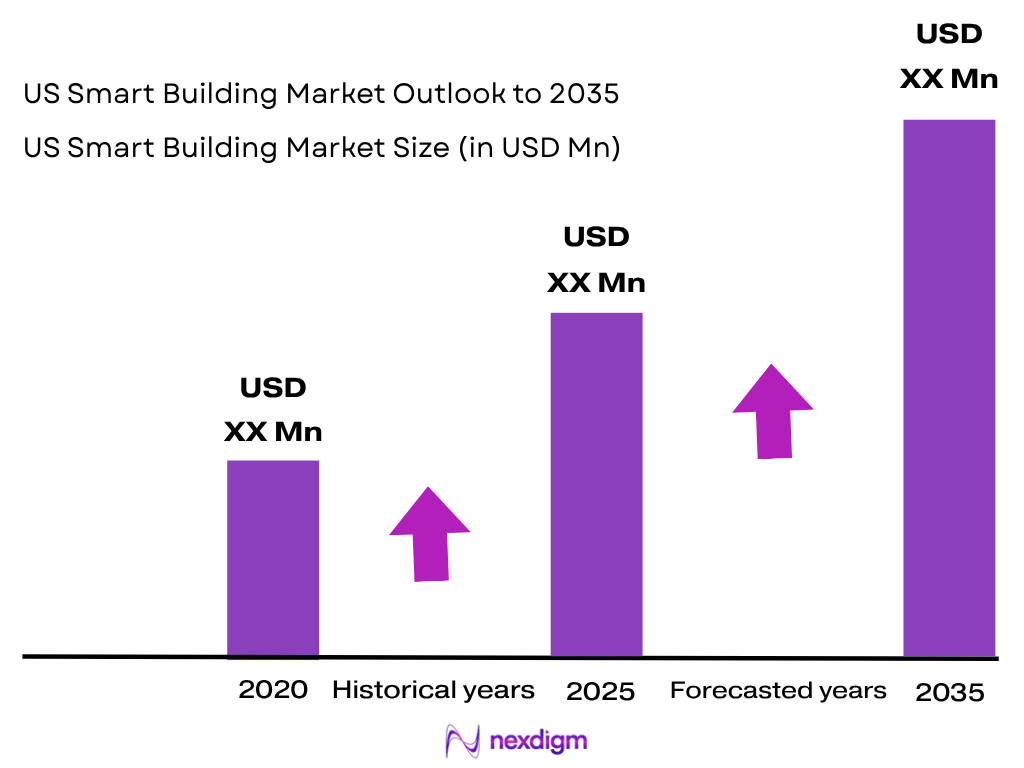
The US Smart Building Market was valued at approximately ~USD XX billion in 2024 and is supported by the scale of the country’s building and energy ecosystem. DOE reports that US buildings consume about 75% of national electricity and 40% of total energy, while EIA recorded 20.6 quadrillion Btu of combined residential and commercial end-use energy consumption in the preceding period. These fundamentals strengthen demand for building automation, intelligent HVAC, energy management, sensors and analytics. U.S. Energy Information Administration.
New York City, California’s major metropolitan areas, Texas, Chicago and Washington, D.C. represent important smart-building demand centers because of their concentration of offices, institutional facilities, data centers, healthcare properties and large commercial portfolios. Census construction data recorded USD 84.061 billion of private office construction and USD 57.032 billion of private healthcare construction during the first ten months of the latest comparable period, versus USD 82.648 billion and USD 53.993 billion respectively in the preceding period, supporting continuing opportunities for connected-building infrastructure.
Market Segmentation
By Solution Type
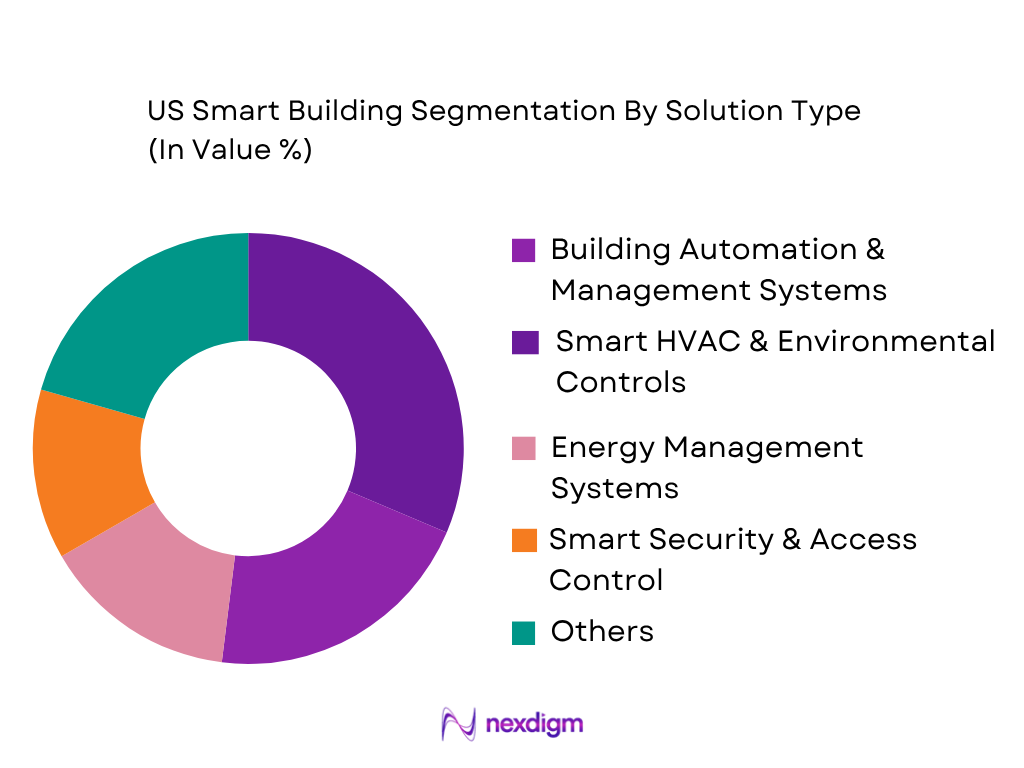
The US Smart Building Market is segmented by solution type into building automation systems, building management systems, energy management systems, smart HVAC and environmental controls, intelligent lighting systems, security and access control, and occupancy and space-management solutions. Building automation and management systems represent the dominant segment because they provide the central control architecture connecting HVAC, lighting, security, fire protection, sensors and energy-management infrastructure. Their role is expanding as building owners migrate from isolated controls toward integrated platforms capable of centralized monitoring and analytics. Smart HVAC represents another substantial category because heating, cooling and ventilation are critical building loads and directly influence occupant comfort. Energy-management solutions are becoming increasingly important as owners seek granular consumption visibility, while cloud connectivity and AI analytics are extending conventional automation toward fault detection, predictive maintenance and portfolio-level optimization. DOE’s emphasis on grid-interactive efficient buildings further supports integration between building controls, demand flexibility and energy-management infrastructure.
By Building Type
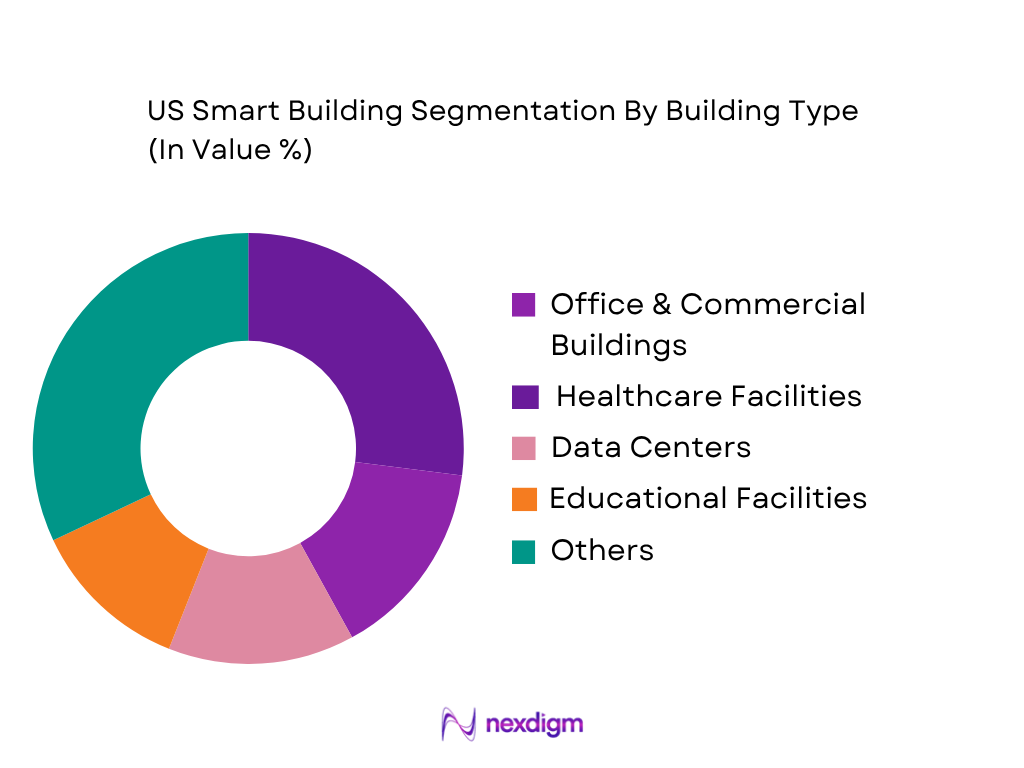
The US Smart Building Market is segmented by building type into office buildings, healthcare facilities, data centers, educational facilities, retail buildings, hotels and hospitality properties, industrial facilities, government buildings and multifamily properties. Office and commercial buildings represent a leading smart-building application group because large facilities contain interconnected HVAC, lighting, access, elevators, security and energy-consuming assets that benefit from centralized monitoring. EIA identifies offices as major electricity-consuming commercial buildings; its CBECS data show office buildings consumed 775 trillion Btu of electricity, compared with 250 trillion Btu of natural gas in the underlying benchmark dataset. Healthcare facilities also represent an important application because ventilation, temperature control and continuous building operation are mission-critical. Data centers are increasingly relevant as commercial computing loads expand: EIA estimates computing accounted for 8% of commercial-sector electricity consumption in 2024. These operating characteristics strengthen adoption of integrated controls, real-time monitoring, predictive analytics and energy optimization.
Competitive Landscape
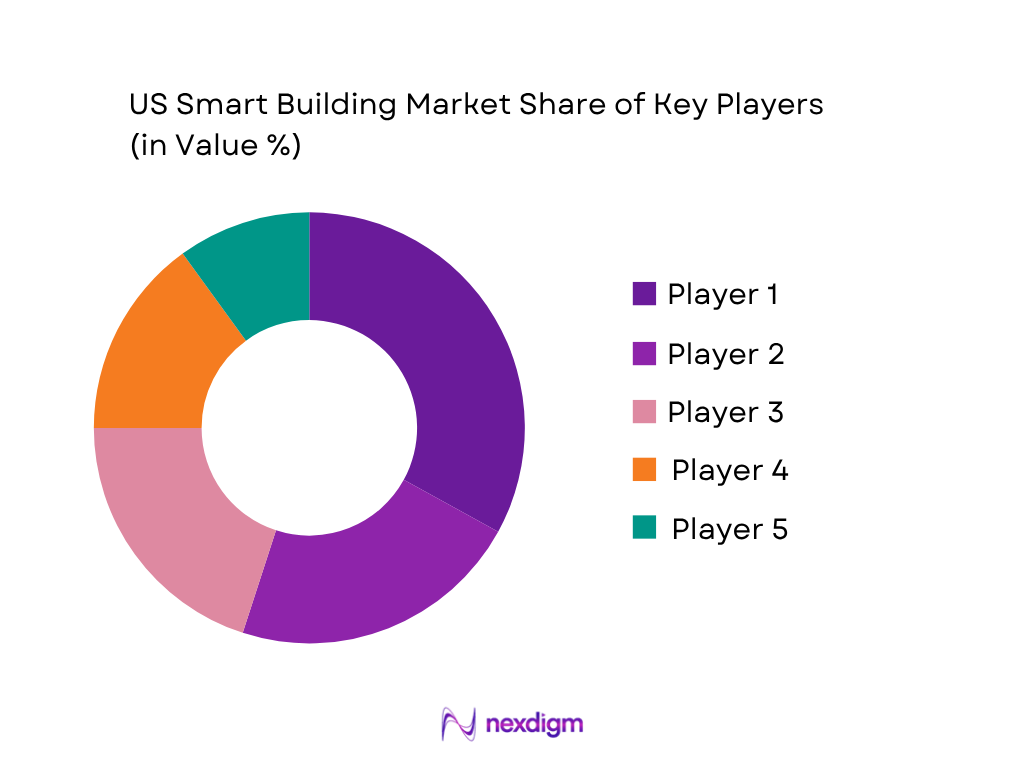
The US Smart Building Market combines global building-automation manufacturers with HVAC, electrification and digital-building specialists. Competition increasingly extends beyond conventional controllers toward open architecture, cloud analytics, AI-supported optimization, cybersecurity, digital twins and portfolio-level energy management. Honeywell, Johnson Controls, Siemens, Schneider Electric and Carrier maintain broad building technology portfolios, while specialized vendors compete within controls, sensors, lighting, security and software layers. Johnson Controls’ Metasys platform, for example, is deployed across more than 54,000 locations worldwide, demonstrating the installed-base advantage held by established building-automation vendors.
| Company | Established | Headquarters | Core Smart Building Platform | Building Automation | Energy Management | AI/Analytics | Cloud/IoT Capability | Key Building Applications |
| Honeywell | 1906 | Charlotte, North Carolina | ~ | ~
|
~
|
~
|
~
|
~
|
| Johnson Controls | 1885 | Cork, Ireland | ~
|
~
|
~
|
~
|
~
|
~
|
| Siemens | 1847 | Munich, Germany | ~
|
~
|
~
|
~
|
~
|
~
|
| Schneider Electric | 1836 | Rueil-Malmaison, France | ~
|
~
|
~
|
~
|
~
|
~
|
| Carrier | 1915 | Palm Beach Gardens, Florida | ~
|
~
|
~
|
~
|
~
|
~
|
US Smart Building Market Analysis
Growth Drivers
Building Energy Efficiency Requirements and Commercial Building Modernization
Building energy efficiency requirements are accelerating smart-building deployment as owners seek tighter control of HVAC, lighting, ventilation, plug loads and other building systems. The U.S. Energy Information Administration recorded 4,308,634,297 MWh of net electricity generation and 3,975,381,832 MWh of retail electricity sales in 2024, demonstrating the scale of electricity flows that building controls ultimately interact with. Commercial computing alone is becoming a major controllable building load, with EIA identifying computing as one of the fastest-expanding commercial electricity end uses in its 2025 outlook. The economic base supporting modernization is similarly substantial: World Bank data place U.S. GDP at USD 29.298 trillion in 2024, while the U.S. Census Bureau recorded USD 1.308 trillion in economic activity associated with construction of buildings in its 2024 Annual Integrated Economic Survey dataset. These conditions strengthen the business case for building management systems, automated HVAC controls, intelligent lighting, occupancy sensing and energy analytics. Modernization is particularly relevant for large office, healthcare, educational and institutional properties where multiple mechanical and electrical systems must operate simultaneously. Smart controls allow these assets to coordinate equipment schedules, detect abnormal consumption and manage operational loads more systematically.
Data Center Expansion, IoT Deployment and Cloud-Based Building Management
Growth in computing-intensive facilities is strengthening requirements for connected building controls capable of continuously managing cooling, power distribution, environmental conditions and equipment performance. The U.S. Energy Information Administration reported that commercial computing represented a major electricity end use in 2024 and identified it as the fastest-growing commercial building electricity application in its 2025 Annual Energy Outlook analysis. At the national level, U.S. electricity infrastructure supported 1,230,416 MW of net summer generating capacity and produced 4,308,634,297 MWh during 2024, illustrating the enormous electrical system into which increasingly digital buildings are integrated. World Bank data show the U.S. economy generated USD 29.298 trillion in GDP in 2024, while the country’s population reached 340,110,988, providing a large economic and physical base for digital infrastructure deployment. Data centers require precise temperature, humidity, airflow and power monitoring, making IoT sensors, building management platforms, automated cooling controls and fault detection particularly relevant. Cloud-based BMS architectures additionally allow operators to consolidate information from geographically dispersed facilities and apply standardized operational rules. As commercial computing infrastructure expands, building-control requirements increasingly move beyond conventional HVAC scheduling toward real-time analytics, predictive maintenance and automated equipment optimization.
Market Challenges
Legacy Building Integration and Multi-Vendor Interoperability Complexity
Legacy building infrastructure creates a substantial implementation challenge because smart-building projects frequently require modern cloud platforms, sensors and analytics to communicate with older HVAC equipment, controllers, electrical systems and proprietary automation protocols. The scale of the existing construction ecosystem illustrates the operational complexity involved. U.S. Census Bureau data recorded USD 1.308 trillion associated with construction of buildings and USD 1.440 trillion associated with specialty trade contractors in its 2024 Annual Integrated Economic Survey dataset. Meanwhile, Bureau of Labor Statistics data show approximately 2.600 million employees working for building-equipment contractors in December 2024, including about 1.117 million employees with electrical and wiring installation contractors and 1.319 million with plumbing, heating and air-conditioning contractors. These large workforces operate across an equally diverse installed base of mechanical, electrical and control technologies. Smart-building modernization therefore requires coordination among controls technicians, HVAC contractors, electricians, IT teams and systems integrators rather than a simple software installation. Older buildings can contain multiple generations of controllers using different communications architectures, requiring gateways, controller replacement and data normalization. Consequently, interoperability between BACnet-connected equipment, proprietary controllers, IoT devices and cloud applications remains an important technical barrier to scalable smart-building modernization.
Building OT Cybersecurity and Skilled Controls Workforce Requirements
Increasing connectivity expands the operational-technology attack surface of commercial buildings because HVAC controllers, access systems, sensors, lighting networks, energy-management platforms and remote interfaces increasingly communicate across digital networks. The scale of connected infrastructure makes security architecture increasingly relevant: World Bank data indicate the United States had 340,110,988 residents in 2024 and an economy producing USD 29.298 trillion, while the EIA recorded an electricity system with 1,230,416 MW of net summer capacity and nearly 3.975 billion MWh of retail electricity sales. Smart buildings increasingly sit at the intersection of this digital and electricity infrastructure. Workforce capacity creates an additional implementation constraint. Bureau of Labor Statistics data show building-equipment contractors employed roughly 2.600 million workers in December 2024, including approximately 1.117 million in electrical and wiring installation and 1.319 million in plumbing, heating and air-conditioning contracting. Smart-building projects require a narrower combination of controls engineering, networking, cybersecurity, HVAC knowledge and software-integration expertise within this broader workforce. Building owners consequently must manage both technical security requirements and specialist labor availability when integrating cloud-connected controllers, remote-access systems, IoT sensors and analytics platforms into operational buildings. Secure commissioning, network segmentation and lifecycle software maintenance therefore become integral parts of smart-building implementation.
Market Opportunities
AI-Driven Autonomous Operations, Digital Twins and Fault Detection
AI-driven building operations represent an important development opportunity because the growing volume of building data can support automated fault detection, equipment optimization, predictive maintenance and digital-twin applications. The U.S. Energy Information Administration recorded 3,975,381,832 MWh of retail electricity sales in 2024, while total national net generation reached 4,308,634,297 MWh. Within commercial facilities, computing has emerged as a particularly important electricity-consuming activity, creating more equipment-level information that can be incorporated into intelligent control strategies. The economic environment also provides a substantial installed asset base: World Bank data put U.S. GDP at USD 29.298 trillion in 2024, while Census Bureau data identify approximately USD 1.308 trillion in activity associated with construction of buildings. AI-based platforms can use sensor and equipment information to identify abnormal HVAC operation, coordinate temperature setpoints, optimize chiller sequencing, detect simultaneous heating and cooling and prioritize maintenance interventions. Digital twins can extend this capability by creating operational representations of equipment, floors or entire buildings. The opportunity is therefore moving beyond dashboards that simply visualize building conditions toward systems capable of interpreting operating data and recommending or automatically implementing control changes across offices, hospitals, campuses and data centers.
Grid-Interactive Buildings, Distributed Energy Resources and Smart EV Charging
Grid-interactive smart buildings provide a significant expansion pathway as building controls increasingly coordinate electricity demand with distributed generation, storage systems and electric-vehicle charging infrastructure. EIA data show the U.S. electricity system generated 4,308,634,297 MWh in 2024 and delivered 3,975,381,832 MWh through retail electricity sales, supported by 1,230,416 MW of net summer generating capacity. These numbers establish a large electricity ecosystem in which controllable commercial-building loads can provide operational flexibility. Smart-building platforms can coordinate HVAC equipment, thermal storage, batteries, on-site generation and EV chargers according to facility requirements and grid conditions rather than managing each asset independently. The economic capacity supporting such infrastructure is substantial, with World Bank data recording U.S. GDP of USD 29.298 trillion in 2024 and USD 30.770 trillion in 2025. Building-to-grid integration creates opportunities for advanced energy management systems that can schedule flexible loads, consolidate distributed energy resources and respond dynamically to operational signals. Commercial campuses, data centers, hospitals, offices and mixed-use properties are particularly relevant because they contain multiple controllable electrical systems. This creates a pathway for smart buildings to evolve from individually optimized properties into active, digitally managed components of the wider electricity system.
Future Outlook
The US Smart Building Market is forecast to expand at approximately ~XX% CAGR during 2026-2035, supported by digitization of existing building stock, building electrification, cloud-based controls and increasing deployment of AI-enabled building-management platforms. Growth will increasingly shift from standalone automation toward integrated ecosystems connecting HVAC, lighting, energy, security, occupancy and distributed energy resources. Grid-interactive efficient buildings represent another development pathway. DOE identifies demand flexibility as an important mechanism for reducing energy waste, balancing consumption during peak periods and integrating variable electricity generation.
Major Players
- Honeywell
- Johnson Controls,
- Siemens,
- Schneider Electric,
- Carrier,
- Trane Technologies,
- ABB,
- Cisco,
- Delta Controls,
- Distech Controls,
- Legrand,
- Lutron Electronics,
- Crestron Electronics,
- Belimo 7
- 5F.
Key Target Audience
- Smart Building Technology and Building Automation Manufacturers
- Commercial Real Estate Owners and Property Developers
- Facility Management and Building Operations Companies
- HVAC, Building Controls and Energy Management System Providers
- Data Center, Healthcare and Mission-Critical Facility Operators
- Investments and Venture Capitalist Firms
- Government and Regulatory Bodies (US Department of Energy, Federal Energy Management Program, US Environmental Protection Agency, National Institute of Standards and Technology)
- Energy Service Companies, Utilities and Demand-Response Providers
Research Methodology
Step 1: Identification of Key Variables
The initial phase constructs an ecosystem map covering building-automation manufacturers, HVAC suppliers, sensor providers, software platforms, systems integrators, property owners, facility managers and utilities. Critical variables include connected building stock, BAS/BMS penetration, retrofit activity, building type, energy intensity, cloud adoption, sensor density, interoperability, cybersecurity requirements and AI-enabled optimization.
Step 2: Market Analysis and Construction
Historical market construction combines top-down analysis of US commercial building activity and building technology expenditure with bottom-up assessment of automation hardware, controls, software, analytics and professional services. Installed-building stock, retrofit cycles, new construction and application-level adoption are evaluated separately to avoid double counting integrated hardware and software revenues.
Step 3: Hypothesis Validation and Expert Consultation
Market hypotheses are validated through CATIs and structured interviews with building-automation OEMs, system integrators, facility managers, real-estate owners, HVAC contractors and smart-building software providers. Discussions examine BMS replacement cycles, retrofit economics, cloud migration, protocol requirements, AI adoption, cybersecurity, energy optimization and customer procurement criteria.
Step 4: Research Synthesis and Final Output
Primary findings are triangulated against government building-energy statistics, construction indicators, company disclosures and technology deployments. Bottom-up supplier and installation analysis is reconciled with top-down building-stock and end-user demand indicators. The resulting framework establishes market structure, segmentation, competitive positioning, technology evolution and the long-term outlook for the US Smart Building Market.

- Executive Summary
- Research Methodology (Market Definition and Scope, Smart Building Technology Classification, Building Automation System Mapping, Building Management System Assessment, IoT Sensor and Device Assessment, Smart HVAC Controls Evaluation, Intelligent Lighting Control Assessment, Energy Management System Analysis, Access Control and Video Surveillance Assessment, Fire and Life-Safety Integration, Indoor Environmental Quality Monitoring, Occupancy and Space Analytics Assessment, AI-Based Building Optimization, Cloud Building Management Platform Assessment, Edge Computing Evaluation, Digital Twin Assessment, Grid-Interactive Building Assessment, Demand Response Capability Mapping, Building Electrification Assessment, EV Charging Integration, Distributed Energy Resource Integration, BACnet and Open-Protocol Interoperability Assessment, Building OT Cybersecurity Assessment, Retrofit versus New-Building Assessment, Installed Building Stock Analysis, Smart Building Penetration Assessment, Supply-Side Assessment, Demand-Side Assessment, Top-Down Market Sizing, Bottom-Up Market Sizing, Primary Industry Interviews, Data Triangulation, Forecasting Framework)

- Definition and Scope
- US Smart Building Industry Evolution
- Smart Building Value Chain Analysis
- Smart Building Supply Chain Analysis

- Growth Drivers (Building Energy Efficiency Requirements, Increasing Building Electrification, Rising Deployment of IoT Sensors, Expansion of Cloud-Based Building Management, Growing Data Center Infrastructure, Commercial Building Modernization, Demand for Predictive Maintenance, Increasing Occupancy Analytics Adoption, Grid Flexibility Requirements, Corporate Energy and Emissions Management)
- Market Challenges (Legacy Building System Integration, Building Automation Interoperability Constraints, High Retrofit Complexity, Building OT Cybersecurity Risks, Fragmented Building Data Architecture, Skilled Controls Technician Requirements, Proprietary Protocol Lock-In, Integration of Multi-Vendor Systems, Building Owner Capital Allocation Constraints)
- Market Opportunities (AI-Driven Autonomous Building Operations, Grid-Interactive Efficient Buildings, Digital Twin Deployment, Existing Commercial Building Retrofits, Data Center Smart Controls, Building-to-Grid Integration, Distributed Energy Resource Orchestration, Smart EV Charging Integration, Portfolio-Wide Cloud Building Management, Fault Detection and Diagnostics, Demand Flexibility Services)
- Market Trends (AI-Based HVAC Optimization, Cloud-Native Building Management Systems, IT-OT Convergence, Open-Protocol Building Architecture, Edge Analytics, Occupancy-Based Controls, Remote Building Operations, Predictive Equipment Maintenance, Digital Building Profiles, Zero-Trust Building Cybersecurity, Autonomous Building Controls, Integrated Energy and Carbon Management)
- Government Regulations and Standards (US Department of Energy Building Energy Efficiency Programs, Federal Smart Buildings Accelerator Framework, ASHRAE Standard 90.1, ASHRAE Standard 135 BACnet, NIST Cybersecurity Framework, NIST Operational Technology Security Guidance, State Building Energy Codes, Building Performance Standards, Federal Energy Management Requirements, ENERGY STAR Building Performance Requirements)
- SWOT Analysis
- Porter’s Five Forces Analysis
- PESTLE Analysis
- Stakeholder Ecosystem
- Technology Ecosystem
- Competition Ecosystem

- By Market Value (2020-2025)
- By Smart Building Installed Base (2020-2025)
- By Number of Connected Building Systems (2020-2025)
- By Building Automation System Installations (2020-2025)
- By Building Management System Installations (2020-2025)
- By Smart HVAC and Controls Revenue (2020-2025)

- By Solution Type (In Value %)
Building Automation Systems
Building Management Systems
Energy Management Systems
Smart HVAC and Environmental Controls
Intelligent Lighting and Lighting Controls
Smart Security and Access Control Systems
Fire and Life-Safety Systems
Occupancy and Space Management Systems
Smart Metering and Energy Monitoring Systems
Indoor Environmental Quality Monitoring Systems
Integrated Workplace Management Solutions - By Component (In Value %)
Sensors and IoT Devices
Controllers and Gateways
Smart Thermostats and HVAC Controls
Smart Meters and Sub-Meters
Lighting Controllers
Access Control Hardware
Building Management Software
Cloud Building Platforms
AI and Analytics Software
Building Connectivity Infrastructure
Professional and Managed Services - By Building Type (In Value %)
Office Buildings
Retail and Shopping Centers
Healthcare Facilities
Educational Buildings and Campuses
Hotels and Hospitality Properties
Data Centers
Industrial and Manufacturing Buildings
Warehouses and Logistics Facilities
Government and Federal Buildings
Multifamily Residential Buildings
Mixed-Use Developments - By Deployment Type (In Value %)
New-Building Smart Infrastructure
Existing-Building Retrofit
Single-Building Deployment
Campus and Multi-Building Deployment
Enterprise Portfolio Deployment - By Technology Architecture (In Value %)
On-Premise Building Automation
Cloud-Connected Building Management
Edge-Enabled Smart Building Systems
Hybrid Cloud-Edge Architecture
AI-Enabled Building Platforms
Digital Twin-Enabled Building Management
Grid-Interactive Building Architecture - By Building Function (In Value %)
HVAC Automation and Optimization
Lighting Automation
Energy Monitoring and Optimization
Physical Security and Access Management
Fire and Life Safety
Occupancy and Space Optimization
Predictive Maintenance and Asset Management
Indoor Air Quality and Comfort Management
Demand Response and Grid Interaction
EV Charging and Distributed Energy Resource Management - By Communication Protocol and Connectivity (In Value %)
BACnet-Based Systems
Modbus-Based Systems
KNX-Based Systems
IP/Ethernet-Based Building Networks
Wi-Fi-Connected Systems
Bluetooth Low Energy Systems
Zigbee and Mesh Networks
Cellular and LPWAN Connectivity
Proprietary Building Automation Networks - By End User (In Value %)
Commercial Real Estate Owners
Corporate Enterprises
Healthcare Providers
Educational Institutions
Retail and Hospitality Operators
Data Center Operators
Industrial Facility Operators
Government Agencies
Multifamily Property Operators
Facility Management Companies - By Region (In Value %)
Northeast USA
Midwest USA
South USA
West USA
California
Texas
New York
Florida
Illinois
Rest of USA

- Market Share of Major Players (By US Smart Building Revenue, Building Automation Revenue, Building Management System Installed Base, Smart HVAC Portfolio, Energy Management Capability, Security and Access Control Capability, Software and Analytics Portfolio, Cloud Platform Capability, AI-Based Optimization Capability, Systems Integration Capability, Retrofit Project Presence, Commercial Building Coverage, Data Center Presence, Healthcare and Education Presence, Service Network)
- Cross Comparison Parameters (Building Automation and BMS Portfolio Breadth, Open-Protocol and Multi-Vendor Interoperability, AI and Predictive Analytics Capability, Cloud and Edge Platform Capability, Building OT Cybersecurity Capability, Energy Optimization and Demand Flexibility Capability, Digital Twin and Occupancy Analytics Capability, Systems Integration and Lifecycle Service Coverage)
- SWOT Analysis of Major Players
- Detailed Profiles of Major Companies
Honeywell International Inc.
Johnson Controls International plc
Siemens AG
Schneider Electric SE
Carrier Global Corporation
Trane Technologies plc
ABB Ltd.
Cisco Systems Inc.
Delta Controls Inc.
Distech Controls Inc.
Legrand SA
Lutron Electronics Co. Inc.
Crestron Electronics Inc.
Belimo Holding AG
75F Inc.

- Commercial Property Owner Requirement Assessment
- Corporate Real Estate Smart Building Requirement Assessment
- Facility Manager Technology Adoption Assessment
- Building Energy Manager Requirement Analysis
- Data Center Smart Infrastructure Assessment
- Healthcare Facility Automation Requirement Assessment

- By Market Value (2026-2035)
- By Smart Building Installed Base (2026-2035)
- By Number of Connected Building Systems (2026-2035)
- By Building Automation System Installations (2026-2035)
- By Building Management System Installations (2026-2035)
- By Smart HVAC and Controls Revenue (2026-2035)


 Request a Sample
 Ask for Customization
 Get a Quote
 Enquire Now
