

 Download PDF
Market Overview
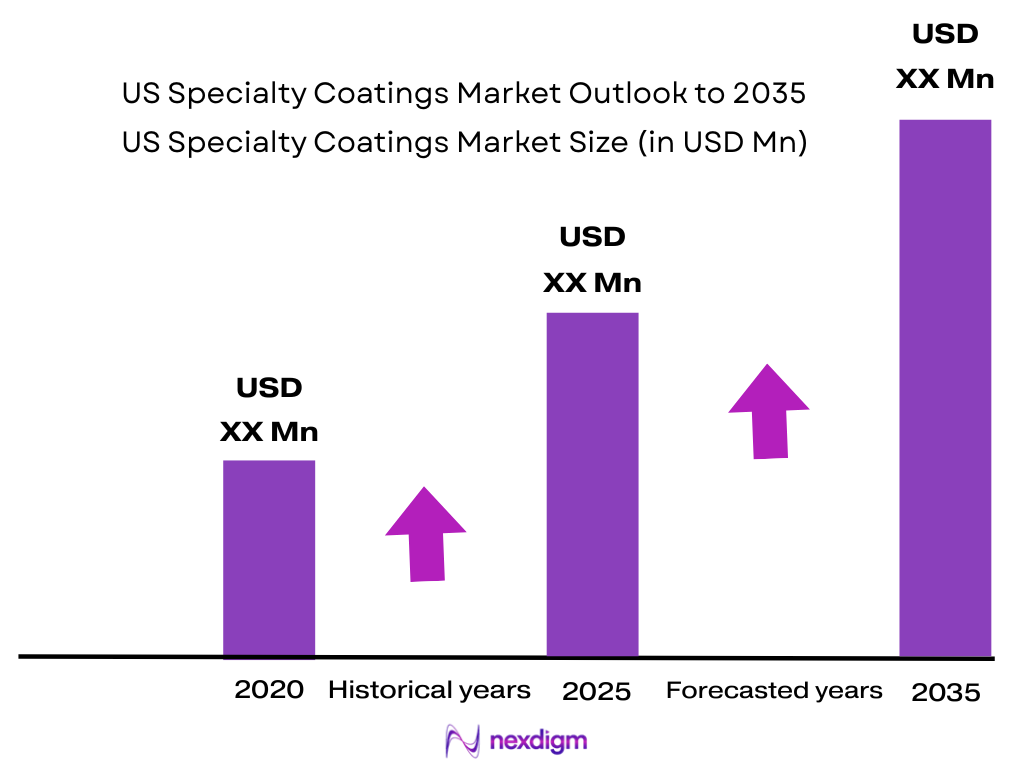
The US Specialty Coatings Market is valued at USD ~ million in 2024, reflecting demand for coatings engineered for specific performance requirements such as corrosion resistance, chemical resistance, abrasion resistance, thermal protection, fire protection and specialized surface functionality. The broader US economy expanded at a real GDP rate of 2.8% in 2024, following 2.9% in 2023, while construction real GDP increased 4.9% in 2023 before moderating in 2024. These industrial and construction activities support recurring coating requirements across machinery, infrastructure, transportation and industrial assets.
Specialty coatings are also supported by the continued scale of US manufacturing and transportation industries. The market encompasses high-performance systems used in automotive, aerospace, marine, oil and gas, industrial machinery, electronics, construction and infrastructure applications. PPG’s US operations, for example, cover protective coatings, industrial finishes, pavement-marking technologies and related specialty products, with manufacturing and distribution facilities across states including Ohio, Texas, North Carolina, Alabama and California. This broad industrial footprint creates geographically distributed demand for specialized coatings and technical application services.
Market Segmentation
By Coating Technology
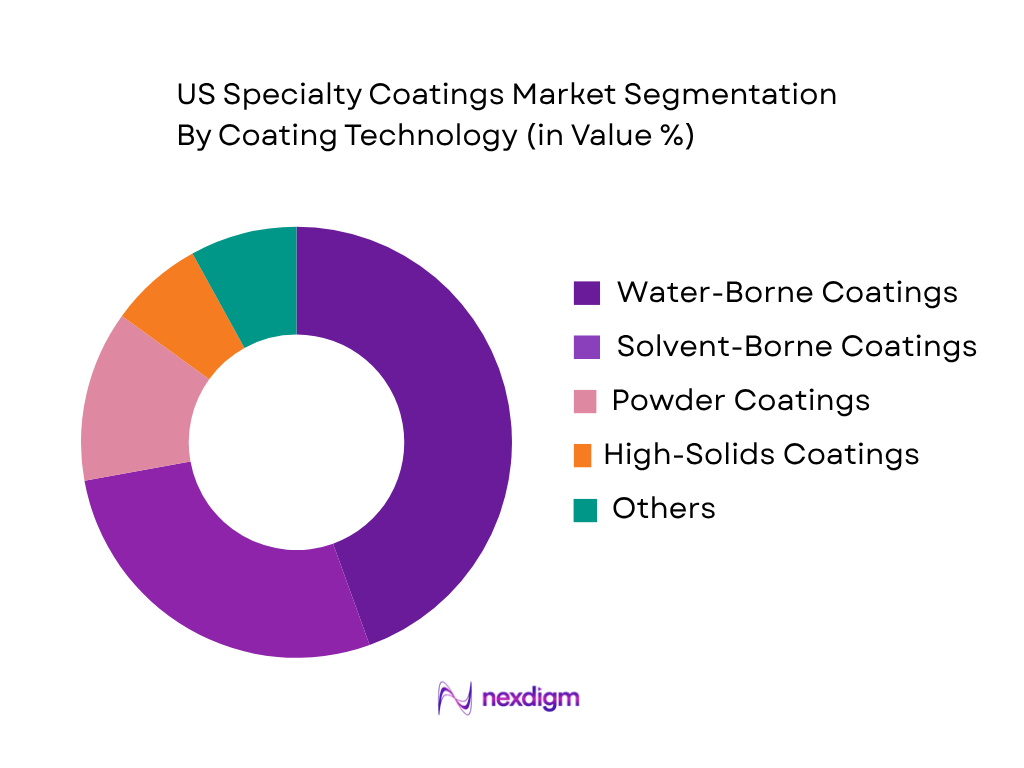
The US Specialty Coatings Market is segmented by coating technology into solvent-borne coatings, water-borne coatings, powder coatings, high-solids coatings, UV-cured coatings, radiation-cured coatings and electrocoatings. Water-borne and high-solids systems are positioned as leading segments because they allow manufacturers and industrial users to address increasingly stringent VOC requirements while maintaining coating performance. Powder coatings are also important in fabricated metal, automotive-component, appliance and industrial-equipment applications because they provide durable finishes with efficient material utilization. Specialty coatings increasingly require a balance between corrosion protection, chemical resistance, durability, appearance and environmental compliance. The technology mix therefore varies significantly according to application: aerospace and energy applications prioritize performance and qualification, while industrial equipment and fabricated metal applications place greater emphasis on curing efficiency, durability and application productivity.
By End-Use Industry
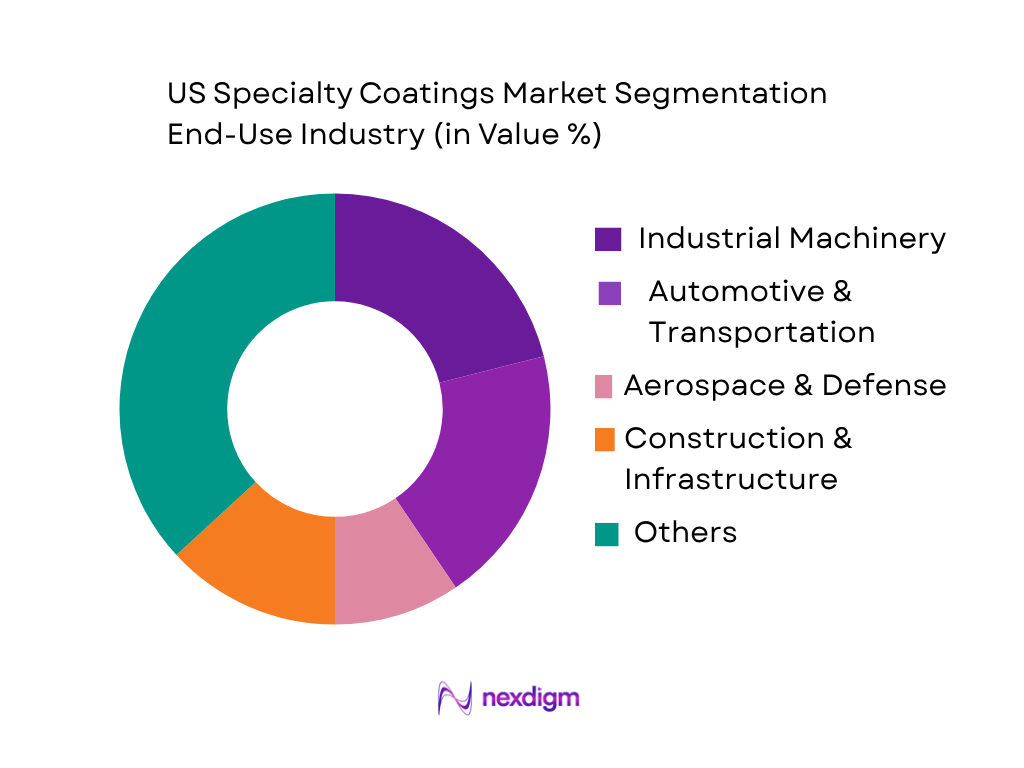
The US Specialty Coatings Market is segmented by end-use industry into automotive and transportation, aerospace and defense, oil and gas, petrochemicals and chemicals, marine and shipbuilding, construction and infrastructure, industrial machinery, electronics and semiconductors, power generation, renewable energy, healthcare and medical devices, and food and beverage processing. Industrial machinery and protective infrastructure applications are positioned among the dominant demand areas because large installed asset bases require corrosion, abrasion, chemical and weather protection throughout their operating lives. Automotive and aerospace applications provide additional demand for highly engineered coatings where adhesion, durability, lightweight-material compatibility and resistance to temperature or chemicals are critical. The expansion of renewable-energy equipment, semiconductor manufacturing and electric-vehicle production is also broadening the addressable market for thermal, electrical, protective and functional coatings.
Competitive Landscape
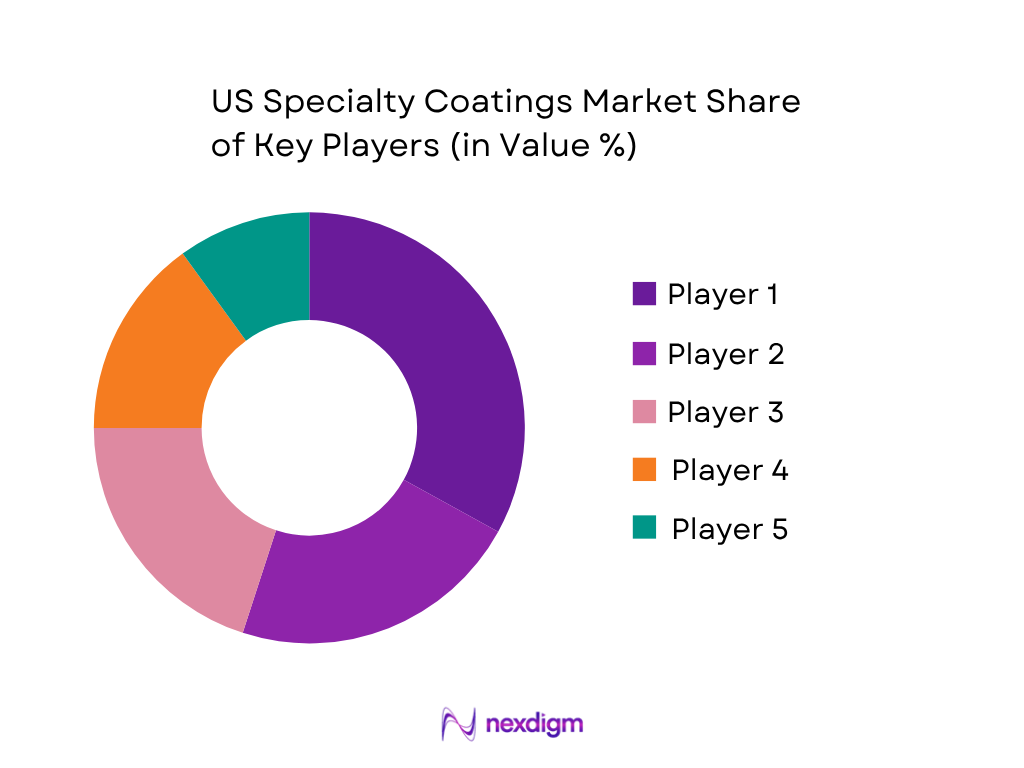
The US Specialty Coatings Market is characterized by strong participation from diversified coatings manufacturers and specialized industrial-coating suppliers. PPG Industries, Sherwin-Williams, Axalta Coating Systems, RPM International and BASF are among the principal competitive names, with portfolios spanning protective, industrial, automotive, aerospace and other performance-oriented applications. Competition is shaped by formulation technology, product qualification, technical service, manufacturing footprint, distribution, application productivity and regulatory compliance rather than by product price alone.
| Company | Establishment Year | Headquarters | Core Specialty-Coatings Focus | Key End-Use Markets | Technology Strength | US Manufacturing/Distribution | Technical-Service Capability |
| PPG Industries | 1883 | Pittsburgh, Pennsylvania | ~ | ~ | ~ | ~ | ~ |
| Sherwin-Williams | 1866 | Cleveland, Ohio | ~ | ~ | ~ | ~ | ~ |
| Axalta Coating Systems | 1866* | Philadelphia, Pennsylvania | ~ | ~ | ~ | ~ | ~ |
| RPM International | 1947 | Medina, Ohio | ~ | ~ | ~ | ~ | ~ |
| BASF | 1865 | Ludwigshafen, Germany | ~ | ~ | ~ | ~ | ~ |
US Specialty Coatings Market Analysis
Growth Drivers
Automotive Lightweighting
Automotive lightweighting is strengthening demand for specialty coatings that provide corrosion resistance, thermal management, abrasion protection, electrical insulation and adhesion on aluminum, composites and battery-related components. The U.S. automotive manufacturing base remains substantial, while electrification is adding technically demanding coating applications across battery housings, motors, power electronics and charging components. Semiconductor and advanced-manufacturing investment is also reinforcing the broader industrial coating ecosystem. The U.S. Department of Commerce announced up to $1.5 billion in CHIPS funding for GlobalFoundries, supporting approximately $13 billion of planned U.S. manufacturing investment and around 10,000 jobs across New York and Vermont. (Commerce.gov) Intel separately received up to $7.865 billion in direct CHIPS funding against nearly $90 billion of expected U.S. investment. (Commerce.gov) These investments expand demand for protective and functional coatings used on production equipment, cleanroom infrastructure, electronic assemblies and industrial machinery. The wider U.S. economy also recorded real GDP growth of 2.8% in 2024, demonstrating continued expansion in overall economic activity and investment. (Bureau of Economic Analysis) Together, automotive technology shifts, advanced manufacturing investment and industrial-capital expenditure create recurring requirements for high-performance specialty coatings rather than conventional decorative coating systems.
Infrastructure Rehabilitation
Infrastructure rehabilitation is creating sustained requirements for corrosion-control, protective and high-durability specialty coatings across bridges, highways, rail assets, utilities, pipelines and industrial structures. Federal Highway Administration data show that the U.S. Bridge Investment Program provided $930 million for 31 projects across 24 states, including $635 million awarded to 22 projects during 2024. (Federal Highway Administration) In addition, FHWA’s 2024 highway statistics record substantial federal expenditure across national highway and surface-transportation programs, demonstrating continuing public investment in transportation infrastructure. (Federal Highway Administration) Infrastructure rehabilitation directly increases demand for coatings designed to withstand moisture, salt exposure, ultraviolet radiation, abrasion and cyclic temperature conditions, particularly on steel bridges, structural components and transportation assets. The requirement is especially relevant because rehabilitation projects often require longer service intervals and higher-performance corrosion protection than basic architectural coatings. Specialty coating demand is therefore linked not only to new construction but also to asset preservation and life-extension programs. Continued federal infrastructure funding, bridge replacement activity and transportation-system modernization provide a broad and recurring application base for epoxy, polyurethane, zinc-rich, high-solids and other protective coating technologies.
Market Challenges
VOC and Emissions Compliance
VOC and emissions compliance remains a significant formulation challenge because specialty coatings must balance environmental requirements with demanding performance characteristics such as adhesion, chemical resistance, durability, cure speed and corrosion protection. U.S. regulatory requirements continue to evolve around VOC-reactive compounds and ozone formation. The Environmental Protection Agency’s updated aerosol-coatings rule revises product-weighted reactivity limits, adds compounds and reactivity factors, updates regulated-VOC thresholds and changes reporting requirements. (US EPA) For specialty-coatings manufacturers, these requirements can increase formulation complexity because reducing conventional solvent content may affect viscosity, application behavior, drying characteristics and final-film performance. The challenge is particularly relevant for industrial and transportation coatings where specifications can require controlled application characteristics and long-term durability. Manufacturers must therefore invest in waterborne, high-solids, powder and radiation-cured alternatives while maintaining compatibility with existing application equipment and substrate requirements. Compliance also creates additional documentation, testing and reformulation requirements across product portfolios. The regulatory burden is not limited to formulation: manufacturers and industrial users may need revised process controls, emission-management procedures and product documentation. Consequently, VOC regulation can slow product development and increase technical qualification requirements even as it encourages the transition toward lower-emission specialty-coating technologies.
Raw-Material Supply and Formulation Complexity
Specialty-coatings producers face greater exposure to raw-material availability and formulation complexity because high-performance systems depend on specific resins, pigments, additives, curing agents and functional materials that cannot always be substituted without extensive testing. This challenge becomes more important when coatings are required to meet aerospace, automotive, electronics, energy or infrastructure specifications. The broader U.S. industrial environment remains investment-intensive: real GDP increased 2.8% in 2024, while major manufacturing programs continued to generate large new production commitments. (Bureau of Economic Analysis) Semiconductor manufacturing alone illustrates the scale of specialized industrial requirements. TSMC Arizona’s CHIPS-supported program involves more than $65 billion of planned investment in 3 leading-edge fabs, while Samsung’s program involves more than $37 billion of planned U.S. investment. (Commerce.gov) Such facilities require highly controlled materials and surface-treatment systems, increasing the need for technically qualified coating inputs. At the same time, specialty formulations often require compatibility testing when a resin, additive or curing component changes. This creates qualification delays and raises the technical risk of supply substitutions. Producers consequently need stronger supplier qualification, multiple-source strategies, formulation redundancy and application-specific testing, making supply-chain management a central competitive issue in the U.S. specialty-coatings market.
Market Opportunities
Aerospace High-Temperature Coatings
Aerospace manufacturing presents an opportunity for specialty coatings engineered for high temperature, corrosion, erosion, chemical exposure and extreme environmental conditions. Demand is supported by continued U.S. investment in advanced manufacturing and defense-related technology, while specialized semiconductor and aerospace supply-chain programs are simultaneously expanding the domestic manufacturing base. The Department of Commerce awarded BAE Systems Electronic Systems up to $35.5 million and Rocket Lab up to $23.9 million through the CHIPS program for semiconductor production critical to defense and space applications. (Commerce.gov) GlobalFoundries’ U.S. investment program is also designed to supply semiconductor technologies for automotive, aerospace and defense applications, with approximately $13 billion of planned investment. (Commerce.gov) These developments support a wider ecosystem of specialized production equipment, aircraft systems, electronics and high-value components requiring advanced surface protection. Specialty coatings can address applications involving thermal stability, dielectric insulation, oxidation resistance, erosion resistance and protection of lightweight substrates. The opportunity is particularly attractive where coating performance is tied to component reliability and qualification rather than basic appearance. Suppliers capable of developing high-temperature, low-emission and multifunctional formulations can therefore address increasingly demanding aerospace and defense specifications while also leveraging adjacent demand from advanced electronics, space systems and high-performance industrial equipment.
Renewable-Energy Equipment Manufacturing
Renewable-energy equipment manufacturing is expanding the addressable opportunity for specialty coatings used on wind-turbine components, solar equipment, electrical infrastructure, energy-storage systems and associated industrial machinery. U.S. utility-scale generating capacity additions reached 48.6 GW in 2024, the largest annual installation level since 2002, according to the Energy Information Administration. (U.S. Energy Information Administration) Utility-scale solar additions alone reached approximately 30 GW in 2024, while EIA data record 5,155.9 MW of wind-generator additions and 31,102.3 MW of solar photovoltaic generator additions. (U.S. Energy Information Administration) These installations require durable surfaces capable of resisting ultraviolet exposure, moisture, corrosion, temperature cycling, abrasion and environmental contamination. Wind-turbine blades, towers, nacelles, fasteners and electrical components require different coating properties, creating opportunities for application-specific formulations rather than one universal product. Solar equipment similarly requires coatings that preserve surface performance under prolonged outdoor exposure while supporting durability and maintenance reduction. The expansion of renewable infrastructure therefore creates demand for protective, functional and low-maintenance coating technologies. Suppliers can target this opportunity through UV-resistant, anti-corrosion, hydrophobic, self-cleaning, thermal-management and low-VOC systems designed specifically for renewable-energy operating environments.
Future Outlook
The US Specialty Coatings Market is expected to expand steadily through 2035 as industrial asset protection, advanced manufacturing, transportation, aerospace, electronics and infrastructure applications require increasingly specialized surface technologies. Growth will be shaped by the transition toward low-VOC and high-solids formulations, alongside continued demand for corrosion-resistant and functional coatings. EV batteries, renewable-energy equipment and semiconductor-related applications are expected to broaden the market’s technology base. The competitive environment should increasingly favor suppliers capable of combining formulation expertise, regulatory compliance, application engineering and dependable US distribution.
Major Players
- PPG Industries, Inc.
- The Sherwin-Williams Company
- Axalta Coating Systems Ltd.
- RPM International Inc.
- BASF SE
- Akzo Nobel N.V.
- Hempel A/S
- Jotun A/S
- Nouryon
- 3M Company
- Henkel AG & Co. KGaA
- Dow Inc.
- DuPont de Nemours, Inc.
- Covestro AG
- Kansai Paint Co., Ltd.
Key Target Audience
- Specialty coatings manufacturers and formulators
- Automotive and EV component manufacturers
- Aerospace and defense coating buyers
- Oil, gas, petrochemical and pipeline operators
- Industrial machinery and infrastructure asset owners
- Investments and venture capitalist firms
- Government and regulatory bodies (US Environmental Protection Agency, Occupational Safety and Health Administration, California Air Resources Board)
- Coatings distributors, applicators and industrial procurement organizations
Research Methodology
Step 1: Identification of Key Variables
The initial phase involves constructing a specialty-coatings ecosystem map covering resin suppliers, additive producers, coating formulators, distributors, applicators, OEMs and industrial end users. The analysis defines product categories according to coating technology, resin chemistry, functional performance, application and end-use industry. Public regulatory, industrial and company information is used to establish the market boundary and identify the variables influencing US specialty-coatings demand.
Step 2: Market Analysis and Construction
Historical market information is compiled through top-down and bottom-up approaches, with demand mapped across automotive, aerospace, industrial machinery, infrastructure, oil and gas, marine, electronics, energy and other specialty applications. Production, consumption, imports, exports and application-level demand are assessed to construct the market value framework. Segment-level validation is performed against company disclosures, industry activity and available public datasets.
Step 3: Hypothesis Validation and Expert Consultation
Market hypotheses are developed around coating technology adoption, resin-system demand, application requirements, regulatory transitions and end-use purchasing behavior. Interviews with manufacturers, distributors, coating applicators, technical specialists and industrial purchasers are used to validate assumptions. Particular attention is given to qualification requirements, formulation switching, application productivity, regulatory compliance and emerging functional-coating technologies.
Step 4: Research Synthesis and Final Output
The final stage integrates supply-side and demand-side findings into a unified US Specialty Coatings Market model. Segment estimates are reconciled through data triangulation, while company-level information is used to validate competitive positioning and application exposure. Forecast assumptions are then constructed around industrial activity, infrastructure maintenance, advanced manufacturing, technology adoption and regulatory changes to produce the market outlook through 2035.

- Executive Summary
- Research Methodology (Market Definition and Scope, Specialty-Coatings Classification Framework, Top-Down Market Sizing, Bottom-Up Market Construction, Volume-to-Value Conversion, Application-Level Demand Mapping, Supply-Side Capacity Assessment, Raw-Material Consumption Mapping, Import-Export Validation, Primary Industry Interviews, Manufacturer and Distributor Validation, Data Triangulation, Forecasting Framework, Scenario Analysis, Assumptions and Limitations)

- Definition and Scope
- Specialty Coatings Industry Structure
- Evolution of Specialty Coatings in the United States
- Key Industry Development Milestones
- Specialty Coatings Value Chain Analysis

- Market Growth Drivers (Automotive Lightweighting, Infrastructure Rehabilitation, Aerospace Production, Oil and Gas Pipeline Investment, Renewable-Energy Equipment Manufacturing, Semiconductor Manufacturing Expansion, Industrial Automation, Corrosion-Control Requirements)
- Market Challenges (Volatility in Resin and Additive Supply, VOC and Emissions Compliance, High Performance-Formulation Complexity, Raw-Material Price Volatility, Skilled Formulation-Labor Requirements, Qualification Cycles for Aerospace and Automotive Applications, Environmental Compliance Costs, Competition from Alternative Surface-Treatment Technologies)
- Market Opportunities (Aerospace High-Temperature Coatings, EV Battery and Component Coatings, Wind-Turbine Protective Coatings, Solar-Equipment Coatings, Semiconductor and Electronics Coatings, Infrastructure Corrosion Protection, Low-VOC Formulations, Bio-Based Coatings, Smart and Functional Coatings, Antimicrobial and Self-Cleaning Coatings)
- Market Trends (Water-Borne Conversion, Powder-Coating Adoption, High-Solids Technology, Low-VOC Formulation, Bio-Based Resin Development, Functional Nanocoatings, Self-Healing Coatings, Antimicrobial Surfaces, Conductive Coatings, Thermal-Barrier Coatings, Lightweight-Component Protection)
- Regulatory and Standards Analysis (EPA Requirements, Clean Air Act Compliance, VOC Limits, OSHA Chemical-Safety Requirements, TSCA Requirements, State-Level Coating Regulations, California Air Resources Board Requirements, SCAQMD Requirements, ASTM Standards, SSPC Standards)
- PESTLE Analysis
- SWOT Analysis
- Porter’s Five Forces Analysis

- By Market Value (2020-2025)
- By Coating Consumption Volume (2020-2025)
- By Production Volume (2020-2025)
- By Domestic Consumption (2020-2025)
- By Domestic Production (2020-2025)
- By Import Volume (2020-2025)
- By Export Volume (2020-2025)
- By Average Selling Price (2020-2025)
- By Application (2020-2025)
- By End-Use Industry (2020-2025)

- By Resin Type (In Value %)
Epoxy-Based Specialty Coatings
Polyurethane-Based Specialty Coatings
Acrylic-Based Specialty Coatings
Alkyd-Based Specialty Coatings
Fluoropolymer-Based Specialty Coatings
Silicone-Based Specialty Coatings
Vinyl-Based Specialty Coatings
Polyaspartic-Based Specialty Coatings
Other Resin Systems - By Coating Technology (In Value %)
Solvent-Borne Coatings
Water-Borne Coatings
Powder Coatings
High-Solids Coatings
Radiation-Cured Coatings
Thermal-Cured Coatings
Electrocoating - By Specialty Coating Function (In Value %)
Corrosion-Resistant Coatings
Heat-Resistant Coatings
Chemical-Resistant Coatings
Abrasion-Resistant Coatings
Antimicrobial Coatings
Anti-Fouling Coatings
Conductive and ESD Coatings
Insulating Coatings
Low-Friction Coatings
Self-Cleaning and Easy-Clean Coatings
Wear-Resistant Coatings - By Application (In Value %)
Protective Coatings
Industrial Equipment Coatings
Automotive Specialty Coatings
Aerospace Coatings
Marine Coatings
Oil and Gas Coatings
Pipeline Coatings
Infrastructure Coatings
Electronics and Electrical Coatings
Packaging Coatings
Wood and Furniture Coatings
Concrete and Masonry Coatings - By End-Use Industry (In Value %)
Automotive and Transportation
Aerospace and Defense
Oil and Gas
Petrochemicals and Chemicals
Marine and Shipbuilding
Construction and Infrastructure
Power Generation
Industrial Machinery
Electronics and Semiconductors
Renewable Energy
Food and Beverage Processing
Medical Devices and Healthcare
General Industrial Manufacturing

- Market Share of Major Players (By Value, Volume, Resin Type, Technology, Application, End-Use Industry, Distribution Channel)
- Cross Comparison Parameters (Resin-System Portfolio Breadth, Specialty-Technology Portfolio, Corrosion-Protection Expertise, Aerospace Qualification Capability, Automotive OEM Penetration, Industrial Distribution Reach, R&D and Formulation Capability, Low-VOC and Sustainable-Coating Portfolio)
- SWOT Analysis of Major Players
- Detailed Profiles of Major Companies
PPG Industries, Inc.
The Sherwin-Williams Company
Axalta Coating Systems Ltd.
RPM International Inc.
BASF SE
Akzo Nobel N.V.
Hempel A/S
Jotun A/S
Nouryon
3M Company
Henkel AG & Co. KGaA
Dow Inc.
DuPont de Nemours, Inc.
Covestro AG
Kansai Paint Co., Ltd.

- Automotive and Transportation Coatings
- Aerospace and Defense Coatings
- Oil and Gas Coatings
- Marine Coatings
- Construction and Infrastructure Coatings
- Electronics and Semiconductor Coatings

- By Market Value (2026-2035)
- By Coating Consumption Volume (2026-2035)
- By Production Volume (2026-2035)
- By Domestic Consumption (2026-2035)
- By Domestic Production (2026-2035)
- By Import Volume (2026-2035)
- By Export Volume (2026-2035)
- By Average Selling Price (2026-2035)
- By Application (2026-2035)
- By End-Use Industry (2026-2035)


 Request a Sample
 Ask for Customization
 Get a Quote
 Enquire Now