
 Download PDF
Market Overview
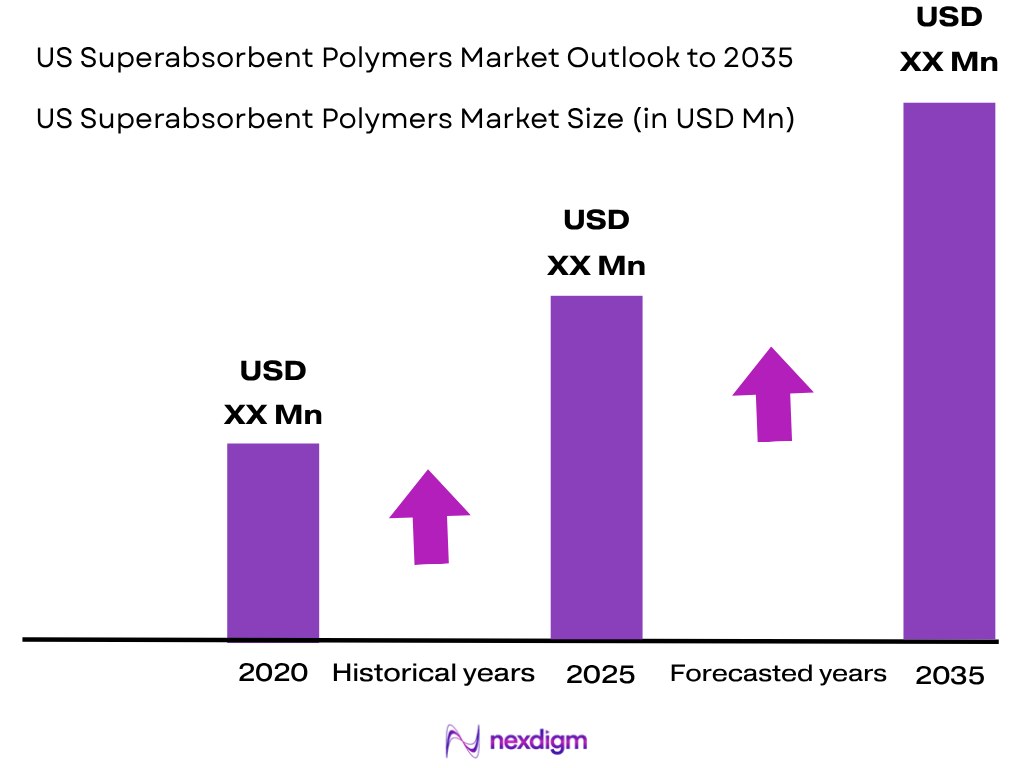
The US Superabsorbent Polymers Market is valued at ~USD XXX million, supported primarily by hygiene products, particularly baby diapers, adult incontinence products and feminine hygiene products. A published US market assessment reported revenue of USD 1,109.3 million for the preceding annual observation, while the market is also supported by the country’s large consumer base and healthcare infrastructure. US live births increased from 3,596,017 to 3,628,934, sustaining demand for infant hygiene products, while the population aged 65 and above reached 61,245,283, strengthening the long-term requirement for adult incontinence products.
The US Superabsorbent Polymers Market is concentrated around major chemical manufacturing and hygiene-product production corridors, particularly the Gulf Coast and large population centers across California, Texas, the Midwest and Northeast. Texas is strategically important because Nippon Shokubai operates a SAP manufacturing facility in Pasadena, while BASF operates its North American SAP facility in Freeport. BASF invested USD 19.2 million in its Freeport facility to improve production efficiency and expand capacity. These locations combine petrochemical feedstock access, logistics infrastructure and proximity to large hygiene-product customers.
Market Segmentation
By Product Type
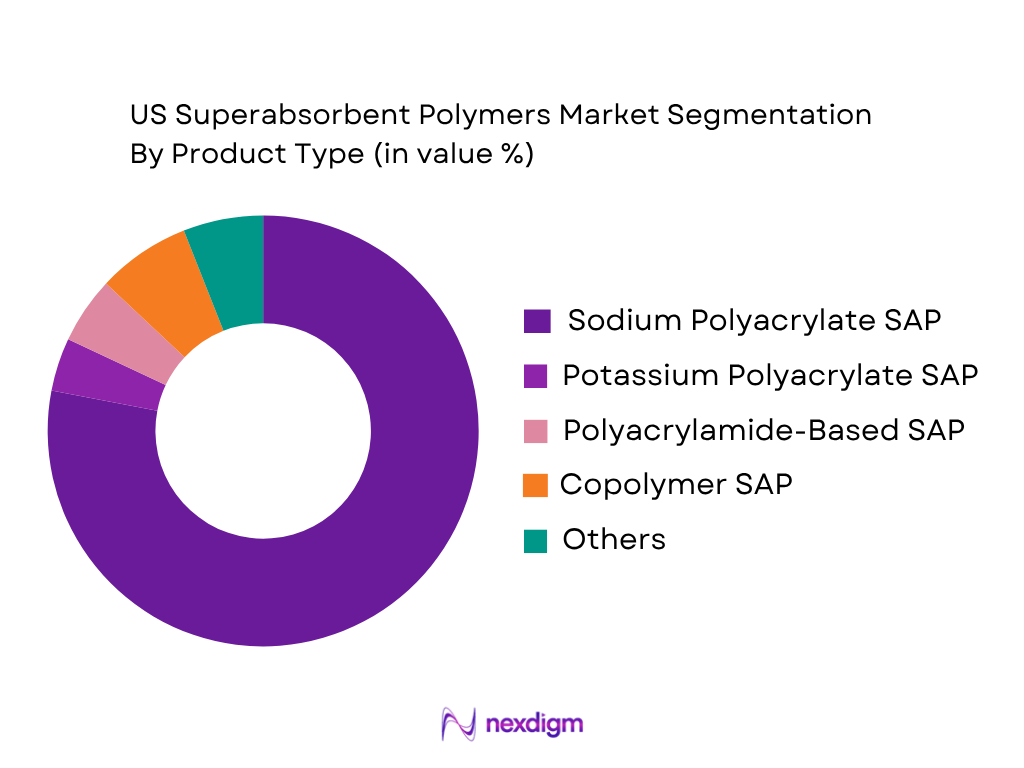
The US Superabsorbent Polymers Market is segmented by product type into sodium polyacrylate, potassium polyacrylate, polyacrylamide-based SAP, copolymer SAP, bio-based and modified natural polymer SAP, and other specialty superabsorbent polymers. Sodium polyacrylate represents the dominant sub-segment because it combines high absorption capacity, liquid retention, manufacturing compatibility and established use in disposable hygiene products. SAP is principally incorporated into diapers and sanitary products, where manufacturers require predictable swelling, rapid liquid uptake and retention under pressure. LG Chem describes SAP as a material capable of absorbing several hundred times its weight in water and identifies baby diapers, adult diapers and sanitary pads as primary applications. Nippon Shokubai similarly identifies disposable diapers as a core SAP application and has developed grades targeting absorption speed and liquid retention. The maturity of sodium polyacrylate production, established converter qualification and compatibility with high-speed diaper manufacturing reinforce its position, while bio-based and other specialty grades remain focused on sustainability and performance-oriented applications.
By Application
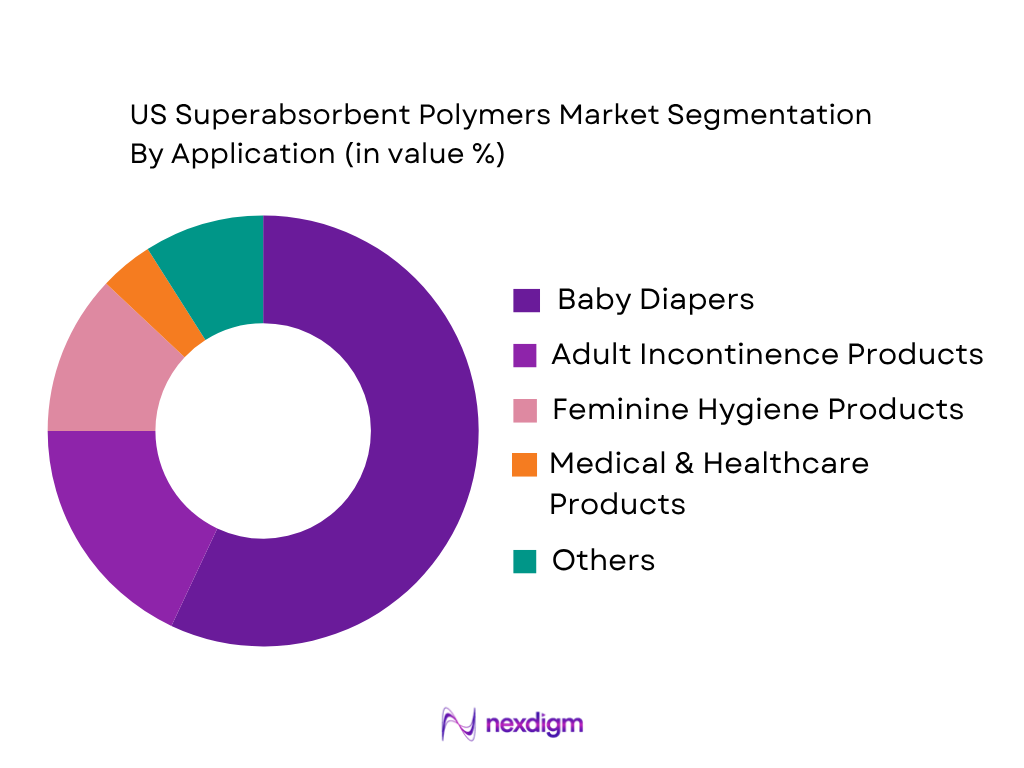
The US Superabsorbent Polymers Market is segmented by application into baby diapers, adult incontinence products, feminine hygiene products, medical and healthcare products, agriculture and horticulture, industrial absorbents, cable and wire protection, and specialty applications. Baby diapers represent the dominant application because SAP is a core absorbent material in modern diaper cores, providing liquid uptake and retention while enabling thinner product designs. The US recorded 3,628,934 births, creating a recurring requirement for infant hygiene products, while adult-oriented demand benefits from an aging population. The Census Bureau recorded 61,245,283 people aged 65 and over, creating a substantial demographic base for adult incontinence products. LG Chem identifies baby diapers, adult diapers and sanitary pads as major SAP applications, while Nippon Shokubai notes that adult sanitary products require properties including rapid absorption and liquid retention. Medical, agricultural and industrial applications provide diversification, but their consumption remains smaller than hygiene applications. Consequently, product innovation is increasingly focused on improving absorbency under pressure, absorption speed, retention and SAP efficiency within thinner hygiene cores.
Competitive Landscape
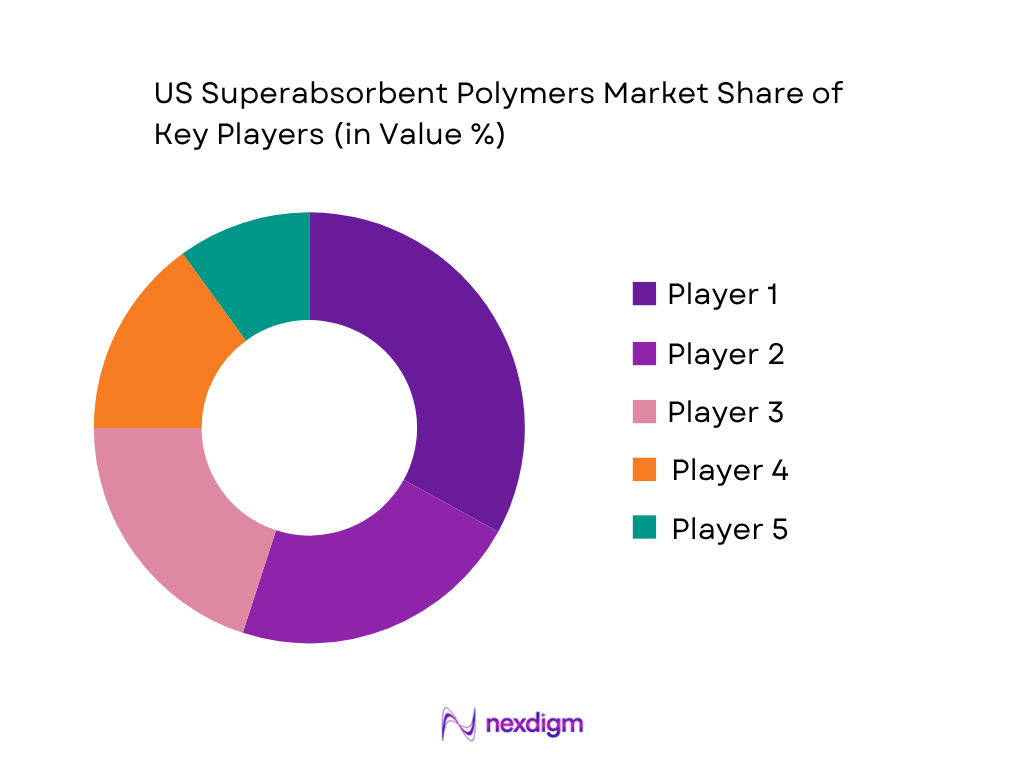
The US Superabsorbent Polymers Market includes major global chemical manufacturers with dedicated SAP production, acrylic-acid integration, technical-development capabilities and established relationships with hygiene-product manufacturers. Competition is centered on absorption capacity, absorption speed, retention under pressure, particle characteristics, manufacturing consistency, sustainability credentials and supply reliability. BASF has strengthened its North American position through investment in its Freeport, Texas SAP operation, while Nippon Shokubai operates US SAP manufacturing through Nippon Shokubai America Industries. LG Chem also maintains a dedicated SAP portfolio serving baby diapers, adult diapers and feminine hygiene applications.
| Major Player | Establishment Year | Headquarters | SAP Product Focus | US Manufacturing / Supply | Key Applications | Performance Capability | Sustainability / Innovation |
| BASF SE | 1865 | Ludwigshafen, Germany | ~ | ~ | ~ | ~ | ~ |
| Evonik Industries AG | 2007 | Essen, Germany | ~ | ~ | ~ | ~ | ~ |
| Nippon Shokubai Co., Ltd. | 1941 | Osaka, Japan | ~ | ~ | ~ | ~ | ~ |
| Sumitomo Seika Chemicals | 1944 | Osaka, Japan | ~ | ~ | ~ | ~ | ~ |
| LG Chem | 1947 | Seoul, South Korea | ~ | ~ | ~ | ~ | ~ |
US Superabsorbent Polymers Market Analysis
Growth Drivers
High Diaper Penetration and Aging Population and Adult Incontinence Demand
High penetration of disposable hygiene products and the expanding older population provide a broad structural demand base for superabsorbent polymers in the United States. The U.S. Census Bureau reported 3,628,934 births in 2024, compared with 3,596,017 births in 2023, maintaining a substantial annual population of infants requiring diaper products. At the opposite end of the demographic spectrum, the population aged 65 and older reached 61.2 million in 2024, increasing by 1.8 million people from 2023. The same demographic dataset shows that the population under 18 stood at 73.1 million, creating demand across both infant and family-care categories. These demographic conditions support continued consumption of diapers, training pants and adult incontinence products incorporating SAP for liquid absorption and retention. The United States also has a mature healthcare and retail infrastructure capable of distributing disposable hygiene products nationwide. For SAP manufacturers, the combination of a large infant cohort and a rapidly expanding elderly population broadens demand across both established baby-care applications and adult-care products. The demographic transition is therefore supporting demand diversification rather than dependence on a single hygiene application.
Expansion of Feminine Hygiene Products and Increasing Absorbency Requirements
Increasing requirements for thinner, higher-performing absorbent products are supporting the use of technically advanced superabsorbent polymers across feminine hygiene, baby-care and adult-care applications. The U.S. Census Bureau recorded 168.3 million females in the United States in 2024, providing a substantial demographic base for feminine hygiene products, while the population aged 65 and older reached 61.2 million. At the same time, the U.S. healthcare system recorded approximately 1.0 million hospital admissions for childbirth-related care in 2024, demonstrating the scale of maternal-care activity associated with disposable absorbent products. SAP enables manufacturers to increase liquid absorption and retention while reducing the amount of conventional fluff pulp required in absorbent cores. This supports product development toward thinner diapers, sanitary pads and adult incontinence products without sacrificing functional performance. The U.S. market also benefits from sophisticated hygiene-product converting infrastructure, where automated production lines require SAP with consistent particle size, absorption speed and retention characteristics. Rising performance expectations therefore create opportunities for surface-crosslinked, high-retention and pressure-resistant SAP grades rather than only additional commodity polymer volumes.
Market Challenges
Acrylic Acid Feedstock Volatility and Petrochemical Raw Material Dependency
The US Superabsorbent Polymers Market remains exposed to upstream petrochemical and chemical-feedstock conditions because conventional SAP production relies heavily on acrylic-acid-based chemistry. Changes in crude oil, natural gas and petrochemical operating conditions can affect the broader cost and availability structure of chemical intermediates used by SAP manufacturers. The International Monetary Fund reported US real GDP growth of 2.8 in 2024, while the Federal Reserve maintained the federal funds rate at a comparatively restrictive level through much of the year, with the effective rate ending the year at approximately 4.33. These macroeconomic conditions matter for chemical producers because financing, inventory management, plant investment and working-capital requirements influence the economics of maintaining reliable raw-material supply. The challenge is amplified where specialty SAP grades require tightly controlled acrylic-acid quality and formulation conditions. Manufacturers serving baby diapers, adult incontinence products and medical applications cannot freely substitute feedstocks without undertaking qualification and performance testing. Consequently, volatility in upstream chemical markets can affect procurement planning even when downstream hygiene demand remains comparatively stable. Greater supplier diversification, inventory planning and integration with acrylic-acid and sodium-acrylate production can reduce exposure, but these measures require additional operational coordination and capital.
Environmental Concerns Regarding Conventional SAP Disposal and Recycling Limitations
End-of-life management represents a continuing challenge because conventional SAP is primarily incorporated into disposable hygiene products that combine polymers, cellulose fibers, films, adhesives and other materials, making recovery technically difficult. The U.S. Environmental Protection Agency reported approximately 292.4 million tons of municipal solid waste generated in the United States in 2018, with approximately 146.1 million tons disposed in landfills; disposable hygiene products form part of the broader waste-management challenge associated with single-use consumer products. More recent EPA waste-management programs continue to emphasize source reduction, material recovery and improved product sustainability. For SAP manufacturers, this creates pressure to develop materials that maintain absorption performance while improving environmental attributes and compatibility with emerging recycling or alternative disposal systems. The challenge is particularly relevant for hygiene manufacturers because SAP must remain stable during product use while avoiding excessive complexity during end-of-life processing. Conventional diaper recycling also involves separation of SAP-containing absorbent cores from plastic films, cellulose and other components. As sustainability requirements become more prominent in procurement decisions, suppliers may need to demonstrate improvements in feedstock sourcing, manufacturing efficiency and end-of-life characteristics without compromising absorption capacity, retention or production-line compatibility.
Market Opportunities
High-Performance Hygiene-Grade SAP and Adult Incontinence Applications
The expanding elderly population creates an opportunity for higher-performance SAP grades designed specifically for adult incontinence products, where absorption capacity, retention under pressure, acquisition speed and skin-dryness performance are important product attributes. The U.S. Census Bureau recorded 61.2 million people aged 65 and older in 2024, compared with approximately 59.4 million in 2023, demonstrating continued expansion of the demographic group most closely associated with age-related incontinence needs. The population aged 65 and older also increased by 13.0% between 2020 and 2024, substantially faster than the working-age population. This demographic shift creates opportunities for SAP suppliers to move beyond conventional diaper grades toward specialized materials optimized for adult briefs, protective underwear and other continence-care products. Higher-retention polymers can help manufacturers design thinner products with improved liquid-locking performance, while faster-absorbing grades can support products designed for mobility and heavier fluid loads. The opportunity extends to medical absorbent products, where predictable swelling and retention are important. Suppliers capable of combining high absorbency with pressure resistance and consistent particle characteristics can address the increasingly differentiated requirements of adult-care manufacturers and healthcare-product converters.
Sustainable and Bio-Based SAP Development and Agricultural Water-Retention Applications
Sustainable SAP development and agricultural water-retention applications offer diversification opportunities beyond conventional disposable hygiene products. The U.S. Department of Agriculture reported 212,714 irrigating farms using 53.1 million irrigated acres and 81.0 million acre-feet of water in the latest national Irrigation and Water Management Survey, demonstrating the scale of water-dependent agricultural activity. California alone accounted for 7.8 million irrigated acres and 22.6 million acre-feet of applied irrigation water, while Nebraska accounted for 7.3 million irrigated acres. These conditions create a technical application environment for water-retention polymers capable of absorbing and gradually releasing moisture around plant roots. At the same time, sustainability requirements in hygiene products are encouraging development of bio-based and lower-impact SAP technologies. The combination creates an opportunity for suppliers to develop differentiated polymer platforms rather than relying exclusively on conventional sodium polyacrylate used in diapers. Agricultural SAP can potentially support moisture management in horticulture, nursery production and selected crop applications, while bio-based or bio-balanced materials can address environmental requirements in consumer products. Development must still demonstrate agronomic effectiveness, biodegradation or environmental characteristics where applicable, and compatibility with established manufacturing processes.
Future Outlook
Over the next decade, the US Superabsorbent Polymers Market is expected to develop around continued hygiene-product consumption, adult incontinence requirements, product miniaturization and higher absorbency expectations. Baby hygiene will remain an important consumption base, while demographic aging should support increasing attention toward adult incontinence applications. Manufacturers are expected to prioritize SAP grades offering faster absorption, stronger liquid retention and improved absorbency under pressure. Sustainability will also become increasingly relevant, with bio-balanced and lower-carbon SAP products entering commercial supply chains. Agricultural and specialty industrial applications provide additional diversification opportunities, particularly where water retention and moisture management are important.
The competitive environment is expected to emphasize domestic supply security, technical collaboration with hygiene converters and higher-performance SAP grades rather than simple volume expansion. Investments in North American production capacity and process optimization demonstrate the importance manufacturers place on serving regional hygiene-product demand. BASF’s Freeport investment and Nippon Shokubai’s US manufacturing footprint illustrate this supply-chain localization trend.
Major Players
- BASF SE
- Evonik Industries AG
- Nippon Shokubai Co., Ltd.
- Sumitomo Seika Chemicals Co., Ltd.
- LG Chem
- Formosa Plastics Corporation
- Yixing Danson Technology
- Shandong Nuoer Biological Technology
- SDP Global Co., Ltd.
- Songwon Industrial Group
- Kao Corporation
- Chase Corporation
- SNF Group
- Sumitomo Chemical Co., Ltd.
- Arkema Group
Key Target Audience
- Superabsorbent Polymer Manufacturers
- Baby Diaper and Hygiene Product Manufacturers
- Adult Incontinence Product Manufacturers
- Feminine Hygiene and Medical Product Manufacturers
- Chemical Feedstock and Acrylic Acid Producers
- Industrial and Agricultural Absorbent Product Manufacturers
- Investments and Venture Capitalist Firms
- Government and Regulatory Bodies (U.S. Environmental Protection Agency, U.S. Food and Drug Administration, Occupational Safety and Health Administration, U.S. Department of Agriculture, U.S. Department of Commerce)
Research Methodology
Step 1: Identification of Key Variables
The initial phase involves constructing an ecosystem map covering acrylic-acid producers, SAP manufacturers, converters, hygiene-product companies, distributors and specialty users. Key variables include SAP chemistry, production capacity, absorption performance, retention characteristics, application requirements and end-use consumption. Particular emphasis is placed on baby diapers, adult incontinence, feminine hygiene and medical applications.
Step 2: Market Analysis and Construction
This phase compiles historical and current information on US SAP production, imports, exports, consumption and manufacturing capacity. Market construction is performed across product chemistry, performance characteristics, applications and end-use industries. Company-level production footprints and customer applications are assessed to develop a bottom-up consumption model, while industry-level demand indicators provide top-down validation.
Step 3: Hypothesis Validation and Expert Consultation
Market hypotheses are developed and validated through engagement with SAP producers, hygiene-product manufacturers, converters, distributors and technical specialists. Discussions examine product specifications, absorption requirements, procurement practices, qualification procedures and sustainability requirements. The resulting operational insights are used to refine assumptions and validate competitive and application-level findings.
Step 4: Research Synthesis and Final Output
The final phase integrates supply-side, demand-side, trade and company-level information into the US Superabsorbent Polymers Market model. Data are cross-checked across production, consumption, application and geographic dimensions to identify inconsistencies. The final analysis presents market size, segmentation, competitive positioning, industry dynamics, opportunities and future development pathways.

- Executive Summary
- Research Methodology (Market Definition and Scope, US Superabsorbent Polymers Market Classification, Superabsorbent Polymer Product Mapping, Polymer Chemistry Assessment, Absorption Performance Assessment, Application-Level Demand Analysis, End-Use Industry Assessment, Production Capacity Mapping, Domestic Manufacturing Assessment, Import and Export Trade Analysis, Acrylic Acid and Sodium Acrylate Feedstock Assessment, Demand-Side Assessment, Supply-Side Assessment, Top-Down Market Sizing, Bottom-Up Market Sizing, Primary Industry Interviews, Converter and End-User Interviews, Data Triangulation, Forecasting Framework, Market Share Validation, Limitations and Future Conclusions)

- Definition and Scope
- US Superabsorbent Polymers Industry Evolution
- Superabsorbent Polymers Value Chain Analysis Supply Chain Analysis
- Raw Material-to-SAP Conversion Chain Analysis
- Acrylic Acid and Sodium Acrylate Feedstock Availability Assessment
- US Domestic Production and Import Dependency Assessment

- Growth Drivers (High Diaper Penetration, Aging Population and Adult Incontinence Demand, Expansion of Feminine Hygiene Products, Increasing Absorbency Requirements, Growth of Medical Absorbent Products, Agricultural Water-Efficiency Requirements, Product Performance Improvements, Lightweight Hygiene Product Development, Increasing Demand for High-Retention SAP Grades)
- Market Challenges (Acrylic Acid Feedstock Volatility, Petrochemical Raw Material Dependency, Energy-Intensive Polymer Production, Environmental Concerns Regarding Conventional SAP Disposal, Recycling Limitations, Product Qualification Requirements, Manufacturing Capacity Concentration, Supply Chain Disruptions, Pressure from Alternative Absorbent Materials)
- Market Opportunities (High-Performance Hygiene-Grade SAP, Adult Incontinence Applications, Sustainable and Bio-Based SAP Development, Agricultural Water-Retention Applications, Medical Absorbent Materials, Flushable and Recycling-Compatible Hygiene Solutions, Specialty Industrial Absorbents, Next-Generation Surface-Crosslinked SAP, Domestic Feedstock and Manufacturing Integration, High-Retention Polymer Technology)
- Market Trends (Thinner Diaper Core Development, Higher Absorption-to-Weight Ratios, Surface-Crosslinked SAP Adoption, High-Pressure Absorbency Development, Adult Incontinence Product Innovation, Sustainable Hygiene Materials, Bio-Based SAP Research, Agricultural Water Management, Specialty Medical Absorbents, SAP Optimization for Automated Hygiene Manufacturing)
- Government Regulations and Standards (US Food and Drug Administration Medical Device Requirements, Environmental Protection Agency Chemical Requirements, Toxic Substances Control Act, Occupational Safety and Health Administration Chemical Handling Requirements, US Department of Agriculture Agricultural Input Requirements, Consumer Product Safety Requirements, State-Level Chemical Regulations, California Proposition 65 Requirements, Solid Waste and Recycling Regulations)
- SWOT Analysis
- Porter’s Five Forces Analysis
- PESTLE Analysis
- Stakeholder Ecosystem
- Competition Ecosystem

- By Market Value (2020-2025)
- By Market Volume (2020-2025)
- By Superabsorbent Polymer Consumption Volume (2020-2025)
- By Domestic Production Volume (2020-2025)
- By Import Volume (2020-2025)

- By Product Type (In Value %)
Sodium Polyacrylate Superabsorbent Polymers
Potassium Polyacrylate Superabsorbent Polymers
Polyacrylamide-Based Superabsorbent Polymers
Copolymer Superabsorbent Polymers
Bio-Based and Modified Natural Polymer SAPs
Other Specialty Superabsorbent Polymers - By Particle Size and Form (In Value %)
Standard SAP Granules
Fine-Particle SAP
Coarse-Particle SAP
Surface-Crosslinked SAP
Core-Shell SAP
Powdered SAP - By Absorption Performance (In Value %)
Standard Absorption Capacity
High Absorption Capacity
High Retention Capacity
Fast Absorption SAP
Pressure-Resistant Absorbency
High-Performance Hygiene-Grade SAP - By Application Type (In Value %)
Baby Diapers
Adult Incontinence Products
Feminine Hygiene Products
Medical and Healthcare Products
Agriculture and Horticulture
Industrial Absorbents
Cable and Wire Protection
Packaging and Other Specialty Applications - By End-Use Industry (In Value %)
Baby Care and Hygiene Products
Adult Incontinence Care
Feminine Hygiene
Healthcare and Medical Products
Agriculture and Horticulture
Food Packaging and Freshness Management
Industrial Manufacturing
Electrical and Cable Manufacturing
Water Management Applications - By Distribution Channel (In Value %)
Direct Industrial Sales
OEM and Converter Contracts
Specialty Chemical Distributors
Industrial Chemical Distributors
Agricultural Input Distributors
Medical Supply Distributors
Online Industrial Platforms

- Market Share of Major Players (By US Revenue, SAP Sales Volume, Production Capacity, Absorption Performance, Product Grade Portfolio, Hygiene Industry Exposure, Agricultural Application Exposure, Domestic Manufacturing Footprint, Distribution Network Coverage, Regional Presence, OEM and Converter Customer Coverage, R&D Capability, Product Certification Coverage)
- Cross Comparison Parameters (Superabsorbent Polymer Revenue, Production Capacity, SAP Grade Portfolio Breadth, Absorption and Retention Performance, Hygiene Application Coverage, Adult Incontinence and Medical Application Capability, Sustainable SAP Technology Portfolio, US Manufacturing and Distribution Reach)
- SWOT Analysis of Major Players
- Detailed Profiles of Major Companies
BASF Corporation
Evonik Corporation
Nippon Shokubai America Industries
Sumitomo Seika America
Formosa Plastics Corporation, USA
LG Chem America
Yixing Danson Technology
Shandong Nuoer Biological Technology
Demi Specialty Chemicals
Quanzhou BLD Science Technology
Zhejiang Satellite Petrochemical
Kao Corporation
Chase Corporation
Stockhausen Inc.
SNF Holding Company

- Baby Diaper Manufacturer SAP Procurement Assessment
- Adult Incontinence Product Manufacturer Absorbency Requirement Analysis
- Feminine Hygiene Product Manufacturer SAP Requirement Assessment
- Medical Absorbent Product Manufacturer Material Qualification Analysis
- Hygiene Product Converter SAP Specification Assessment
- Agricultural Input Manufacturer Water-Retention Polymer Assessment
- Horticultural Grower SAP Application Assessment

- By Market Value (2026-2035)
- By Market Volume (2026-2035)
- By Superabsorbent Polymer Consumption Volume (2026-2035)
- By Domestic Production Volume (2026-2035)
- By Import Volume (2026-2035)


 Request a Sample
 Ask for Customization
 Get a Quote
 Enquire Now