
 Download PDF
Market Overview
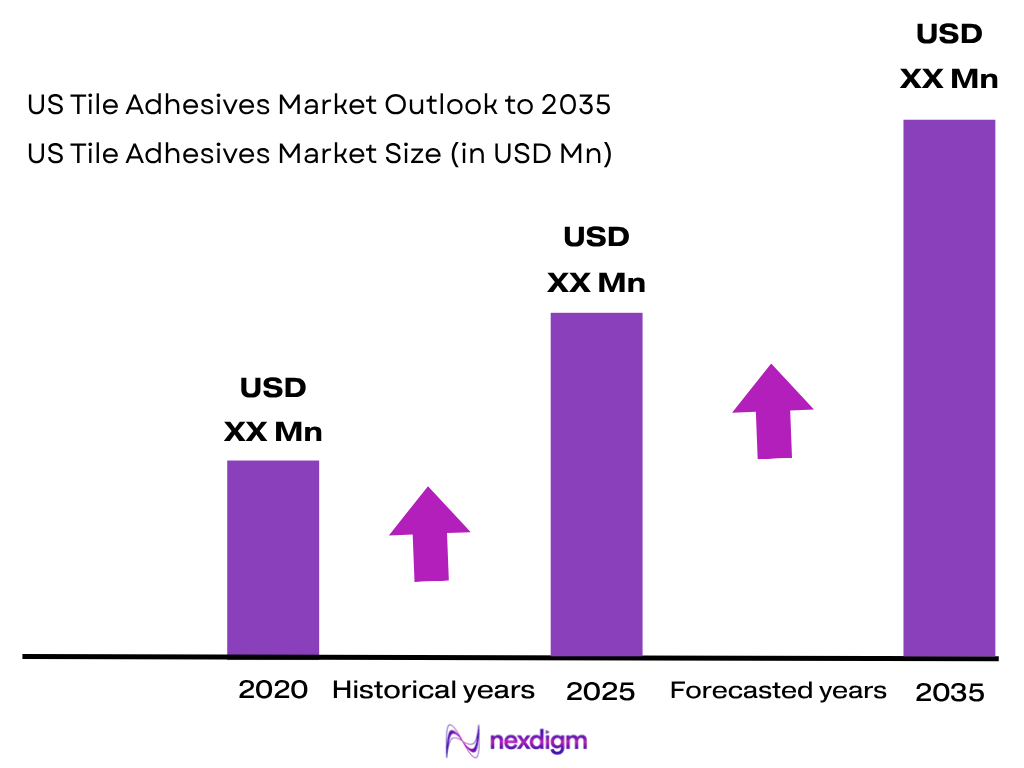
The US Tile Adhesives Market is valued at approximately ~USD XX million, supported by residential completion, renovation, porcelain installation and commercial construction. Annual housing completions increased from 1,448,800 units to 1,627,900 units across the latest two observations. At the same time, December residential construction activity increased from an annualized USD897.2 billion to USD951.5 billion, expanding the installation base for polymer-modified mortars, shower-system mortars and large-format tile adhesives.
Texas, Florida, California and the broader South and West dominate US Tile Adhesives Market demand because of large housing stocks, continuing construction, warmer-climate tile usage and extensive remodeling. National ceramic tile consumption totaled 2.847 billion square feet in the earlier observation, while 2.027 billion square feet had already been consumed through the first nine months of the subsequent observation. These regions also support porcelain, outdoor tile, shower and large-format installations requiring specialized mortars.
Market Segmentation
By Adhesive Technology
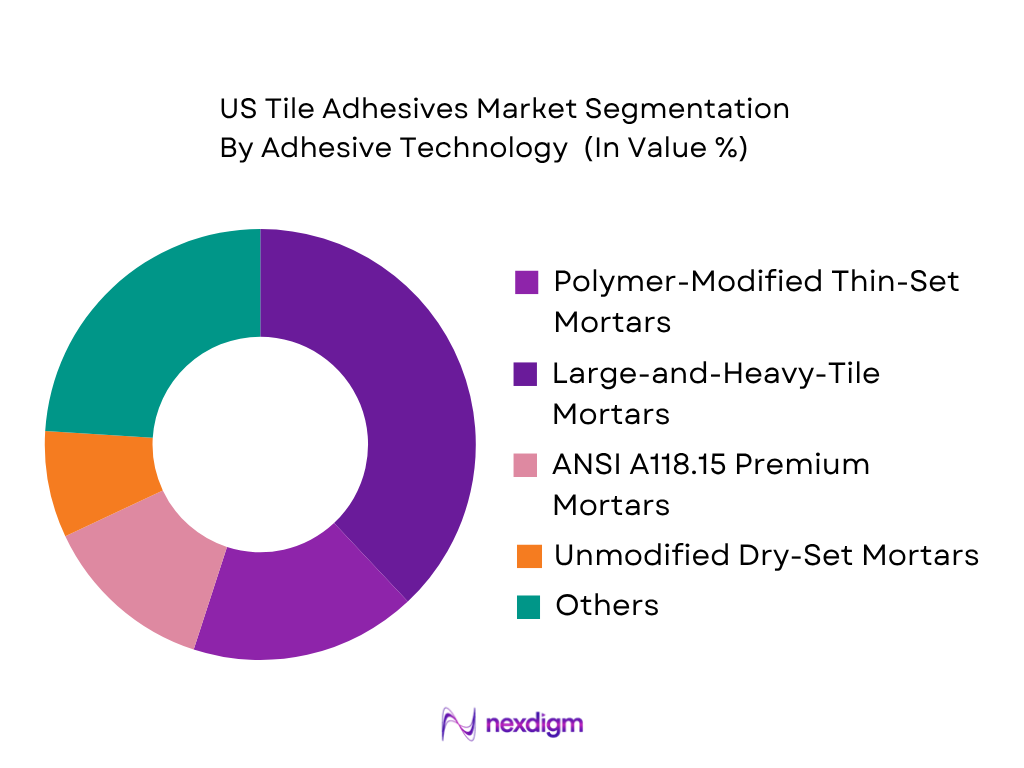
The US Tile Adhesives Market is segmented into polymer-modified thin-set mortars, ANSI A118.15 high-performance mortars, large-and-heavy-tile mortars, unmodified dry-set mortars, rapid-setting mortars, lightweight mortars, uncoupling-membrane mortars, epoxy adhesives and ready-to-use products. Polymer-modified thin-set mortars hold the dominant modeled share because they address the broadest range of ceramic, porcelain and natural-stone installations while delivering improved bond strength and substrate compatibility compared with basic dry-set products. Their importance has increased as low-absorption porcelain and larger tiles have become common in residential and commercial interiors. High-performance mortars meeting ANSI A118.15 are particularly relevant for demanding installations; the current ANSI standard covers improved modified dry-set cement mortar, and leading manufacturers maintain extensive A118.15 product portfolios for porcelain, large-format and specialty tile applications. Integrated waterproofing and uncoupling systems also encourage use of manufacturer-approved modified mortars rather than generic setting materials.
By Tile and Stone Type
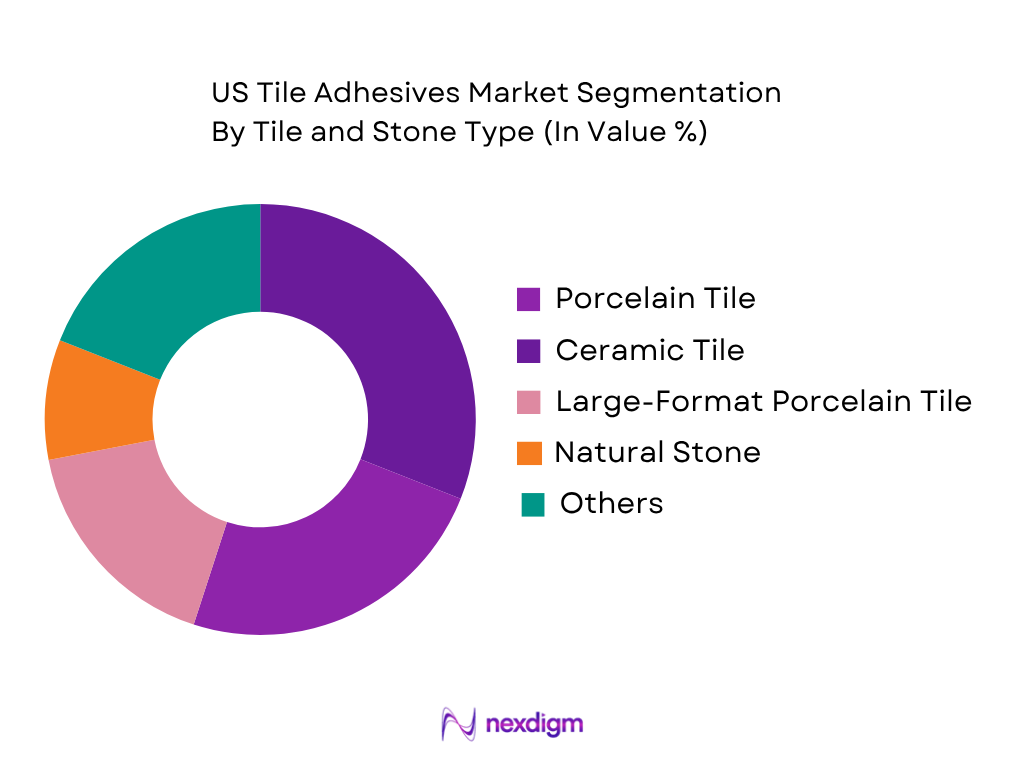
The US Tile Adhesives Market is segmented into ceramic tile, porcelain tile, large-format porcelain, gauged porcelain panels, natural stone, marble, granite, glass mosaic, quarry tile and manufactured stone veneer. Porcelain and large-format porcelain collectively form the dominant modeled demand group because their low absorption, dimensional scale and increasing use on both floors and walls require stronger polymer modification and better mortar-transfer characteristics than many traditional ceramic applications. Large-and-heavy tile is generally treated as a specialized installation category when a tile has a side exceeding 15 inches, and current mortar portfolios emphasize non-sag, non-slump and high-transfer properties for these formats. LATICRETE likewise defines large-and-heavy tile products around tiles with at least one side greater than 15 inches, while premium lightweight mortars can achieve high ANSI classifications and greater installer coverage per bag. These requirements raise adhesive value intensity as tile dimensions increase.
Competitive Landscape
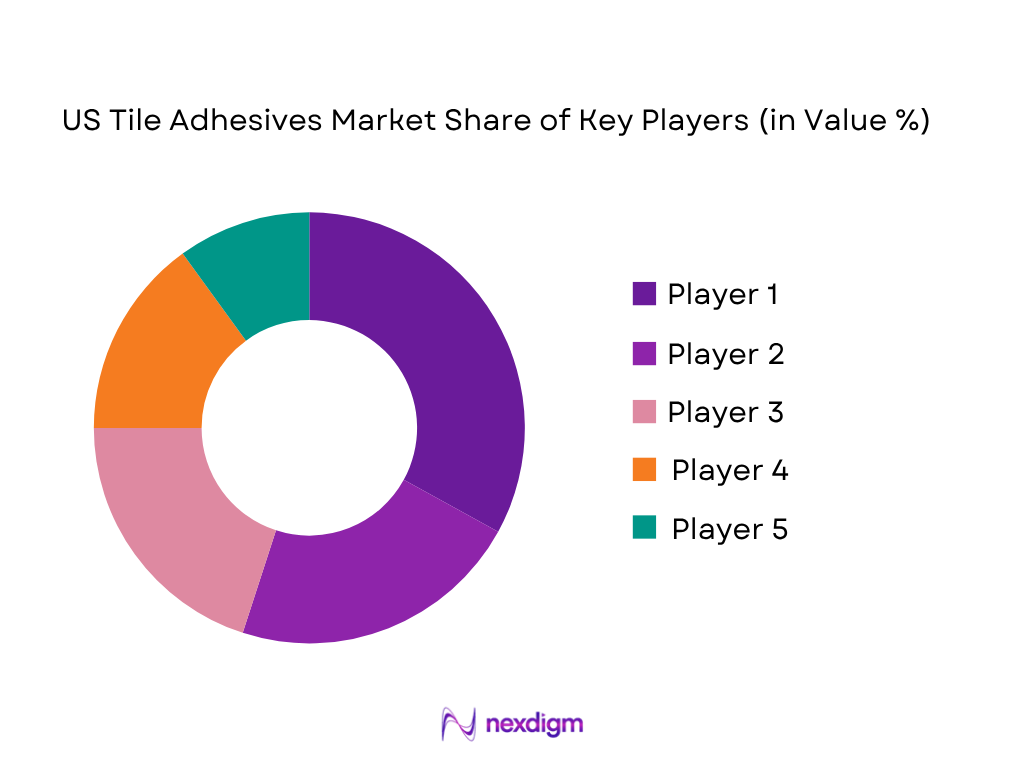
The US Tile Adhesives Market is characterized by several large installation-system suppliers with established dry-mix manufacturing, professional distribution and strong contractor relationships. Custom Building Products, LATICRETE, MAPEI, ARDEX and Schluter Systems compete not only on basic mortar performance but increasingly on ANSI A118.15 compliance, large-and-heavy-tile capability, waterproofing compatibility, rapid-setting technology and complete-system warranties. Competition is therefore shifting from standalone bags of mortar toward integrated tile-installation systems.
| Major Player | Establishment Year | Headquarters | High-Performance Mortars | Large-Format Capability | Membrane / Shower Compatibility | US Manufacturing / Supply | Rapid / Lightweight Technology | Contractor Technical Support |
| Custom Building Products | 1964 | Huntington Beach, California | ~ | ~ | ~ | ~ | ~ | ~ |
| LATICRETE International | 1956 | Bethany, Connecticut | ~ | ~ | ~ | ~ | ~ | ~ |
| MAPEI Corporation | 1937 | Deerfield Beach, Florida | ~ | ~ | ~ | ~ | ~ | ~ |
| ARDEX Americas | 1949 | Aliquippa, Pennsylvania | ~ | ~ | ~ | ~ | ~ | ~ |
| Schluter Systems | 1966 | Plattsburgh, New York | ~ | ~ | ~ | ~ | ~ | ~ |
US Tile Adhesives Market Analysis
Growth Drivers
Residential Remodeling and Housing Completions Sustain Tile Adhesive Consumption
Residential construction and remodeling remain major demand generators for polymer-modified thin-set mortars, shower-system mortars, porcelain adhesives and tile-over-tile systems in the United States. Census data show 1,627,900 privately owned housing units were completed in 2024, compared with 1,448,800 units in the previous year, expanding the installed base of kitchens, bathrooms, showers and tiled flooring. Total residential construction was running at an annualized USD951.5 billion in December 2024, providing substantial underlying demand for both initial tile installation and subsequent refurbishment. Tile itself remains a high-volume finish: U.S. ceramic tile consumption reached approximately 2.70 billion square feet in 2024, inferred from TCNA’s subsequently reported 2.57 billion square feet in 2025 and the stated year-on-year change. The macroeconomic backdrop also supports household renovation expenditure, with World Bank data placing 2024 U.S. GDP at USD28.75 trillion, GDP per capita at USD84,534, and population at 340,110,988. IMF data record 2024 real GDP growth at 2.8, providing a broad economic base for residential construction, replacement flooring and bathroom renovation activity.
Porcelain, Large-Format Tiles and Performance Standards Drive Premium Mortar Adoption
The shift toward porcelain, large-format tile and gauged porcelain panels is increasing the technical intensity of the US Tile Adhesives Market because these surfaces demand higher bond strength, improved transfer, longer open time and tighter substrate preparation. TCNA reports that U.S. ceramic tile consumption reached 2.57 billion square feet in 2025, while domestic manufacturers shipped 707.7 million square feet and imports reached 1.86 billion square feet, demonstrating the substantial installation volume flowing through contractors and flooring distributors. Larger and denser tile formats increasingly require mortars meeting ANSI A118.15:2023, the current specification for improved modified dry-set cement mortar, while ANSI A108/A118/A136.1:2024 provides current installation requirements. Gauged porcelain tile panels are also governed by dedicated standards including ANSI A137.3:2022 and installation standards ANSI A108.19 and A108.20. These requirements favor higher-performance polymer-modified products rather than basic dry-set mortar. World Bank data show 2024 U.S. GDP of USD28.75 trillion, GDP per capita of USD84,534, and population of 340,110,988, while the IMF reports 2024 real GDP growth of 2.8, supporting continued spending on premium residential and commercial finishing systems.
Market Challenges
Installation Labor, Substrate Flatness and Mortar Coverage Increase Failure Risk
Tile adhesive performance is highly dependent on installer execution, creating a material challenge as larger tiles require flatter substrates, correct trowel selection and higher mortar-transfer consistency. The U.S. installation base remains substantial, with 1,627,900 housing units completed in 2024 and ceramic tile consumption subsequently reaching 2.57 billion square feet in 2025. Large-format and gauged porcelain installations magnify the consequences of poor preparation because incomplete coverage can create voids, lippage, cracked tiles or bond failure. Current U.S. standards reinforce the technical burden: ANSI A118.15:2023 governs improved modified mortars, while ANSI A108/A118/A136.1:2024 addresses installation practices and ANSI A137.3:2022 covers gauged porcelain tiles and panels. Contractors must therefore coordinate substrate flatness, mortar consistency, open time, coverage and movement accommodation rather than relying on a generic adhesive selection. The broader labor and financing environment adds pressure: IMF data place the U.S. unemployment rate at 4.1 in the fourth quarter of 2024 and the federal funds rate at 4.4 at year-end, while World Bank data show GDP per capita of USD84,534. These conditions increase the importance of labor-saving mortars, contractor training and technically correct installation.
Slower Tile Consumption and Dependence on Imported Tile Supply Pressure Product Mix
The US Tile Adhesives Market must operate against softer near-term tile consumption and substantial reliance on imported finished tile, creating volume and specification uncertainty for mortar producers and distributors. TCNA reported 2.57 billion square feet of U.S. ceramic tile consumption in 2025, with imports accounting for 1.86 billion square feet and domestic manufacturers shipping 707.7 million square feet. Imports therefore remain the largest source of installed tile volume, and shifts in supply from Spain, Italy, India and other countries can influence tile formats, body composition and installation requirements. Contractors and adhesive suppliers must accommodate porcelain density, panel dimensions, surface treatments and substrate combinations that differ across imported product categories. At the same time, nonresidential and residential construction spending remains large but uneven, with Census historical construction datasets showing significant differences between project categories through 2025 and 2026. Macroeconomic conditions also affect renovation decisions: the IMF records a 4.4 federal funds rate at the end of 2024 and a 4.1 unemployment rate, while World Bank data place U.S. GDP at USD28.75 trillion and GDP per capita at USD84,534. This environment favors suppliers with broad, standards-based mortar portfolios capable of adapting to changing tile mixes.
Market Opportunities
ANSI A118.15 and Large-and-Heavy-Tile Mortars Offer Higher-Performance Growth
High-performance polymer-modified mortars represent a strong future opportunity because current tile formats increasingly require performance beyond conventional dry-set systems. TCNA identifies ANSI A118.15:2023 as the current specification for improved modified dry-set cement mortar, while ANSI A118.4:2023 covers modified dry-set mortar and ANSI A118.10:2023 covers bonded waterproof membranes. The existence of separate high-performance and membrane standards reflects a more system-oriented installation environment in which mortar selection is linked to tile size, substrate and waterproofing technology. U.S. ceramic tile consumption remained substantial at 2.57 billion square feet in 2025, including 1.86 billion square feet of imported tile, creating a large current installed-volume base for premium mortars. Gauged porcelain is also supported by ANSI A137.3:2022 plus dedicated A108.19 and A108.20 installation standards, giving suppliers a technically defined route to premium products for thin panels and large slabs. World Bank data place 2024 U.S. GDP at USD28.75 trillion, GDP per capita at USD84,534, and population at 340,110,988, while IMF data show real GDP growth of 2.8. These current fundamentals support future migration toward higher-specification tile-setting systems.
Waterproofing, Uncoupling and Rapid-Setting Systems Expand Value per Installation
Integrated waterproofing, uncoupling and rapid-setting mortar systems provide another future growth avenue because contractors increasingly install tile as part of complete substrate-management systems rather than using standalone mortar. ANSI A118.10:2023 currently governs load-bearing bonded waterproof membranes for thin-set ceramic tile and dimension stone, while ANSI A118.12:2014 remains current for crack-isolation membrane specifications. These standards create direct compatibility requirements between membranes and setting materials, supporting dedicated mortars formulated for showers, heated floors and uncoupling assemblies. The current installation base is large: Census data report 1,627,900 housing completions in 2024, while U.S. ceramic tile consumption reached 2.57 billion square feet in 2025. Each completed residential unit expands the potential lifetime base for bathroom remodeling, shower replacement and heated-floor upgrades, while commercial renovation creates demand for rapid-setting systems that reduce downtime. The macroeconomic environment remains supportive of continued renovation spending, with World Bank data recording 2024 U.S. GDP of USD28.75 trillion, GDP per capita of USD84,534, and population of 340,110,988. IMF data show 2024 real GDP growth of 2.8, reinforcing the economic platform for higher-value system-based tile installation products.
Future Outlook
The US Tile Adhesives Market is forecast to expand at approximately ~X.X% CAGR during 2026–2035, supported by residential replacement, bathroom renovation, porcelain tile use, large-format installation and higher-performance system specifications. Product mix is expected to continue shifting toward ANSI A118.15 mortars, lightweight formulations, large-and-heavy-tile systems and mortars integrated with waterproofing and uncoupling membranes. The underlying construction base remains substantial. US Census Bureau data showed total construction activity at a seasonally adjusted annual rate of approximately USD2.192 trillion in December 2024, including USD951.5 billion of residential construction and USD1.241 trillion of non-residential construction. A year earlier, the corresponding levels were approximately USD2.101 trillion, USD897.2 billion and USD1.204 trillion, respectively. This large installed construction base supports demand for tile setting in both new buildings and subsequent renovation.
Major Players
- Custom Building Products
- LATICRETE International
- MAPEI Corporation
- ARDEX Americas
- Schluter Systems
- Sika Corporation
- Bostik / Arkema
- TEC / H.B. Fuller
- Merkrete / Sika
- PROFLEX Products
- ProSpec / Oldcastle APG
- Super-Tek Products
- Parex USA / Sika
- W.R. Meadows
- The QUIKRETE Companies
Key Target Audience
- Tile Adhesive and Dry-Mix Mortar Manufacturers
- Ceramic, Porcelain and Natural Stone Manufacturers
- Tile and Flooring Distributors
- Residential Builders and Remodeling Companies
- Tile, Stone and Flooring Installation Contractors
- Home Improvement and Building Material Retailers
- Investments and Venture Capitalist Firms
- Government and Regulatory Bodies (US Environmental Protection Agency, Occupational Safety and Health Administration, National Institute of Standards and Technology, State Building Code Authorities)
Research Methodology
Step 1: Identification of Key Variables
The initial phase involves constructing an ecosystem map covering cement and polymer suppliers, mortar manufacturers, tile producers, distributors, retailers, contractors, builders and remodelers. Secondary and proprietary research identifies critical variables such as tile size, porcelain penetration, ANSI performance class, substrate type, membrane use, construction activity, remodeling exposure and regional distribution.
Step 2: Market Analysis and Construction
Historical data for the US Tile Adhesives Market are assessed using top-down and bottom-up approaches. Top-down analysis considers construction spending, housing completions and ceramic tile consumption, while bottom-up modelling evaluates tile area installed, mortar coverage, bag consumption, application type, tile dimensions and the mix between standard and high-performance setting materials.
Step 3: Hypothesis Validation and Expert Consultation
Market hypotheses are validated through computer-assisted telephone interviews with tile adhesive manufacturers, flooring distributors, tile contractors, homebuilders and professional installers. Discussions are used to validate large-format mortar penetration, ANSI A118.15 usage, membrane compatibility requirements, contractor preferences, regional installation practices and adoption of lightweight or rapid-setting products.
Step 4: Research Synthesis and Final Output
The final phase triangulates Census construction statistics, TCNA tile-consumption information, ANSI standards, manufacturer technical documentation and primary industry inputs. Bottom-up mortar-consumption models are reconciled against national construction and tile volumes to produce the final market segmentation, competitive positioning, technology assessment and future strategic outlook.

- Executive Summary
- Research Methodology (Market Definitions and Assumptions, US Tile Adhesives Market Boundary, Thin-Set Mortar Classification, Dry-Set Mortar Assessment, Polymer-Modified Mortar Assessment, ANSI A118.1 Assessment, ANSI A118.4 Assessment, ANSI A118.11 Assessment, ANSI A118.15 High-Performance Mortar Assessment, Large-and-Heavy-Tile Mortar Assessment, Rapid-Setting Mortar Assessment, Epoxy Adhesive Assessment, Organic Mastic Assessment, Ready-to-Use Tile Adhesive Assessment, Uncoupling Membrane Mortar Assessment, Gauged Porcelain Tile Panel Assessment, Natural Stone Installation Assessment, Exterior Tile Installation Assessment, Shower and Wet-Area Assessment, Swimming Pool Assessment, Residential Remodeling Assessment, Commercial Construction Assessment, Tile Contractor Mapping, Flooring Distributor Mapping, Home-Center Channel Mapping, Supply-Side Assessment, Demand-Side Assessment, Top-Down Market Sizing, Bottom-Up Market Sizing, Primary Industry Interviews, Construction Pipeline Assessment, Data Triangulation, Forecasting Framework)

- Definition and Scope
- Evolution of Tile Adhesive Technology in the United States, Transition from Conventional Dry-Set Mortars to Polymer-Modified Thin-Set Mortars, ANSI A118.4 Systems, ANSI A118.15 High-Performance Mortars, Large-and-Heavy-Tile Mortars, Rapid-Setting Mortars, Lightweight Mortars, Non-Sag Wall Mortars, Uncoupling Membrane Mortars, Epoxy Tile Adhesives, Ready-to-Use Mastics, Porcelain Tile Adhesives, Natural Stone Mortars, Gauged Porcelain Tile Panel Installation Systems, Crack-Isolation-Compatible Mortars, Waterproofing-Membrane-Compatible Mortars, Low-VOC Tile Adhesive Systems
- Tile Adhesives Industry Value Chain Analysis
- Tile Adhesives Supply Chain Analysis
- Portland Cement Suppliers, Calcium Aluminate Cement Suppliers, Silica Sand Suppliers, Redispersible Polymer Powder Suppliers, Cellulose Ether Suppliers, Rheology Modifier Suppliers, Specialty Additive Suppliers, Epoxy Resin Suppliers, Tile Adhesive Manufacturers, Dry-Mix Mortar Plants, Packaging Suppliers, Flooring Distributors, Tile Distributors, Home Improvement Retailers, Professional Contractor Supply Houses, Tile Contractors, Flooring Contractors, General Contractors, Homebuilders, Remodelers, Architects and Specifiers

- Growth Drivers (Residential Remodeling, Bathroom Renovation, Porcelain Tile Installation, Large-Format Tile Adoption, Gauged Porcelain Panels, Commercial Flooring Replacement, Hospitality Renovation, Waterproof Shower Systems, Uncoupling Membrane Adoption, Labor-Saving Mortars, High-Performance ANSI A118.15 Specification, Premium Natural Stone Installation)
- Market Challenges (Tile Installation Labor Availability, Substrate Flatness Requirements, Inadequate Mortar Coverage, Incorrect Trowel Selection, Mortar Skinning and Open-Time Loss, Moisture and Temperature Conditions, Large-Format Tile Lippage, Porcelain Bonding Complexity, Traditional Low-Cost Mortar Competition, Polymer Raw Material Exposure, Product-Substrate Compatibility, Installation Standard Awareness)
- Market Opportunities (ANSI A118.15 High-Performance Mortars, Large-and-Heavy-Tile Mortars, Gauged Porcelain Tile Panel Adhesives, Lightweight Mortars, Rapid-Setting Mortars, Tile-over-Tile Renovation Systems, Shower and Waterproofing System Mortars, Uncoupling Membrane Mortars, Heated-Floor Tile Systems, Exterior Porcelain Installation, Low-VOC Tile Adhesives, Single-Source Installation Systems, Contractor Training and Certification)
- Market Trends (Polymer-Modified Mortar Penetration, Large-and-Heavy-Tile Mortars, A118.15 Specification, Lightweight Technology, High-Transfer Mortars, Non-Sag Wall Systems, Rapid-Setting Technology, Gauged Porcelain Tile Panels, Uncoupling Membranes, Waterproof Shower Systems, Low-VOC Formulations, Premixed Specialty Adhesives, Complete-System Warranties)
- Government Regulations and Standards (ANSI A118.1 Dry-Set Mortar Requirements, ANSI A118.4 Modified Mortar Requirements, ANSI A118.11 EGP Plywood Mortar Requirements, ANSI A118.15 Improved Modified Mortar Requirements, ANSI A108 Installation Standards, TCNA Handbook Methods, ASTM C627 Robinson Floor Testing, OSHA Hazard Communication Requirements, EPA Chemical Compliance, State VOC Requirements, LEED Low-Emitting Material Considerations)
- SWOT Analysis
- Porter’s Five Forces Analysis
- PESTLE Analysis

- By Market Value (2020-2025)
- By Tile Adhesive Consumption Volume (2020-2025)
- By Polymer-Modified Mortar Consumption (2020-2025)
- By ANSI A118.15 High-Performance Mortar Consumption (2020-2025)
- By Large-and-Heavy-Tile Mortar Consumption (2020-2025)
- By Dry-Set Mortar Consumption (2020-2025)
- By Rapid-Setting Mortar Consumption (2020-2025)
- By Epoxy Tile Adhesive Consumption (2020-2025)

- By Adhesive Technology (In Value %)
Polymer-Modified Thin-Set Mortars
ANSI A118.15 High-Performance Mortars
Large-and-Heavy-Tile Mortars
Unmodified Dry-Set Mortars
Rapid-Setting Mortars
Lightweight Polymer-Modified Mortars
Non-Sag Wall Mortars
Uncoupling Membrane Mortars
Epoxy Tile Adhesives
Organic Mastics
Ready-to-Use Tile Adhesives
Specialty Reactive Adhesives - By Tile and Stone Type (In Value %)
Ceramic Tile
Porcelain Tile
Large-Format Porcelain Tile
Gauged Porcelain Tile Panels and Slabs
Natural Stone
Marble
Granite
Glass Mosaic
Quarry Tile
Manufactured Stone Veneer
Thin Brick
Mosaic and Decorative Tile - By Application (In Value %)
Residential Floor Tile Installation
Residential Wall Tile Installation
Bathroom and Shower Installation
Kitchen and Backsplash Installation
Commercial Floor Installation
Commercial Wall Installation
Large-Format Tile Installation
Tile-over-Tile Installation
Exterior Tile and Stone Installation
Swimming Pool and Immersed Applications
Natural Stone Installation
Gauged Porcelain Panel Installation
Manufactured Stone Veneer Installation - By Building Type (In Value %)
Single-Family Residential Buildings
Multifamily Residential Buildings
Commercial Offices
Retail Buildings
Hotels and Hospitality Buildings
Healthcare Facilities
Educational Buildings
Restaurants and Foodservice Facilities
Airports and Transportation Buildings
Government Buildings
Mixed-Use Developments
High-End Residential Properties - By Performance Standard (In Value %)
ANSI A118.1 Dry-Set Mortars
ANSI A118.4 Modified Dry-Set Mortars
ANSI A118.11 EGP Plywood-Compatible Mortars
ANSI A118.15 Improved Modified Dry-Set Mortars
ANSI A118.15F Fast-Setting Mortars
Large-and-Heavy-Tile Rated Mortars
Non-Sag Mortars
Extended Open-Time Mortars
High-Transfer Mortars
Freeze-Thaw Resistant Mortars
Submerged-Service Mortars - By Substrate Type (In Value %)
Concrete
Cement Mortar Beds
Cement Backer Board
Exterior-Grade Plywood
Gypsum Wallboard
Uncoupling Membranes
Waterproofing Membranes
Crack-Isolation Membranes
Existing Tile
Heated Floor Systems
Precast Concrete

- Market Share of Major Players (By US Revenue, Tile Adhesive Volume, Polymer-Modified Mortar Portfolio, ANSI A118.15 Portfolio, Large-and-Heavy-Tile Mortar Portfolio, Porcelain Tile Exposure, Natural Stone Exposure, Membrane System Exposure, Residential Remodeling Exposure, Commercial Project Exposure, Manufacturing Footprint, Flooring Distributor Network, Home-Center Presence, Contractor Training, Technical Support)
- Cross Comparison Parameters (Tile Adhesive and Mortar Portfolio Breadth, ANSI A118.4 A118.11 and A118.15 Performance Capability, Large-and-Heavy-Tile and Gauged Porcelain Panel Capability, Waterproofing Uncoupling and Heated-Floor System Compatibility, US Dry-Mix Manufacturing and Supply Footprint, Tile Distributor Home-Center and Contractor Channel Reach, Low-VOC Lightweight and Rapid-Setting Technology Capability, Specification Contractor Training and Field Technical Support Capability)
- SWOT Analysis of Major Players (Technology Portfolio, Manufacturing, Distribution, Contractor Brand Strength, System Integration)
- Major Companies
Custom Building Products
LATICRETE International
MAPEI Corporation
ARDEX Americas
Schluter Systems
Sika Corporation
Bostik / Arkema
TEC / H.B. Fuller
Merkrete / Sika
PROFLEX Products
ProSpec / Oldcastle APG
Super-Tek Products
Parex USA / Sika
W.R. Meadows
The QUIKRETE Companies

- Tile Contractor Requirement Assessment
- Residential Builder Requirement Assessment
- Remodeler Requirement Assessment
- Commercial Flooring Contractor Requirement Assessment
- General Contractor Requirement Assessment
- Architect and Specification Requirement Assessment
- Tile Manufacturer System Partnership Assessment

- By Market Value (2026-2035)
- By Tile Adhesive Consumption Volume (2026-2035)
- By Polymer-Modified Mortar Consumption (2026-2035)
- By ANSI A118.15 High-Performance Mortar Consumption (2026-2035)
- By Large-and-Heavy-Tile Mortar Consumption (2026-2035)
- By Dry-Set Mortar Consumption (2026-2035)
- By Rapid-Setting Mortar Consumption (2026-2035)
- By Epoxy Tile Adhesive Consumption (2026-2035)


 Request a Sample
 Ask for Customization
 Get a Quote
 Enquire Now
