
 Download PDF
Market Overview
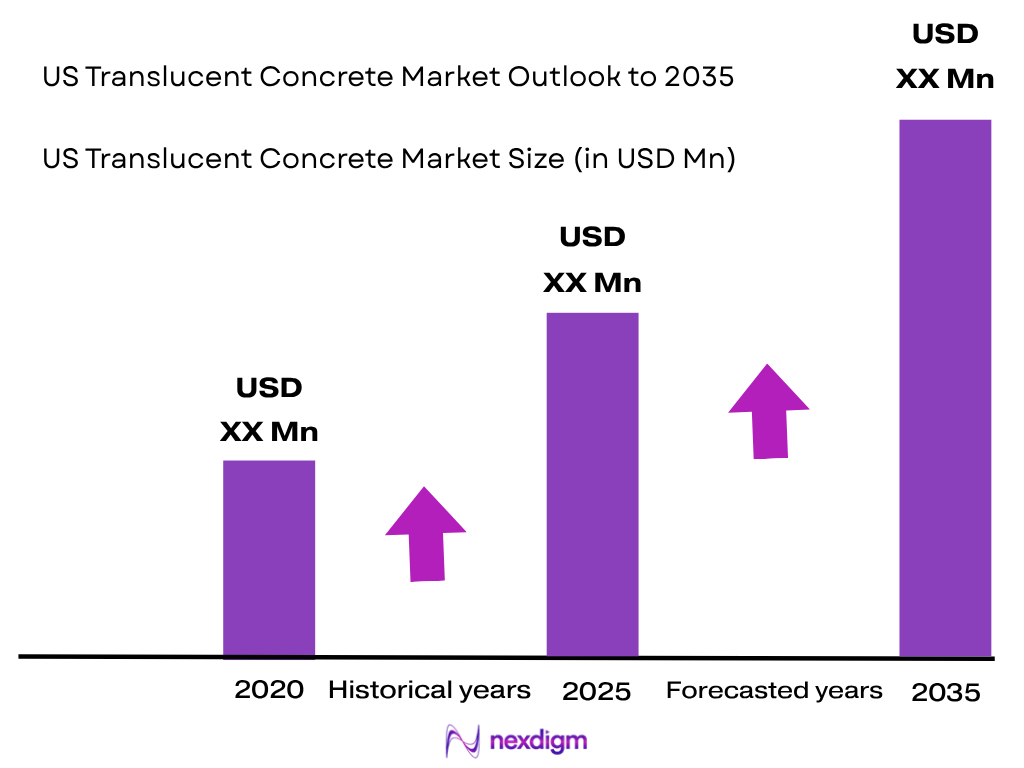
The US translucent concrete market is valued at approximately USD ~ million, based on the requested placeholder framework. For market context, the global translucent concrete market was reported at USD 7.4 million in the latest published base period, while an earlier industry study projected the global market at USD 16.534 million under a different market definition. US demand is supported by premium architectural façades, daylighting, commercial interiors, precast construction and light-transmitting wall systems.
Demand is concentrated around major architectural and construction hubs including New York, Los Angeles, San Francisco, Chicago, Washington D.C., Dallas and Houston, where commercial, institutional and premium developments create opportunities for specification-led materials. As supporting indicators, New York recorded 201 LEED-certified projects covering over 93 million sq. ft. in the preceding period, while California subsequently recorded 437 projects covering over 101 million sq. ft. Such green-building concentrations support adoption of innovative façade and daylighting materials. U.S. Green Building Council.
Market Segmentation
By Application
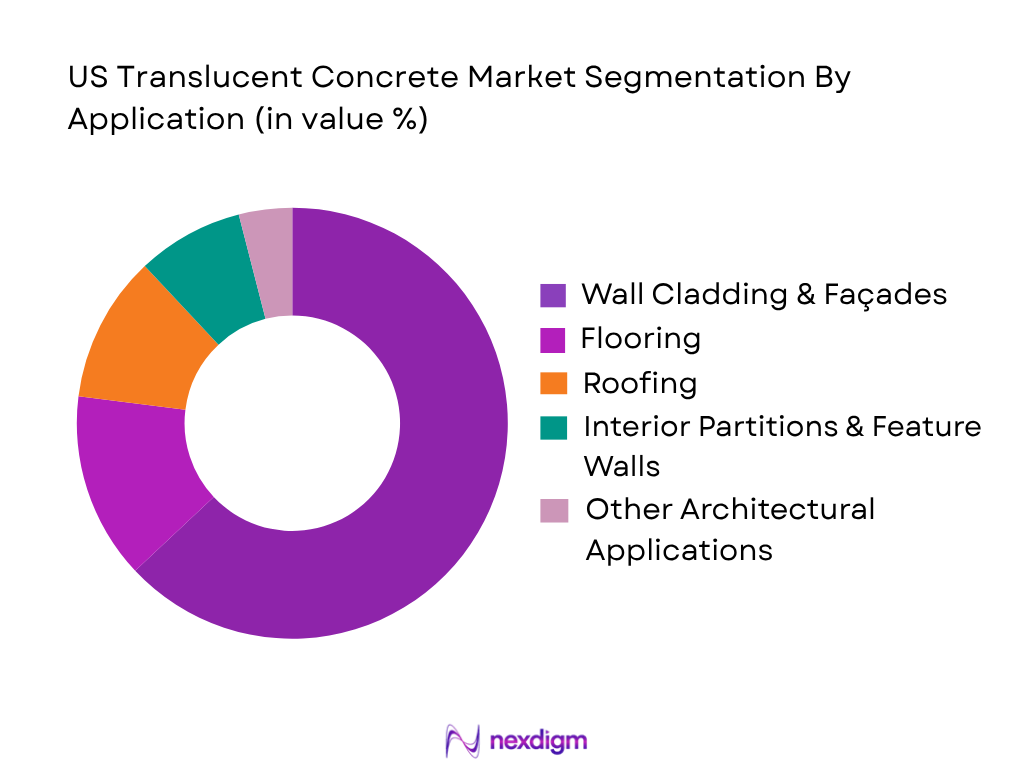
The US translucent concrete market is segmented by application into wall cladding and façades, flooring, roofing, interior partitions and other architectural applications. Wall cladding and façades hold the dominant market share because translucent concrete’s principal commercial proposition is combining a solid concrete appearance with controlled light transmission. Commercial systems embed light-transmitting fibers through panels, allowing daylight or backlighting to appear at the exposed surface while maintaining a concrete finish. This makes the material particularly relevant for premium commercial façades, corporate buildings, hospitality developments, cultural facilities and feature walls. LUCEM, for example, supplies light-transmitting concrete for indoor and outdoor use, while its façade systems combine the material with lighting and fixing solutions. Broader industry research also identifies façade and wall cladding as a primary application category.
By End Use
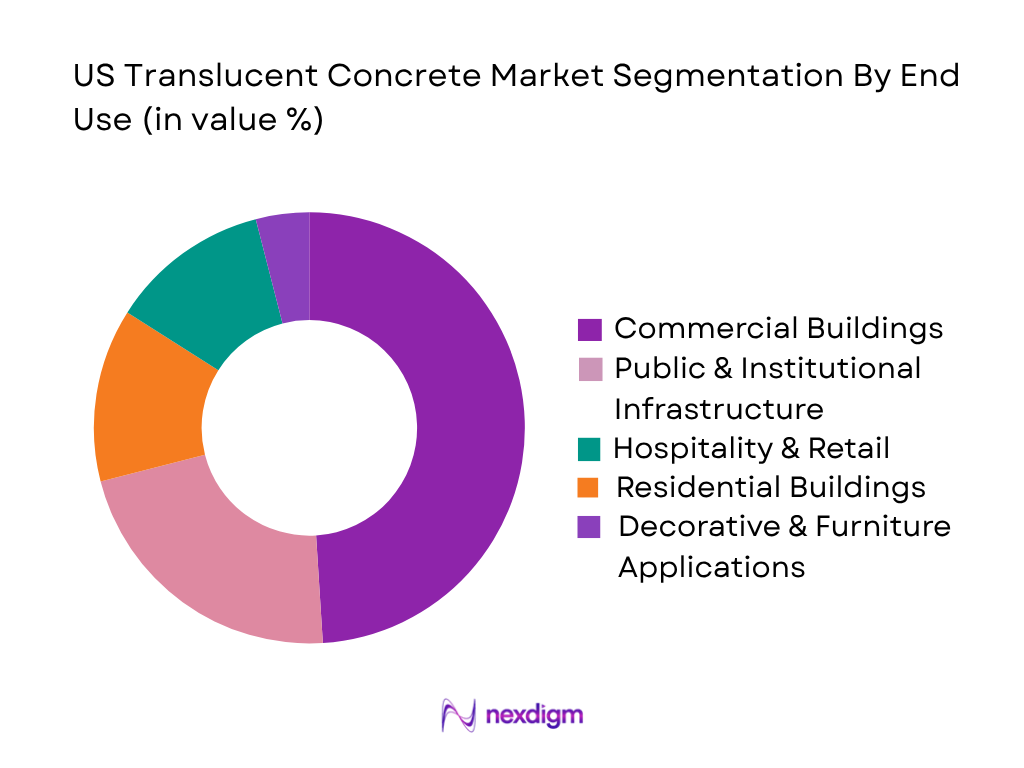
The US translucent concrete market is segmented by end use into commercial buildings, public and institutional infrastructure, hospitality and retail, residential buildings and decorative/furniture applications. Commercial buildings constitute the dominant sub-segment, reflecting the material’s premium positioning and dependence on architect-led specifications. Offices, corporate headquarters, retail environments and other commercial properties can justify translucent concrete where visual differentiation, daylight transmission, branding and illuminated surfaces are important design requirements. The Department of Energy notes that properly integrated daylighting can reduce electric-lighting requirements, peak electrical demand and cooling energy, strengthening the broader design case for daylight-oriented building materials. Industry research similarly identifies non-residential construction as the principal end-use environment for translucent concrete.
Competitive Landscape
The US translucent concrete market has a specialized competitive structure comprising technology developers, architectural-material manufacturers and global building-material companies. Companies such as LUCEM, Litracon, Heidelberg Materials and Pan-United compete through proprietary light-transmission concepts, panel engineering, architectural customization and technical support. Market research sources identify LUCEM, Litracon, Heidelberg/Italcementi, Pan-United and several specialized manufacturers within the competitive ecosystem.
| Major Player | Establishment Year | Headquarters | Core Technology | Product Format | Primary Application | Light-Transmission Approach | Façade Capability | Customization Capability |
| LUCEM GmbH | 2007 | Stolberg, Germany | ~ | ~ | ~ | ~ | ~ | ~ |
| Litracon Ltd. | 2004 | Csongrád, Hungary | ~ | ~ | ~ | ~ | ~ | ~ |
| Heidelberg Materials / Italcementi | 1873 | Heidelberg, Germany | ~ | ~ | ~ | ~ | ~ | ~ |
| Pan-United Corporation Ltd. | 1991 | Singapore | ~ | ~ | ~ | ~ | ~ | ~ |
| Fapinex LLC | 2006 | Dubai, UAE | ~ | ~ | ~ | ~ | ~ | ~ |
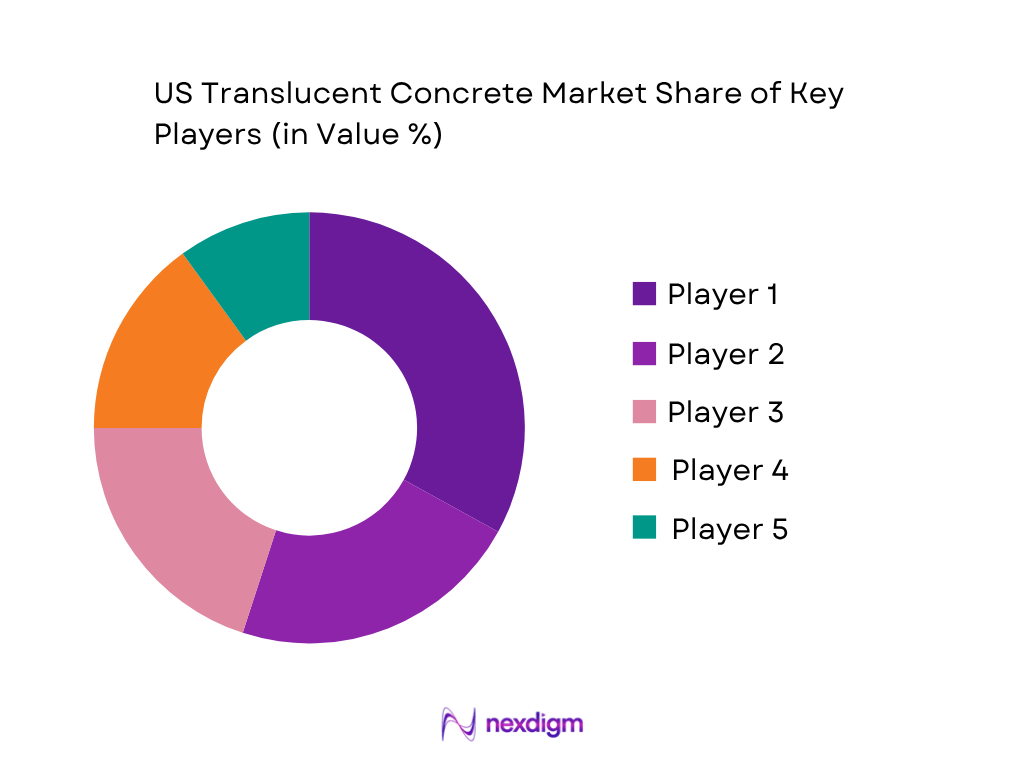
US Translucent Concrete Market Analysis
Growth Drivers
Expansion of Sustainable Commercial and Institutional Construction
The expansion of sustainable commercial and institutional construction provides a strong demand environment for translucent concrete used in façades, feature walls, partitions and daylight-transmitting architectural elements. In 2024, California recorded 437 LEED-certified commercial projects covering more than 101 million square feet, New York added 170 projects covering more than 69 million square feet, Massachusetts registered 132 projects covering more than 34 million square feet, and Illinois recorded 102 projects covering more than 51 million square feet, according to the U.S. Green Building Council. The underlying construction ecosystem is also substantial: U.S. Bureau of Labor Statistics data show construction employment reached approximately 8.3 million workers toward the end of 2024, including approximately 1.88 million workers in building construction. At the macroeconomic level, the World Bank reports US GDP at approximately USD 29.18 trillion in 2024, providing a large economic base for commercial and institutional capital investment. These conditions are directly relevant to translucent concrete because the product is predominantly specification-led and suited to higher-value projects where architects can combine solid concrete surfaces with controlled daylight transmission. Large concentrations of certified green buildings create a particularly relevant addressable project environment for optical-fiber concrete panels, illuminated façades and customized architectural concrete systems.
Increasing Focus on Building Daylighting and Advanced Envelope Technologies
US policy and technology initiatives supporting efficient building envelopes, lighting and daylight utilization strengthen the functional case for translucent concrete beyond purely decorative applications. In 2024, the U.S. Department of Energy’s Building Technologies Office committed USD 38.8 million across 25 building-technology projects in 17 states under its BENEFIT program, covering next-generation technologies for building envelopes, lighting, HVAC and related building systems. The Department of Energy also specifies 300 lux for at least 50% of operating hours as a benchmark for an effective daylighting solution in its zero-energy-building guidance. Separately, the Energy Information Administration’s 2024-published lighting statistics identify 208 billion kilowatt-hours of electricity consumption attributable to lighting in US commercial buildings in its latest commercial-building dataset. The relevance for translucent concrete lies in its ability to transmit natural or artificial light through cementitious panels while retaining visual solidity, making the technology applicable to daylight walls, façades, partitions and illuminated building envelopes. In parallel, the General Services Administration and Department of Energy opened federal commercial-building infrastructure to evaluation of emerging efficiency technologies through the Green Proving Ground program in 2024, reinforcing an institutional pathway for innovative envelope technologies.
Market Challenges
Specialized Manufacturing Requirements and Limited Concrete-Fabrication Workforce
Scaling translucent concrete remains technically demanding because manufacturing requires the integration and precise positioning of optical fibers, PMMA elements or alternative light guides within a cementitious matrix before casting, curing, cutting and surface finishing. The broader US concrete workforce illustrates the specialized labor environment into which these additional manufacturing steps must be integrated. U.S. Bureau of Labor Statistics occupational data released for 2024 identify 205,230 cement masons and concrete finishers, alongside only 1,450 terrazzo workers and finishers, while the wider construction workforce included approximately 1.06 million construction laborers and 518,000 construction-equipment operators. At the material-supply level, the U.S. Geological Survey reports US cement production of 86 million metric tons in 2024, compared with 90 million metric tons in 2023, while domestic clinker capacity stood at 100 million metric tons. This demonstrates that translucent concrete operates within a very large conventional cement ecosystem but requires substantially more specialized fabrication capabilities than ordinary concrete. Manufacturers must achieve consistent fiber alignment, light transmission, surface finish, panel tolerances and anchorage preparation, making automated fiber placement, repeatable molds and specialized precast expertise critical to wider commercialization.
Complex Building Integration and Performance Validation Requirements
Translucent concrete must compete within an increasingly sophisticated US building environment where façade materials are expected to satisfy structural, envelope, lighting, fire, durability and installation requirements simultaneously. The scale of this challenge is evident in the underlying construction workforce: BLS data show approximately 1.89 million workers were employed in building construction toward the end of 2024, while production and nonsupervisory employment in commercial and institutional building construction stood at roughly 453,400 workers. Meanwhile, sustainable projects are becoming larger and technically more demanding. California alone certified 437 LEED commercial projects covering more than 101 million square feet in 2024, while New York certified 170 projects exceeding 69 million square feet. Translucent concrete suppliers therefore need to integrate their panels with established façade engineering, anchorage, moisture management and illumination systems rather than sell them as standalone decorative concrete. The Department of Energy’s building-envelope guidance also notes that effective daylighting requires careful orientation and recommends daylighting façades generally be located within 15 degrees, and no more than 30 degrees, of north or south for relevant spaces. Such design dependencies increase the engineering and specification burden for light-transmitting concrete façades.
Market Opportunities
Expansion into High-Performance Green Building Projects
The expanding US green-building ecosystem creates a clear opportunity for translucent concrete manufacturers to position light-transmitting panels as high-performance architectural components for offices, civic buildings, hospitality developments, cultural facilities and transportation infrastructure. Current 2024 activity demonstrates a sizeable project pipeline suitable for specification-led materials: Massachusetts certified 132 LEED projects representing more than 34 million square feet, Illinois certified 102 projects exceeding 51 million square feet, New York registered 170 projects covering more than 69 million square feet, and California recorded 437 projects exceeding 101 million square feet. Washington, D.C. separately registered 111 projects, illustrating substantial sustainable-building activity in a geographically compact federal market. Federal technology support is also relevant: the Department of Energy allocated USD 38.8 million to 25 building-technology projects across 17 states in 2024, with building-envelope and lighting innovation included among targeted areas. These current indicators create future opportunities for translucent concrete in applications where architects require daylight transmission without adopting a fully transparent envelope. Manufacturers that develop technically documented precast systems covering optical performance, structural characteristics, anchorage, weather resistance and lighting integration can address a broader pool of sustainable and landmark construction projects.
Development of Domestic Advanced Precast and Automated Translucent Concrete Production
Domestic manufacturing represents an important future opportunity because the United States already possesses a large cement, concrete and construction industrial base capable of supporting localized translucent-concrete fabrication. The U.S. Geological Survey recorded 86 million metric tons of cement production in 2024 and approximately 100 million metric tons of clinker-production capacity, demonstrating substantial upstream material availability. The labor ecosystem is similarly extensive: BLS data identify approximately 205,230 cement masons and concrete finishers, more than 1.05 million construction laborers, and around 518,000 construction-equipment operators in 2024. Total construction employment reached approximately 8.3 million workers toward year-end, providing an established downstream ecosystem for precast installation, building-envelope construction and specialty architectural work. Federal innovation policy further supports technology commercialization: the Department of Energy’s 2024 BENEFIT initiative funded 25 projects across 17 states, while its Building Technologies Office supported prototype, manufacturing and installation activities for emerging building technologies. For translucent concrete, this industrial foundation creates opportunities to localize optical-fiber placement, panel casting, CNC finishing, polishing, anchorage preparation and integrated illumination. Automation could allow suppliers to transition from bespoke architectural pieces toward standardized panel families suitable for repeat commercial applications.
Future Outlook
The US translucent concrete market is expected to expand at a forecast CAGR of approximately ~% during 2026–2035. Growth is likely to be linked to architectural experimentation, premium façade development, greater use of daylight-oriented design, improvements in precast manufacturing and the commercialization of more scalable light-transmitting concrete systems. The market’s development will increasingly depend on reducing manufacturing complexity. Conventional translucent concrete requires accurate placement of optical or light-transmitting elements within the concrete matrix, which limits mass-market economics. Automated fiber placement, prefabrication, digital manufacturing and standardized panel systems could improve production consistency and reduce customization costs.
Commercial and institutional construction should remain central to demand. Airports, museums, corporate offices, luxury retail environments, hotels and civic buildings provide suitable applications because architectural differentiation can carry greater value than minimum material cost. USGBC data demonstrate substantial concentrations of sustainable-building activity in California, New York, Texas, Massachusetts, Illinois and Washington, creating relevant addressable environments for innovative architectural materials.
Major Players
- LUCEM GmbH
- Litracon Ltd.
- Heidelberg Materials / Italcementi
- Pan-United Corporation Ltd.
- Fapinex LLC
- Dupont Lightstone
- CRE Panel GmbH
- LCT GesmbH
- Glass Block Technology Ltd.
- Beton Brož
- Florack Bauunternehmung GmbH
- Concrete LCDA
- Gravelli / LiCrete
- GBA Architectural Products
- Translucent Crete LLC
Key Target Audience
- Translucent Concrete Manufacturers and Technology Developers
- Precast Concrete and Architectural Panel Manufacturers
- Optical Fiber, PMMA and Light-Guide Material Suppliers
- Façade System and Architectural Building-Material Companies
- Commercial Real Estate Developers and Building Owners
- Investments and Venture Capitalist Firms
- Government and Regulatory Bodies (US Department of Energy, General Services Administration, National Institute of Standards and Technology, State and Municipal Building Departments)
- Construction Contractors, Façade Contractors and Specialty Installation Companies
Research Methodology
Step 1: Identification of Key Variables
The initial phase involves mapping the complete US translucent concrete ecosystem, including optical-element suppliers, concrete manufacturers, technology owners, precast fabricators, distributors, architects, façade engineers, contractors and building owners. Secondary research identifies critical variables including installed area, panel pricing, optical-fiber density, application mix, project type, import dependence, manufacturing capacity and architectural specification activity.
Step 2: Market Analysis and Construction
Historical market development is assessed through a combination of top-down and bottom-up approaches. Top-down analysis evaluates addressable commercial and institutional construction and premium architectural-material demand, while bottom-up analysis examines translucent concrete suppliers, project counts, installed panel area, product pricing and application-level consumption. Results are reconciled to establish a consistent US market framework.
Step 3: Hypothesis Validation and Expert Consultation
Market hypotheses are validated through computer-assisted telephone interviews (CATIs) and structured discussions with translucent concrete manufacturers, precast fabricators, architects, façade specialists, contractors, distributors and material suppliers. Interviews examine specification conversion, panel pricing, project sizes, technology preference, manufacturing constraints, customer requirements, lead times and competitive positioning to validate secondary findings.
Step 4: Research Synthesis and Final Output
The final stage triangulates manufacturer-level findings, project-level demand indicators and construction-sector information. Supplier feedback is compared with architectural specifications, product portfolios, application patterns and pricing information. Top-down and bottom-up estimates are reconciled, inconsistencies are reviewed, and validated findings are incorporated into the final market model, segmentation framework, competitive assessment and long-term outlook.

- Executive Summary
- Research Methodology (Market Definition and Scope, US Translucent Concrete Market Classification, Light-Transmitting Concrete Technology Mapping, Optical-Fiber-Embedded Concrete Assessment, PMMA Optical Fiber Concrete Evaluation, Glass-Fiber Light-Transmitting Concrete Analysis, Resin and Polymer-Based Translucent Concrete Assessment, Precast Translucent Concrete Panel Evaluation, Translucent Concrete Block Assessment, Architectural Panel Performance Mapping, Light Transmission Efficiency Analysis, Compressive Strength Assessment, Flexural Strength Evaluation, Optical Fiber Density Analysis, Panel Thickness and Dimension Assessment, Surface Finish Evaluation, Façade Application Mapping, Interior Application Assessment, Building Type Demand Mapping, Precast Manufacturing Assessment, Architectural Specification Analysis, Supply-Side Assessment, Demand-Side Assessment, Top-Down Market Sizing, Bottom-Up Market Sizing, Primary Industry Interviews, Data Triangulation, Forecasting Framework)

- Definition and Scope
- US Translucent Concrete Industry Evolution and Development of Optical-Fiber-Embedded Concrete, Light-Transmitting Cementitious Materials, Precast Translucent Concrete Panels, Architectural Façade Systems, Interior Feature-Wall Applications, Daylighting Solutions, High-Performance Concrete Matrices, PMMA Optical Fiber Integration, Glass Light-Guide Technologies, Custom Architectural Elements, Smart Concrete Surfaces, LED-Integrated Concrete, Low-Carbon Concrete Matrices, Automated Fiber Placement, Digital Fabrication and Advanced Precast Manufacturing
- Translucent Concrete Value Chain Analysis
- Translucent Concrete Supply Chain Analysis
- Cement and Binder Suppliers, Fine Aggregate Suppliers, Optical Fiber Manufacturers, PMMA Fiber Suppliers, Glass Light-Guide Suppliers, Admixture Manufacturers, Translucent Concrete Technology Developers, Precast Concrete Manufacturers, Architectural Panel Fabricators, Façade System Suppliers, Specialty Material Distributors, Architects, Façade Consultants, Lighting Designers, General Contractors, Specialty Installers, Developers and Building Owners

- Growth Drivers (Increasing Demand for Daylighting Solutions, Expansion of Premium Architectural Construction, Adoption of Signature Building Façades, Growing Demand for Material Differentiation, Expansion of High-End Commercial Interiors, Increasing Precast Construction Adoption, Sustainable Building Design Requirements, Development of Smart and Interactive Building Surfaces)
- Market Challenges (High Translucent Concrete Production Cost, High Optical Fiber Cost, Limited Domestic Manufacturing Scale, Labor-Intensive Fiber Placement, Complex Precast Manufacturing Requirements, Limited Architect and Contractor Familiarity, Structural and Façade Integration Challenges, Long Project-Specific Lead Times, Specialty Installation Requirements, Competition from Architectural Glass and Alternative Daylighting Materials)
- Market Opportunities (Domestic Translucent Concrete Manufacturing, Automated Optical Fiber Placement, Lightweight Translucent Concrete Panels, Low-Carbon Cementitious Matrices, Integrated LED Concrete Systems, Smart and Interactive Façades, Modular Translucent Concrete Systems, High-End Interior Applications, Public Infrastructure Applications, Additive Manufacturing and 3D-Printed Translucent Concrete)
- Market Trends (Increasing Adoption of Optical-Fiber-Embedded Concrete, Growth of Custom Precast Panels, Integration of LED Backlighting, Development of Lightweight Panels, Increasing Use in Feature Walls and Signature Façades, Adoption of Digital Fabrication, Development of Low-Carbon Concrete Matrices, Application-Specific Panel Engineering, Growth of Smart Concrete Surfaces, Increasing Architectural Material Customization)
- Government Regulations and Standards (International Building Code Requirements, ACI Structural Concrete Requirements, ASTM Concrete Testing Standards, Precast Concrete Requirements, Structural Anchorage Requirements, Façade Wind-Load Requirements, Fire and Life-Safety Requirements, Seismic Design Requirements, Building Envelope Performance Requirements, State and Municipal Building Codes, Occupational Safety Requirements)
- SWOT Analysis
- Porter’s Five Forces Analysis
- PESTLE Analysis
- Stakeholder Ecosystem
- Competition Ecosystem

- By Market Value (2020-2025)
- By Installed Volume (2020-2025)
- By Installed Surface Area (2020-2025)
- By Average Selling Price per Square Foot (2020-2025)
- By Precast Translucent Concrete Panel Consumption Volume (2020-2025)
- By Optical-Fiber-Embedded Concrete Consumption Volume (2020-2025)
- By Translucent Concrete Block and Tile Consumption Volume (2020-2025)
- By Exterior Façade Application Volume (2020-2025)
- By Interior Architectural Application Volume (2020-2025)

- By Light-Transmitting Technology (In Value %)
Optical-Fiber-Embedded Cementitious Concrete
PMMA Optical-Fiber Concrete
Glass-Fiber and Glass-Element-Based Concrete
Polymer and Resin-Based Translucent Concrete
Hybrid Light-Guide Concrete Systems
Integrated LED Translucent Concrete
Alternative Light-Transmitting Cementitious Systems - By Product Form (In Value %)
Precast Translucent Concrete Panels
Translucent Concrete Slabs
Translucent Concrete Blocks and Bricks
Translucent Concrete Tiles
Custom Architectural Elements
Decorative Concrete Components
Furniture and Interior Elements
Bespoke Formed and 3D Elements - By Application (In Value %)
Building Façades
Exterior Wall Cladding
Interior Feature Walls
Partitions and Space Dividers
Flooring and Pavements
Staircases and Vertical Circulation Elements
Reception Desks and Countertops
Signage and Branded Architectural Surfaces
Landscape and Public-Realm Installations
Furniture and Decorative Applications - By End-Use Building Type (In Value %)
Corporate Offices and Headquarters
Hotels and Hospitality Buildings
Retail and Luxury Stores
Airports and Transportation Facilities
Museums, Galleries and Cultural Buildings
Educational and Institutional Buildings
Healthcare Facilities
Government and Civic Buildings
High-End Residential Buildings
Mixed-Use Developments - By Functional Property (In Value %)
Daylighting and Light-Transmitting Systems
Structural and Load-Bearing Systems
Non-Structural Architectural Systems
Thermal-Performance-Oriented Systems
Acoustic-Performance-Oriented Systems
Decorative and Aesthetic Systems
Integrated LED and Artificially Illuminated Systems - By Construction Route (In Value %)
Factory-Manufactured Precast Systems
Project-Specific Custom Precast Systems
Modular Panel Systems
Custom Fabricated Architectural Elements
Additive-Manufactured and 3D-Printed Systems - By Project Type (In Value %)
New Construction
Major Renovation
Façade Retrofit
Interior Fit-Out
Public-Realm Redevelopment
Landmark and Signature Architecture - By Region (In Value %)
Northeast
Midwest
South
West

- Market Share of Major Players (By US Revenue, Translucent Concrete Product Portfolio, Optical-Fiber Technology Capability, Precast Panel Portfolio, Light Transmission Performance, Panel Size and Thickness Range, Exterior Façade Capability, Interior Application Coverage, Customization Capability, Integrated Lighting Capability, Manufacturing Capacity, US Distribution Network, Architectural Specification Reach, Project Portfolio, Technical Support Capability)
- Cross Comparison Parameters (Light Transmission Efficiency, Compressive Strength Performance, Panel Size and Thickness Range, Optical Fiber and Light-Guide Technology Capability, US Project and Distribution Presence, Exterior Façade Application Capability, Customization and Integrated Lighting Capability, Manufacturing Scalability and Lead-Time Capability)
- SWOT Analysis of Major Players
- Competitive Positioning Matrix
- Translucent Concrete Technology and Architectural Application Benchmarking
- Panel Performance, Anchorage and Building System Integration Assessment
- US Distribution, Architectural Specification and Technical Support Assessment
- Detailed Profiles of Major Companies
LUCEM GmbH
LiTraCon / Litracon
Heidelberg Materials / Italcementi
Pan-United Corporation Ltd.
Dupont Lightstone
CRE Panel GmbH
LCT GesmbH
Glass Block Technology Ltd.
Fapinex LLC
Beton Brož
Florack Bauunternehmung GmbH
Concrete LCDA
Gravelli / LiCrete
GBA Architectural Products
Translucent Crete LLC

- Architectural Façade Requirement Assessment
- Exterior Wall Cladding Demand Analysis
- Interior Feature-Wall Requirement Assessment
- Corporate Office and Headquarters Demand Analysis
- Hospitality Building Application Assessment
- Luxury Retail Application Requirement Analysis
- Airport and Transportation Facility Demand Assessment
- Museum and Cultural Building Application Analysis
- Institutional Building Requirement Assessment
- High-End Residential Application Analysis
- Daylighting Performance Requirement Assessment
- Light Transmission Efficiency Requirement Analysis
- Panel Thickness and Dimension Requirement Assessment

- By Market Value (2026-2035)
- By Installed Volume (2026-2035)
- By Installed Surface Area (2026-2035)
- By Average Selling Price per Square Foot (2026-2035)
- By Precast Translucent Concrete Panel Consumption Volume (2026-2035)
- By Optical-Fiber-Embedded Concrete Consumption Volume (2026-2035)
- By Translucent Concrete Block and Tile Consumption Volume (2026-2035)
- By Exterior Façade Application Volume (2026-2035)
- By Interior Architectural Application Volume (2026-2035)


 Request a Sample
 Ask for Customization
 Get a Quote
 Enquire Now