
 Download PDF
Market Overview
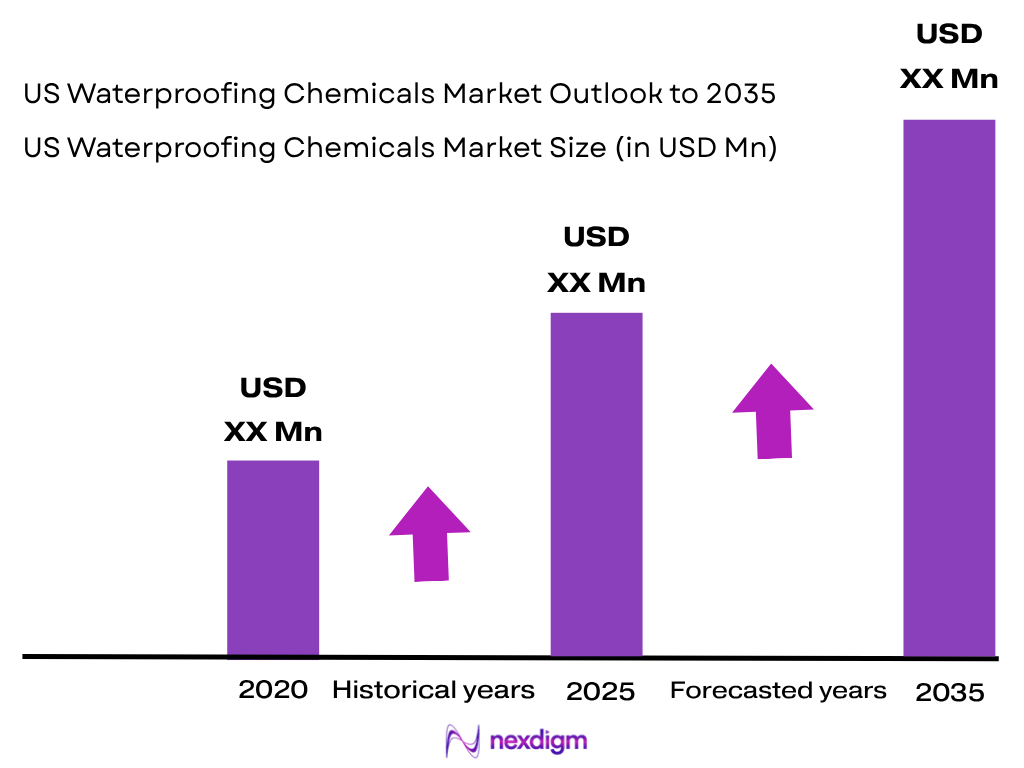
The US Waterproofing Chemicals Market is valued at approximately ~ USD ~ billion, with demand supported by sustained construction activity, infrastructure rehabilitation, concrete durability requirements, roofing renewal, and below-grade construction. US construction-related activity provides a broad addressable base: construction establishments generated USD 3.24 trillion in employer sales, shipments or revenue, while specialty trade contractors generated USD 1.44 trillion. Public construction also reached USD 492.7 billion, including USD 142.7 billion in highway construction, reinforcing the requirement for waterproofing, concrete protection and water-intrusion control systems.
The US Waterproofing Chemicals Market is concentrated around major construction and infrastructure centers, particularly California, Texas, Florida, New York and other large metropolitan markets where commercial development, residential construction, transportation infrastructure and rehabilitation activity create recurring waterproofing requirements. The South remains particularly important for residential and commercial construction, while coastal states generate additional demand for moisture protection because of exposure to rainfall, hurricanes and marine environments. Recent Census data recorded approximately 980,000 permitted single-unit housing structures and 440,000 units in structures containing 5 or more units, supporting demand for foundation, wet-area, roof and concrete waterproofing systems.
Market Segmentation
By Chemistry Type
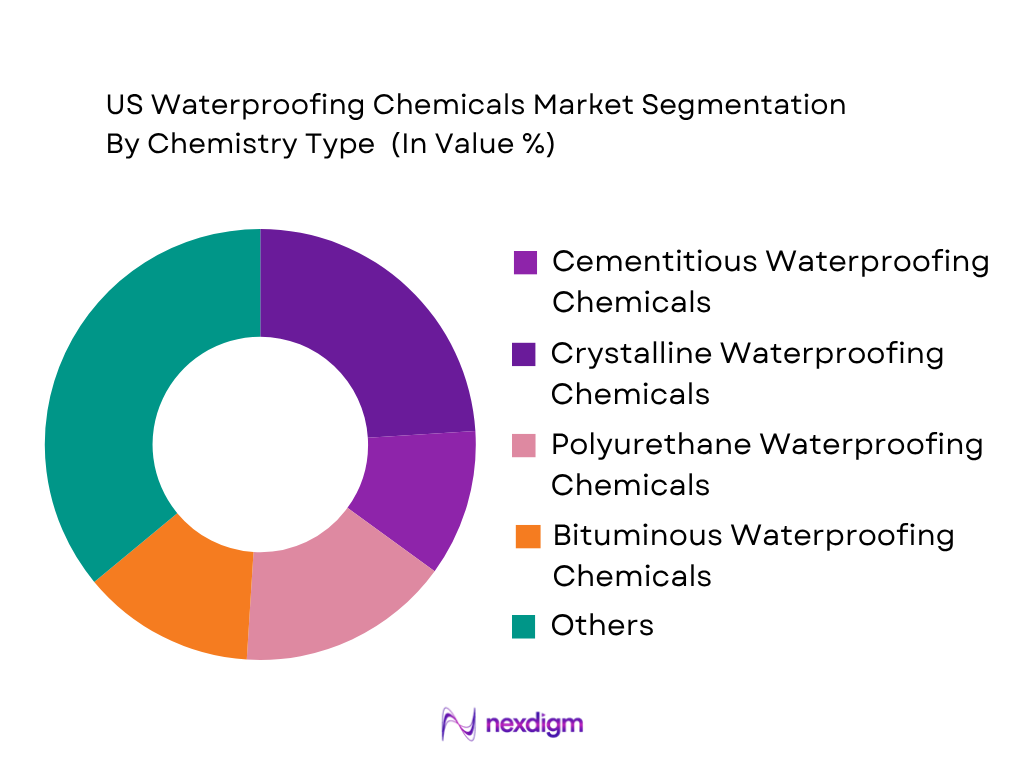
The US Waterproofing Chemicals Market is segmented by chemistry type into cementitious waterproofing chemicals, crystalline waterproofing chemicals, polyurethane waterproofing chemicals, acrylic waterproofing chemicals, bituminous waterproofing chemicals, polyurea waterproofing chemicals, epoxy waterproofing chemicals, silane and siloxane water-repellent chemicals, integral waterproofing admixtures and hybrid waterproofing formulations. Cementitious waterproofing chemicals hold the dominant modeled share because they are compatible with concrete and masonry substrates and can be applied across foundations, basements, water-retaining structures, tunnels, parking structures and wet areas. Their compatibility with concrete construction allows contractors to incorporate waterproofing into conventional construction and rehabilitation workflows without requiring highly specialized equipment. Crystalline systems also benefit from their ability to reduce water penetration through concrete capillaries, while polyurethane and polyurea systems provide flexible, high-performance solutions where crack bridging and rapid application are important. The broad US infrastructure and building stock creates demand for both new-build and rehabilitation applications. The chemistry mix therefore reflects different substrate conditions, exposure environments, application techniques and performance requirements across residential, commercial and infrastructure projects.
By Application
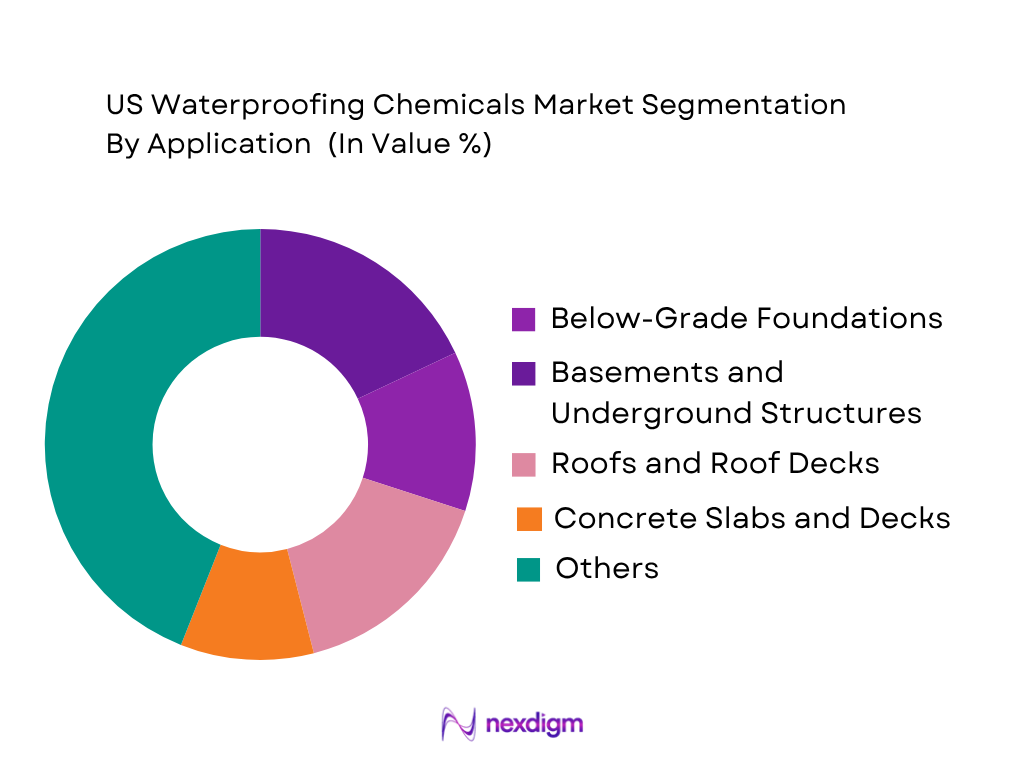
The US Waterproofing Chemicals Market is segmented by application into below-grade foundations, basements and underground structures, roofs and roof decks, concrete slabs and decks, bathrooms and wet areas, balconies and terraces, parking structures, bridges and viaducts, tunnels and underground transit, water treatment and containment structures, swimming pools and water tanks, and industrial floors and process areas. Below-grade foundations represent the dominant modeled application because foundations and basement structures are continuously exposed to soil moisture, hydrostatic pressure and groundwater intrusion. The large US construction base creates a substantial requirement for foundation protection in both new construction and renovation. Waterproofing chemicals are used for exterior foundation coatings, negative-side repairs, crack injection, joint treatment and concrete protection. Infrastructure rehabilitation further expands the application base, particularly for parking structures, tunnels, bridges and water facilities. Public construction reached USD 492.7 billion, while highway construction reached USD 142.7 billion, demonstrating the scale of construction and infrastructure environments where moisture protection can be incorporated.
Competitive Landscape
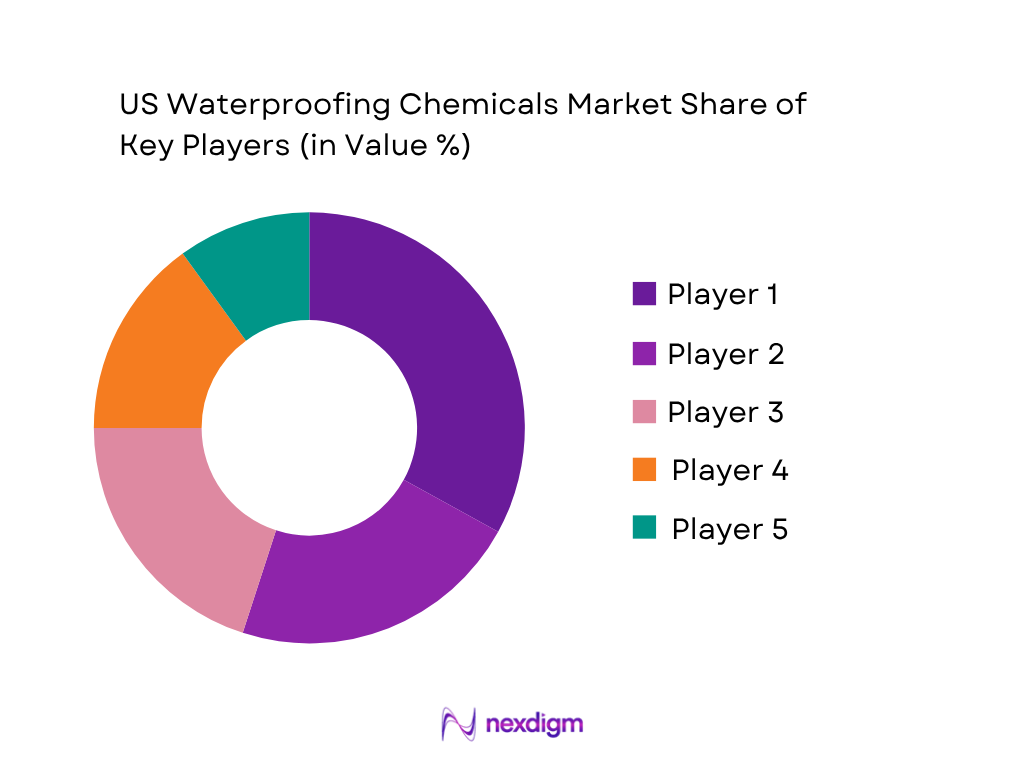
The US Waterproofing Chemicals Market is characterized by multinational construction-chemical manufacturers, specialized waterproofing suppliers and diversified building-material companies competing through chemistry breadth, technical performance, distribution coverage and contractor support. Major participants include Sika, Tremco CPG, Carlisle, MAPEI and Saint-Gobain’s construction-chemicals businesses. Their competitive positioning is supported by broad product portfolios spanning membranes, coatings, admixtures, sealants, concrete protection and specialty waterproofing systems. Sika’s origins are directly linked to waterproofing admixtures, while MAPEI operates a broad construction-chemicals portfolio and has maintained a US presence since 1983.
| Major Player | Establishment Year | Headquarters | Core Waterproofing Technology | Primary Product Form | Below-Grade Capability | Roof Waterproofing Capability | Concrete Protection Capability | Infrastructure Capability |
| Sika AG | 1910 | Baar, Switzerland | ||||||
| Tremco CPG | 1928 | Beachwood, Ohio, USA | ||||||
| Carlisle Companies | 1917 | Scottsdale, Arizona, USA | ||||||
| MAPEI Corporation | 1937 | Milan, Italy | ||||||
| Saint-Gobain / GCP | 2015 | Paris, France |
US Waterproofing Chemicals Market Analysis
Growth Drivers
Aging Building and Infrastructure Stock and Rising Demand for Concrete Durability
The US Waterproofing Chemicals Market is supported by the continuing need to protect aging buildings, foundations, bridges, parking structures, tunnels and other concrete assets from water intrusion and deterioration. The Federal Highway Administration’s 2024 National Bridge Inventory recorded 624,764 bridges across the United States, including 42,067 bridges classified as poor, creating a substantial rehabilitation environment for concrete repair and waterproofing systems. The same database records bridge deck areas by condition, allowing waterproofing demand to be linked directly with rehabilitation requirements. The construction workforce also demonstrates the scale of the specialty-contractor ecosystem supporting waterproofing installation: the Bureau of Labor Statistics reported 5.27 million specialty-trade contractor employees in December 2024, including 1.00 million employees in foundation, structure and building-exterior contracting. Poured-concrete foundation and structure contractors accounted for 252,000 employees, providing a direct construction channel for waterproofing technologies. These conditions support demand for crystalline, cementitious, polyurethane, polyurea and protective coating systems used to extend concrete service life.
Expansion of Commercial Construction, Data Centers and Below-Grade Structures
Commercial construction and specialized facilities are creating additional application environments for the US Waterproofing Chemicals Market. The US Census Bureau maintains monthly construction-spending data through 2026, covering private residential, private nonresidential and public construction activity, demonstrating the continuing scale of the national construction pipeline. Data-center development is particularly relevant because the Department of Energy reported in December 2024 that US data-center electricity demand had already tripled over the preceding decade and could double or triple again through 2028. This expansion reflects increasing investment in highly engineered facilities requiring protection of foundations, equipment rooms, utility areas and other moisture-sensitive structures. The specialty-contractor base further supports deployment, with 2.85 million nonresidential specialty-trade employees reported in December 2024. Within this group, foundation, structure and building-exterior contractors employed approximately 1.00 million workers, illustrating the installation ecosystem available for waterproofing systems. The combination of commercial construction, technology infrastructure and specialized contracting supports greater specification of liquid-applied membranes, concrete admixtures, crystalline systems, polyurethane and polyurea solutions.
Market Challenges
Volatility in Polymer and Resin Feedstock Availability and Stringent Environmental Requirements
The US Waterproofing Chemicals Market faces formulation and procurement challenges because several waterproofing technologies depend on polymeric and resin-based raw materials. Recent Bureau of Labor Statistics producer-price data show that the US index for plastics materials and resins manufacturing moved through substantial monthly fluctuations, reaching 315.011 in January 2025 and 302.525 in December 2025 before moving to 328.413 in April 2026 and a preliminary 360.445 in May 2026. These movements demonstrate changing input conditions for manufacturers using polymer-intensive formulations, including polyurethane, polyurea and acrylic systems. Construction-product inputs can also experience movement; the BLS index for construction products from plastics recorded 340.761 in January 2025 and a preliminary 356.017 in July 2026. Such movements can complicate formulation planning, procurement and inventory management even when manufacturers maintain established supplier relationships. At the same time, waterproofing manufacturers must develop products compatible with evolving environmental and building requirements, particularly regarding volatile organic compounds and chemical constituents. These conditions increase the technical burden associated with reformulation, product qualification and application guidance.
Skilled Applicator Requirements, Complex Substrate Preparation and Project-Specific Installation Conditions
Installation complexity remains a structural challenge for the US Waterproofing Chemicals Market because performance depends heavily on substrate preparation, moisture conditions, crack treatment, joint detailing, curing and compatibility with existing construction materials. The scale of the construction workforce indicates both the opportunity and complexity of this installation ecosystem. The Bureau of Labor Statistics reported 5.27 million specialty-trade contractor employees in December 2024, while foundation, structure and building-exterior contractors employed approximately 1.00 million workers. Roofing contractors alone accounted for 192,700 production and nonsupervisory employees, while poured-concrete foundation and structure contractors accounted for 206,900. Waterproofing systems must therefore operate across multiple specialist trades with different application practices and project specifications. Below-grade projects can introduce additional complications from groundwater, hydrostatic pressure and restricted access, while rehabilitation projects may involve deteriorated concrete and unknown existing waterproofing assemblies. Product selection can consequently depend on substrate condition, exposure, structural movement and intended service environment rather than chemistry alone. This creates a need for trained applicators, detailed specifications, inspection procedures and technical support, increasing execution complexity for manufacturers, contractors and building owners.
Market Opportunities
Expansion of Infrastructure Rehabilitation and Water Infrastructure Modernization
Infrastructure rehabilitation provides a substantial opportunity for the US Waterproofing Chemicals Market because concrete and water-related assets require protection against continuous moisture exposure and deterioration. The Federal Highway Administration’s 2024 bridge inventory recorded 624,764 bridges, including 42,067 poor-condition bridges, establishing a large pool of assets where rehabilitation and concrete-protection solutions can be relevant. Water infrastructure represents another significant opportunity. The Environmental Protection Agency announced USD 5.8 billion in 2024 State Revolving Fund investment, consisting of USD 2.6 billion for clean-water infrastructure and USD 3.2 billion for drinking-water infrastructure. Later in 2024, EPA announced another USD 3.6 billion, bringing that fiscal-year funding announcement to USD 6.2 billion. The agency also made USD 7.5 billion of WIFIA financing available during 2024. These programs support wastewater, drinking-water, stormwater and related infrastructure projects where waterproofing and concrete protection can be incorporated into construction and rehabilitation specifications. The opportunity is therefore strongest for technologies that provide durable moisture barriers, crack protection and concrete preservation while fitting public-infrastructure installation requirements.
Data Center Waterproofing, Low-VOC Formulations and Integrated Concrete Protection
Data-center construction creates an emerging opportunity for specialized waterproofing systems because these facilities combine extensive concrete foundations, equipment areas, utility infrastructure and highly controlled operating environments. The Department of Energy’s 2024 data-center assessment found that US data-center electricity demand had tripled over the previous decade and projected that demand could double or triple through 2028, reflecting continued expansion of AI, digital services and technology infrastructure. This creates opportunities for waterproofing suppliers capable of meeting demanding specifications for foundations, below-grade structures, equipment spaces and utility areas. At the same time, product development can increasingly focus on low-VOC, water-based and lower-impact chemistries that address environmental requirements while maintaining moisture resistance and concrete protection. The US water-infrastructure funding environment strengthens this opportunity: EPA’s 2025 funding round provided USD 6.5 billion through WIFIA, with an additional USD 550 million available through SWIFIA. EPA reported that WIFIA had announced USD 22 billion to finance 141 projects by November 2025. This creates a broad pipeline for integrated waterproofing, concrete protection and rehabilitation technologies.
Future Outlook
The US Waterproofing Chemicals Market is expected to experience continued expansion as construction activity increasingly emphasizes durability, water intrusion prevention and lifecycle performance. Demand is likely to remain supported by infrastructure rehabilitation, below-grade development, roof restoration, water infrastructure and commercial construction. Data-center construction also provides an emerging application environment because the US Department of Energy identified substantial growth in data-center electricity demand and industrial investment, increasing the importance of protecting highly engineered facilities from moisture-related disruption.
Major Players
- Sika AG
- Tremco CPG
- Carlisle Companies Incorporated
- MAPEI Corporation
- Saint-Gobain / GCP
- RPM International
- Euclid Chemical
- PROSOCO
- Kryton International
- Xypex Chemical Corporation
- W. R. Meadows
- Henry Company
- LATICRETE International
- ChemMasters
- GAF
Key Target Audience
- Waterproofing chemical manufacturers and formulation companies
- Construction chemical distributors and building-material suppliers
- Specialty waterproofing contractors and applicators
- Real-estate developers and commercial property owners
- Infrastructure developers and engineering contractors
- Investments and venture capitalist firms
- Government and regulatory bodies (US Environmental Protection Agency, Federal Highway Administration, Department of Energy)
- Roofing, façade and building-envelope solution providers
Research Methodology
Step 1: Identification of Key Variables
The initial phase involves constructing an ecosystem map covering waterproofing chemical manufacturers, raw-material suppliers, distributors, contractors, architects, engineers and end users. The assessment identifies chemistry types, application areas, substrates, construction activities and infrastructure categories influencing market demand.
Step 2: Market Analysis and Construction
Historical market information is compiled using a combination of industry data, government construction statistics, company disclosures and product-level assessments. Demand is evaluated across chemistry, product form, application, end-use sector, substrate and geographic markets to construct the market baseline.
Step 3: Hypothesis Validation and Expert Consultation
Market hypotheses are evaluated through discussions with waterproofing manufacturers, distributors, contractors, engineers and construction-material specialists. These consultations are used to validate application penetration, technology adoption, purchasing criteria, competitive positioning and channel dynamics.
Step 4: Research Synthesis and Final Output
The final stage integrates top-down and bottom-up calculations with company-level, construction-sector and infrastructure indicators. Market estimates are triangulated against application demand, product deployment, construction activity and competitive evidence to produce a structured assessment of the US Waterproofing Chemicals Market.

- Executive Summary
- Research Methodology (Market Definition and Scope, US Waterproofing Chemicals Market Classification, Waterproofing Chemistry Mapping, Cementitious Waterproofing Assessment, Crystalline Waterproofing Evaluation, Polyurethane Waterproofing Analysis, Acrylic Waterproofing Assessment, Bituminous Waterproofing Evaluation, Polyurea Waterproofing Analysis, Epoxy Waterproofing Assessment, Silane and Siloxane Water-Repellent Evaluation, Integral Waterproofing Admixture Assessment, Liquid-Applied Membrane Analysis, Waterproofing Coating Assessment, Joint and Crack Treatment Assessment, Below-Grade Waterproofing Mapping, Roof Waterproofing Assessment, Bridge Deck Waterproofing Evaluation, Tunnel and Underground Waterproofing Assessment, Foundation Waterproofing Analysis, Swimming Pool and Water-Tank Waterproofing Assessment, Concrete Permeability Analysis, Water Absorption Assessment, Crack Bridging Capability Assessment, Chemical Resistance Assessment, UV and Weathering Performance Assessment, Freeze-Thaw Resistance Assessment, VOC and Environmental Compliance Assessment, Building Code and ASTM Standard Mapping, Domestic Manufacturing Capability Assessment, Distribution Network Assessment, Supply-Side Assessment, Demand-Side Assessment, Top-Down Market Sizing, Bottom-Up Market Sizing, Primary Industry Interviews, Data Triangulation, Forecasting Framework)

- Definition and Scope
- US Waterproofing Chemicals Industry Evolution and Development of Cementitious Waterproofing Systems, Crystalline Waterproofing Admixtures, Polyurethane Membranes, Acrylic Waterproofing Coatings, Polyurea Systems, Bituminous Waterproofing Materials, Epoxy Waterproofing Systems, Silane and Siloxane Water Repellents, Integral Concrete Waterproofing Admixtures, Liquid-Applied Membranes, Elastomeric Coatings, Below-Grade Waterproofing Systems, Roof Waterproofing Chemicals, Bridge Deck Waterproofing Systems, Tunnel Waterproofing Materials, Joint Sealants, Crack-Injection Materials, Concrete Densifiers, Water-Repellent Admixtures, Low-VOC Waterproofing Systems and Sustainable Waterproofing Formulations
- Waterproofing Chemicals Supply Chain Analysis
- Cement Manufacturers, Polymer and Resin Suppliers, Polyurethane Raw Material Suppliers, Acrylic Polymer Suppliers, Epoxy Resin Suppliers, Bitumen Suppliers, Silane and Siloxane Suppliers, Chemical Admixture Manufacturers, Waterproofing Chemical Formulators, Membrane Manufacturers, Waterproofing System Providers, Construction Chemical Distributors, Building Material Distributors, Specialty Waterproofing Contractors, Concrete Contractors, Roofing Contractors, Infrastructure Contractors, Architects, Engineers, Building Envelope Consultants, General Contractors, Property Developers and Building Owners

- Growth Drivers (Aging Building and Infrastructure Stock, Expansion of Commercial Construction, Growth of Data Center Construction, Increasing Below-Grade Construction, Bridge and Highway Rehabilitation, Expansion of Water and Wastewater Infrastructure, Rising Demand for Concrete Durability, Growth of Roof Restoration Activity, Increasing Building Envelope Performance Requirements, Adoption of Long-Life Waterproofing Systems)
- Market Challenges (Volatility in Polymer and Resin Feedstock Availability, Complex Substrate Preparation Requirements, Skilled Applicator Shortages, Stringent VOC and Environmental Requirements, Moisture and Temperature Sensitivity During Application, Competition from Waterproofing Membranes and Sheet Systems, Complex Below-Grade Installation Conditions, Product Compatibility Requirements, Project-Specific Specification Requirements, Remediation of Existing Waterproofing Failures)
- Market Opportunities (Expansion of Data Center Waterproofing, Infrastructure Rehabilitation, Below-Grade Waterproofing Modernization, Low-VOC Waterproofing Formulations, Bio-Based and Lower-Impact Chemistry, Crystalline Concrete Waterproofing, High-Performance Polyurethane Systems, Polyurea Spray Applications, Integrated Waterproofing and Concrete Protection Systems, Smart Building Envelope Solutions, Long-Life Bridge Deck Protection, Water Infrastructure Rehabilitation)
- Market Trends (Growth of Liquid-Applied Membranes, Increasing Crystalline Waterproofing Adoption, Higher Use of Polyurethane Systems, Expansion of Polyurea Applications, Low-VOC Formulation Development, Integral Concrete Waterproofing, Multifunctional Waterproofing and Concrete Protection, Crack-Sealing Technologies, High-Durability Below-Grade Systems, Sustainable Waterproofing Chemistry)
- Government Regulations and Standards (International Building Code Requirements, International Residential Code Requirements, ASTM Waterproofing Standards, ASTM C836 Liquid-Applied Waterproofing Requirements, ASTM C1305 Crack Bridging Requirements, ASTM E514 Water Penetration Requirements, ASTM E96 Water Vapor Transmission Requirements, EPA VOC Requirements, OSHA Chemical Handling Requirements, State Building Code Requirements, Green Building Material Requirements, Potable Water Contact Requirements)
- SWOT Analysis
- Porter’s Five Forces Analysis
- PESTLE Analysis
- Stakeholder Ecosystem
- Competition Ecosystem

- By Market Value (2020-2025)
- By Waterproofing Chemicals Consumption Volume (2020-2025)
- By Waterproofing Coating Consumption Volume (2020-2025)
- By Liquid-Applied Waterproofing Consumption Volume (2020-2025)
- By Cementitious Waterproofing Consumption Volume (2020-2025)
- By Polyurethane Waterproofing Consumption Volume (2020-2025)

- By Chemistry Type (In Value %)
Cementitious Waterproofing Chemicals
Crystalline Waterproofing Chemicals
Polyurethane Waterproofing Chemicals
Acrylic Waterproofing Chemicals
Bituminous Waterproofing Chemicals
Polyurea Waterproofing Chemicals
Epoxy Waterproofing Chemicals
Silane and Siloxane Water-Repellent Chemicals
Integral Waterproofing Admixtures
Hybrid Waterproofing Formulations - By Product Form (In Value %)
Liquid-Applied Waterproofing Membranes
Powder-Based Waterproofing Compounds
Waterproofing Coatings
Waterproofing Admixtures
Water-Repellent Treatments
Injection Grouts and Resin Systems
Crack-Sealing Compounds
Joint Waterproofing Materials
Primer and Surface Preparation Systems - By Application (In Value %)
Below-Grade Foundations
Basements and Underground Structures
Roofs and Roof Decks
Concrete Slabs and Decks
Bathrooms and Wet Areas
Balconies and Terraces
Parking Structures
Bridges and Viaducts
Tunnels and Underground Transit
Water Treatment and Containment Structures
Swimming Pools and Water Tanks
Industrial Floors and Process Areas - By End-Use Sector (In Value %)
Residential Construction
Commercial Buildings
Industrial Facilities
Data Centers
Healthcare Facilities
Hospitality Buildings
Transportation Infrastructure
Water and Wastewater Infrastructure
Energy and Utility Infrastructure
Marine Infrastructure
Government and Institutional Buildings - By Waterproofing Location (In Value %)
Below-Grade Waterproofing
Above-Grade Waterproofing
Roof Waterproofing
Internal Wet-Area Waterproofing
External Wall Waterproofing
Concrete Structure Waterproofing
Joint and Penetration Waterproofing - By Substrate Type (In Value %)
Concrete
Reinforced Concrete
Masonry
Brick
Cementitious Screed
Metal
Asphalt and Bituminous Substrates
Wood and Composite Substrates - By Region (In Value %)
Northeast USA
Midwest USA
South USA
West USA
California
Texas
Florida
New York

- Market Share of Major Players (By US Revenue, Waterproofing Chemicals Product Portfolio, Chemistry Portfolio, Liquid-Applied Membrane Capability, Cementitious Waterproofing Capability, Crystalline Waterproofing Capability, Polyurethane Technology Capability, Polyurea Technology Capability, Below-Grade Waterproofing Capability, Roof Waterproofing Capability, Infrastructure Waterproofing Capability, Distribution Network Reach, Manufacturing Footprint, Technical Specification Support, Project Portfolio, Contractor Support Capability)
- Cross Comparison Parameters (Waterproofing Chemistry Portfolio Breadth, Liquid-Applied Membrane Technology Capability, Crack-Bridging and Flexibility Performance, Below-Grade and Foundation Waterproofing Capability, Concrete Integral and Crystalline Waterproofing Capability, Infrastructure and Bridge Waterproofing Project Capability, VOC and Sustainable Formulation Portfolio, US Manufacturing Distribution and Technical Support Reach)
- SWOT Analysis of Major Players
- Detailed Profiles of Major Companies
Sika AG
GCP Applied Technologies / Saint-Gobain
RPM International / Tremco CPG
Carlisle Companies / Carlisle Construction Materials
MAPEI Corporation
Master Builders Solutions
Euclid Chemical
PROSOCO
Kryton International
Xypex Chemical Corporation
W. R. Meadows
Henry Company
LATICRETE International
ChemMasters
GAF

- Below-Grade Waterproofing Requirement Assessment
- Foundation and Basement Waterproofing Demand Analysis
- Data Center Waterproofing Application Analysis
- Tunnel and Underground Infrastructure Demand Analysis
- Roof Deck Waterproofing Assessment
- Parking Structure Waterproofing Assessment
- Swimming Pool and Water-Tank Waterproofing Demand Analysis
- Industrial Facility Waterproofing Requirement Assessment

- By Market Value (2026-2035)
- By Waterproofing Chemicals Consumption Volume (2026-2035)
- By Waterproofing Coating Consumption Volume (2026-2035)
- By Liquid-Applied Waterproofing Consumption Volume (2026-2035)
- By Cementitious Waterproofing Consumption Volume (2026-2035)
- By Polyurethane Waterproofing Consumption Volume (2026-2035)


 Request a Sample
 Ask for Customization
 Get a Quote
 Enquire Now