

 Download PDF
Market Overview
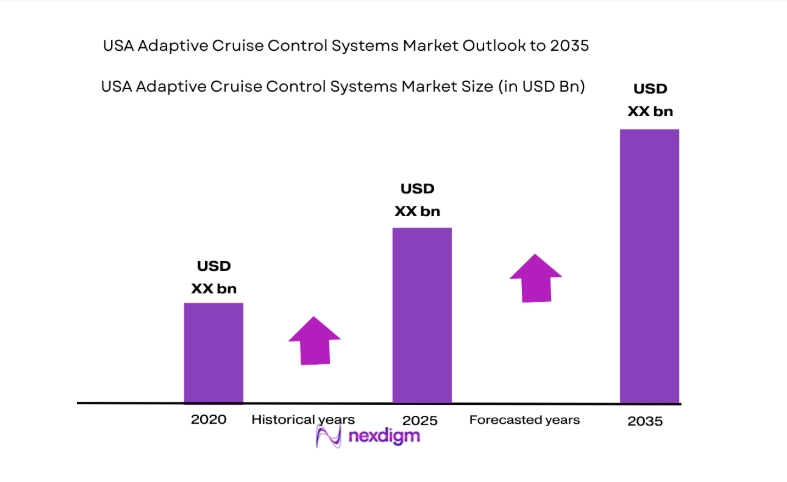
The USA Adaptive Cruise Control Systems market is valued at USD ~ billion, supported by data from the U.S. Department of Transportation and industry production disclosures from major automotive OEMs operating in the country. The market is driven by growing integration of advanced driver assistance systems in passenger and commercial vehicles, regulatory focus on collision avoidance technologies, and increasing consumer demand for semi-autonomous driving features that enhance safety and highway driving comfort.
Michigan, Ohio, Kentucky, and Texas dominate the USA Adaptive Cruise Control Systems market due to concentrated automotive manufacturing clusters and the presence of major OEM assembly plants and suppliers. California also plays a significant role in software development and AI innovation ecosystems that support ADAS technologies. Strong federal safety compliance frameworks established semiconductor supply chains, and proximity to vehicle testing facilities further strengthen regional dominance across these automotive hubs.
Market Segmentation
By Product Type
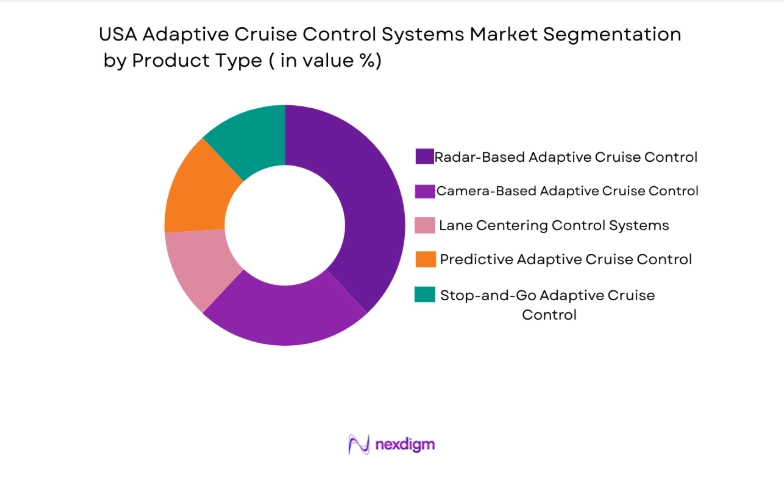
USA Adaptive Cruise Control Systems market is segmented by product type into radar-based adaptive cruise control, camera-based adaptive cruise control, LiDAR-integrated adaptive cruise control, predictive adaptive cruise control, and stop-and-go adaptive cruise control. Recently, radar-based adaptive cruise control has a dominant market share due to strong OEM adoption, reliability in varying weather conditions, cost optimization through large-scale semiconductor production, compatibility with mid-range passenger vehicles, and its proven performance in highway collision avoidance scenarios. Radar technology offers consistent long-range object detection and speed modulation capabilities, making it the preferred choice for mass-market vehicle integration. Its scalability across passenger cars and light commercial vehicles further strengthens dominance, while regulatory emphasis on forward collision mitigation technologies continues to reinforce deployment across domestic automotive manufacturing platforms.
By Platform Type
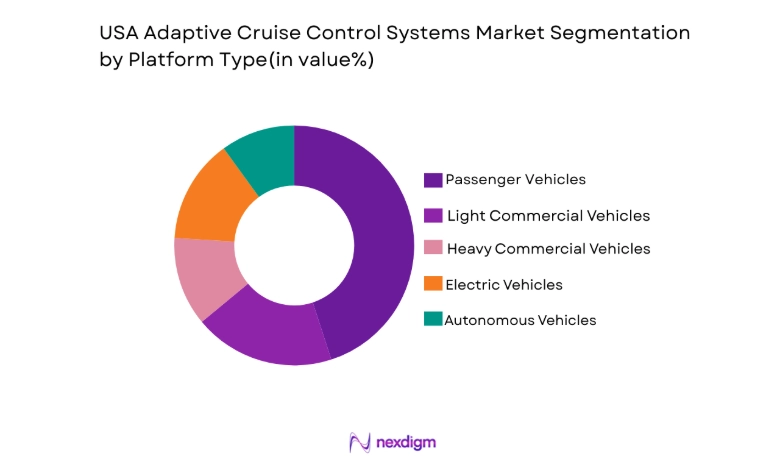
USA Adaptive Cruise Control Systems market is segmented by platform type into passenger vehicles, light commercial vehicles, heavy commercial vehicles, electric vehicles, and autonomous vehicles. Recently, passenger vehicles have a dominant market share due to large-scale production volumes, widespread consumer adoption of driver assistance technologies, and OEM strategies to integrate adaptive cruise control as standard equipment across mid-range sedans and SUVs. High daily commuting exposure increases demand for automated speed and distance management features in passenger cars. Competitive pricing of ADAS packages and regulatory encouragement for collision avoidance technologies further accelerate deployment across mass-market automotive platforms nationwide.
Competitive Landscape
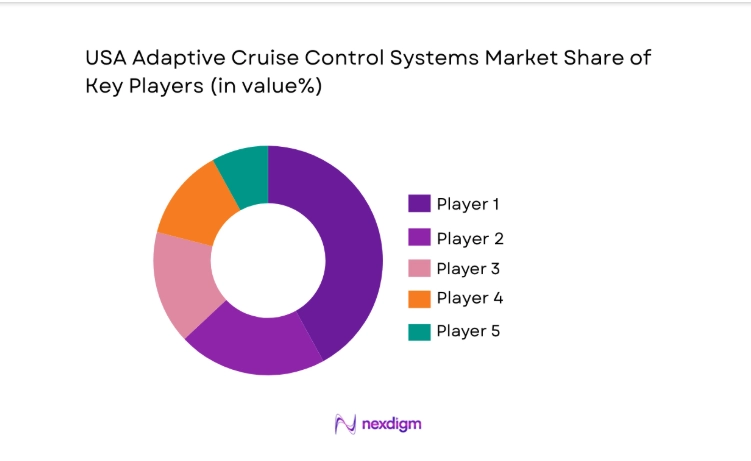
The USA Adaptive Cruise Control Systems market is moderately consolidated, with major automotive technology suppliers controlling system integration and OEM contracts. Competition is driven by sensor innovation, AI software capability, semiconductor integration, and long-term partnerships with domestic vehicle manufacturers. Leading players focus on R&D investments, vertical integration of radar and microcontroller technologies, and expansion of ADAS portfolios to strengthen competitive positioning.
|
Company Name |
Establishment Year | Headquarters | Technology Focus | Market Reach | Key Products | Revenue | ADAS Integration Capability |
| Robert Bosch GmbH | 1886 | Germany | ~ | ~ | ~ | ~ | ~ |
| Continental AG | 1871 | Germany | ~ | ~ | ~ | ~ | ~ |
| ZF Friedrichshafen AG | 1915 | Germany | ~ | ~ | ~ | ~ | ~ |
| Denso Corporation | 1949 | Japan | ~ | ~ | ~ | ~ | ~ |
| Aptiv PLC | 1994 | Ireland | ~ | ~ | ~ | ~ | ~ |
USA Adaptive Cruise Control Systems Market Analysis
Growth Drivers
Increasing Integration of Advanced Driver Assistance Systems in Mass-Market Vehicles
The significantly accelerating adoption of adaptive cruise control technologies across the USA automotive ecosystem. Automakers are embedding radar-based cruise control systems into mid-segment sedans, SUVs, and light trucks to comply with evolving safety expectations and consumer demand for semi-autonomous capabilities. Federal highway safety initiatives promoting collision mitigation and driver assistance functionalities further encourage OEM standardization of adaptive cruise control features. Rising traffic congestion on interstate highways increases the value proposition of automated speed modulation and safe distance management systems. Insurance providers increasingly recognize ADAS-equipped vehicles as lower risk categories, indirectly supporting consumer uptake. Continuous reduction in sensor and semiconductor production costs enables manufacturers to integrate these systems without significantly increasing vehicle prices. Electric vehicle manufacturers are incorporating adaptive cruise control within connected vehicle ecosystems to enhance autonomous driving readiness. Software-defined vehicle architectures allow over-the-air updates that improve cruise control performance and predictive algorithms. Strong collaboration between Tier-1 suppliers and domestic OEMs supports scalable production and deployment nationwide.
Expansion of Sensor Fusion and AI-Driven Vehicle Automation Platforms
The reshaping adaptive cruise control system capabilities across the USA market landscape. Modern vehicles increasingly rely on the integration of radar, cameras, ultrasonic sensors, and advanced microcontrollers to deliver accurate object detection and dynamic speed adjustments. AI-based predictive algorithms enable vehicles to anticipate traffic patterns, lane curvature, and speed limit transitions with greater precision. Enhanced processing power improves system reliability under varying weather and lighting conditions, expanding operational usability. Automotive manufacturers are investing heavily in autonomous driving research, positioning adaptive cruise control as a foundational technology for higher automation levels. Integration with lane centering and traffic jam assist features enhances overall driver assistance functionality. Semiconductor advancements support higher computational efficiency while maintaining automotive safety standards. Growing consumer trust in automated driving features further stimulates adoption across premium and mid-range vehicle categories. Regulatory bodies increasingly support driver assistance technologies that reduce collision frequency and improve roadway safety outcomes.
Market Challenges
High System Integration and Calibration Costs Across Vehicle Platforms
platforms present a major restraint for adaptive cruise control deployment in the USA market. Integration requires precise alignment of radar modules, camera systems, braking mechanisms, and electronic control units to ensure accurate distance measurement and safe vehicle response. Calibration processes during manufacturing increase production complexity and operational expenses for automakers. Smaller OEMs face financial pressure when incorporating advanced sensor suites into lower priced vehicles. Variations in vehicle architecture demand customized software validation and hardware placement strategies. Compliance with federal safety standards further elevates testing and certification costs. Semiconductor shortages can amplify system pricing volatility. Aftermarket installation often requires professional calibration, limiting accessibility. Continuous software updates demand cybersecurity safeguards that add additional compliance expenditure.
Performance Limitations Under Adverse Environmental Conditions
Conditions pose a challenge for consistent adaptive cruise control functionality across diverse driving scenarios in the USA. Heavy rain, snow accumulation, fog, and road debris can impair radar and camera sensor accuracy. False positives or delayed object detection may reduce system reliability and driver confidence. Geographic diversity across states introduces wide variations in weather exposure and road infrastructure conditions. Manufacturers must invest in redundant sensor technologies to maintain operational safety. Calibration sensitivity increases maintenance complexity in colder climates. Consumer skepticism regarding automated systems during extreme weather can slow adoption. Technical limitations in differentiating stationary objects from moving vehicles may affect braking response precision. Continuous research and development is required to improve sensor resilience and predictive modeling algorithms.
Opportunities
Integration with Level Two and Level Three Autonomous Driving Architectures
Architecture offers substantial growth potential for adaptive cruise control systems in the USA. As automakers transition toward semi-autonomous capabilities, adaptive cruise control serves as a core component enabling hands-on automation functionalities. Expansion of highway pilot systems increases reliance on predictive cruise control algorithms. Consumer willingness to adopt higher automation features strengthens long-term demand. Over-the-air software upgrades allow performance enhancements without hardware replacement. Fleet modernization programs seek advanced safety technologies to reduce operational risks. Partnerships between semiconductor firms and automotive OEMs facilitate scalable production. Development of smart infrastructure supports vehicle-to-infrastructure communication. Regulatory frameworks encouraging collision reduction technologies further expand deployment opportunities.
Commercial Fleet Modernization and Logistics Safety Enhancement Programs
programs represent a significant opportunity within the USA adaptive cruise control systems market. Long-haul trucking companies prioritize technologies that improve fuel efficiency and reduce driver fatigue. Adaptive cruise control optimizes highway speed management and maintains safe following distances. Logistics firms aim to minimize accident-related downtime and liability exposure. Integration with telematics systems enables fleet managers to monitor driving performance metrics. Insurance incentives for ADAS-equipped commercial vehicles enhance adoption potential. Electrification of delivery fleets further accelerates integration of advanced driver assistance systems. Government safety compliance initiatives encourage adoption across transportation enterprises. Continuous advancements in sensor durability make systems suitable for heavy-duty applications.
Future Outlook
Over the next five years, the USA Adaptive Cruise Control Systems market is expected to witness steady expansion driven by increasing penetration of semi-autonomous vehicle technologies. Advancements in sensor fusion, AI processing, and connected vehicle ecosystems will enhance system performance and reliability. Regulatory support for collision avoidance technologies will further strengthen adoption. Growing consumer demand for safety-oriented vehicle features and expanding electric vehicle production are likely to sustain long-term market momentum.
Major Players
- Robert Bosch GmbH
- Continental AG
- ZF Friedrichshafen AG
- Denso Corporation
- AptivPLC
- Valeo SA
- Magna International Inc
- Mobileye Global Inc
- NXP Semiconductors
- Infineon Technologies AG
- Texas Instruments Incorporated
- AutolivInc
- HyundaiMobis
- HitachiAstemoLtd
- VeoneerInc
Key Target Audience
- Automotive OEMs
- Automotive Suppliers
- Fleet Operators
- Logistics Companies
- Electric Vehicle Manufacturers
- Investments and venture capitalist firms
- Government and regulatory bodies
- Automotive Technology Integrators
Research Methodology
Step 1: Identification of Key Variables
Key performance indicators including system penetration rate, OEM integration trends, regulatory compliance standards, and sensor technology adoption were identified. Supply chain inputs and manufacturing volumes were assessed to establish market structure and demand patterns.
Step 2: Market Analysis and Construction
Market modeling incorporated production statistics, ADAS integration rates, and pricing benchmarks across vehicle categories. Segmentation analysis evaluated product type and vehicle type adoption levels to construct a comprehensive market framework.
Step 3: Hypothesis Validation and Expert Consultation
Industry experts including automotive engineers, OEM procurement specialists, and ADAS technology developers were consulted to validate system adoption trends and regulatory impacts. Assumptions were cross-verified with secondary data sources and government publications.
Step 4: Research Synthesis and Final Output
Validated data inputs were synthesized into structured market estimates and qualitative assessments. Analytical frameworks ensured consistency across segmentation, competitive landscape, and future outlook projections.

- Executive Summary
- Research Methodology (Definitions, Scope, Industry Assumptions, Market Sizing Approach, Primary & Secondary Research Framework, Data Collection & Verification Protocol, Analytic Models & Forecast Methodology, Limitations & Research Validity Checks)

- Market Definition and Scope
- Value Chain & Stakeholder Ecosystem
- Regulatory / Certification Landscape
- Sector Dynamics Affecting Demand
- Strategic Initiatives & Infrastructure Growth

- Growth Drivers
Rising adoption of advanced driver assistance systems across vehicle categories
Federal safety regulations encouraging collision avoidance technologies
Growing consumer preference for semi autonomous driving features
Expansion of electric and connected vehicle production
Technological advancements in sensor fusion and AI processing - Market Challenges
High system integration and calibration costs
Complex validation requirements for autonomous safety compliance
Sensor performance limitations in adverse weather conditions
Semiconductor supply chain volatility
Cybersecurity risks in connected vehicle platforms - Market Opportunities
Integration with Level 2 and Level 3 autonomous driving platforms
Expansion into commercial fleet modernization programs
Development of over the air upgrade enabled cruise control systems - Trends
Increased deployment of stop and go adaptive cruise functionality
Growing use of AI driven predictive speed adjustment
Integration of ACC with lane centering assistance
Shift toward solid state radar sensors
Rising partnerships between OEMs and semiconductor firms - Government Regulations & Defense Policy
Federal Motor Vehicle Safety Standards compliance requirements
NHTSA initiatives on collision avoidance technologies
Infrastructure investment supporting connected vehicle ecosystems - SWOT Analysis
- Stakeholder and Ecosystem Analysis
- Porter’s Five Forces Analysis
- Competition Intensity and Ecosystem Mapping

- By Market Value, 2019-2025
- By Installed Units, 2019-2025
- By Average System Price, 2019-2025
- By System Complexity Tier, 2019-2025

- By System Type (In Value%)
Radar-Based Adaptive Cruise Control
Camera-Based Adaptive Cruise Control
LiDAR-Integrated Adaptive Cruise Control
Predictive Adaptive Cruise Control
Stop-and-Go Adaptive Cruise Control - By Platform Type (In Value%)
Passenger Vehicles
Light Commercial Vehicles
Heavy Commercial Vehicles
Electric Vehicles
Luxury Vehicles - By Fitment Type (In Value%)
OEM Factory Installed Systems
Aftermarket Installed Systems
Integrated ADAS Suites
Standalone ACC Modules
Software Upgrade Enabled Systems - By End User Segment (In Value%)
Private Vehicle Owners
Fleet Operators
Logistics Companies
Ride Sharing Companies
Corporate Mobility Providers - By Procurement Channel (In Value%)
Direct OEM Contracts
Tier-1 Supplier Agreements
Aftermarket Distribution Networks
Online Automotive Platforms
Dealership Installations

- Market structure and competitive positioning
Market share snapshot of major players - Cross Comparison Parameters (Sensor Technology, Software Capability, System Integration Level, Pricing Tier, OEM Partnerships, Production Capacity, R&D Investment, Geographic Presence, Aftermarket Support)
- SWOT Analysis of Key Competitors
- Pricing & Procurement Analysis
- Key Players
Robert Bosch GmbH
Continental AG
ZF Friedrichshafen AG
Aptiv PLC
Denso Corporation
Valeo SA
Magna International Inc
Mobileye Global Inc
Texas Instruments Incorporated
NXP Semiconductors
Infineon Technologies AG
Autoliv Inc
Hyundai Mobis
Hitachi Astemo Ltd
Veoneer Inc

- Passenger vehicle buyers increasingly demand enhanced safety
- Fleet operators prioritize fuel efficiency and driver fatigue reduction technologies
- Logistics firms adopt ACC to improve highway safety and operational consistency
- Ride sharing companies integrate ADAS to enhance passenger safety standards

- Forecast Market Value, 2026-2030
- Forecast Installed Units, 2026-2030
- Price Forecast by System Tier, 2026-2030
- Future Demand by Platform, 2026-2030


 Request a Sample
 Ask for Customization
 Get a Quote
 Enquire Now