

 Download PDF
 Download PDF
Market Overview
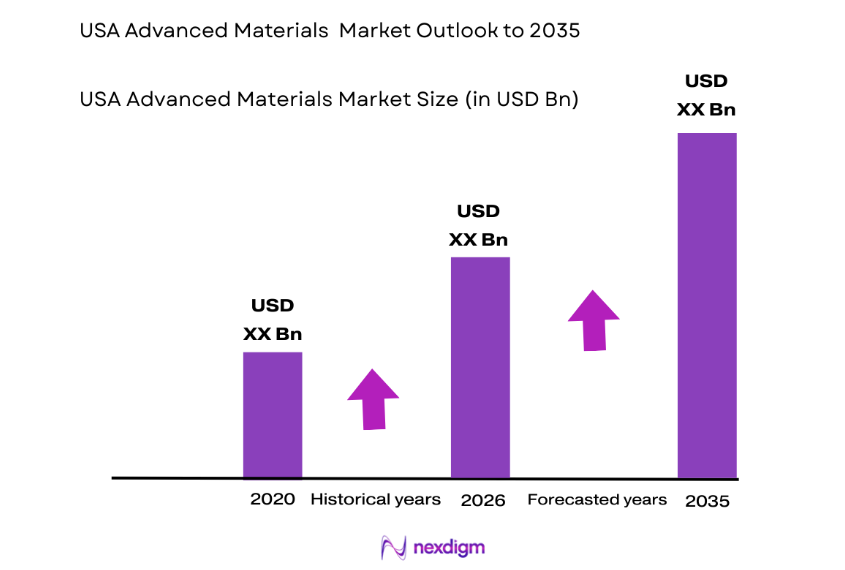
The USA Advanced Materials market is expected to reach USD ~ billion in 2024, driven by the growing demand for high-performance materials across industries such as aerospace, automotive, and electronics. Key drivers include advancements in material science, the increasing need for lightweight and durable materials, and the rising adoption of advanced composites in manufacturing processes. Materials such as carbon fiber, graphene, and nanomaterials are particularly crucial for enhancing product performance and efficiency.
Regions like California, Michigan, and Texas dominate the USA Advanced Materials market due to their strong industrial and manufacturing bases. California leads with innovations in nanomaterials and semiconductors, while Michigan has a robust automotive sector that increasingly incorporates advanced materials into vehicle manufacturing. Texas, with its significant energy industry, focuses on materials for energy efficiency and sustainability. These regions have established infrastructure and high levels of investment in research and development, driving their dominance in the market.
Market Segmentation
By Product Type
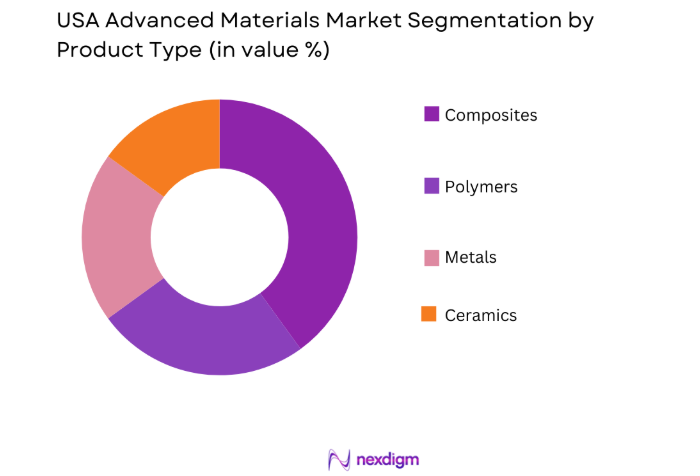
The USA Advanced Materials market is segmented by product type into composites, polymers, metals, and ceramics. Recently, composites have gained a dominant market share due to their widespread use in industries such as aerospace, automotive, and construction. Composites, particularly carbon fiber and fiber-reinforced polymers, offer superior strength-to-weight ratios, making them ideal for lightweight, high-performance applications. Their ability to enhance fuel efficiency, reduce emissions, and improve structural integrity drives their high demand, particularly in the aerospace and automotive sectors. Additionally, continuous advancements in manufacturing processes and cost reduction have made composites more accessible, further increasing their adoption.
By End-User Industry
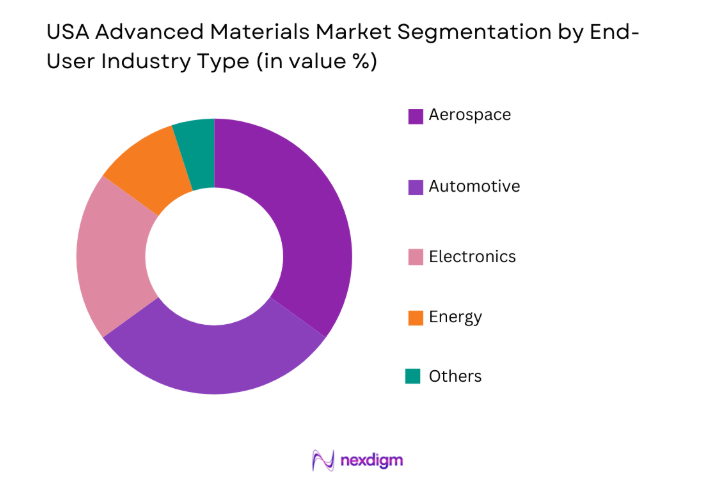
The USA Advanced Materials market is segmented by end-user industry into aerospace, automotive, electronics, energy, and others. The aerospace industry holds a dominant market share due to the increasing demand for lightweight, durable materials that can withstand extreme conditions. Advanced materials such as carbon composites and titanium alloys are used extensively in aircraft components, from fuselage to turbine blades. The aerospace sector’s continuous focus on improving fuel efficiency, performance, and safety in aircraft has driven the growth of advanced materials. Additionally, the increasing trend of commercial space exploration further fuels demand in this sector, making aerospace a critical driver of advanced materials adoption.
Competitive Landscape
The USA Advanced Materials market is highly competitive, with key players focusing on innovation, strategic partnerships, and acquisitions to expand their market presence. Companies are investing heavily in research and development to develop new materials with enhanced properties, such as higher strength, lighter weight, and improved sustainability. There is also a strong trend towards collaborations with industries such as aerospace, automotive, and energy to create tailor-made solutions. The market sees consolidation as companies strive to integrate new technologies and meet the increasing demand for advanced materials.
| Company Name | Establishment Year | Headquarters | Technology Focus | Market Reach | Key Products | Revenue | Additional Parameter |
| 3M | 1902 | St. Paul, USA | ~ | ~ | ~ | ~ | ~ |
| Dow Inc. | 1897 | Midland, USA | ~ | ~ | ~ | ~ | ~ |
| Hexcel | 1948 | Stamford, USA | ~ | ~ | ~ | ~ | ~ |
| Covestro | 2015 | Leverkusen, Germany | ~ | ~ | ~ | ~ | ~ |
| Carpenter Technology | 1889 | Wyomissing, USA | ~ | ~ | ~ | ~ | ~ |

USA Advanced Materials Market Analysis
Growth Drivers
Technological Advancements in Material Science
Technological advancements in material science are a key growth driver for the USA Advanced Materials market. Ongoing innovations in nanotechnology, polymer chemistry, and composite materials are enabling the development of materials with superior properties such as increased strength, reduced weight, and enhanced thermal and electrical conductivity. These innovations are critical in industries such as aerospace, automotive, and electronics, where performance improvements are continually sought. For instance, the development of lighter, stronger composite materials allows aerospace manufacturers to build more fuel-efficient aircraft, while advanced polymers and metals are helping automotive manufacturers create lighter, more energy-efficient vehicles. The research into smart materials, which can adapt to environmental changes, is also opening new avenues for product applications. These technological advancements are driving the demand for advanced materials across various industries, providing businesses with the ability to manufacture products that are not only more efficient but also more sustainable, reducing energy consumption and environmental impact.
Rising Demand for Lightweight and Durable Materials
The rising demand for lightweight and durable materials is another significant growth driver for the USA Advanced Materials market. As industries, particularly aerospace, automotive, and construction, strive for increased efficiency, the demand for materials that offer high strength-to-weight ratios is growing. Lightweight materials such as carbon composites and advanced polymers are critical in reducing energy consumption and improving performance. In the aerospace industry, lighter materials contribute to reduced fuel consumption, making aircraft more fuel-efficient and environmentally friendly. In the automotive sector, the shift towards electric vehicles (EVs) is driving the need for lightweight materials that can offset the weight of batteries, improving vehicle range and performance. The demand for durable materials that can withstand extreme conditions, such as high temperatures and corrosion, is also increasing, especially in industries like energy and electronics. As a result, the USA Advanced Materials market is benefiting from the growing need for materials that not only enhance performance but also contribute to sustainability and cost savings.
Market Challenges
High Production Costs and Limited Accessibility
One of the key challenges facing the USA Advanced Materials market is the high production costs associated with manufacturing advanced materials. Materials such as carbon fiber, titanium alloys, and graphene are expensive to produce due to the complex processes required to create them. These high costs limit the accessibility of advanced materials to small and medium-sized enterprises (SMEs) that cannot afford the initial investment in specialized manufacturing equipment or processes. Additionally, the scalability of production is often a challenge for newer advanced materials, as mass production techniques may not be fully developed or standardized. This can result in bottlenecks in the supply chain, leading to delays in product availability and higher prices for consumers. While advancements in manufacturing technologies are helping to reduce costs over time, the initial expense remains a barrier to broader adoption of these materials, especially in industries where cost-sensitive decisions are made, such as automotive and construction.
Regulatory Hurdles and Material Certification
Regulatory hurdles and material certification are also significant challenges in the USA Advanced Materials market. Many advanced materials, particularly those used in critical applications such as aerospace and medical devices, must meet stringent safety and performance standards. The certification process for these materials is time-consuming and costly, with long approval cycles that can delay product development and market entry. This is particularly challenging for smaller companies or startups that may not have the resources to navigate the complex regulatory landscape. Additionally, the lack of standardized testing methods for some advanced materials can create uncertainty around their performance, making it more difficult for companies to adopt new materials confidently. The regulatory challenges surrounding the use of advanced materials can also slow down innovation, as businesses may hesitate to invest in materials that have not yet been certified for widespread use.
Opportunities
Adoption of Sustainable and Eco-friendly Materials
The adoption of sustainable and eco-friendly materials presents a significant opportunity for the USA Advanced Materials market. As industries continue to focus on reducing their environmental footprint, the demand for materials that are not only high-performing but also environmentally friendly is growing. Biodegradable polymers, recyclable composites, and sustainable manufacturing processes are gaining traction in industries such as packaging, automotive, and construction. Companies are increasingly seeking alternatives to traditional materials that may be harmful to the environment, and advanced materials offer a solution by providing the necessary performance characteristics while being more sustainable. The push for a circular economy, where materials can be reused, recycled, or repurposed, is driving innovations in material science, creating new opportunities for the adoption of eco-friendly materials. As government regulations and consumer preferences shift towards sustainability, the market for advanced, sustainable materials is expected to expand significantly.
Expansion of 3D Printing and Additive Manufacturing
The expansion of 3D printing and additive manufacturing presents a considerable opportunity for the USA Advanced Materials market. 3D printing technologies are enabling manufacturers to create complex components with high precision using advanced materials such as metals, polymers, and composites. This technology reduces material waste, speeds up the prototyping process, and allows for the production of custom parts that would be difficult or impossible to manufacture using traditional methods. The use of advanced materials in 3D printing is particularly valuable in industries such as aerospace, healthcare, and automotive, where lightweight, high-strength components are required. As 3D printing becomes more widely adopted and advances in material science continue, the demand for advanced materials tailored for additive manufacturing is expected to increase, providing significant growth opportunities for companies involved in material development and production.
Future Outlook
The USA Advanced Materials market is set to experience continued growth over the next five years, driven by ongoing innovations in material science and a rising demand for sustainable, high-performance materials. Key industries such as aerospace, automotive, and energy will continue to be major adopters of advanced materials, seeking to improve efficiency, reduce environmental impact, and enhance product performance. Technological developments in 3D printing, smart materials, and nanomaterials will open new applications for advanced materials, further fueling market expansion. Regulatory support for sustainability and eco-friendly materials will also contribute to the market’s growth, creating new opportunities for businesses involved in material innovation.
Major Players
- 3M
- Dow Inc.
- Hexcel
- Covestro
- Carpenter Technology
- BASF
- Huntsman Corporation
- DuPont
- Arkema
- Mitsubishi Chemical
- Toray Industries
- Solvay
- Owens Corning
- PPG Industries
- SGL Carbon
Key Target Audience
- Investments and venture capitalist firms
- Government and regulatory bodies
- Aerospace manufacturers
- Automotive manufacturers
- Energy and utility companies
- Construction industry leaders
- Industrial design and development companies
Research Methodology
Step 1: Identification of Key Variables
Key factors influencing market growth, such as technological advancements, material demand, and regulatory policies, are identified for structured research.
Step 2: Market Analysis and Construction
A thorough analysis of market trends, segmentation, and competitive forces is conducted to construct an accurate market model.
Step 3: Hypothesis Validation and Expert Consultation
Industry experts and key stakeholders are consulted to validate hypotheses and refine market projections based on real-world insights.
Step 4: Research Synthesis and Final Output
The findings from analysis and consultations are synthesized into a comprehensive report, providing actionable insights and strategic recommendations for stakeholders.

- Executive Summary
- Research Methodology (Definitions, Scope, Industry Assumptions, Market Sizing Approach, Primary & Secondary Research Framework, Data Collection & Verification Protocol, Analytic Models & Forecast Methodology, Limitations & Research Validity Checks)

- Market Definition and Scope
- Value Chain & Stakeholder Ecosystem
- Regulatory / Certification Landscape
- Sector Dynamics Affecting Demand

- Growth Drivers
Rising Demand for Lightweight Materials in Automotive and Aerospace
Advancements in Nanotechnology Driving Material Innovation
Increasing Demand for High Performance Materials in Energy and Power Applications - Market Challenges
High Production Costs for Advanced Material Processing
Limited Availability of Specialized Raw Materials
Complexity in Integrating Advanced Materials with Existing Manufacturing Processes - Market Opportunities
Expanding Demand for Smart Materials in Consumer Electronics
Growth of Advanced Materials in Renewable Energy Systems
Development of High-Performance Composites for Aerospace and Automotive Industries - Trends
Increasing Use of Nanomaterials in Electronics Manufacturing
Growing Demand for Smart Materials in Healthcare Applications - Government Regulations
- SWOT Analysis
- Porter’s Five Forces

- By Market Value, 2020-2025
- By Installed Units, 2020-2025
- By Average System Price, 2020-2025
- By System Complexity Tier, 2020-2025

- By System Type (In Value%)
Advanced Composites
Nanomaterials
Smart Materials
High Performance Polymers
Advanced Ceramics - By Platform Type (In Value%)
Automotive Manufacturing Platforms
Aerospace and Aviation Platforms
Energy and Power Infrastructure Platforms
Electronics and Semiconductor Manufacturing Platforms - By Fitment Type (In Value%)
Structural Components
Electronic and Semiconductor Components
Thermal Management Systems
Coatings and Surface Treatments - By End User Segment (In Value%)
Automotive Industry
Aerospace Industry
Electronics and Semiconductor Industry
Energy and Utilities Industry

- Market Share Analysis
- Cross Comparison Parameters (Material Technology Portfolio, Supply Chain Integration, Industry Application Coverage, Pricing Strategy, Innovation Capability, Regional Distribution Network, After-Sales Service)
- SWOT Analysis of Key Competitors
- Pricing & Procurement Analysis
- Key Players
Toray Industries
Hexcel Corporation
Solvay SA
Teijin Limited
SGL Carbon SE
3M Company
DuPont de Nemours
Dow Inc
BASF SE
Saint Gobain
Huntsman Corporation
Mitsubishi Chemical Group
Evonik Industries
Arkema SA
SCG Chemicals

- Automotive Manufacturers Integrating Lightweight Advanced Materials for Fuel Efficiency
- Aerospace Manufacturers Utilizing High-Performance Composites for Aircraft Design
- Semiconductor Manufacturers Using Advanced Materials for Chip Production
- Energy Companies Adopting Advanced Materials in Renewable Power Infrastructure

- Forecast Market Value, 2026-2035
- Forecast Installed Units, 2026-2035
- Price Forecast by System Tier, 2026-2035
- Future Demand by Platform, 2026-2035


 Request a Sample
 Ask for Customization
 Get a Quote
 Enquire Now