
 Download PDF
 Download PDF
Market Overview
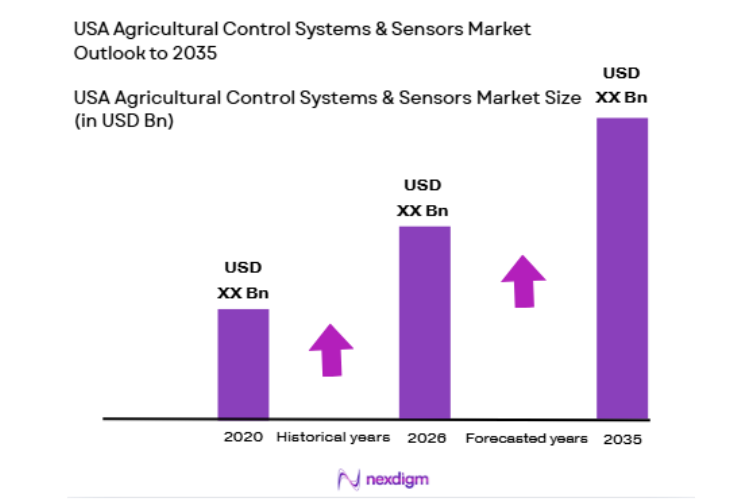
The USA Agricultural Control Systems & Sensors Market reached approximately USD ~ billion based on a recent historical assessment derived from precision agriculture technology shipments and sensor integration values reported by the Association of Equipment Manufacturers and USDA digital agriculture adoption studies. Demand is driven by widespread adoption of precision farming, automation in tractors and harvesters, and increasing deployment of GPS guidance, yield monitoring, and environmental sensing technologies to improve productivity and resource efficiency across large-scale commercial farming systems.
Major activity clusters are concentrated in Midwest and technology-driven agricultural regions including Iowa, Illinois, Nebraska, Kansas, and California due to high mechanization intensity and advanced precision agriculture adoption. Cities such as Moline, Fargo, Ames, and Salinas host leading agricultural technology development centers and OEM engineering facilities. These regions benefit from strong agritech innovation ecosystems, research universities, and commercial farming operations that accelerate integration of sensors, automation controllers, and digital farm management platforms.
Market Segmentation
By Product Type
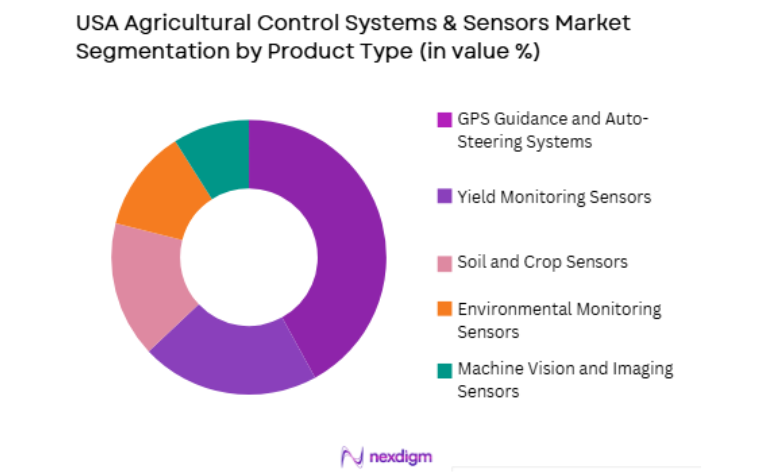
USA Agricultural Control Systems & Sensors Market is segmented by product type into GPS guidance and auto-steering systems, yield monitoring sensors, soil and crop sensors, machine vision and imaging sensors, and environmental monitoring sensors. Recently, GPS guidance and auto-steering systems has a dominant market share due to factors such as widespread installation in tractors and combines, direct productivity impact, and compatibility with precision farming practices across large grain farms. These systems enable accurate field navigation, reduce overlap in operations, and improve input efficiency, making them foundational technologies in modern precision agriculture equipment fleets.
By Application
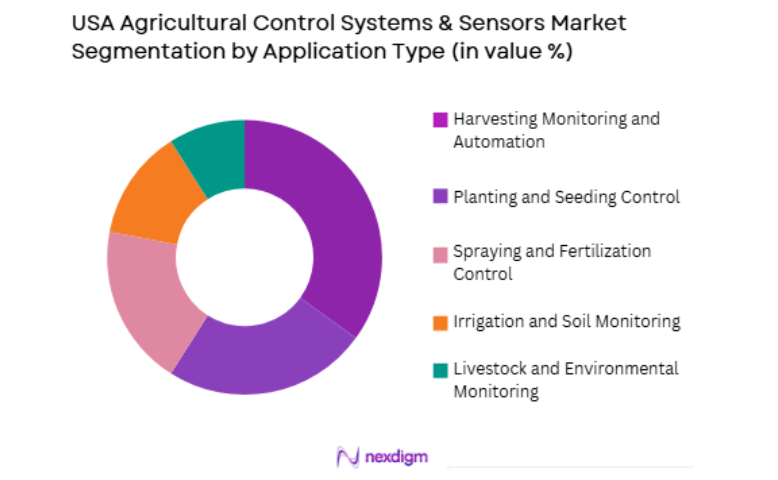
USA Agricultural Control Systems & Sensors Market is segmented by application into planting and seeding control, spraying and fertilization control, harvesting monitoring and automation, irrigation and soil monitoring, and livestock and environmental monitoring. Recently, harvesting monitoring and automation has a dominant market share due to factors such as extensive use of yield sensors, moisture sensing, and automation controllers in combine harvesters across large commercial grain operations. Harvesting represents the most data-intensive phase of crop production, requiring real-time monitoring and automation to optimize yield capture and machine performance, driving higher adoption of advanced control systems.
Competitive Landscape
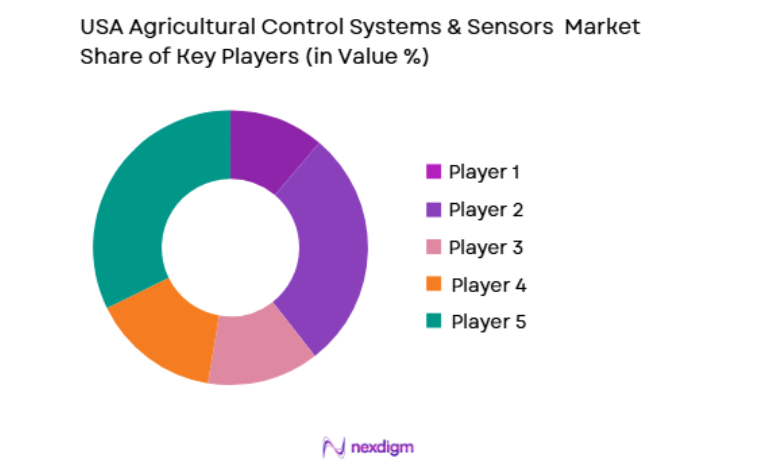
The USA Agricultural Control Systems & Sensors Market is moderately consolidated with strong influence from precision agriculture technology providers and agricultural machinery OEMs integrating sensors and control systems into equipment platforms. Major players leverage digital agriculture ecosystems, software analytics, and hardware integration capabilities to maintain competitive positioning. Technology partnerships between equipment manufacturers and sensor developers drive innovation, while aftermarket retrofitting solutions expand market reach across existing machinery fleets.
| Company Name | Establishment Year | Headquarters | Technology Focus | Market Reach | Key Products | Revenue | Precision Platform Integration |
| John Deere | 1837 | USA | ~ | ~ | ~ | ~ | ~ |
| Trimble | 1978 | USA | ~ | ~ | ~ | ~ | ~ |
| Raven Industries | 1956 | USA | ~ | ~ | ~ | ~ | ~ |
| AGCO | 1990 | USA | ~ | ~ | ~ | ~ | ~ |
| Topcon Agriculture | 1932 | Japan | ~ | ~ | ~ | ~ | ~ |
USA Agricultural Control Systems & Sensors Market Analysis
Growth Drivers
Precision Agriculture Adoption and Data-Driven Farm Management Expansion
USA Agricultural Control Systems & Sensors Market growth is strongly driven by widespread adoption of precision agriculture technologies across large commercial farming operations seeking to optimize productivity, input efficiency, and crop yield consistency. Farmers increasingly deploy GPS guidance, yield sensors, and crop monitoring systems to collect high-resolution field data enabling variable-rate planting, fertilization, and harvesting decisions. Precision agriculture technologies reduce input waste and operational overlap, directly improving economic returns and sustainability metrics. Integration of sensors and controllers into tractors, planters, and combines enables automated machine functions aligned with digital agronomy platforms. Farm management software platforms rely on sensor-generated data streams to support decision-making and performance analytics. Commercial grain and specialty crop producers adopt precision systems to manage large acreage efficiently under labor constraints. Continuous data collection across crop cycles improves predictive agronomy and risk management. OEM integration of sensors into equipment platforms accelerates adoption among farmers purchasing new machinery. Government conservation and sustainability initiatives encourage precision input management technologies. These structural shifts toward data-driven agriculture therefore act as a major long-term driver for control systems and sensor deployment across U.S. farming.
Automation and Autonomous Agricultural Machinery Development
USA Agricultural Control Systems & Sensors Market expansion is significantly driven by increasing automation and autonomy integration in agricultural machinery designed to reduce operator workload and improve operational efficiency. Modern tractors, sprayers, and combines incorporate auto-steering, implement control, and machine vision sensors enabling semi-autonomous operation across large fields. Sensor fusion technologies combining GPS, lidar, cameras, and environmental sensing enable autonomous navigation and task execution. Labor shortages in agriculture accelerate demand for automation capable of sustaining productivity with fewer operators. Autonomous equipment requires extensive sensor arrays and control systems for navigation, crop detection, and machine performance optimization. OEM investment in autonomous agriculture platforms drives demand for advanced sensing technologies. Automation also enhances safety and operational consistency in large-scale farming operations. Integration with digital connectivity platforms allows remote monitoring and control of equipment fleets. Precision automation reduces operator fatigue and operational variability.
Market Challenges
High Integration Cost and Technology Complexity in Precision Sensor Systems
USA Agricultural Control Systems & Sensors Market faces significant barriers from high acquisition and integration cost of advanced sensor and control technologies required for precision agriculture and automation systems. Precision guidance, imaging sensors, and machine control modules add substantial cost to farm equipment purchases, limiting adoption among smaller or cost-sensitive farms. Retrofitting existing machinery with sensors and controllers often requires complex installation and calibration processes. Farmers may face compatibility issues across mixed equipment brands and generations. Software integration and data interoperability challenges increase implementation complexity. Training requirements for operators and technicians raise operational cost and learning barriers. Rapid technology evolution risks obsolescence of installed systems. Maintenance and calibration of sensors add lifecycle cost.
Data Connectivity Limitations and Interoperability Challenges in Farm Systems
USA Agricultural Control Systems & Sensors Market development is constrained by inconsistent rural connectivity infrastructure and lack of standardized data interoperability across agricultural equipment and software platforms. Precision agriculture systems depend on reliable GPS correction signals, cloud connectivity, and data transfer between machines and farm management systems. Connectivity gaps in remote farming regions limit real-time data utilization and remote monitoring capability. Proprietary data formats across OEM platforms restrict cross-brand compatibility. Farmers operating mixed equipment fleets face integration challenges. Data ownership concerns affect willingness to share agronomic data across platforms. Interoperability limitations reduce full value realization from sensor data. Software fragmentation complicates digital agriculture adoption. These structural connectivity and interoperability issues restrict scalable deployment of control and sensor technologies.
Opportunities
Expansion of Autonomous and Robotics-Based Agricultural Systems
USA Agricultural Control Systems & Sensors Market presents major opportunity through rapid development of autonomous tractors, robotic harvesters, and sensor-driven agricultural robots requiring advanced sensing and control architectures. Autonomous field robots for planting, weeding, and harvesting rely heavily on machine vision, lidar, and environmental sensors. Robotics integration expands sensor demand beyond traditional machinery platforms. Autonomous fleets require coordination and sensor fusion systems. Agricultural robotics startups and OEMs are investing heavily in sensor technologies. Commercial farms seeking labor-independent operations adopt robotic solutions. Sensor miniaturization and AI-based perception improve robotics capability. Regulatory acceptance of autonomous agricultural machines supports commercialization. Robotics-driven agriculture therefore expands long-term demand for advanced agricultural sensors and control systems.
Integration of AI Analytics and Digital Twin Farming Platforms
USA Agricultural Control Systems & Sensors Market holds strong opportunity in integration of sensor data streams with artificial intelligence analytics and digital twin farm modeling platforms enabling predictive agronomy and equipment optimization. Sensor networks generate continuous environmental, crop, and machine performance data that AI systems analyze for yield prediction and operational recommendations. Digital twin farm models simulate field conditions and machinery operations for planning optimization. Integration enhances value of sensor investments beyond data collection. AI-driven agronomy improves decision accuracy and resource efficiency. Equipment manufacturers incorporate analytics into precision platforms. Farms adopting AI-enabled management increase sensor deployment density. Cloud computing and edge processing improve data utilization.
Future Outlook
The USA Agricultural Control Systems & Sensors Market is expected to grow steadily over the next five years driven by precision agriculture expansion, automation in farm machinery, and integration of AI-based analytics. Autonomous agricultural equipment will increase sensor density and control system complexity. Digital farm platforms and connectivity improvements will enhance data utilization. Sustainability-driven input optimization will further accelerate adoption across commercial farming regions.
Major Players
- Trimble
- Raven Industries
- AGCO
- CNH Industrial
- Topcon Agriculture
- Hexagon Agriculture
- Bosch Rexroth
- Danfoss Power Solutions
- TeeJet Technologies
- Sensata Technologies
- Garmin
- Climate LLC
- CropX
- Ag Leader Technology
Key Target Audience
- Agricultural equipment manufacturers
- Precision agriculture technology providers
- Farm management software companies
- Agricultural sensor and electronics manufacturers
- Commercial farming enterprises
- Investments and venture capitalist firms
- Government and regulatory bodies
- Agricultural automation integrators
Research Methodology
Step 1: Identification of Key Variables
Key variables including sensor deployment rates, precision agriculture adoption, automation integration, and equipment platform compatibility were identified using agricultural technology adoption studies and industry shipment data.
Step 2: Market Analysis and Construction
Market size and segmentation were constructed by mapping sensor and control system integration across tractors, planters, sprayers, and harvesters used in major U.S. farming regions.
Step 3: Hypothesis Validation and Expert Consultation
Assumptions regarding adoption drivers, technology cost barriers, and interoperability challenges were validated through consultation with precision agriculture experts and equipment manufacturers.
Step 4: Research Synthesis and Final Output
Validated quantitative and qualitative insights were synthesized into structured analysis covering market size, segmentation, and growth dynamics for the agricultural control systems and sensors sector.

- Executive Summary
- Research Methodology (Definitions, Scope, Industry Assumptions, Market Sizing Approach, Primary & Secondary Research Framework, Data Collection & Verification Protocol, Analytic Models & Forecast Methodology, Limitations & Research Validity Checks)

- Market Definition and Scope
- Value Chain & Stakeholder Ecosystem
- Regulatory / Certification Landscape
- Sector Dynamics Affecting Demand

- Growth Drivers
Expansion of precision agriculture and data driven farming
Integration of automation and autonomous farm machinery
Demand for input optimization and yield monitoring - Market Challenges
High cost of advanced sensor and control technologies
Interoperability issues across equipment brands
Connectivity limitations in rural farm areas - Market Opportunities
Adoption of AI enabled crop and soil sensing systems
Growth of autonomous and robotics farming platforms
Cloud based farm management and analytics integration - Trends
Shift toward multi sensor integrated control platforms
Real time field data analytics and decision support
Edge computing and on machine processing adoption - Government regulations
Data privacy and agricultural data ownership policies
Precision agriculture support and innovation programs
Wireless communication spectrum regulations - SWOT analysis
- Porters 5 forces

- By Market Value, 2020-2025
- By Installed Units, 2020-2025
- By Average System Price, 2020-2025
- By System Complexity Tier, 2020-2025

- By System Type (In Value%)
Guidance and Steering Control Systems
Variable Rate Control Systems
Machine Vision and Imaging Sensors
Environmental and Soil Sensors
Telematics and Monitoring Sensors - By Platform Type (In Value%)
Tractor Integrated Systems
Combine Harvester Integrated Systems
Sprayer Integrated Systems
Autonomous Agricultural Platforms
Standalone Sensor Networks - By Fitment Type (In Value%)
OEM Factory Installed Systems
Aftermarket Retrofit Kits
Precision Agriculture Modules
Autonomous Ready Configurations
Cloud Connected Sensor Systems - By End User Segment (In Value%)
Large Commercial Farms
Corporate Agribusiness Enterprises
Precision Agriculture Service Providers

- Market Share Analysis
- Cross Comparison Parameters (Sensor Type Portfolio, Precision Control Capability, Automation Integration Level, Data Analytics Platform Compatibility, OEM Integration Strength)
- SWOT Analysis of Key Competitors
- Pricing & Procurement Analysis
- Key Players
John Deere Precision Ag
Trimble Agriculture
AGCO Precision Planting
CNH Industrial Raven
Topcon Agriculture
Hexagon Agriculture
Deere Blue River Technology
Climate LLC
Taranis
Sentera
Ag Leader Technology
Lindsay FieldNET
Valmont Industries
CropX Technologies
Bosch Smart Agriculture

- Large farms adopting integrated precision control systems
- Agribusiness enterprises investing in automation platforms
- Precision service providers deploying retrofit sensor kits
- Research farms piloting advanced sensing technologies

- Forecast Market Value, 2026-2035
- Forecast Installed Units, 2026-2035
- Price Forecast by System Tier, 2026-2035
- Future Demand by Platform, 2026-2035


 Request a Sample
 Ask for Customization
 Get a Quote
 Enquire Now