
 Download PDF
Market Overview
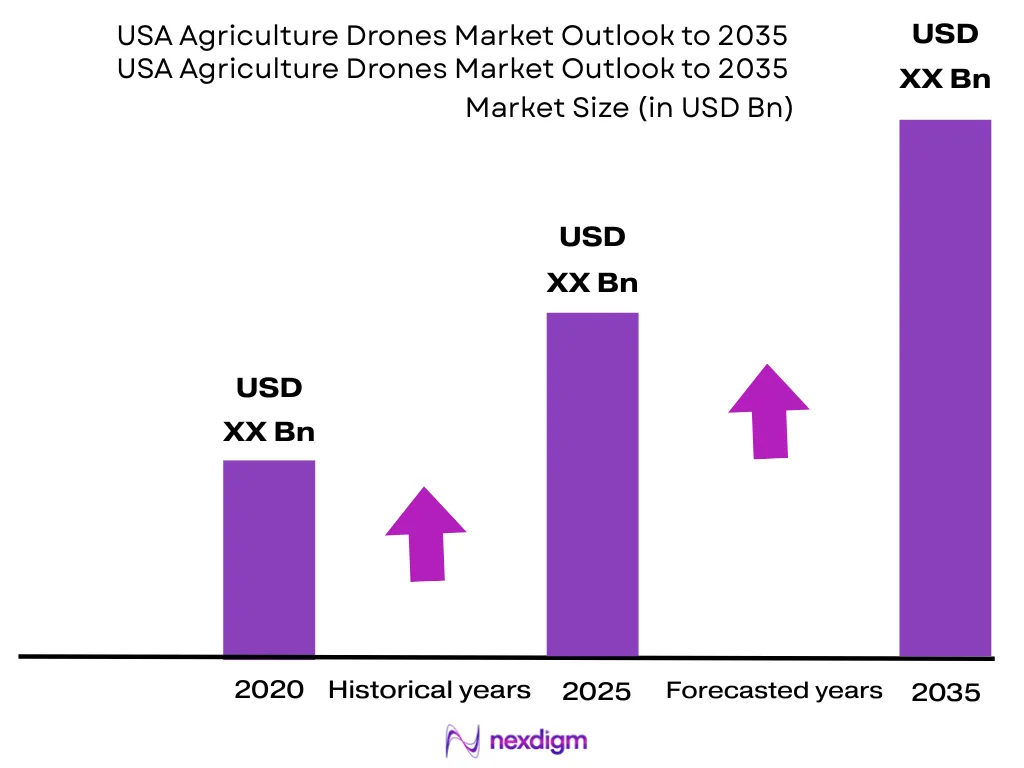
The USA Agriculture Drones Market is valued at approximately USD ~ Billion in 2024, supported by the increasing adoption of precision agriculture technologies across large-scale farming operations. According to the United States Department of Agriculture (USDA), U.S. farms covered approximately 880 million acres of farmland, while planted acreage for corn reached 94.6 million acres and soybean acreage exceeded 87 million acres. The Federal Aviation Administration (FAA) recorded more than 420,000 registered commercial drones, reflecting the growing deployment of unmanned aerial systems across industries, including agriculture. Demand for crop monitoring, precision spraying, field mapping, and yield optimization continues to drive drone adoption among commercial farming enterprises.
Market Segmentation
By Drone Type
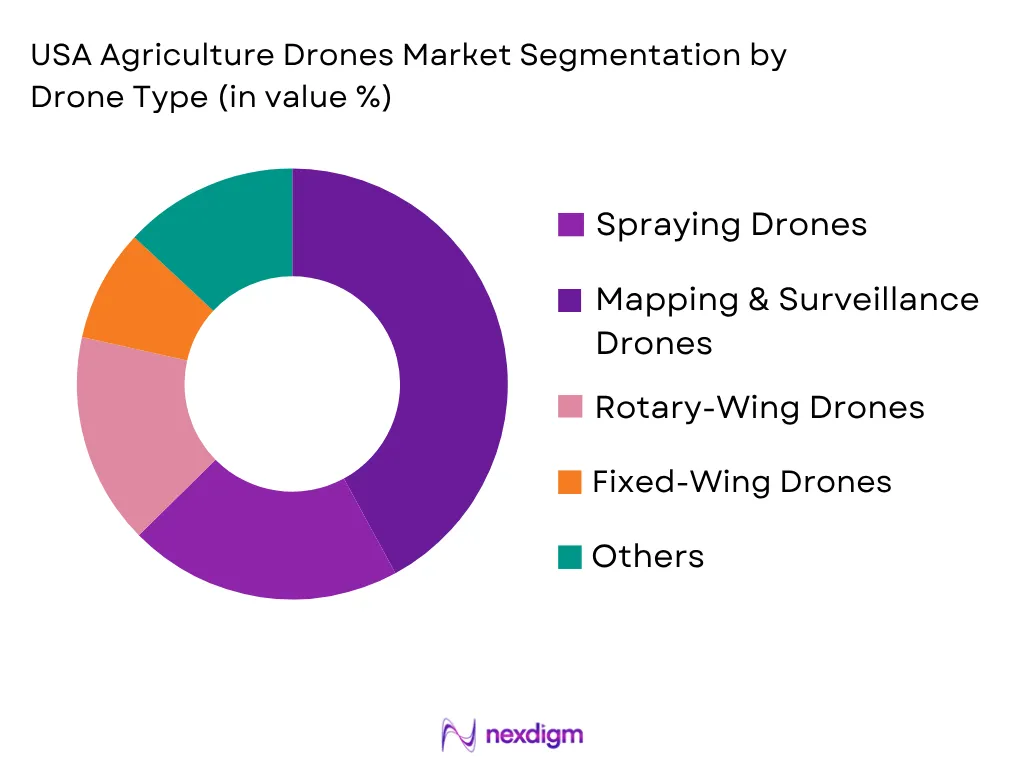
USA Agriculture Drones Market is segmented by drone type into Fixed-Wing Drones, Rotary-Wing Drones, Hybrid VTOL Drones, Spraying Drones, Mapping & Surveillance Drones, and Autonomous Swarm Drones. Recently, Spraying Drones have held the dominant market share under this segmentation due to their ability to address one of the largest operational costs in U.S. agriculture—crop input management. Farmers across corn, soybean, cotton, and specialty crop sectors increasingly utilize spraying drones for precise application of pesticides, herbicides, fungicides, and fertilizers. These drones reduce chemical wastage, improve field accessibility, and minimize crop damage compared to traditional machinery. Additionally, increasing labor shortages in agricultural operations have accelerated the transition toward automated spraying technologies. The availability of higher payload capacities, improved battery performance, and advanced route planning software has further strengthened the adoption of spraying drones, making them the leading category within the U.S. agricultural drone ecosystem.
By Application
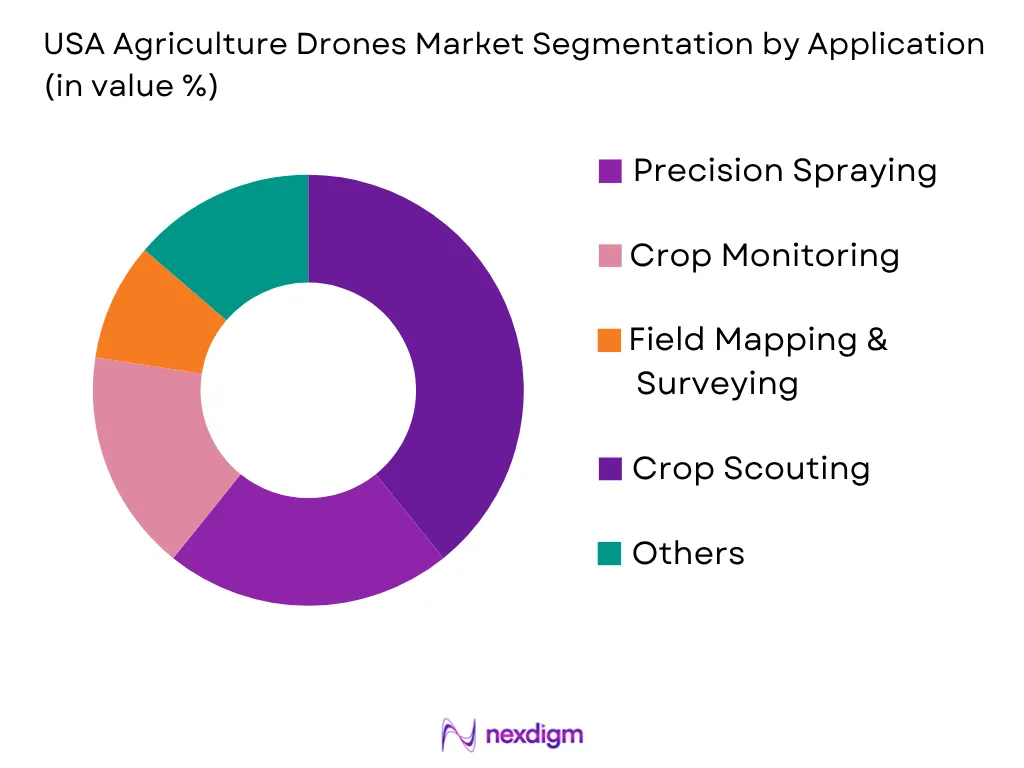
USA Agriculture Drones Market is segmented by application into Precision Spraying, Crop Health Monitoring, Field Mapping & Surveying, Crop Scouting, Irrigation Management, Soil Analysis, Yield Estimation, Livestock Monitoring, and Disease Detection. Recently, Precision Spraying has accounted for the dominant market share under this segmentation because producers are increasingly focused on maximizing productivity while reducing input costs. Drone-based precision spraying enables targeted application of agrochemicals based on field-specific conditions, improving efficiency and reducing environmental impact. Large farms across the Midwest and Southern states particularly benefit from precision spraying technologies due to extensive acreage and operational complexity. Integration with multispectral imaging and AI-driven analytics allows variable-rate application strategies that further optimize crop protection programs. The technology’s ability to lower labor requirements and improve treatment accuracy has made precision spraying the most commercially valuable application area within the USA Agriculture Drones Market.
Competitive Landscape
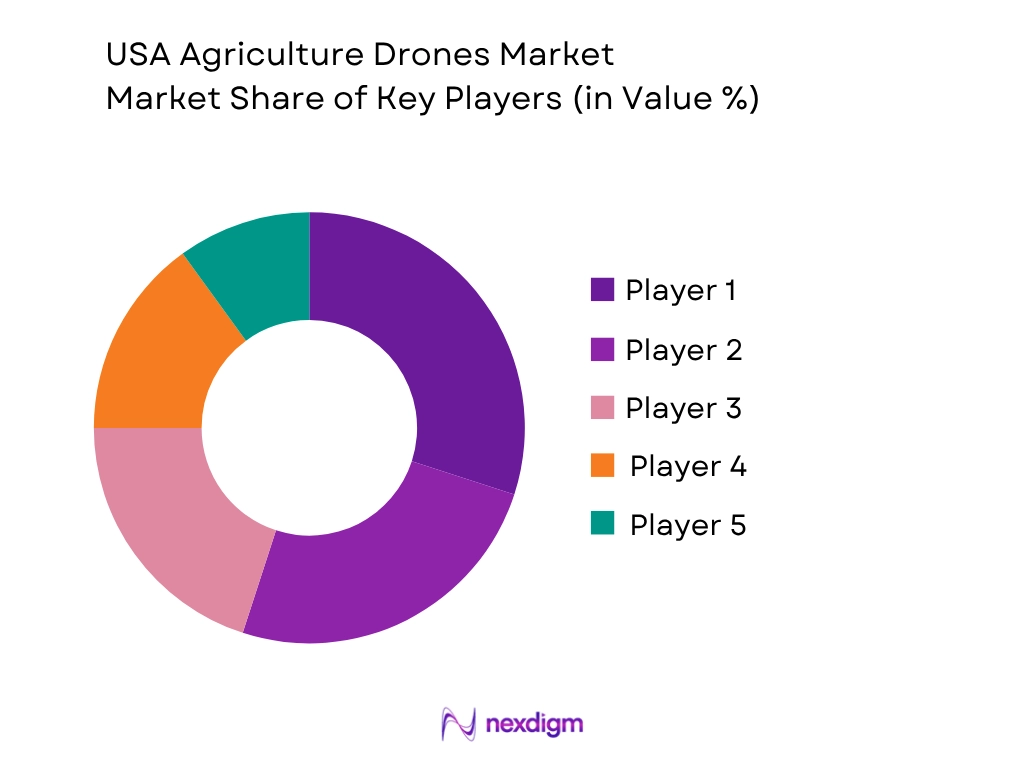
The USA Agriculture Drones Market is characterized by the presence of both domestic and international manufacturers specializing in drone hardware, precision agriculture analytics, autonomous flight systems, and drone-based farm services. The market is moderately concentrated, with several leading companies focusing on high-payload spraying drones, AI-enabled analytics platforms, and integrated precision farming ecosystems. Strategic collaborations with agribusiness firms, software providers, and agricultural cooperatives continue to strengthen competitive positioning across the industry.
| Company | Establishment Year | Headquarters | Agriculture Drone Portfolio | Max Payload Capacity | Precision Spraying Capability | AI Analytics Integration | USA Distribution Network | Precision Agriculture Solutions |
| DJI Agriculture | 2006 | ~ | ~ | ~ | ~ | ~ | ~ | ~ |
| Hylio | 2015 | ~ | ~ | ~ | ~ | ~ | ~ | ~ |
| Guardian Agriculture | 2017 | ~ | ~ | ~ | ~ | ~ | ~ | ~ |
| AgEagle Aerial Systems | 2010 | ~ | ~ | ~ | ~ | ~ | ~ | ~ |
| PrecisionHawk | 2010 | ~ | ~ | ~ | ~ | ~ | ~ | ~ |
USA Agriculture Drones Market Analysis
Growth Drivers
Expansion of Precision Agriculture Adoption
The adoption of precision agriculture across the United States continues to be a major driver for the agriculture drones market. According to the USDA Census of Agriculture, the U.S. has approximately 880 million acres of farmland, while farms with over 2,000 acres account for more than 300 million acres of operated land, creating significant demand for scalable monitoring technologies. USDA data indicates that corn planting exceeded 90 million acres, soybean planting surpassed 86 million acres, and wheat acreage remained above 46 million acres during the latest production cycle. The U.S. Bureau of Economic Analysis reported that the agriculture, food, and related industries contributed over USD 1.5 trillion to the national economy. Large-scale farming operations increasingly require high-frequency crop scouting, field mapping, and input optimization solutions that traditional methods cannot efficiently provide. Agriculture drones equipped with multispectral and thermal sensors enable rapid monitoring of thousands of acres within a single day. Additionally, the USDA’s Climate-Smart Agriculture initiatives and increasing adoption of farm management software platforms have accelerated the integration of drone-generated data into precision farming operations. The combination of extensive cultivated acreage, rising demand for yield optimization, and increasing digitalization of farm operations continues to strengthen the deployment of agricultural drones across major farming regions including Iowa, Illinois, Nebraska, Kansas, and Texas.
Rising Farm Labor Constraints and Need for Operational Efficiency
Labor availability challenges across U.S. agriculture are significantly contributing to the demand for drone-based farming solutions. According to the USDA Economic Research Service, hired farm labor expenses exceeded USD 53 billion, making labor one of the largest operating costs for agricultural producers. The U.S. agricultural sector manages approximately 2 million farms, many of which face seasonal labor shortages for crop monitoring, spraying, and field inspection activities. The Bureau of Labor Statistics reported that agricultural employment remains under pressure from an aging workforce and reduced labor availability in several crop-producing regions. At the same time, the USDA reported agricultural cash receipts exceeding USD 500 billion, highlighting the economic importance of maintaining productivity across farming operations. Agriculture drones help reduce dependency on manual scouting by covering large fields rapidly and identifying crop stress before yield losses occur. Spraying drones are increasingly used to perform targeted chemical applications in areas inaccessible to conventional machinery, improving operational efficiency while reducing labor requirements. The ability of drones to automate repetitive field operations, collect real-time agronomic data, and improve resource allocation makes them an increasingly valuable technology for producers seeking to maintain profitability amid ongoing workforce constraints.
Market Challenges
FAA Regulatory Restrictions and Airspace Compliance Requirements
One of the primary challenges affecting the USA Agriculture Drones Market is the regulatory framework governing commercial drone operations. The Federal Aviation Administration (FAA) reported more than 420,000 registered commercial drones operating across the United States. However, agricultural drone operators must comply with FAA Part 107 requirements, operational altitude restrictions, pilot certification requirements, and airspace authorization procedures. The FAA oversees more than 45,000 daily flights across the National Airspace System, making safety and operational integration critical concerns. Many agricultural operations span large rural areas where Beyond Visual Line of Sight (BVLOS) operations would significantly improve efficiency, yet obtaining regulatory approvals remains a lengthy process. Additionally, drone-based spraying applications often require coordination with state agricultural departments and environmental compliance regulations. Large farms operating across thousands of acres may face operational inefficiencies due to restrictions on autonomous flight distances and mission planning. As agricultural drone technology continues evolving toward higher levels of automation, regulatory compliance remains a significant barrier that can slow deployment, increase administrative requirements, and limit the full operational potential of agricultural drones throughout the United States farming sector.
Data Processing Complexity and Technology Integration Barriers
Agricultural drones generate large volumes of imagery and geospatial data, creating challenges associated with data management, interpretation, and integration. USDA data indicates that U.S. farms operate across approximately 880 million acres, producing extensive datasets when monitored using multispectral, thermal, and LiDAR-equipped drones. Many farming operations have adopted digital agriculture platforms; however, integrating drone-generated insights into existing farm management systems often requires specialized technical expertise. The National Agricultural Statistics Service reports that farms continue increasing their use of precision agriculture technologies, but technological complexity remains a barrier for many operators. Drone data must be processed, analyzed, and translated into actionable recommendations related to irrigation, nutrient management, pest control, and yield optimization. Smaller and medium-sized farming enterprises often lack dedicated personnel with expertise in geospatial analytics, remote sensing, and AI-based agronomic interpretation. Additionally, interoperability challenges between drone software, machinery guidance systems, and farm management platforms can complicate implementation. While drone technology offers substantial operational benefits, the technical requirements associated with data processing and digital integration remain significant obstacles to widespread adoption, particularly among producers with limited technological infrastructure.
Market Opportunities
Expansion of Drone-as-a-Service (DaaS) Across Commercial Farming Operations
The increasing scale and complexity of U.S. agriculture present substantial opportunities for Drone-as-a-Service (DaaS) providers. The USDA reports approximately 880 million acres of farmland and nearly 2 million agricultural operations across the country. Many producers seek access to advanced drone technologies without committing to equipment ownership, pilot certification, software subscriptions, and maintenance requirements. DaaS providers offer scalable solutions for precision spraying, crop scouting, field mapping, and yield monitoring, enabling producers to access advanced technologies through service-based models. Corn acreage exceeding 90 million acres and soybean acreage above 86 million acres create significant demand for aerial monitoring and precision application services. Large commercial farms increasingly require seasonal drone operations that can be outsourced to specialized providers. Furthermore, rising labor costs and increasing focus on operational efficiency support the attractiveness of service-based drone deployment models. DaaS providers are particularly well-positioned to serve medium-sized farms that may lack sufficient utilization rates to justify direct drone ownership. As precision agriculture adoption expands across the United States, service-oriented drone solutions are expected to play an increasingly important role in supporting efficient and cost-effective farm management practices.
Growth of AI-Powered Agronomic Analytics and Smart Farming Ecosystems
The integration of artificial intelligence, machine learning, and advanced analytics into agricultural drone platforms creates significant opportunities for market expansion. The USDA reports that U.S. agricultural production generates hundreds of billions of dollars annually, creating strong incentives for technologies that improve productivity and decision-making. Agriculture drones equipped with multispectral, thermal, and RGB sensors can collect highly detailed field-level information across millions of cultivated acres. When combined with AI-driven analytics platforms, this data can support early disease detection, nutrient deficiency analysis, irrigation optimization, and yield forecasting. According to USDA statistics, corn, soybean, wheat, cotton, and specialty crop production collectively account for hundreds of millions of cultivated acres, providing a vast addressable market for data-driven agriculture solutions. Farm operators increasingly seek actionable intelligence rather than raw imagery, creating opportunities for software developers and drone manufacturers to deliver integrated analytics ecosystems. The growing adoption of connected farm equipment, cloud-based management platforms, and precision agriculture technologies further strengthens demand for advanced drone analytics. As agriculture becomes increasingly data-centric, AI-powered drone solutions are expected to evolve into critical decision-support tools throughout the U.S. farming sector.
Future Outlook
The USA Agriculture Drones Market is expected to witness substantial growth over the coming years due to increasing digitalization of farming operations and broader adoption of precision agriculture technologies. Continued advancements in AI-powered crop analytics, autonomous navigation systems, multispectral imaging, and drone swarm technologies are expected to enhance operational efficiency and decision-making capabilities. Regulatory developments supporting expanded commercial drone operations and Beyond Visual Line of Sight (BVLOS) permissions could further accelerate adoption. Rising labor shortages, increasing pressure on farm productivity, and the growing need for sustainable agricultural practices are anticipated to create favorable conditions for long-term market expansion.
Major Players
- DJI Agriculture
- AgEagle Aerial Systems
- AeroVironment
- Sentera
- Trimble Agriculture
- DroneDeploy
- PrecisionHawk
- American Robotics
- Guardian Agriculture
- Hylio
- XAG
- Delair
- Quantum Systems
- Parrot
- Yamaha Motor
Key Target Audience
- Agriculture Drone Manufacturers
- Precision Agriculture Technology Providers
- Agribusiness Corporations
- Agricultural Cooperatives
- Drone-as-a-Service Providers
- Crop Protection & Agrochemical Companies
- Investments and Venture Capitalist Firms
- Government and Regulatory Bodies (FAA, USDA, EPA)
Research Methodology
Step 1: Identification of Key Variables
The initial phase involves constructing a comprehensive ecosystem map covering all major stakeholders within the USA Agriculture Drones Market. Extensive secondary research is conducted using government databases, industry publications, regulatory filings, company reports, and agricultural technology sources. The primary objective is to identify critical variables influencing demand, technology adoption, regulatory developments, and competitive dynamics.
Step 2: Market Analysis and Construction
This phase involves compiling and evaluating historical market information related to agricultural drone deployments, precision agriculture penetration, hardware sales, software revenues, and service adoption. Demand-side and supply-side assessments are conducted to estimate market performance across key segments including drone type, application, crop type, and region.
Step 3: Hypothesis Validation and Expert Consultation
Market hypotheses are developed and validated through computer-assisted telephone interviews (CATIs) and consultations with drone manufacturers, agribusiness operators, distributors, software providers, precision agriculture specialists, and regulatory experts. These interactions provide operational insights and support the validation of key market assumptions and segmentation analysis.
Step 4: Research Synthesis and Final Output
The final phase involves synthesizing findings obtained from primary and secondary research. Data triangulation methodologies are applied to validate market estimates, competitive positioning, adoption trends, and forecast assumptions. The resulting framework delivers a comprehensive and reliable assessment of the USA Agriculture Drones Market.

- Executive Summary
- Research Methodology (Market Definitions and Assumptions, Abbreviations, Market Sizing Approach, Top-Down Analysis, Bottom-Up Analysis, Demand-Side Assessment, Supply-Side Assessment, Precision Agriculture Adoption Assessment, Drone Fleet Analysis, Primary Industry Interviews, Data Triangulation, Forecasting Framework, Limitations and Future Conclusions)

- Definition and Scope
- Market Evolution and Industry Genesis
- Timeline of Major Industry Developments
- Precision Agriculture Value Chain Analysis
- Agriculture Drone Supply Chain Analysis

- Growth Drivers (Precision Agriculture Adoption, Rising Farm Labor Shortages, Input Cost Optimization, Expansion of Digital Farming, Large-Scale Farm Operations)
- Market Challenges (FAA Regulatory Complexity, Limited BVLOS Permissions, High Equipment Investment Requirements, Data Management Complexity, Weather-Related Operational Constraints)
- Market Opportunities (Drone-as-a-Service Expansion, AI-Powered Agronomic Analytics, Autonomous Drone Operations, Carbon Farming Applications, Smart Agriculture Integration)
- Market Trends (High-Payload Spraying Drones, AI Crop Diagnostics, Real-Time Farm Intelligence Platforms, Drone Swarm Deployment, Multispectral Imaging Adoption)
- Government Regulations (FAA Part 107 Compliance, Beyond Visual Line of Sight Regulations, USDA Precision Agriculture Programs, EPA Aerial Application Standards, State-Level UAS Regulations)
- SWOT Analysis
- Porter’s Five Forces Analysis
- PESTLE Analysis
- Competitive Ecosystem

- By Market Value (2020-2025)
- By Volume (2020-2025)
- By Average Selling Price (2020-2025)

- By Drone Type (In Value %)
Fixed-Wing Drones
Rotary-Wing Drones
Hybrid VTOL Drones
Spraying Drones
Mapping & Surveillance Drones
Autonomous Swarm Drones - By Application (In Value %)
Precision Spraying
Crop Health Monitoring
Field Mapping & Surveying
Crop Scouting
Irrigation Management
Soil & Field Analysis
Planting and Seeding
Yield Estimation
Livestock Monitoring
Disease & Pest Detection
- By Crop Type (In Value %)
Corn
Soybean
Wheat
Cotton
Rice
Fruits & Vegetables
Orchards & Vineyards
Sugar Beet
Alfalfa
Specialty Crops - By Region (In Value %)
Midwest USA
South USA
West USA
Northeast USA - By End User (In Value %)
Commercial Farmers
Agricultural Cooperatives
Agribusiness Corporations
Precision Agriculture Service Providers
Agricultural Research Organizations
Government Agricultural Agencies

- Market Share of Major Players (By Value, Drone Units, Installed Base, Acreage Covered, Application Segment)
- Cross Comparison Parameters (Agriculture Drone Portfolio Breadth, Payload Capacity Range, Acreage Coverage per Flight, Precision Spraying Capability, Sensor & Imaging Technology Strength, AI & Data Analytics Integration, Dealer & Service Network Reach, Drone-as-a-Service Capability)
- SWOT Analysis of Major Players
- Pricing Analysis by Payload Category, Flight Endurance and Sensor Configuration
- Detailed Profiles of Major Companies
DJI Agriculture
AgEagle Aerial Systems
AeroVironment
Sentera
Trimble Agriculture
DroneDeploy
PrecisionHawk
American Robotics
Guardian Agriculture
Hylio
XAG
Delair
Quantum Systems
Parrot
Yamaha Motor

- Market Demand and Utilization Analysis (Drone Flights per Season, Acreage Coverage per Mission, Spraying Frequency, Data Collection Intensity)
- Farm Digitalization Assessment (Precision Agriculture Adoption, Farm Management Software Integration, Connectivity Readiness)
- Purchasing Power and Budget Allocation Analysis (Capital Expenditure, Technology Spending, Operational Efficiency Investments)
- Regulatory Compliance Assessment (FAA Certification Requirements, Agricultural Spraying Compliance, Data Security Requirements)
- Needs, Desires and Pain Point Analysis (Labor Reduction, Yield Optimization, Input Efficiency, Farm Monitoring Accuracy)

- By Market Value (2026-2035)
- By Volume (2026-2035)
- By Average Selling Price (2026-2035)


 Request a Sample
 Ask for Customization
 Get a Quote
 Enquire Now