

 Download PDF
Market Overview
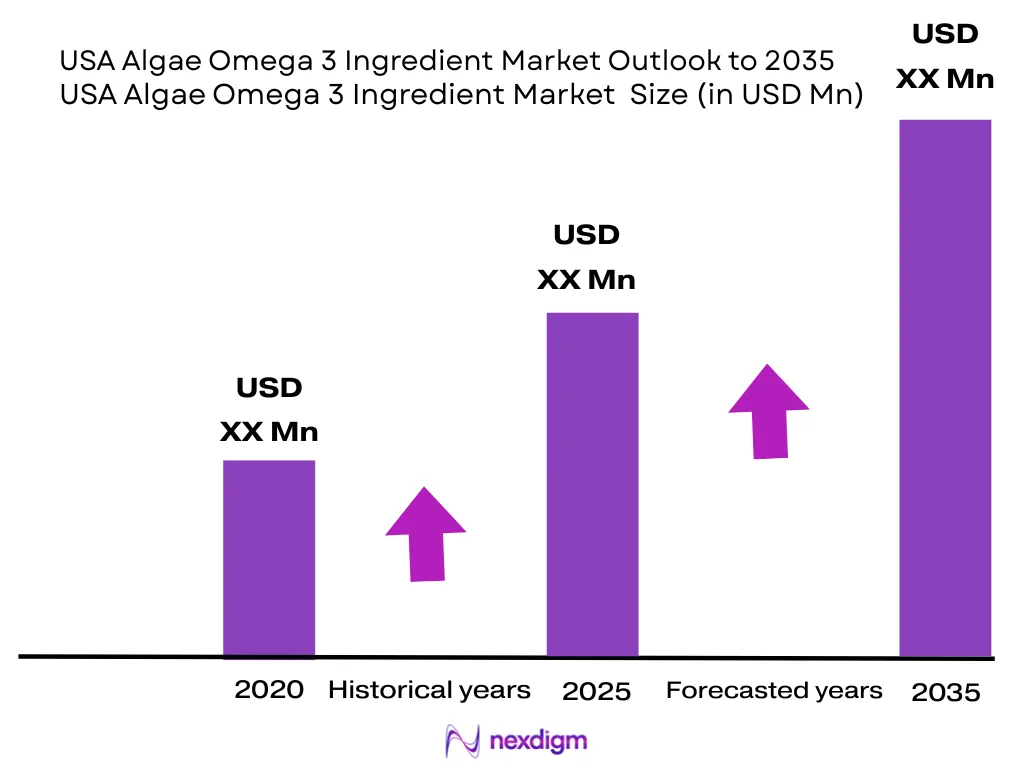
The USA Algae Omega 3 Ingredient Market is valued at USD ~ million, based on published regional analysis for algae omega-3 ingredients. The broader global algae omega-3 ingredients market was valued at USD ~ million, while the U.S. represented the largest single-country market, supported by high dietary supplement usage, infant nutrition applications, plant-based ingredient demand, and functional food innovation. The U.S. omega-3 market was separately valued at USD 2.32 billion, confirming the larger addressable omega-3 ingredient and supplement base into which algae-derived DHA and EPA ingredients compete. California, New Jersey, New York, Illinois, Texas, and Utah dominate the USA Algae Omega 3 Ingredient Market because they combine dietary supplement brands, contract manufacturers, food innovation labs, ingredient distributors, and algae technology platforms. The United States population reached 335.89 million, while GDP reached about USD 29.18 trillion, creating a large nutrition, supplement, infant formula, pet nutrition, and functional food demand base. California and Utah are strong in supplement brands, New Jersey and New York in ingredients and pharma-linked nutrition, Texas in algae cultivation, and Illinois in food ingredient distribution.
Market Segmentation
By Type
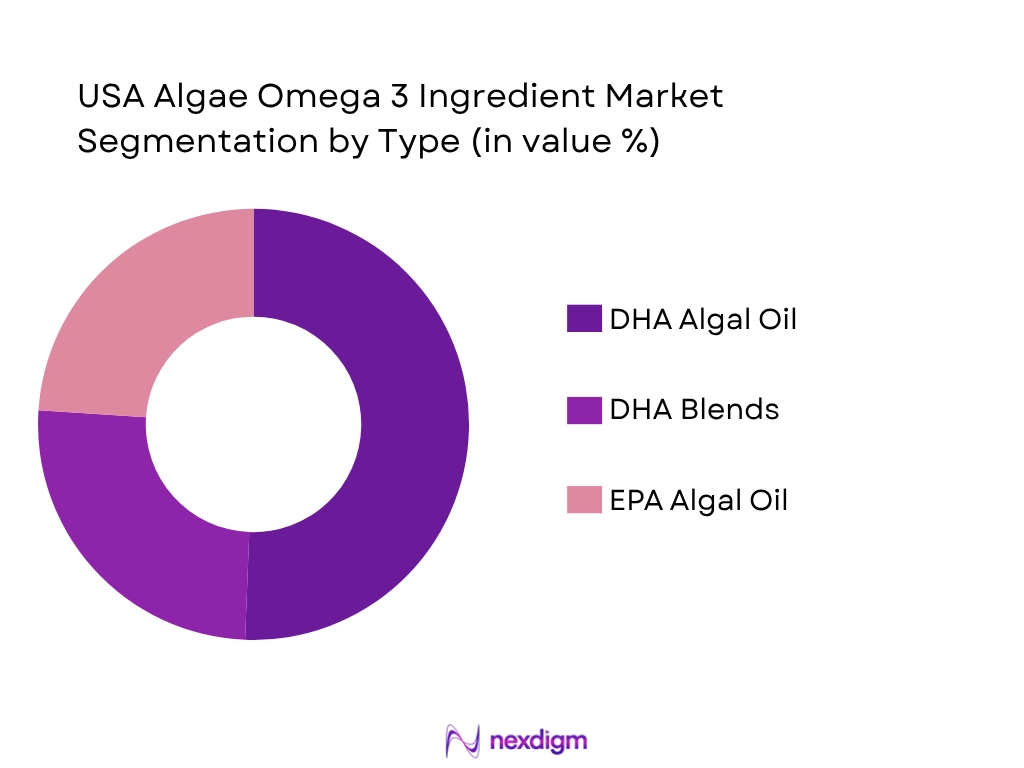
The USA Algae Omega 3 Ingredient Market is segmented by type into DHA algal oil, EPA/DHA blends, and EPA algal oil. Recently, DHA algal oil has a dominant market share in the USA under the segmentation type, due to its entrenched use in prenatal nutrition, infant formula fortification, children’s brain-development supplements, senior cognition products, and eye-health formulations. DHA also benefits from a longer regulatory and commercial history than EPA-only algae ingredients, with FDA GRAS notices covering algae-derived DHA oils used in food and supplement applications. Ingredient suppliers such as dsm-firmenich, DIC, Mara Renewables, and Algarithm have built DHA-led portfolios because Schizochytrium and related microalgae strains are commercially scalable for high-DHA lipid output. EPA/DHA blends are gaining traction as fish-oil-equivalent vegan alternatives, but DHA remains the anchor ingredient because infant nutrition and prenatal formulas require purity, stability, and regulatory documentation. Mordor Intelligence reports DHA as the leading type within algae omega-3 ingredients, with 63.58% share.
By Application
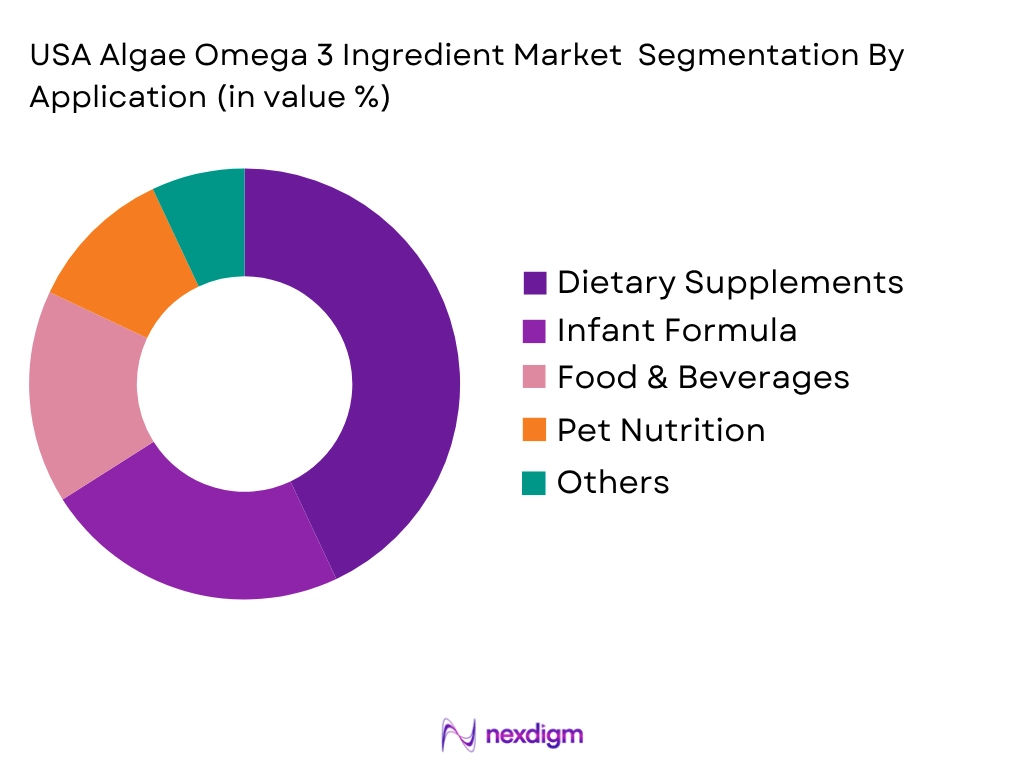
The USA Algae Omega 3 Ingredient Market is segmented by application into dietary supplements, infant formula & maternal nutrition, food & beverages, pet nutrition, and aquafeed & animal nutrition. Recently, dietary supplements have a dominant market share in the USA under the segmentation application, due to the large consumer base for softgels, vegan capsules, gummies, liquid drops, prenatal DHA, brain-health products, and heart-health formulations. Supplement brands can commercialize algae omega-3 faster than food and beverage brands because dosage, label claims, packaging, and sensory masking are easier to control in capsules and gummies than in beverages or dairy alternatives. Algae omega-3 also benefits from vegan, fish-free, non-GMO, contaminant-controlled, and sustainability-oriented positioning, which aligns with premium supplement brands and direct-to-consumer wellness companies. Infant formula remains a high-value application, but buyer qualification is longer and regulatory documentation is more demanding. Mordor Intelligence identifies dietary supplements as the leading application, with 41.92% share in algae omega-3 ingredients.
Competitive Landscape
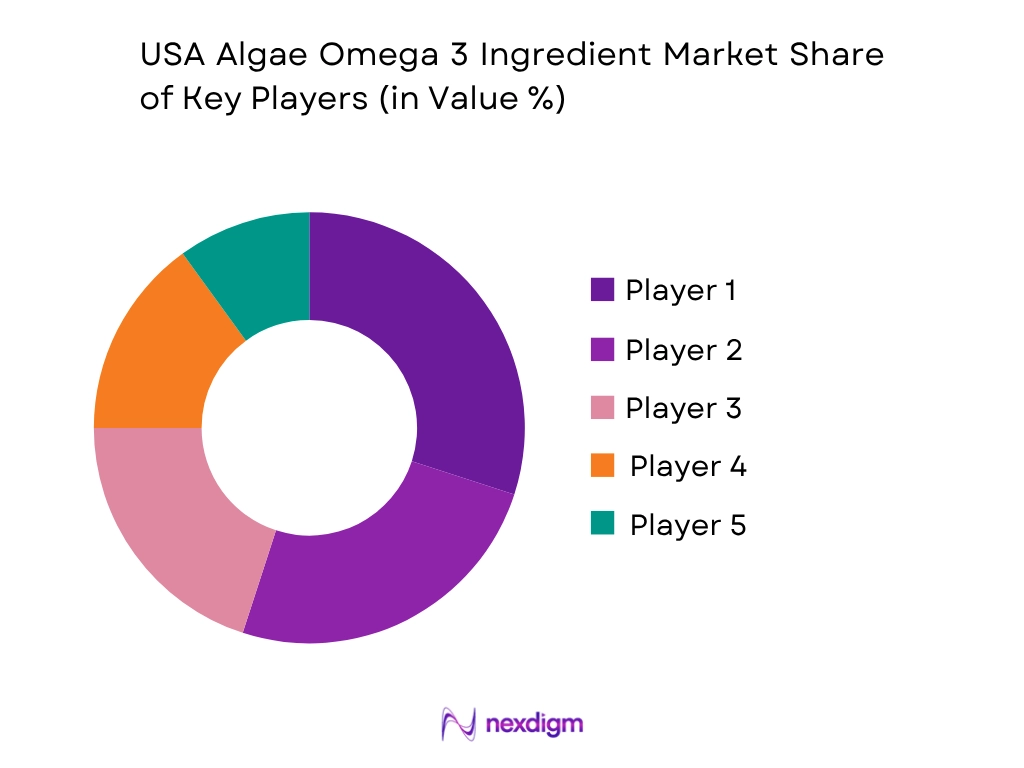
The USA Algae Omega 3 Ingredient Market is dominated by a mix of large nutrition ingredient companies, algae biotechnology specialists, branded ingredient developers, and specialty lipid suppliers. dsm-firmenich and Corbion have strong positions in scalable algal DHA and omega-3 ingredient commercialization, while Fermentalg, Qualitas Health/iwi, Mara Renewables, and DIC provide differentiated algae-derived DHA, EPA, or EPA/DHA solutions. Competition is shaped by regulatory dossiers, DHA/EPA potency, oxidative stability, sensory performance, production technology, customer technical support, and the ability to supply dietary supplement, infant nutrition, food, pet, and aquafeed customers.
| Company | Establishment Year | Headquarters | Core Ingredient Focus | Production/Technology Platform | Key Applications | Regulatory/Quality Positioning | U.S. Commercial Strength | Market-Specific Differentiator |
| dsm-firmenich | 2023 | Kaiseraugst, Switzerland / Maastricht, Netherlands | ~ | ~ | ~ | ~ | ~ | ~ |
| Corbion | 1919 | Amsterdam, Netherlands | ~ | ~ | ~ | ~ | ~ | ~ |
| Fermentalg | 2009 | Libourne, France | ~ | ~ | ~ | ~ | ~ | ~ |
| DIC Corporation | 1908 | Tokyo, Japan | ~ | ~ | ~ | ~ | ~ | ~ |
| Qualitas Health / iwi | 2011 | Houston, Texas | ~ | ~ | ~ | ~ | ~ | ~ |
USA Algae Omega 3 Ingredient Market Analysis
Growth Drivers
Large health-and-wellness consumer base supports algae DHA/EPA ingredient demand
The USA Algae Omega 3 Ingredient Market is supported by a large nutrition-consuming economy, with the World Bank reporting U.S. GDP at USD 28.75 trillion and GDP per capita at USD 84,534.0. This macro base supports premium dietary supplements, vegan capsules, prenatal DHA, senior cognition products, and clean-label functional nutrition. Demand is also reinforced by population scale, as the United States had 335.89 million people, creating a broad end-user base for omega-3 fortified supplements, foods, infant nutrition, pet products, and aquafeed ingredients.
Infant and maternal nutrition applications create stable DHA ingredient pull
The USA Algae Omega 3 Ingredient Market benefits from infant and maternal nutrition demand because algal DHA is widely used in prenatal supplements, pediatric drops, and formula fortification. CDC recorded 3,628,934 births in the United States, with a birth rate of 10.7 per 1,000 population and fertility rate of 53.8 births per 1,000 women aged 15–44. This creates a large recurring formulation base for high-purity DHA ingredients. FDA’s GRAS database also lists algal oils with ≥35%, ≥40%, and ≥45% DHA, supporting commercial use in food and nutrition applications.
Market Challenges
FDA documentation and ingredient qualification increase commercialization complexity
The USA Algae Omega 3 Ingredient Market faces a regulatory challenge because algal DHA/EPA ingredients must pass safety, identity, intended-use, and quality documentation review before entering food, infant nutrition, and supplement formulations. FDA’s GRAS database shows 32 DHA-related GRAS notice records, including algal oil notices with ≥35% DHA, ≥40% DHA, and ≥45% DHA. Several recent entries remain pending, while other notices were stopped at the notifier’s request or did not provide a sufficient GRAS basis. This creates longer buyer qualification cycles for brands using algae-derived DHA and EPA.
Fish oil substitution remains difficult in aquafeed and marine nutrition applications
The USA Algae Omega 3 Ingredient Market faces competition from established marine oil supply chains, especially in aquafeed, pet nutrition, and omega-3 ingredient procurement. NOAA states that fish oil is a major natural source of EPA and DHA in aquaculture feed, which makes fish oil the incumbent benchmark for lipid replacement. USDA ERS reported U.S. seafood exports of USD 4.9 billion, a seafood trade deficit of USD 20.6 billion, and top 5 seafood suppliers accounting for a major part of import expenditure. These figures show that marine-linked supply chains remain deeply embedded.
Market Opportunities
Aging population strengthens opportunity for cognition, eye-health, and heart-health formulations
The USA Algae Omega 3 Ingredient Market has a strong opportunity in senior nutrition because algal DHA/EPA ingredients are used in cognition, eye-health, heart-health, and healthy-aging supplements. The U.S. Census Bureau reported that the population aged 65 and older reached 61.2 million, while the national median age reached 39.1 years. This aging profile supports future demand for high-potency DHA softgels, EPA/DHA blends, gummies, powders, and clinical-style nutrition formats. Algae omega-3 suppliers can target supplement brands seeking fish-free, contaminant-controlled, vegan, and sustainable alternatives for older consumers.
New algal DHA regulatory filings support future ingredient portfolio expansion
The USA Algae Omega 3 Ingredient Market has an opportunity in new product formats because recent FDA records show continuing supplier activity in algal DHA ingredients. FDA’s GRAS database lists algal oil from Aurantiochytrium limacinum H Sc-01 with ≥40% DHA, closed with “FDA has no questions” on June 10, 2025. The database also lists pending algal oil entries with ≥35% DHA and ≥45% DHA. These filings support broader formulation activity across vegan supplements, infant nutrition, food fortification, pet nutrition, and microencapsulated powder systems.
Future Outlook
Over the forecast period, the USA Algae Omega 3 Ingredient Market is expected to expand steadily, supported by plant-based supplement demand, fish-oil substitution, infant and maternal nutrition adoption, and growth in vegan DHA/EPA blends. Published market sources place the global algae omega-3 ingredients forecast at 6.83% CAGR for 2026–2035, while the U.S. is identified as the largest single-country market and is projected to exceed USD 560 million by 2032.
Growth will be led by high-potency DHA oil, balanced EPA/DHA blends, encapsulated powders, gummy-compatible beadlets, and water-dispersible emulsions. The strongest commercial pull will come from dietary supplements, prenatal products, infant nutrition, pet wellness, aquafeed sustainability, and functional foods. Supplier success will depend on cost reduction, fermentation scale, oxidative stability, clean sensory profile, FDA documentation, technical support, and the ability to replace fish oil without compromising active omega-3 dosage.
Major Players
- dsm-firmenich
- Corbion
- BASF
- Fermentalg
- DIC Corporation
- Qualitas Health / iwi
- SourceOne Global Partners
- Mara Renewables Corporation
- Algarithm Ingredients
- Nuseed Nutritional
- Cellana Renewables
- Polaris
- KD Pharma Group
- Croda International
- ADM
Key Target Audience
- Dietary supplement and nutraceutical ingredient procurement heads
- Infant formula and maternal nutrition manufacturers
- Functional food and beverage manufacturers
- Pet nutrition and pet supplement companies
- Aquafeed and animal nutrition manufacturers
- Contract manufacturers and private-label supplement producers
- Investments and venture capitalist firms
- Government and regulatory bodies — U.S. Food and Drug Administration, Federal Trade Commission, United States Department of Agriculture, National Institutes of Health Office of Dietary Supplements, Environmental Protection Agency
Research Methodology
Step 1: Identification of Key Variables
The initial phase involves constructing an ecosystem map for the USA Algae Omega 3 Ingredient Market, covering microalgae strain owners, fermentation companies, phototrophic algae cultivators, lipid refiners, distributors, supplement brands, infant formula manufacturers, pet nutrition companies, aquafeed producers, and contract manufacturers. Key variables include ingredient type, active DHA/EPA content, production route, application mix, regulatory status, product form, and customer qualification requirements.
Step 2: Market Analysis and Construction
In this phase, historical and current data are compiled for algae-derived DHA, EPA, and EPA/DHA ingredient applications across supplements, infant formula, food and beverages, pet nutrition, and aquafeed. Market construction includes top-down review of omega-3 ingredient demand and bottom-up mapping of supplier portfolios, product forms, branded ingredient launches, regulatory notices, and application-level ingredient utilization.
Step 3: Hypothesis Validation and Expert Consultation
Market hypotheses are validated through structured interviews with ingredient suppliers, contract manufacturers, supplement formulators, infant nutrition specialists, regulatory experts, quality assurance heads, distributors, and procurement managers. These consultations support validation of segment share, product-form adoption, DHA versus EPA preference, sensory challenges, buyer qualification timelines, and algae omega-3 substitution potential against fish oil.
Step 4: Research Synthesis and Final Output
The final phase triangulates desk research, public regulatory records, company portfolios, supplier documentation, expert inputs, and application-level formulation assumptions. The output provides a validated view of the USA Algae Omega 3 Ingredient Market, including market sizing, segmentation, competitive landscape, future outlook, key target audience, and methodology aligned with business decision-making needs.

- Executive Summary
- Research Methodology (Market definitions and assumptions, algal oil inclusion criteria, ingredient-grade DHA/EPA scope, finished supplement exclusion logic, B2B ingredient revenue mapping, volume-to-value conversion, primary research framework, expert interview approach, regulatory validation, product-form benchmarking, end-use triangulation, limitations and future conclusions)

- Definition and Scope
- Market Genesis and Evolution
- Timeline of Major Ingredient Innovations
- Business Cycle and Commercialization Pathway
- Supply Chain and Value Chain Analysis

- Growth Drivers (Plant-based nutrition adoption, vegan supplement demand, marine ecosystem pressure, contaminant concerns in fish oil, growth in prenatal DHA, aging population brain-health demand, pet wellness premiumization, aquaculture sustainability targets, functional food fortification)
- Market Challenges (High production cost, fermentation scale constraints, sensory masking, oxidation stability, limited EPA-rich supply, ingredient concentration variability, buyer qualification timelines, GRAS documentation burden, fish oil price competition, cold-chain and storage requirements)
- Opportunities (High-potency algal DHA, EPA-rich vegan ingredients, fish-oil-equivalent EPA:DHA blends, infant nutrition premixes, women’s health supplements, senior brain health, pet cognitive health, plant-based seafood fortification, aquafeed fish oil replacement, organic-compatible algal ingredients)
- Market Trends (Fish-free labels, vegan DHA/EPA, contaminant-free sourcing, non-GMO positioning, high-potency small capsules, gummies and chewables, infant-grade quality, algae-to-omega traceability, retailer sustainability claims, clinically supported branded ingredients)
- SWOT Analysis
- PESTLE Analysis
- Porter’s Five Forces

- By Value (2020-2025)
- By Volume (2020-2025)
- By Active DHA/EPA Content (2020-2025)

- By Fatty Acid Type (In Value %)
DHA-Only Algal Oil
EPA-Only Algal Oil
DHA+EPA Algal Blend
High-DHA Specialty Concentrates
Fish-Oil-Equivalent EPA:DHA Blends - By Product Form (In Value %)
Refined Algal Oil
Encapsulated Powder
Water-Dispersible Emulsions
Microencapsulated Beadlets
Algae Biomass and Concentrates - By Distribution Channel (In Value %)
Direct Supplier-to-Manufacturer Sales
Specialty Ingredient Distributors
Contract Manufacturer Procurement
Premix and Fortification Companies
B2B Digital Ingredient Platforms - By Region (In Value %)
West Coast
Midwest
Northeast
South and Southeast
Texas and Gulf Corridor

- Market Share of Major Players on the Basis of Value and Volume (Ingredient revenue, algal oil volume, active DHA/EPA tonnage, customer contracts, application mix, branded ingredient penetration)
- Cross Comparison Parameters (DHA/EPA concentration, production technology, FDA GRAS/NDI status, strain and source organism, application coverage, microencapsulation capability, sustainability credentials, U.S. distribution and technical support network)
- SWOT Analysis of Major Players
- Pricing Analysis by Ingredient SKU
- Detailed Profiles of Major Companies
dsm-firmenich
Corbion
BASF
Fermentalg
DIC Corporation
Qualitas Health / iwi
SourceOne Global Partners
Mara Renewables Corporation
8.8.9 Algarithm Ingredients
Nuseed Nutritional
Cellana Renewables
Polaris
KD Pharma Group
Croda International
ADM

- Nutraceutical Brand Demand and Utilization
- Infant Formula and Maternal Nutrition Requirements
- Functional Food and Beverage Buyer Needs
- Pet Nutrition and Pet Supplement Demand
- Aquafeed and Animal Nutrition Requirements

- By Value (2026-2035)
- By Volume (2026-2035)
- By Active DHA/EPA Content (2026-2035)


 Request a Sample
 Ask for Customization
 Get a Quote
 Enquire Now