

 Download PDF
Market Overview
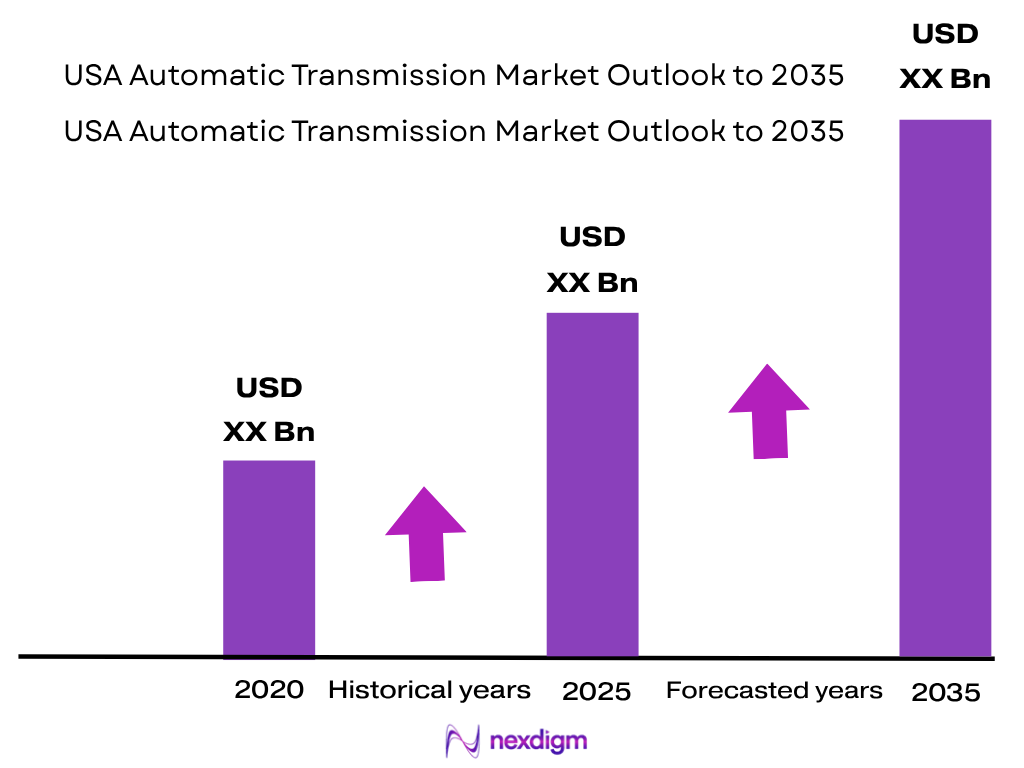
The USA Automatic Transmission Market is valued at approximately ~USD XX billion, based on historical transmission fitment, domestic vehicle production, replacement demand and transmission content per vehicle. Underlying demand strengthened as U.S. new-vehicle activity moved from roughly 15.5 million light vehicles in the preceding annual cycle toward approximately 15.9 million vehicles in the latest cycle. The market is primarily supported by high automatic-transmission penetration across SUVs, pickup trucks, crossovers, passenger cars and commercial vehicles, alongside increasing hybrid powertrain integration.
Michigan, Ohio, Indiana, Kentucky, Texas and the broader Southeast automotive corridor dominate the USA Automatic Transmission Market because they combine vehicle assembly, transmission production, powertrain engineering and Tier-1 component supply. Honda’s Ohio transmission operation alone has annual capacity for 1 million CVT and hybrid transmissions, 1.5 million gear sets, 290,000 four-wheel-drive differentials and 300,000 transfer cases. Toyota’s West Virginia operation produced more than 1.2 million engines, transmissions and hybrid-related units in its latest reported production cycle, reinforcing regional powertrain concentration.
Market Segmentation
By Transmission Type
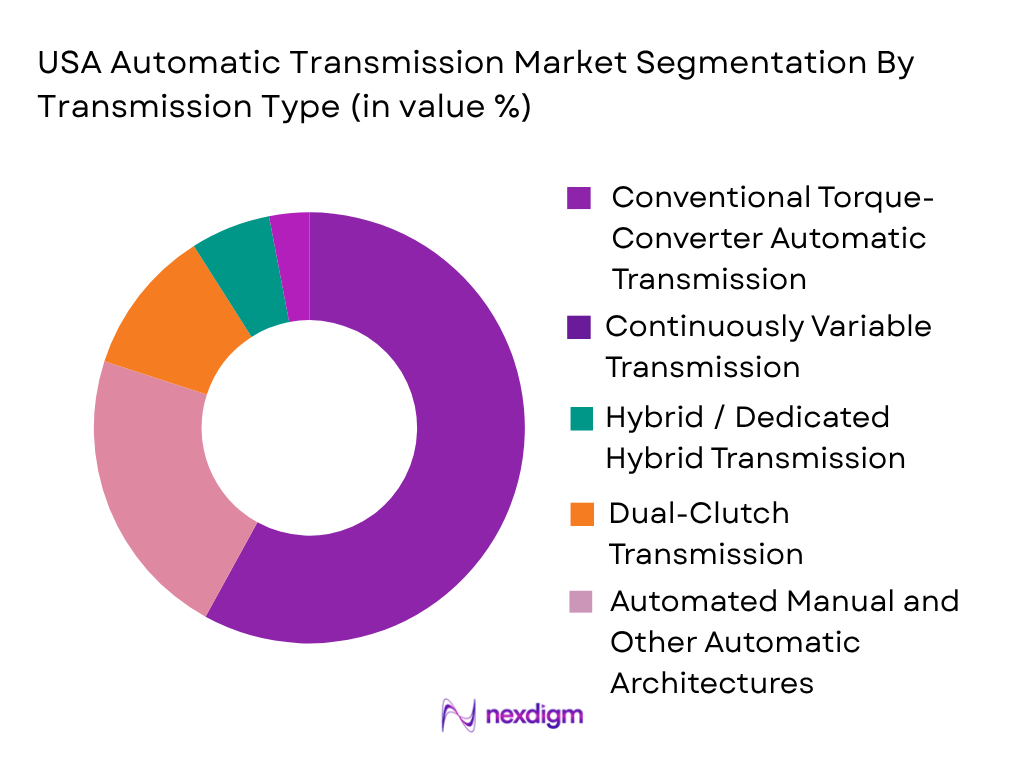
The USA Automatic Transmission Market is segmented into conventional torque-converter automatic transmissions, continuously variable transmissions, dual-clutch transmissions, automated manual transmissions and hybrid/dedicated hybrid transmissions. Conventional torque-converter automatic transmissions hold the dominant market position because of their extensive fitment across pickup trucks, SUVs, crossovers, premium passenger vehicles and commercial applications. The U.S. vehicle mix particularly favors high-torque 8-speed and 10-speed architectures capable of supporting towing, payload and large-displacement or turbocharged engines. EPA technology tracking also demonstrates the widespread role of advanced transmissions with seven or more discrete speeds across large manufacturers. CVTs retain an important position in compact cars and crossovers, particularly among Japanese OEM platforms, while hybrid transmissions are gaining strategic relevance as manufacturers increase electrified offerings. Honda’s Ohio transmission plant demonstrates this coexistence directly, with production covering conventional automatic transmissions, CVTs and two-motor hybrid systems from the same U.S. manufacturing ecosystem.
By Vehicle Type
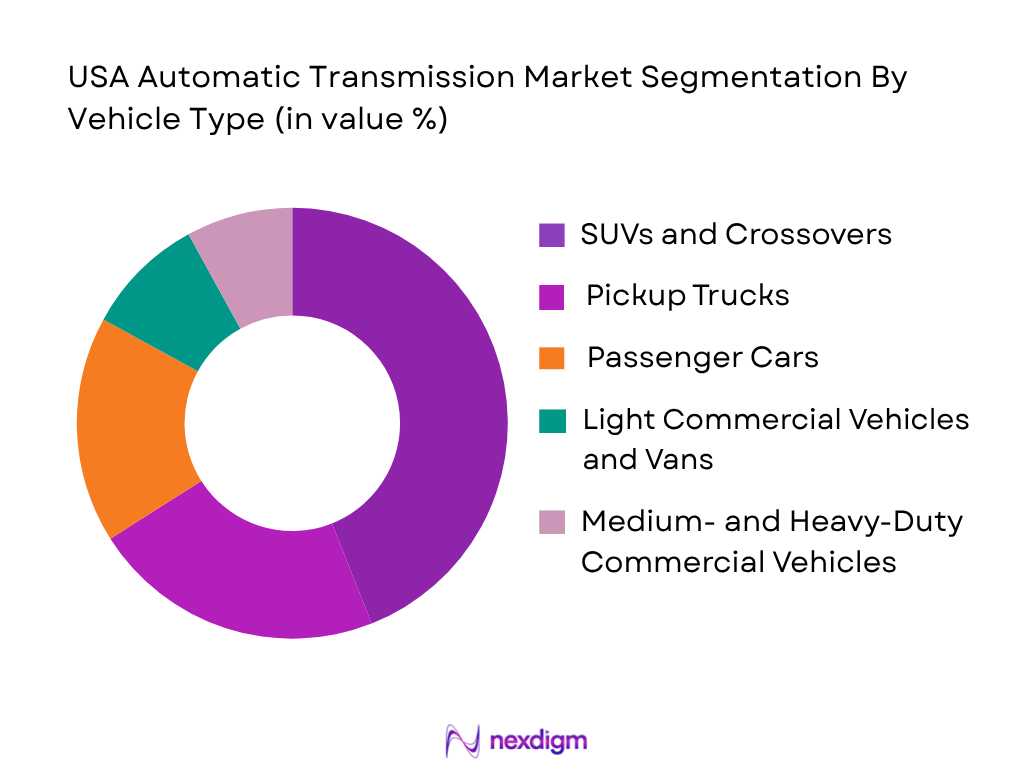
The USA Automatic Transmission Market is segmented into SUVs and crossovers, pickup trucks, passenger cars, light commercial vehicles and medium/heavy commercial vehicles. SUVs and crossovers represent the dominant sub-segment because the U.S. vehicle fleet has shifted structurally away from conventional sedans toward utility vehicles. EPA data show that truck SUVs alone accounted for nearly half of new light-duty vehicle production in model-year 2024, while SUVs across regulatory categories represented approximately 60% of new vehicle production. The truck regulatory class—including truck SUVs, pickups and vans—represented 66% of new vehicles, compared with 62% in the preceding model-year cycle. This mix favors automatic transmissions because crossovers and SUVs increasingly employ multi-speed torque-converter units, CVTs, hybrid transaxles and all-wheel-drive-compatible transmission systems. Pickup trucks further reinforce automatic-transmission demand through high-torque 8-speed and 10-speed architectures optimized for towing, payload, off-road operation and highway efficiency.
Competitive Landscape
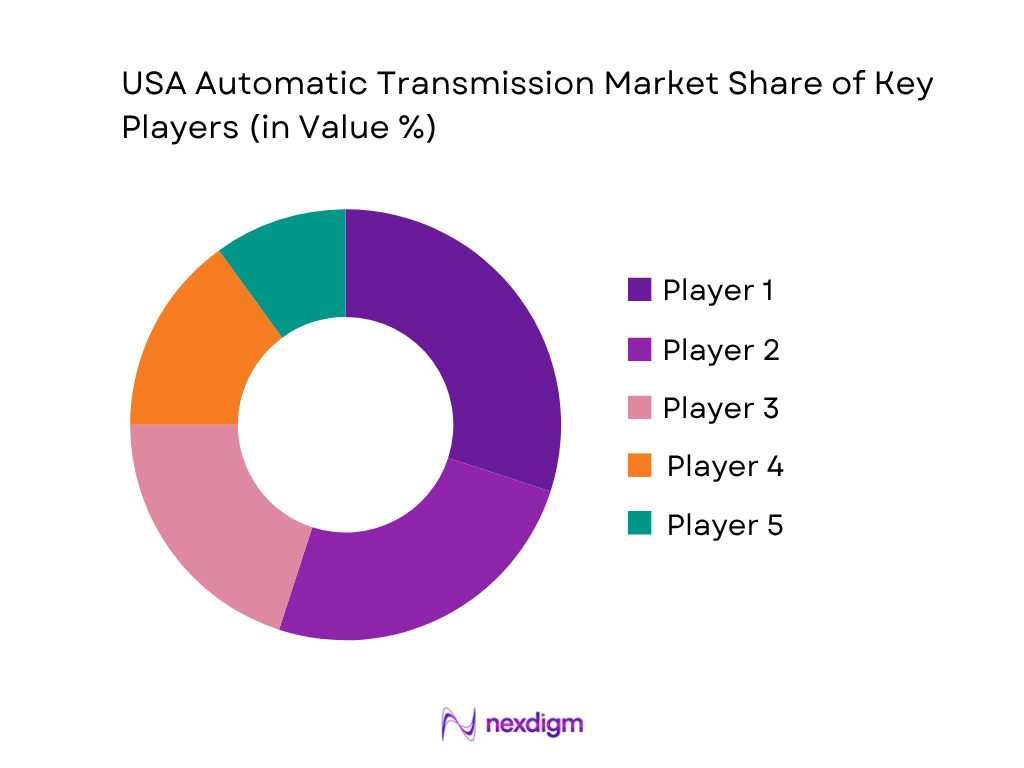
The USA Automatic Transmission Market is characterized by a combination of vertically integrated vehicle manufacturers and specialized Tier-1 transmission suppliers. General Motors and Ford maintain substantial captive powertrain capabilities, while Allison Transmission has a particularly strong position in medium- and heavy-duty fully automatic systems. Aisin, ZF and JATCO serve multiple OEM architectures across conventional, CVT and electrified powertrains. Competition increasingly depends on gear-ratio breadth, torque capacity, hybrid integration, electronic controls, OEM platform qualifications, domestic manufacturing presence and ability to support long vehicle-program cycles.
| Major Player | Establishment Year | Headquarters | Core Transmission Architecture | Key U.S. Vehicle Applications | High-Torque Capability | Hybrid / Electrified Capability | U.S. Manufacturing / Supply Position | Controls & Mechatronics Capability |
| Allison Transmission | 1915 | Indianapolis, Indiana, USA | ~ | ~ | ~ | ~ | ~ | ~ |
| ZF Friedrichshafen | 1915 | Friedrichshafen, Germany | ~ | ~ | ~ | ~ | ~ | ~ |
| Aisin Corporation | 1965 | Kariya, Japan | ~ | ~ | ~ | ~ | ~ | ~ |
| General Motors | 1908 | Detroit, Michigan, USA | ~ | ~ | ~ | ~ | ~ | ~ |
| Ford Motor Company | 1903 | Dearborn, Michigan, USA | ~ | ~ | ~ | ~ | ~ |
USA Automatic Transmission Market Analysis
Growth Drivers
Large Vehicle Production Base and Expanding High-Utilization Vehicle Fleet
The USA Automatic Transmission Market is supported by one of the world’s largest automotive production and operating fleets, generating substantial demand for torque-converter automatics, CVTs, hybrid transmissions, replacement units and transmission components. The United States produced 10.6 million motor vehicles in 2024, while vehicle sales reached 16.3 million units. Registered motor vehicles reached exactly 297,525,836 units in 2024, compared with 284,614,269 vehicles in 2023, creating a broad installed base requiring transmission servicing, remanufacturing, fluid replacement, valve-body repair and eventual unit replacement. Vehicle activity remained intensive, with U.S. motorists generating 3.294 trillion vehicle-miles traveled in 2024, compared with 3.247 trillion vehicle-miles in 2023. High utilization directly increases operating cycles for clutch packs, torque converters, bearings, pumps, solenoids and transmission control systems. U.S. 2024 GDP reached USD 28.75 trillion, while GDP per capita stood at USD 84,534, reflecting the economic scale supporting vehicle ownership and automotive aftermarket activity. Together, domestic vehicle production, an expanding vehicle parc and intensive road utilization create a durable demand foundation for automatic-transmission manufacturers, component suppliers, service providers and transmission remanufacturers.
SUV, Pickup and High-Torque Powertrain Demand Supporting Advanced Automatics
The structural preference of U.S. buyers for SUVs, pickups and other larger vehicles supports demand for advanced automatic transmissions engineered for higher torque, towing loads, four-wheel-drive integration and broad gear-ratio spreads. Average new-vehicle real-world fuel economy reached 27.2 miles per gallon in model year 2024, while truck-SUV fuel economy reached 25.7 miles per gallon, demonstrating continued engineering pressure to optimize drivetrain efficiency even as larger vehicles remain central to the U.S. automotive ecosystem. The country recorded 65,534,861 registered private and commercial trucks in 2024, compared with 62,103,995 in 2023, expanding the installed base for high-torque transmission systems. U.S. motor-vehicle production reached 10.6 million units in 2024, reinforcing domestic OEM demand for electronically controlled 8-speed, 10-speed and other advanced automatic architectures. The broader economic environment provides substantial purchasing and manufacturing capacity, with U.S. 2024 GDP reaching USD 28.75 trillion and GDP per capita standing at USD 84,534. These conditions favor transmission technologies capable of combining towing performance, launch response, thermal durability, highway efficiency and electronically optimized shifting across pickups, SUVs and commercial vehicles.
Market Challenges
Battery-Electric Powertrain Adoption Reducing Conventional Multi-Speed Transmission Content
The expansion of battery-electric vehicles represents a structural challenge for conventional automatic-transmission suppliers because many BEVs replace multi-speed torque-converter, CVT or dual-clutch systems with simplified single-speed reduction drives. California alone recorded 1,533,900 battery-electric light-duty vehicles in 2024, alongside 447,100 plug-in hybrid vehicles, illustrating the growing installed base of electrified vehicles in the country’s largest automotive market. Nationally, electricity consumption by light-duty battery-electric vehicles reached 14,289,717 megawatt-hours in 2024, compared with 10,273,843 megawatt-hours in 2023. Light-duty plug-in hybrid vehicles consumed another 3,510,497 megawatt-hours in 2024, demonstrating continued expansion of powertrains that reduce or fundamentally alter conventional automatic-transmission requirements. Battery-electric propulsion increasingly shifts drivetrain content toward reduction gears, integrated e-axles, traction motors and power electronics rather than traditional planetary multi-speed transmissions. This transition is occurring within an economy generating USD 28.75 trillion in GDP during 2024, meaning even gradual changes in propulsion architecture can affect substantial automotive manufacturing volumes. Transmission suppliers consequently face pressure to diversify toward hybrid transmissions, integrated electric drive systems, reduction gears, thermal-management components and electronic controls rather than relying predominantly on conventional automatic architectures.
Growing Mechatronic Complexity and a Large Aging Serviceable Vehicle Base
Automatic transmissions are becoming more difficult to diagnose, rebuild and service as hydraulic hardware is increasingly integrated with electronic control units, solenoids, sensors, adaptive shift algorithms and vehicle-network communication. This challenge is magnified by the enormous U.S. installed fleet. Registered motor vehicles reached 297,525,836 units in 2024, including 205,550,881 short-wheelbase light-duty vehicles and 65,534,861 long-wheelbase light-duty vehicles, while the national fleet recorded 3.294 trillion vehicle-miles traveled. Certain combination-truck categories averaged 55,276 miles per vehicle in 2024, intensifying thermal, clutch, bearing, fluid and hydraulic-system wear. Modern automatic transmissions increasingly require diagnostic scan tools, electronic valve-body testing, control-module programming, adaptive relearning and calibration procedures extending beyond traditional mechanical rebuilding. The challenge becomes particularly important as 8-speed, 9-speed, 10-speed, CVT and hybrid architectures coexist throughout the national fleet. The U.S. economy generated USD 28.75 trillion in GDP during 2024, while GDP per capita reached USD 84,534, supporting a substantial automotive-service ecosystem but also increasing expectations for technically sophisticated repair capabilities. The market therefore requires greater electronic diagnostic expertise, remanufacturing capability, specialized technicians and reliable availability of transmission-specific components.
Market Opportunities
Hybrid Powertrain Expansion Creating Demand for Dedicated and Integrated Transmissions
Hybridization provides a major future-growth pathway for the USA Automatic Transmission Market because hybrid vehicles continue to require sophisticated mechanical and electromechanical power-transfer systems even as conventional combustion-only platforms evolve. California recorded 1,895,100 hybrid electric vehicles in 2024, alongside 447,100 plug-in hybrid vehicles, demonstrating the scale already achieved by hybrid powertrains in a major U.S. automotive market. Nationally, electricity consumption from light-duty plug-in hybrids reached 3,510,497 megawatt-hours in 2024, compared with 2,938,157 megawatt-hours in 2023, and subsequently reached 4,191,600 megawatt-hours in 2025. This expanding electrified operating base creates opportunities for dedicated hybrid transmissions, power-split gearsets, integrated traction motors, multi-mode clutches, electric oil pumps, thermal-management systems and advanced control software. Hybrid architectures are particularly relevant for SUVs and pickups where manufacturers need to combine improved powertrain efficiency with driving range, towing capability and high torque availability. U.S. 2024 GDP reached USD 28.75 trillion, while GDP per capita stood at USD 84,534, supporting a large addressable base for technologically advanced vehicles. Current hybrid adoption therefore establishes a tangible platform from which transmission manufacturers can expand dedicated and integrated electrified transmission portfolios.
Replacement, Remanufacturing and Advanced Transmission Aftermarket Expansion
The scale and utilization of the U.S. vehicle fleet create a substantial future opportunity for remanufactured automatic transmissions, valve bodies, torque converters, solenoids, control modules, friction components and specialized service networks. Registered motor vehicles reached exactly 297,525,836 units in 2024, compared with 284,614,269 units in 2023. U.S. vehicles collectively traveled 3.294 trillion miles in 2024, compared with 3.247 trillion miles in 2023, while average travel across registered motor vehicles reached 11,071 miles per vehicle. These operating distances progressively accumulate wear on clutch packs, seals, pumps, bearings, torque converters and electronically controlled hydraulic systems, supporting replacement and rebuilding requirements as vehicles age. The opportunity is becoming more technologically intensive because the installed fleet increasingly contains 8-speed, 9-speed, 10-speed, CVT and hybrid transmission systems requiring specialized diagnostics, dynamometer testing, mechatronics servicing and software-compatible remanufacturing. U.S. automotive-parts exports reached approximately USD 85 billion in 2024, demonstrating the scale of the supporting component-production and distribution ecosystem. U.S. 2024 GDP reached USD 28.75 trillion, providing a broad macroeconomic foundation for automotive maintenance activity. Fleet scale, intensive mileage and established component infrastructure therefore create favorable conditions for advanced transmission remanufacturing and aftermarket specialization.
Future Outlook
The USA Automatic Transmission Market is expected to expand at an indicative ~X.X% CAGR during 2026–2035, supported by continued demand for SUVs, pickup trucks, commercial vehicles and hybrid powertrains. Market development will increasingly shift from simply adding transmission speeds toward optimizing complete powertrain efficiency through electronic controls, hybrid motors, thermal management, predictive shift calibration and low-friction components.
Conventional automatic transmissions will remain important in high-torque U.S. applications because pickups, large SUVs, commercial vans and vocational vehicles require significant launch performance, towing capability and durability. The proliferation of 8-speed and 10-speed architectures has already established a broad installed base that will generate both OEM and replacement demand over the forecast period. Hybridization represents one of the most important structural opportunities. Instead of eliminating transmissions entirely, full hybrids and plug-in hybrids create demand for dedicated hybrid transmissions, integrated electric motors, power-split architectures, multi-mode gearsets and sophisticated powertrain-control software. Toyota’s West Virginia facility is particularly relevant because it is the company’s only combined engine and transmission operation in North America and its only North American facility producing hybrid transaxles.
Major Players
- Allison Transmission Holdings, Inc.
- ZF Friedrichshafen AG
- Aisin Corporation
- JATCO Ltd.
- General Motors Company
- Ford Motor Company
- Honda Motor Co., Ltd.
- Toyota Motor Corporation
- Hyundai Transys Inc.
- Magna International Inc. / Magna Powertrain
- BorgWarner Inc.
- Eaton Corporation plc
- TREMEC Corporation
- Dana Incorporated
- American Axle & Manufacturing Holdings, Inc.
Key Target Audience
- Automotive OEMs and Vehicle Manufacturers
- Automatic Transmission and Powertrain System Manufacturers
- Transmission Component, Mechatronics and Control-System Suppliers
- Automotive Aftermarket, Transmission Remanufacturing and Rebuilding Companies
- Commercial Vehicle, Fleet and Vocational Vehicle Operators
- Automotive Powertrain Distributors and Replacement-Part Suppliers
- Investments and Venture Capitalist Firms
- Government and Regulatory Bodies (National Highway Traffic Safety Administration, U.S. Environmental Protection Agency, U.S. Department of Transportation, U.S. Department of Energy, U.S. Department of Commerce)
Research Methodology
Step 1: Identification of Key Variables
The initial phase involves developing an ecosystem map covering automatic-transmission manufacturers, vehicle OEMs, transmission component suppliers, control-system manufacturers, remanufacturers, distributors and fleet operators. The assessment identifies transmission architecture, gear count, vehicle type, propulsion technology, torque capacity, domestic manufacturing, OEM platform fitment and aftermarket replacement as core market variables influencing the USA Automatic Transmission Market.
Step 2: Market Analysis and Construction
Historical market construction uses both top-down and bottom-up approaches. Vehicle production, new-vehicle sales, transmission fitment, powertrain mix and commercial-vehicle activity are evaluated from the demand side, while transmission manufacturing, OEM captive production, Tier-1 supply and imports are analyzed from the supply side. These datasets are reconciled with replacement and remanufacturing activity to develop a comprehensive market structure.
Step 3: Hypothesis Validation and Expert Consultation
Market assumptions are validated through computer-assisted telephone interviews with transmission manufacturers, automotive OEM personnel, Tier-1 suppliers, transmission rebuilders, distributors and commercial-fleet stakeholders. Discussions focus on OEM sourcing, transmission platform life cycles, gear-speed migration, CVT adoption, hybrid integration, torque requirements, failure patterns, remanufacturing activity, electronic controls and supplier-selection criteria to refine the preliminary market model.
Step 4: Research Synthesis and Final Output
The final research stage triangulates vehicle-level demand with transmission production and supplier-level information. Bottom-up transmission volumes are reconciled with vehicle registrations, OEM manufacturing, imports, replacement activity and fleet requirements to minimize duplication. The resulting analysis provides market segmentation, technology evolution, competitive positioning, transmission architecture benchmarking, aftermarket dynamics and long-term opportunities across conventional automatic, CVT, hybrid and commercial-vehicle transmission systems.

- Executive Summary
- Research Methodology (Market Definition and Scope, USA Automatic Transmission Taxonomy, Transmission Architecture Mapping, Passenger and Commercial Vehicle Demand Mapping, OEM Fitment Assessment, Transmission Production Mapping, Gear-Speed Configuration Analysis, Torque Capacity Assessment, Powertrain Compatibility Assessment, Hybridization Mapping, Transmission Control Unit Assessment, Component-Level Demand Assessment, Domestic Production Assessment, Import-Export Assessment, Replacement and Remanufacturing Assessment, Market Sizing Framework)

- Definition and Scope
- USA Automatic Transmission Industry Evolution and Technology Development
- Automatic Transmission Manufacturing and Assembly Process
- Automatic Transmission Value Chain Analysis
- USA Automatic Transmission Supply Chain Analysis
- Transmission Component and Subsystem Ecosystem Analysis
- USA Automatic Transmission Domestic Production and Import Dependency Assessment
- OEM Transmission Platform Architecture and Powertrain Integration Framework

- Growth Drivers (High Pickup Truck and SUV Penetration, Expansion of Multi-Speed Automatic Transmission Fitment, Demand for Higher Torque Capacity, Hybrid Powertrain Integration, Commercial Vehicle Automatic Transmission Adoption, Fuel-Efficiency Optimization, Increasing Transmission Electronic Control Content, Growing Replacement and Remanufacturing Demand)
- Market Challenges (Battery Electric Vehicle Powertrain Substitution, Increasing Transmission System Complexity, High Mechatronic and Electronic Integration Requirements, OEM Platform Consolidation, Semiconductor and Control Module Supply Exposure, Transmission Repair Complexity, Skilled Rebuilder Availability, Warranty and Reliability Requirements)
- Market Opportunities (Hybrid Automatic Transmissions, Dedicated Hybrid Transmissions, High-Torque Pickup Transmission Systems, Commercial Vehicle Fully Automatic Transmissions, Integrated Transmission Thermal Management, Advanced Transmission Control Software, Remanufactured Automatic Transmissions, Low-Viscosity Transmission Fluid-Compatible Systems)
- Market Trends (8-Speed and 10-Speed Transmission Penetration, CVT Optimization, Hybridized Transmission Architectures, Shift-by-Wire Systems, Integrated Mechatronics, Predictive Transmission Controls, Connected Diagnostics, Low-Viscosity ATF Adoption)
- Regulatory and Standards Landscape (NHTSA Corporate Average Fuel Economy Requirements, EPA Light-Duty Vehicle Emissions Requirements, EPA Heavy-Duty Vehicle Emissions Requirements, Federal Motor Vehicle Safety Standards, California Air Resources Board Requirements, SAE Transmission Standards, Automatic Transmission Fluid Specifications, Diagnostic and On-Board Monitoring Requirements)
- SWOT Analysis
- Porter’s Five Forces Analysis
- PESTLE Analysis
- Stakeholder Ecosystem
- Competition Ecosystem

- By Market Value (2020-2025)
- By Transmission Unit Volume (2020-2025)
- By Domestic Production Volume (2020-2025)
- By Import Volume (2020-2025)
- By Export Volume (2020-2025)
- By OEM Fitment Volume (2020-2025)
- By Replacement Transmission Volume (2020-2025)
- By Remanufactured Transmission Volume (2020-2025)
- By Passenger Vehicle Transmission Volume (2020-2025)
- By Commercial Vehicle Transmission Volume (2020-2025)

- By Transmission Type (In Value %)
Conventional Torque-Converter Automatic Transmission
Continuously Variable Transmission
Dual-Clutch Transmission
Automated Manual Transmission
Hybrid Automatic Transmission
Dedicated Hybrid Transmission
Electric-Integrated Transmission
Heavy-Duty Fully Automatic Transmission
Other Advanced Automatic Transmission Architectures - By Number of Forward Speeds (In Value %)
4-Speed and Below Automatic Transmission
5-Speed Automatic Transmission
6-Speed Automatic Transmission
7-Speed Automatic Transmission
8-Speed Automatic Transmission
9-Speed Automatic Transmission
10-Speed Automatic Transmission
Above 10-Speed and Multi-Ratio Advanced Transmission
Continuously Variable Ratio Systems - By Vehicle Type (In Value %)
Passenger Cars
Crossovers and SUVs
Pickup Trucks
Minivans
Light Commercial Vehicles
Medium-Duty Trucks
Heavy-Duty Trucks
Transit Buses
School Buses
Motorcoaches
Off-Highway and Vocational Vehicles
Recreational Vehicles and Motorhomes
Defense and Specialty Vehicles - By Propulsion Type (In Value %)
Gasoline ICE Vehicles
Diesel ICE Vehicles
Full Hybrid Vehicles
Plug-In Hybrid Vehicles
Mild Hybrid Vehicles
Alternative-Fuel Vehicles
Range-Extended Electrified Vehicles
Electrified Commercial Vehicles with Integrated Transmission Systems - By Sales Channel (In Value %)
OEM Captive Supply
Tier-1 Transmission Supplier-to-OEM
Powertrain Module Supplier-to-OEM
Authorized Replacement Transmission Channel
Independent Automotive Aftermarket
Transmission Remanufacturers
Transmission Rebuilders
Dealer Service Networks
Fleet Maintenance Channels
Online Automotive Parts Channels - By Region (In Value %)
Midwest USA
Southeast USA
Southwest USA
West Coast USA
Northeast USA
Great Lakes Automotive Manufacturing Corridor
Southern Automotive Manufacturing Corridor
Texas Commercial Vehicle and Pickup Market
California Vehicle and Electrification Market

- Market Share of Major Players (By Revenue, Transmission Volume, Transmission Type, Vehicle Segment, Gear Count, OEM Customer, Domestic Production, Sales Channel)
- Cross Comparison Parameters (Automatic Transmission Architecture and Gear-Speed Portfolio, USA Manufacturing and Powertrain Plant Footprint, Passenger Vehicle and Light-Truck OEM Fitment Coverage, High-Torque Pickup and Commercial Vehicle Capability, CVT and Dual-Clutch Transmission Technology Capability, Hybrid and Dedicated Hybrid Transmission Readiness, Transmission Control Software and Mechatronics Capability, Aftermarket Service and Remanufacturing Network Strength)
- SWOT Analysis of Major Players
- Competitive Positioning Matrix
- Pricing and Aftermarket Distribution Network Benchmarking
- Detailed Profiles of Major Companies
Allison Transmission Holdings, Inc.
ZF Friedrichshafen AG
Aisin Corporation
JATCO Ltd.
General Motors Company
Ford Motor Company
Honda Motor Co., Ltd.
Toyota Motor Corporation
Hyundai Transys Inc.
Magna International Inc. / Magna Powertrain
BorgWarner Inc.
Eaton Corporation plc
TREMEC Corporation
Dana Incorporated
American Axle & Manufacturing Holdings, Inc.

- Buyer Segmentation
- OEM Procurement Behaviour
- Supplier Selection Criteria
- Buyer Pain Points
- Technology Adoption Assessment
- Replacement and Repurchase Behaviour

- By Market Value (2026-2035)
- By Transmission Unit Volume (2026-2035)
- By Domestic Production Volume (2026-2035)
- By Import Volume (2026-2035)
- By Export Volume (2026-2035)
- By OEM Fitment Volume (2026-2035)
- By Replacement Transmission Volume (2026-2035)
- By Remanufactured Transmission Volume (2026-2035)
- By Passenger Vehicle Transmission Volume (2026-2035)
- By Commercial Vehicle Transmission Volume (2026-2035)


 Request a Sample
 Ask for Customization
 Get a Quote
 Enquire Now