

 Download PDF
Market Overview
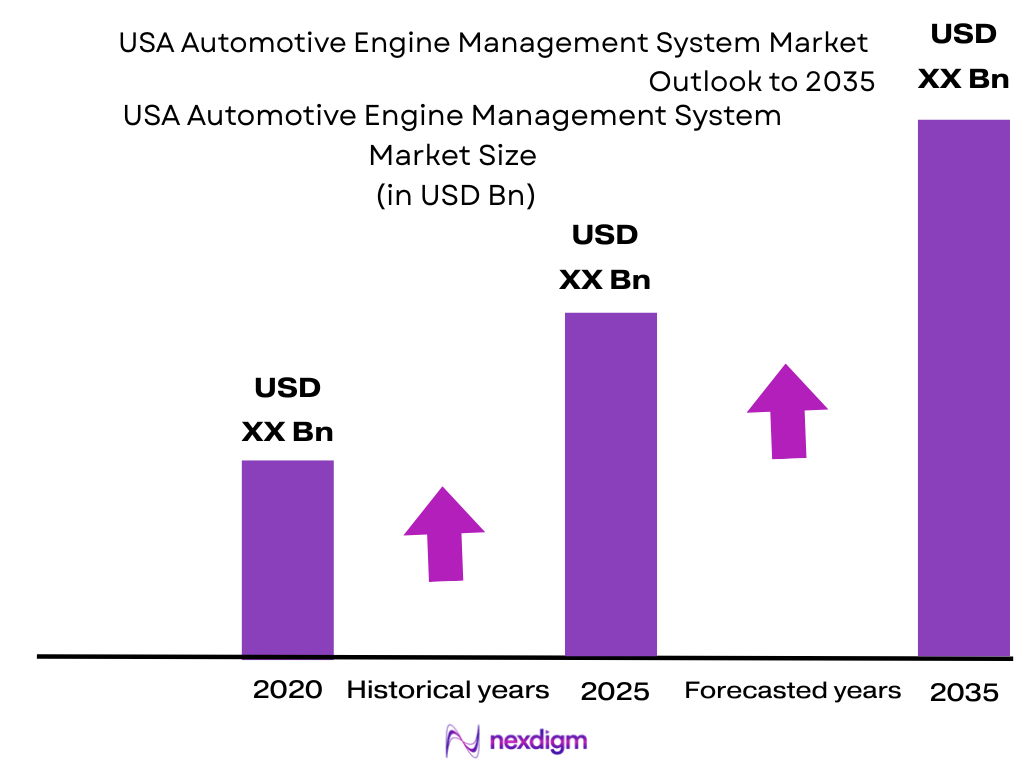
The USA Automotive Engine Management System Market is valued at ~ 18.6 billion, supported by a large combustion and hybrid vehicle base, increasingly complex fuel injection, turbocharging, sensor and powertrain-control architectures. New-vehicle real-world fuel economy moved from 27.1 mpg to 27.2 mpg, while associated CO₂ performance continued improving, demonstrating increasing reliance on precise electronic combustion management, air-fuel control, sensor feedback and powertrain software. Detroit-Auburn Hills-Southfield, the Southeast automotive corridor, Texas and California dominate the USA Automotive Engine Management System Market because these locations concentrate OEM engineering, Tier-1 powertrain suppliers, electronics development, vehicle production and advanced propulsion activity. National new-vehicle fuel economy moved from 27.1 mpg to 27.2 mpg, while hybrid sales reached nearly 1.2 million vehicles in the preceding comparable base, reinforcing investment in electronically controlled combustion and hybrid powertrains.
Market Segmentation
By Component Type
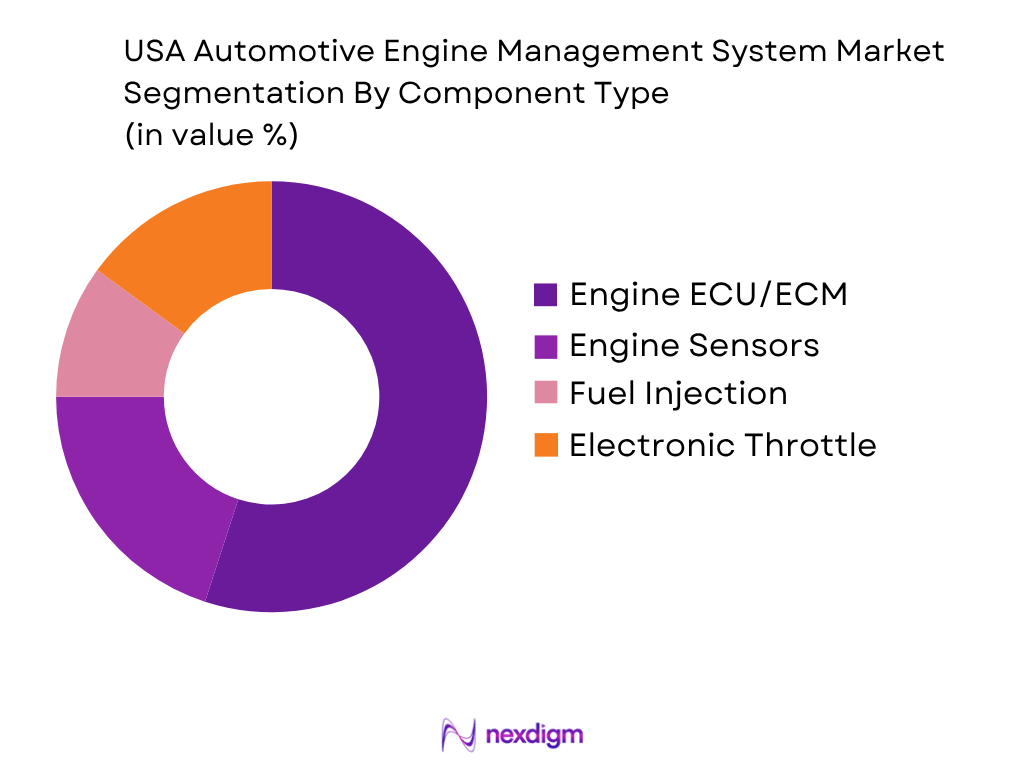
The USA Automotive Engine Management System Market is segmented into engine control units and powertrain control modules, engine sensors, fuel-injection components, ignition-management components, electronic throttle and air-management systems, and other actuators/control electronics. ECU/ECM and powertrain control modules dominate market value because virtually every gasoline, diesel and hybrid combustion platform requires a central controller to process sensor inputs and coordinate fuel supply, injection timing, ignition, airflow, torque output and exhaust functions. Bosch describes the engine ECU as the central engine-management controller spanning gasoline, diesel, flex-fuel, CNG, hydrogen and hybrid applications. DENSO likewise uses engine ECUs for precise injector timing and quantity control. Modern multicore processing, increased software content, hybrid coordination and communications integration increase the value captured by control modules compared with individual sensors.
By Powertrain Type
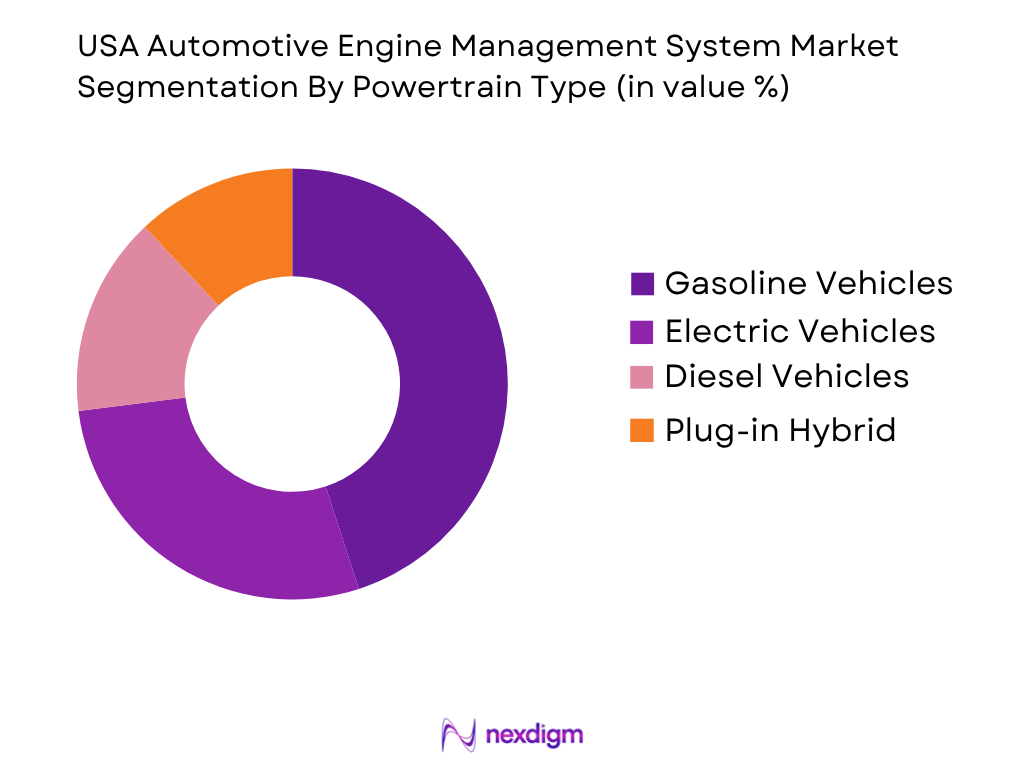
The USA Automotive Engine Management System Market is segmented into conventional gasoline, diesel, full-hybrid electric, plug-in hybrid and other combustion-based powertrains. Conventional gasoline powertrains dominate current demand because the installed light-duty vehicle population continues to rely heavily on gasoline engines requiring ECU control, oxygen sensing, electronic throttle management, fuel injection, ignition and emissions diagnostics. However, full hybrids are becoming particularly important because they retain the complete engine-management stack while adding supervisory controls linking the engine, traction motor, battery and transmission. DOE reported nearly 1.2 million hybrid-electric vehicle sales in its published U.S. baseline, demonstrating the growing scale of this technically richer powertrain category. Hybrid engine shutdown and restart also create additional calibration requirements around catalyst temperature, combustion stability and torque blending.
Competitive Landscape
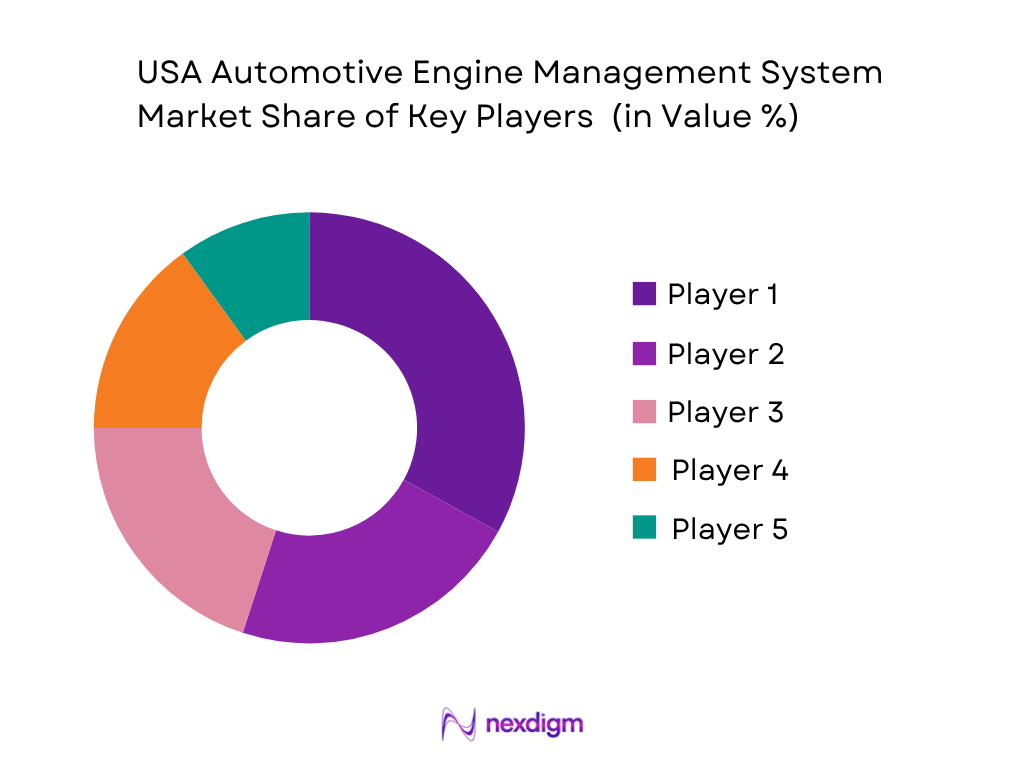
The USA Automotive Engine Management System Market includes global Tier-1 suppliers, fuel-system specialists, automotive electronics companies and large aftermarket manufacturers. Competitive advantage increasingly depends on the ability to combine ECU hardware, embedded software, gasoline and diesel fuel management, sensors, hybrid control, vehicle-platform integration and aftermarket diagnostics. Bosch and DENSO retain particularly broad engine-control portfolios, while PHINIA/Delphi is strongly positioned in fuel systems and aftermarket engine management. BorgWarner brings significant propulsion-system expertise, and Standard Motor Products has extensive exposure to the North American replacement-parts ecosystem.
| Major Player | Establishment | Headquarters | ECU / Control Capability | Engine Sensor Portfolio | Fuel-System Capability | Hybrid Capability | Aftermarket Presence | U.S. Strategic Position |
| Robert Bosch GmbH | 1886 | Gerlingen/Stuttgart, Germany | ~ | ~ | ~ | ~ | ~ | ~ |
| DENSO Corporation | 1949 | Kariya, Japan | ~ | ~ | ~ | ~ | ~ | ~ |
| BorgWarner Inc. | 1928 | Auburn Hills, Michigan | ~ | ~ | ~ | ~ | ~ | ~ |
| PHINIA Inc. / Delphi | 2023 as independent company | Auburn Hills, Michigan | ~ | ~ | ~ | ~ | ~ | ~ |
| Standard Motor Products | 1919 | Long Island City, New York | ~ | ~ | ~ | ~ | ~ | ~ |
USA Automotive Engine Management System Market Analysis
Growth Drivers
Tightening Federal Fuel-Economy and Emissions Requirements
Federal fuel-economy and emissions regulation is a major demand driver for the USA Automotive Engine Management System Market because compliance increasingly depends on tightly integrated ECUs, fuel-injection controls, electronic throttle systems, oxygen sensors, exhaust-temperature sensors, turbocharger actuators and embedded calibration software. In June 2024, NHTSA finalized fuel-economy standards that place the light-duty fleet on a path toward approximately 50.4 miles per gallon, requiring manufacturers to extract more efficiency from each combustion and hybrid powertrain. EPA also finalized its multi-pollutant standards in March 2024 for model-year 2027 and later light- and medium-duty vehicles, tightening the regulatory framework around greenhouse gases and other tailpipe pollutants. These requirements directly increase engine-management sophistication because the ECU must continuously coordinate injection timing, fuel pressure, ignition advance, air-fuel ratio, variable valve timing, cylinder deactivation, EGR operation, turbocharger boost and aftertreatment temperature. EPA’s current Automotive Trends reporting specifically identifies turbocharging and gasoline direct injection as key efficiency technologies and notes growing use of systems capable of switching between direct and port injection according to engine operating conditions. This architecture requires more sensor feedback, higher microcontroller processing capability and increasingly complex software maps than traditional port-injected naturally aspirated engines. Hybrid vehicles create another control layer because the combustion engine must restart quickly after electric-only operation while maintaining torque continuity and catalyst effectiveness. The macroeconomic base supporting these investments remains substantial. World Bank data show the U.S. economy reached USD 30.77 trillion in 2025, while GDP per capita reached USD 90,026.5, providing an economic environment capable of sustaining large automotive R&D and electronics investment. The IMF reports projected U.S. real GDP growth of 2.3 in 2026 and a population of 342.942 million, reinforcing the scale of the underlying vehicle and mobility economy. For engine-management suppliers, regulatory pressure therefore translates into rising value per applicable combustion vehicle rather than simply higher ECU unit counts. An engine controller increasingly acts as a real-time propulsion manager that interprets dozens of sensor signals, controls multiple actuators and coordinates with transmission, hybrid, thermal and emissions subsystems. Future differentiation will depend on faster processing, better sensor fusion, adaptive combustion strategies, secure calibration updates and precise emissions diagnostics. As federal standards become more demanding, OEMs have less tolerance for loosely integrated components, favoring suppliers capable of delivering complete control architectures rather than standalone sensors or modules.
Hybridization and Increasing Electronic Content per Combustion Powertrain
Hybridization is another strong growth driver because hybrid-electric vehicles retain an internal-combustion engine while adding significantly more control complexity around torque blending, regenerative braking, battery state, engine restart and thermal management. The U.S. Department of Energy reported in May 2024 that hybrid-electric vehicle sales had reached nearly 1.2 million vehicles in the latest published annual baseline, establishing hybrids as a major powertrain category rather than a niche alternative. Unlike a battery-electric vehicle, a conventional hybrid still requires an engine ECU, fuel injectors, crankshaft and camshaft position sensors, oxygen sensors, electronic throttle control, ignition coils, fuel-pressure sensing and catalyst monitoring. However, it also needs supervisory logic deciding when the engine should operate, how much torque it should deliver, when it should shut down and how it should coordinate with an electric traction motor. These additional functions increase software and processing value per vehicle. A hybrid engine may start and stop many times during one urban drive cycle, forcing engine-management software to achieve smooth combustion initiation, rapid lubricant pressure recovery, emissions control and imperceptible torque transfer. Frequent engine-off periods can cool the exhaust system, so the ECU must also manage catalyst temperature through ignition timing, engine loading and restart strategy. EPA technology reporting shows that modern U.S. powertrains increasingly combine turbocharging, gasoline direct injection and advanced hybrid technologies, meaning the same vehicle can require simultaneous management of high-pressure injection, boost pressure and electrified propulsion. This creates opportunities for more capable powertrain control modules and domain controllers that replace historically separate engine, transmission and hybrid-control modules with integrated computing platforms. The broader economic environment remains supportive of such technology investment. World Bank data report U.S. nominal GDP of USD 30.77 trillion in 2025 and GDP per capita of USD 90,026.5, while the IMF projects real GDP expansion of 2.3 in 2026. The IMF also places the U.S. population at 342.942 million, indicating a large consumer and mobility base able to support multiple powertrain technologies simultaneously. For engine-management vendors, hybridization is strategically important because it delays complete removal of combustion electronics while increasing their technical complexity. Suppliers can capture value in rapid-restart control, low-temperature emissions calibration, torque arbitration, integrated thermal management, cylinder-level combustion correction and hybrid-specific diagnostics. The opportunity is especially attractive for suppliers capable of providing both hardware and embedded software, because calibration becomes inseparable from hardware performance as propulsion functions become more tightly integrated. Consequently, the growth of hybrids does not merely preserve the existing engine-management market; it moves it toward higher-value electronic architectures with more semiconductor content, software layers and cross-domain communication.
Market Challenges
Battery-Electric Vehicle Adoption Removing Conventional Engine-Management Content
Battery-electric vehicle expansion is the largest structural challenge to the USA Automotive Engine Management System Market because a BEV removes the internal-combustion engine and therefore eliminates most traditional engine-management components. U.S. electric-car sales reached approximately 1.6 million units in 2024, creating a growing pool of vehicles that do not require fuel injectors, ignition coils, crankshaft sensors, camshaft sensors, knock sensors, mass-air-flow sensors, electronic throttle systems or combustion-focused ECUs. DOE data also show that annual U.S. light-duty EV sales had already exceeded 1 million vehicles in the preceding annual baseline, while plug-in hybrid sales exceeded 250,000 vehicles, demonstrating that electrified propulsion had moved well beyond early adoption before 2024. The distinction between BEVs and PHEVs is critical for engine-management suppliers: PHEVs preserve substantial combustion-control content, while BEVs eliminate it completely. A gasoline vehicle can carry an engine ECU, several oxygen sensors, high-pressure fuel hardware, throttle control, ignition electronics and numerous pressure and position sensors; a BEV replaces these with battery-management systems, inverters and electric motor controllers. This substitution shifts electronics value to different product categories and threatens suppliers concentrated in combustion-specific modules. EPA’s technology reporting shows increasing electrification within mainstream vehicle categories, indicating that the threat is not confined to specialty or premium models. The challenge is particularly serious for high-volume replacement components. Every BEV entering the fleet not only removes an original engine ECU but also eliminates future aftermarket replacement demand for injectors, ignition coils, oxygen sensors, MAF sensors and engine-related control electronics across that vehicle’s life. The macroeconomic environment suggests that this substitution is structural rather than merely cyclical. World Bank data show U.S. GDP at USD 30.77 trillion in 2025, while the IMF reports a 342.942 million population and projected 2.3 real GDP growth in 2026. In other words, electrification is occurring within a large functioning economy capable of funding new propulsion technologies rather than because conventional vehicle demand has collapsed. Suppliers therefore need to manage a difficult technology transition. They must continue servicing hundreds of millions of existing combustion and hybrid vehicles while developing products for hybrid supervisory control, power electronics, domain computing and thermal management. This creates duplicated engineering requirements and potentially stranded manufacturing assets if conventional ECU volumes decline faster than expected. Standalone ECU vendors face an additional architectural risk because software-defined vehicles are moving toward centralized computing, potentially reducing module counts even on combustion and hybrid platforms. The companies best positioned to manage this challenge will be those able to migrate from narrow engine-control hardware toward integrated propulsion electronics without abandoning the large legacy ICE aftermarket.
Semiconductor Dependence and Shortage of Advanced Diagnostic Skills
The increasing semiconductor intensity of engine-management systems creates both supply-chain and service challenges. Modern engine ECUs depend on automotive microcontrollers, power-management ICs, analog interfaces, memory, communication transceivers and high-current drivers capable of controlling fuel injectors, ignition coils, throttle actuators and turbocharger systems in real time. The strategic importance of automotive chip supply was demonstrated in 2024, when the U.S. Department of Commerce awarded GlobalFoundries up to USD 1.5 billion in CHIPS incentives to expand semiconductor manufacturing for sectors including automotive and defense. Commerce also advanced multiple semiconductor-production and packaging investments during 2024–2025, reflecting the need to strengthen domestic supply resilience for critical electronics. Engine-management suppliers cannot freely substitute commercial consumer chips during shortages because automotive electronics face demanding temperature, vibration, durability, functional-safety and lifecycle requirements. Microcontroller changes can require extensive software revalidation and vehicle testing, making redesign expensive and slow even when alternate chips are technically available. The second challenge appears downstream in vehicle diagnostics. Engine-management faults increasingly span mechanical, electrical and software systems. A single drivability problem can originate from injector behavior, fuel pressure, crankshaft timing, oxygen sensing, wiring resistance, ECU software or a mechanical engine condition. BLS projects approximately 70,000 automotive service technician and mechanic openings each year over the 2024–2034 period, highlighting the continuing need to replenish technical labor across the U.S. service ecosystem. Modern technicians also need capabilities far beyond traditional mechanical repair: CAN diagnostics, bidirectional scan-tool use, oscilloscope interpretation, GDI pressure testing, wideband oxygen-sensor diagnosis, hybrid-system awareness, ECU programming and software-based calibration procedures are becoming routine. An incorrectly diagnosed ECU can lead to unnecessary module replacement, while many replacement modules require VIN programming, immobilizer pairing or calibration downloads before the vehicle can operate properly. The broader U.S. economy increases the scale of this challenge. World Bank data place nominal GDP at USD 30.77 trillion in 2025 and GDP per capita at USD 90,026.5, while the IMF projects 2.3 real GDP growth in 2026. These figures indicate that demand for complex vehicle electronics is supported by a high-value economy, but the corresponding technician and semiconductor ecosystems must scale accordingly. For suppliers, semiconductor resilience increasingly requires multi-source architectures, long-term foundry relationships and modular hardware designs. On the service side, manufacturers and distributors need training, remote diagnostic support, software-guided fault isolation and reliable technical databases. The issue is therefore not simply component availability; it is the growing interdependence of semiconductor supply, embedded software and technical service capability throughout the engine-management lifecycle.
Market Opportunities
Software-Defined Powertrain Control, Advanced Sensors and Integrated Domain Controllers
The migration toward software-defined vehicles creates a major future opportunity for U.S. engine-management suppliers because value is shifting from standalone hardware toward integrated powertrain software, high-performance control units and intelligent sensors. EPA reporting emphasizes turbocharging, gasoline direct injection and combined direct-port injection as important technologies in modern U.S. powertrains. Each of these systems increases control requirements. GDI needs precise rail-pressure management, high-current injector control and injection timing measured in extremely short crank-angle windows; turbocharged engines need electronic wastegate or variable-geometry control, boost-pressure sensing and knock protection; combined direct-port systems require software capable of allocating fuel between two injector architectures according to load, temperature and emissions conditions. Federal efficiency requirements further increase the value of these capabilities. NHTSA’s 2024 rule places the light-duty fleet on a trajectory toward approximately 50.4 mpg, while EPA finalized multi-pollutant standards for model-year 2027 and later vehicles. These regulations create incentives for predictive combustion control, cylinder-specific correction, advanced thermal management and more sophisticated diagnostic monitoring. The emerging architecture is increasingly domain-based: instead of one small ECU handling only the engine, a high-performance controller can coordinate engine torque, transmission operation, hybrid motor contribution, exhaust temperature and thermal systems. This raises semiconductor content per controller even if the total number of controllers eventually declines. Smart sensors represent another opportunity. Pressure, oxygen, temperature and position sensors can increasingly incorporate signal processing, self-diagnostics and digital communication, moving value away from simple analog measurement. The domestic semiconductor investment cycle supports this shift. U.S. Department of Commerce semiconductor incentives included up to USD 1.5 billion for GlobalFoundries in 2024 and additional support for advanced packaging capacity, creating a stronger domestic ecosystem for automotive-grade processing and analog devices. Macroeconomic conditions support long-term development: World Bank data place U.S. GDP at USD 30.77 trillion in 2025, while the IMF projects 2.3 real GDP growth in 2026 and lists a population of 342.942 million. The opportunity for suppliers is therefore to move beyond selling ECUs as fixed hardware. Recurring value can come from calibration software, diagnostics, secure over-the-air updates, cybersecurity maintenance and platform-level engineering. Companies capable of combining microcontrollers, embedded software, sensor fusion and OEM calibration knowledge can become deeply integrated into vehicle development programmes. This model also provides some protection from BEV substitution because domain-control and software expertise can eventually migrate into broader electrified propulsion architectures. Engine-management companies that successfully reposition themselves as propulsion-control technology providers rather than combustion-module suppliers will therefore capture more durable value through the technology transition.
Hybrid Powertrain Management and the Large High-Age ICE Aftermarket
The coexistence of increasing hybrid adoption and a very large ageing combustion-vehicle fleet creates a substantial opportunity for engine-management suppliers across both OEM and replacement channels. DOE reported nearly 1.2 million hybrid-electric vehicle sales in its published 2024 baseline document, indicating that hybrids have already achieved significant scale in the United States. Hybrids preserve conventional engine-management hardware while requiring additional control functions. The engine ECU must coordinate with a traction motor, battery and transmission, determine optimal engine restart points, manage catalyst temperature after engine-off periods and deliver seamless torque transitions during acceleration and regenerative braking. This favors higher-performance processors and more sophisticated software than conventional engine-only architectures. The aftermarket opportunity is structurally different but equally important. The United States has a mature vehicle fleet with large numbers of gasoline and diesel vehicles remaining in service for extended periods. As these vehicles age, engine-management components experience thermal cycling, vibration, corrosion and electrical degradation, generating recurring demand for oxygen sensors, crankshaft sensors, camshaft sensors, throttle bodies, MAF sensors, fuel injectors, ignition coils and remanufactured control modules. BLS projections of 70,000 automotive technician openings annually through the 2024–2034 period indicate the scale of the service ecosystem needed to maintain this fleet. ECU remanufacturing is particularly attractive because many older vehicles remain mechanically serviceable after original control modules become unavailable or uneconomic through dealer channels. A remanufactured ECU can involve printed-circuit-board repair, replacement of failed output drivers, memory correction, calibration reflashing, VIN programming and immobilizer pairing, allowing older vehicles to remain operational without a newly manufactured OEM module. The aftermarket also benefits from increasingly sophisticated e-commerce and application lookup, enabling distributors to carry vehicle-specific sensors and modules across a broad national parc. Macroeconomic fundamentals support maintenance spending even as households simultaneously adopt newer electrified vehicles. World Bank data show nominal GDP of USD 30.77 trillion in 2025 and GDP per capita of USD 90,026.5, while the IMF projects 2.3 real GDP growth in 2026. This allows the U.S. market to sustain two parallel powertrain economies: advanced hybrids and newer software-defined vehicles at the OEM end, and a large ageing combustion fleet in the replacement channel. Suppliers that maintain broad legacy application coverage while investing in hybrid supervisory control can therefore diversify transition risk. The strategic opportunity is strongest for companies able to supply both OE-level electronics and aftermarket diagnostic support, because they can monetize engine-management content from initial vehicle production through sensor replacement, ECU remanufacturing and high-mileage fleet maintenance. This dual-track market structure should keep engine-management demand commercially relevant even as BEV penetration progressively reduces new conventional-ICE fitment.
Future Outlook
The USA Automotive Engine Management System Market is forecast to expand at ~ CAGR during 2026–2035 under the requested placeholder framework. Growth will increasingly come from system complexity rather than a straightforward increase in the number of combustion engines. Hybridization, high-pressure gasoline injection, turbocharging, advanced sensing, tighter emissions control and software-defined powertrain architectures will increase electronic content on surviving combustion platforms. Federal efficiency requirements are pushing powertrains toward increasingly precise electronic management. EPA reports record model-year 2024 real-world fuel economy of 27.2 mpg, compared with 27.1 mpg previously. Modern control systems must synchronize injection quantity and timing, ignition advance, electronic throttle position, turbocharger boost, valve timing, exhaust temperature and emissions aftertreatment while continuously adapting to driver demand and operating conditions. Gasoline direct injection and combined direct-port injection are important technology opportunities. EPA explicitly tracks direct injection and combined gasoline direct/port systems as major efficiency technologies. These architectures require high-pressure pumps, rail-pressure sensing, more sophisticated injector drivers and closed-loop ECU calibration, increasing electronic and software content per engine.
Hybridization is likely to provide one of the strongest defensible demand pools. DOE reported that hybrid-electric vehicle sales reached nearly 1.2 million units in its published U.S. baseline. Unlike BEVs, hybrids continue to require the complete engine-management architecture—ECU, injectors, ignition, crank/cam sensing, airflow measurement, oxygen sensing and exhaust management—while also requiring coordination with the traction motor and battery. Engine-management architecture itself will shift. Bosch’s current ECU platform can control gasoline, diesel, flex-fuel, CNG, ethanol, hydrogen and hybrid topologies while integrating transmission and wider vehicle functions. Its vehicle-control architecture can also coordinate engine, transmission, inverter and battery-management functions. This demonstrates the direction of travel from isolated engine ECUs toward integrated powertrain or vehicle-domain controllers. DENSO follows a similarly integrated approach. Its engine ECU analyses injector electrical waveforms to adjust individual injection quantity and timing, while its hybrid portfolio combines engine control, injection hardware and crankshaft sensing. The competitive battleground is therefore moving beyond controller hardware toward control algorithms, semiconductor processing, calibration accuracy and vehicle-level software integration. The largest structural risk is battery-electric substitution. U.S. electric-car sales reached approximately 1.6 million units in 2024. A BEV eliminates traditional fuel injectors, ignition coils, throttle-based combustion control, engine crank/cam sensing, lambda sensing and the combustion-engine ECU, transferring electronic content toward battery, inverter and electric-motor controllers instead.
Major Players
- Robert Bosch GmbH / Bosch Mobility
- DENSO Corporation
- AUMOVIO
- PHINIA Inc. / Delphi
- BorgWarner Inc.
- Schaeffler Group
- Astemo Ltd.
- Marelli
- Valeo
- Aptiv PLC
- Standard Motor Products, Inc.
- Sensata Technologies
- Infineon Technologies
- NXP Semiconductors
- Texas Instruments
Key Target Audience
- Automotive OEMs and Vehicle Manufacturers
- Automotive Tier-1 and Tier-2 Powertrain Suppliers
- Engine ECU, Sensor and Fuel-System Manufacturers;
- Automotive Semiconductor and Embedded Electronics Companies
- Automotive Parts Distributors and ECU Remanufacturing Networks
- Commercial Fleet and Vehicle Maintenance Operators
- Investments and Venture Capitalist Firms
- Government and Regulatory Bodies (U.S. Environmental Protection Agency, National Highway Traffic Safety Administration, U.S. Department of Energy, U.S. Department of Commerce)
Research Methodology
Step 1: Identification of Key Variables
The initial phase constructs an ecosystem map covering automotive OEMs, ECU suppliers, engine-sensor manufacturers, fuel-injection companies, semiconductor vendors, Tier-1 powertrain suppliers, aftermarket distributors and ECU remanufacturers. The principal variables include vehicle parc, powertrain mix, ECU content, sensors per vehicle, fuel-delivery architecture, hybrid penetration, vehicle age and replacement frequency.
Special attention is given to GDI, combined direct-port injection, turbocharging, hybrid powertrains and centralized controller architecture because these technologies materially alter electronic content per vehicle. EPA and DOE technology classifications provide the foundation for mapping the powertrain transition.
Step 2: Market Analysis and Construction
The top-down analysis begins with the U.S. light-duty and commercial vehicle base and allocates engine-management demand across gasoline, diesel, HEV, PHEV and alternative-fuel powertrains. Battery-electric vehicles are excluded from conventional combustion-engine management while retained separately as a substitution factor.
Bottom-up modelling analyzes ECU shipments, sensor content, injectors, throttle-control components, ignition electronics, OEM production, aftermarket replacements and remanufactured modules. Vehicle-specific component penetration is triangulated against supplier product portfolios and prevailing powertrain architectures.
Step 3: Hypothesis Validation and Expert Consultation
Market hypotheses are validated through computer-assisted telephone interviews with OEM powertrain teams, Tier-1 suppliers, electronics manufacturers, fuel-system specialists, independent distributors, repair workshops and ECU remanufacturers.
The consultations test assumptions concerning ECU replacement cycles, sensor failures, direct-injection content, hybrid-control architecture, semiconductor availability, calibration complexity, OBD-II diagnostics, software integration and the speed at which BEVs displace combustion-specific electronic content.
Step 4: Research Synthesis and Final Output
The final stage reconciles top-down vehicle and powertrain indicators with bottom-up component-level data. Demand is segmented by component, powertrain, vehicle class, injection technology, control architecture, sales channel, vehicle age and region.
Forecast scenarios incorporate federal efficiency requirements, GDI penetration, hybrid adoption, BEV substitution, vehicle ageing, semiconductor availability, ECU consolidation, software-defined vehicle architecture and the shift from hardware-centric engine management toward integrated powertrain control.

- Executive Summary
- Research Methodology (Market Definitions and Assumptions, Abbreviations, Engine Management System Market Boundary, Vehicle-Parc Mapping, Powertrain Mapping, ECU-per-Vehicle Assessment, Sensor Content Assessment, Gasoline-Diesel-Hybrid Architecture Mapping, OEM Fitment Analysis, Replacement Cycle Assessment, Vehicle Age Analysis, EPA Technology Mapping, OBD-II Failure Mapping, Market Sizing Approach, Top-Down Analysis, Bottom-Up Analysis, Demand-Side Assessment, Supply-Side Assessment, OEM-Tier-1-Distributor-Workshop Interviews, Data Triangulation, Forecasting Framework, Technology Substitution Scenarios, Limitations and Future Conclusions)

- Definition and Scope
- Evolution of Electronic Engine Management in the United States
- Transition from Electronic Fuel Injection to Integrated Powertrain Control
- Evolution of OBD-II Engine Diagnostics
- Engine Control Architecture Evolution
- Gasoline Engine Management Ecosystem

- Growth Drivers (Federal Fuel-Economy Requirements, Multi-Pollutant Emission Compliance, Hybrid Powertrain Adoption, GDI Penetration, Turbocharged Engine Adoption, Increasing Sensor Content, Ageing ICE Vehicle Parc, Software-Defined Powertrain Integration)
- Market Challenges (Battery-Electric Vehicle Substitution, Semiconductor Dependence, ECU Software Complexity, Cybersecurity Exposure, Skilled Diagnostic Technician Availability, Legacy ECU Support, Calibration Fragmentation, OEM Software Access)
- Market Opportunities (Hybrid Supervisory Control, Domain-Controlled Powertrains, Smart Sensors, GDI Engine Management, Advanced Diagnostics, Remanufactured ECUs, Predictive Maintenance, Hydrogen and Alternative-Fuel Engine Control)
- Market Trends (Combined Direct-Port Injection, Multicore ECUs, AUTOSAR Adoption, Centralized Computing, OTA Calibration, Smart Sensors, Torque-Based Control, Cloud-Connected Diagnostics)
- Technology Substitution Risk (Battery-Electric Vehicles, Centralized Vehicle Compute, Integrated Domain Controllers, Reduced Standalone ECU Count, Electrified Commercial Vehicles)
- SWOT Analysis
- Porter’s Five Forces Analysis
- PESTLE Analysis

- By Market Value (2020-2025)
- By Engine Management System Unit Volume (2020-2025)
- By Engine ECU/ECM Volume (2020-2025)

- By Component Type (In Value %)
Engine Control Unit / Engine Control Module
Powertrain Control Module
Fuel Injectors
High-Pressure Fuel Pumps
Fuel-Rail Pressure Sensors - By Vehicle Type (In Value %)
Passenger Cars
Crossovers and SUVs
Pickup Trucks
Minivans and MPVs
Light Commercial Vehicles - By Powertrain Type (In Value %)
Conventional Gasoline Vehicles
Conventional Diesel Vehicles
Full Hybrid Electric Vehicles
Plug-in Hybrid Electric Vehicles
Mild Hybrid Vehicles - By Application (In Value %)
Fuel Injection Management
Ignition Management
Air-Path Management
Electronic Throttle Management
Turbocharger and Boost Management - By Region (In Value %)
Northeast
Midwest
South
West

- Market Share of Major Players by Value
- Cross Comparison Parameters (Engine ECU/Powertrain Controller Portfolio Breadth, Gasoline-Diesel-Hybrid Powertrain Coverage, GDI/Common-Rail Fuel-System Capability, Engine Sensor and Actuator Portfolio Depth, Embedded Software-AUTOSAR-Calibration Capability, U.S. OEM and Vehicle-Platform Coverage, Aftermarket Diagnostics-Distribution-Remanufacturing Reach, Semiconductor and Software-Defined Powertrain Integration Capability)
- SWOT Analysis of Major Players
- Detailed Profiles of Major Companies
Robert Bosch GmbH / Bosch Mobility
DENSO Corporation
AUMOVIO
PHINIA Inc. / Delphi
BorgWarner Inc.
Schaeffler Group
Astemo Ltd.
Marelli
Valeo
Aptiv PLC
Standard Motor Products, Inc.
Sensata Technologies
Infineon Technologies
NXP Semiconductors
Texas Instruments

- Passenger Vehicle OEM Procurement
- Pickup and SUV OEM Procurement
- Commercial Vehicle OEM Procurement
- Hybrid Vehicle OEM Procurement
- Tier-1 Powertrain Supplier Procurement

- By Market Value (2026-2035)
- By Engine Management System Unit Volume (2026-2035)
- By Engine ECU/ECM Volume (2026-2035)


 Request a Sample
 Ask for Customization
 Get a Quote
 Enquire Now