

 Download PDF
 Download PDF
Market Overview
The USA Engine Oils market is valued at approximately ~ billion USD, driven by the growing demand for high-performance oils across the automotive and industrial sectors. This demand is largely attributed to rising vehicle production, increasing fleet size, and the shift towards synthetic oils due to their superior performance and efficiency. Furthermore, technological advancements in engine design and the emphasis on fuel efficiency are contributing to the market’s robust growth. Consumer preference for longer-lasting and more efficient oils has also boosted market dynamics.
The USA is home to a large concentration of automotive manufacturing plants, with cities like Detroit and regions such as California driving the demand for engine oils. These areas are recognized for their industrial infrastructure, automotive companies, and high vehicle ownership rates. Additionally, cities with growing logistics and manufacturing industries, such as Houston and Chicago, also significantly contribute to market growth. The dominance of these cities is attributed to their large-scale industrial activities and the high rate of commercial vehicle use, which increases engine oil consumption.

Market Segmentation
By Product Type
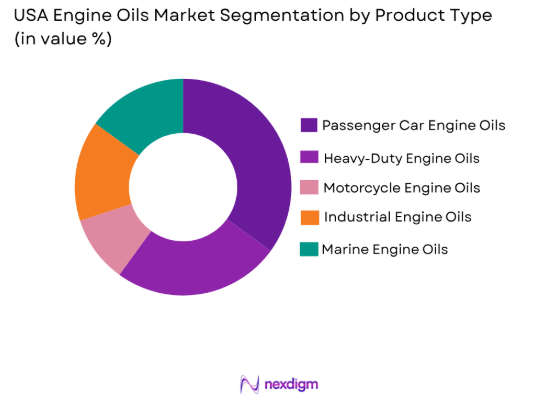
USA Engine Oils market is segmented by product type into passenger car engine oils, heavy-duty engine oils, motorcycle engine oils, industrial engine oils, and marine engine oils. Recently, passenger car engine oils have dominated the market share due to increasing vehicle production and consumer preference for oil products that enhance vehicle efficiency and performance. The growing awareness about the benefits of synthetic oils, along with advancements in engine technology, has led to increased demand in the passenger car segment, cementing its position as a dominant sub-segment.
By Platform Type
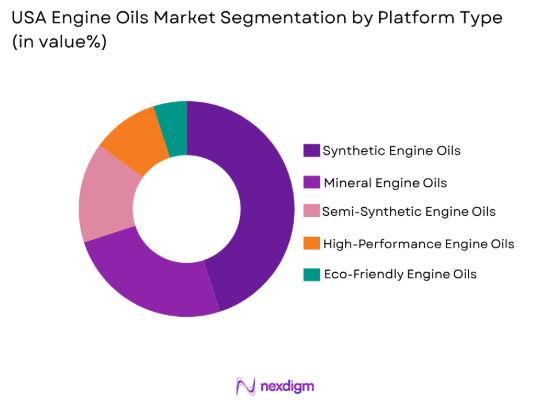
USA Engine Oils market is segmented by platform type into synthetic engine oils, mineral engine oils, semi-synthetic engine oils, high-performance engine oils, and eco-friendly engine oils. Among these, synthetic engine oils have emerged as the dominant sub-segment, owing to their superior performance, longer oil change intervals, and improved fuel efficiency. The rising adoption of synthetic oils by both consumer and commercial vehicle owners has bolstered their market share, making them the preferred choice across various sectors.
Competitive Landscape
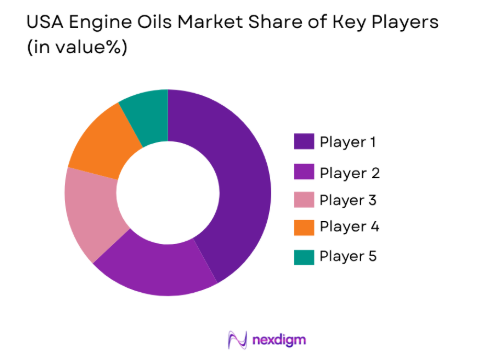
The competitive landscape of the USA Engine Oils market is highly dynamic, with leading global brands dominating the industry. Market consolidation is evident as major players continue to expand their product portfolios and technological capabilities. These companies leverage extensive distribution networks, brand recognition, and customer loyalty to maintain a competitive edge. In addition, the ongoing focus on developing high-performance and eco-friendly engine oils further intensifies competition within the sector.
| Company Name | Establishment Year | Headquarters | Technology Focus | Market Reach | Key Products | Revenue (USD) | Additional Parameter |
| ExxonMobil | 1870 | Irving, Texas | ~ | ~ | ~ | ~ | ~ |
| Shell | 1907 | The Hague, NL | ~ | ~ | ~ | ~ | ~ |
| Chevron | 1879 | San Ramon, CA | ~ | ~ | ~ | ~ | ~ |
| BP | 1908 | London, UK | ~ | ~ | ~ | ~ | ~ |
| Castrol | 1899 | Pangbourne, UK | ~ | ~ | ~ | ~ | ~ |
USA Engine Oils Market Analysis
Growth Drivers
Increased Consumer Awareness of Oil Performance
The rising awareness about the benefits of high-performance oils in enhancing vehicle engine life and fuel efficiency is a major driver of growth in the USA Engine Oils market. Consumers are becoming more knowledgeable about the various types of engine oils available in the market and their impact on engine performance. This awareness has prompted an increase in demand for premium synthetic and semi-synthetic oils, which offer extended drain intervals and better protection for engines under extreme conditions. As a result, the consumer shift towards higher-quality oils is directly contributing to the market’s growth. Furthermore, advancements in engine technology have created a need for more specialized oils, driving the demand for advanced formulations that provide better protection against wear and tear. The expansion of electric vehicles, while still at an early stage, is also expected to increase demand for specialized oils in hybrid and plug-in hybrid vehicles, adding to the market’s growth trajectory.
Automotive Industry Expansion and Technological Advancements
Another significant growth driver in the USA Engine Oils market is the continual expansion of the automotive industry. As vehicle production continues to rise, particularly with the increasing adoption of SUVs and light commercial vehicles, the demand for high-performance engine oils is expected to remain strong. The automotive sector has also seen rapid advancements in engine technology, with manufacturers focusing on improving fuel efficiency and reducing emissions. These advancements require more efficient and durable engine oils that can withstand higher performance demands, further boosting the market. As consumers increasingly opt for vehicles that offer better fuel economy and performance, the need for advanced oils that can meet these expectations will continue to rise. The shift towards electric and hybrid vehicles, while still evolving, will further diversify the market, requiring different types of oils for various engine types. With technological innovations playing a crucial role in shaping the market, the growth of the automotive industry remains a key driver for the engine oils market.
Market Challenges
Volatility in Raw Material Prices
One of the major challenges facing the USA Engine Oils market is the volatility in raw material prices, which directly impacts the production cost of engine oils. The primary raw materials used in engine oils, such as base oils and additives, are subject to price fluctuations due to factors such as geopolitical instability, changes in crude oil prices, and supply chain disruptions. This volatility creates challenges for oil manufacturers in maintaining stable production costs and profit margins, which may lead to price hikes for consumers. Additionally, the global supply chain for base oils has been disrupted in recent years, further compounding the issue. The need for continual innovation and the use of higher-quality ingredients to meet evolving consumer demands also adds to production costs. As a result, manufacturers must navigate this challenge to maintain their market competitiveness while balancing the cost of raw materials with the pricing of their products.
Stringent Environmental Regulations and Standards
The USA Engine Oils market also faces the challenge of meeting stringent environmental regulations and industry standards. Governments and regulatory bodies are continuously introducing new rules to limit the environmental impact of petroleum-based products, including engine oils. These regulations are pushing manufacturers to develop oils that are not only more efficient but also environmentally friendly. In particular, the push for low-emission vehicles and biodegradable oils has added pressure to manufacturers to reformulate their products to meet these standards. Furthermore, the regulatory complexity in different states and regions within the USA creates an additional layer of challenge, as companies must ensure their products comply with varying environmental laws. These challenges require continuous investment in research and development to create oils that satisfy regulatory requirements while maintaining high performance and reliability.
Opportunities
Growing Demand for Eco-Friendly Engine Oils
A significant opportunity in the USA Engine Oils market lies in the increasing demand for eco-friendly and sustainable products. As consumers become more environmentally conscious, they are actively seeking engine oils that are biodegradable, made from renewable resources, and have a lower environmental impact. This trend is especially prevalent among consumers in urban areas who are willing to pay a premium for products that align with their sustainability values. In response, manufacturers are investing in the development of eco-friendly engine oils that not only comply with environmental standards but also offer comparable performance to traditional oils. With regulations encouraging the adoption of low-emission vehicles and greener lubricants, this market segment presents a considerable growth opportunity. By expanding their product offerings to include eco-friendly oils, companies can cater to this growing consumer segment while benefiting from the increasing demand for sustainable products.
Rise in Hybrid and Electric Vehicle Oil Needs
The rise of hybrid and electric vehicles presents a unique opportunity for the USA Engine Oils market. Although electric vehicles (EVs) require significantly less engine oil than traditional internal combustion engine (ICE) vehicles, hybrid vehicles still rely on engine oils for their internal combustion engines. As the adoption of hybrid vehicles continues to grow, there will be an increased need for specialized oils that can meet the demands of these engine types. Additionally, as automakers focus on enhancing the efficiency and performance of EVs, there is a growing demand for lubricants that can optimize the performance of electric drivetrains. This opens up opportunities for manufacturers to innovate and develop new oil formulations that cater specifically to the needs of hybrid and electric vehicles. The continued growth in the electric vehicle market is expected to drive demand for these specialized lubricants, creating a significant opportunity for growth in the engine oils market.
Future Outlook
Over the next five years, the USA Engine Oils market is expected to experience steady growth, driven by technological advancements, increasing demand for high-performance oils, and evolving consumer preferences. The continued expansion of the automotive industry, especially in the electric and hybrid vehicle segments, will further boost demand for specialized oils. Additionally, regulatory support promoting fuel efficiency and eco-friendly solutions will encourage manufacturers to invest in sustainable and innovative engine oil formulations. As competition intensifies and consumer demands for high-quality, eco-friendly oils rise, market players will continue to focus on research and development to meet these changing needs.
Major Players
- ExxonMobil
- Shell
- Chevron
- BP
- Castrol
- Total
- Valvoline
- Petro-Canada
- Lubrizol
- Fuchs Petrolub
- Idemitsu Kosan
- Chevron Oronite
- Schaeffer Manufacturing
- Lubrication Engineers
- Chevron Phillips Chemical
Key Target Audience
- Investments and venture capitalist firms
- Government and regulatory bodies
- Automotive manufacturers
- Industrial equipment manufacturers
- Automotive aftermarket service providers
- Lubricant distributors
- Fleet operators
Research Methodology
Step 1: Identification of Key Variables
This step involves identifying the key drivers, challenges, and market segmentation factors affecting the USA Engine Oils market. Key variables such as product types, platform types, and regulatory requirements are established to shape the analysis.
Step 2: Market Analysis and Construction
We conduct a detailed market analysis using primary and secondary research. Data is collected from reliable industry sources, market reports, and expert interviews to construct an accurate market framework.
Step 3: Hypothesis Validation and Expert Consultation
Market hypotheses are validated through consultations with industry experts and stakeholders. Insights from these consultations help refine our understanding of the market’s dynamics and support the development of accurate forecasts.
Step 4: Research Synthesis and Final Output
The collected data is synthesized into a comprehensive report that provides actionable insights, market projections, and strategic recommendations. The final output is designed to assist stakeholders in making informed decisions.

- Executive Summary
- Research Methodology (Definitions, Scope, Industry Assumptions, Market Sizing Approach, Primary & Secondary Research Framework, Data Collection & Verification Protocol, Analytic Models & Forecast Methodology, Limitations & Research Validity Checks)

- Market Definition and Scope
- Value Chain & Stakeholder Ecosystem
- Regulatory / Certification Landscape
- Sector Dynamics Affecting Demand
- Strategic Initiatives & Infrastructure Growth

- Growth Drivers
Increased Demand for High-Performance Engine Oils
Rising Automotive Production in the USA
Technological Advancements in Engine Oil Formulation - Market Challenges
Fluctuations in Raw Material Prices
Stringent Regulatory Compliance and Standards
High Competition in the Aftermarket Sector - Market Opportunities
Expansion in Synthetic Engine Oil Adoption
Rising Demand for Eco-Friendly Engine Oils
Growth in Marine and Industrial Engine Oils - Trends
Development of Biodegradable Engine Oils
Shift Towards Synthetic and High-Performance Oils - Government Regulations
- SWOT Analysis
- Porter’s Five Forces

- By Market Value, 2020-2025
- By Installed Units, 2020-2025
- By Average System Price, 2020-2025
- By System Complexity Tier, 2020-2025

- By System Type (In Value%)
Passenger Car Engine Oils
Heavy-Duty Engine Oils
Motorcycle Engine Oils
Industrial Engine Oils
Marine Engine Oils - By Platform Type (In Value%)
Synthetic Engine Oils
Mineral Engine Oils
Semi-Synthetic Engine Oils
High-Performance Engine Oils
Eco-Friendly Engine Oils - By Fitment Type (In Value%)
OEM Engine Oils
Aftermarket Engine Oils
Blended Engine Oils
Custom Engine Oils - By End User Segment (In Value%)
Automotive Industry
Industrial Sector
Marine Sector

- Market Share Analysis
- Cross Comparison Parameters (System Type, Platform Type, Fitment Type, End User Segment, Procurement Channel, Raw Materials, Market Share)
- SWOT Analysis of Key Competitors
- Pricing & Procurement Analysis
- Key Players
ExxonMobil
Royal Dutch Shell
Chevron
BP
Castrol
Total
Valvoline
Petro-Canada
Lubrizol
Fuchs Petrolub
Idemitsu Kosan
Chevron Oronite
Schaeffer Manufacturing
Lubrication Engineers
Chevron Phillips Chemical

- Automotive Industry’s Shift Towards Synthetic Oils
- Industrial Applications Increasing Demand for High-Tier Engine Oils
- Marine Industry’s Focus on Lubrication Efficiency
- Aftermarket Products Gaining Popularity in Consumer Markets

- Forecast Market Value, 2026-2035
- Forecast Installed Units, 2026-2035
- Price Forecast by System Tier, 2026-2035
- Future Demand by Platform, 2026-2035


 Request a Sample
 Ask for Customization
 Get a Quote
 Enquire Now