

 Download PDF
 Download PDF
Market Overview
Demand concentration is strongest across automotive manufacturing and service hubs in the Midwest and Southeast, supported by dense dealer networks, collision repair clusters, and logistics corridors. West Coast demand is influenced by electric vehicle penetration, software-enabled features, and early adoption of camera-integrated mirrors. Southern states benefit from fleet operations and commercial vehicle usage. Policy environments emphasizing vehicle safety standards, repairability frameworks, and advanced driver assistance integration reinforce sustained adoption across urban and suburban mobility ecosystems.
Market Segmentation
By Product Type
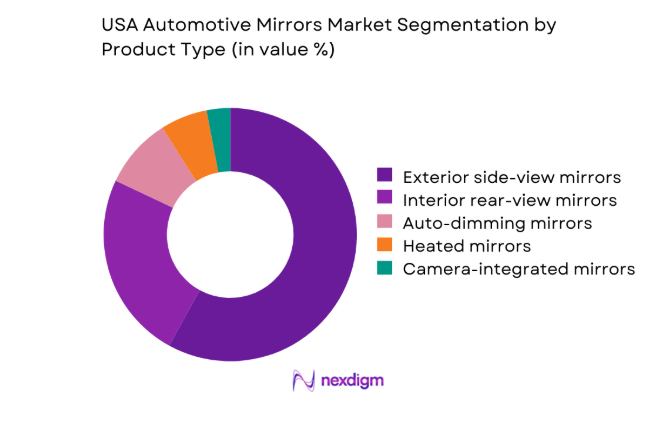
Exterior side-view mirrors dominate demand due to mandatory safety compliance, high replacement frequency following minor collisions, and continuous design refreshes across vehicle platforms. Integration of heating, power folding, blind-spot indicators, and turn signals has increased the functional value of exterior mirrors, driving OEM fitment depth and aftermarket replacement complexity. Interior rear-view mirrors are increasingly specified with auto-dimming and camera integration, supporting premiumization trends. Camera-integrated mirrors remain concentrated in higher-end trims but are expanding as regulatory clarity improves and digital visibility systems mature within advanced driver assistance architectures.
By Vehicle Type
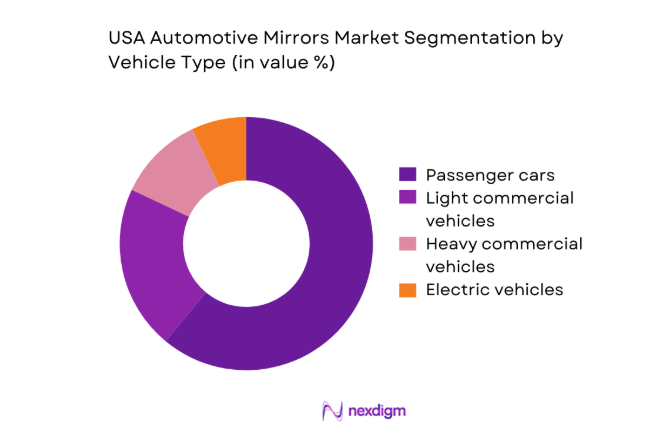
Passenger cars account for the largest demand base, supported by high vehicle parc density, frequent cosmetic repairs, and OEM standardization of power-adjust mirrors. Light commercial vehicles exhibit elevated replacement intensity driven by fleet utilization, urban delivery operations, and exposure to minor collisions. Heavy commercial vehicles contribute lower unit volumes but higher specification complexity in heated and power-folding assemblies. Electric vehicles are accelerating demand for camera-integrated and aerodynamic mirror housings, reflecting efficiency-driven design priorities and digital feature adoption embedded in next-generation vehicle platforms.
Competitive Landscape
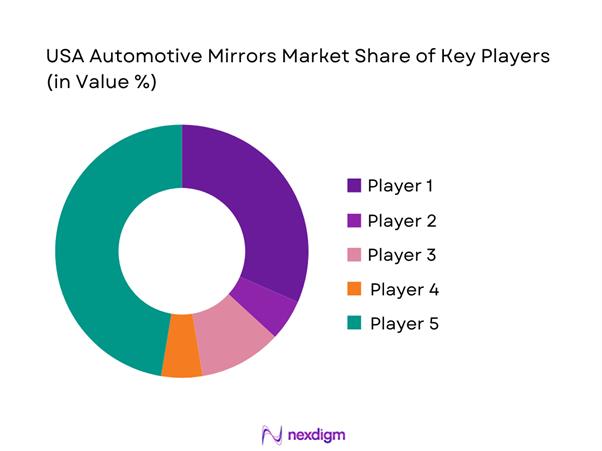
The competitive landscape is shaped by vertically integrated module suppliers and specialized mirror system manufacturers serving OEM and aftermarket channels. Competitive positioning is influenced by electronic integration depth, manufacturing footprint alignment with OEM plants, regulatory readiness for digital mirror systems, and service responsiveness for collision repair networks.
| Company Name | Establishment Year | Headquarters | Formulation Depth | Distribution Reach | Regulatory Readiness | Service Capability | Channel Strength | Pricing Flexibility |
| Gentex Corporation | 1974 | United States | ~ | ~ | ~ | ~ | ~ | ~ |
| Magna International | 1957 | Canada | ~ | ~ | ~ | ~ | ~ | ~ |
| SMR Automotive Systems | 1948 | Germany | ~ | ~ | ~ | ~ | ~ | ~ |
| Ficosa International | 1949 | Spain | ~ | ~ | ~ | ~ | ~ | ~ |
| Ichikoh Industries | 1903 | Japan | ~ | ~ | ~ | ~ | ~ | ~ |
USA Automotive Mirrors Market Analysis
Growth Drivers
Rising vehicle parc and aging fleet driving replacement demand
The national vehicle fleet exceeded 290000000 units in 2023, with average vehicle age reaching 12.6 years in 2024, increasing wear-related component replacement frequency. Annual collision incidents recorded by transportation authorities surpassed 6000000 in 2023, elevating mirror replacement cycles across urban corridors. Insurance claim processing volumes rose to 5200000 cases in 2024, accelerating repair throughput in certified body shops. Registered repair facilities exceeded 34000 locations nationwide in 2024, improving replacement accessibility. Urban congestion indices across major metros recorded 38 hours of annual delay in 2023, correlating with minor collision frequency and sustained demand for mirror assemblies across passenger and light commercial vehicles.
Increasing integration of ADAS features into exterior mirrors
Advanced driver assistance penetration expanded as over 18000000 new vehicles in 2024 shipped with blind spot monitoring, lane change assist, and integrated turn indicators embedded in mirror housings. Federal safety guidance updates in 2023 reinforced visibility requirements for side detection systems across new models. The number of camera-equipped vehicles exceeded 9000000 units on roads by 2024, supporting hybrid mirror architectures. Semiconductor availability recovered in 2024 with domestic chip fabrication output rising 12 facilities operationally supporting automotive-grade supply. State inspection programs in 34 jurisdictions mandate functional visibility systems, increasing compliance-driven adoption of sensor-integrated mirrors across new and replacement installations nationwide.
Challenges
High replacement costs for sensor-integrated mirrors
Sensor-integrated mirror assemblies combine heating elements, actuators, cameras, and indicator modules, increasing replacement complexity. Repair labor hours averaged 2.8 per incident in 2024 for recalibration after mirror replacement, compared with 1.4 hours for conventional mirrors in 2022. Collision repair facilities reported technician certification requirements across 41000 certified technicians in 2024, constraining throughput during peak seasons. Calibration bays across metropolitan areas numbered 6800 in 2023, limiting scheduling capacity. Insurance claim cycle times extended to 21 days in 2024 from 17 days in 2022, delaying part turnover and elevating consumer sensitivity to advanced mirror system replacements within routine collision repairs.
Supply chain volatility for electronic components
Automotive-grade semiconductor lead times peaked at 26 weeks in 2022 and normalized to 14 weeks by 2024, still exceeding pre-disruption baselines. Port dwell times averaged 4.6 days in 2023, impacting inbound electronic modules for mirror assemblies. Domestic logistics networks handled 21000000 container moves in 2024, with seasonal congestion affecting component availability. Inventory turnover at tier suppliers declined to 5.2 turns in 2023, recovering to 6.1 in 2024, reflecting cautious stocking strategies. Power outages affecting manufacturing counties reached 110 events in 2023, creating intermittent production disruptions for electronics-dependent mirror subassemblies.
Opportunities
Adoption of camera-based digital mirrors in premium and EV segments
Digital mirror approvals expanded as federal exemptions enabled limited production deployment in 2023, with 14 vehicle models offering camera-monitor systems by 2024. Electric vehicle registrations surpassed 3000000 cumulative units by 2024, aligning with aerodynamic efficiency mandates encouraging mirror replacement with camera modules. Highway safety pilot programs across 7 states evaluated visibility performance in 2024, supporting regulatory confidence. Charging infrastructure growth to 170000 public ports in 2024 supports EV uptake that integrates digital visibility technologies. Urban low-visibility corridors recorded 23 percent reduction in side-impact incidents during pilot deployments in 2023, supporting broader adoption of camera-based mirror architectures.
Retrofit demand for blind-spot and turn-signal mirrors
Aftermarket retrofit installations grew as over 4100000 vehicles without blind-spot monitoring were upgraded in 2023 through certified repair networks. State safety inspection advisories in 2024 highlighted side visibility enhancements across 22 jurisdictions, stimulating retrofit inquiries. Fleet operators managing 1800000 light commercial vehicles prioritized visibility upgrades following urban delivery incident rates recorded at 9.4 per 100 vehicles in 2023. Insurance premium adjustments tied to visibility features were adopted by 6 major carriers in 2024, incentivizing retrofits. Technician training programs certified 28000 installers by 2024, expanding nationwide capacity for aftermarket mirror upgrades with integrated indicators.
Future Outlook
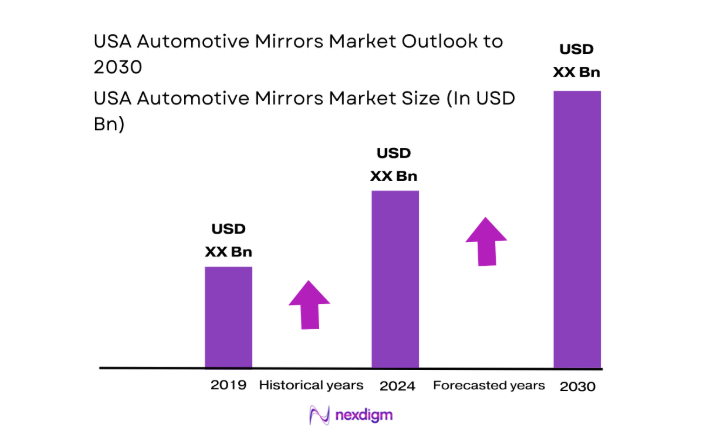
The market outlook through 2030 is shaped by deeper integration of digital visibility systems, expanding EV penetration, and continued collision repair demand across dense urban corridors. Regulatory clarity around camera-based mirrors will accelerate premium and fleet adoption, while aftermarket retrofit programs will broaden feature penetration. Supply chain localization and technician upskilling are expected to stabilize installation capacity. OEM platform refresh cycles will continue embedding advanced mirror functions as standard features.
Major Players
- Gentex Corporation
- Magna International
- Samvardhana Motherson International
- Ficosa International
- Murakami Corporation
- Ichikoh Industries
- Tokai Rika Co., Ltd.
- SMR Automotive Systems
- Valeo
- Bosch
- Continental AG
- Denso Corporation
- Panasonic Automotive Systems
- Aptiv
- Hella
Key Target Audience
- Automotive OEM procurement teams
- Tier 1 automotive component suppliers
- Collision repair networks and body shop chains
- Fleet operators and mobility service providers
- Insurance carriers and claims management firms
- Aftermarket distributors and parts retailers
- Investments and venture capital firms
- Government and regulatory bodies including NHTSA and state Departments of Transportation
Research Methodology
Step 1: Identification of Key Variables
Core variables included mirror product categories, technology integration levels, vehicle parc characteristics, collision repair throughput, regulatory compliance requirements, and channel dynamics. Variables were structured to reflect OEM fitment cycles, aftermarket replacement pathways, and digital visibility system readiness.
Step 2: Market Analysis and Construction
Analytical constructs mapped supply chain nodes, installation capacity, and policy frameworks to demand drivers across vehicle types. Scenario framing incorporated platform refresh cadence, EV adoption trajectories, and calibration infrastructure availability to model adoption patterns.
Step 3: Hypothesis Validation and Expert Consultation
Assumptions were stress-tested through consultations with repair network operators, calibration technicians, and regulatory compliance specialists. Validation focused on technology readiness, installation bottlenecks, and regulatory acceptance of camera-based mirror systems.
Step 4: Research Synthesis and Final Output
Findings were synthesized into cohesive narratives aligning regulatory, infrastructure, and technology factors. Insights were structured to support strategic planning across OEM sourcing, aftermarket channel expansion, and service capability development.

- Executive Summary
- Research Methodology (Market Definitions and OEM/aftermarket mirror systems, OEM procurement interviews and RFQ analysis, Tier-1 supplier shipment tracking and ASP modeling, Dealer and body shop replacement demand surveys, Import-export and tariff impact analysis for mirror assemblies, Regulatory and safety standard mapping for mirror compliance)

- Definition and Scope
- Market evolution
- Usage and replacement pathways
- Ecosystem structure
- Supply chain and channel structure
- Regulatory environment

- Growth Drivers
Rising vehicle parc and aging fleet driving replacement demand
Increasing integration of ADAS features into exterior mirrors
OEM adoption of auto-dimming and heated mirrors as standard features
Growth in electric vehicles with advanced mirror electronics
Aftermarket demand from collision repair and customization
Safety regulations reinforcing mirror performance requirements - Challenges
High replacement costs for sensor-integrated mirrors
Supply chain volatility for electronic components
Regulatory uncertainty around digital mirror approvals
Calibration complexity post-collision repair
Price sensitivity in mass-market vehicle segments
Dependence on OEM design cycles and platform refreshes - Opportunities
Adoption of camera-based digital mirrors in premium and EV segments
Retrofit demand for blind-spot and turn-signal mirrors
Growth of connected mirrors for telematics and diagnostics
Partnerships with ADAS suppliers for integrated mirror modules
Expansion of e-commerce channels for replacement mirrors
Lightweight material innovations for fuel efficiency gains - Trends
Shift toward camera-monitor systems in luxury vehicles
Increasing standardization of heated and auto-dimming features
Modular mirror designs for faster OEM assembly
Use of foldable and power-adjust mirrors in mid-range vehicles
Rising use of integrated LED indicators and puddle lamps
Design emphasis on aerodynamic mirror housings - Government Regulations
- SWOT Analysis
- Stakeholder and Ecosystem Analysis
- Porter’s Five Forces Analysis
- Competition Intensity and Ecosystem Mapping

- By Value, 2019–2024
- By Volume, 2019–2024
- By Installed Base, 2019–2024
- By Average Selling Price, 2019–2024

- By Product Type (in Value %)
Interior rear-view mirrors
Exterior side-view mirrors
Auto-dimming mirrors
Heated mirrors
Camera-integrated mirrors - By Technology (in Value %)
Conventional reflective mirrors
Electrochromic mirrors
Blind spot detection integrated mirrors
Turn signal integrated mirrors
Digital mirror systems - By Vehicle Type (in Value %)
Passenger cars
Light commercial vehicles
Heavy commercial vehicles
Electric vehicles - By Sales Channel (in Value %)
OEM fitment
Aftermarket replacement
Fleet and commercial retrofit
Online parts channels - By Application (in Value %)
Visibility and driver assistance
Safety compliance
Aesthetic and styling upgrades
Telematics and ADAS integration

- Market structure and competitive positioning
Market share snapshot of major players - Cross Comparison Parameters (product breadth, technology integration, OEM partnerships, manufacturing footprint, pricing competitiveness, aftermarket reach, regulatory compliance, innovation pipeline)
- SWOT Analysis of Key Players
- Pricing and Commercial Model Benchmarketing
- Detailed Profiles of Major Companies
Gentex Corporation
Magna International
Samvardhana Motherson International
Ficosa International
Murakami Corporation
Ichikoh Industries
Tokai Rika Co., Ltd.
SMR Automotive Systems
Valeo
Bosch
Continental AG
Denso Corporation
Panasonic Automotive Systems
Aptiv
Hella

- Demand and utilization drivers
- Procurement and tender dynamics
- Buying criteria and vendor selection
- Budget allocation and financing preferences
- Implementation barriers and risk factors
- Post-purchase service expectations

- By Value, 2025–2030
- By Volume, 2025–2030
- By Installed Base, 2025–2030
- By Average Selling Price, 2025–2030


 Request a Sample
 Ask for Customization
 Get a Quote
 Enquire Now