
 Download PDF
Market Overview
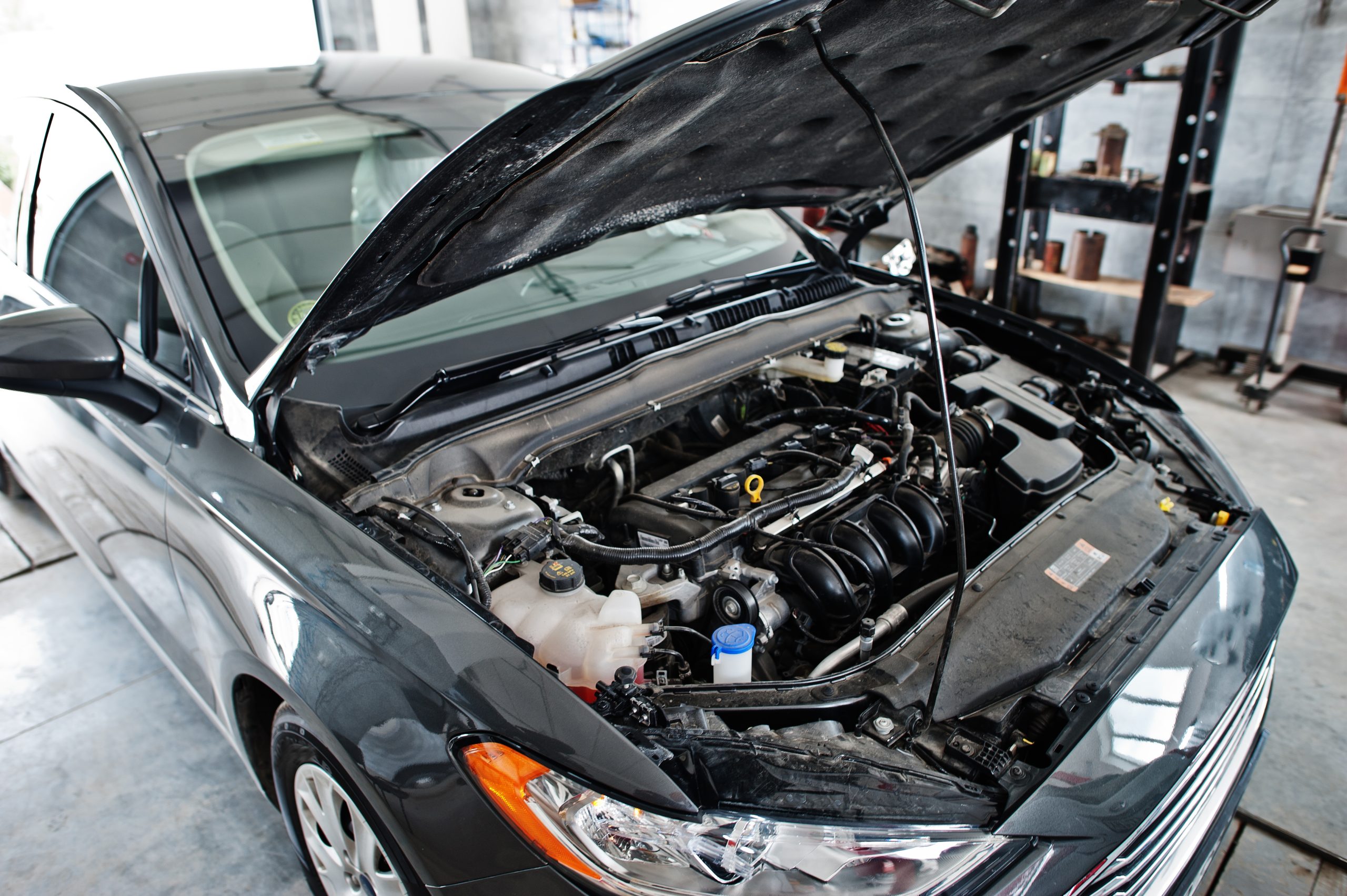
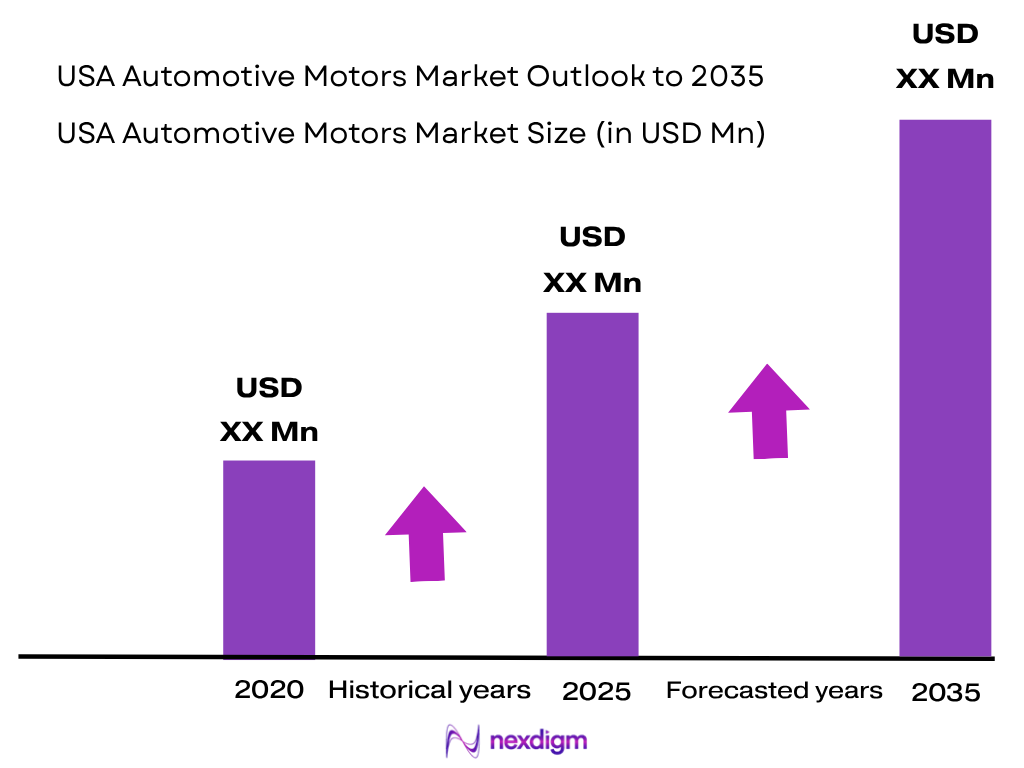
The USA Automotive Motors Market represents demand for traction, auxiliary, actuator, thermal-management, steering, HVAC, body and comfort motors installed across passenger and commercial vehicles. The market is supported by the scale of U.S. vehicle manufacturing and sales: the U.S. produced 10.56 million motor vehicles in 2024, including 1.43 million passenger cars and 9.13 million commercial vehicles, according to OICA. SelectUSA reports 16.3 million vehicle sales in the same period. Electrification is additionally increasing motor content per vehicle, with U.S. electric-car sales reaching 1.6 million units, while EV model availability continued expanding.
The U.S. Automotive Motors Market is concentrated around established automotive manufacturing and technology clusters including Michigan, Ohio, Indiana, Kentucky, Tennessee, Alabama, South Carolina, Georgia, Texas and California. Michigan remains strategically important because of its concentration of OEMs, Tier-1 suppliers, engineering operations and powertrain manufacturing, while southern states have attracted substantial vehicle and battery investments. California and other major EV-adoption states create additional demand for electrified powertrains and auxiliary motors. The underlying supplier ecosystem is substantial: U.S. motor-vehicle and parts manufacturing employed approximately 1.06 million workers in late 2024, including approximately 586,000 in motor-vehicle parts manufacturing, supporting a broad domestic market for motor components and systems.
Market Segmentation
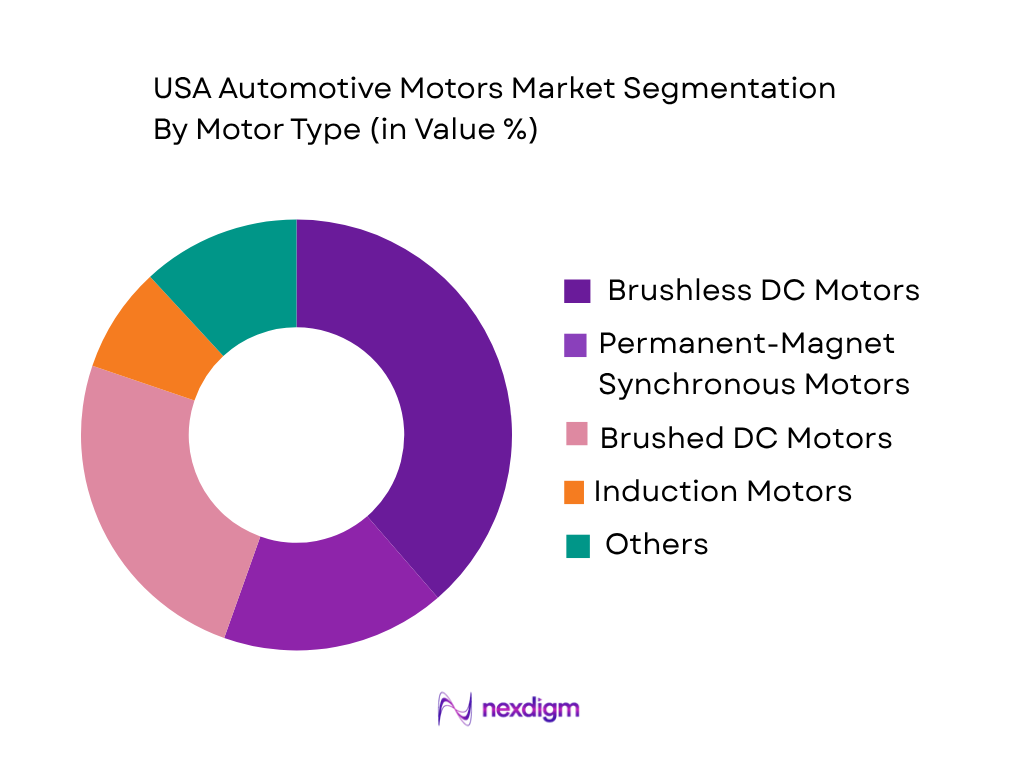
By Motor Type
The USA Automotive Motors Market is segmented by motor type into brushed DC motors, brushless DC motors, permanent-magnet synchronous motors, induction motors, stepper motors, switched-reluctance motors, traction motors and integrated motor-actuator systems. Brushless DC and permanent-magnet motor technologies represent the leading high-value opportunity because they combine compact packaging, controllability, efficiency and high power density with the requirements of modern electronically controlled vehicles. Their relevance increases as vehicles incorporate more electric functions, including steering, pumps, cooling, HVAC, power seats, doors and ADAS actuators. EV adoption further strengthens demand for permanent-magnet and other advanced traction architectures. The U.S. recorded approximately 1.6 million electric-car sales in 2024, while the median range of model-year 2024 EVs reached 283 miles, illustrating the continuing engineering emphasis on efficiency and powertrain optimization.
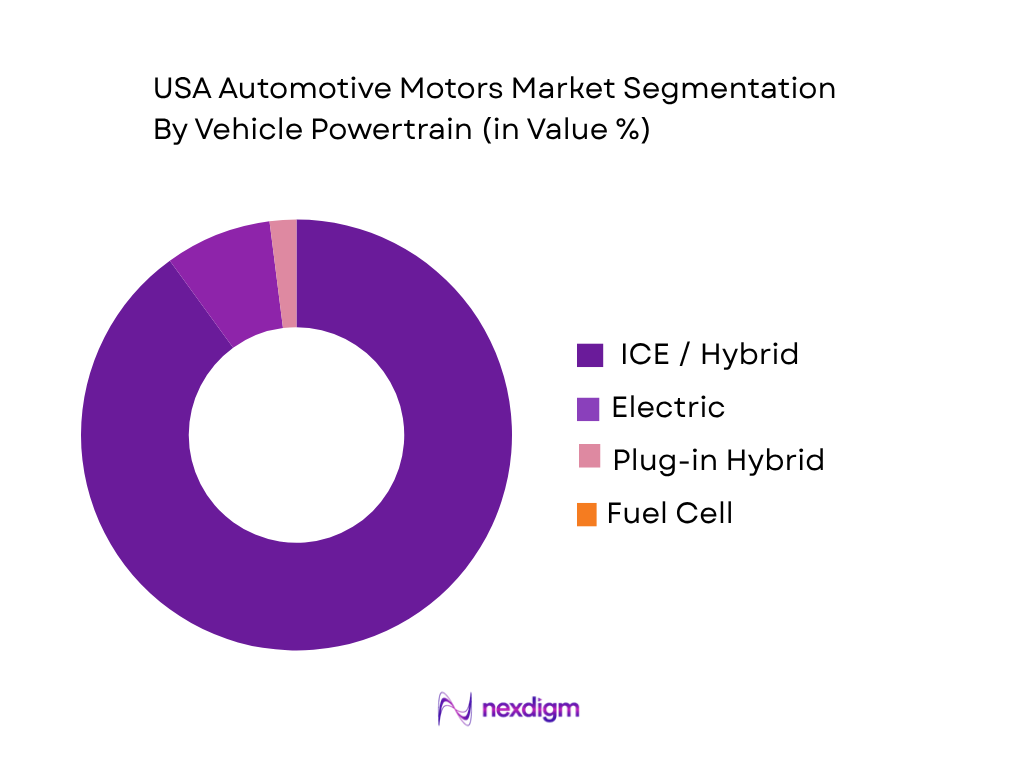
By Vehicle Powertrain
The USA Automotive Motors Market is segmented by vehicle powertrain into internal-combustion engine vehicles, mild-hybrid vehicles, hybrid electric vehicles, plug-in hybrid electric vehicles, battery electric vehicles and fuel-cell electric vehicles. Internal-combustion and hybrid vehicles continue to generate substantial motor demand because they retain numerous electrically driven auxiliary systems while hybrids add electric propulsion and thermal-management requirements. At the same time, BEVs create significantly different motor-content requirements through traction motors, electric compressors, coolant pumps, battery thermal-management systems and electronically controlled auxiliaries. U.S. electric-drive sales reached approximately 3.18 million units in 2024, including about 1.57 million plug-in vehicles and 1.61 million hybrids, demonstrating the scale of electrified vehicle deployment.
Competitive Landscape
The USA Automotive Motors Market is characterized by a combination of global automotive-component manufacturers, specialist motor producers and vertically integrated Tier-1 suppliers. Major participants compete through OEM qualification, motor efficiency, compact design, power density, thermal performance, manufacturing scale and integration with electronic controls. Companies including DENSO, Bosch, Johnson Electric, Nidec and Valeo maintain broad exposure across automotive actuation and motor applications, while BorgWarner, ZF and Hitachi Astemo have stronger positioning across electrified powertrain and vehicle systems. The breadth of U.S. automotive production creates opportunities for suppliers across both conventional auxiliary motors and higher-value EV traction and thermal-management systems.
| Company | Establishment | Headquarters | Key Motor Portfolio | EV Capability | Major Applications | U.S. Positioning | OEM/Tier-1 Focus |
| DENSO | 1949 | Kariya, Japan | ~ | ~ | ~ | ~ | ~ |
| Robert Bosch | 1886 | Gerlingen, Germany | ~ | ~ | ~ | ~ | ~ |
| Johnson Electric | 1959 | Hong Kong | ~ | ~ | ~ | ~ | ~ |
| Nidec | 1973 | Kyoto, Japan | ~ | ~ | ~ | ~ | ~ |
| Valeo | 1923 | Paris, France | ~ | ~ | ~ | ~ | ~ |
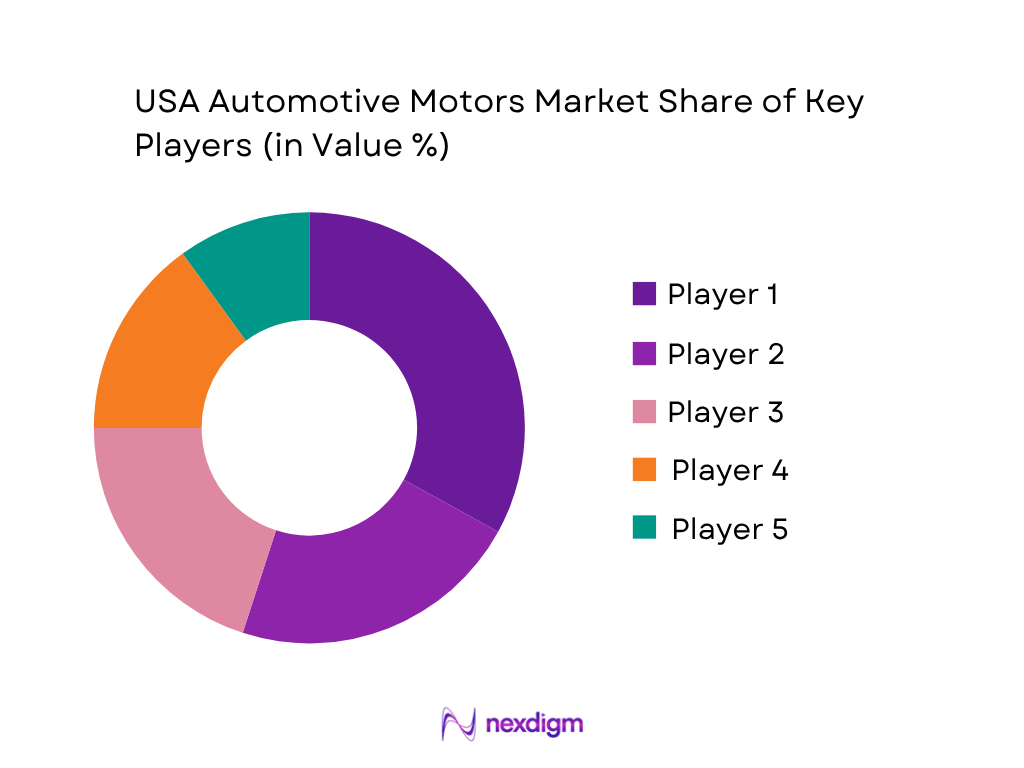
USA Automotive Motors Market Analysis
Growth Drivers
Vehicle Electrification
The increasing electrification of U.S. vehicles is expanding the number and sophistication of motors installed per vehicle, supporting demand across traction, pumps, fans, compressors, actuators and thermal-management systems. The U.S. EPA reports that model-year 2024 new-vehicle fuel economy reached a record 27.2 mpg, while BEVs and PHEVs materially influenced fleet efficiency. The same EPA dataset shows that 30% of car SUVs were BEVs and 3% were PHEVs, demonstrating that electrified powertrains are moving beyond niche applications. BEV technology is also becoming more capable: the EPA reports an average new-BEV range of 292 miles for model-year 2024. These developments directly increase motor content because electrified propulsion requires traction motors, electric coolant pumps, electric compressors and electronically controlled auxiliaries that are absent or mechanically driven in conventional architectures. Vehicle electrification also intersects with thermal management, as battery packs, power electronics and electric motors require active temperature control. The Bureau of Economic Analysis reported that U.S. real GDP increased 2.8% in 2024, while motor vehicles and parts contributed to growth in consumer spending. The U.S. EPA additionally confirms that its automotive database covers every new light-duty vehicle model sold in the country since 1975, providing a broad regulatory dataset for tracking technology adoption. Together, electrification, improving EV capability and continued vehicle demand are increasing the quantity, functionality and technical specification of motors required across U.S. vehicles.
ADAS Penetration, Advanced HVAC Electrification, 48V Adoption, Thermal Management Requirements, Premium Vehicle Features
The growing electronic content of U.S. vehicles is creating additional motor applications beyond propulsion, particularly in ADAS actuators, active-grille systems, electric steering, braking, seating, HVAC, pumps and thermal-management equipment. The U.S. EPA reports that model-year 2024 vehicles incorporated increasingly diverse advanced technologies, while average new-vehicle fuel economy reached 27.2 mpg. EPA data also show that trucks represented 66% of new vehicles under NHTSA regulatory classification, creating a substantial installed base for higher-power auxiliary motors used in larger vehicles. Electrification of HVAC and thermal systems is especially relevant because battery-electric and hybrid architectures require electrically driven compressors and coolant pumps that can operate independently of the engine. The increasing importance of electronics also raises demand for compact, electronically controlled BLDC and actuator motors. Semiconductor availability is therefore directly connected to motor-system development. The U.S. Department of Commerce announced up to $1.5 billion in CHIPS funding for GlobalFoundries in 2024 to strengthen domestic current-generation and mature-node semiconductor production, with the supported facilities serving automotive applications. Commerce also announced up to $400 million in proposed funding for Amkor’s Arizona advanced-packaging project, including automotive applications and approximately 2,000 jobs. These investments indicate the strategic importance of automotive semiconductor availability to increasingly software-defined and electrically controlled vehicles. As OEMs integrate more electronic functions, motor controllers, sensors and actuators into vehicle platforms, the addressable motor ecosystem expands from propulsion into numerous electrically controlled subsystems.
Market Challenges
Raw Material Exposure, Rare-Earth Magnet Dependency, Semiconductor Availability, OEM Pricing Pressure, Motor Miniaturization, Thermal Constraints, Supply-Chain Volatility
The U.S. automotive motor industry faces supply-chain exposure across copper, electrical steel, aluminum, permanent-magnet materials, semiconductors and specialized electronic components. Rare-earth permanent magnets are particularly relevant to high-performance traction and auxiliary motors. The U.S. Geological Survey identifies permanent magnets as a principal application for rare earths and reports that U.S. imports of rare-earth compounds and metals historically relied heavily on overseas supply, with China accounting for 72%, Malaysia 11% and Japan 6% of reported import sources in the cited trade period. USGS’s more recent critical-minerals methodology also explicitly incorporates U.S. trade in sintered neodymium-iron-boron and samarium-cobalt permanent magnets and identifies electric-vehicle motors as an application for neodymium-iron-boron magnets. Semiconductor availability presents a parallel vulnerability because automotive motors increasingly require microcontrollers, power semiconductors and integrated control electronics. The Department of Commerce noted that semiconductor shortages during the pandemic affected more than 1% of global GDP, demonstrating the economic consequences of automotive chip disruption. Domestic semiconductor capacity is being expanded, but the supply chain remains internationally interconnected. In 2024, Commerce announced $162 million in proposed CHIPS incentives for Microchip Technology to expand U.S. production of automotive-relevant microcontrollers and mature-node semiconductors, with projects expected to create more than 700 direct construction and manufacturing jobs. These conditions create challenges for motor suppliers because securing magnet materials, copper, electrical steel and semiconductor components requires supply diversification and inventory planning while OEMs simultaneously demand smaller, lighter and more efficient motors.
OEM Pricing Pressure, Motor Miniaturization, Thermal Constraints, Supply-Chain Volatility
Automotive motor manufacturers must simultaneously meet tighter packaging, efficiency, noise, vibration and durability requirements while responding to strong OEM pressure for system-level cost optimization. Motor miniaturization is particularly challenging because smaller housings must accommodate increasing torque density, thermal loads and electronic integration without compromising reliability. The U.S. EPA reports that average new vehicles reached 27.2 mpg in model-year 2024, reflecting continuing efficiency improvements alongside increasing vehicle size and technology content. EPA also reports that average vehicle weight, horsepower and footprint have generally increased, creating a technically complex environment in which motors must deliver higher functionality within constrained packaging envelopes. Thermal constraints become more pronounced as motor power density rises and as electric vehicles add battery, inverter and cabin thermal-management loads. Semiconductor supply adds another layer of complexity because motor-control systems depend on microcontrollers and power devices. Commerce’s 2024 GlobalFoundries award provided up to $1.5 billion in direct funding to strengthen domestic semiconductor manufacturing for automotive applications, while the company planned approximately $13 billion of investment in U.S. manufacturing sites over more than 10 years. The broader automotive supply chain also remains exposed to international trade movements: BEA reported that U.S. imports of automotive vehicles, parts and engines increased by $16.1 billion in 2024, including a $4.8 billion increase in other automotive parts and accessories. For motor suppliers, this combination of imported components, tighter vehicle efficiency requirements and higher functional integration increases the need for robust sourcing, thermal engineering, compact architectures and manufacturing scale while limiting the ability to pass all engineering and material costs through to OEM customers.
Market Opportunities
EV Traction Motors, E-Axles, Electric Pumps, Advanced Steering Motors, ADAS Actuators, High-Efficiency BLDC Motors, Rare-Earth-Free Motors, Integrated Motor Controllers
The expansion of electrified vehicle architectures creates opportunities for U.S. automotive motor suppliers to move toward higher-value integrated propulsion and auxiliary systems. EPA data show that model-year 2024 BEVs averaged 292 miles of range, while BEVs and PHEVs increasingly influenced overall fleet fuel economy. EPA also reports that without BEVs and PHEVs, average new-vehicle real-world fuel economy in 2024 would have been 1.7 mpg lower, illustrating the measurable influence of electrified vehicles on the U.S. vehicle fleet. This creates opportunities for traction motors, e-axles and integrated motor-inverter systems that can improve packaging and drivetrain efficiency. Electric pumps represent another scalable application because EV and hybrid platforms require electrically controlled coolant circulation for batteries, power electronics and motors. Electric steering and ADAS actuators provide additional opportunities as mechanical and hydraulic functions increasingly transition toward electronically controlled architectures. Semiconductor localization is also improving the foundation for these systems. The Department of Commerce awarded GlobalFoundries up to $1.5 billion in 2024 for automotive-relevant semiconductor manufacturing, while Bosch announced a planned U.S. silicon-carbide facility expected to begin producing chips on 200-millimeter wafers in 2026. Such developments support greater integration between motors, controllers and power electronics. Suppliers capable of combining high-efficiency BLDC or permanent-magnet architectures with integrated sensing and control can therefore address a broader share of the vehicle’s electrical architecture. At the same time, rare-earth supply concerns create an opening for induction, switched-reluctance and other rare-earth-reduced or rare-earth-free motor designs where their efficiency, cost and packaging characteristics meet vehicle requirements.
E-Axles, Electric Pumps, Advanced Steering Motors, ADAS Actuators, Rare-Earth-Free Motors, Integrated Motor Controllers
The next opportunity layer is the integration of motors with gearboxes, inverters, sensors and control electronics into compact vehicle subsystems. U.S. vehicle technology is moving toward architectures in which propulsion and auxiliary functions are increasingly electronically coordinated, creating demand for motor systems rather than standalone electric machines. The EPA reports that 66% of new vehicles were trucks in model-year 2024 under NHTSA classification, while electrified powertrains were already influencing fuel-economy performance across SUVs and other vehicle classes. This combination favors high-torque, high-efficiency motor systems suitable for larger vehicle platforms, including e-axles, electric steering and thermal-management systems. The domestic semiconductor ecosystem is also becoming more relevant to these integrated architectures. Commerce reported that Bosch’s planned Roseville, California silicon-carbide production could represent more than 40% of U.S.-based SiC device manufacturing capacity when fully operational, with initial 200-millimeter wafer production expected in 2026. SiC power electronics can support higher-efficiency motor drives and integrated propulsion systems, strengthening the commercial case for advanced motor-controller combinations. Rare-earth diversification provides another avenue. USGS explicitly tracks neodymium-iron-boron magnets used in EV motors and has identified permanent magnets as an important rare-earth application, making alternative motor architectures strategically relevant for supply-chain resilience. Suppliers can therefore differentiate through induction, switched-reluctance and other magnet-reduced designs, alongside high-efficiency BLDC systems where application requirements permit. Opportunities also extend to integrated actuator modules for ADAS, steering, braking and thermal management, allowing suppliers to capture additional value through electronics, sensing, software-enabled control and subsystem integration rather than competing solely on the price of the motor itself.
Future Outlook
Over the forecast period, the USA Automotive Motors Market is expected to undergo a structural transition toward higher motor content, greater electrification and increased integration between motors, sensors, controllers and power electronics. EV and hybrid adoption will support traction and auxiliary motor demand, while ADAS, thermal management and vehicle comfort functions will expand the number of electronically actuated systems installed per vehicle. The market should also benefit from domestic automotive manufacturing investments and continued localization of vehicle-component supply chains.
Major Players
- DENSO Corporation
- Robert Bosch GmbH
- Johnson Electric Holdings Limited
- Nidec Corporation
- Valeo SE
- BorgWarner Inc.
- ZF Friedrichshafen AG
- Continental AG
- Mitsubishi Electric Corporation
- Hitachi Astemo, Ltd.
- Mitsuba Corporation
- Mabuchi Motor Co., Ltd.
- Marelli Holdings Co., Ltd.
- Brose Fahrzeugteile SE & Co. KG
- MAHLE GmbH
Key Target Audience
- Automotive OEMs and Vehicle Manufacturers
- Tier-1 Automotive Component Suppliers
- Automotive Motor and Actuator Manufacturers
- Electric Powertrain and E-Axle Manufacturers
- Automotive Parts Distributors and Aftermarket Suppliers
- Fleet Operators and Commercial Vehicle Owners
- Investments and Venture Capitalist Firms
- Government and Regulatory Bodies (U.S. Department of Energy, Environmental Protection Agency, National Highway Traffic Safety Administration)
Research Methodology
Step 1: Identification of Key Variables
The initial stage establishes the market ecosystem covering automotive OEMs, Tier-1 suppliers, motor manufacturers, component suppliers and aftermarket participants. Key variables include vehicle production, motor installation rates, motor technologies, powertrain mix, motor content per vehicle and replacement demand. Secondary research is used to establish the underlying automotive production and technology framework.
Step 2: Market Analysis and Construction
Historical vehicle-production, sales and powertrain data are mapped against motor applications and installation rates. The analysis separates traction motors from auxiliary motors and evaluates applications across HVAC, steering, pumps, cooling, body systems, ADAS and comfort functions. OEM production and supplier information are then used to construct the bottom-up market model.
Step 3: Hypothesis Validation and Expert Consultation
Market hypotheses are validated through discussions with automotive OEM procurement professionals, Tier-1 engineering teams, motor manufacturers, distributors and aftermarket specialists. Expert inputs are used to test assumptions concerning motor content, technology adoption, qualification requirements, replacement cycles and OEM sourcing patterns.
Step 4: Research Synthesis and Final Output
The final analysis triangulates production statistics, powertrain adoption, supplier information, motor applications and replacement demand. Bottom-up estimates are reconciled with top-down industry indicators to produce market segmentation, competitive positioning and future-demand assessments.

- Executive Summary
- Research Methodology (Market Definition and Scope, Automotive Motor Taxonomy, Inclusion and Exclusion Criteria, Market Sizing Framework, Revenue and Unit-Volume Assessment, Top-Down Market Reconstruction, Bottom-Up Vehicle-to-Motor Mapping, OEM Production Analysis, Motor Content per Vehicle Assessment, Import–Export Analysis, Aftermarket Demand Reconstruction, Primary Interviews, Secondary Research, Data Triangulation, Forecasting Model, Scenario Analysis, Assumptions and Limitations)

- Definition and Scope
- Automotive Motors Industry Evolution
- U.S. Automotive Manufacturing Ecosystem
- Automotive Motor Value Chain
- Automotive Motor Supply Chain
- U.S. Vehicle Production Landscape

- Growth Drivers (Vehicle Electrification, Rising Motor Content per Vehicle, ADAS Penetration, Advanced HVAC Electrification, 48V Adoption, Thermal Management Requirements, Premium Vehicle Features)
- Market Challenges (Raw Material Exposure, Rare-Earth Magnet Dependency, Semiconductor Availability, OEM Pricing Pressure, Motor Miniaturization, Thermal Constraints, Supply-Chain Volatility)
- Market Opportunities (EV Traction Motors, E-Axles, Electric Pumps, Advanced Steering Motors, ADAS Actuators, High-Efficiency BLDC Motors, Rare-Earth-Free Motors, Integrated Motor Controllers)
- Technology Trends (Brushless Architecture, Permanent-Magnet Motors, Hairpin Windings, High-Speed Motors, Integrated Inverters, Silicon-Carbide Power Electronics, Sensorless Control)
- Regulatory Environment (NHTSA Requirements, EPA Emission Regulations, DOE Efficiency Programs, Federal EV Policy, State-Level ZEV Policies, Vehicle Safety Standards)
- Porter’s Five Forces Analysis
- PESTLE Analysis
- SWOT Analysis

- By Market Value (2020-2025)
- By Motor Volume (2020-2025)
- By Average Motor Value (2020-2025)
- By Vehicle Production (2020-2025)
- By Motor Content per Vehicle (2020-2025)
- By OEM Procurement (2020-2025)

- By Motor Type (in value %)
Brushed DC Motors
Brushless DC Motors
Stepper Motors
Permanent-Magnet Synchronous Motors
Induction Motors
Switched Reluctance Motors
Traction Motors
Integrated Motor-Actuator Systems - By Vehicle Powertrain (in value %)
Internal Combustion Engine Vehicles
Mild Hybrid Electric Vehicles
Hybrid Electric Vehicles
Plug-in Hybrid Electric Vehicles
Battery Electric Vehicles
Fuel Cell Electric Vehicles - By Vehicle Type (in value %)
Passenger Cars
Light Commercial Vehicles
Medium-Duty Commercial Vehicles
Heavy-Duty Commercial Vehicles
Pickup Trucks
SUVs and Crossovers
Buses - By Application
Electric Power Steering Motors
HVAC and Air-Conditioning Motors
Cooling Fan Motors
Electric Water Pump Motors
Electric Oil Pump Motors
Fuel Pump Motors
Starter Motors - By Functional Category (in value %)
Powertrain Motors
Thermal Management Motors
Chassis and Steering Motors
Safety and ADAS Motors
Body and Exterior Motors
Interior and Comfort Motors
Utility and Auxiliary Motors - By Motor Power Output (in value %)
Below 100 W
100–500 W
501 W–1 kW
1–5 kW
5–20 kW
21–100 kW
Above 100 kW

- Market Share of Major Players (By Revenue, Unit Volume, Motor Type, Application, Vehicle Type, Powertrain, OEM Supply and Aftermarket)
- Cross Comparison Parameters (Automotive Motor Portfolio Breadth, Motor Applications Supplied, Maximum Motor Power Density, BLDC and PMSM Technology Capability, EV Traction Motor Portfolio, U.S. Manufacturing Footprint, OEM/Tier-1 Customer Coverage, Integrated Motor–Controller Capability)
- SWOT Analysis of Major Players
- Detailed Profiles of Major Companies
DENSO Corporation
Robert Bosch GmbH
Johnson Electric Holdings Limited
Nidec Corporation
Valeo SE
BorgWarner Inc.
ZF Friedrichshafen AG
Continental AG
Mitsubishi Electric Corporation
Hitachi Astemo, Ltd.
Mitsuba Corporation
Mabuchi Motor Co., Ltd.
Marelli Holdings Co., Ltd.
Brose Fahrzeugteile SE & Co. KG
MAHLE GmbH

Automotive Motor Buyer Ecosystem
OEM Purchasing Behavior
Tier-1 Supplier Demand Assessment
Aftermarket Consumer Analysis
Vehicle Owner Replacement Behavior
Fleet Operator Motor Demand

- By Market Value (2026-2035)
- By Motor Volume (2026-2035)
- By Average Motor Value (2026-2035)
- By Vehicle Production (2026-2035)
- By Motor Content per Vehicle (2026-2035)
- By OEM Procurement (2026-2035)


 Request a Sample
 Ask for Customization
 Get a Quote
 Enquire Now