
 Download PDF
 Download PDF
Market Overview
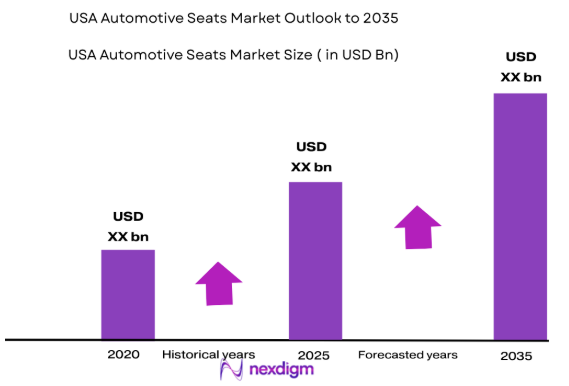
The USA Automotive Seats market reached approximately USD ~ Billion based on a recent historical assessment supported by industry production data and OEM revenue disclosures. Growth is primarily driven by sustained light vehicle manufacturing volumes reported by the U.S. Bureau of Economic Analysis and increasing content value per vehicle due to electrification and premium interior demand. Higher penetration of powered, ventilated, and sensor-integrated seating systems has significantly expanded average seat system pricing across passenger vehicles and SUVs.
Detroit, Michigan remains the core manufacturing hub due to concentrated OEM headquarters and integrated supplier ecosystems. States such as Ohio, Kentucky, Tennessee, and Alabama also maintain strong production clusters supported by large assembly plants and supplier networks. The United States dominates regional demand due to high vehicle ownership rates, strong SUV preference, and domestic electric vehicle production investments supported by federal industrial policies and localized manufacturing incentives.
Market Segmentation
By Product Type
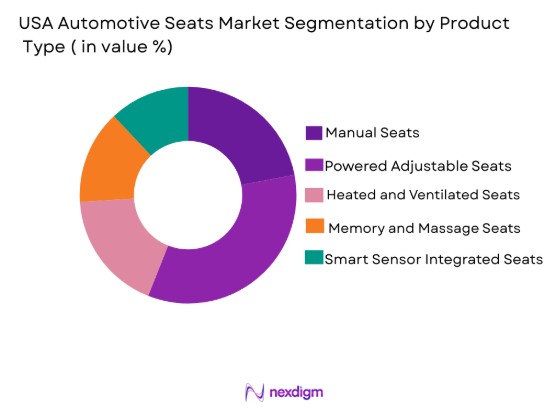
USA Automotive Seats market is segmented by product type into manual seats, powered adjustable seats, heated and ventilated seats, memory and massage seats, and smart sensor integrated seats. Recently, powered adjustable seats have a dominant market share due to increasing consumer preference for enhanced comfort, broader adoption in mid-range SUVs, strong OEM bundling strategies, expanding electric vehicle production requiring feature-rich interiors, and competitive differentiation by automakers emphasizing premium cabin experience across mass-market vehicles.
By Platform Type
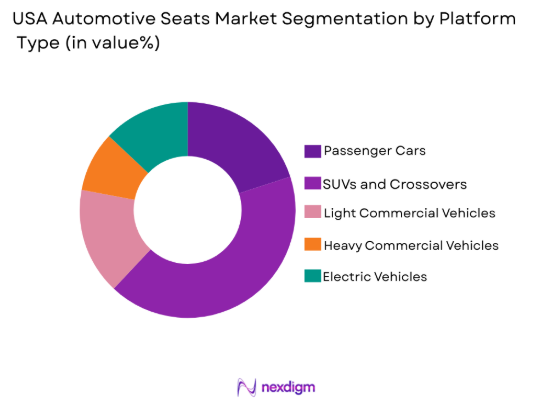
USA Automotive Seats market is segmented by platform type into passenger cars, SUVs and crossovers, light commercial vehicles, heavy commercial vehicles, and electric vehicles. Recently, SUVs and crossovers have a dominant market share due to strong consumer demand trends, higher seating capacity requirements, elevated feature integration levels, premium interior configurations, and consistent production growth across domestic manufacturing facilities concentrated in southern and midwestern states.
Competitive Landscape
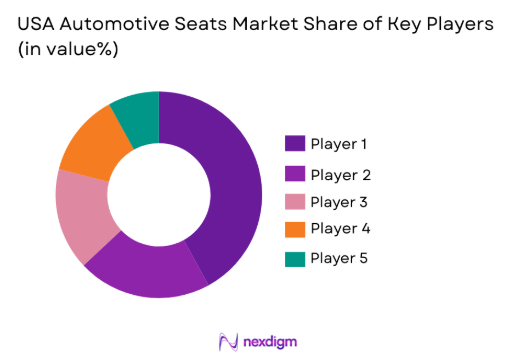
The USA Automotive Seats market demonstrates moderate consolidation with a few global suppliers controlling large OEM contracts while regional manufacturers focus on niche and commercial segments. Long-term supply agreements, vertical integration of foam and frame manufacturing, and advanced electronics capabilities influence competitive positioning. Strategic alliances with electric vehicle manufacturers and localized production footprints enhance supplier leverage.
|
Company Name |
Establishment Year | Headquarters | Technology Focus | Market Reach | Key Products | Revenue | OEM Partnership Strength |
| Adient plc | 2016 | Plymouth, USA | ~ | ~ | ~ | ~ | ~ |
| Lear Corporation | 1917 | Southfield, USA | ~ | ~ | ~ | ~ | ~ |
| Faurecia Seating | 1997 | Auburn Hills, USA | ~ | ~ | ~ | ~ | ~ |
| Magna Seating | 1957 | Aurora, Canada | ~ | ~ | ~ | ~ | ~ |
| Toyota Boshoku | 1918 | Kariya, Japan | ~ | ~ | ~ | ~ | ~ |
USA Automotive Seats Market Analysis
Growth Drivers
Expansion of Electric Vehicle Production and Premium Feature Integration
The significantly accelerating demand within the USA Automotive Seats market as automakers redesign interiors to differentiate electric models from traditional combustion platforms. Electric vehicle manufacturers are leveraging cabin space flexibility to integrate powered adjustable systems, memory functions, heated and ventilated features, and embedded electronic modules that enhance occupant comfort and brand positioning. Federal manufacturing incentives and domestic battery production investments are indirectly stimulating vehicle assembly volumes, which in turn increase seating system installations across new platforms. Automakers are also using advanced seating technologies as a strategic value addition to justify higher vehicle pricing amid competitive electric vehicle launches. Increased adoption of smart sensors within seats to support driver monitoring and safety systems further strengthens content value per unit. Consumers are demonstrating willingness to pay for enhanced interior refinement, especially in SUVs and crossovers where electric variants are expanding rapidly. Lightweight seat frame engineering using high strength steel and composite materials is enabling automakers to maintain energy efficiency targets while integrating additional features. suppliers are expanding localized production capacity to support higher content per vehicle while meeting regulatory and safety standards. Continuous innovation in foam structures and ergonomic design is enhancing long distance driving comfort, supporting broader adoption across both premium and mid segment vehicles.
Rising Consumer Preference for Comfort Oriented and Technology Enabled Interiors
Reshaping the structural design and functional composition of automotive seats in the USA Automotive Seats market. Buyers increasingly prioritize adjustable lumbar support, multi contour shaping, and climate controlled seating in both luxury and mainstream vehicle segments. The shift toward SUVs and crossovers with larger cabin footprints is amplifying demand for enhanced second row and third row seating comfort features. Automakers are responding by integrating advanced seat control modules that connect with infotainment systems and memory personalization profiles. Growing urban commuting times and road travel frequency are further increasing demand for ergonomic seating capable of reducing fatigue. Fleet operators and ride sharing platforms are also incorporating higher specification seats to improve passenger satisfaction and retention metrics. Enhanced interior aesthetics using premium upholstery materials including synthetic leather and sustainable fabrics are influencing purchase decisions across multiple demographics. The integration of occupancy detection sensors and safety alerts within seat assemblies is reinforcing their importance beyond basic structural support. Continuous collaboration between OEM design teams and seat manufacturers is enabling modular seat platforms adaptable across multiple vehicle models, thereby optimizing cost efficiency while expanding feature penetration.
Market Challenges
Volatility in Raw Material Costs and Supply Chain Disruptions
present substantial operational challenges for the USA Automotive Seats market as seating systems rely heavily on steel frames, polyurethane foam, specialty textiles, electronic components, and advanced polymers. Fluctuations in commodity pricing directly influence production cost structures, creating margin pressures for suppliers operating under long term OEM contracts with fixed pricing mechanisms. Geopolitical tensions and global logistics bottlenecks have increased transportation lead times and inventory carrying costs. Dependence on specialized semiconductor components for smart seat modules further complicates procurement cycles and production scheduling. Domestic labor shortages and wage inflation are elevating operational expenses across manufacturing facilities concentrated in the Midwest and Southern United States. Suppliers must maintain compliance with safety regulations while simultaneously controlling cost escalation, limiting flexibility in material substitution strategies. Inventory imbalances resulting from unpredictable vehicle production schedules can lead to inefficiencies in assembly line operations. Supplier consolidation in upstream material segments also reduces bargaining leverage for seat manufacturers. Continuous investment in risk mitigation strategies, dual sourcing frameworks, and localized supply networks is necessary to stabilize production continuity and protect profitability.
Stringent Safety Compliance and Engineering Complexity
The significantly influence product development cycles within the USA Automotive Seats market due to mandatory adherence to Federal Motor Vehicle Safety Standards governing seat anchorage, structural integrity, and occupant protection. Seating systems must withstand rigorous crash testing protocols and integrate seamlessly with airbag deployment systems, adding engineering layers that increase research and development expenditure. The incorporation of side airbags and occupancy sensors into seat assemblies complicates design architecture and electronic integration requirements. Lightweight material substitution strategies must balance structural durability with weight reduction targets, intensifying material science challenges. Compliance testing and certification procedures extend product development timelines, delaying market introduction of new seat technologies. OEM expectations for continuous innovation alongside cost reduction amplify pressure on suppliers to optimize design efficiency. Integration of advanced electronics into seating platforms introduces additional validation requirements for electromagnetic compatibility and cybersecurity standards. Increasing complexity in vehicle platforms, particularly electric and hybrid architectures, demands adaptable seat mounting and wiring configurations. The cumulative impact of regulatory scrutiny and technological integration requirements increases capital investment needs and elevates entry barriers for smaller manufacturers.
Opportunities
Adoption of Sustainable and Recyclable Upholstery Materials
The Represents a significant opportunity in the USA Automotive Seats market as automakers align product strategies with environmental responsibility commitments and carbon neutrality goals. Increasing regulatory attention toward lifecycle emissions is encouraging OEMs to prioritize materials with lower environmental impact across vehicle interiors. Suppliers are developing bio based foams, recycled polyester fabrics, and eco friendly synthetic leather alternatives that maintain durability while reducing carbon footprint. Consumer awareness regarding sustainability is influencing purchasing behavior, particularly among electric vehicle buyers who associate eco conscious interiors with brand authenticity. Integration of recycled materials can also reduce long term dependency on volatile raw material markets by expanding alternative sourcing pathways. Strategic partnerships with material science innovators enable seat manufacturers to differentiate offerings and secure premium contracts with sustainability focused automakers. Adoption of circular economy practices, including seat component recyclability at end of vehicle life, enhances long term environmental compliance. Development of lightweight sustainable composites supports both efficiency and regulatory alignment objectives. Continuous innovation in green material processing technologies is expected to expand scalability and cost competitiveness, positioning sustainability as a long term value driver rather than a compliance obligation.
Integration of Biometric and Health Monitoring Technologies within Seat Systems
offers transformative potential for the USA Automotive Seats market by expanding the functional role of seating platforms beyond comfort and safety. Advanced sensor arrays embedded within seat cushions and backrests can monitor driver posture, heart rate, and fatigue indicators, contributing to enhanced vehicle safety and personalized driving experiences. Increasing focus on autonomous and semi autonomous vehicle technologies creates demand for intelligent seating capable of interacting with advanced driver assistance systems. Automotive manufacturers are exploring data integration between seat sensors and central vehicle control units to enable proactive safety alerts. Fleet operators may leverage health monitoring features to enhance driver wellbeing and reduce accident risks associated with fatigue. Collaboration with technology firms specializing in wearable and biometric analytics can accelerate commercialization of integrated seat based monitoring solutions. Data driven personalization of seat adjustments based on occupant profiles can further differentiate premium vehicle offerings. Regulatory frameworks supporting driver monitoring systems indirectly stimulate demand for sensor integrated seating platforms. As vehicles evolve into connected mobility environments, intelligent seat systems are positioned to become central nodes in the broader in cabin digital ecosystem.
Future Outlook
The USA Automotive Seats market is expected to maintain steady expansion over the next five years supported by sustained electric vehicle production, premium interior demand, and modular seat platform innovation. Advancements in lightweight structures and embedded electronics will redefine product design standards. Regulatory emphasis on safety and sustainability will further influence material selection and engineering strategies. Increasing collaboration between OEMs and technology providers will accelerate development of intelligent and sensor integrated seating solutions.
Major Players
- Adient plc
- Lear Corporation
- Faurecia Seating
- Magna Seating
- Toyota Boshoku Corporation
- TS Tech Co Ltd
- Hyundai Transys
- Brose Fahrzeugteile
- NHK Spring Co Ltd
- Grammer AG
- Tachi S Co Ltd
- Grupo Antolin
- Freedman Seating Company
- Commercial Vehicle Group
- Guelph Manufacturing Group
Key Target Audience
- Automotive OEMs
- Tier-1 Seating Suppliers
- Electric Vehicle Manufacturers
- Fleet Operators
- Commercial Vehicle Manufacturers
- Investments and venture capitalist firms
- Government and regulatory bodies
- Automotive Component Distributors
Research Methodology
Step 1: Identification of Key Variables
Comprehensive identification of production volumes, seat content value per vehicle, material cost variables, regulatory requirements, and technology integration levels was conducted through industry databases and public financial disclosures. Demand drivers and supply chain factors were mapped to establish baseline assumptions.
Step 2: Market Analysis and Construction
Market sizing was developed using vehicle production data, average seat pricing benchmarks, and OEM contract structures. Segmentation modeling incorporated product type, platform distribution, and feature penetration rates across vehicle categories.
Step 3: Hypothesis Validation and Expert Consultation
Preliminary findings were validated through structured consultations with automotive supply chain specialists, engineering professionals, and procurement executives to refine assumptions and confirm demand patterns.
Step 4: Research Synthesis and Final Output
All qualitative and quantitative inputs were consolidated into a structured analytical framework to ensure consistency, accuracy, and actionable insights for strategic decision making.

- Executive Summary
- Research Methodology (Definitions, Scope, Industry Assumptions, Market Sizing Approach, Primary & Secondary Research Framework, Data Collection & Verification Protocol, Analytic Models & Forecast Methodology, Limitations & Research Validity Checks)

- Market Definition and Scope
- Value Chain & Stakeholder Ecosystem
- Regulatory / Certification Landscape
- Sector Dynamics Affecting Demand
- Strategic Initiatives & Infrastructure Growth

- Growth Drivers
Increasing SUV and crossover production across the United States
Rising penetration of comfort and luxury seating features in mid-range vehicles
Growth in electric vehicle manufacturing requiring lightweight seating solutions
Expansion of advanced safety systems integrated into seat structures
Higher consumer preference for premium interior customization - Market Challenges
Volatility in raw material prices including foam and specialty textiles
Supply chain disruptions affecting seat component sourcing
Pressure from OEMs to reduce system cost per vehicle
Stringent safety compliance requirements increasing development complexity
Rising labor and manufacturing costs in domestic production facilities - Market Opportunities
Adoption of sustainable and recycled upholstery materials
Integration of biometric sensors within smart seating platforms
Growth in autonomous vehicle interior reconfiguration concepts - Trends
Shift toward lightweight magnesium and composite seat frames
Expansion of ventilated and multi-contour seat demand
Increased modularization of seat platforms for multi-model compatibility
Higher penetration of electronic seat control modules
Integration of occupant monitoring and safety sensors within seat assemblie - Government Regulations & Defense Policy
Federal Motor Vehicle Safety Standards compliance for seat strength and anchorage
Occupant protection mandates impacting seat structure engineering
Emissions regulations indirectly encouraging lightweight seat materials
SWOT Analysis
Stakeholder and Ecosystem Analysis
Porter’s Five Forces Analysis
Competition Intensity and Ecosystem Mapping

- By Market Value, 2019-2025
- By Installed Units, 2019-2025
- By Average System Price, 2019-2025
- By System Complexity Tier, 2019-2025

- By System Type (In Value%)
Standard Manual Seats
Powered Adjustable Seats
Heated and Ventilated Seats
Memory and Massage Seats
Integrated Smart Sensor Seats - By Platform Type (In Value%)
Passenger Cars
SUVs and Crossovers
Light Commercial Vehicles
Heavy Commercial Vehicles
Electric Vehicles - By Fitment Type (In Value%)
OEM Factory Installed
Aftermarket Replacement
Premium Upgrade Kits
Fleet Retrofit Installations
Specialty Mobility Conversions - By End User Segment (In Value%)
Private Vehicle Owners
Fleet Operators
Automotive OEMs
Ride Sharing Operators
Commercial Transport Operators - By Procurement Channel (In Value%)
Direct OEM Contracts
Supplier Agreements
Aftermarket Distributors
Online Parts Retailers
Fleet Procurement Programs - By Material / Technology (in Value %)
Fabric Upholstery Systems
Synthetic Leather Systems
Genuine Leather Systems
Lightweight Composite Frames
Smart Embedded Electronics Modules

- Market structure and competitive positioning
- Market share snapshot of major players
- Cross Comparison Parameters (Production Capacity, Technology Integration Level, OEM Partnerships, Product Portfolio Depth, Manufacturing Footprint)
- SWOT Analysis of Key Competitors
- Pricing & Procurement Analysis
- Porter’s Five Forces Analysis
- Key Players
Adient plc
Lear Corporation
Faurecia Seating
Toyota Boshoku Corporation
Magna Seating
TS Tech Co Ltd
Brose Fahrzeugteile
Hyundai Transys
NHK Spring Co Ltd
Grammer AG
Tachi S Co Ltd
Grupo Antolin
Guelph Manufacturing Group
Freedman Seating Company
Commercial Vehicle Group

- OEMs are prioritizing modular seat architectures to reduce assembly complexity across multiple vehicle platforms
- Fleet operators emphasize durability and easy maintenance to reduce lifecycle cost
- Electric vehicle manufacturers demand lightweight and integrated battery-safe seating systems
- Luxury vehicle buyers drive adoption of high-end comfort and personalization features

- By Market Value, 2019-2025
- By Installed Units, 2019-2025
- By Average System Price, 2019-2025
- By System Complexity Tier, 2019-2025


 Request a Sample
 Ask for Customization
 Get a Quote
 Enquire Now